
You're at the counter with a product in one hand and a certificate of analysis on your phone. The report says 28% THC, but that number doesn't tell you whether the certificate matches the package, whether safety panels passed, or how much THC you'll take in. Good lab tests results interpretation starts with those questions, not with the biggest number on the page.
A cannabis COA is a batch-level measurement, not a guarantee about every individual item or a promise of a particular effect. Read it in a consistent order, separate safety from potency, and treat each result as an estimate with limits.
The Reading Order for Any Cannabis COA
A shopper sees “THC 28%” on a COA and naturally wonders whether the product is strong, safe, or both. Read the report in a fixed order instead of jumping straight to potency: confirm the batch and laboratory first, check contaminant panels second, then evaluate potency, terpenes, methods and limits, and the final report status. Potency tells you how much of a measured cannabinoid the lab found. Contamination results help determine whether the product should be used at all, so safety comes before strength.
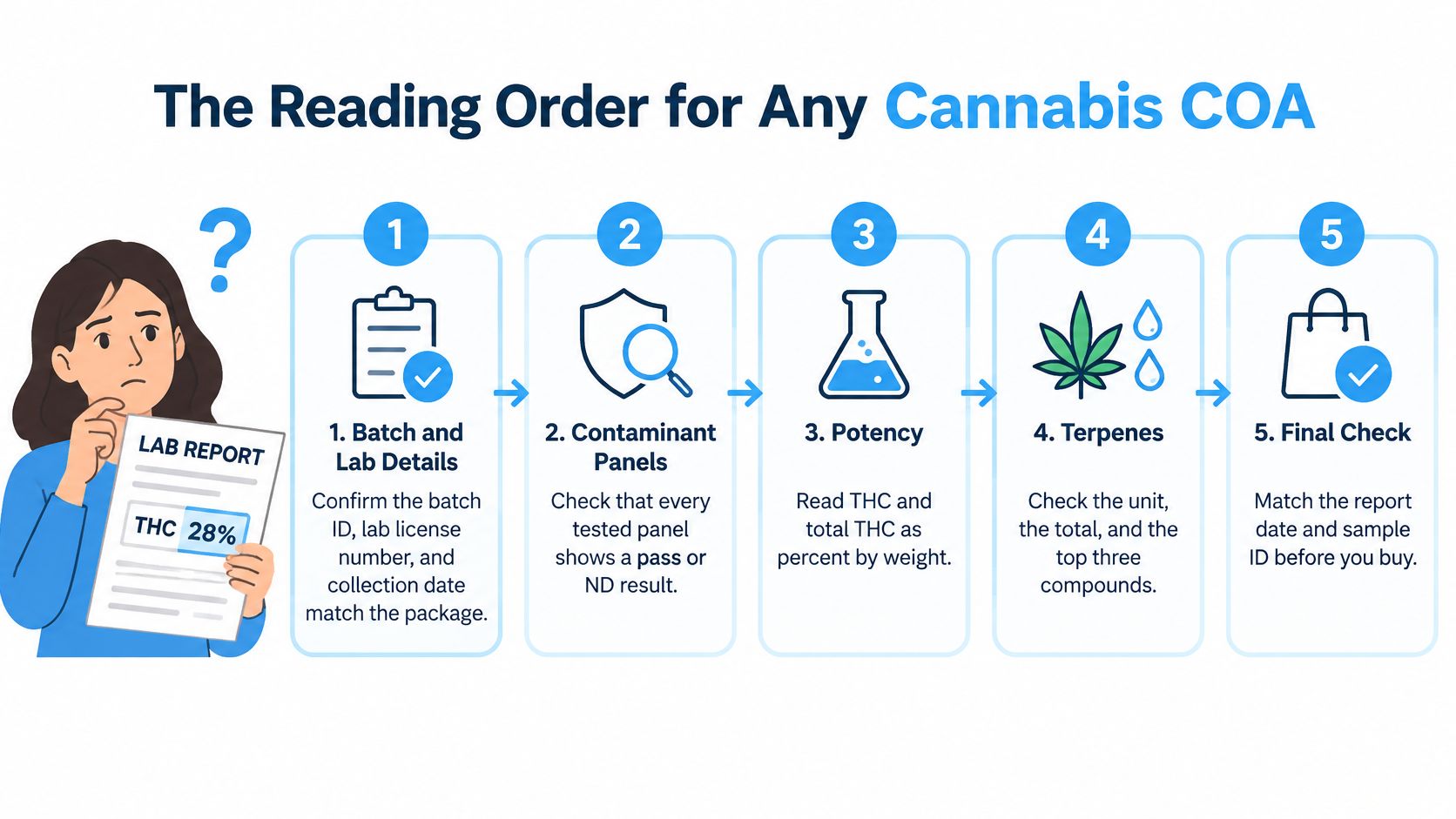
Think of a COA as a nutrition label with a fine-print page. The front may feature the headline number, but the details tell you which product was tested, what the lab looked for, and how to interpret the results.
- Batch and lab header. Match the batch or lot number on the product to the number in the report. Check the laboratory identity and report dates.
- Contaminant panels. Look for the relevant tests and an explicit pass or fail status. A high-potency result doesn't cancel a failed safety panel.
- Cannabinoid potency. Read the named cannabinoids and use units that make sense for the product, such as percent for flower or milligrams per serving for edibles.
- Terpene profile. Review the units, total, and listed compounds to understand what the report says about aroma and flavor.
- Methods and limits. Find the method, units, and detection or reporting limits. These details show what the test can and can't report.
- Lab sign-off and status. Check whether the report is accepted, qualified, or suppressed, rather than assuming every displayed result was accepted without qualification.
| COA section | What it tells you | First thing to check |
|---|---|---|
| Header and batch ID | Which batch, lab, and dates the report covers | Batch number matches the package |
| Contaminant panels | Pesticides, metals, microbials, mycotoxins, solvents | Every panel is present with a pass or fail status |
| Cannabinoid potency | THCA, THC, total THC, CBD, and other cannabinoids | Units match the product type |
| Terpene profile | Aromatic compounds and their percentages | Total and top-three terpenes are listed |
| Methods and limits | Test methods, units, LOD and LOQ values | Detection limits are stated for each analyte |
| Lab sign-off | Signer, accreditation, and report status | Status reads accepted, not qualified or suppressed |
Use this reading order as a quick screen before comparing products such as flower from Cookies, concentrates from MFNY, or edibles from Kiva. If you're also comparing lab reports in another product category, what a peptide COA actually proves offers a useful comparison of what a certificate can document and what it can't prove. With practice, you can scan a cannabis COA in under two minutes and know which parts need a closer look.
Batch Details That Prove a Report Matches Your Product
Start with the package in your hand. Find the batch or lot number on its label and compare it character for character with the COA header. A report for the same brand or strain isn't enough if the batch identifier doesn't match.
Next, check the sample ID, collection date, test date, laboratory name, and lab license number. The dates and identifiers help establish which material the lab tested and when. California's testing-laboratory rules require standard operating procedures, ISO/IEC 17025 accreditation, a quality-assurance program, and participation in proficiency testing. Those controls indicate a managed measurement process, not an informal estimate. California's laboratory requirements describe the state's expectations for testing facilities.
A COA can cover cannabinoids and terpenes as well as residual solvents and processing chemicals, pesticides, heavy metals, microbial impurities, mycotoxins, moisture and water activity, and foreign material. A high THC figure doesn't answer whether those other panels were run or passed. Treat the document as a whole report, not a potency receipt.
At the counter, check for these warning signs:
- The product name differs. A strain or format mismatch may mean the report belongs to a different item.
- The batch number is off by a digit. Don't assume a near match is good enough.
- The date sequence doesn't make sense. A test date older than the packaging date deserves an explanation.
- The laboratory details are missing. Look for the lab's identity and license information.
- The QR code goes to a generic page. You need the batch record, not a brand landing page.
Counter check: If the batch can't be matched, ask for the COA for that exact batch before buying. If the store can't provide it, treat the report as unverified.
Contaminant Panels, ND Results and Detection Limits
A pass means the tested analytes were below their applicable regulatory action limits. It doesn't prove that a product is chemically risk-free, and it doesn't tell you anything about a panel that wasn't reported. New York's testing scope may include cannabinoid profile, microorganisms, foreign material, heavy metals, microbial impurities, moisture and water activity, mycotoxins, pesticides, residual solvents, and terpenoids, depending on the product. New York's testing limits show why a COA should be read panel by panel.
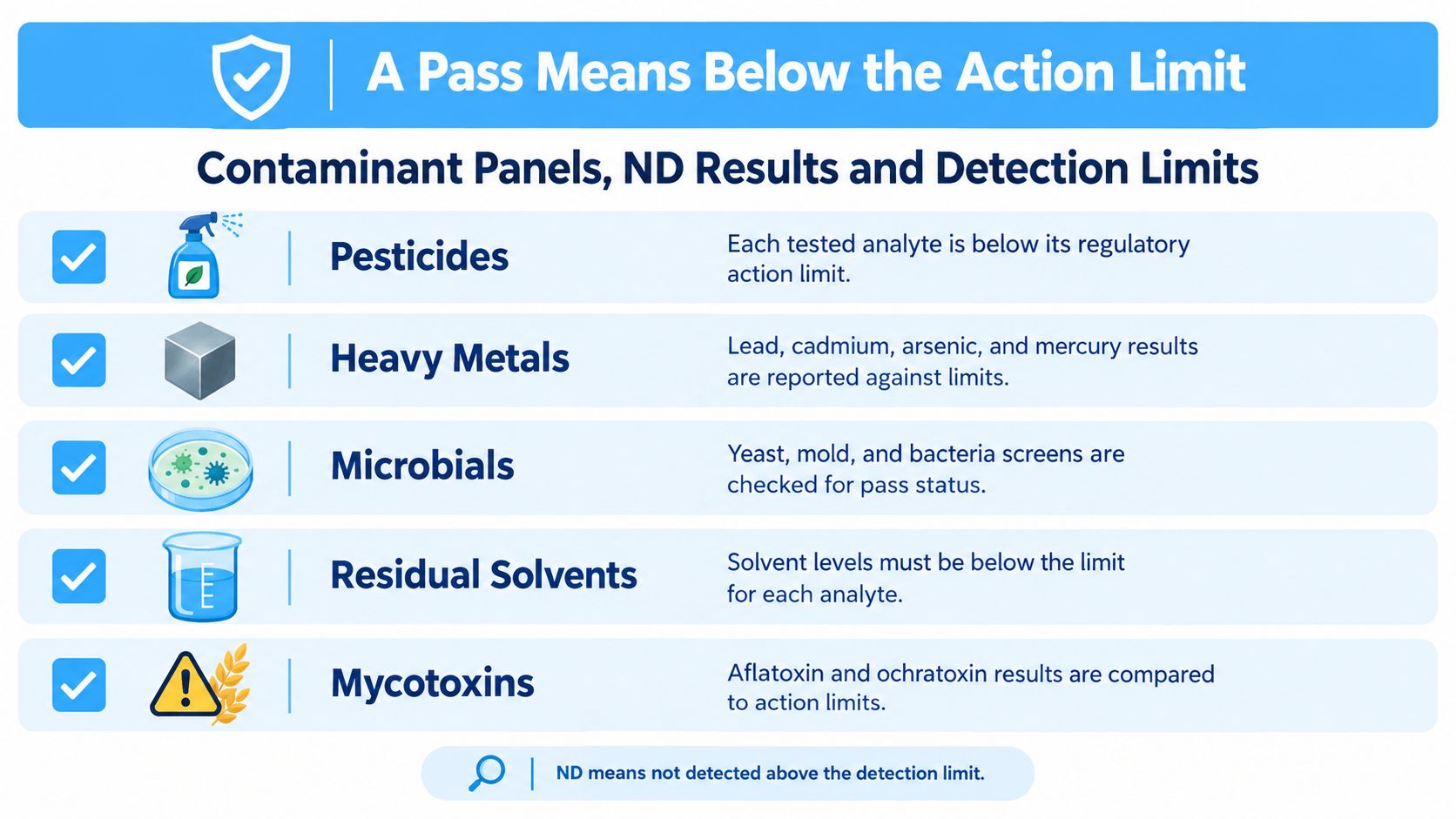
Review the relevant panels, then look for a stated outcome for each one:
- Pesticides: Check that tested analytes have a reported result and pass status.
- Heavy metals: Look for results such as lead, arsenic, cadmium, and mercury where the panel applies.
- Microbials: Review the reported screens for microorganisms and microbial impurities.
- Mycotoxins: Check whether the relevant toxins were tested and how the lab reported them.
- Residual solvents: This is especially important for concentrates and vapes, where processing chemicals may be relevant.
- Moisture, water activity, and foreign material: Check whether these product-specific measures are included when applicable.
A result marked ND means “not detected” above the method's reporting threshold. It does not mean that the analyte's concentration is mathematically zero. The limit of detection (LOD) is the lowest amount a method can reliably distinguish from zero; the limit of quantitation (LOQ) is the lowest amount the method can report as a number. A value between those limits may appear as a trace or below-LOQ result, depending on the lab's reporting convention.
A metal detector with a sensitivity dial makes the distinction easier to picture. A more sensitive setting may identify smaller amounts, while a less sensitive setting may not show them. The reported finding depends on the method's capability, so check the limits instead of reading ND as a claim of absolute absence.
Sampling creates another boundary: the COA describes the sampled batch, not necessarily every individual flower or edible. Under California regulations, the representative sample for a harvest batch must weigh 0.35% of the total batch weight; the collected increments must be homogenized before analysis, except when testing foreign material. The minimum analytical amount is 0.5 grams for cannabinoid profiling and 1.0 gram for microbial-impurity testing. California's sampling and testing regulations explain how the sample is prepared and tested.
For inhaled flower and vapes, pay close attention to the relevant pesticide and microbial panels, and review residual solvents for vape products. Check residual solvents closely for concentrates. For edibles, look at microbial results and potency per serving. A missing panel is unknown, not clean. A failed panel is a reason not to buy or use the product.
Turning Potency Numbers Into a Real Dose
Potency isn't a dose until you translate the number into the product unit you're using. THCA is the acidic form found in unheated flower; total THC estimates the potential THC after heat-driven decarboxylation. Labs generally calculate total THC using measured neutral THC plus the potential THC from THCA. Heating doesn't convert every molecule with perfect efficiency, so the theoretical amount isn't the same as the amount you'll absorb.
The arithmetic starts with a simple conversion: 1% by weight equals 10 milligrams per gram. At 25% total THC, one gram corresponds to about 250 mg before losses. A 0.5 g pre-roll therefore contains about 125 mg before losses, while a 3.5 g eighth corresponds to about 875 mg before losses. Smoking or vaping can deliver less than that theoretical content. The New York testing rules for cannabis potency describe representative batch sampling and how total THC is calculated.
| Total THC (%) | mg per gram | 0.5 g pre-roll | 3.5 g eighth |
|---|---|---|---|
| 15% | 150 mg | 75 mg | 525 mg |
| 20% | 200 mg | 100 mg | 700 mg |
| 25% | 250 mg | 125 mg | 875 mg |
| 30% | 300 mg | 150 mg | 1,050 mg |
These are theoretical amounts before losses, not recommended doses and not promises about what each portion contains. Sampling, extraction, instrument calibration, matrix effects, and variation within a batch all affect the result. A COA showing 25% THC doesn't mean every gram contains precisely 250 mg of usable THC.
Compare like with like: use percent by weight for flower and concentrates, and milligrams per serving and per package for edibles and tinctures. Don't compare a flower percentage directly with an edible's milligram label. For edibles, use the labeled serving as your dosing anchor, start below the advertised maximum potency, and wait until you understand the product's delayed effects before increasing. A cannabis dosage chart can help you think through serving amounts, but it can't replace the product label or your own cautious approach.
Terpene Profiles Without the Hype
Terpenes are aromatic compounds that contribute to cannabis smell and flavor. A report might list myrcene, often associated with earthy or musky notes; limonene, with citrus peel; caryophyllene, with pepper and wood; pinene, with pine; linalool, with floral or lavender notes; and terpinolene, with piney or herbal aromas. Those descriptions help you picture a sensory profile, not predict a personal effect.
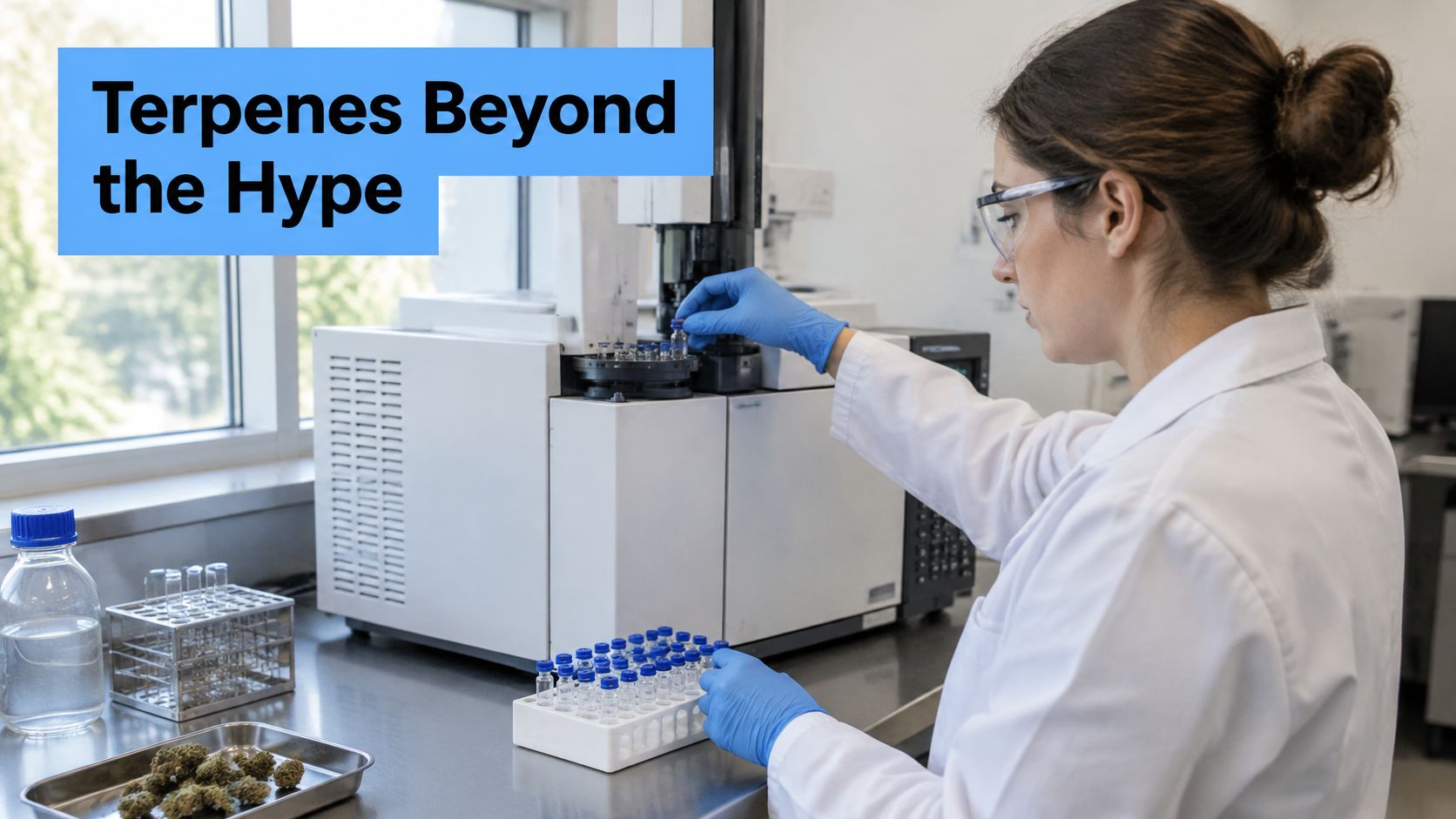
To read the profile, check the unit first, then the total terpene amount and the top listed compounds. Some reports list only selected terpenes, so a short list doesn't necessarily represent every aromatic compound in the sample. Compare reports using the same unit and remember that aroma descriptions can't establish how a product will feel to you.
Caryophyllene is known to bind CB2 receptors in laboratory studies, but that doesn't establish human effects. The broader idea that terpenes and cannabinoids produce a predictable combined effect, often called the entourage effect, remains debated. A terpene percentage or compound name shouldn't be treated as a medical claim.
One edge case is a vape or distillate cartridge. Extraction may remove terpenes, which can then be added back, so check whether the COA describes the finished cartridge or the starting flower. A profile from the source flower may not describe the cartridge you're considering.
You may see a high terpene total marketed as a premium feature, but a high number alone doesn't prove quality, safety, or a particular experience. Use the terpene panel to set aroma and flavor expectations, and use the contaminant panels to assess the report's safety information. For a closer look at how terpene content is discussed in strain selection, see this guide to high-terpene strains.
A short video can provide another visual introduction to cannabis testing and lab analysis:
Choosing a Product Based on Its Lab Report
A COA earns more confidence when the batch matches the package, relevant contaminant panels are present with explicit pass results, and potency is reported in units you can interpret. Even then, lab-tested doesn't mean precisely dosed. A University of Colorado Boulder study of 277 commercially purchased flower and concentrate products found that 44% of flower products differed from their labeled potency by at least 15%, with inaccurate labels generally overstating THC, as reported by Colorado Public Radio's coverage of the study.
| Report situation | What it tells you | Best action |
|---|---|---|
| Batch matches, all panels pass, units convert | Strongest evidence for that batch | Buy, then dose by labeled serving |
| Batch number does not match the package | The report may describe a different product | Don't rely on it; request the correct COA |
| Any contaminant panel marked failed | Fails the safety standard | Don't buy or use |
| Contaminant panel missing | Safety status unknown | Treat it as unverified and ask for the full report |
| Potency given without units or method | It can't be compared reliably with other products | Ask for flower or edible units before comparing |
| Terpenes listed, safety panels absent | Aroma data only | Use it for flavor, not safety |
If the report matches and passes, keep your dosing cautious. Convert potency to milligrams per serving where possible, start below the maximum advertised amount, and wait for the full onset of an edible before taking more. That's especially important when comparing flower, concentrates, vapes, and edibles, because the same headline percentage doesn't mean the same real-world exposure.
If you're shopping in New York, ask the Strong Strains team for the batch COA that matches your exact package. The team can help compare strains, formats, and potency information; if the store can't provide that batch's report, treat the product as unverified. You can also review this overview of lab-tested cannabis products while comparing what different reports disclose.
Strong Strains Cannabis Dispensary offers lab-tested flower, pre-rolls, vapes, edibles, concentrates, tinctures, and other cannabis products, with in-store pickup and local delivery. Visit Strong Strains Cannabis Dispensary to ask for a COA that matches the package you're considering and get help comparing its reported results. Cannabis is for adults 21+; use responsibly and follow the product label.