
A legal-market flower sample can average 2% total terpenes by weight, yet most individual terpenes remain below 0.5%, and many sit below 0.2%. That single contrast explains why shopping for high terpene strains requires more than chasing the biggest number on a label. A flower can have a strong total terpene result because of a broad, layered profile, while another with a similar total may be dominated by one loud aroma.
For adult shoppers, terpenes are best treated as a sensory and formulation variable. They help explain why one product smells like citrus, another like pepper and fuel, and a third like pine or flowers. They can also interact with cannabinoids in ways researchers are still investigating, but a high terpene percentage isn't a guarantee of stronger, better, or more therapeutic effects.
What High Terpene Strains Actually Mean
The phrase high terpene strains has meaning only when you connect it to a lab result. Terpenes are volatile aromatic compounds found in cannabis and many other plants. Limonene contributes citrus-like aromas, while pinene is associated with pine. In cannabis, these compounds are among the primary constituents of essential oils responsible for aroma, as described in peer-reviewed cannabis chemistry research.
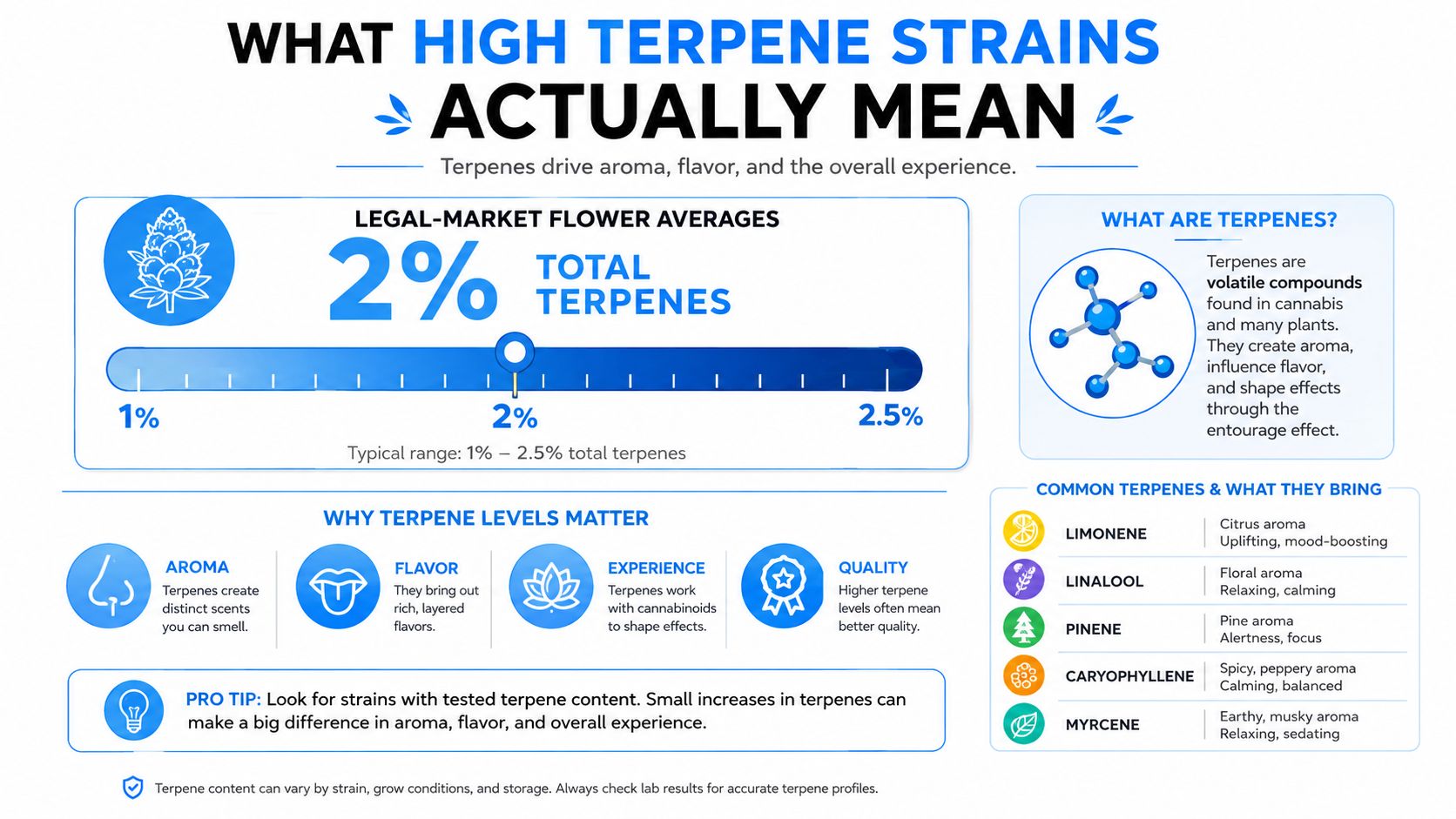
A useful way to read the number is to think in practical bands. One published breakdown describes 0.5% to 1% as average, 1% to 1.5% as high, 1.5% to 2% as very high, and 2% or more as extremely high (Dutch Passion's terpene guide). Another industry guide says products above 1% total terpenes generally have a strong aroma and that individual terpenes commonly appear around 0.2% to 0.5% (Eaze's cannabis terpene guide).
The important detail is that these percentages are weight-based. A result of 1.5% total terpenes equals 15 milligrams of terpenes per gram of flower, according to the same Eaze reference. The number describes chemical content, not the intensity of the effect you personally will feel.
Why the total doesn't tell the whole story
A 2022 analysis of commercial cannabis flower in the United States found an average total terpene content of 2% by weight. The study also reported a positive correlation between total terpene and total cannabinoid content, with r approximately 0.37 and P less than 0.0001, suggesting that terpene-rich flower doesn't necessarily represent a tradeoff against chemically rich cannabinoid content (PLOS ONE analysis).
Still, genetics, harvest handling, curing, storage, dose, tolerance, and personal sensitivity all matter. Use the total terpene result to estimate aroma potential, then inspect the individual profile before deciding whether the product fits your preferences.
The Most Common Cannabis Terpenes and Their Effects
A COA often lists several familiar names, but shoppers can misread them as fixed effect labels. Aroma descriptions are more dependable than promises about outcomes, and reported effects should be treated as general tendencies, not guarantees.
| Terpene | Aroma | Reported Effect | Notes |
|---|---|---|---|
| Myrcene | Earthy, musky, herbal | Often associated with a heavier, more relaxing profile | A high myrcene result doesn't define the entire experience |
| Limonene | Lemon, citrus, sweet peel | Often associated with a brighter mood | Review the supporting terpenes before drawing conclusions |
| Pinene | Pine, fresh herbs | Commonly linked with alertness and memory recall | A pine aroma can coexist with relaxing compounds |
| Linalool | Floral, lavender | Often tied to calm and relaxation | Its influence depends on the complete terpene cluster |
| Caryophyllene | Black pepper, clove, spice | Often described as grounded or body-focused | It's unusual because it can bind directly to CB2 receptors |
| Humulene | Hops, wood, earth | Studied for appetite-related signals | Human outcomes shouldn't be inferred from aroma alone |
| Ocimene | Sweet herbs, tropical, fresh | Often associated with lively or social profiles | It can be subtle or prominent depending on genetics |
| Terpinolene | Floral, pine, herbal, pungent | Often found in energizing-leaning profiles | It can dominate aroma in distinctive chemovars |
Readers who want a closer look at one of the most discussed citrus-forward compounds can review this guide to limonene terpene effects.
Avoid the dominant-aroma trap
One terpene can be the loudest note without explaining every part of the product. In one peer-reviewed dataset, terpinolene measured below 0.3% in 27 of 33 chemovars, then ranged from 13.4% to 41.2% in six distinctive high-terpinolene chemovars. Another strain volatile-profile study found beta-myrcene averaged 46.1% of dominant aroma compounds and reached 80.1% in its highest strain (Thieme Connect dataset).
That range is why the top three terpenes are more useful than a strain name or tasting note alone. Two products may both advertise citrus, yet one could combine limonene with pinene and caryophyllene, while another pairs limonene with myrcene and linalool. The aroma may overlap, but the profiles aren't interchangeable.
How Terpenes Interact with Cannabinoids
The entourage idea proposes that cannabinoids and terpenes can influence the experience together rather than THC acting as the only meaningful variable. That concept is useful as a working framework, but it shouldn't be presented as settled clinical fact. Much of the evidence comes from cell studies, receptor experiments, and other early-stage research, not large randomized human trials.
A receptor study reported that 16 individual cannabis terpenes activated CB1 receptors at approximately 10% to 50% of THC's response. Some THC-terpene mixtures also increased CB1 activity several-fold compared with THC alone at terpene-to-THC ratios similar to those found naturally in cannabis. A newer study found dose-dependent CB1R and CB2R responses for many terpenes, with maximum activation reaching roughly 10% to 60% of THC's effect in tested conditions (PubMed receptor research).
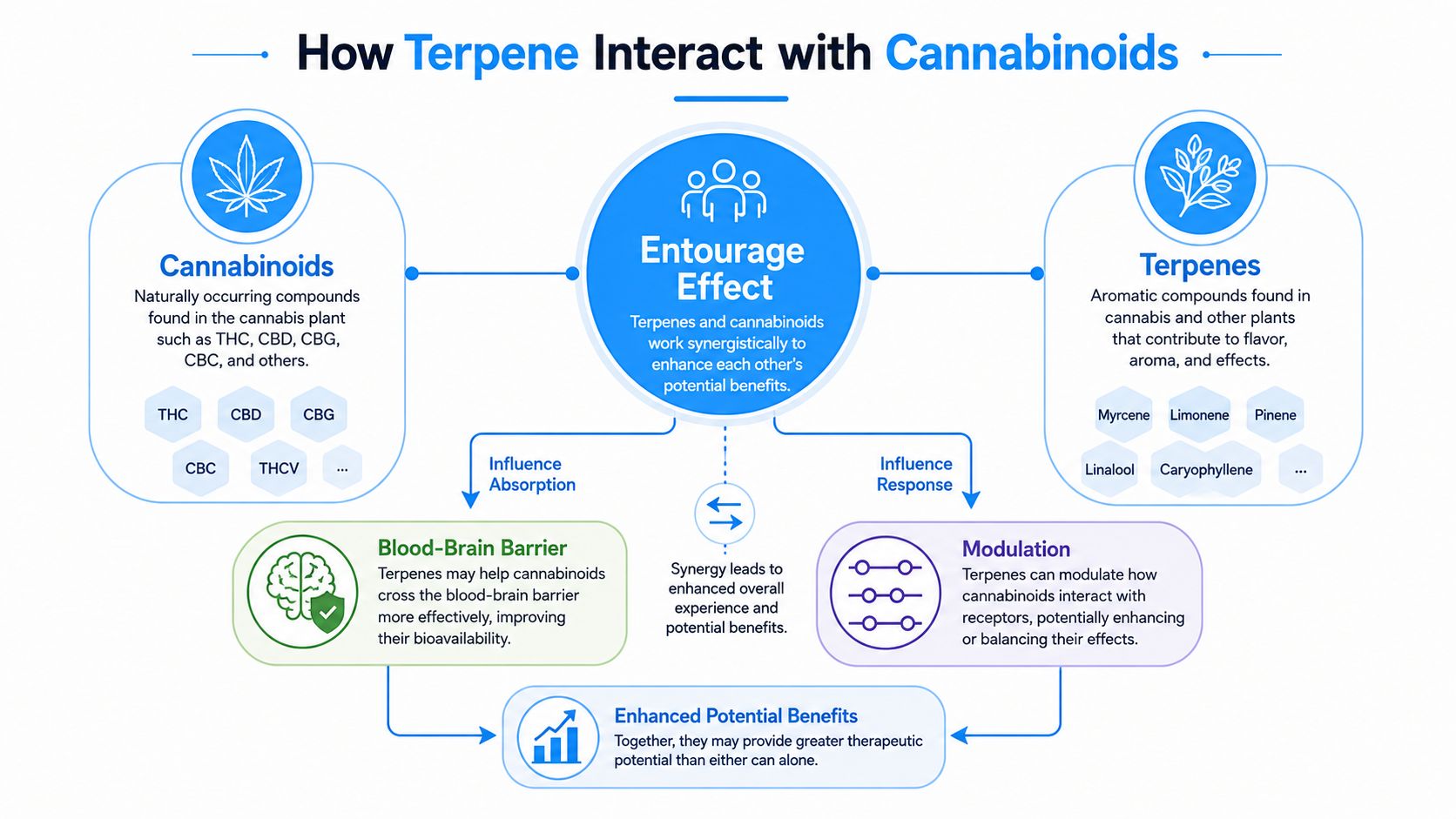
Beta-caryophyllene is a particularly useful example because it interacts directly with CB2 receptors. That finding helps explain why shoppers pay attention to it, but receptor activity in a laboratory doesn't predict a guaranteed feeling in a person.
Practical rule: Treat terpene data like seasoning information, not a medical prescription. A pinch of salt can change how sweet food tastes without becoming the main ingredient. Terpenes may shape a cannabinoid experience in a similar way, but dose, genetics, tolerance, and setting still control much of the outcome.
For consumers comparing cannabinoid formats beyond flower, a resource such as find THC CBD seltzer on Loyaltie can also help illustrate how product formulation changes the shopping question. In a beverage, the cannabinoid serving and onset expectations matter more than treating aroma as a potency shortcut.
Reading Lab Reports for Terpene Content
A Certificate of Analysis, or COA, turns a marketing phrase into something you can evaluate. Start with the product identity and test information, then locate the terpene or terpenoid panel. Look for a total terpene percentage and the individual compounds that make up that total.
New York requires terpenoids to be reported as a percentage by weight. For vaporized or inhaled cannabis products, the state's testing rules set a 10% total terpene limit, with a 15% variance allowance that reaches 11.5% under the cited testing document (New York cannabis testing rules). Read that rule as a compliance ceiling, not as a target. A legal product doesn't need to approach the limit to offer a vivid profile.
| COA Field | What It Shows | Shopper Benchmark | Red Flag |
|---|---|---|---|
| Total terpenes | The combined measured terpene content | Compare the result with the practical bands described earlier | No total is provided |
| Individual terpenes | Which compounds contribute to the total | Review the top three, not just the headline compound | Only one terpene appears |
| Units | How the lab expresses the result | New York reports terpenoids as percentage by weight | Units are unclear |
| Detection limits | Whether a compound was detected reliably | Prefer clearly measured results over ambiguous marks | Every strain shows identical values |
| Product type and compliance | Whether the product fits applicable rules | Confirm inhaled products remain within New York limits | The product category is missing |
| Test date and batch identity | Whether the document belongs to what you're buying | Match the batch details to the package | The COA can't be tied to the item |
A fast three-pass method
First, scan the total. This tells you whether the product is likely to sit in average, high, very high, or extremely high territory based on the published reference bands.
Second, inspect the top three. Ask whether the profile matches the aroma you enjoy. A high total made mostly of myrcene will read differently from a high total led by limonene and terpinolene.
Third, verify the document. Match the batch or lot information, review the test date, and check that the reported values are actual measurements rather than detection-limit notation. A useful companion explanation of testing terminology appears in this guide to cannabis lab testing.
A high-terpene claim without a matching lab sheet is only a claim. If a dispensary can't show the current COA, ask a budtender to pull it before you buy.
Choosing the Right Format for Terpene Richness
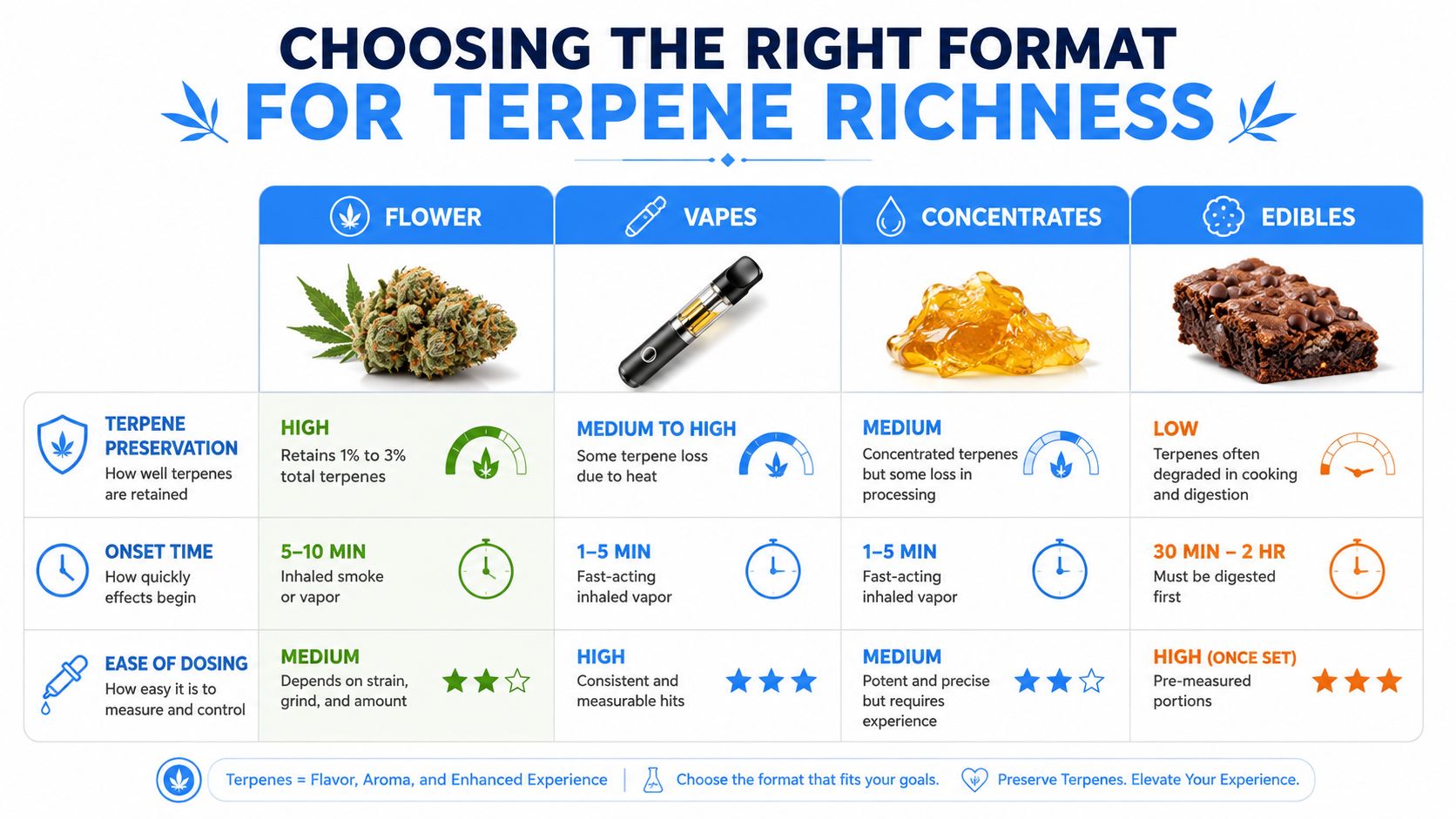
Format changes the role terpenes play. Flower offers the most direct aroma-led experience, while vapes, concentrates, and edibles create different tradeoffs between preservation, onset, and dosing.
| Format | Terpene Preservation | Onset | Dosing |
|---|---|---|---|
| Flower | Preserves a broad natural profile when handled well | Inhaled effects arrive relatively quickly | Flexible, but puff size varies |
| Vapes | Can preserve strain-specific compounds or use added terpenes | Inhaled effects arrive relatively quickly | Convenient, though pulls differ |
| Concentrates | Often deliver an intense aromatic profile | Inhaled effects arrive relatively quickly | Less forgiving because products can be potent |
| Edibles | Volatile aroma compounds usually play a smaller role after processing | Slower and longer-lasting | Serving-based, but patience matters |
A published flower breakdown describes cured flower as commonly retaining 1% to 3% total terpenes, but that figure comes from the supplied research background rather than the verified data provided here, so treat the format comparison qualitatively. Heat, light, oxygen, and time can reduce aromatic quality, which makes freshness and storage important regardless of the starting number.
Match the format to the moment
Choose flower if you want a hands-on ritual and a full plant aroma. Choose a live resin or rosin-style concentrate if flavor intensity is your priority and you're comfortable with more concentrated dosing. A distillate vape may taste bright and consistent, but added botanical terpenes can create a simpler profile than a product preserving the plant's native fingerprint.
Edibles make more sense when you want a serving-based format and a longer session. Their effects aren't driven by smelling a terpene-rich bud, so judge them by cannabinoid content, serving size, and timing rather than aroma.
Start with the goal. Select the terpene profile second. Choose the product format third.
For shoppers comparing inhaled options, this guide to Strong Strains cannabis vapes offers a useful format-specific reference. The same COA habit still applies. Check the actual profile instead of assuming a flavor name proves natural terpene preservation.
Matching High Terpene Strains to Your Goal
Sam lives on Long Island and doesn't shop by “indica” or “sativa” alone. Sam starts with the occasion, checks the top terpene cluster, then chooses a format and dose that leaves room for adjustment.
After work in Huntington, Sam wants a quieter evening. A flower or vape led by myrcene and linalool, with caryophyllene in the supporting profile, may fit that preference. Sam checks the cannabinoid result, takes one small inhalation, and waits rather than assuming a high terpene number will create instant relaxation.
For a Saturday hike near Caumsett, Sam looks for a profile led by pinene and limonene. The goal is a brighter, more alert-feeling session, not maximum intensity. Sam chooses a modest inhaled serving and avoids consuming before driving or while responsible for navigating the trail.
A creative Sunday in Patchogue calls for a more expressive aromatic profile. Sam might compare terpinolene and ocimene alongside limonene, then choose flower if tasting and smelling the product are part of the activity. A strain name can suggest a direction, but the COA decides whether the product fits the intended profile.
At night in Port Jefferson, Sam prefers a calmer ritual and may compare myrcene, linalool, and caryophyllene in an edible or flower. The format changes the timing, so Sam doesn't take more just because the first effects aren't immediate. For weather-sensitive routines, a migraine weather and pollen tracker can provide environmental context to record alongside product notes, without treating cannabis as a guaranteed treatment.
Build a personal record
Use a phone note with the product name, top three terpenes, cannabinoid results, format, serving, and how you felt later. Keep the language descriptive, such as “peppery aroma,” “heavy body feel,” or “clearer than expected,” rather than turning one experience into a universal rule.
A cautious beginner routine is simple: one puff or one serving, wait ten minutes for inhaled products, and write down the effect. Edibles require more patience because their timing differs from inhalation. If you're new, ask a qualified budtender or healthcare professional about a responsible starting approach.
Storage, Safety, and Shopping Locally on Long Island
Terpenes are volatile, so freshness depends on how you store the product after purchase. Keep flower in an airtight glass jar at 60°F to 65°F with 58% to 62% humidity, based on the supplied storage guidance. Avoid clear plastic bags, sunny counters, hot cars, and repeated exposure to open air.
The jar should be large enough to avoid crushing the flower, but not so oversized that the product sits in a large pocket of air. Open it only when needed, close it promptly, and keep it in a cool, dark place. Vapes should remain upright at room temperature to reduce the chance of leaks and keep oil away from the mouthpiece.
Protect the product and the people around it
A strong aroma doesn't make a product safer, and a high terpene result doesn't tell you how much THC your body should receive. Use a new product cautiously, especially when switching from flower to concentrates or from inhalation to edibles.
- Start low: Use a small amount when trying a new terpene profile, format, or cannabinoid combination.
- Check the cartridge: Never vape a cartridge with unclear contents, missing testing information, or a package that doesn't match the COA.
- Secure the package: Keep cannabis locked away from children and pets.
- Avoid driving: Don't drive, cycle in traffic, or operate equipment while impaired.
- Track the batch: Save the product label or COA if you want to compare future purchases.
A complete panel is more useful than a flashy strain name. Ask whether the retailer can show the latest batch-specific testing and explain the top three terpenes in plain language.
For North Shore shoppers, Strong Strains Cannabis Dispensary in East Setauket offers lab-tested flower, vapes, pre-rolls, edibles, concentrates, tinctures, topicals, and accessories, with in-store pickup and local delivery. Its budtenders can help compare terpene profiles and pull the relevant COA, which gives you a more transparent starting point than relying on packaging language alone.
Visit Strong Strains Cannabis Dispensary in East Setauket to compare lab-tested high-terpene flower, vapes, pre-rolls, and concentrates with guidance from knowledgeable budtenders. Ask for the current COA, match the top terpene profile to your goal, and choose convenient in-store pickup or local delivery across Long Island.