
Could a topical with fewer labeled milligrams deliver more cannabinoid through the skin than a stronger-looking cream? It can. The number on the package matters, but it doesn't tell you by itself where a product acts or how much gets through the skin. The carrier, other ingredients, and intended route all count.
This guide breaks down topical products by format, formulation, label, and purpose. Use the comparison tables and label checks to assess what you're buying, without treating marketing claims as proof of medical benefit.
What Topical Products Are and How They Work
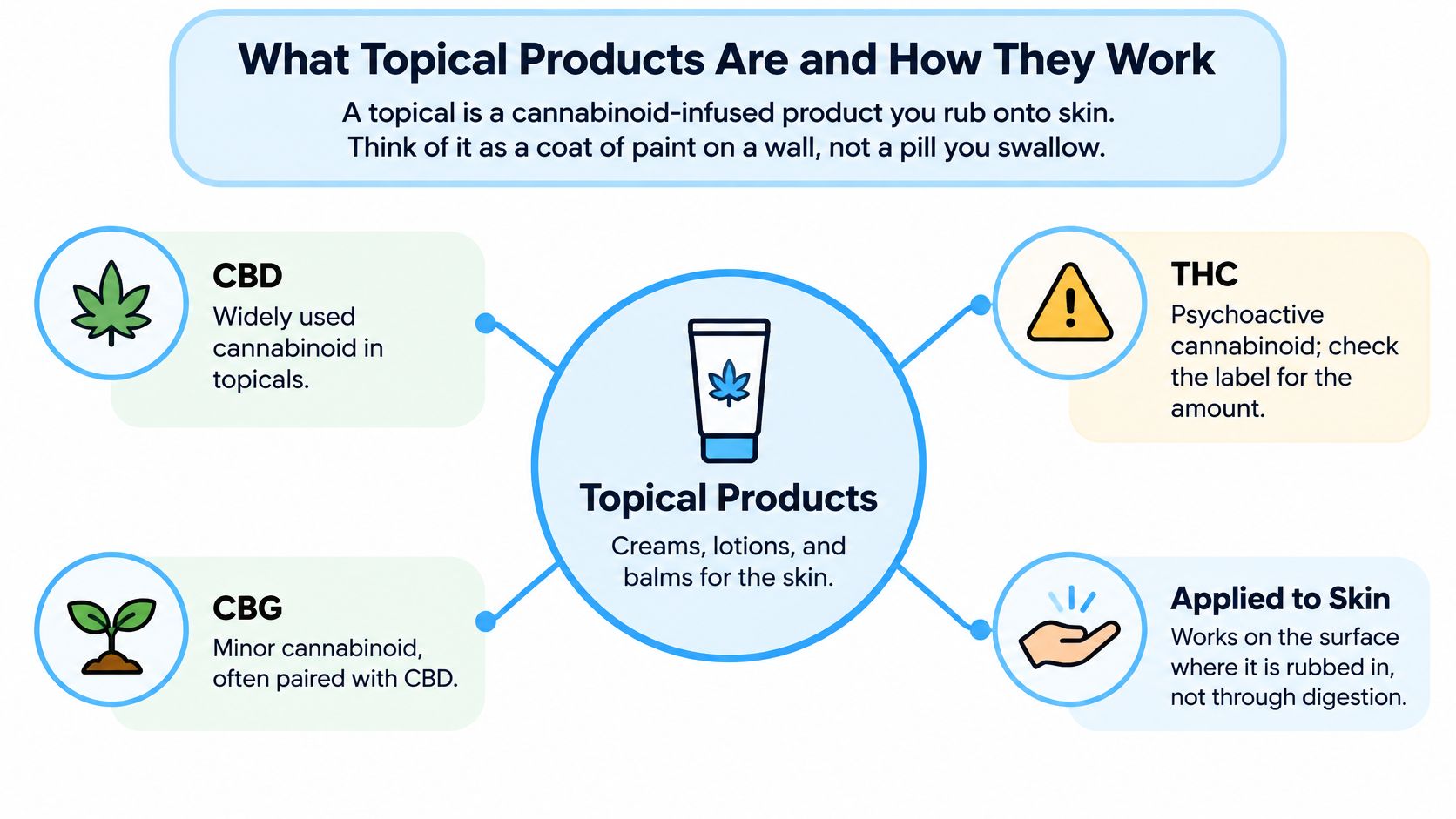
A topical is a cannabinoid-infused product you rub onto your skin. Think of it as a coat of paint on a wall, not a pill you swallow: the product is applied to a particular area, and its formulation influences what happens next.
Common cannabinoids in topicals include CBD, THC, and CBG. A carrier holds and spreads them through a product such as a balm, cream, lotion, or gel. Carriers may include oils and beeswax, or water-based emulsions and gels.
The outermost skin layer, the stratum corneum, acts as a barrier. Cannabinoids are fat-loving and don't dissolve readily in water, so the carrier and other ingredients can affect how they remain on the skin or move through it. That's why two products with similar cannabinoid amounts can behave differently.
Popularity isn't proof
After the 2018 U.S. Farm Bill legalized hemp containing no more than 0.3% delta-9-THC by dry weight, hemp-derived CBD topicals in the United States had an estimated market value exceeding $826 million by 2021, making them the country's second-most-popular CBD product class after tinctures, according to a 2024 pharmacology study. That same study's systematic review found only 8 eligible human interventional studies from 544 screened records, with high risk of bias and incomplete reporting. Product popularity, in other words, doesn't establish that a topical treats a particular condition.
When comparing a product, ask three things: Where is it meant to act? What carries the cannabinoid? What does the label measure? A useful concept map is cannabinoid → carrier → skin layers → intended target.
Balms, Creams, Gels and Patches Compared
Two jars can promise the same total milligrams and still behave nothing alike. The number on the front tells you quantity. The base, the solvent and the intended route tell you where those cannabinoids are likely to end up.
| Format | Base and feel | Where it acts | Onset pattern | Check on the label |
|---|---|---|---|---|
| Balm | Beeswax and oils, thick, low water | Skin surface and small local area | Usually felt within minutes to about an hour | Carrier list and cannabinoid amount per jar |
| Cream | Water-and-oil emulsion, absorbs fast | Skin and superficial tissue near application | Usually felt within minutes to about an hour | Concentration, enhancer ingredients, and serving size |
| Gel | Water-based, light, often cooling | Skin surface and nearby tissue | Often felt within minutes as the solvent dries | Solvent, such as ethanol, and total dose per package |
| Transdermal patch | Adhesive reservoir with a release system | Designed to cross skin into the bloodstream | Builds slowly over hours, with later peaks in small studies | Dose released per patch, wear time, and intended use |
A balm is thick and made with oils and waxes. It works like a waxy coat that stays put on a small area, which is why people reach for it for a single joint or a small patch of skin rather than a whole back. A cream combines oil and water, so it spreads over a wider area and absorbs faster. A gel is mostly water with a solvent such as ethanol, and it feels cooling as that solvent evaporates.
Texture tells you what a product will feel like. The ingredient list tells you more. The carrier and any enhancer ingredients are the clues to how far a cannabinoid may travel, so read them before you compare strength.
A transdermal patch plays by different rules. Its adhesive reservoir is built to move cannabinoids through the skin and into the bloodstream, so it behaves closer to a slow-release dose than to a surface rub. In small exploratory studies, specialized transdermal formulations have delivered CBD and THC into systemic circulation with late peaks, suggesting prolonged rather than rapid delivery. Separate permeability research found CBD had approximately 10 times higher human-skin permeability than THC, according to the study of topical and transdermal cannabis products. A high THC amount on a conventional topical label doesn't, by itself, mean it will cause intoxication. It does mean you should check whether the product is formulated for local use or for delivery through the skin.
When you compare patches, look at the release system and intended use rather than the word “patch” alone. This guide to choosing pain patches with SunnyBay can help you think through patch features beyond cannabinoid content. For a closer look at how balm bases are built, see cannabis topical balm.
Simple rule: Match the format to the area you want to treat and to whether you want local application or systemic delivery. Compare carrier, enhancer and intended route before you compare milligrams.
Reading Concentrations and Dosing Math
Two jars can carry the same labeled strength and still deliver very different amounts of cannabinoid to your skin. A label percentage tells you how much cannabinoid is present relative to the product's weight. One percent equals 10 milligrams per gram, so a 28-gram jar at 1% contains 280 milligrams in total. That math lets you compare labels. It says nothing about how much will absorb, which is where formulation takes over.
| Labeled strength | mg per gram | mg per 28 g jar | Context |
|---|---|---|---|
| 0.075% | 0.75 | 21 | Lowest concentration in reviewed trials |
| 0.5% | 5 | 140 | Mid-range of reviewed trials |
| 1.0% | 10 | 280 | Top of the reviewed concentration range |
| 2% | 20 | 560 | Above the reviewed trial range |
The human studies analyzed in a 2024 pharmacology review used CBD doses from 50 to 250 milligrams or concentrations from 0.075% to 1.0%, often alongside other ingredients. Those figures describe controlled study conditions rather than consumer dosing instructions. What they confirm is the habit worth building: check the percentage and the total milligrams in the container before you compare two products.
Why the carrier changes the comparison
Cannabinoids are lipophilic, meaning they mix more readily with fats than water. The skin's outer barrier works like a lipid wall sitting over water-rich tissue, so the vehicle largely decides whether a cannabinoid stays near the surface or moves deeper. A review of topical cannabinoid formulations describes human-skin experiments in which 30.8% ethanol increased CBD solubility from 5.72 to 16.2 micromol/mL, nearly threefold. In an animal transdermal model from the same review, the enhancer Transcutol HP increased plasma CBD exposure 3.7-fold. Equal labeled amounts can therefore deliver unequal amounts depending on what carries them.
Read the ingredient list in three passes: the cannabinoids, the carrier such as shea butter, beeswax, or coconut oil, and any penetration enhancers such as ethanol. Menthol and capsaicin add cooling or warming sensations, and those effects are separate from the cannabinoid amount.
For a careful first trial, use a small measured amount and keep the product and application frequency consistent. Weighing the first few applications on a kitchen scale makes the amount repeatable. Treat the package's total milligrams as a pool you draw from, since there is no standardized dosing recommendation for transdermal cannabis delivery.
How to Apply a Topical Step by Step
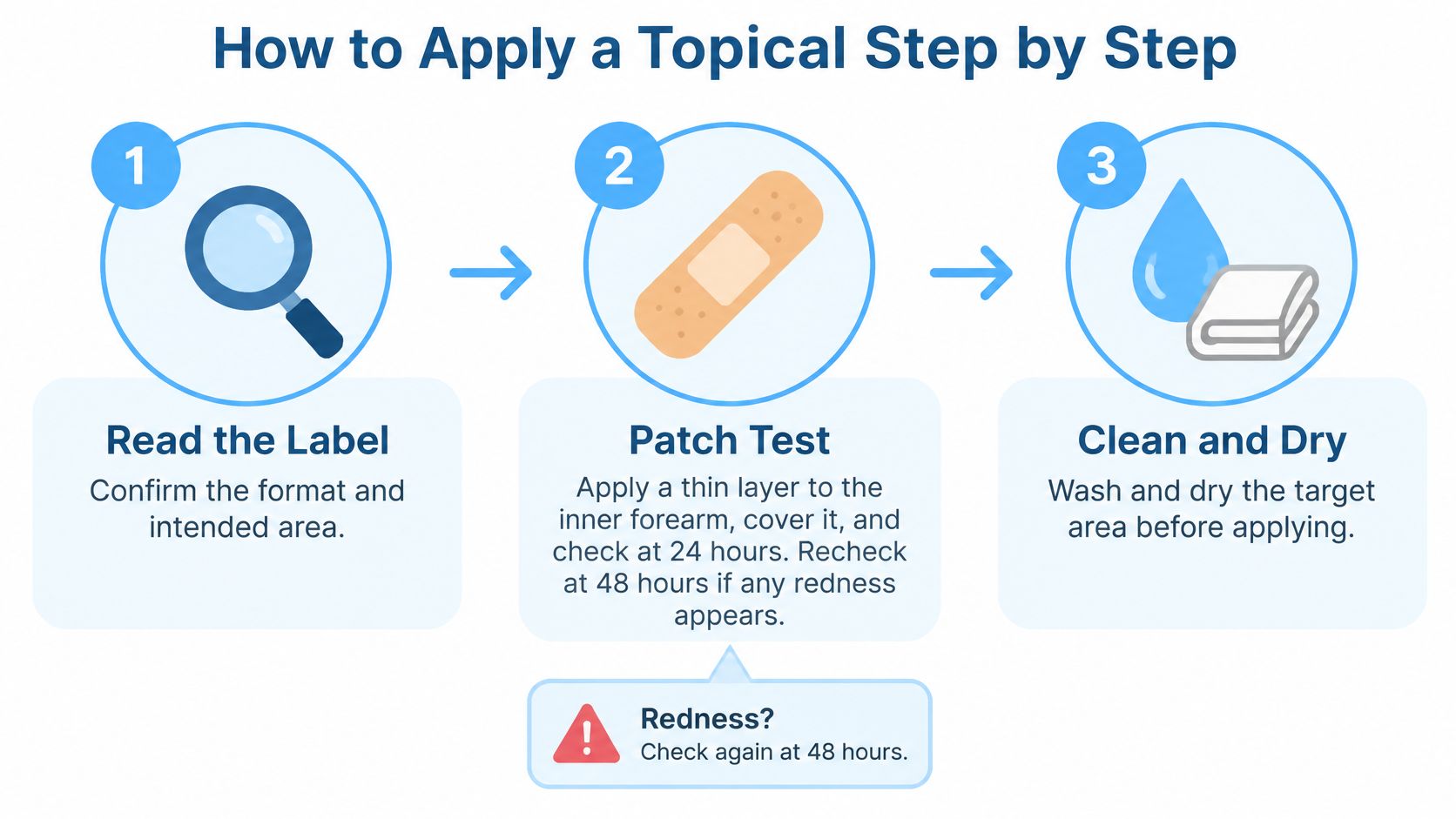
Follow a steady routine so you can tell what you applied and how your skin responded.
Read the label. Confirm whether the product is a balm, cream, gel, or transdermal patch, and check the intended application area. The route matters because products aren't interchangeable.
Patch test first. Apply a thin layer to your inner forearm, cover it, and check the area after 24 hours. If redness appears, check again at 48 hours and don't proceed if irritation persists or worsens.
Clean and dry the target area. Wash the skin gently and pat it dry before application. Avoid cuts, rashes, sunburn, and other broken or irritated skin.
Measure a small amount. Use a small scale or a consistent fingertip-unit approach rather than estimating a large dose by eye. This gives you a repeatable starting point.
Apply a thin layer. Massage it in for one to two minutes, or until it absorbs, unless the label gives different directions. Adding extra product immediately can make it harder to judge the first amount.
Wash your hands. Do this after application unless you're treating your hands. Residue can transfer to your eyes or food.
Record the trial. Note the product, amount, time, application area, and any sensations in a notebook or phone note. Keep other products unchanged while you assess it.
Reassess before reapplying. Set a check-in point instead of adding more to chase an effect. Stop if your skin burns, stings, develops a rash, or gets worse.
For patches, follow the product's specific wear-time directions. Apply to clean, dry, hairless skin, press firmly for about 30 seconds if instructed, rotate sites, and don't place a heating pad over the patch or soak it in a hot bath. Heat may change absorption. Avoid layering two topical products, applying one to broken skin, or ignoring the patch-test window.
Here's the process in short: read the label → patch test → clean and dry → measure → apply → log → reassess.
What Topicals Can and Cannot Do for Pain and Skin
A labeled milligram total does not predict where a topical will act. Milligrams are the payload, while the formulation controls the delivery route. Before comparing potency, check whether the product is intended for the skin surface or transdermal delivery, then compare its carrier and any listed penetration enhancer.
| Goal | What the evidence shows | Realistic expectation | See a clinician if |
|---|---|---|---|
| Itching | A 2025 review found a modest, statistically significant reduction | Possible small comfort, not a cure | Itch disrupts sleep or persists past your reassessment point |
| Dry skin or redness | No significant benefit in the same review | Do not expect cannabinoids alone to repair the skin barrier | Skin cracks, bleeds, or shows signs of infection |
| Muscle or joint soreness | Human trials are limited and uneven | Treat it as a short-term comfort trial | Pain continues beyond a few weeks or limits movement |
| Eczema, psoriasis, or neuropathy | The review found no regulator-approved topical cannabis medicines and very limited consumer evidence | Not a disease treatment | A rash spreads or symptoms need prescribed care |
A 2025 review of cannabinoid interventions for dermatologic symptoms included 3,359 participants across 11 randomized trials, three quasi-experimental studies, and three observational studies. It found a modest, statistically significant reduction in itching, but no significant benefit for skin dryness or redness. Statistically significant means the observed difference was unlikely to result from chance; modest means the practical improvement may still be small.
The review also reported that no topical cannabis-based medicines had been approved by regulators, and that evidence for consumer products remained very limited. A change in itching does not establish that a product treats eczema, chronic pain, or another underlying condition.
For a sore knee, a skin-focused product may change sensation around the application area without showing that cannabinoids reached the joint. A transdermal product follows a different intended route, but formulation still matters more than package milligrams alone. For joint-specific questions, cannabis topicals for arthritis can help frame a cautious clinician discussion.
The same intended-use check applies outside cannabis. A resource focused on another skin concern, such as this witch hazel guidance from Revivol-XR, illustrates why a cream's ingredients and stated purpose should be read before assuming it will work like a cannabinoid topical.
Use a measured self-trial
Try one product at a time. Keep the concentration and application frequency steady, write down what you notice, and stop if irritation or worsening symptoms occur. Set a reassessment point, such as two weeks, rather than increasing use indefinitely.
At that point, compare the first and most recent entries. Look for a repeatable pattern rather than a single good or bad day. A topical may provide local comfort, but persistent pain, spreading rash, or loss of movement needs professional assessment. Keep prescribed care in place unless your clinician advises otherwise.
Lab Results, Safety Checks and New York Labeling Rules
Start by comparing the per-serving THC amount, not just the package total. New York's adult-use labeling rules require applicable non-inhalable cannabis products, including topicals, to list total THC in milligrams per serving and per package. The state defines total THC as THC + (THCA × 0.877), and packaging must include the warning that cannabis products are for people age 21 and older, according to New York's Part 128 guidance.
For example, if a hypothetical package lists 500 milligrams of total THC across 10 servings, that works out to 50 milligrams per serving. Compare that serving figure with another product's serving figure, and check how many applications the package contains. A vague potency claim can't replace those details.
Check the certificate of analysis
A certificate of analysis (COA) is a lab report tied to a product batch. Before buying, check that:
- The batch matches. The COA's batch number should match the number printed on the package.
- The report is dated. Confirm that it identifies when the lab performed its testing.
- The lab is accredited. Check the lab's credentials rather than relying on a product-page claim.
- The tests cover key contaminants. Look for potency, pesticides, heavy metals, and microbials.
- Solvent testing is included when relevant. For solvent-based extracts, check for residual-solvent results.
This guide to interpreting lab test results can help you read the report rather than treating a “lab-tested” badge as the whole story.
Stop using a product if it causes burning, stinging, or a rash. Keep it away from your eyes and mucous membranes, don't apply it to broken skin, and store it where children and pets can't reach it.
Common Questions About Topical Products
Will a topical get me high?
Most topicals are designed for local action, but the answer depends on the formulation, application area, and THC amount. A transdermal patch is intended for body-wide delivery, so use more caution with it.
Will a topical show up on a drug test?
That can depend on the product, amount, frequency, and test type. Check your employer's policy before using cannabis products.
How often can I reapply?
Follow the label and reassess rather than reapplying to chase an effect. Keep a note of your amount and timing.
Can I use a topical with medication or alcohol?
Ask a clinician or pharmacist before combining a topical with prescription medicine, especially a transdermal product. Keep cannabis products separate from drinking.
Use the label checklist in the final section before choosing a product.
Choosing Your Topical at Strong Strains
The biggest number on the front of the package is rarely the most useful one. A topical's carrier and any penetration enhancers decide whether cannabinoids stay near the skin surface or travel deeper, so the intended route matters more than total milligrams. Two jars with identical THC per serving can act differently if one uses a heavy balm base and the other a light gel. Read the formulation first, then the potency.
Before buying, run through this checklist:
- Match the format to your goal. Confirm whether you want a product that stays local or a transdermal product designed for body-wide delivery.
- Compare THC amounts clearly. Look for total THC per serving and per package, not a general potency description.
- Ask for the batch-matched COA. Check its batch number, date, lab, and test coverage.
- Read the full ingredient list. Identify the carrier and any penetration enhancers, since these shape where the product acts.
- Check use directions. Look for the intended application area and patch-test instructions.
- Choose a practical package size. Match the size to how often you plan to apply it rather than assuming you will need larger amounts over time.
To see how these checks look on a real product page, browse this CBD cream roundup on how to assess CBD cream quality. It shows how ingredient lists, strengths, and lab claims appear in actual product presentations, which makes the checklist easier to apply on your own shelf search.
Strong Strains Cannabis Dispensary carries topicals alongside tinctures, edibles, and other formats, so you can compare product types and ask a budtender about formulation, carriers, and label details. The store offers in-store pickup and local delivery across the North Shore, sits at 19 Technology Drive, East Setauket, NY 11733, and is open daily with extended evening hours.
Bring the product name or a photo of the label, choose one format, patch test at home, and log the first two weeks before deciding whether to repeat it. Bring valid identification showing you are 21 or older.
Visit Strong Strains Cannabis Dispensary or stop by the East Setauket store for in-person guidance, and ask a team member about carriers, THC per serving, and the batch-matched COA before you buy.