
The coffee jar won't budge. Your thumb aches at the base, your knuckles feel stiff, and the day hasn't really started yet. For plenty of Long Island shoppers 21 and older, that's the moment when a cream you rub on one sore spot sounds more appealing than smoking, an edible, or another product that affects your whole body. Topical cannabis for arthritis gets asked about at the counter for that exact reason, and it's worth slowing down before you expect too much, or too little, from a jar.
Why Arthritis Pain Sends People to Cannabis Topicals
Mornings tell the story. You wake up, try to button a shirt or turn a key, and one thumb or knee complains before you've done anything to earn it. A topical feels like a simple answer because you put it where it hurts.
That's the core appeal of topical cannabis for arthritis. These are creams, balms, gels, lotions, and patches made with CBD, THC, or both. Most shoppers aren't looking for a head high. They're looking for localized comfort they can apply at home, wash off their hands, and get on with work, errands around Suffolk County, or a walk in Brookhaven.
What shoppers usually hope to avoid
At the counter, the same worries come up again and again.
- Intoxication at work or while driving: Many people want to stay clear headed, especially if they're new to cannabis.
- Whole body effects for one joint: If only your thumb hurts, a smoked or swallowed product can feel like more than you asked for.
- Smoke and smell: A non smoked option is easier to discuss with family and easier to use discreetly.
Those are reasonable preferences. They don't, by themselves, tell you whether a product will help.
You also need to name the kind of arthritis you're dealing with. Osteoarthritis in a thumb or knee is a different question from rheumatoid arthritis or psoriatic arthritis, where immune driven inflammation affects the whole system and needs medical management. A rub aimed at one sore joint shouldn't be confused with treatment for disease activity across the body.
If you're building a broader routine around movement, rest, and clinician guided care, joint wellness insights from NexiHerb can help you think about daily joint care in plain terms. A topical, if you try one, sits alongside that routine, not on top of it as a replacement.
A balm may be worth testing for one sore spot. It isn't a reason to stop prescribed anti-inflammatory or disease modifying care.
There are encouraging early signals for some localized pain, and you'll see the strongest one in detail below. The honest starting point is narrower. A topical is a possible adjunct for localized discomfort, not a proven fix for cartilage damage or rheumatoid disease. Keep that line clear and the rest of your shopping gets easier. Mechanism first, evidence second, then formats, labels, and a cautious trial you can judge.
How Topical Cannabis Works on a Sore Joint
Rubbing something over a joint doesn't mean it reaches the joint. That's the part shoppers miss most often, and it's where formulation matters more than a bold claim on the front of a jar.
Cannabinoids are oily compounds. Oil doesn't move through skin easily on its own. A lotion sitting on the surface is not the same as a formula built with a carrier that's meant to help ingredients travel inward. Think of a surface balm like oil on a door hinge you can reach. A transdermal product is built to pass through the doorway, and it may reach the bloodstream.
This diagram maps that delivery problem before we get into product types.
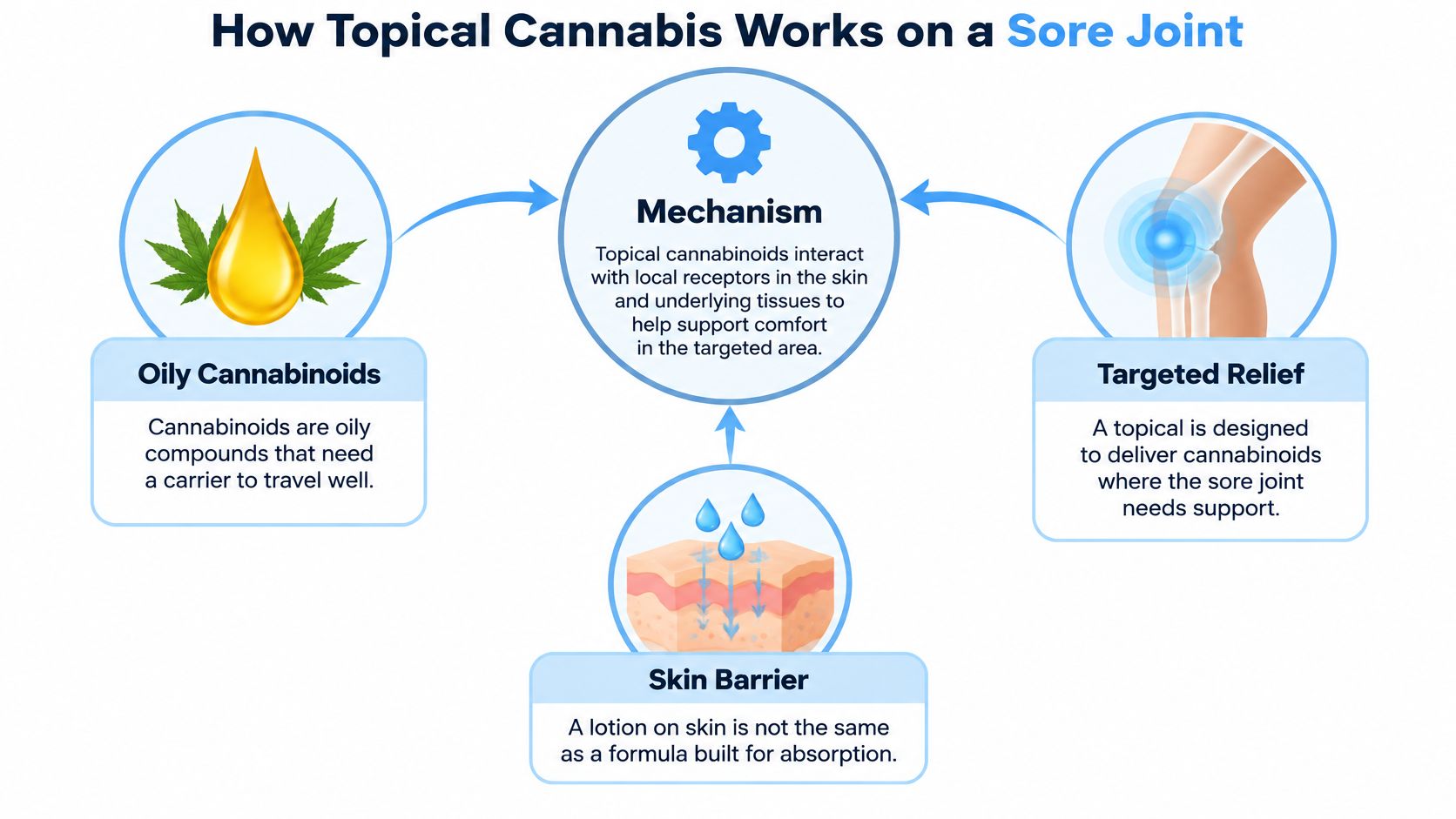
Topical and transdermal aren't the same word
A true topical is meant to act at the application site. A transdermal product is designed to cross the skin, which means systemic exposure becomes possible. Packaging doesn't always make that distinction obvious, so ask which one you're holding.
That difference explains why a milligram number on a label can't predict results by itself. The label tells you what's in the container. It doesn't tell you how much reaches a thumb joint close to the skin versus a deeper knee or hip. Joint depth, delivery vehicle, skin condition, and repeated use all change the story.
The Arthritis Foundation notes it remains unclear whether ordinary CBD lotions and balms release CBD beneath the skin, and a medical expert interviewed by the organization emphasized that cannabinoids are oily and may need an appropriate delivery vehicle, as described on the Arthritis Foundation page on CBD for arthritis pain. Some small studies using transdermal solutions reported hand pain improvements. Another study didn't find significant benefit, according to that same discussion. Don't treat those results as interchangeable.
What local really limits
If a product stays local, it's poorly matched to widespread pain. You'd be chasing spot after spot. Onset and duration also vary by formula and person, so no budtender should promise you relief on a clock.
- Surface rub: Intended for the area you cover, with limited reason to expect whole body effects.
- Transdermal patch or gel: Built for absorption through skin, so you should think harder about THC exposure and dizziness.
- Deep joint: A cream over a knee can't be assumed to match a gel studied on a thumb.
Once you understand that skin is a barrier first and a delivery route second, the evidence makes more sense. You're not asking whether cannabis works in general. You're asking whether this formula, on this joint, for this symptom, is worth a careful test.
What the Arthritis Evidence Actually Shows
One small trial does most of the heavy lifting in conversations about topical CBD and arthritis. It's worth knowing exactly what it tested, because the details limit what you can claim for any other jar.
The 2022 randomized, double-blind, placebo-controlled crossover trial of topical CBD for thumb basal-joint osteoarthritis enrolled 18 participants with a mean age of 64.2 years, and each person applied 6.2 mg/mL CBD in shea butter or shea butter alone twice daily for 2 weeks, then had a 1-week washout before crossing over. On a 0 to 10 visual-analog pain scale, average pain was approximately 5 at baseline, remained about 5 with the control cream, and fell to approximately 2 with CBD, described as roughly a 60% reduction from baseline, with the full results reported in the Journal of Hand Surgery trial report00133-2/fulltext).
This visual keeps that trial in proportion with the wider literature.
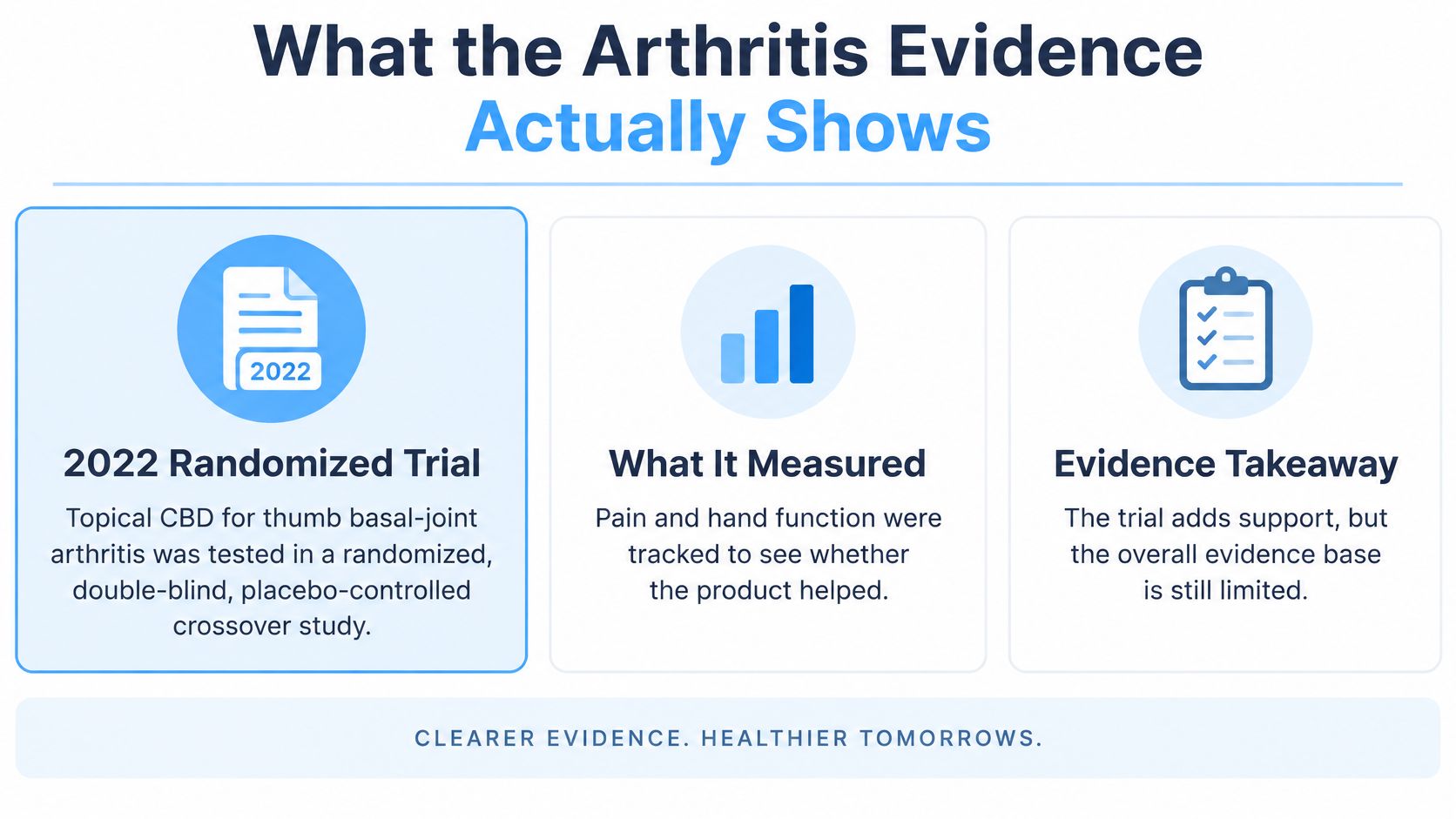
Function moved less clearly. A standardized upper extremity score rose from 39 at baseline to 42 after CBD, an 8% increase that wasn't statistically significant, and the researchers reported no adverse events during the short study, as reported in that trial report. That's an encouraging pain signal for one small joint. It isn't proof for knees, hips, long term use, or inflammatory arthritis.
The wider literature is much thinner
A 2021 evidence review identified 26 systematic reviews on cannabis products for rheumatic conditions but only one randomized trial directly addressing the clinical question at that time, and that rheumatoid arthritis trial used a cannabis-based medicine rather than a shelf balm, with little or no clear pain reduction, according to the New Zealand Medical Journal review of cannabis-based products in arthritis.
A scoping review that identified 19 relevant studies from 517 records found topical CBD had the most encouraging early signal for osteoarthritis symptom relief, but it stressed substantial heterogeneity in doses, delivery vehicles, and study designs and concluded evidence is insufficient for routine clinical use, as summarized in the scoping review of topical cannabinoids for arthritis.
If you're comparing symptom focused options with clinician led approaches for joint damage, reading about joint function and stem cell therapy may help you separate pain management from treatments aimed at the joint itself. For shoppers comparing rubs by purpose, our guide to topical cream for inflammation and localized use can help you sort product language before you buy.
What the numbers support: A possible adjunct for localized osteoarthritis discomfort. What they don't support is disease modification or a substitute for prescribed care.
Treat that distinction as non negotiable, especially with rheumatoid arthritis. Controlling immune mediated inflammation requires medical management. A topical hasn't been shown to do that job.
CBD, THC, Creams, Balms, and Patches Compared
Once you leave the trial behind, you're holding real products with different textures, cannabinoids, and risks. Matching the format to your joint and your tolerance for any high matters more than chasing the strongest label.
CBD-only topicals are what most shoppers mean when they say they want joint area comfort without intoxication. CBD itself is non intoxicating. That doesn't make every CBD cream effective, and it doesn't erase skin reactions, but it removes the head high question for most surface products.
THC-containing topicals need a closer look. A standard rub is intended to stay local, but the word topical on a package doesn't guarantee zero systemic exposure. Risk changes if a formula is transdermal, if you apply it to broken skin, or if you transfer it to your lips, eyes, or someone else's skin before washing your hands.
Matching texture to the joint
Creams and lotions spread easily, which helps on hands and smaller joints where you want thin, even coverage. Balms and salves are thicker. They sit longer on knuckles and knees and can feel better when you want to massage a small area without the product running.
Patches work differently. Placement stays fixed, hands stay cleaner, and the intent is often transdermal rather than a simple surface rub. That can be useful, but it's also why a patch deserves more caution around dizziness and intoxication.
Topical Formats for Localized Arthritis Discomfort
| Format | Intended action | Intoxication concern | Shopper caution |
|---|---|---|---|
| CBD cream or lotion | Local application to hands and smaller joints | Low for CBD alone on intact skin | Check ingredients if your skin is reactive |
| THC or mixed balm | Thicker local coverage for knuckles and knees | Lower for a surface rub, higher if transferred or used on broken skin | Wash hands and avoid eyes and mouth |
| Transdermal patch | Designed to cross skin from a fixed spot | Highest of the three because systemic exposure is the point | Ask about THC content and driving before first use |
Remember what the thumb trial used. Its concentration, shea butter vehicle, and twice daily schedule belonged to that preparation. A different balm with different penetration helpers or THC content can't claim the same result, a gap discussed in the living systematic review material on cannabis for rheumatic diseases.
Don't confuse hemp-seed oil with a cannabinoid rich topical either. They aren't equivalent products. If you're narrowing in on creams, our overview of CBD relief cream formats and label checks can help you compare jars without guessing from the front label alone.
How to Choose a Lab-Tested Topical at Strong Strains
Start with the label, not the promise. A budtender should walk it in a steady order so you leave knowing what you bought and why.
This screenshot shows where to begin that label check online before you visit or order.
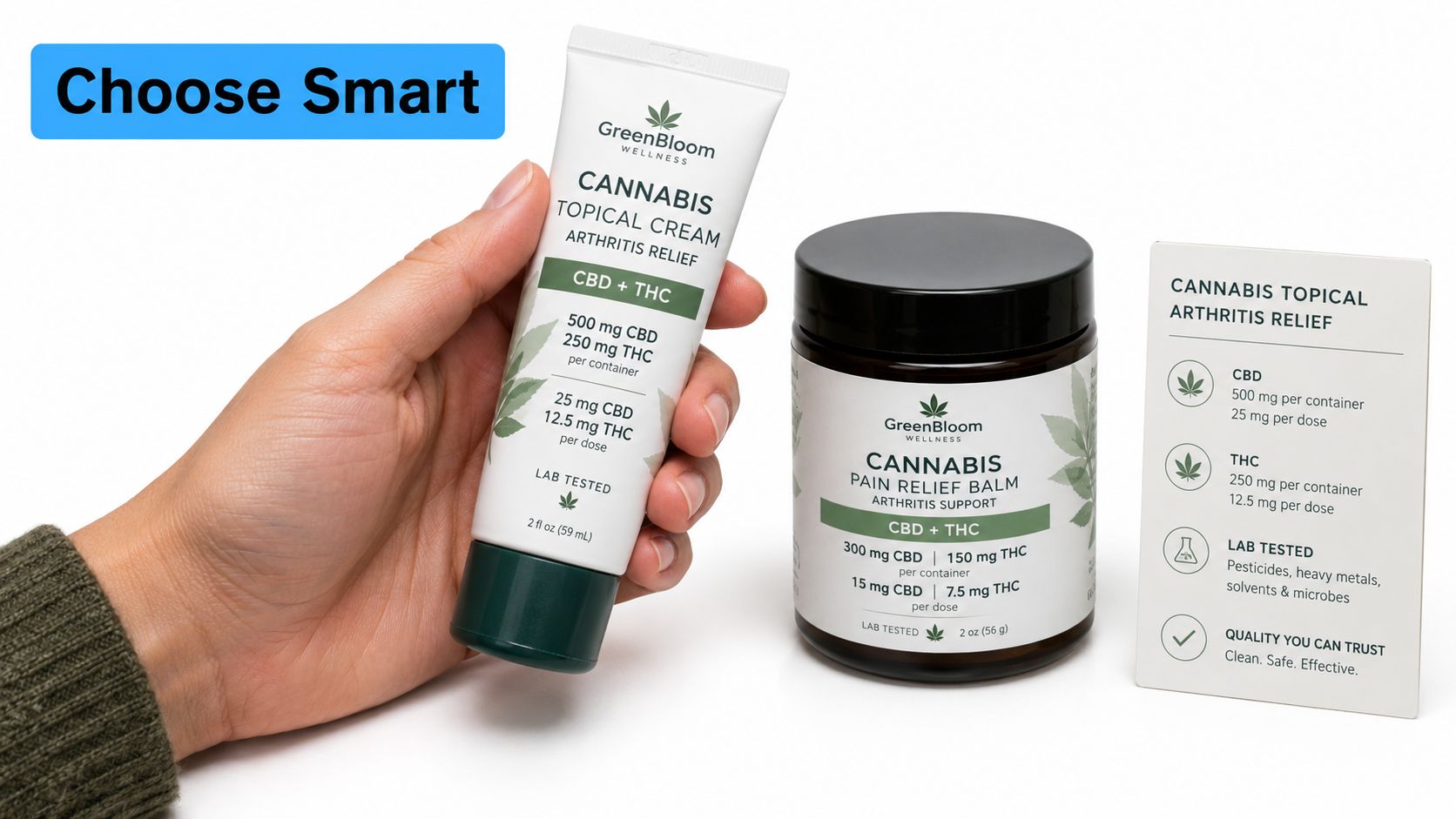
Read the jar like a budtender
- Cannabinoid type first: Is it CBD only, THC containing, or mixed, and is it described as topical or transdermal?
- Amounts per container and per use: Look for clearly stated CBD and THC amounts if they're listed, not vague strength language.
- Other ingredients: Check the base, fragrances, and penetration helpers, especially if you have allergies or sensitive skin.
- Batch testing: Ask for the certificate of analysis. Reliable batch testing matters more than a wellness slogan.
Our explainer on cannabis lab testing and how to read a certificate of analysis shows what to look for before you trust a potency claim. A tested product doesn't prove a topical will ease your pain. It does prove the jar contains what the label says, which is the minimum you should accept.
Strong Strains Cannabis Dispensary is East Setauket's premium dispensary at 19 Technology Drive, East Setauket, NY 11733, open daily with evening hours. The store offers lab tested topicals alongside flower, vapes, edibles, tinctures, and accessories, with in-store pickup or local delivery for adult shoppers.
This short video gives you a sense of the in-store conversation before you come in.
Tell the budtender four things. Name the joint. Say clearly whether any high is unwanted. Mention skin sensitivities. State that your goal is an adjunct for localized discomfort, not a replacement for prescribed care.
Brands in the broader curated conversation can include topical leaning names such as Papa & Barkley, Head & Heal, and Greenline Apothecary Cannabis when they're on the shelf. Availability changes, so don't assume every name is stocked every week. Ask what's tested, clearly dosed, and in stock that day instead of ordering an unverified jar online and hoping for the best.
Safe Application, Dosing, and Side Effects
There's no milligram recipe to hand you here, and anyone who offers one with confidence is getting ahead of the guidance. Arthritis Canada's medical-cannabis guide states there are currently no established dosage guidelines for topical cannabis products and reports that some users experience rashes and itching from cannabis-based creams, while NICE recommends not offering CBD for chronic pain in adults except as part of a clinical trial, citing modest evidence overall with an average improvement of about 0.4 points on a 0 to 10 pain scale, as stated in the NICE guideline on cannabis-based medicinal products.
That doesn't mean you can't test a product carefully. It means you test it like an experiment with stop rules, not like a cure you escalate until something happens.
This checklist puts the first-use habits in one place.
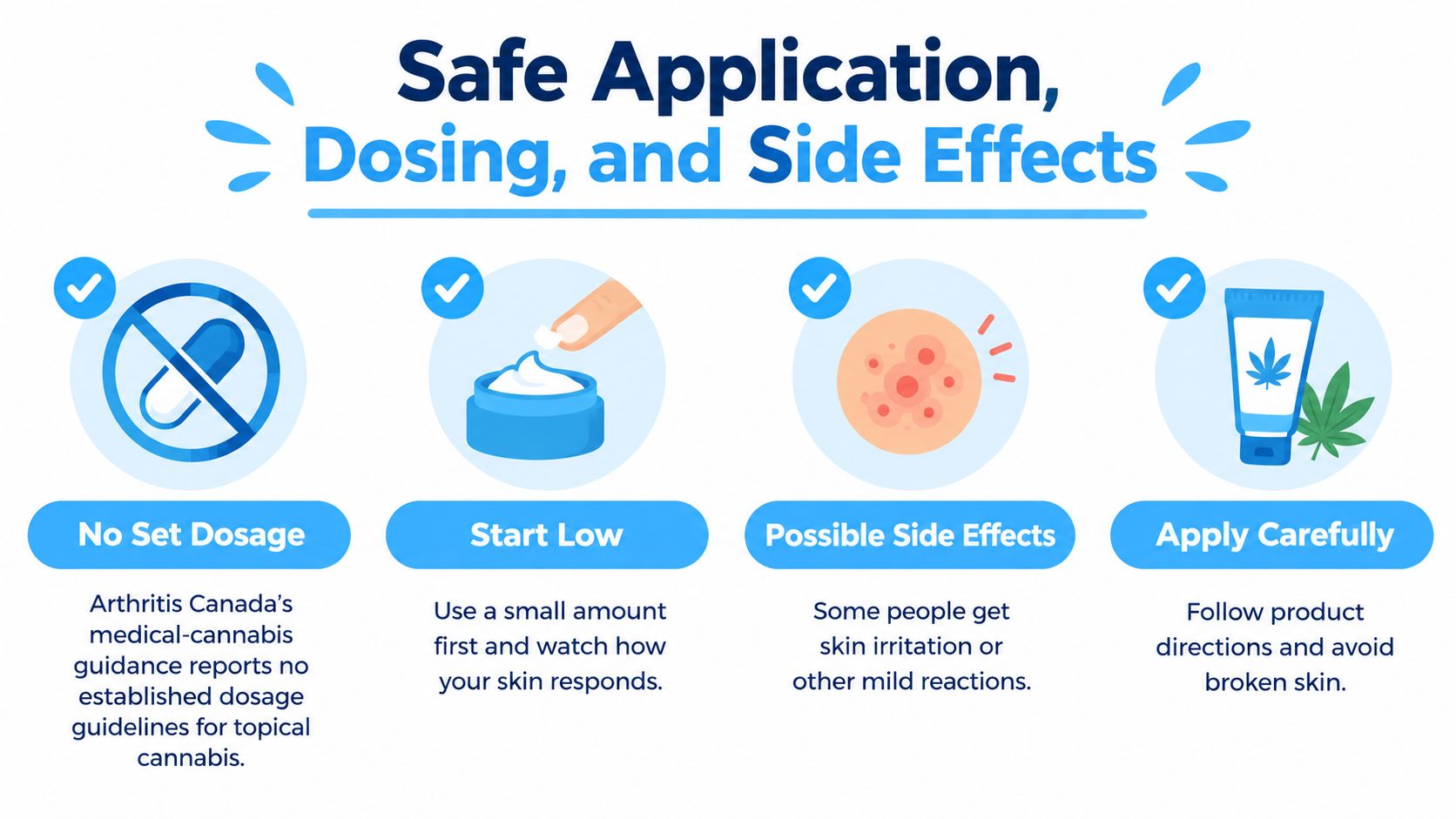
Your first use, step by step
- Patch-test a small area: Apply a little product first and watch for rash, itching, or irritation before covering a larger joint.
- Use intact skin only: Avoid broken or irritated skin, eyes, and mucous membranes.
- Wash your hands: This prevents accidental transfer to your face, children, or pets.
- Pick one activity to judge: Opening a jar, climbing stairs, or a short walk gives you a clearer check than a general feeling.
Give yourself a predefined trial window in line with the short research periods, then review the results. Did that one activity get easier? Did your skin react? If nothing changed, raising potency indefinitely isn't a plan.
If dizziness or intoxication appears, especially with a THC containing or transdermal product, stop using it. Don't drive. Sit down, hydrate, and seek medical help if symptoms worry you.
Questions about interactions with arthritis medicines, blood thinners, or allergies belong with your clinician, not with a product label.
The materials from Arthritis Canada's medical cannabis and arthritis presentation also describe topical cannabis as locally focused with variable onset and duration and limited usefulness for widespread pain. Keep products stored away from children and pets, and stop and reassess if pain spreads, a joint swells, or a rash keeps returning.
Your Next Step for Topical Cannabis on Long Island
Your decision is simpler now. A lab tested topical may be reasonable to try as a localized, non intoxicating adjunct for osteoarthritis type joint discomfort. The evidence doesn't support it as treatment of the disease itself, as repair for cartilage, or as a swap for prescribed care.
That narrow claim is useful. It lets you shop with a clear job in mind. You're choosing a formula for one joint, checking testing and ingredients, and judging it against one activity over a short, predefined trial.
Make the visit concrete
New York adult-use cannabis is for people 21 and older. Bring your questions to 19 Technology Drive in East Setauket and ask a budtender to walk the topical shelf with you. Compare CBD versus THC out loud. Compare cream versus balm versus patch for the exact joint that hurts.
If getting to the store is tough on a stiff day, ask about in-store pickup or local delivery and what fits your schedule. Responsible use, clear safety guidance, and compliant, lab tested products should be part of that conversation either way.
Members who join the newsletter hear about new releases and deals. That's useful for shopping. It isn't medical advice, and it shouldn't be treated as guidance for your diagnosis or medicines.
Call your clinician first if any of these sound familiar.
- Rheumatoid or psoriatic arthritis: Systemic inflammation needs medical management before you lean on a balm.
- Spreading or worsening pain: New swelling, heat, or loss of function deserves prompt care.
- Skin reactions or medicine concerns: Repeated rashes, allergies, or interaction worries are clinician questions.
Come in with the joint, the goal, and your no high preference if you have one. Leave with a tested product matched to that joint and a clear way to judge it. That's a fair trial. Anything promised beyond that is sales talk, and you don't need it.
Visit Strong Strains Cannabis Dispensary at 19 Technology Drive in East Setauket to compare lab tested CBD and THC topicals with a budtender who'll help you match a cream, balm, or patch to your specific joint and comfort goals. Order ahead for in-store pickup or ask about local delivery if that's easier on a sore day, and bring your label questions so we can check testing and cannabinoid amounts together before you buy.