
A safe starting reference on a cannabis dosage chart is 10 mg THC per serving for adults, with 2.5 mg or less for true beginners. Onset and duration can vary dramatically depending on whether cannabis is inhaled, swallowed, absorbed under the tongue, or used in another format.
You're standing at a dispensary counter, looking at two packages of gummies. One says 5 mg THC per piece. Another says 100 mg THC, but you can't tell whether that means one serving or the entire package. Nearby, an experienced customer picks up a high-potency chocolate bar and a concentrate, while you're still trying to work out what “mg per serving” means.
That confusion is common, but you don't have to guess. A cannabis dosage chart turns product labels, THC thresholds, CBD amounts, and timing windows into a plan you can understand before your session. The most useful chart doesn't treat every product as interchangeable. It separates inhalation from oral dosing, shows when effects usually begin, and tells you when taking more could create an uncomfortable dose stack.
Why You Need a Cannabis Dosage Chart Before Your First Session
Two packages can look similar while representing very different doses. A gummy might contain 5 mg THC per piece, while a chocolate bar displays 100 mg THC for the entire package and contains several servings. Reading only the largest number can lead you to treat a package total as one dose.
A cannabis dosage chart puts three decisions in one place:
- How much THC is in this serving? Use the amount per gummy, measured tincture portion, or planned piece, rather than the package total.
- How long should I wait? The route sets the clock. Inhaled cannabis usually takes effect sooner, while swallowed cannabis may continue building after the first effects appear.
- What happens if I combine routes? A vape may feel active while an edible is still developing. Taking more during that overlap can create an unintended dose stack.
Practical rule: Use a chart to plan, not to predict perfectly. Tolerance, food, product formulation, medications, and personal sensitivity can all change your response.
Three mistakes a chart helps prevent
Dose stacking occurs when someone takes an edible, feels little after a short wait, and adds more. Oral cannabis often reaches its strongest effects roughly 1.5 to 4 hours after use and may last 8 to 12 hours, according to clinical evidence on cannabis pharmacokinetics. The waiting window is part of the dose, not empty time.
Route mixing can blur that timing. Inhaled cannabis may peak in about 10 to 30 minutes, whereas a conventional edible takes much longer to reach its strongest effects. A chart that places both routes side by side helps you avoid judging the edible before it has fully arrived.
Serving confusion begins with the label. The package total is not automatically the amount in one serving. Before buying products such as Camino, Kiva, Wana, Wyld, or Lost Farm, check the THC amount per unit and the number of units in the package. A clear chart keeps those figures connected to your route and waiting window, so milligrams do not become the only part of the plan.
Understanding THC mg, CBD mg, and Serving Size
THC mg measures the amount of tetrahydrocannabinol in a serving. THC is the cannabinoid most associated with intoxication, altered perception, impairment, and the familiar psychoactive cannabis experience. CBD mg measures cannabidiol, a non-intoxicating cannabinoid that appears in CBD-dominant and balanced formulations.
Serving size is the label's standard unit. One serving could be one gummy, a measured dropper amount, one capsule, or part of a beverage. The serving size tells you how to translate the product's cannabinoid content into a planned amount.
Milligram-based labeling matters because product weight doesn't tell you cannabinoid strength. A heavier product isn't automatically stronger, and a small product isn't automatically mild. Modern edible rules helped establish 10 mg THC as a widely recognized reference point. Colorado and Washington set one edible serving at no more than 10 mg Δ9-THC, and Canadian regulations later capped edible cannabis at 10 mg THC per package, according to the review of North American edible regulations.
The label math in one example
Suppose a package contains 100 mg THC and lists 10 servings. The package total is 100 mg, but each serving contains 10 mg THC. Eating the entire package would not be the same as taking one serving.
| Label Term | What It Means | Example Value | Why It Matters |
|---|---|---|---|
| Total THC | THC across the whole package | 100 mg | Shows cumulative potency |
| THC per serving | THC in one labeled portion | 10 mg | Guides a single dose |
| Total CBD | CBD across the whole package | 100 mg | Shows cumulative CBD content |
| CBD per serving | CBD in one labeled portion | 10 mg | Helps compare ratios |
| Servings per package | Number of labeled portions | 10 servings | Connects total content to each serving |
| Minor cannabinoids | Secondary cannabinoids such as CBG, CBN, or THCV | Label-dependent | Adds formulation context, but isn't the primary THC dose |
Minor cannabinoids can help describe a product, but don't use CBG, CBN, or THCV as a substitute for reading the THC and CBD amounts. If you're comparing products from brands such as Head & Heal, Canna Clinicals, Aeterna, or Papa & Barkley, start with the per-serving cannabinoid numbers.
THC Dosage Tiers by Experience Level
A dosage chart becomes more useful when it separates experience level from route. The same listed amount can feel different when inhaled compared with swallowed, and a person with established tolerance may need more THC to notice effects than someone new to cannabis.
The ranges below use the common edible reference points for beginner, low, moderate, and high dosing. The inhalation descriptions are qualitative because inhaled labels often report product potency rather than a precise absorbed dose per puff.
| Tier | THC mg Range | Inhalation per session | Oral per serving | Expected Effects |
|---|---|---|---|---|
| Beginner | 1 to 2.5 mg | Use a very small inhaled amount and pause | 1 to 2.5 mg | Mild relaxation, possible mood lift |
| Low | 3 to 5 mg | Small, measured session with time between puffs | 3 to 5 mg | Noticeable relaxation and clearer psychoactive effects |
| Moderate | 10 to 15 mg | May feel substantial depending on product and tolerance | 10 to 15 mg | Stronger body effects and altered perception |
| High | 20 mg or more | High-intensity inhalation can arrive quickly | 20 to 30+ mg | Pronounced impairment and higher risk of discomfort |
For edibles, 1 to 2.5 mg THC is commonly treated as a beginner amount, 3 to 5 mg as low, 10 to 15 mg as moderate, and 20 to 30+ mg as a range generally reserved for experienced users, according to this edible dosing reference. A true beginner may notice mild relaxation and a mood lift around 2.5 mg orally, but individual response still varies.
Why inhalation and oral dosing don't match
Inhalation gives you faster feedback. You can take a puff, wait for the effect to develop, and decide whether to stop. Oral dosing removes that immediate feedback, so a 5 mg edible can feel more intense and last longer than a similar amount of inhaled THC.
Tolerance changes the picture, too. Someone who uses cannabis frequently may experience less effect from a dose that feels strong to a new consumer. That doesn't make a high amount automatically appropriate. It means the chart should guide a slow adjustment rather than dictate a permanent target.
The number tells you how much THC is present. The route tells you when that THC will matter.
Inhalation Methods and Their Dosing Windows
Inhaled cannabis includes smoked flower, dry-herb vapor, cartridge vaping, and concentrates. These methods provide faster feedback than edibles, but the actual absorbed amount can be difficult to standardize. Bowl size, draw length, device temperature, flower potency, and inhalation technique all change the experience.
For a practical session, count puffs instead of estimating what percentage of a bowl you consumed. Start with one small inhalation, put the product down, and observe how you feel before deciding whether to continue. Avoid inhalation if you have a respiratory condition unless a qualified healthcare professional has advised you otherwise.
| Method | Typical THC % | Per-Puff or Dose THC | Onset | Peak | Duration |
|---|---|---|---|---|---|
| Smoked flower | Label-dependent | Difficult to standardize | Seconds to minutes | Early in the session | Shorter than oral use |
| Dry-herb or cartridge vape | Label-dependent | Depends on device and draw | Seconds to minutes | Within the early session window | Shorter than oral use |
| Dab or concentrate | Label-dependent | Highly variable and often much stronger | Rapid | Rapid | Shorter than oral use |
Flower and vape sessions
Flower and vapes can feel active quickly, which lets you titrate by puff. A calm environment, water nearby, and a seated first session can make it easier to notice the transition from mild effects to impairment. Don't treat a cartridge, pre-roll, or flower product from Alien Labs, Good Green, Rythm, or Rove as interchangeable merely because the package appears similar.
Concentrates require extra caution. Their potency and delivery can produce a much sharper experience than flower. If you're comparing concentrate accessories or products such as PUFFCO, Puff, Jetty, or DTF Hash Co., use the product's test information and ask a knowledgeable budtender about a low-intensity approach.
For more context on concentrate technique and product handling, see this guide to the best way to smoke concentrates.
Edibles, Tinctures, and Oral Dosing
Oral cannabis needs its own rules because swallowing THC creates a delayed experience. The body processes swallowed THC through the digestive system and liver, producing metabolites that can make the effect feel longer-lasting and more intense than inhaled cannabis. That delay is why an edible can seem inactive before it suddenly becomes noticeable.
Conventional edibles commonly begin working in about 30 to 120 minutes, and their effects often last 4 to 8 hours, according to this edible onset and duration guide. A full stomach can delay the experience compared with an empty stomach, so keep your food state consistent when you're trying to understand your response.
| Format | Standard Serving | Onset | Peak | Duration | Redose Wait |
|---|---|---|---|---|---|
| Gummy or baked edible | Often 10 mg THC, with smaller portions possible | 30 to 120 minutes | About 1.5 to 4 hours | 4 to 8 hours, sometimes longer | Wait at least 2 hours |
| Swallowed tincture | Label-dependent | 45 to 120 minutes | About 1.5 to 4 hours | Several hours | Wait at least 2 hours |
| Capsule | Label-dependent | 45 to 120 minutes | About 1.5 to 4 hours | Several hours | Wait at least 2 hours |
| Sublingual tincture | Label-dependent | Often faster than swallowing | Earlier than swallowed forms | Product-dependent | Wait 30 to 60 minutes |
| Infused beverage | Label-dependent | Product-dependent | Product-dependent | Product-dependent | Read the label and wait |
The most common oral mistake is taking more at the 30-minute mark because the first dose hasn't appeared. For swallowed forms, take one measured serving and wait at least two hours before considering more. For sublingual tinctures, keep the liquid under your tongue as directed and allow 30 to 60 minutes before reassessing.
A 10 mg product can be divided into smaller portions when the label and product design allow it. Brands such as Soft Power Sweets, Tune | Infused Seltzers, Weed Water, Nama, and Wana may use different formats, so check whether the stated amount applies to one piece, one drink, one dropper, or the whole package.
Readers comparing high-potency products can also review this explanation of 100 mg THC products, but a large package total isn't a recommended single serving.
CBD, THC, and Balanced Ratios Compared
A product's ratio describes the relationship between CBD and THC, while milligrams show how much of each cannabinoid you receive. A CBD-dominant product contains far more CBD than THC. A balanced formula provides comparable amounts. A THC-dominant product places most of its cannabinoid content in THC.
Clinical guidance favors gradual titration instead of a fixed target. One consensus approach starts CBD-predominant therapy at 5 mg CBD twice daily, then increases the daily CBD amount by 10 mg every 2 to 3 days, up to 40 mg CBD per day. For balanced THC:CBD products, it recommends 2.5 to 5 mg of each cannabinoid once or twice daily, with adjustments every 2 to 3 days until the intended goal is reached or the dose reaches 40 mg THC, as summarized in peer-reviewed cannabinoid dosing guidance.
| Ratio Category | Common Ratios | Starting THC mg | Starting CBD mg | Typical Use |
|---|---|---|---|---|
| CBD-dominant | 20:1, 10:1, 4:1 | Under 2.5 mg | 10 to 25 mg | Daytime wellness or cannabinoid-sensitive users |
| Balanced | 1:1, 2:1 | 2.5 to 5 mg | Equal to or higher than THC | Evening relaxation or sleep routines |
| THC-dominant | 10:1 or higher THC | 2.5 mg for new consumers | Product-dependent | Experienced consumers seeking stronger THC effects |
A 1:1 gummy with 5 mg THC and 5 mg CBD may feel different from a 10 mg THC edible with no CBD. The ratio changes the formulation, but total THC still affects intensity, onset, and impairment. CBD does not guarantee that THC will avoid anxiety, impairment, or other unwanted effects. Route and timing still matter, so use one measured serving and allow the product's expected window to develop before stacking another dose.
For broader context on CBD and emotional wellness, see this resource on cannabidiol easing withdrawal anxiety from Addiction Resource Center LLC. Prescription medicines can interact with CBD or THC, so ask a clinician or pharmacist before adding either cannabinoid.
Adjusting Your Dose for Weight and Tolerance
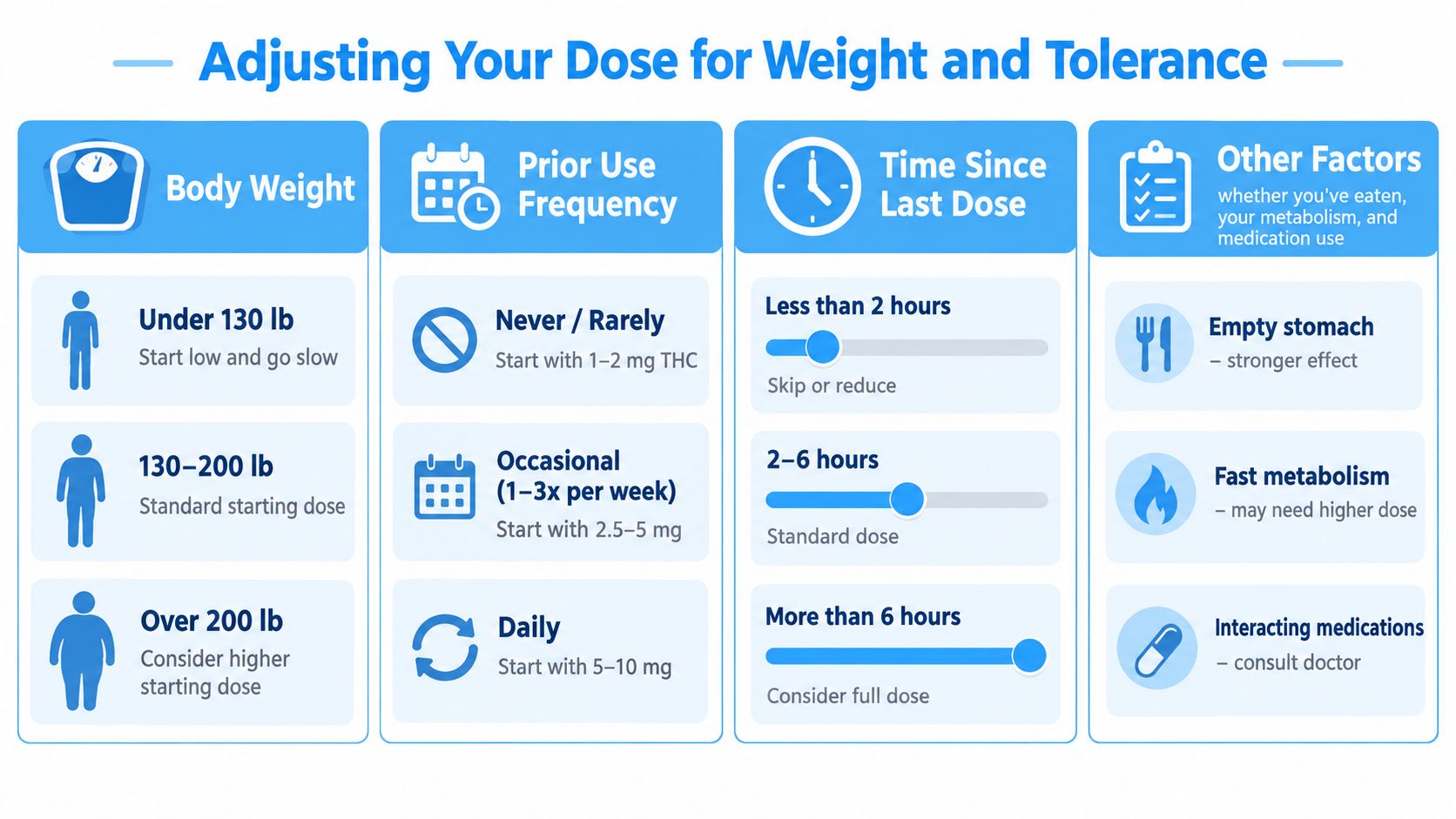
Body size can influence how a dose feels, but weight alone can't predict your ideal amount. Tolerance, recent use, food state, metabolism, health conditions, and medications can matter just as much. A cannabis dosage chart should help you make a conservative starting choice, not encourage automatic increases.
Use these factors as caution flags rather than mathematical instructions:
- Body weight: A smaller adult may need a more cautious starting point, while a larger adult may respond differently to the same labeled amount.
- Prior use: Someone who rarely uses cannabis should stay near the lower end of a range. Daily use can increase tolerance, but it doesn't eliminate impairment.
- Time since last dose: If you recently consumed cannabis and still feel strong effects, don't add more just because a chart shows a standard serving.
- Food state: A full stomach can delay oral onset, while an empty stomach may make the experience arrive differently.
A conservative adjustment approach
For oral THC, make changes in small milligram steps and give each change enough time to evaluate. Utah's evidence-based medical cannabis guidance starts oral dosing at 1 to 2.5 mg THC-equivalent at bedtime for the first 1 to 2 days, then uses the same range once daily on days 3 to 4, followed by twice-daily use on days 5 to 6 and beyond if needed and tolerated. The guidance recommends increases of 1 to 2.5 mg and caps this routine titration pathway at 15 mg THC-equivalent per 24 hours, as described in the Utah Medical Cannabis general-use guideline.
CBD generally gets adjusted less aggressively than THC because it doesn't produce the same intoxicating effect, but that doesn't make every CBD product suitable for every person. Keep a simple record of product, amount, route, time, food state, and effects. That record will tell you more than trying to calculate a dose from body weight alone.
Safety Thresholds and Overconsumption Warning Signs
A package may call 10 mg THC one serving, but that label is a reference point, not a starting instruction for every adult. For someone new to cannabis, begin with 2.5 mg THC or less. People who are young, elderly, or medically vulnerable may need 1.25 mg, based on clinical cannabis dosing recommendations.
Route and timing matter as much as the milligram amount. Inhaled cannabis can feel stronger sooner and may wear off sooner, while edibles can take longer to appear and last longer. Treat an edible like a slow kettle, not a light switch. Taking more before the first dose has fully developed is the common dose-stacking mistake. Wait through the expected onset and duration window listed for that product or route before deciding whether more is appropriate.
People with no cannabis experience, adults over 65, anyone taking sedating medication, and people who know they are sensitive to THC should choose the lowest available amount and discuss cannabis use with a healthcare professional. Do not drive, operate equipment, or make important decisions while impaired.
Overconsumption may cause extreme drowsiness, rapid heart rate, nausea, dizziness, anxiety, paranoia, or short-term memory disruption. Cannabis alone is not associated with a documented fatal overdose, yet severe reactions and emergency-room visits can occur after consuming too much.
| Symptom | What It Feels Like | What To Do |
|---|---|---|
| Extreme drowsiness | Difficulty staying alert | Sit or lie down somewhere safe and avoid driving |
| Rapid heart rate | Noticeable pounding or racing | Rest, breathe slowly, and seek medical help if severe |
| Nausea or dizziness | Stomach upset or unsteady movement | Sip water and stay seated |
| Anxiety or paranoia | Fear, agitation, or suspicious thoughts | Move to a quiet, familiar space with a trusted person |
| Chest pain or breathing trouble | Potential medical emergency | Seek urgent medical care or contact emergency services |
Do not mix edibles with alcohol. For chest pain, breathing trouble, severe confusion, or symptoms that feel medically urgent, contact emergency services or poison control. A quiet setting and time may help mild overconsumption, but neither replaces medical care when red flags appear.
For more context on psychological well-being, read this cannabis and mental health study. Personal mental-health history matters, especially for people with anxiety or conditions cannabis may worsen.
How to Read a Cannabis Product Label
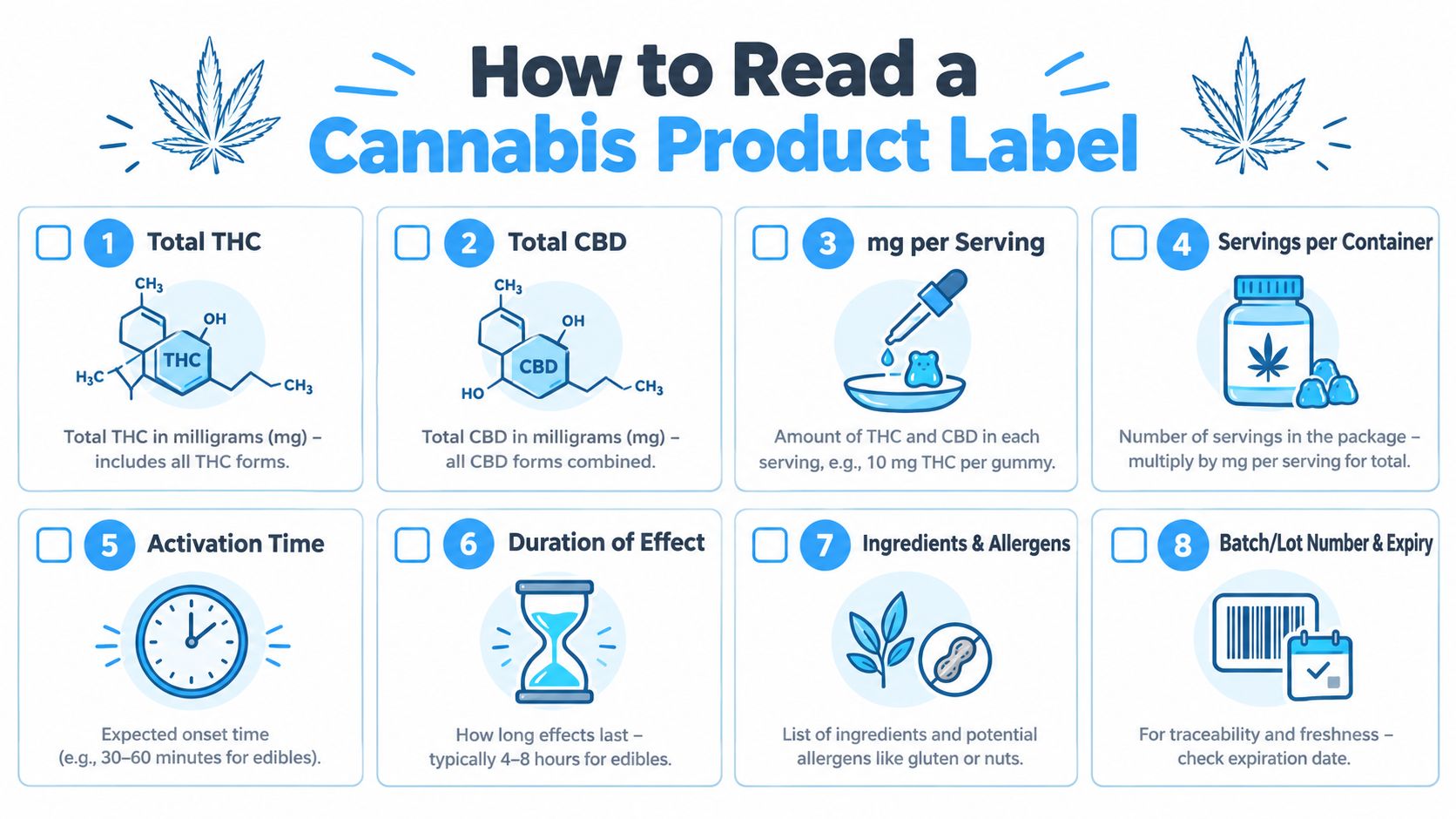
Start at the top of the label and find total THC and total CBD. Then look for the amount per serving. These are separate figures, and the per-serving number is the one you use for a single gummy, capsule, dropper amount, or beverage.
Next, confirm the number of servings in the container. A package with 100 mg THC divided into 10 servings contains 10 mg per serving. A package with the same total amount but a different serving count requires different portion planning.
The label-scan checklist
Look for the production or harvest date, batch or lot number, and expiration information. A certificate of analysis QR code may connect you with third-party laboratory results for cannabinoids, terpenes, and contaminants. For a closer look at testing documentation, see this cannabis lab testing guide.
Terpenes such as myrcene, limonene, and caryophyllene add context about the product's aromatic profile and likely character, but they don't replace THC dosing information. Read the required warnings, including keep out of reach of children, don't drive, may impair cognition, and pregnancy or breastfeeding cautions.
Before buying products such as Jeeter, Stiiizy, Camino, or Rove, check:
- Total THC and CBD: Find the package totals.
- Per-serving amount: Confirm the THC and CBD in one serving.
- Serving count: Make sure the portion math makes sense.
- Batch and test information: Look for traceability and laboratory documentation.
- Warnings and ingredients: Check allergens, impairment warnings, and storage instructions.
Quick Reference Chart You Can Save
Use the route first, then the milligrams. A 2.5 mg edible and a small inhaled session aren't identical experiences because the body receives and processes them differently. The chart below keeps the key variables together so you can check the product, choose a conservative starting point, and avoid adding another dose before the first one has developed.
| Route | Beginner Dose | Standard Serving | Onset | Peak | Duration | Redose Wait |
|---|---|---|---|---|---|---|
| Smoking flower | Small inhaled amount | Product-dependent | Seconds to minutes | Early session | Shorter than oral use | Pause and assess before another puff |
| Vaping | Small inhaled amount | Product-dependent | Seconds to minutes | Early session | Shorter than oral use | Pause and assess before another puff |
| Dabbing | Avoid for true beginners | Product-dependent | Rapid | Rapid | Product-dependent | Don't redose until effects are clear |
| Edibles | 1 to 2.5 mg THC | 10 mg THC reference serving | 30 to 120 minutes | About 1.5 to 4 hours | 4 to 8 hours, sometimes longer | Wait at least 2 hours |
| Tincture, sublingual | Low measured amount | Label-dependent | Often faster than swallowing | Earlier than swallowed forms | Product-dependent | Wait 30 to 60 minutes |
| Tincture, swallowed | 1 to 2.5 mg THC-equivalent | Label-dependent | 45 to 120 minutes | About 1.5 to 4 hours | Several hours | Wait at least 2 hours |
| Topical | Product-dependent | Label-dependent | Product-dependent | Product-dependent | Product-dependent | Follow the product label |
Beginner safety card
| Reference Point | Meaning |
|---|---|
| 1.25 mg THC | Extra-cautious starting amount for sensitive or medically vulnerable adults |
| 2.5 mg THC | Beginner oral reference point |
| 5 mg THC | Low oral dose range |
| 10 mg THC | Widely recognized adult serving reference |
| 15 mg THC-equivalent | Routine daily ceiling in the cited Utah titration pathway |
For homemade edibles, the practical calculation is: (grams of cannabis × THC% ÷ 100 × 1000 × decarb efficiency) ÷ servings = mg THC per serving, using the edible dosage calculator formula. With packaged products, still verify total THC, milligrams per serving, servings per package, and batch information.
Save this chart before visiting a dispensary. If you're shopping on Long Island, Strong Strains Cannabis Dispensary offers lab-tested flower, vapes, pre-rolls, edibles, concentrates, tinctures, topicals, and accessories with in-store pickup or local delivery. Visit Strong Strains Cannabis Dispensary and ask the team to help you compare products by route, serving size, THC:CBD ratio, and timing.