
A cannabis product can carry a passing lab result and still miss its labeled THC value by a meaningful margin. One independent retail-flower study found that about 70% of samples tested more than 15% below the THC printed on the label, with observed THC averaging 23.1% below the lowest labeled values and 35.6% below the highest. (Oregon Health Authority technical report)
That finding changes the buying question. Lab tested cannabis products aren't automatically perfect products. Testing can identify contaminants, document potency, and create accountability, but a buyer still needs to know what was tested, which batch the result represents, and whether the report is complete enough to trust.
What Lab Tested Cannabis Means in 2026
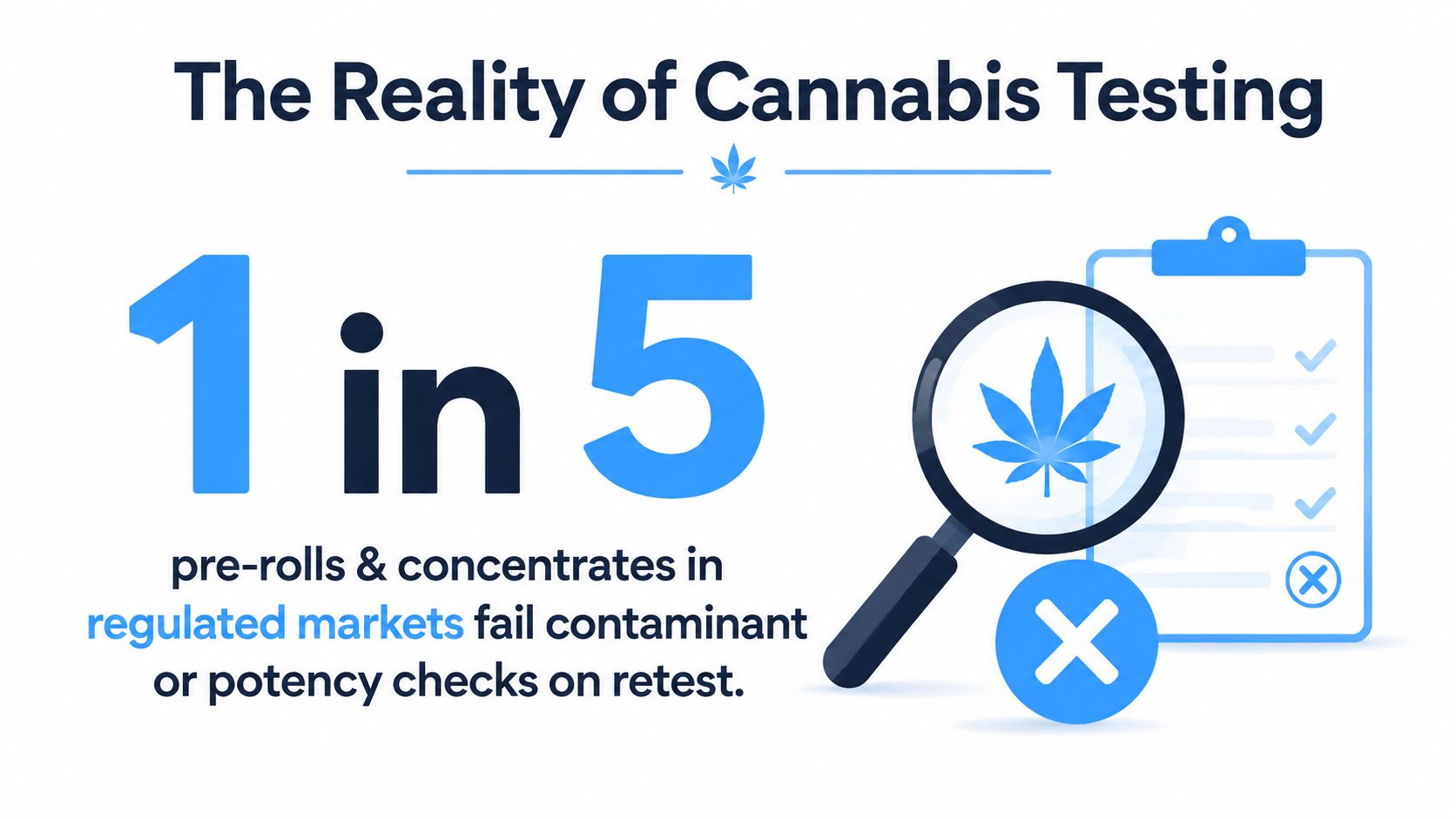
About 18% of California cannabis batches failed at least one laboratory requirement during the first two months of regulated testing, including 33% of tested edible batches. (Cannabis Business Times report) Those results show why a lab-tested label should be read as evidence from a defined process, not as a universal safety badge.
A complete definition includes three parts:
- Independent laboratory: A permitted third-party lab analyzes the product rather than relying only on the producer's own evaluation.
- Traceable documentation: The certificate of analysis, or COA, identifies the product, batch or lot, testing laboratory, and relevant results.
- Consumer access: The dispensary or brand makes the report available so buyers can compare the package with the laboratory record.
New York requires adult-use processors to contract with an independent permitted laboratory, while dispensaries must keep laboratory test reports publicly available for every product they sell. (New York cannabis law) Required testing covers categories including microorganisms, foreign material, metals, moisture, water activity, mycotoxins, pesticides, residual solvents, and terpenoids. (New York laboratory testing limits)
The practical test is simple: can the COA connect a specific sample to applicable state limits? A THC percentage beside a logo provides little context by itself. The report should show which panels were run and whether the results met their limits.
A COA describes the representative sample from a particular batch. It does not automatically describe every flower nug, gummy, cartridge, or tincture produced over time. New York guidance requires representative sampling before distribution, with laboratories testing each batch or lot. (New York laboratory testing guidance) A passing result therefore gives useful batch-level evidence, while leaving the buyer to confirm that the package and report refer to the same lot.
Why Independent Testing Exists and How It Works
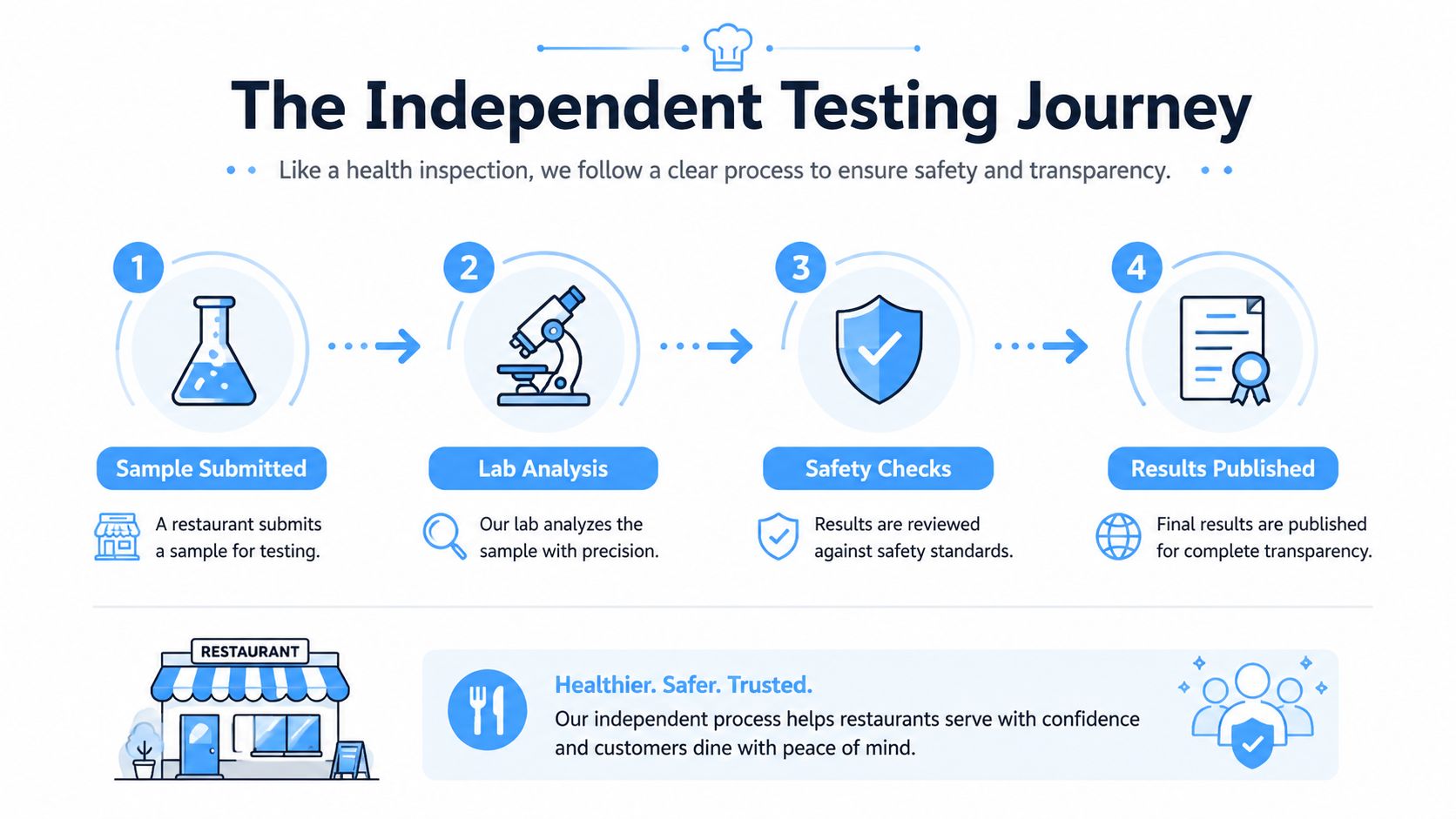
Restaurant health inspections show why a separate check matters. Customers cannot see Salmonella on a cutting board, pesticide residue in an ingredient, or unsafe refrigerator temperatures. Inspectors and laboratories add verification between a seller's claims and a customer's decision.
Cannabis needs that same layer. Flower may look bright and smell fresh while containing pesticides, heavy metals, microbial impurities, mycotoxins, or residual solvents. Appearance and aroma offer useful clues about quality, but they cannot reliably identify these hazards.
The chain from sample to report
The process starts with a representative sample collected under the applicable jurisdiction's rules. The laboratory confirms the product and batch, prepares the material, and applies validated methods to the required testing panels. Cannabinoid testing commonly uses liquid chromatography. Mass spectrometry can help identify chemical compounds and contaminants. Readers interested in related analytical approaches can review HPLC and MS for peptide verification.
Sampling is where a result can gain or lose meaning. Cannabis is not chemically uniform: a dense flower top may differ from smaller buds, and an infused edible must be mixed well enough for a portion to represent the lot. New York rules require laboratories testing new product offerings to test five samples for homogeneity, regardless of batch or lot size. The sampling requirement described in the state guidance helps address variation within a product.
Practical rule: A laboratory result is only as representative as the sample collection and preparation behind it.
A third-party laboratory separates testing from the producer's own quality claims, but independent laboratories still need comparable qualifications. New York laboratory rules require a cannabis laboratory to pass two consecutive proficiency tests for approval of an analyte or analyte group. Those rules also require cannabis testing laboratories to be physically located in New York state. (New York cannabis laboratory rules)
For a broader explanation of laboratory documentation and product testing standards, review the testing criteria alongside the report itself. Independent testing functions as a chain of custody, sampling, analysis, review, and reporting. Each step must be complete for the results to be credible.
Reading a Certificate of Analysis Like a Pro
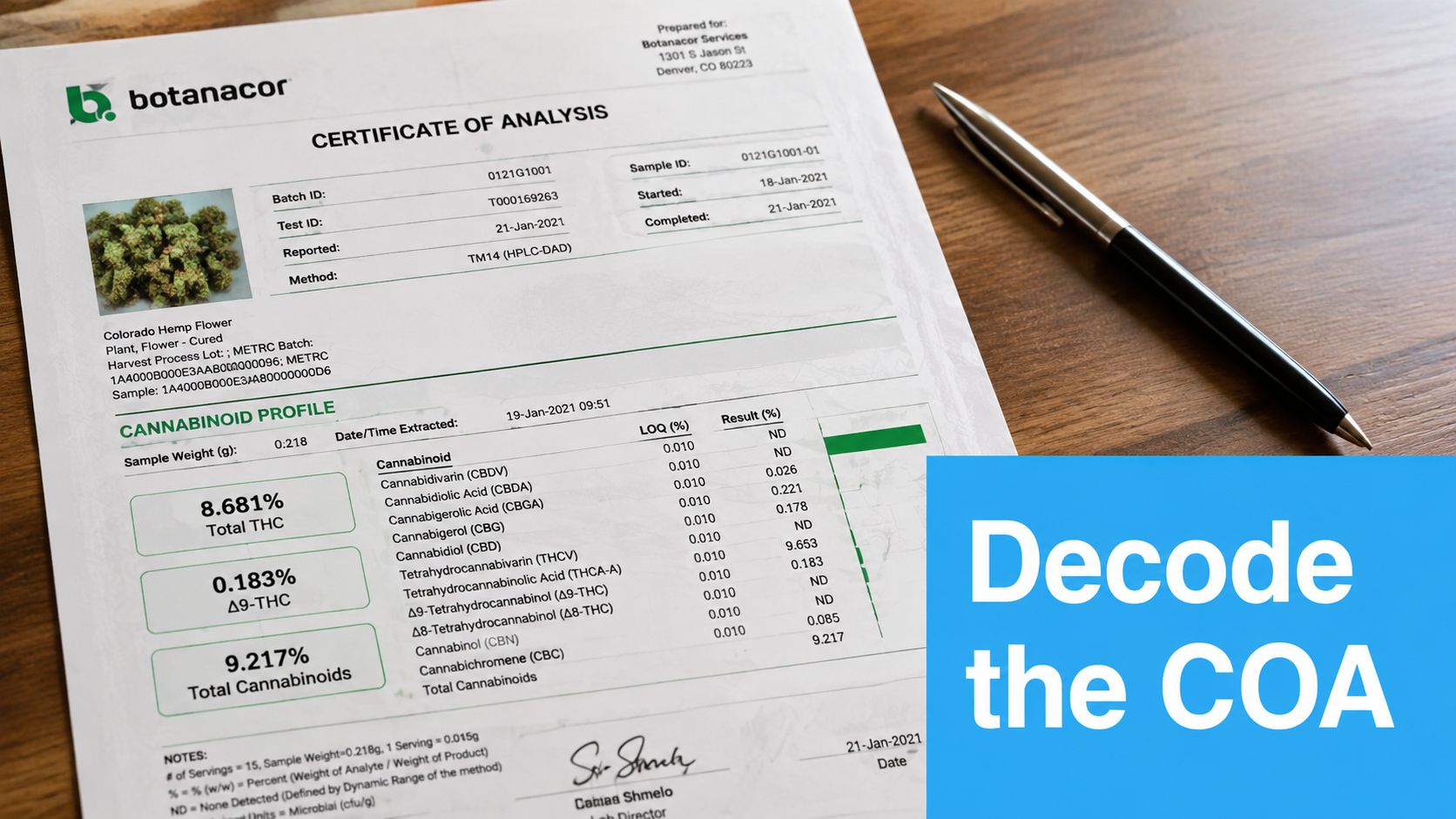
A COA brings several kinds of evidence into one document. Read it in five passes: identity, cannabinoids, terpenes, contaminants, and final status. Each pass answers a different question, like checking a food label, a quality-control record, and a test result together.
Start with identity
Find the product name, product type, batch or lot number, sample identification, testing date, laboratory name, and license or permit details. The package and report should carry the same batch number. A mismatch means the COA may describe another production run, even if the product name looks familiar.
The cannabinoid panel lists the compounds the laboratory measured. A flower result of 24.3% THC means approximately 243 milligrams per gram of flower, assuming the percentage is expressed by weight. Total THC may combine delta-9 THC already present with THCA converted under the laboratory's calculation method. Compare like with like: a total-THC result and a delta-9-only result use different definitions.
Treat “ND” as a measurement statement
“ND” means not detected, rather than absolute zero. An instrument has a limit of detection, the smallest amount it can notice, and a limit of quantification, the smallest amount it can measure with sufficient confidence. A molecule below either relevant threshold may therefore appear as ND while remaining present at a very low level.
Terpenes help describe aroma and product profile, but they do not replace contaminant screening. A familiar name, including Cookies, Alien Labs, Rythm, or 1937, still needs a report tied to the specific batch.
Read the footer, not just the headline
The final pass or fail status indicates whether the tested batch met applicable requirements. One analyte can have a reported result while another panel causes the product to fail. Check the actual result, reporting limit, action limit, and status wherever the report provides them.
Moisture and water activity matter for flower, hash, and other products whose storage stability depends on those conditions. For a visual comparison of real reports, you can browse third-party lab reports and practise locating the identity block, cannabinoid panel, and contaminant results.
A COA documents what the laboratory measured in the sampled batch and whether those results met applicable requirements. It does not assess strain effects, flavour, or personal enjoyment, so use it as evidence about the tested product rather than a promise about your experience.
Contaminants That Matter by Product Format
A COA is more useful when its contaminant panels match the product. Flower, concentrates, edibles, tinctures, and topicals don't carry identical testing priorities, because growing, extraction, formulation, packaging, and storage create different exposure routes.
California's testing areas include cannabinoids, terpenes, solvents, pesticides, heavy metals, microbial impurities, mycotoxins, moisture, water activity, and foreign material. Maryland likewise groups relevant contaminants into pesticides, residual solvents, microbiological impurities, and heavy metals. (Maryland Cannabis Administration technical authority)
| Product Format | Primary Contaminant Risk | Secondary Risk | COA Section to Check |
|---|---|---|---|
| Flower | Pesticides and microbial impurities | Heavy metals, foreign material, moisture | Pesticides, microbes, metals, moisture, water activity |
| Pre-rolls | Microbial impurities and foreign material | Pesticides, metals, moisture | Microbial, pesticide, metal, and foreign-material results |
| Concentrates and vape products | Residual solvents | Pesticides and heavy metals | Residual solvents, pesticides, metals |
| Edibles | Microbial impurities and mycotoxins | Homogeneity and foreign material | Microbial, mycotoxin, homogeneity, and potency results |
| Tinctures | Microbial impurities and formulation stability | Metals or solvent residues from processing | Microbial, metals, solvents, cannabinoid panel |
| Topicals | Microbial impurities and foreign material | Packaging or carrier-material concerns | Microbial, metals, foreign-material, and stability-related results |
Flower deserves attention to its growing environment. Cannabis can absorb metals from soil, while cultivation and handling can introduce pesticide residues or microbes. A clean-looking jar cannot reveal those results, so the corresponding COA panels matter.
Concentrate and vape buyers should start with residual solvents. Extraction may involve butane, propane, ethanol, or other solvents, and incomplete purification can leave residues behind. Pesticide testing also matters because extraction can concentrate compounds already present in the starting plant.
Format changes the practical question. For edibles, the package's total milligrams do not show whether the ingredient is distributed evenly throughout the batch. The homogeneity result helps indicate whether the tested portion represents the product consistently. For more context on how infused formats differ from ordinary flower, see infused pre-rolls.
Testing can also produce conflicting signals. A New York recall involved product lots with falsely reported Aspergillus results and a lot with an incorrectly reported cadmium result. The episode shows why a passing report should be paired with batch traceability, laboratory identification, and a transparent recall process. Lab testing is evidence about a sampled batch, not an absolute guarantee that every unit is contaminant-free.
Why Potency Numbers Are Less Precise Than You Think
A label reading 24% THC presents a precise-looking result, while the underlying measurement includes a meaningful range of uncertainty.
A controlled inter-laboratory ring test found that results were often consistent only within about ±20%, even after careful sample homogenization. Differences of up to 20% between laboratories were common enough to matter when comparing labels. (Project CBD cannabis laboratory testing comparison)
These findings reflect variability inherent in the process. Sample preparation, laboratory method, instrument calibration, reference standards, and the portion selected for testing all contribute to the possible result. A flower sample labeled at 25% THC can produce a result several percentage points higher or lower under another laboratory's method.
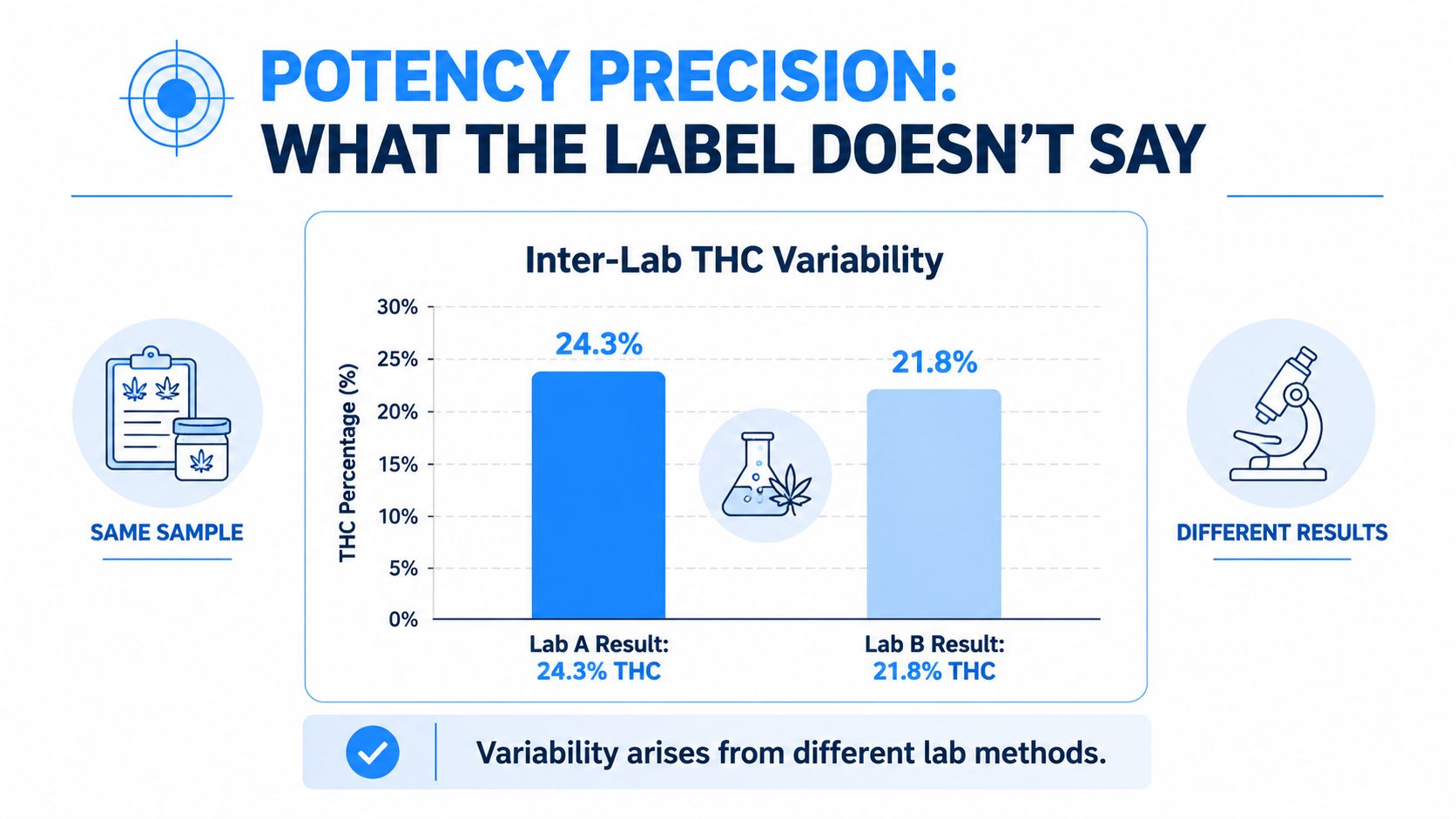
The practical reading is category, not coordinate. Treat 24% and 26% as broadly similar potency claims rather than assuming the second product will feel dramatically stronger. Dose, tolerance, consumption method, terpene composition, and minor cannabinoids can influence the experience more than a small label difference.
Why different reports can disagree
Independent reanalysis has found discrepancies in both directions. One Cannabis Science report described a sample of about 150 commercially available products, with 87% testing more than 10% above labeled THC potency. One product labeled around 32.2% THC re-tested near 22.7% THC, a difference of roughly 10 percentage points. (Cannabis Science testing and quality)
The Oregon technical report cited earlier found the opposite pattern in retail flower, with many samples testing below their labels. Taken together, these findings support a cautious interpretation of high THC figures. The percentage helps set expectations, but it cannot guarantee a particular effect.
A better buying habit: Use THC percentage to set expectations, then choose a dose you can control and compare products using consistent laboratory methods when possible.
For readers comparing cannabinoid profiles beyond THC, full-spectrum cannabis offers useful context. A complete COA can describe the chemical profile, while dose, tolerance, and individual biology still shape the experience.
How to Verify a COA in Three Minutes
A COA check takes about three minutes and can reveal whether the document belongs to the package, covers the right tests, and supports the product's format. Follow the same sequence each time.
First minute, identify the batch
Find the batch or lot number on the package. It may sit near the barcode, manufacturing details, or cultivation date. Compare it character for character with the COA linked from the dispensary menu, product page, or package QR code.
Scan the QR code if available. The destination should identify the laboratory or compliance platform and display a report for that specific batch. A homepage alone does not confirm that your specific jar was tested.
Second minute, validate the report
Check the product name, format, batch number, sample ID, laboratory name, permit or license information, and testing date. New York requires certificates of analysis to be maintained for five years from the date of expiration, supporting recordkeeping and traceability. (New York cannabis laboratory rules)
Confirm that the laboratory is authorized for cannabis testing and that the report covers the product type in your hand. A potency result covers cannabinoid strength only. It does not show whether the sample was evaluated for pesticides, metals, microbes, or residual solvents.
Third minute, scan the decision lines
Review cannabinoid potency and the contaminant panels that fit the format:
- Flower: Check pesticides, metals, microbial results, moisture, and water activity.
- Vapes or concentrates: Check residual solvents, pesticides, and metals.
- Edibles: Check potency, microbial and mycotoxin results, plus evidence that the sample represented a consistent batch.
- Tinctures and topicals: Check the cannabinoid panel, along with microbial, metal, solvent, and foreign-material results where applicable.
Use the report to investigate mismatches, not to chase a single number. If a menu lists 30% THC while the COA lists 25%, ask the budtender whether the menu is outdated, the batch changed, or the label contains an error. Missing reports, mismatched batch numbers, or a failed panel are practical reasons to choose another product and report the discrepancy to the dispensary.
Strong Strains Lab Testing Standards and Buyer Checklist
A useful store standard rests on batch traceability, full-panel documentation, and easy consumer access. Strong Strains Cannabis Dispensary states that its products undergo laboratory testing for potency, purity, and safety. Available COAs may list cannabinoid and terpene profiles, pesticides, heavy metals, microbes, and residual solvents. The claim matters less than whether the buyer can open the matching report before paying.
New York rules support that expectation. Processors must use independent permitted laboratories, dispensaries must make reports publicly available, and representative samples must be tested before distribution. Treat those requirements like a chain of custody: each link should connect the package, its batch, and its report.
The seven-point counter check
- QR code presence: Scan the package code and confirm that it opens product documentation, not a generic brand page.
- Batch ID match: Compare the package batch or lot number with the COA character by character.
- Date recency: Review harvest, production, sample, and test dates. Confirm that the report represents the package currently offered.
- Full-panel coverage: Check that the report covers relevant contaminants, rather than listing potency alone.
- Terpene reporting: Use the terpene panel to compare aroma and profile. Terpenes describe composition, not product safety.
- Contaminant status: Confirm that applicable pesticide, microbial, metal, solvent, mycotoxin, and foreign-material results meet stated limits.
- Laboratory authorization: Verify that the laboratory is permitted or licensed to test cannabis in the relevant jurisdiction.
A passing checklist supports a better purchasing decision, though it cannot predict a particular effect. It also helps compare products such as Airo, Ayrloom, Camino, Connected, Cookies, Jeeter, Kiva, MFNY, Rove, Rythm, Stiiizy, Wana, Wyld, or other brands sold by a licensed retailer.
Ask the budtender to open the COA with you if you are shopping for the first time. Experienced buyers can compare the same brand and format across batches instead of selecting only the highest printed THC value. Lab testing works like a quality-control checkpoint, not a permanent safety badge. The report is useful when its identity, coverage, and results all line up.
Frequently Asked Questions From Long Island Buyers
Why can two dispensaries show different THC percentages for the same strain?
The products may come from different harvest batches, use different laboratories, or reflect different sample preparation and reporting conventions. Match the batch number first, then compare testing methods and the definition used for total THC. A label is a snapshot of one tested sample, not a permanent value for every package of that strain.
Are home cannabis test kits worth using?
Home kits can provide a rough screening signal, but they do not replace a laboratory COA. They generally cannot evaluate the same range of pesticides, metals, microbes, solvents, and other analytes. Use the licensed dispensary's batch report as the primary verification document, and treat a home result as limited information.
What should I do if a COA looks suspicious or is missing?
Pause before consuming the product. Ask the dispensary for the current report, compare the package and COA batch identifiers, and request help from a budtender. New York dispensaries must keep laboratory reports publicly available for products offered for sale, as required under New York cannabis law. A missing report or mismatched identifier deserves clarification before purchase.
How should I compare terpene percentages with total cannabinoids?
Total cannabinoids quantify measured cannabinoid content. Terpenes describe aromatic compounds and the product's profile. Higher terpene percentages do not indicate superior quality on their own and should not replace contaminant screening. Compare dominant terpenes, freshness, format, and a controllable dose alongside cannabinoid values.
Strong Strains Cannabis Dispensary offers lab-tested flower, vapes, pre-rolls, edibles, concentrates, tinctures, topicals, and accessories, with in-store pickup and local delivery for Long Island customers. Bring this checklist to the counter, ask to review the matching COA, and visit Strong Strains Cannabis Dispensary for product guidance from knowledgeable budtenders.