
A THC tincture is a liquid cannabis preparation dispensed with a dropper, usually held under the tongue or swallowed, with the dose measured in milligrams of THC. For example, a tincture labeled 10 mg/mL contains 1 mg of THC in a measured 0.1 mL serving.
You're standing at a dispensary shelf, looking at a small bottle that seems less familiar than a pre-roll or gummy. The important question isn't how strong the bottle looks. It's how much THC you'll take, how you'll measure it, and how long you'll wait before deciding what it feels like.
What a THC Tincture Actually Is
A tincture contains delta-9-tetrahydrocannabinol, usually shortened to THC, in a liquid you take by mouth. THC is the intoxicating ingredient. The carrier is the ingestible liquid that holds it, such as an oil or alcohol-based vehicle.
Think of the bottle as a measuring system rather than a single serving. You don't need to consume everything inside, and a dropperful isn't automatically the right amount for you. The useful information is the concentration, the measured volume, and the resulting THC dose.
Milligrams instead of a flower percentage
If you're used to shopping for flower, you might look first for a potency percentage. With tinctures, milligrams per milliliter, written as mg/mL, are more useful because they connect directly to the amount of liquid you draw.
The distinction is between concentration and quantity. A bottle can contain a substantial amount of THC overall while allowing small individual servings. Conversely, a little liquid can contain more THC than you intended if the concentration is high.
The bottle, liquid, administration method, and measuring tool work together.
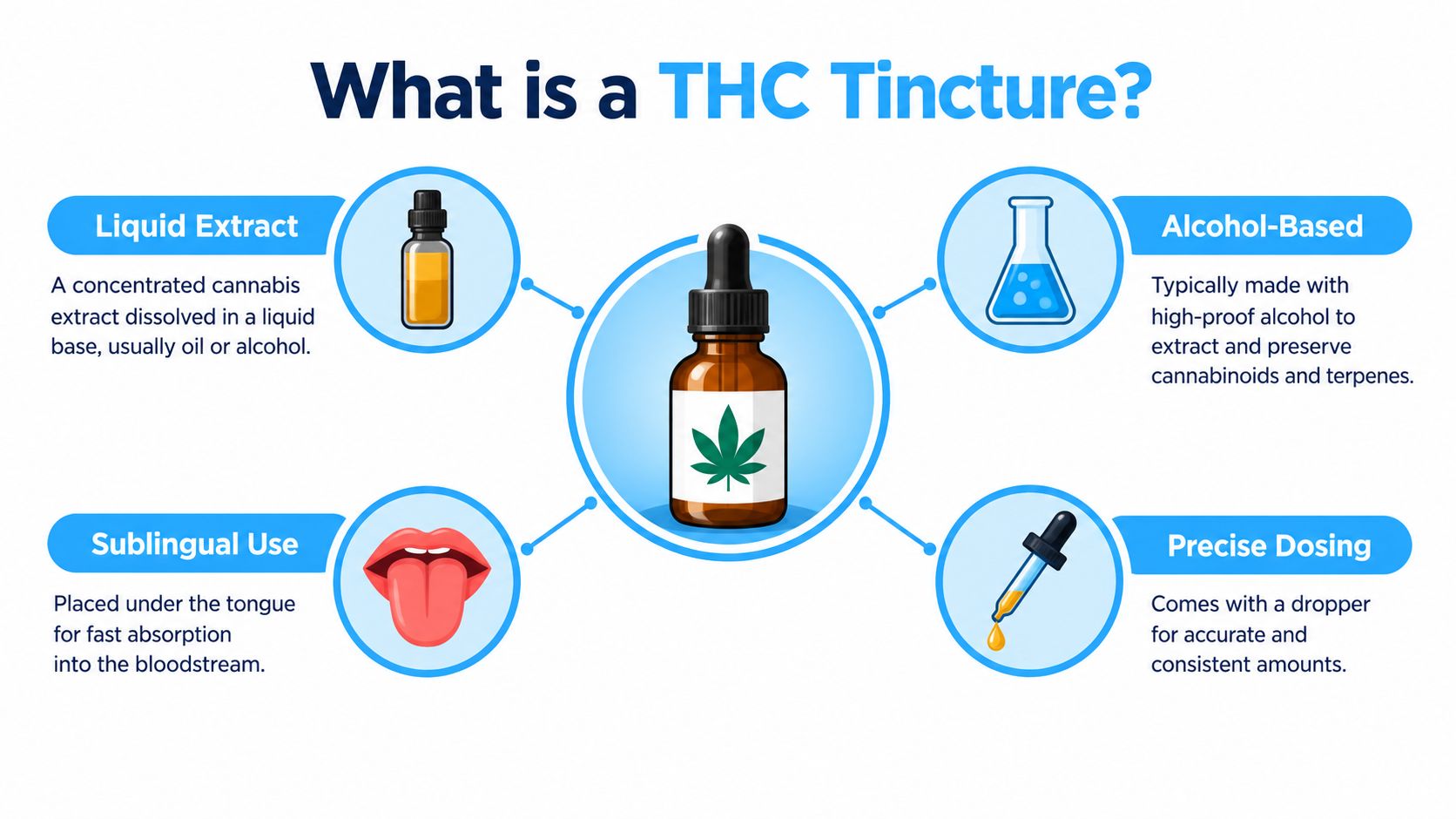
Precision is about the serving
A calibrated dropper has markings that let you measure volume. Those markings matter more than guessing from the number of drops or assuming every squeeze fills the dropper identically.
Practical rule: Measure the liquid you take. Don't use the bottle's appearance as a substitute for reading its label.
There's also a distinction between a retail cannabis tincture and a standardized prescription THC medicine. FDA labeling for oral dronabinol describes a pharmaceutical preparation with defined dosing and pharmacokinetic information, not a guarantee that every dispensary bottle behaves identically.
So, what is THC tincture in everyday terms? It's a liquid way to take a measured THC serving without inhaling cannabis. Its usefulness depends on understanding both the measurement and the way your body absorbs the liquid.
How THC Tinctures Are Made
A teabag steeping in water offers a useful starting analogy: something from the original material moves into a liquid. Cannabis extraction follows that broad idea, although a commercial tincture involves more processing and testing than making tea.
The analogy has limits. THC doesn't behave like tea flavor in water, and producers can formulate a tincture from an extracted cannabis ingredient rather than steeping flower directly in the finished bottle.
Extraction and the finished carrier aren't identical
Extraction means separating desired cannabis compounds from the starting material. Formulation means preparing those compounds in the liquid the customer will use.
Traditional tinctures use an alcohol-based vehicle. Oil-based products instead carry cannabinoids in an ingestible oil, including formulations made with MCT oil, short for medium-chain triglycerides. Don't assume the carrier tells you every detail of the extraction process.
A finished oil tincture might resemble this arrangement, but its ingredient list, not its appearance, identifies what's inside.
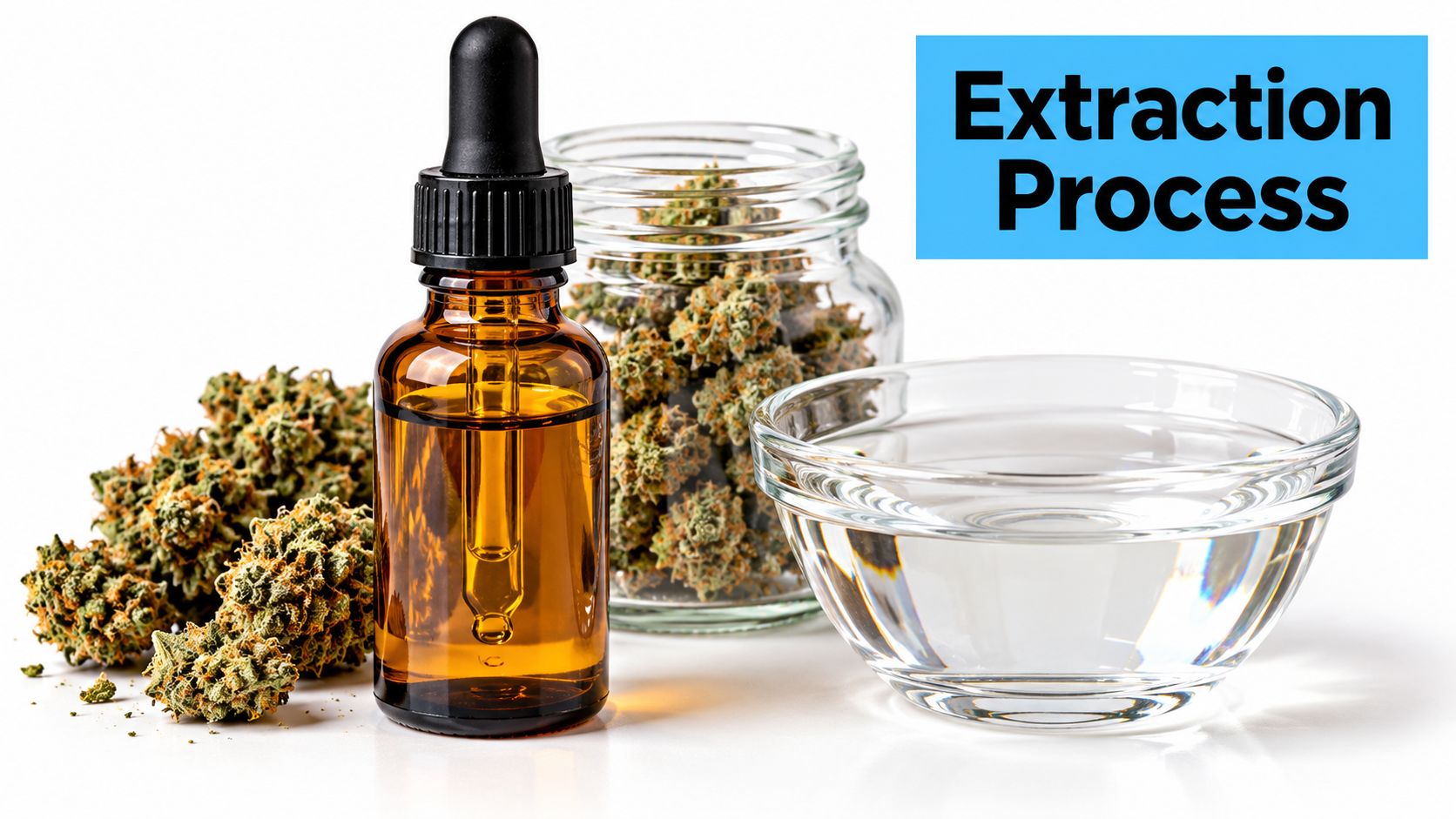
Activation, blending, and verification
Decarboxylation is the heating step used to convert THC's acid precursor into THC. A producer may perform that step on cannabis material or an extract before preparing the finished liquid. It's more accurate to think of this as converting a particular cannabinoid than turning all plant material from harmless to intoxicating.
Afterward, the producer prepares the intended concentration and packages the product. For the shopper, the practical checkpoints are:
- Carrier ingredients: Identify the oil or alcohol-based vehicle rather than guessing from the bottle's color.
- Measured concentration: Look for a THC amount tied to a defined liquid volume.
- Batch testing: Ask for laboratory information connected to the actual bottle.
Formulation isn't cosmetic. A review of cannabinoid delivery and bioavailability identifies formulation, food intake, meal fat content, and individual metabolism as factors that can change response.
Neither an amber color nor an oil texture proves quality. The finished label and testing documentation are more useful than an appealing manufacturing story.
Sublingual vs Swallowed Absorption
Sublingual means under the tongue. Oral-mucosal absorption means absorption through tissues inside the mouth. Swallowing sends the liquid through the digestive system instead.
Think of watering soil versus delivering water close to a plant's roots. Both routes can reach the destination, but the pathways differ. With tinctures, that difference affects timing and how the body processes THC.
This visual introduces the routes, although its simplified clock labels shouldn't be treated as personal dosing deadlines.
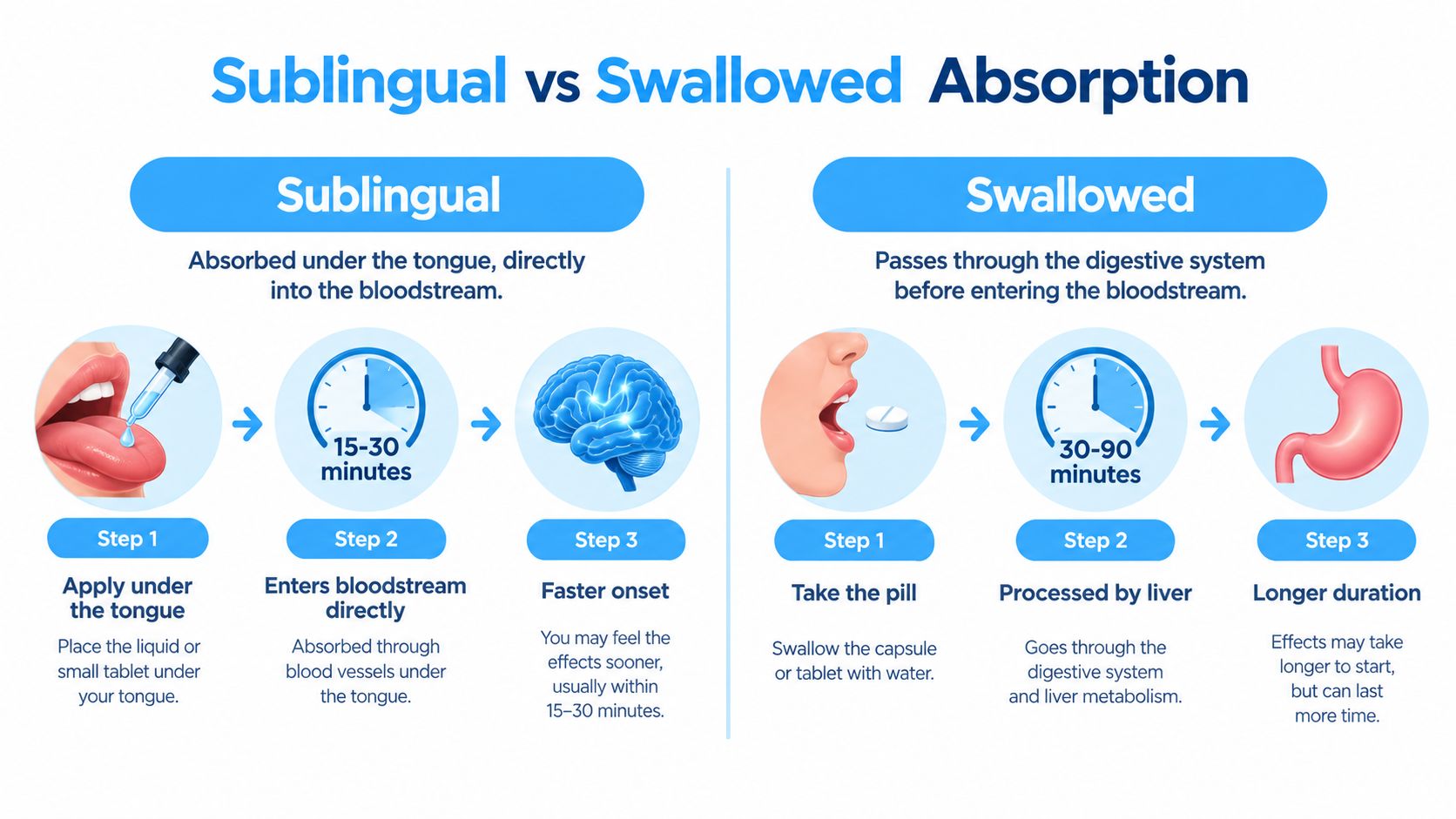
Timing ranges, not promises
A clinical review of cannabis administration reports sublingual onset of approximately 15–60 minutes, peak effects around 45 minutes, and duration of roughly 4–6 hours, compared with oral onset commonly after 1–3 hours and effects lasting approximately 6–12 hours.
Those ranges describe general observations, not a schedule everyone follows. In particular, the earliest possible onset and the typical peak aren't interchangeable. Feeling something doesn't mean the experience has fully developed.
Swallowed THC passes through the liver, where some becomes 11-hydroxy-THC, an active metabolite. A metabolite is a substance your body produces while processing another substance. This one can contribute to the intensity and duration of the experience.
Why the routes overlap
Some liquid held under the tongue can still be swallowed. That means the same serving may involve both mouth-tissue absorption and digestive processing.
- Holding the dose: Can favor earlier absorption, depending on the formulation and how it's used.
- Swallowing the dose: Makes digestive processing more important.
- Either method: Doesn't provide a perfectly predictable absorbed dose.
Faster onset isn't permission to repeat the dose quickly.
If your goal is a shorter waiting period, ask whether the product is intended for sublingual use. If you swallow it or add it to food, plan around an oral experience rather than assuming the dropper bottle changes that route.
For another explanation of the distinction, this video offers a supplementary overview.
Dosing a THC Tincture Safely
The calculation is straightforward: THC concentration multiplied by liquid volume equals the THC serving. You're calculating what you take, not exactly how much reaches your bloodstream.
For example, 10 mg/mL × 0.1 mL = 1 mg THC, while 10 mg/mL × 0.5 mL = 5 mg THC, as illustrated in this review of cannabis dosing and administration.
Build a measured first-use routine
Read the manufacturer's directions before opening the bottle. A labeled serving is a measurement reference, not proof that it's appropriate for your tolerance.
- Check the concentration: Locate THC per milliliter and the labeled serving volume.
- Use the dropper markings: Measure the intended volume instead of counting uncalibrated drops.
- Follow preparation directions: Shake the bottle if the label instructs you to.
- Use the intended route: For sublingual products, place the measured liquid under the tongue and follow the manufacturer's holding instructions.
- Record what you took: Note the product, measured serving, route, and time so you don't have to reconstruct them later.
A tincture administration guide describes holding liquid under the tongue for 30–60 seconds before swallowing, but your bottle's directions should determine how you use that specific formulation.
The visual below summarizes measurement habits. Its starting-dose range and waiting interval aren't universal recommendations; use the more conservative guidance in the text.
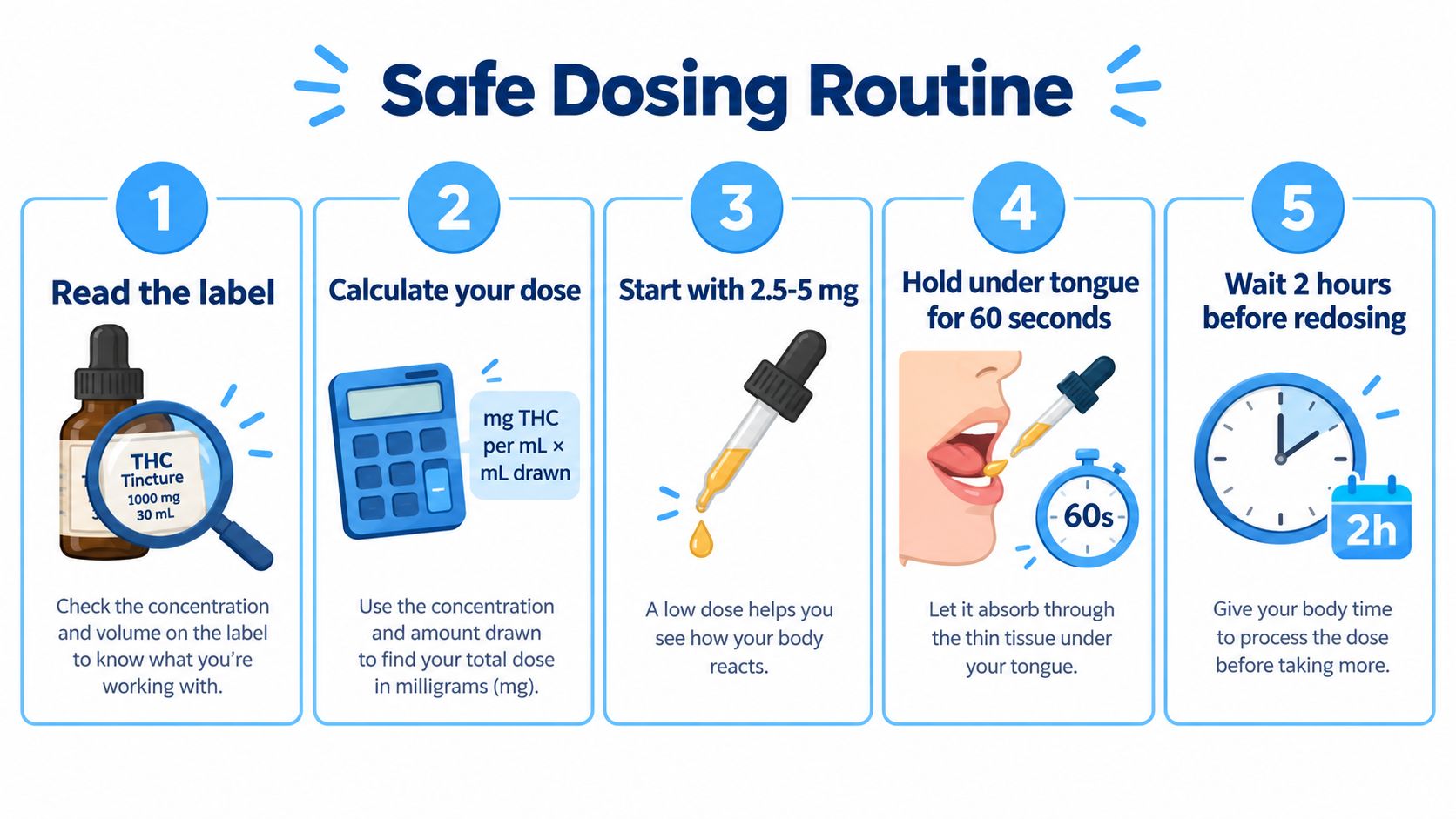
Don't turn waiting into dose stacking
The CDC's cannabis poisoning guidance describes oral intoxicating effects taking 30 minutes to 2 hours to appear; the accompanying consumer guidance emphasizes starting with 2.5 mg THC or less for new or occasional edible users and allowing for full effects that can take 4 hours.
For a tincture that's swallowed, a short wait isn't enough to establish the final effect. Even reaching the earlier waiting interval doesn't automatically make another dose appropriate. Follow the smallest labeled serving and allow the experience to develop without stacking doses.
Keep driving, machinery, alcohol, and other intoxicants out of your first-use plan. If you're comparing tinctures with inhaled options, this guide to choosing cheap pre-rolls can help frame a separate product conversation, but don't add another format while you're still assessing your tincture.
Tinctures vs Flower, Vapes and Edibles
Choose a format by the experience you can responsibly plan for, not by which package looks most convenient. A tincture's strongest practical distinction is the ability to adjust a measured liquid serving.
It doesn't automatically replace flower, vapes, or edibles. Each involves a different balance of administration, waiting, and measurement.
Cannabis Formats Compared
| Format | Onset | Duration | Dose Control |
|---|---|---|---|
| Flower | Faster than oral administration | Different from prolonged oral effects | Portion size doesn't directly establish an absorbed THC dose |
| Vapes | Faster than oral administration | Depends on product and use | Draw size and technique complicate measurement |
| Edibles | Delayed digestive onset | Can be prolonged | Defined servings, but subdividing isn't always straightforward |
| Tinctures | Depends on sublingual or swallowed use | Depends on absorption route | Concentration and calibrated volume allow measured adjustments |
The table is a decision aid, not a timing calculator. The absorption distinctions already discussed are more useful than assuming every product within a category behaves alike.
Where a dropper earns its place
A tincture can make sense when you want to take a small, documented serving during an evening without inhaling anything. You can choose a volume, record it, and compare future experiences without relying solely on the size of a puff or a piece of food.
Discretion is another practical consideration. Taking liquid doesn't create smoke or require the same setup as smoking flower. Still, discreet use isn't the same as being unimpaired, and transporting cannabis means following applicable rules rather than assuming a pocket-sized bottle is unrestricted.
Adding tincture to food or drink changes how you consume it. Consider this guide to cannabis oil uses when comparing ingestible products, and check that the specific bottle is intended for your chosen use.
Decision check: Choose the format that fits your schedule and measurement needs, not a promise of a particular mood.
A small THC serving shouldn't be sold as guaranteed daytime focus. If you need to drive, work safely, or make important decisions, precise measurement doesn't remove those responsibilities.
Likewise, a swallowed tincture isn't a sensible choice when you expect immediate relief. For medical symptoms, ask a clinician about appropriate treatment rather than choosing a cannabis route solely because it's described as faster.
Pros and Cons of THC Tinctures
The main benefit and the main limitation coexist: you can measure the serving carefully, but you can't make your body's response equally exact. That's the distinction an honest tincture recommendation should preserve.
A good fit starts with your preferences. Someone comfortable measuring liquid may appreciate the format, while someone who dislikes its texture may find the same bottle inconvenient.
Advantages that matter in practice
- Fine serving adjustments: A clearly labeled concentration and readable dropper let you choose a defined volume.
- No combustion: Taking the liquid doesn't require burning cannabis.
- Flexible administration: A suitable product can be used under the tongue or swallowed according to its directions.
- A straightforward record: You can write down the serving and route, then use that information when discussing future choices.
These advantages concern the format, not a guaranteed therapeutic outcome. A repeatable measuring routine is useful even when the resulting experience varies.
Limitations worth taking seriously
Delayed absorption demands patience. If you tend to interpret a quiet beginning as a failed dose, the format may encourage a habit you'll need to change before using it comfortably.
Taste and texture matter, too. Don't let someone talk you into an oil-based bottle if you already know you dislike oily liquids. Ask about the carrier and flavor before buying, especially when a product's branding gives little information about its contents.
Storage and cost deserve their own questions:
- Storage instructions: Follow the bottle's requirements and expiration information rather than assuming every tincture has a long shelf life.
- Value comparison: Compare labeled concentration, usable serving size, and price. There's no basis for declaring all tinctures either cheap or expensive per milligram.
- Immediate needs: Don't choose a swallowed product expecting an instant response.
- Medical goals: Discuss symptoms and medications with a healthcare professional instead of treating a dropper as a substitute for clinical guidance.
The bottle is a tool, not a verdict on how you should consume cannabis. If the measuring routine feels manageable and the waiting period fits your plans, it may be useful. If those requirements feel like a mismatch, another format, or not consuming, can be the better decision.
Reading Labels and Choosing a Lab-Tested Bottle
Turn the bottle around before deciding whether to buy it. The front label can introduce the product; the detailed label should help you understand what you'll take.
Ask for THC per milliliter, total THC in the bottle, the carrier ingredients, and a batch or lot identifier. If you can't connect a measured volume to a THC amount, you don't yet have enough information to dose confidently.
Check the report against the bottle
A Certificate of Analysis, or COA, is laboratory documentation for a tested sample. Ask whether the report matches the product's batch and whether it includes potency and contaminant screening.
When reviewing a cannabis lab-testing guide, use these questions to make the conversation concrete:
- Potency: Does the cannabinoid result support the concentration printed on the label?
- Residual solvents: Does the report address substances associated with extraction?
- Pesticides and heavy metals: Are those screening results available?
- Microbial contamination: Can you identify the relevant testing information?
- Traceability: Does the batch identifier match, and can you verify the report?
A missing report or unexplained mismatch deserves clarification. A low price alone doesn't establish that something is unsafe, just as premium packaging doesn't establish that it's tested.
Brand names don't replace label reading
Apply the same checks when browsing names such as Ayrloom, Botanist, Canna Clinicals, Eaton Botanicals, Florist Farms, Green Revolution, Head & Heal, Hepworth, Jaunty, MFNY, Nanticoke, Papa & Barkley, UrbanXtracts, or Veterans Choice Creations. Brand familiarity doesn't tell you whether a particular item is a tincture, what its concentration is, or whether it's currently available.
New York's categories also matter: regulatory context discussed in this cannabinoid review distinguishes cannabinoid-hemp limits of 1 mg THC per serving and 10 mg per package from cited adult-use limits of 10 mg per serving and up to 1,000 mg per tincture package.
Those are category limits, not recommended starting doses. Ask Strong Strains' East Setauket team to translate the actual label into a measured serving and explain the available testing documentation.
Responsible Use and Where to Go Next
A responsible routine connects measurement with patience. Read the concentration, use the smallest appropriate labeled serving, follow the product's administration directions, and allow the full experience to develop before considering more.
Don't combine THC with alcohol or other intoxicants, and don't drive or operate machinery while impaired. A neatly measured serving is still an intoxicating serving.
Respect the product without treating it as either harmless or something to fear.
The CDC's cannabis safety guidance explains that THC can impair memory, attention, decision-making, and risk-taking, and that high-concentration products or delayed effects can increase poisoning risk.
If cannabis use starts feeling difficult to control, or you're concerned about its place in your routine, Addiction Resource Center cannabis care from Addiction Resource Center LLC offers a relevant resource for exploring support.
For Long Island adults of legal purchasing age, an in-person conversation can remove uncertainty before a first purchase. Bring your questions about the dropper, carrier, serving calculation, and testing rather than guessing from the package. Medical dosing questions and potential medication interactions belong with a qualified healthcare professional.
Visit Strong Strains Cannabis Dispensary in East Setauket for lab-tested tinctures and knowledgeable help comparing concentrations, carriers, and serving measurements. Ask the team to walk you through an available bottle's label before choosing in-store pickup or local delivery.