
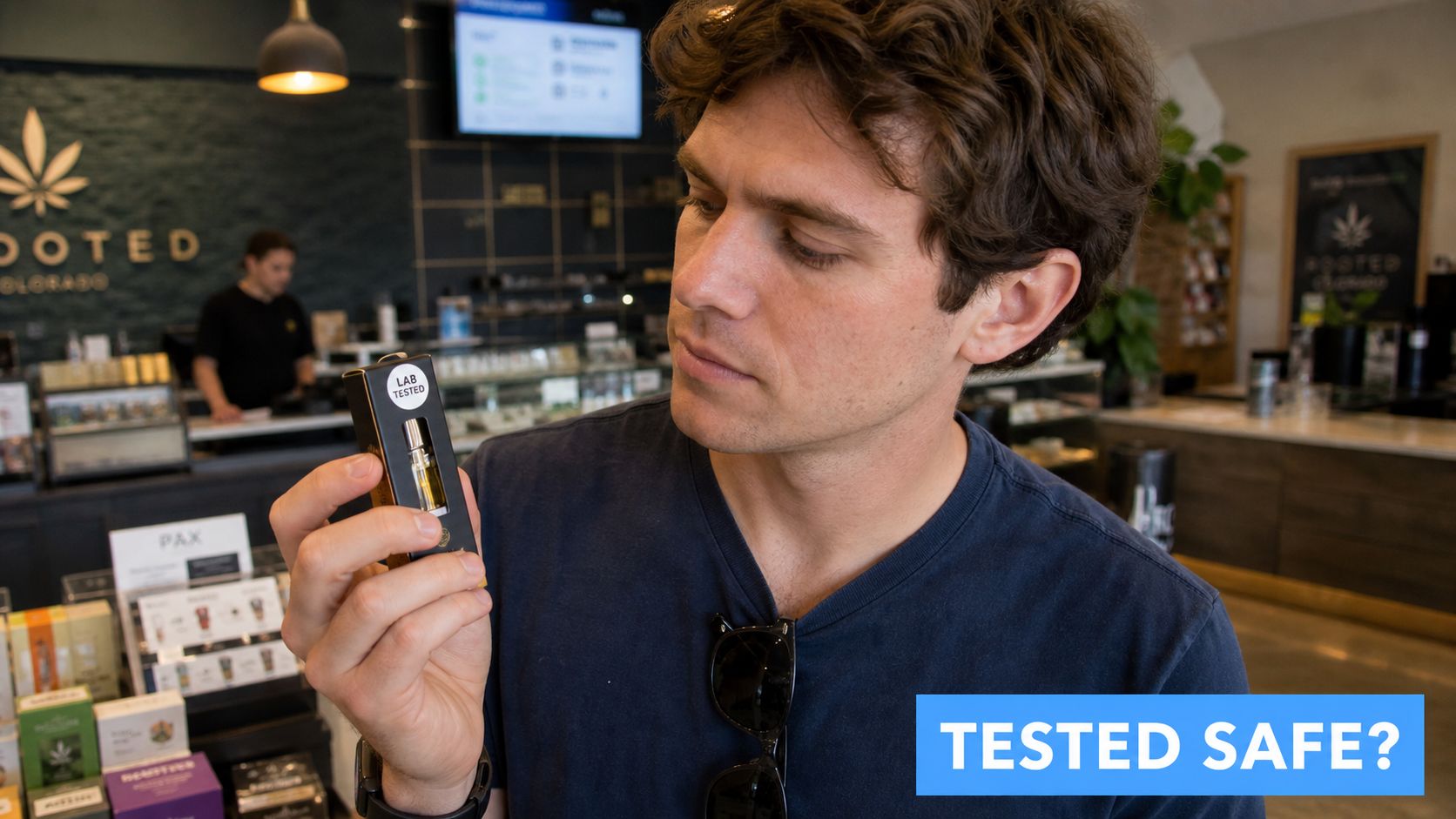
You're standing at a dispensary counter, holding a sleek vape cartridge or a jar of premium flower. The package says “lab tested,” the THC number looks impressive, and everything appears polished. Then you pause. What does that sticker guarantee, and how can you tell whether the report behind it belongs to the product in your hand?
That question matters because cannabis lab testing is more than a potency check. Licensed markets use independent laboratory analysis to screen for pesticides, heavy metals, residual solvents, microorganisms, mycotoxins, and labeling accuracy. A product can look, smell, and package beautifully while still failing an analytical safety threshold.
A Certificate of Analysis, or COA, gives you a way to look past the marketing. It can show whether the batch number matches, whether the laboratory tested the right product type, and whether the report covers the hazards that matter for flower, vapes, concentrates, edibles, or topicals. The practical skill isn't memorizing chemistry. It's learning which details deserve your attention before you buy.
Why Cannabis Lab Testing Matters More Than Ever
A customer comparing products from brands such as Alien Labs, MFNY, Rythm, or Wyld may begin with flavor, format, and THC percentage. Those details help, but they don't answer the safety question. A lab-tested sticker is only useful when it connects to a current, batch-specific report from a qualified laboratory.
Legal cannabis testing developed to address risks that visual inspection can't catch. A flower jar may have no obvious signs of pesticide residue or heavy metals. A concentrate may look clean even when residual solvents require investigation. California's Department of Cannabis Control says testing laboratories verify that cannabis goods are free of contaminants and accurately labeled for cannabinoids and terpenes, with required panels covering pesticides, heavy metals, microbial impurities, mycotoxins, moisture content, water activity, and foreign material. California's testing laboratory guidance shows how broad the safety review can be.
Potency affects real decisions
THC accuracy matters because people use the label to decide how much to consume. A new customer may choose a lower-potency product, while a medical user may need consistent dosing from one purchase to the next. If the listed number and the tested result differ, the gap can affect expectations and consumption choices.
Regulators have recognized that cannabis is a heterogeneous plant, so some variance is built into testing. Maryland's technical authority states that a ±10% potency variance is accepted because of plant heterogeneity. Maryland's technical authority document explains why a result isn't necessarily suspicious because it doesn't duplicate the package claim.
Testing is a trust system, not a decoration
A 2022 peer-reviewed comparison found that 36 U.S. states plus the District of Columbia regulated 679 distinct cannabis contaminants, including 551 pesticides, 74 solvents, 12 inorganics, 21 microbes, 5 mycotoxins, and 16 other contaminants. The peer-reviewed comparison puts the modern testing burden in perspective. Legal cannabis isn't just being checked for strength.
Practical rule: Treat “lab tested” as an invitation to inspect the COA, not as a substitute for inspecting it.
That mindset also helps distinguish regulated products from items carrying unsupported claims or copied packaging. Whether you're shopping for a Harney Brothers Cannabis product, a Jetty vape, a Kiva edible, or a local delivery order, a verifiable report is the baseline for informed purchasing.
The Six Core Tests Every Product Should Pass
A useful way to approach a COA is to treat it like a guided inspection. Start with what the product contains, then check what could make it unsafe.
1. Potency testing
Chromatography methods such as LC-UV and LC-DAD measure cannabinoids in flower, oils, concentrates, and other matrices. The potency panel may list THC, THCA, CBD, CBDA, CBN, CBG, and additional cannabinoids.
For a consumer, the important distinction is between a reported cannabinoid value and the label claim. Potency testing helps establish whether the package communicates a reasonably accurate strength, which supports more predictable dosing. A passing result should sit within the jurisdiction's permitted acceptance range.
2. Terpene profiling
Terpenes help describe aroma and flavor. A profile may identify compounds associated with citrus, pine, pepper, floral, or earthy notes, giving you more information than a strain name alone.
Terpene testing isn't the same as a contaminant screen. It's a quality and identity tool that can help you compare products with similar THC levels but different sensory profiles. A missing terpene panel isn't automatically proof that a product is unsafe, but it gives you less information about what you're buying.
3. Pesticide screening
Pesticide analysis looks for agricultural chemicals that may remain on cannabis. That matters particularly for inhaled products, because consumers aren't evaluating exposure through appearance alone.
A passing result means the detected compounds are absent or below the applicable action limits. California's rules illustrate how strict these requirements can be. The state has required testing for more than 100 contaminants, including 66 pesticides with tolerance levels lower than those allowed for other agricultural products in the state. The review of cannabis testing policy describes that regulatory direction.
4. Heavy metals analysis
Cannabis can take up contaminants from growing media, water, or soil. Laboratories commonly screen for arsenic, cadmium, lead, and mercury, then compare results with regulatory limits.
A passing heavy-metals panel doesn't mean the plant contains none of these elements in an absolute sense. It means the result meets the relevant threshold under the testing framework. That's why the report's action level and detection limit deserve a glance.
5. Residual solvents testing
Manufacturers may use solvents such as butane, hexane, heptane, or ethanol while producing extracts. Residual-solvent testing checks whether unwanted traces remain in the finished concentrate or vape product.
A result marked pass means the tested sample complies with the applicable limit. Colorado's rules require testing for potency, residual solvents including butane, hexane, heptane, and BTX, and microorganisms including E. coli, Salmonella, yeast, and mold. Colorado testing guidance shows why extract shoppers shouldn't treat a high cannabinoid number as the whole quality story.
6. Microbial contaminants and mycotoxins
Microbial analysis looks for hazards such as mold, yeast, E. coli, and Salmonella. Mycotoxin testing looks for toxic compounds that some fungi can produce.
These checks are especially important for medical users and people with compromised immune systems. A product that has been sterilized isn't automatically free from every fungal hazard. A McGill study reported that gamma irradiation didn't fully eliminate toxic fungi or their chemical residues, and that current practices may miss risks for immunocompromised users. McGill's report on irradiated cannabis is a useful reminder that compliance testing and complete health protection aren't identical.
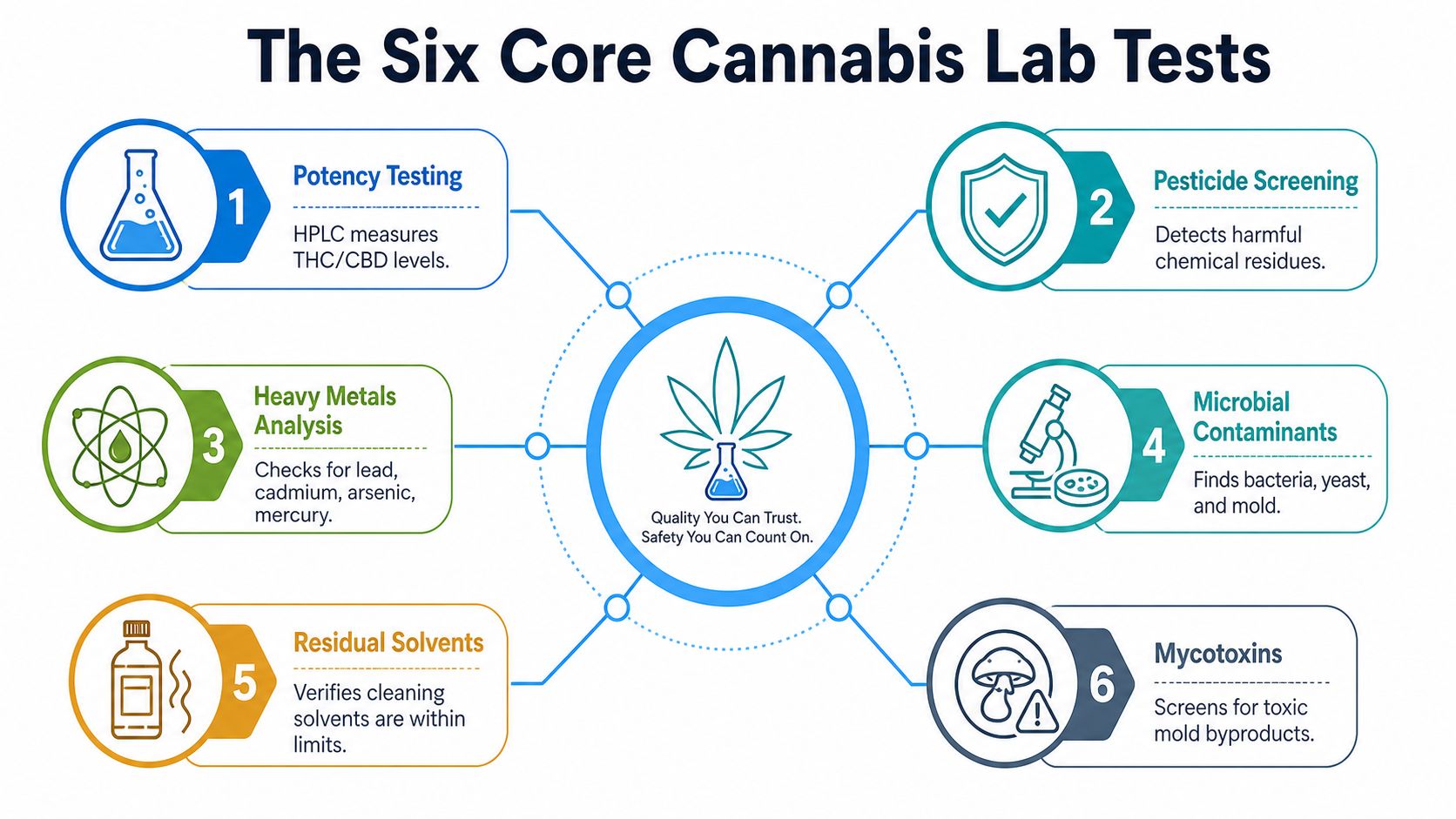
The four-part contaminant foundation is generally pesticides, residual solvents, microbiological impurities, and heavy metals, with stability testing also tracking microorganisms and potency for shelf-life decisions. Maryland's 2025 technical authority reflects the practical split: potency is a quantitative quality attribute, while contaminant screening acts as the main consumer-safety gate.
How to Read a Certificate of Analysis Like a Pro
A COA becomes much less intimidating when you read it from the top down. Don't jump straight to the THC percentage. First confirm that the document belongs to the exact product and batch you're holding.
Start with identity fields
Look for the product name, product type, batch or lot ID, sample ID, sample date, test date, laboratory name, and laboratory license information. Compare the batch or lot number with the package. A report for a different lot isn't evidence about your item, even if the brand name and product name match.
Then check whether the lab tested a comparable matrix. A flower report shouldn't be used to validate a filled vape cartridge, and a concentrate report shouldn't stand in for an edible.
Read the cannabinoid panel carefully
The panel may separate delta-9 THC from THCA. THCA is the acidic form that can convert into THC when heated, so the report may also show total THC as a calculated value. Focus on the value the jurisdiction uses for labeling and enforcement, rather than assuming the largest number on the page tells the whole story.
Massachusetts has used a 75% to 125% acceptance band around labeled THC content. Under that approach, a product labeled at 15% THC could test between 11.25% and 18.75% total THC and still fall within the stated range. The AOAC-referenced harmonization guide provides that example and explains why method consistency matters.
New York's current testing limits specify a 90% to 110% labeled potency variance, with an additional ±2% laboratory variability potentially applied to products containing less than 5 mg of total THC or CBD per dose or serving. New York's OCM testing limits show why the governing state matters when you interpret a result.
Scan the safety pages
Find the pesticide, heavy-metals, residual-solvents, microbial, mycotoxin, and other required panels. Check whether each category says pass, not detected, or provides a result below the action level. A detection limit tells you what the method could identify, while an action level tells you the threshold used for a compliance decision. Those aren't interchangeable terms.
If you enjoy organizing technical information, a resource on science note-taking with Verbex can help you build a consistent way to compare reports. You can also review what full-spectrum cannabis means when connecting a cannabinoid and terpene profile with the product format.
| COA Element | Green Light, Trustworthy | Red Flag, Proceed with Caution |
|---|---|---|
| Product identity | Product, matrix, batch, and lot details match the package | Batch number is missing or doesn't match |
| Laboratory | Named independent lab with license information | Lab identity or licensing is unclear |
| Dates | Sample and test dates are clear and relevant to the product | COA appears expired or undated |
| Potency | Result sits within the applicable acceptance range | Suspiciously round numbers with no method details |
| Safety panels | Required categories show results and pass status | Major categories are absent |
| Traceability | Report can be verified through a brand, retailer, or regulator | Recycled document or generic QR code |
A reputable dispensary should be able to provide a full COA when you ask. If the staff can only show a sticker or a cropped potency screenshot, keep asking for the complete batch-specific report.
New York Testing Standards and What They Mean for Long Island Shoppers
New York shoppers don't operate under one universal national testing rule. The Office of Cannabis Management framework applies to products sold through the state's regulated adult-use system, while California, Colorado, and Michigan use their own agencies, action levels, sampling procedures, and laboratory requirements.
The most practical difference is that state minimums are a floor. They define what a product must meet before sale, but they don't eliminate the need to inspect the report, packaging, batch identity, and handling history.
A side-by-side view
| Test Category | New York, OCM | California, BCC | Colorado, MED | Michigan, CRA |
|---|---|---|---|---|
| Potency | Labeled potency variance of 90% to 110%, with an additional ±2% laboratory variability provision for certain products below 5 mg per dose or serving | Testing verifies accurate cannabinoid and terpene labeling | Retail products require cannabinoid potency testing | Requirements depend on the applicable product and state framework |
| Pesticides | State-defined testing limits apply | Required pesticide panel | Required contaminant testing | State-defined contaminant testing applies |
| Heavy metals | State-defined limits apply | Required heavy-metals testing | Required contaminant testing | State-defined contaminant testing applies |
| Microbial hazards | Microbial and pathogen requirements apply under OCM rules | Microbial impurities and mycotoxins are included in required panels | E. coli, Salmonella, yeast, and mold are included | Testing requirements apply under CRA rules |
| Residual solvents | Extract and vape products are evaluated under applicable limits | Required where relevant to the product | Butane, hexane, heptane, and BTX are listed among required solvent checks | Product-specific testing requirements apply |
The table gives you the framework, not a shortcut. Limits can change, and the product category affects which panels apply. For a deeper look at the role of product testing standards, compare the report itself with current OCM information rather than relying on a brand's summary.
What this means on Long Island
At a licensed New York retailer, the product should move through the state's regulated supply chain and be associated with an OCM-compliant testing process. An item from an unregulated source may use the same words, colors, or QR-code style without offering the same traceability.
Hemp-derived cannabinoid products can fall under a different regulatory framework from New York adult-use cannabis. Don't assume that a hemp vape and a licensed adult-use vape have identical testing obligations. Ask which framework applies, who tested the product, and whether the report covers safety contaminants rather than potency alone.
When Lab Tested Does Not Actually Mean Safe
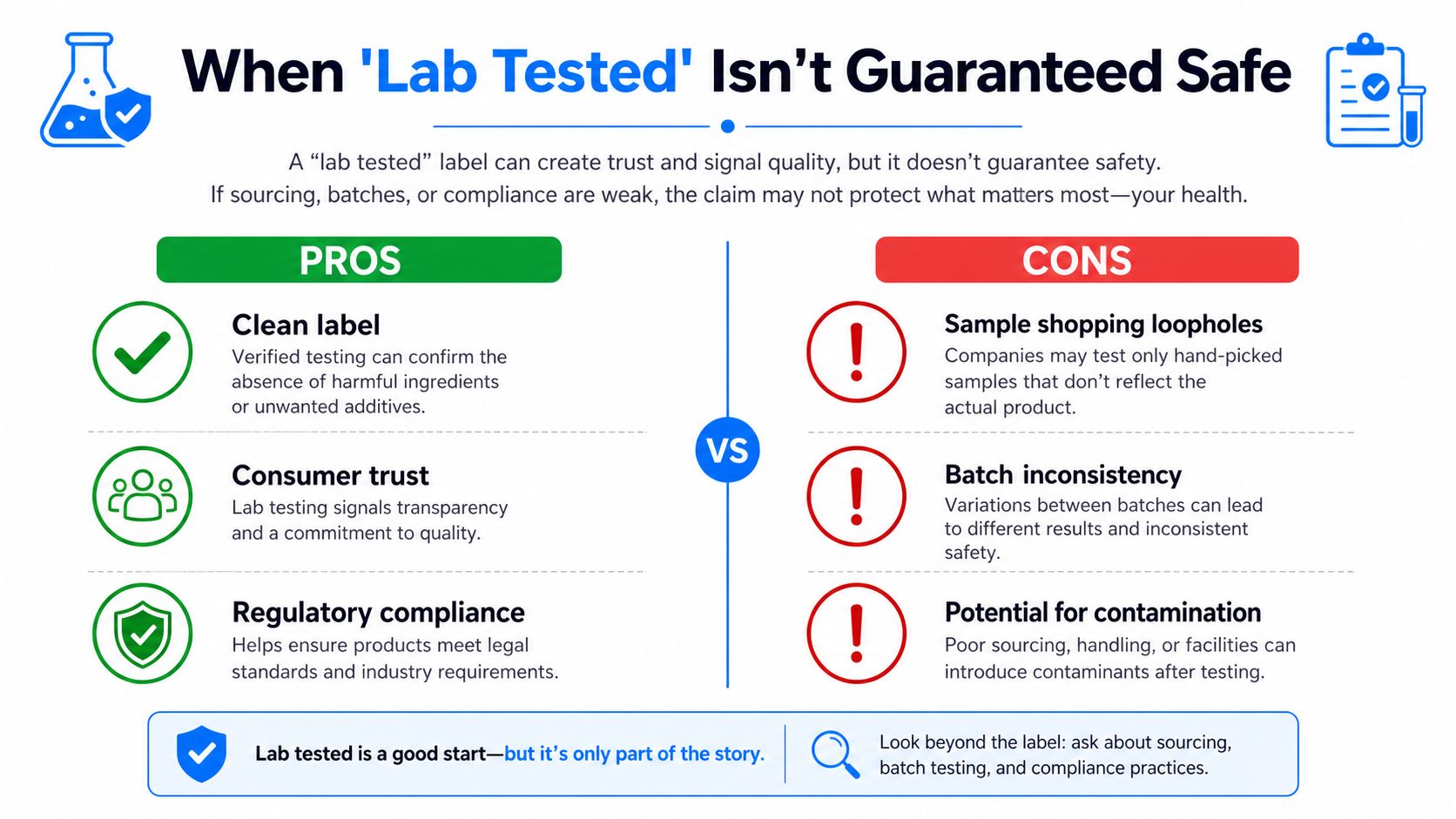
A lab-tested label can create false confidence when shoppers treat it as a complete guarantee. Testing only tells you what the laboratory found in the sample submitted under the documented conditions. It doesn't automatically prove that every unit in a large inventory is identical to that sample.
Several weak practices can undermine that connection. Sample shopping occurs when an operator submits a cleaner sample while selling material from a broader, less consistent inventory under the same product identity. Lab shopping can also create concern when a company seeks a laboratory perceived as more permissive or less rigorous.
Forged COAs, reused batch numbers, and copied documents create a second problem. A QR code may open a real-looking PDF while the batch number on the package points to an unrelated product. A polished report isn't enough if the identifiers don't line up.
The sample is only one moment
Contamination can enter after testing through packaging, transport, storage, or handling. A passing report can't predict every event that occurs after the laboratory receives the sample. Stability testing helps evaluate shelf-life conditions by tracking potency and microorganisms, but shoppers still need to inspect package integrity and dates.
The same caution applies to products marketed as hemp-derived delta-8 or synthetic cannabinoid alternatives. A sticker that confirms potency doesn't necessarily show that the product received a full safety panel for pesticides, heavy metals, solvents, microbes, and mycotoxins. If you're comparing a tincture, vape, or topical such as a CBD relief cream, ask what the report tested.
A passing COA is evidence about a documented sample. It isn't permission to ignore the batch number, test categories, or product history.
For medical users and immunocompromised consumers, that distinction deserves extra attention. The McGill findings discussed earlier show why sterilization and routine screening shouldn't be treated as interchangeable with complete protection.
How Strong Strains Ensures Every Product Is Verified
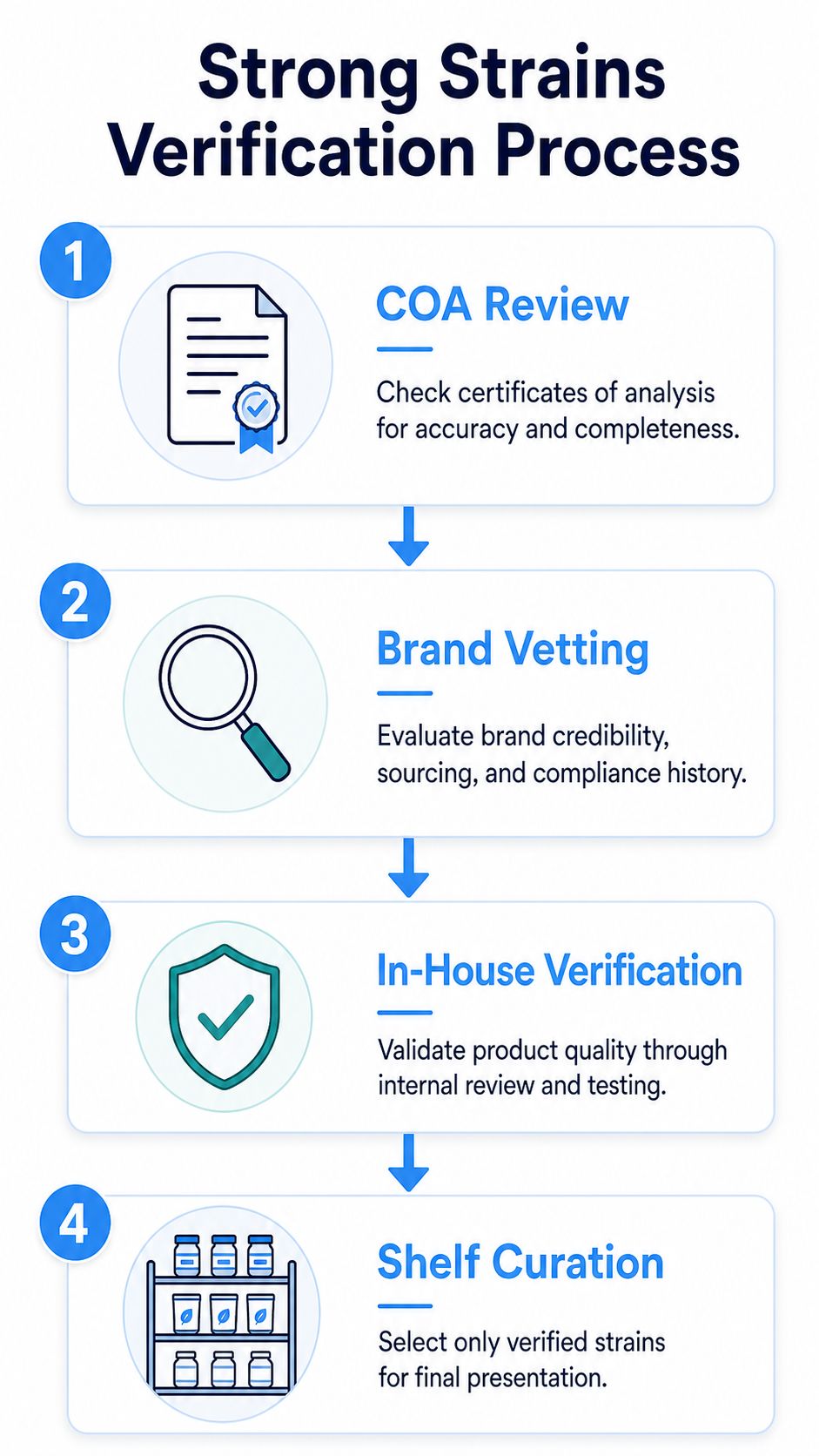
Strong Strains Cannabis Dispensary uses a verification process built around documentation rather than the phrase “lab tested” alone. Before a product reaches the menu, the team reviews the available full-panel COA, confirms the product and batch identity, and checks whether the report covers the tests appropriate to that format.
That review looks beyond a single THC number. Staff can examine cannabinoid and terpene information, contaminant results, laboratory details, dates, and the relationship between the report and the package. A vape cartridge, flower jar, concentrate, edible, or topical shouldn't be evaluated as though every product has the same testing needs.
Verification continues after onboarding
A product doesn't become permanently approved because one report passed. If a manufacturer issues a recall or a later retest fails, the affected inventory can be pulled from the shelf while the issue is reviewed. That ongoing attention matters because a COA is tied to a batch and a point in the supply chain.
Budtenders also help customers read the documentation at the counter. A shopper can ask why total THC differs from delta-9 THC, what a “not detected” result means, or whether the listed batch matches the package. The goal is a conversation that makes the report usable, not a handoff that leaves the customer to decode it alone.
Brand quality still deserves scrutiny
Brands with structured quality programs can complement state-mandated testing. That includes manufacturers and cultivators whose documentation, production controls, and batch records are easy to review. Customers may encounter names such as Connected, Cookies, Good Green, Heavy Hitters, Jetty, MFNY, Papa & Barkley, Pax, Preferred Gardens, Rove, Stone Road, Turn, Wana, and Wyld, but the brand name itself shouldn't replace a current COA.
Strong Strains treats verification as an ongoing relationship with suppliers. That approach gives Long Island shoppers a practical defense against the gaps that appear when a retailer relies on a sticker, a product reputation, or a single old report.
Your Shopper Checklist for Choosing Safe Cannabis
Use this checklist whether you're buying flower in a Long Island dispensary, picking up a cartridge, ordering delivery, or comparing products from brands such as Ayrloom, Camino, Kiva, Lost Farm, Plug Play, or Rythm.
Match the batch first. Find the lot or batch number on the package and compare it with the COA. If those identifiers differ, stop there and request the correct report.
Confirm the product type. Make sure the report describes the item you're buying. Flower, concentrates, filled cartridges, edibles, tinctures, and topicals can require different analytical considerations.
Check the dates. Look for sample and test dates, then inspect the package for harvest, manufacture, or expiration information where provided. A stale report may not describe the condition of the product today.
Read total potency, not just the biggest number. Separate delta-9 THC, THCA, CBD, and total THC. Use the applicable New York acceptance rules rather than comparing a result with a different state's standard.
Verify the safety panels. Look for pesticides, heavy metals, residual solvents, microbial contaminants, and mycotoxins where applicable. Stability information can add useful context for shelf-life and storage.
Inspect the laboratory details. Confirm the lab name, license information, sample identifiers, methods, detection limits, and pass or fail results. You can also cross-reference the laboratory with New York's approved or licensed laboratory information.
Question unusually tidy numbers. A perfectly round potency figure isn't proof of fraud, but it deserves more scrutiny when the report lacks method details, sampling information, or a clear batch connection.
Examine the package. Reject damaged, leaking, opened, or poorly labeled products. Packaging can't reveal every contaminant, but it can reveal handling and traceability problems.
Ask direct questions. Request the full COA, not just a summary sticker. Ask which lab performed the work, whether the report is batch-specific, and which tests apply to that product.
Learning from an old school grower at a modern dispensary can also help you appreciate why cultivation, curing, extraction, sampling, and storage all affect the final product. Non-negotiable checks include a matching batch number, an identifiable laboratory, current documentation, and passing safety results. Nice-to-have indicators include a detailed terpene profile, transparent methods, clear storage guidance, and staff who can explain the report without evasion.
Strong Strains Cannabis Dispensary offers independently tested flower, vapes, pre-rolls, edibles, concentrates, tinctures, topicals, and accessories with in-store pickup and local delivery options. Visit Strong Strains Cannabis Dispensary in East Setauket, ask the team to walk through a current COA, and choose your next product with the batch details in view.