
You're standing at a Long Island dispensary with two pre-rolls in front of you. One is a $5 single, the other is $15, and both labels promise a satisfying session. The cheaper joint could be a smart everyday buy, or it could be dry, unevenly packed, and weaker than its THC number suggests.
That's the core question behind cheap pre rolls. Most shoppers aren't looking only for the lowest sticker price. They want the lowest cost for a useful dose, or the best experience they can get without crossing a personal budget. The shelf rarely makes that comparison easy, especially when one package lists whole flower, another says trim, and a third is an infused product.
A good budget buy starts with evidence, not flashy packaging. You'll want to check the flower source, batch information, test results, grind, moisture, and format before deciding whether the low price represents efficient production or a product that has been sitting too long.
What Shoppers Actually Mean When They Search for Cheap Pre Rolls
The shopper picks up the $5 joint first. It feels light, but the package says it contains a full gram. The label shows a high THC figure, yet there's no obvious harvest date and the QR code leads to a general brand page instead of a certificate of analysis.
Next to it, the $15 pre-roll has a clearer batch number, a recent pack date, and a whole-flower description. It costs more, but the shopper still wonders whether the difference is quality or branding. That decision comes up every day because pre-rolls now occupy a large, competitive part of legal cannabis retail. In 2025, the category reached about $3.6 billion in sales, more than 383 million units, and a 15.9% market share, while the average price reached $9.31, down 6.6% year over year and nearly 20% from the 2022 peak of $11.70 (Cannabis Industry Journal).
Those numbers explain why a $5 joint can appear beside a premium product without being unusual. Mature markets sometimes offer mass-market singles for roughly $2 to $4, while broader pre-roll prices can range from $5 to $30 depending on market, strain, flower amount, quality, and infusion (Weedmaps' pre-roll guide; THC The Herbal Care pricing guide).
Three meanings of “cheap”
A buyer may be asking for:
- The lowest upfront price: A single is easier to purchase when you're testing a strain or watching your spending.
- The lowest cost per THC milligram: A larger or more potent product may look cheaper after adjusting for labeled potency, though the label still needs independent verification.
- The best experience under a budget: A slightly more expensive whole-flower joint may burn better and feel more satisfying than a bargain trim roll.
The everyday complaints are familiar. A pre-roll can be too dry, packed like a pencil, loosely filled, harsh, or inconsistent from first puff to last. A cheap product also may be old inventory rather than a deliberately efficient value product.
If you're comparing regular and infused formats, review this guide to how infused pre-rolls differ from standard joints. Infusion can change both the price and the intensity, so it shouldn't be compared with a basic flower-only single as if they were identical products.
What Goes Into the Price of a Pre-Roll
A pre-roll's price reflects more than the cannabis inside the cone. The producer is also paying for the paper and filter, filling and quality-control labor, packaging, labels, required testing, and any concentrate used in an infused format.
Flower source usually creates the biggest visible difference. A product made from trimmed material or shake can cost less than one made from recognizable whole flower, but the lower input cost doesn't automatically mean the finished joint is bad. Efficient grinding, careful sifting, consistent filling, and good storage can turn lower-cost material into a serviceable product.
The main cost categories
| Component | Typical Cost Range | Impact on Final Price |
|---|---|---|
| Flower source | Varies by trim, shake, or whole flower | Usually the largest quality and price variable |
| Cone and filter | Varies by paper and construction | Affects draw, burn, waste, and manufacturing consistency |
| Infusion | Varies by concentrate and recipe | Raises the product tier and changes the expected experience |
| Packaging | Varies by tube, box, label, and compliance features | Adds protection, shelf life support, and regulatory information |
| Testing and documentation | Varies by market and required panels | Supports legal sale and gives shoppers evidence about potency and contaminants |
| Labor and quality control | Varies by filling method and inspection process | Pays for accurate filling, sealing, labeling, and rejection of defective units |
The table uses qualitative cost categories because production expenses differ sharply by state, supplier, batch size, and format. A cheap pre-roll can come from savings on unnecessary presentation, efficient production, or lower-cost flower. Those are different from cutting corners on testing, accurate weight, packaging integrity, or storage.
The market's price decline shows how competition affects the shelf. Tracked U.S. markets saw average pre-roll pricing fall from $7.80 in January 2023 to $6.50 in June 2024, a 16.7% decrease, while another analysis placed the 2025 average at $9.29, down from $9.96 in 2024, with an equalized price per gram of about $5.93 (Cannabis Business Times).
A useful distinction: Lower price is acceptable when the producer saves on branding, format, or scale. It becomes a warning sign when the savings appear in missing testing, vague labeling, stale flower, or unreliable filling.
Infused products and multipacks also complicate comparisons. In 2025, infused pre-rolls represented nearly 47% of category revenue, and multipacks accounted for 48.5% of SKUs (Forbes). A budget multipack may offer a lower unit price, but it can be a poor value if you won't finish it while the flower is fresh.
How to Tell If a Budget Pre-Roll Is Worth Buying
You can screen a budget pre-roll quickly if you know where to look. Start with the package, not the brand name or the largest THC figure.
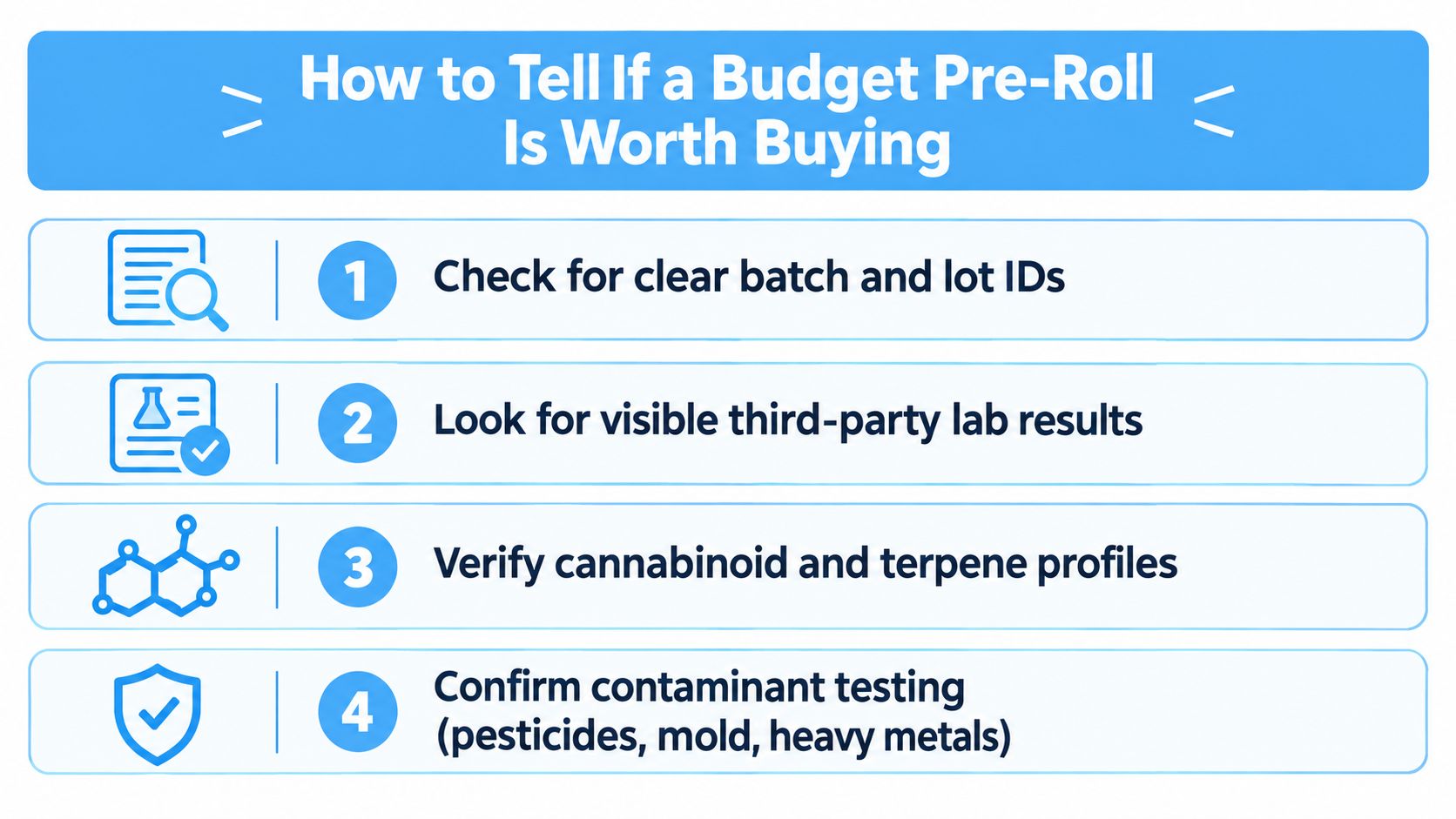
Read the package like a quality-control document
Look for a batch or lot ID that connects the product to a specific production run. A clear pack date helps you judge freshness, while a harvest date can provide more context when the label includes it. The information should be specific enough for a budtender or retailer to trace the product.
A QR code is useful only if it leads somewhere meaningful. Ideally, it should connect to a certificate of analysis with cannabinoid results and contaminant panels. Those panels may cover pesticides, mold, heavy metals, and other required checks. For a deeper explanation of what testing documents mean, use this guide to cannabis lab testing.
Use the label as a starting point, not a promise
Potency numbers deserve skepticism when the rest of the package is unclear. A 2022 Anresco test of seven California preroll brands included nine products, and every tested product came in below its labeled THC, with implied inflation ranging from 14% to more than 500% (Anresco's California preroll testing report). A Colorado experiment reported by MJBizDaily found four of five tested pre-rolls more than 15% below label, with an average THC variance of 28% (MJBizDaily).
That doesn't mean every inexpensive product is inaccurately labeled. It means the label alone can't tell you how much you'll experience.
Green flags include:
- Clear identifiers: Batch, lot, pack, and product information are easy to find.
- Accessible lab results: The QR code leads to a specific certificate of analysis.
- Complete panels: The documentation covers cannabinoids and relevant contaminants.
- Protected packaging: The tube or pack is sealed and includes appropriate product information.
- Sound physical condition: The cone has a slight give and doesn't feel rock-hard or hollow.
Red flags include:
- Vague potency claims: The package highlights strength without useful batch details.
- Broken construction: The cone is split, leaking flower, crushed, or visibly re-rolled.
- Extreme dryness: The joint feels brittle, dusty, or hard enough to crackle when handled.
- Unconvincing weight: A claimed full-size joint feels unusually light or poorly filled.
- Missing documentation: There's no usable QR code or no certificate tied to the product.
Before checkout, ask yourself: Can I identify the batch? Can I find the test results? Does the packaging look intact? Does the joint feel evenly filled? If the answers are mostly yes, the low price may reflect a sensible value tier rather than a defective product.
Trim Rolls Versus Whole-Flower Budget Joints
A trim-based pre-roll and a budget whole-flower pre-roll can look nearly identical through a sealed tube. Inside, they may burn and taste very differently.
Trim consists of smaller leaves and leftover plant material collected during flower processing. Shake is the loose material that separates from buds during handling. Whole flower starts with more recognizable buds before grinding. You can learn more about the material itself in this explanation of what ground flower means.
The practical differences
| Factor | Trim Roll | Budget Whole-Flower |
|---|---|---|
| Starting material | Lower-cost trim, shake, or a blend | Ground buds or a higher whole-flower share |
| Burn | May burn quickly or unevenly | More likely to provide a steady burn when packed well |
| Flavor | Can taste flatter or harsher | More likely to carry recognizable strain character |
| Potency experience | May feel less consistent through the joint | Usually offers a more uniform material profile |
| Best use | Casual group session or low-commitment purchase | Solo use or a small group seeking better consistency |
Trim and shake have more exposed surface area after grinding. That can make them dry faster and burn hotter, especially if the material was already brittle. Uneven particles can also create air pockets, leading to canoeing or a joint that races on one side.
Whole flower isn't automatically excellent. A poorly milled, stale whole-flower joint can still disappoint. The advantage is that the starting material often gives the producer more recognizable resin and terpene character to preserve, provided the flower was cured and stored properly.
The label matters, too. In regulated markets, products made from trim should be identified as trim products. Read the product description instead of assuming a premium-sounding strain name means the cone contains intact, high-grade buds.
Buying rule: Choose trim rolls when the session is casual and the price matters most. Choose a well-documented whole-flower single when you're using it alone and want the most dependable experience from the material you're paying for.
The same THC percentage can appear on both products, but percentage doesn't describe grind uniformity, terpene carry-through, or burn behavior. A slightly lower-labeled whole-flower joint may provide better practical value if it burns evenly and delivers a more consistent effect.
Why Burn Quality and Freshness Matter More Than the Label
A pre-roll's printed potency can't rescue flower that was packed too tightly, ground poorly, or dried beyond its useful range. Moisture, particle size, and packing density determine how air moves through the joint and how heat reaches the material.
Cannabis flower typically contains about 6% to 15% moisture, with around 9% considered suitable for automated pre-roll filling. Another industry source identifies roughly 8% to 12% as an optimal moisture range for clean grinding and consistent handling (Custom Cones USA smokability research).
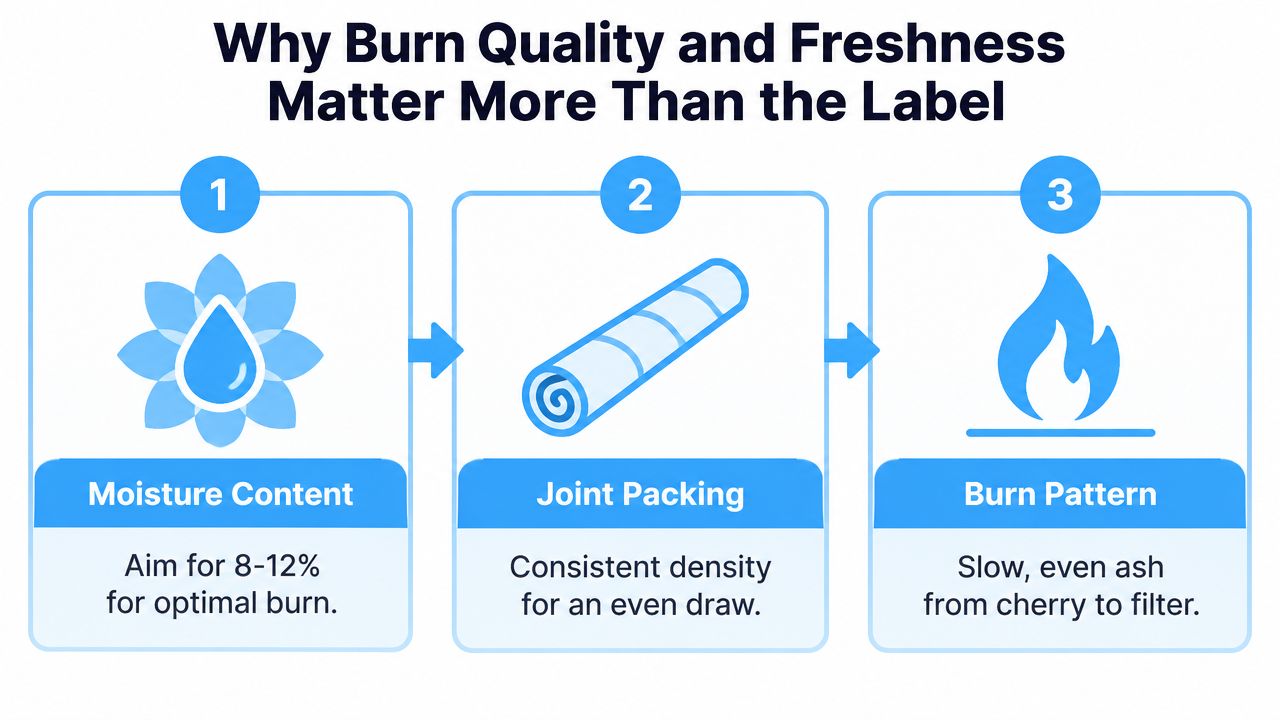
Three checks that predict the session
Moisture comes first. Flower that's too dry becomes brittle and dusty, which can cause poor grinding and terpene loss. Flower that's too moist may resist grinding and burn unevenly. You can't measure moisture accurately with your fingers, but you can notice whether the joint feels fragile, powdery, or unusually stiff.
Packing controls airflow. A loose cone may burn rapidly and waste material. An overpacked cone can be difficult to draw and may extinguish repeatedly. The best budget products still require consistent density from the tip through the body of the joint.
Burn pattern reveals the manufacturing result. A steady cherry and even ash suggest that the material and cone are working together. A joint that runs down one side, produces repeated crackling, or burns painfully hot deserves a lower value assessment, regardless of the THC number.
Particle size can change delivered cannabinoids dramatically. In an independent study summarized by StratCann, 1-mm and 3-mm ground cannabis in half-gram joints delivered about 16 to 19 mg THC per pre-roll, while 5-mm particles delivered about 28 mg THC. The first puff contained the least cannabinoids, and delivery rose roughly 50% from the first puff to the middle for the smaller particles, compared with about 500% for the 5-mm samples (StratCann's pre-roll grind study summary).
That's why a cheap joint made with coarse or uneven material can feel inconsistent from beginning to end. Freshness and grind quality affect the dose you receive, not just the flavor.
Singles, Multipacks, or DIY Which Actually Saves Money
The cheapest-looking option isn't always the lowest-cost way to use cannabis. Your frequency, tolerance, storage habits, and willingness to prepare a joint all matter.
Consider three common paths. A single costs $8. A five-pack costs $30, which works out to $6 each. Rolling your own from an $25 eighth produces a raw flower cost of about $3.13 per joint before papers, filters, time, and equipment. These examples are arithmetic based on the stated purchase prices, not a promise that every dispensary will use them.
Comparing the formats
| Option | Unit Cost | Cost Per Joint | Best For |
|---|---|---|---|
| Single | $8 | $8 | Testing a strain without a larger commitment |
| Five-pack | $30 | $30 per pack | Regular users who can keep the pack fresh |
| DIY from an eighth | $25 | About $3.13 before supplies | Shoppers who already own tools and roll regularly |
A single gives you control over commitment. If you're unfamiliar with a strain, it lets you evaluate the burn and effects before buying more. It also avoids opening a multipack that may sit unused.
A multipack generally wins on sticker price per joint, but only if you use it while the contents remain fresh. It can also simplify portioning because every joint is prepared consistently. Check whether each pre-roll is individually protected or whether opening the pack exposes the remaining joints to air.
DIY offers the lowest raw flower cost in this example, but it shifts the work to you. You need papers, filters, a grinder, storage, and enough time to prepare a consistent joint. You also gain control over the strain and amount, while giving up the convenience of a ready-to-use product.
Best-value shortcut: Buy a multipack for routine use, a single for exploration, and DIY when rolling is already part of your regular setup.
For someone using cannabis a few times weekly, freshness can matter more than the lowest theoretical unit cost. A cheaper product that sits open and dries out may deliver less satisfaction than a slightly more expensive format you finish promptly.
Smart Ways to Save at a Local Dispensary Without Sacrificing Quality
Budget shopping works better when you ask targeted questions. A budtender can often explain why one pre-roll is discounted, whether a product is trim-based, and which options have recently arrived.
Start with three questions:
- Which budget singles are on promotion today?
- Which strains are priced lowest this week, and why?
- Do your house or unbranded rolls have the same batch documentation and testing information as labeled products?
The third question matters because a lower-profile package isn't automatically lower quality. The paperwork, freshness, and construction tell you more than the logo.
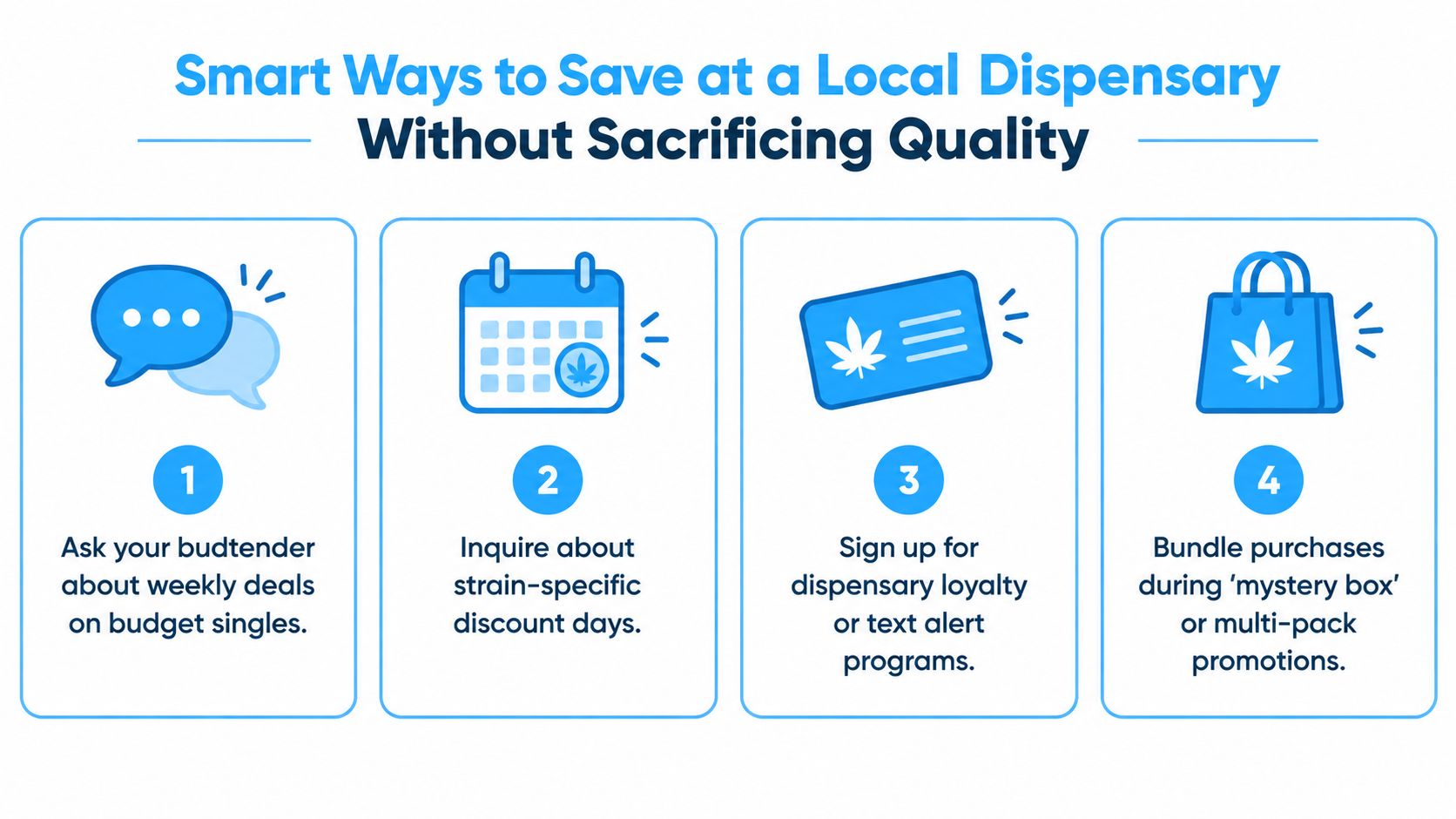
Build a repeatable savings routine
Use loyalty programs strategically. Points earned on lower-priced purchases can still reduce the cost of future pre-rolls. Ask whether the store offers birthday bonuses or member-only flash sales, and check the redemption rules before assuming points can be combined with other discounts.
Watch direct alerts. Newsletters and SMS programs often announce rotating deals before shoppers notice them on a public menu. Social media can also surface same-day clearance posts, but verify the product's pack date and test documentation before buying purely because the price dropped.
Compare bundles by usable value. A five-pack discounted by 15% can beat a full-price single on a per-gram basis when the flower is fresh and you'll finish the pack promptly. The discount doesn't make sense if the multipack contains stale inventory or a format that doesn't suit your use.
Ask about timing. Midweek restocks, holiday weekends, and recurring day-of-week promotions can change which budget options are available. Don't wait for a discount if the current product has strong documentation and fresh packaging, but do ask when the next restock or promotion is expected.
Brands such as 1937, &Shine, Good Green, Jeeter, Kiva, Rove, Rythm, Stiiizy, Stone Road, and Turn may appear in different markets and product tiers, but a familiar name shouldn't replace package-level checking. The same shelf can also include multipacks, infused products, and regular flower-only singles, so compare like with like.
For shoppers on Long Island, Strong Strains Cannabis Dispensary offers individual and multipack pre-rolls, along with in-store pickup and local delivery. Ask the staff to compare current budget options by format, freshness, testing information, and intended session rather than choosing by THC percentage alone.
At the counter, bring one budget single and one multipack option to the budtender, then ask about batch dates, lab results, flower source, and current loyalty pricing. Visit Strong Strains Cannabis Dispensary to compare lab-tested pre-rolls and get practical guidance on choosing a fresh, fairly priced product for your next session.