
You're standing at a dispensary counter in East Setauket with a tincture bottle in one hand, a vape cartridge in the other, and a jar of gummies beside them. All three may be described as cannabis oil, yet they can feel completely different because the oil is delivered through different routes, with different cannabinoid ratios, absorption patterns, and timing. That confusion is common, especially for adults who want measured relief without guessing their way through a strong product.
The useful question isn't, “What are cannabis oil uses?” It's which oil format fits your goal, how quickly you need it, and how carefully you want to control the dose. The guide below separates practical uses from overhyped promises, using current medical evidence and the kind of shelf-level details a knowledgeable budtender would explain before you buy.
What Cannabis Oil Actually Is and Who Uses It
Cannabis oil is a family of concentrated extracts, not one uniform product. Manufacturers extract cannabinoids such as THC and CBD, with varying amounts of terpenes, from cannabis flower or trim. The extract may become distillate, retain more of the plant profile as full-spectrum oil, isolate one cannabinoid, or be diluted with a carrier such as MCT, olive, or grapeseed oil.
The label “oil” can describe several shelf formats. A tincture is measured under the tongue or added to food. A vape cartridge heats the extract for inhalation. A capsule places the same general ingredient in a swallowed format, while a topical applies it to the skin. The route changes how quickly effects appear, how long they may last, and how easy the dose is to repeat.
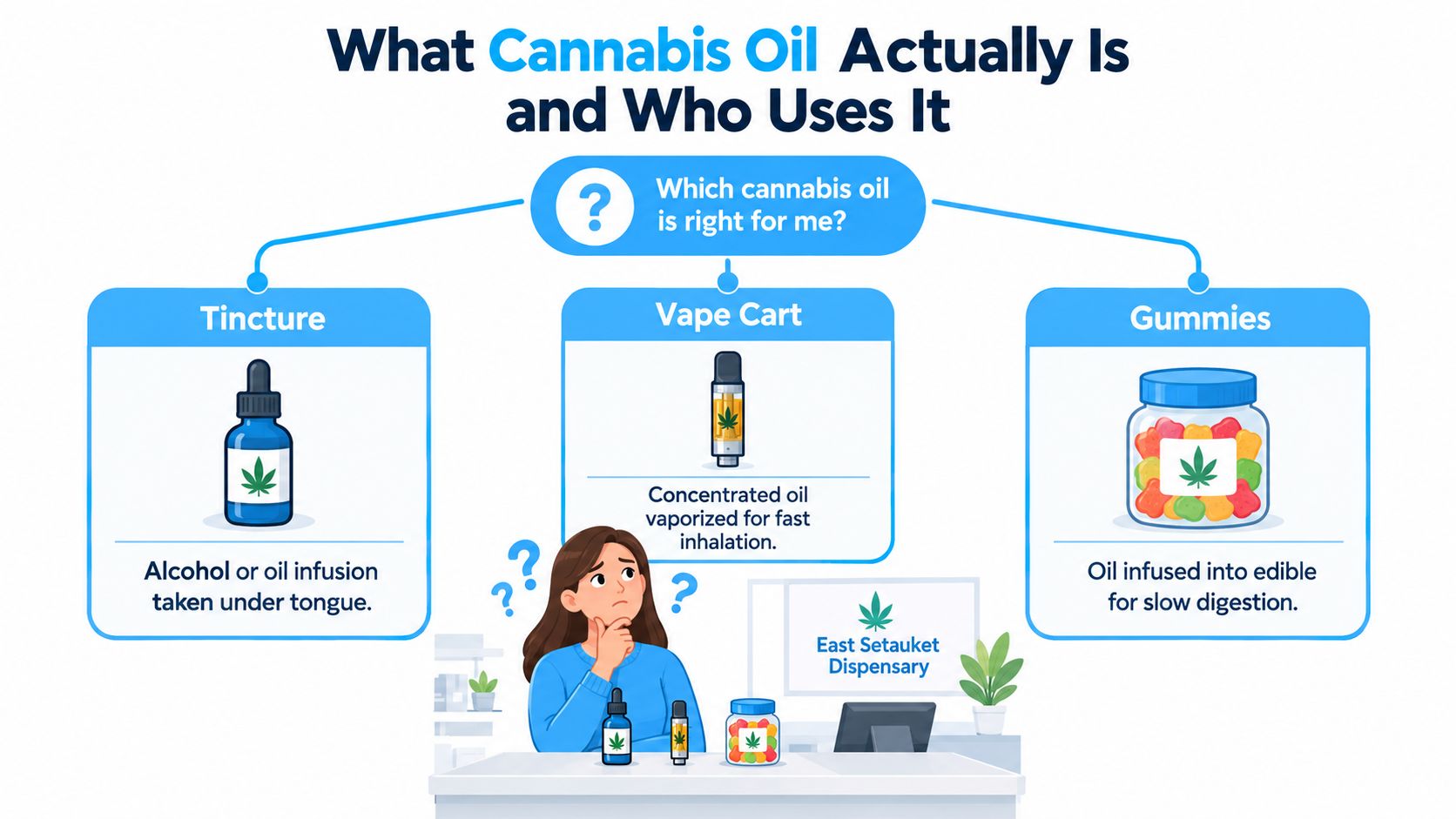
Why adults choose oil formats
An adult in Long Island who wants a discreet option for a lunch break may choose a measured tincture or capsule. Someone who needs effects quickly may look at a cartridge, while a person avoiding inhalation may prefer a gummy or topical. An older adult who does not want smoke may find a labeled oil format easier to handle than flower. The practical question is whether the product's route and cannabinoid content match the reason for using it.
Labels can show cannabinoid amounts per milliliter, capsule, serving, or cartridge, which helps people repeat a dose instead of guessing. That information supports consistency, but it does not prove that a product will treat a particular condition. Marketing language about relaxation, focus, inflammation, or broad wellness should be separated from uses supported by medical evidence.
The National Cancer Institute's cannabis overview describes a long history of medicinal cannabis use and historical reports involving analgesic, sedative, anti-inflammatory, antispasmodic, and anticonvulsant effects. Those records explain the continuing interest in cannabinoid oils, but historical use is not proof that every modern tincture, cart, capsule, or gummy works for every condition.
Oil has also become a familiar retail category rather than a niche preparation. That availability makes product literacy more important, since an informal product may have a familiar-looking bottle without the testing and labeling expected from a licensed source.
New York adults should distinguish licensed cannabis products from informal retail products. Adult-use purchases belong in the state's licensed framework, while qualifying patients can follow New York's medical cannabis registration pathway. At the counter, identify the route first, then the THC and CBD content, then the serving size. This sequence prevents the common mistake of treating every bottle, cartridge, and gummy as the same medicine.
THC, CBD, and Blended Oils Explained
A Long Island adult comparing oils might want THC for an evening change in mood, CBD for daytime use without intoxication, or both while learning how psychoactivity feels. The label's cannabinoid balance helps explain those choices, but it cannot predict every person's response.
A useful shelf analogy is a sound system. THC is the volume knob, because it generally determines how strongly perception and mood change. CBD is the tone control, because it is not intoxicating and may alter the overall experience without producing the classic THC high. Minor cannabinoids and terpenes add texture and character, rather than guaranteeing a specific result.
A THC-dominant oil contains enough THC to produce psychoactive effects. A CBD-dominant oil emphasizes cannabidiol and may suit someone seeking a non-intoxicating option. A blended oil combines both, often in ratios such as 1:1, 2:1, 5:1, or 10:1 THC to CBD. These ratios describe the relationship between cannabinoids, not a promise about how the oil will feel.
The strongest condition-specific medical signal for CBD involves certain rare forms of epilepsy. Cannabinoid medicines have also been studied for chemotherapy-related nausea and vomiting, HIV/AIDS-related appetite and weight loss, and some symptoms of chronic pain and multiple sclerosis. The prescription CBD medicine Epidiolex is the benchmark for particular epilepsy indications. An over-the-counter CBD tincture is not automatically equivalent to that prescription formulation, so claims that any CBD oil treats those conditions deserve caution.
A shelf example could be a 10 mg THC per milliliter distillate syringe chosen by an experienced adult for evening use, a 25 mg CBD per milliliter tincture selected for daytime use without intoxication, or a 5:1 THC-to-CBD blend for someone easing into psychoactivity. These examples explain label math, not universal dosing recommendations.
What the label should tell you
| Oil Type | Psychoactive? | Typical Ratio / Potency | Best-Fit Moment | Example Product |
|---|---|---|---|---|
| THC-dominant | Usually yes | THC-led, such as 10 mg per ml | Evening relaxation or experienced use | Distillate syringe |
| CBD-dominant | Usually non-intoxicating | CBD-led, such as 25 mg per ml | Daytime use without a high | CBD tincture |
| Blended | Depends on THC level | Ratios such as 1:1 or 5:1 | A balanced or lower-intensity introduction | THC:CBD tincture |
The entourage effect describes the possibility that cannabinoids and terpenes influence one another. It can help compare full-spectrum products with isolates, yet it does not prove that a terpene-forward oil will treat a symptom. Also separate hemp-derived CBD from licensed dispensary cannabis oil. A regulated product should identify cannabinoid content, batch information, and testing details. A vague CBD bottle from a gas station may not provide the same transparency or oversight.
Ways People Use Cannabis Oil Day to Day
You are choosing between a tincture before work, a vape for faster feedback, or a balm for one patch of skin. Those products may all be called cannabis oil, yet they behave differently. The route, cannabinoid ratio, and formulation determine whether the product suits a Long Island adult planning daytime use, an evening at home, or a localized skin application.
Five formats, five practical reasons
A sublingual tincture goes under the tongue and is commonly held there for 30 to 60 seconds before swallowing. It suits measured daytime use because the dropper supports repeatable servings. Effects may feel quicker than with fully swallowed oil, although the response depends on both the product and the person. This cannabis tincture guide compares tinctures with other oral options.
Swallowed oils and capsules travel through the digestive system and liver before taking effect. The oral cannabis pharmacokinetics review reports that oral THC typically reaches peak plasma concentrations 1 to 8 hours after dosing, with oral bioavailability around 4% to 20%. That delayed, variable process makes these formats more suitable for planned overnight coverage than for immediate feedback.
A vape cartridge heats concentrated oil for inhalation. Effects usually arrive faster than with oral products, which can appeal to someone who wants to assess the experience during an evening out or at home. The tradeoff is a shorter duration and less precise dose control. One puff does not translate as neatly as a measured dropper serving.
Topicals include balms, creams, and patches. A balm fits a customer focused on a particular skin area, while a transdermal patch is designed to move cannabinoids through the skin into systemic circulation. Skin application does not automatically produce a high or deliver cannabinoids into the bloodstream. The 2024 review of topical cannabidiol research found only 11 studies in its search and concluded that well-designed randomized trials and absorption data remain limited. That evidence gap matters when a product label promises more than localized use can establish.
Cooking infusions mix prepared oil extracts into food. They work for discreet use at home, but digestion creates the same delayed-onset issue found with swallowed tinctures and capsules. Carrier oil changes flavor and texture. MCT is relatively neutral, olive oil tastes familiar, and grapeseed oil can blend into recipes. Some products are unflavored, while others retain botanical or terpene-forward notes.
| Format | How It's Used | Typical Onset | Duration | Best-Fit Moment |
|---|---|---|---|---|
| Sublingual tincture | Held under the tongue, then swallowed | Faster than fully swallowed oil, often variable | Longer than inhalation | Measured daytime use |
| Oral oil or capsule | Swallowed | Slow and variable | Extended coverage | Sleep or planned overnight use |
| Vape cartridge | Inhaled after heating | Fast | Shorter than oral formats | Immediate feedback |
| Topical balm | Applied to the skin | Local and variable | Product-dependent | Targeted skin application |
| Transdermal patch | Applied to the skin | Gradual | Extended systemic delivery | Planned, steady exposure |
| Cooking infusion | Mixed into food | Delayed | Long-lasting | Low-discretion home use |
Check the delivery tool before buying. Dropper markings show liquid volume, and syringe graduations show the amount of concentrated extract. Neither one reveals the THC dose until you calculate the cannabinoid amount per milliliter.
Dosing Cannabis Oil Safely and Predictably
A measured first dose should feel almost uneventful. The safest starting rule is start low and increase slowly. For CBD-predominant oil, one consensus approach suggests 5 mg twice daily, then raising the daily amount by 10 mg every 2 to 3 days until reaching 40 mg per day. For balanced THC:CBD products, it suggests 2.5 to 5 mg of each cannabinoid once or twice daily, followed by 2.5 to 5 mg increases until the goal is reached or 40 mg of THC is reached. Review the full consensus dosing guidance for cannabinoid medicines with a clinician if the oil is part of medical treatment.
For a first THC experience, a conservative starting point is 2.5 to 5 mg THC. Some adults settle near 5 to 15 mg, while a novice should treat 30 mg as a ceiling, not a destination. These ranges are guides, not guarantees. Prescription medicines, age, metabolism, and individual sensitivity can all change the result.
Match the dose to the route
Oral THC may take 1 to 8 hours to reach peak concentration in the blood. Swallowed oil therefore behaves more like a slow-release message than an instant signal. Sublingual use may feel faster, although absorption varies with the formula and with how much oil is swallowed. Inhaled formats act quickly, but translating each puff into an exact milligram dose is difficult.
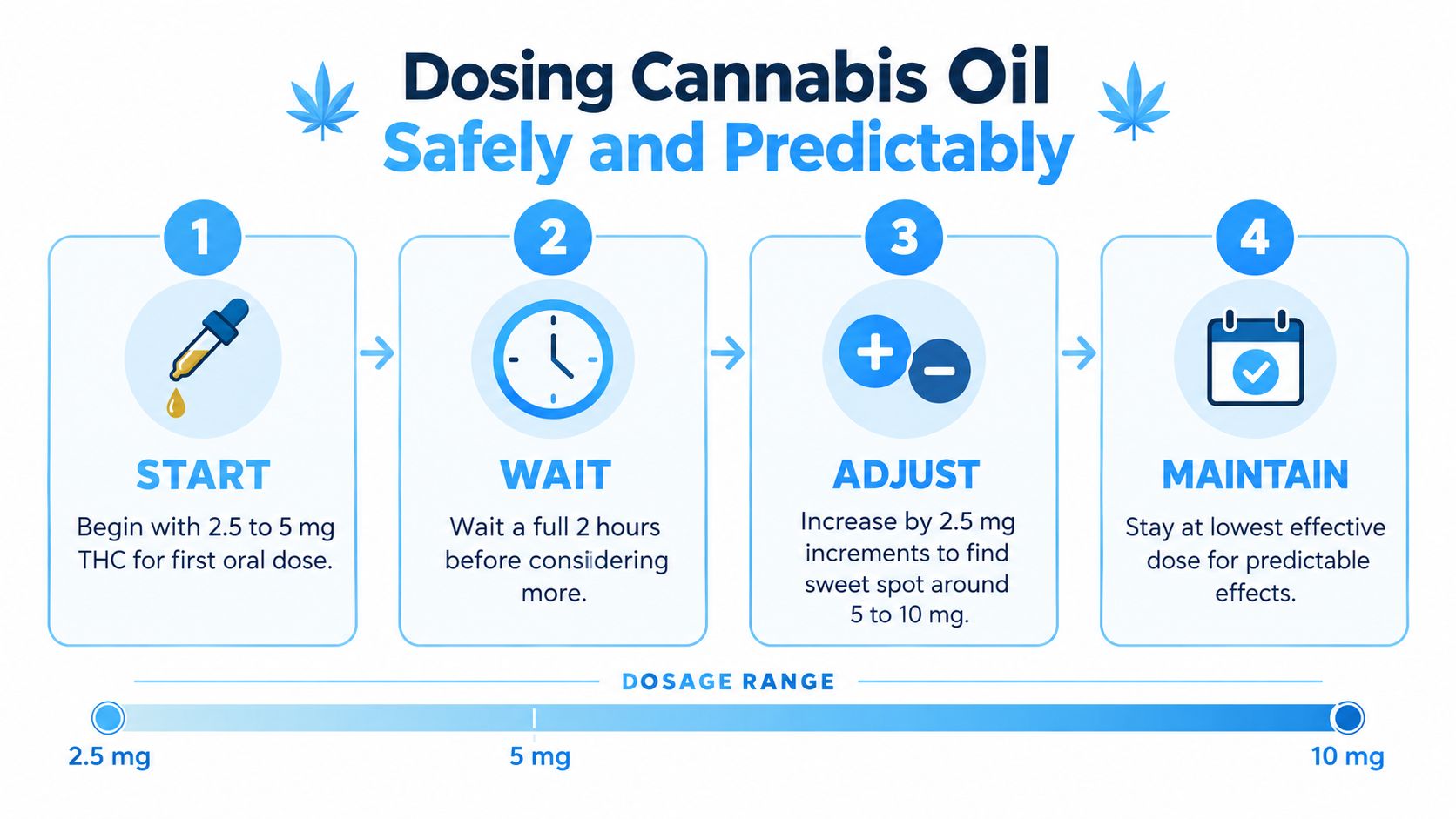
Practical rule: After swallowing a dose, wait a full two hours before taking more. A quiet first hour can become an uncomfortable, prolonged experience after a second serving.
Pay attention to anxiety, a racing heart, dry mouth, dizziness, or couch-lock. Move somewhere calm, avoid driving, drink water, and skip alcohol during a first THC experience. Keep oils away from children and pets. If you take prescription medicines, ask a healthcare professional about possible interactions.
What the Latest Research Actually Supports
If a Long Island customer reaches for cannabis oil after seeing claims about pain, sleep, inflammation, or “wellness,” the label may sound more certain than the evidence. Research supports specific cannabinoid medicines for specific problems, not one oil for every goal. The formulation, dose, route, and condition all affect what the results mean.
The NIH evidence review on the health effects of cannabis and cannabinoids describes meaningful evidence for cannabinoid use in adult chronic pain, muscle spasticity, and certain seizure disorders. That does not make every bottle on a dispensary shelf equivalent to a studied medicine. A prescription CBD formulation for a rare epilepsy is a very different product and use case from a CBD-rich oil marketed for everyday aches.
Crohn's disease shows why symptom relief and disease treatment must stay separate. A review of three studies involving 93 participants found no difference in clinical remission between smoked cannabis or cannabis oil and placebo for active Crohn's disease. Some participants reported symptom improvement, while others experienced side effects. Feeling less discomfort does not prove that the underlying intestinal inflammation is controlled, so cannabis oil should not replace gastrointestinal care.
A consumer evidence scorecard
| Condition | Evidence Strength | What the evidence means for shoppers |
|---|---|---|
| Chronic pain | Substantial or moderate, depending on the pain type | A precisely dosed cannabinoid product may be an adjunct |
| Muscle spasticity | Moderate support | Use clinician-guided cannabinoid medicine |
| Certain rare epilepsies | Clear support for prescription CBD | Look to the prescription formulation, not a retail substitute |
| Chemotherapy-related nausea | Supported for certain cannabinoid medicines | Discuss an oral or prescribed product with the care team |
| Active Crohn's disease remission | No demonstrated difference in the cited review | Do not treat cannabis oil as an anti-inflammatory replacement |
| Osteoarthritis knee pain | Mixed, including a negative 2025 trial | CBD-rich oil is not a guaranteed pain solution |
| Broad wellness claims | Insufficient or variable | Treat sweeping marketing language cautiously |
The newer trial evidence adds useful friction to broad claims. A 2025 Frontiers clinical trial found that CBD-rich cannabis oil did not significantly improve osteoarthritis knee pain compared with placebo. For a Long Island adult choosing oil for joint discomfort, that result argues for modest expectations rather than assuming “CBD-rich” means effective.
A separate 2025 Australian longitudinal study reported improvements in quality of life, fatigue, sleep, anxiety, depression, and pain over one year among patients using cannabis oil for chronic health conditions. Because the study observed people over time rather than assigning treatment against a placebo, it cannot show that the oil caused every improvement. Cannabis oil also should not be sold as a cancer cure, a guaranteed long-term sleep solution, or a proven treatment for opioid addiction.
How to Read Lab Results Before You Buy
A Certificate of Analysis, or COA, is the product's batch-level lab report. It should let you confirm what's in the bottle and whether the batch passed safety testing. If a product has no accessible COA, ask the budtender why before spending money.
Start with four label details:
- Total THC percentage or amount. This helps estimate psychoactive strength.
- Total CBD percentage or amount. This shows the non-intoxicating cannabinoid balance.
- Total cannabinoids per milliliter. This is the number that drives practical liquid dosing.
- Terpene profile, when present. Terpenes shape aroma and may contribute to the product's character, but they don't guarantee a medical effect.
Potency math is easier than it looks. A 30 ml bottle labeled 600 mg total cannabinoids contains roughly 20 mg per ml. One full dropper would therefore represent about 20 mg total cannabinoids, assuming the dropper holds one milliliter. You still need to separate the THC and CBD amounts, because 20 mg total may be mostly CBD, mostly THC, or a blend.
Inspect the safety panel
Look for an identified testing laboratory and evidence that the lab is properly accredited. Confirm the batch date, ideally within the last six months, then scan the contaminant panel for passing results on residual solvents, heavy metals, microbials, and pesticides. The cannabis lab testing guide offers a practical explanation of how those checks fit together.
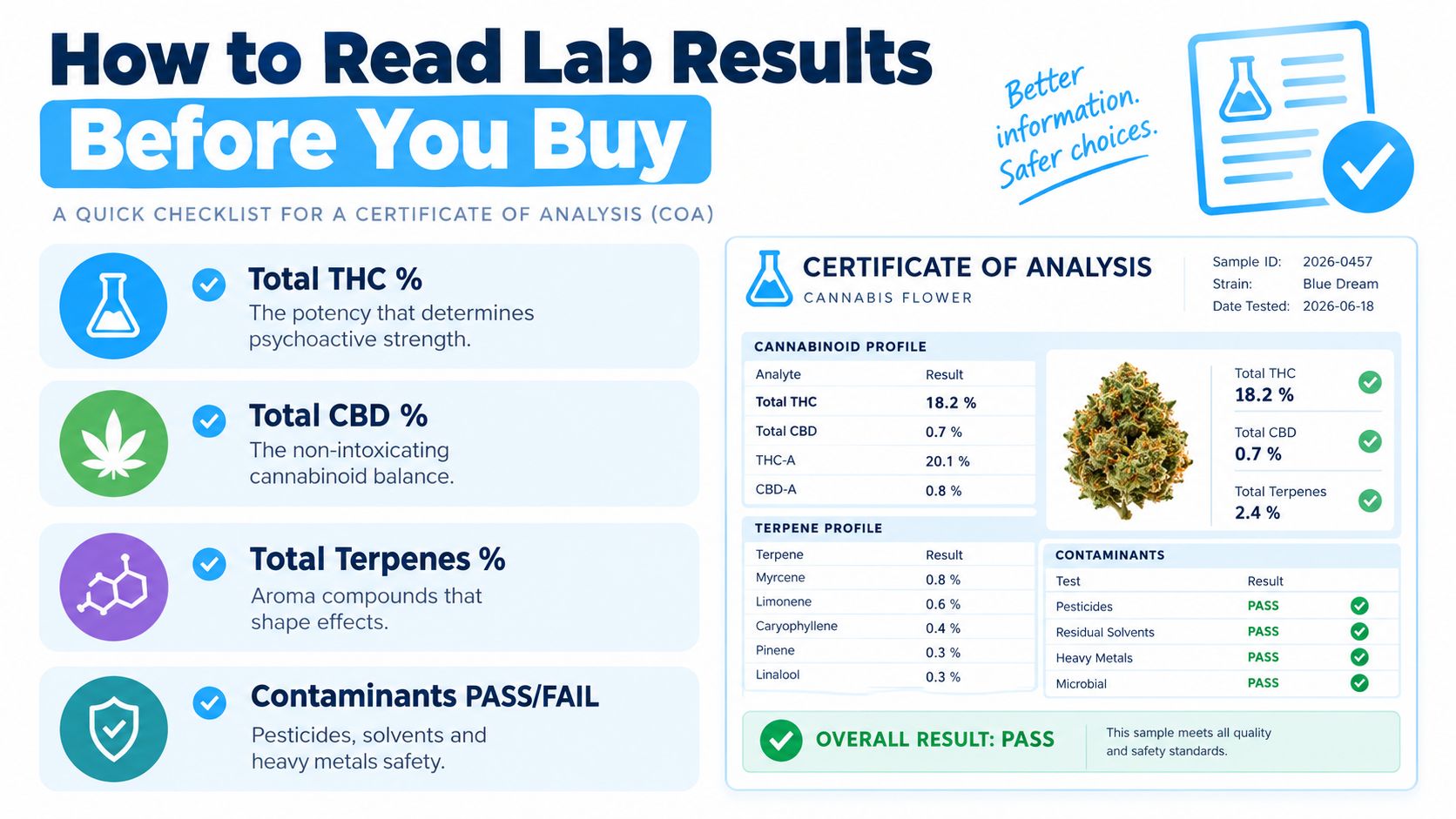
A missing batch number, vague “natural” labeling, or a product with no lab documentation should send you back to another shelf. Responsible retailers shouldn't treat testing as optional for oils, vapes, edibles, topicals, or concentrates. Keep the COA with the package information so you can match the report to the exact bottle you bought.
Choosing the Right Oil and Where to Get It
Choose the goal before you choose the bottle. If you want planned evening relaxation or support for pain, look first at THC-dominant or balanced tinctures, then compare the serving size and total THC per milliliter. If you want daytime use without a strong high, a CBD-forward or low-THC blend may be a more comfortable starting point.
For a localized skin concern, compare balms, creams, and patches rather than assuming an oral oil will be the most direct option. The topical evidence remains limited, so treat claims about eczema, inflammation, or pain as questions to investigate, not promises. If you need rapid effects and already understand your THC tolerance, a vape cartridge may fit better. Review the vape pen oil guide before choosing between a cartridge and an all-in-one device.
Use a counter-side decision tree
- Sleep or evening comfort: Compare THC-dominant and balanced sublingual tinctures, starting with the lowest practical serving.
- Daytime calm or a non-intoxicating option: Look for CBD-forward oils and verify the CBD amount per milliliter.
- Targeted skin use: Consider a topical, then ask what testing and absorption information the manufacturer provides.
- Fast feedback: Consider a regulated vaporizer cartridge, particularly if you already know how THC affects you.
- Precise medical dosing: Favor a clearly labeled tincture, capsule, or other format with measurable cannabinoid content.
Before buying, confirm the COA, check pesticide and heavy-metal results, and verify the manufacturing or batch date. Read the ratio, not just the front-label strain name. Products from brands such as Papa & Barkley, Head & Heal, Olios, RSO, or other licensed oil lines can differ substantially in concentration and route, so the label matters more than the familiar name.
For Long Island shoppers, a practical path is to browse the East Setauket menu, filter by oil type, potency, and THC-to-CBD ratio, then reserve a product for in-store pickup. If you're within the service area, local delivery can remove the need to make a separate trip. Strong Strains offers tinctures, concentrated cannabis oil vape products, RSO labeled as Full Extract Cannabis Oil, topicals, and other formats, with lab information and budtender guidance available for product selection.
Filter the menu by format, cannabinoid ratio, and milligrams per serving, then reserve the oil that matches your actual goal instead of the loudest marketing claim. Visit Strong Strains Cannabis Dispensary for in-store pickup or local delivery, and ask the team to walk through the COA and dosing math before you check out.