
You're at a dispensary and ask for a THC tincture because you've heard it works faster. The budtender sets a small bottle on the counter, then points to another that looks almost identical: an oil with a dropper and a similar label. Which one should you choose?
The answer depends less on the words tincture and oil than on what's in the bottle, how you measure a serving, and whether you hold the liquid under your tongue or swallow it. In this THC tincture vs. oil comparison, the practical differences come down to route of use, dose, ingredients, and how soon you want to feel effects. Knowing what to check on the label can help you choose without relying on terms that don't reliably predict the experience.
The Tincture vs Oil Confusion at the Dispensary
A shopper asks for a tincture because they want something faster than an edible. The budtender picks up a small bottle of THC oil and explains that it may be used under the tongue, too. The labels look different, but the dropper and liquid format seem familiar. The shopper's real question isn't just what the products are called. They want to know how to use one, how to measure it, and what to expect.
That's where the comparison can get muddled. Tincture and oil are often presented as competing product types, even though the terms describe different aspects of a liquid cannabis product. Oil usually describes the carrier, while tincture commonly describes a liquid preparation intended for oral or sublingual use. Either way, the product name alone doesn't tell you how quickly the THC will take effect.
What matters at the counter is the route. Sublingual use means placing liquid under the tongue and holding it there as directed on the label. Swallowing sends the dose through the digestive system. Some THC may be absorbed through oral tissues during sublingual use, but some can also be swallowed, so the difference isn't always clear-cut.
Ask the budtender: “Is this product intended to be held under the tongue, swallowed, or either?”
That simple question gets you closer to a useful comparison than asking which format is automatically stronger or faster. A product with a dropper can be easier to measure than a product without one, but the concentration and serving instructions still matter. And a label that says “high potency” doesn't promise a quicker onset or a more predictable effect.
Before choosing, decide what matters most to you: control over a small measured amount, the ingredients in the carrier, discreet use, or a preference for a particular route. Then compare the label and product instructions. The overview below is a starting point, not a guarantee that every bottle bearing one of these names will act the same way.
| What you're comparing | What to check |
|---|---|
| Product terminology | Whether “oil” describes the carrier and whether “tincture” describes intended use |
| Route | Whether the label says sublingual, oral, or both |
| Dose | THC per milliliter and THC per measured serving |
| Ingredients | Carrier oil, added cannabinoids, flavorings, and other ingredients |
| Testing | Whether batch-specific laboratory results are available |
What Tincture and Oil Actually Mean
Oil usually refers to the liquid carrier or base, such as MCT, olive, or hemp-seed oil. Tincture generally refers to a liquid cannabis preparation intended for oral or sublingual use. Those terms aren't a tidy either-or choice: a product can be a THC oil and also be marketed as a tincture, depending on its ingredients, instructions, or how the product is described.
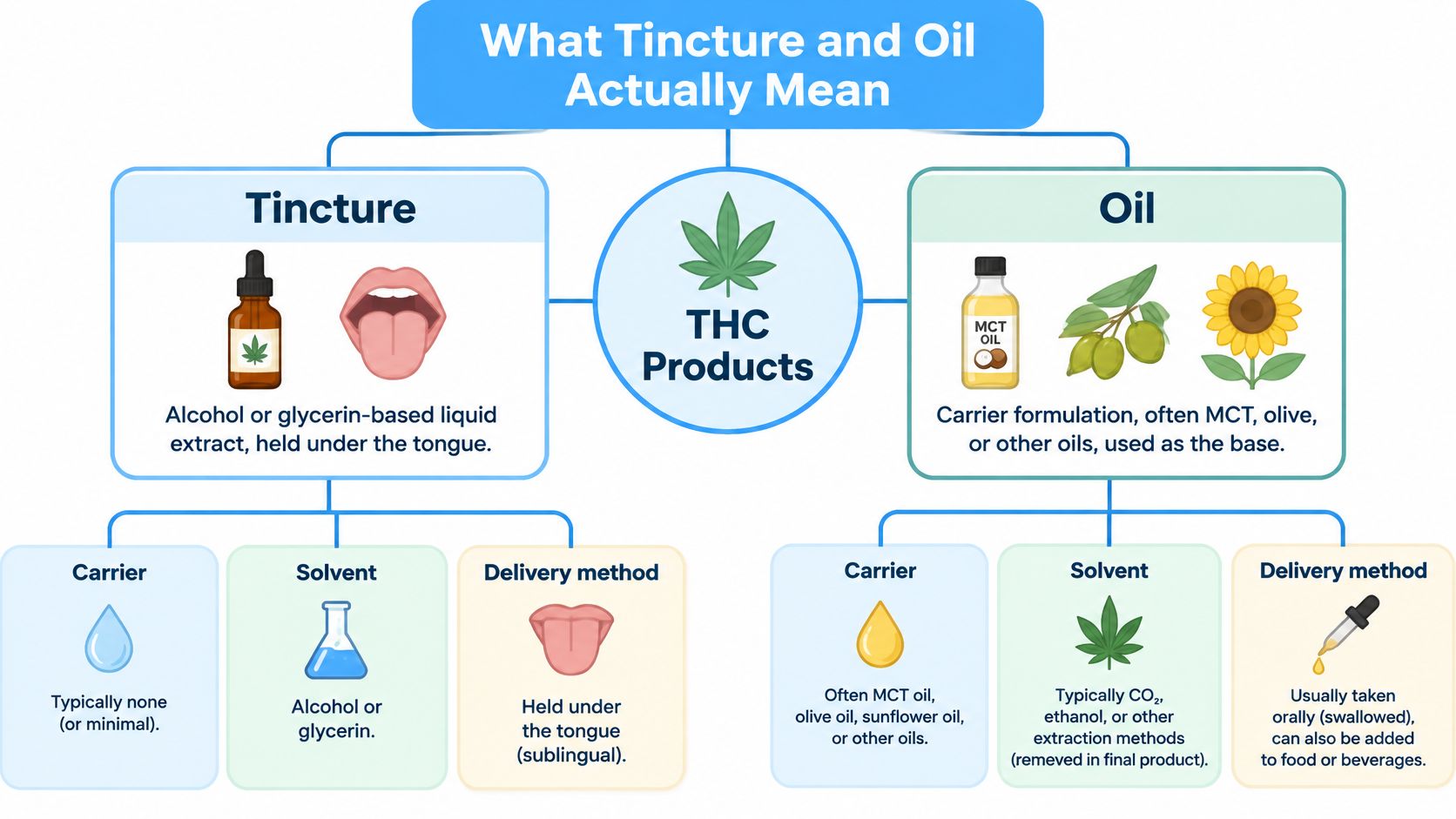
The distinction matters because the bottle's name doesn't tell you the dose or the route. Look for total THC per bottle, THC per milliliter, and the amount in the serving the label describes. Check whether the product contains other cannabinoids and what carrier ingredients it uses. Always check whether the instructions specifically say to hold it under the tongue, swallow it, or use it either way.
A carrier ingredient can be relevant to your preferences or sensitivities, but it doesn't make a product automatically faster, stronger, or more therapeutic. Likewise, “high potency” describes a marketing or product attribute, not a guarantee of a particular experience. If you're comparing bottles, focus on the labeled amount of THC and the instructions for use rather than assuming that one category name predicts the effect.
Product names help you identify what you're looking at. The label's dose and route instructions help you decide how to use it.
For a plain-language look at the carrier side of the discussion, Strong Strains also covers common cannabis oil uses. Keep the distinction in mind at the shelf: “oil” tells you something about the base, while “tincture” often signals a liquid format and intended method of use. Neither word replaces the serving information.
Sublingual vs Swallowed How Absorption Changes Everything
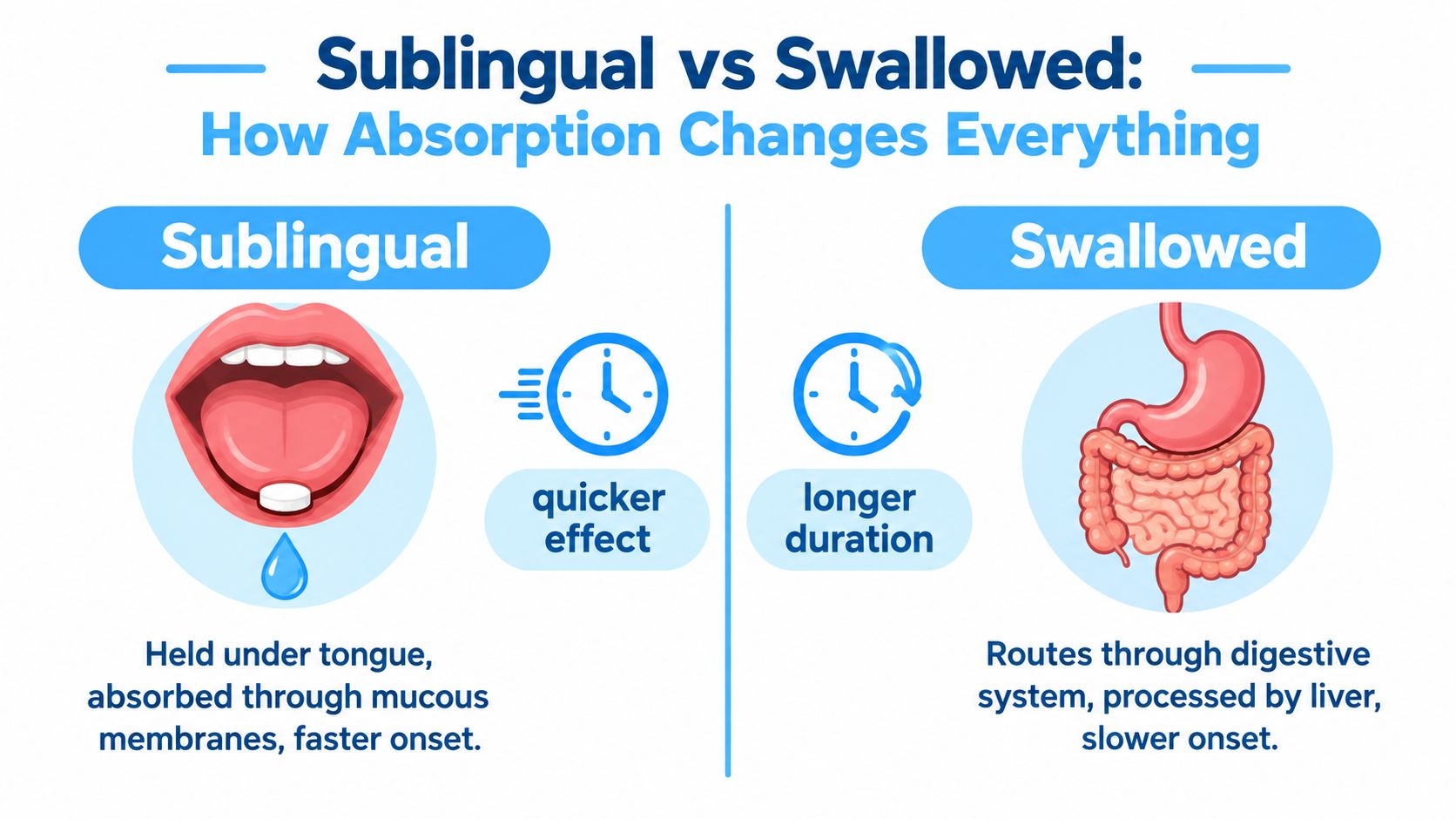
The most useful comparison is not just tincture versus oil. It's under the tongue versus swallowed. Holding a liquid beneath the tongue may allow some THC to enter circulation through oral tissues. Swallowing it sends the dose through digestion, where absorption and first-pass processing in the liver contribute to a slower, more variable experience.
A 2024 clinical review estimated sublingual THC bioavailability at approximately 13%. Using the review's example, a 1 mL tincture containing 10 mg THC could theoretically deliver about 1.3 mg systemically. The same review associated sublingual products with onset of roughly 15–60 minutes, peak effects around 45 minutes, and a duration of approximately 4–6 hours. Those figures describe estimates and typical timing, not a promise for an individual product or person. (Clinical review of sublingual THC)
Swallowed THC can take longer to have an effect. Human research commonly places oral THC bioavailability around 4–20%, while clinical guidance gives an oral onset of about 1–3 hours and a duration of roughly 6–12 hours. The timing and amount absorbed can vary, which is why taking more before the first dose has fully taken effect can lead to excessive intoxication. (Review of oral THC pharmacokinetics)
Why the difference isn't absolute
Holding a product under the tongue doesn't guarantee that the entire dose will be absorbed that way. Research on sublingual cannabinoid sprays found serum metabolite patterns similar to oral products, suggesting that some of the dose is often swallowed and processed through digestion. A human pharmacokinetic study also reported that orally consumed cannabis reached peak concentration after approximately 2–3 hours, with return to baseline taking 6–20 hours after exposure. (Human pharmacokinetic study of oral cannabis)
Your experience can also depend on the product's concentration, dropper volume, food intake, metabolism, and how much THC your body absorbs. An oil used under the tongue and a tincture swallowed immediately may therefore behave more like their administration routes than their names suggest.
In practical terms, follow the label's directions and don't treat “tincture” as a synonym for “fast.” Holding the dose under the tongue as directed may increase the chance of partial sublingual absorption. Swallowing it makes the experience more like an oral dose, even if the bottle is marketed as a tincture.
Potency, Dosing, and How to Read the Bottle
A bottle's total THC and a single serving's THC are different measurements. Start by finding the total amount of THC in the package, then look for the concentration per milliliter and the labeled serving size. If the product says 10 mg THC per milliliter, a measured 1 mL contains that labeled amount; a smaller measured volume contains a corresponding share. Check the actual markings on the dropper and the product instructions instead of treating a “drop” as a consistent unit.
Regulations illustrate why the per-serving number deserves its own attention. New York requires labels to state total THC per serving and package, and no single serving may contain more than 10 mg total THC under the cited guidance. Vermont requires a tincture dropper capable of reliably measuring doses of no more than 5 mg THC, limits a serving to 5 mg THC, and says “drops” shouldn't be used as the dosing unit. Canada caps THC at 10 mg per discrete ingestible unit, while Massachusetts guidance limits an individual tincture serving to 5 mg delta-9 THC. (New York cannabis packaging guidance; Vermont cannabis labeling guidance)
| Jurisdiction | Maximum THC per Serving |
|---|---|
| New York | 10 mg total THC |
| Vermont | 5 mg THC |
| Canada | 10 mg THC per discrete ingestible unit |
| Massachusetts | 5 mg delta-9 THC |
What the label can and can't tell you
Labels and online product listings don't always match. In an Ontario study of 30 legal oral cannabis oils, website and physical-label information differed for 33.3% of products; among higher-potency products, 43.8% contained more than 15% less THC than labeled. Those findings don't establish that every tincture or oil is inaccurate, but they're a reason to check the physical package and seek batch-specific lab information when it's available. (Ontario study of legal oral cannabis oils)
A separate 2025 Colorado analysis found that 96.0% of tested concentrate products were within 15% of labeled THC, compared with 56.7% of flower products. The observed potency was significantly lower than labeled for both categories, and those findings don't prove that a particular tincture or oil is inaccurate. They do reinforce the value of checking product-specific testing rather than assuming a headline potency tells the whole story. (Colorado cannabis potency analysis)
For another way to think through dose amounts, see this cannabis dosage chart. Use measured servings, follow the product's instructions, and treat the dose on the label as the starting point for comparison, not a guarantee of how much THC your body will absorb.
Best Use Cases for Tinctures and Oils
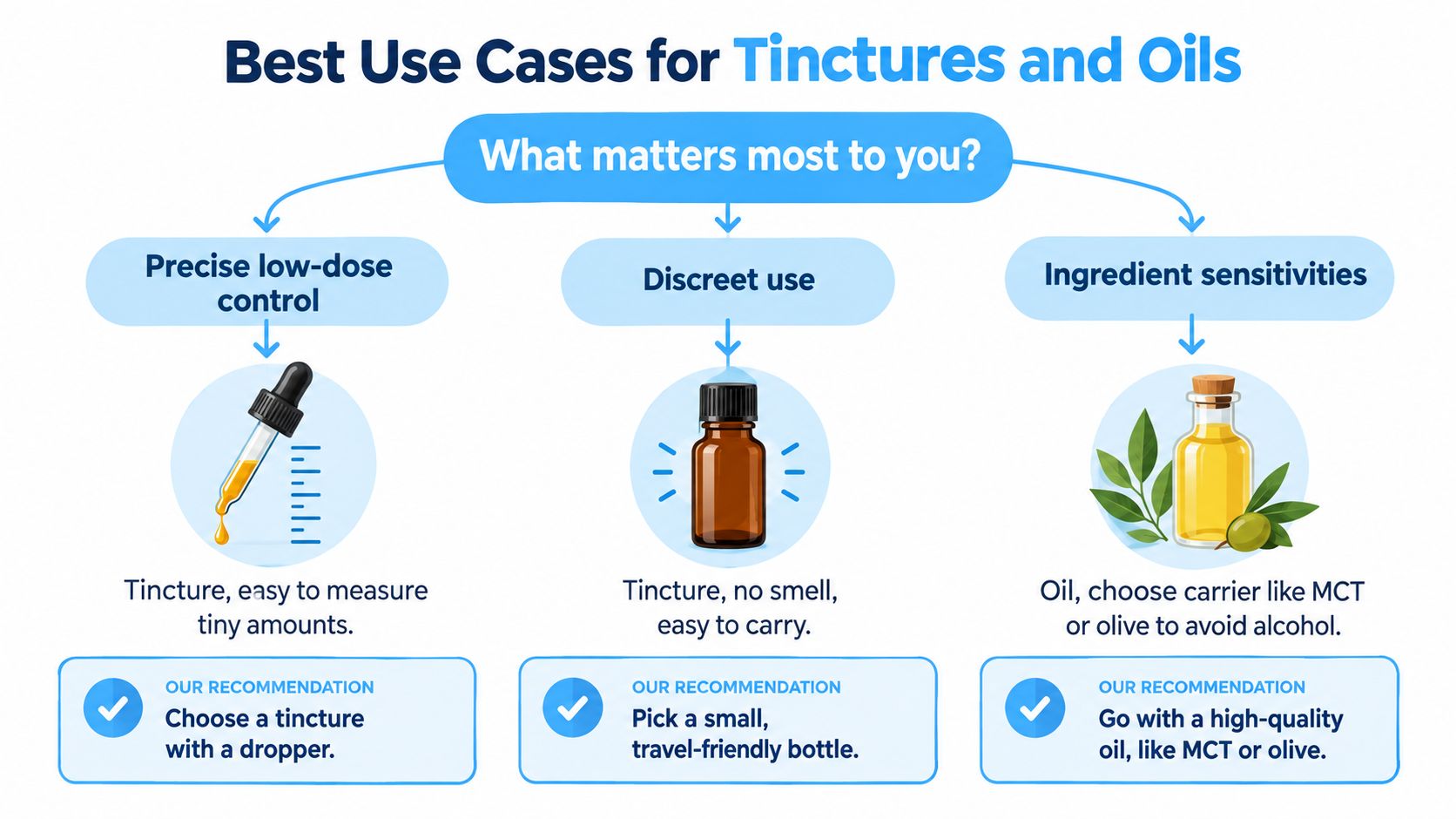
The right choice depends on what you want to control. If measured amounts are your priority, choose a product with a clearly marked dropper and easy-to-understand THC per milliliter. If ingredients matter more, compare the carrier and other listed components before deciding. A shopper who wants to avoid a particular carrier should ask the budtender to help identify a product with a suitable ingredient list rather than assuming every oil or tincture uses the same base.
Discreet use is another practical consideration. Liquid products don't require smoking or vaping, and a dropper bottle can be convenient to carry. But being discreet doesn't make a product risk-free to use anywhere: plan for the effects, keep it stored safely, and don't drive after consuming THC.
Match the route to your priorities
If you're hoping for an earlier onset, a product labeled for sublingual use may be worth discussing with a budtender. It still isn't a guarantee: some of the dose may be swallowed, and your response can differ from another person's. If a longer-lasting experience is what you're considering, swallowing a measured dose may suit that preference, but the delayed onset makes patience especially important.
A new user's key question shouldn't be only “Which works better?” It should be “How can I measure my first amount and avoid taking more before I know how it affects me?” Start with a low amount, follow the package instructions, and wait a measured interval before considering any increase. Avoid mixing THC with alcohol, and don't drive after using it. Delayed oral effects can make it easy to take more while the first dose is still building.
The same bottle may produce a different experience depending on whether you hold the liquid under your tongue or swallow it. Write down the amount, route, and timing so you can make a careful comparison on another occasion. That record is more useful than guessing from a product name or trying to judge the experience by the concentration printed on the front of the bottle.
Pros and Cons of Each Format
A liquid product with a calibrated dropper can make measured dosing straightforward, but the word “tincture” doesn't guarantee a particular dropper design or a predictable onset. Sublingual use may bring effects on sooner than swallowing and may produce a shorter experience, yet some of the liquid can still be swallowed. The trade-off is less certainty about how much of the dose follows each route.
Swallowed THC oil can be easier to take for someone who prefers to mix a liquid into food, and a fat-based carrier can sometimes improve absorption because THC dissolves in fat. That doesn't make oil more potent or consistent. Oral absorption and peak concentrations can vary substantially from person to person, and a swallowed dose may take longer to become noticeable.
Formulation matters beyond the oil-versus-tincture label. In a 2025 crossover study of 14 healthy adults, researchers compared equivalent 8 mg THC doses from a sublingual oil-based formulation and an enhanced powder formulation. The powder produced more than twice the plasma cannabinoid concentrations, with THC relative bioavailability 2.9-fold higher and the active metabolite 11-OH-THC 2.5-fold higher than with oil drops. The result shows that formulation technology, excipients, droplet size, and mucosal contact can affect exposure, even when labeled doses match. It doesn't establish that one of those formats will be better for every consumer. (2025 crossover study of THC formulations)
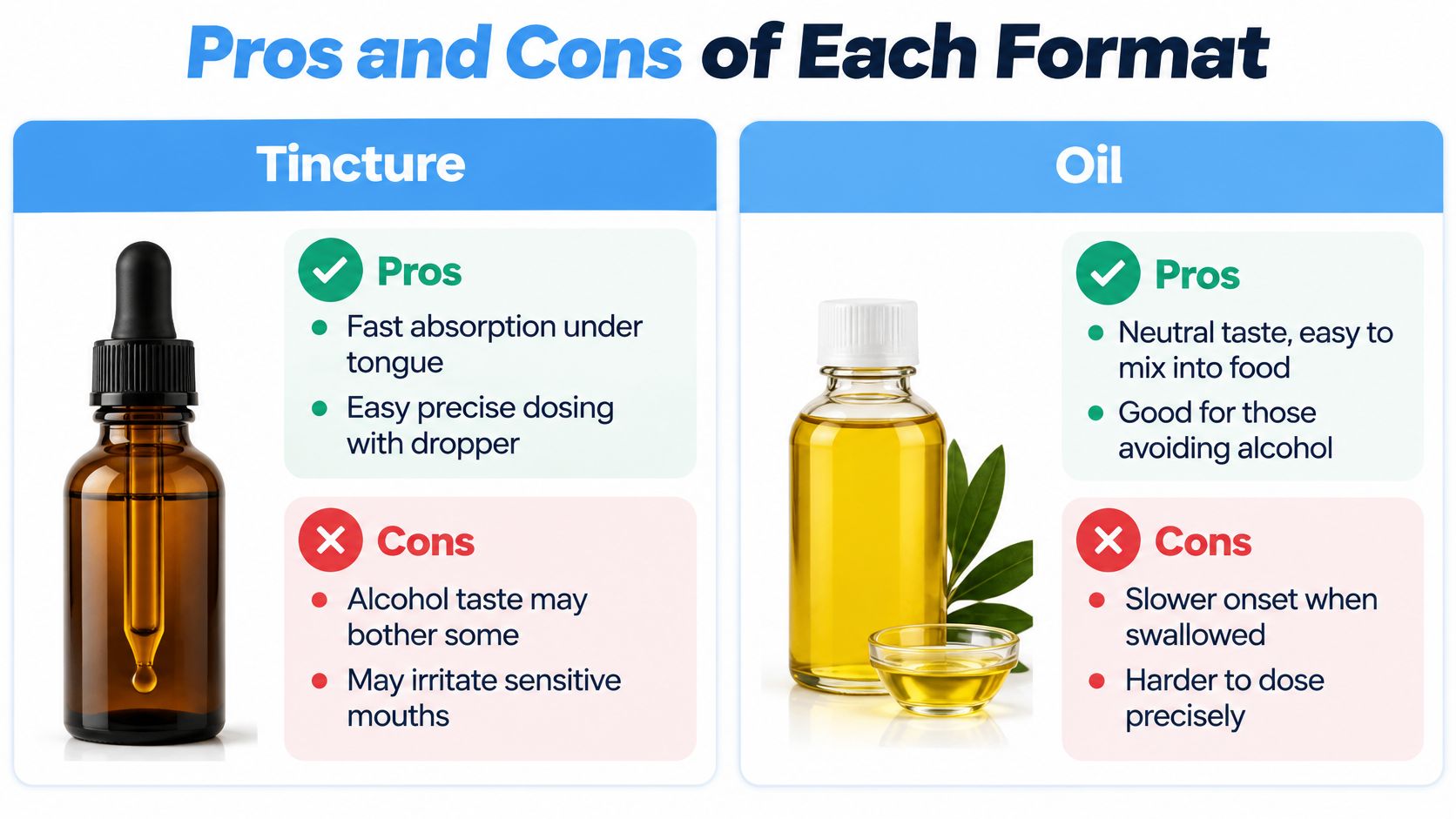
So weigh the trade-offs against your own priorities. A product's carrier may suit your ingredient preferences, and its dosing device may suit your need for measured amounts. But neither “oil” nor “tincture” alone tells you the product's absorption, consistency, or duration. The route, formulation, label, and your response all matter.
How to Choose at a Dispensary
When you're comparing bottles in person or online, look past the front label and ask:
- What route does the label describe? Check whether it's intended for sublingual use, swallowing, or both.
- How much THC is in a serving? Compare milligrams per serving and per milliliter, not drops or bottle size alone.
- What's in the carrier? Review the ingredients and consider any sensitivities or preferences.
- Can I check batch testing? Look for product-specific laboratory results; this guide to cannabis lab testing explains why transparent results are useful.
- How will I measure and track it? Use the marked dropper and record the amount, route, and timing of your response.
Strong Strains Cannabis Dispensary offers lab-tested tinctures and concentrated cannabis oil products, with budtender guidance for comparing formats, concentrations, and serving information. Take the time to review the label with a staff member, then choose based on ingredients, measured dose, and intended use rather than words like “premium” or “fast-acting.”
Visit Strong Strains Cannabis Dispensary in East Setauket to compare lab-tested tinctures and cannabis oils with help from knowledgeable budtenders. Ask about the product's carrier, serving size, and directions so you can choose a format that fits how you plan to use it.