
You're standing in a dispensary, holding a low-dose gummy or tincture and wondering whether 1 mg of THC is too little to matter. You may also be wondering whether such a small amount is automatically safe, whether you'll feel impaired, and how long you should wait before deciding it didn't work. Those are sensible questions, because the number on the label is only one part of the experience.
1 mg THC is best understood as a precision starting point, not a promise of a specific feeling. Delivery method, label accuracy, tolerance, metabolism, food, medications, and previous cannabis exposure all influence what happens after you take it.
Why One Milligram of THC Is Having a Moment
A shopper enters a modern dispensary looking for a gentler way to try cannabis. They want to stay oriented, avoid losing an evening, and know what they consumed. Among the mints, tinctures, and edibles, one label stands out: 1 mg THC.

A dose this small can suit a first-time consumer seeking a cautious introduction, someone returning after a long break, or an experienced user who wants a modest change in comfort or mood. The appeal is precision. A small serving gives the consumer a narrower starting point for learning how their body responds.
In cannabis culture, microdosing generally means using a very small amount while aiming to remain functional and observe a modest effect. The goal is to identify the lowest amount that produces a personally useful response. That amount may be noticeable, even if it does not resemble the stronger intoxication associated with a conventional recreational serving.
The useful question isn't “Is 1 mg enough for everyone?” It's “What does this amount do in my body, in this product, on this day?”
Health Canada's public guidance places 2.5 mg THC as a general starting point for oral or sublingual use, while 1.25 mg may be considered for higher-risk groups. In that context, 1 mg functions as a deliberately cautious starting point for especially sensitive consumers, not a universal standard for effectiveness. Individual responses still vary.
The printed dose is only one part of the calculation. Label accuracy affects how much THC reaches the consumer, while the delivery method affects how quickly effects begin and how long they last. Food, tolerance, metabolism, medications, and previous cannabis exposure can also change the result.
A careful low dose creates room to observe onset, duration, mood, and unwanted effects before trying more. Reliable product measurement and patience matter just as much as the number itself, because taking another serving too soon can turn a measured experiment into an unexpectedly strong experience.
What 1 mg of THC Actually Means
You open a package, see 1 mg of THC, and wonder whether such a small amount can matter. It can. One milligram equals one-thousandth of a gram of delta-9-tetrahydrocannabinol, the primary intoxicating cannabinoid in cannabis. The number describes the THC content, not a guaranteed feeling.
A 1 mg serving is below common recreational amounts and can serve as a precision starting point for a cautious consumer. Clinical pharmacy guidance places an initial range of 1 to 2.5 mg THC once daily, often in the evening. Inexperienced users, older adults, and people with health conditions or multiple medications may respond to about 1 mg or less. Use the amount to observe your response, rather than treating it as a universal standard.
Your body determines how noticeable that dose becomes. Prior cannabis exposure, age, metabolism, concurrent drugs, administration route, food intake, product formulation, and individual body chemistry can all change the result. The same number on two packages may therefore produce different experiences.
1 mg THC vs Common Recreational Doses
| Dose | Typical User | Expected Intensity |
|---|---|---|
| 1 mg | Highly sensitive, first-time, or cautious consumer | Often subtle, but can still be noticeable |
| 2.5 mg | Beginner following a conservative oral starting point | Mild and more apparent for many people |
| 5 mg | Consumer with some familiarity | Clearly noticeable for many consumers |
| 10 mg | Experienced consumer with established tolerance | More intense and more likely to cause impairment |
This table offers orientation, not a promise. A person with low tolerance may notice 1 mg, while a frequent consumer may feel little. A capsule, tincture, edible, and inhaled product can also deliver the same labeled amount differently because absorption and timing vary.
For a visual comparison, use this cannabis dosage chart. One milligram is small, but it is not nothing. Treat it as a measured starting point, and check the label, delivery method, and your own response before deciding whether any change is appropriate.
How 1 mg Feels Across Different Product Types
A person using 1 mg THC in a vape may notice a change within minutes, while the same labeled amount in a gummy can take much longer. The route of administration shapes the experience as much as the number on the package. Inhaled THC reaches the bloodstream quickly, oral products pass through digestion, and topical products are generally intended for localized sensations rather than intoxication.
A 2021 randomized, double-blind, placebo-controlled crossover study in Israel examined a single inhaled dose containing 0.5 mg or 1 mg THC in 27 patients with pain. Among participants assessed for pharmacokinetics, average peak concentration occurred about 4.4 minutes after 1 mg and 3.7 minutes after 0.5 mg. The European Journal of Pain study used a controlled investigational formulation, so its timing is a reference point, not a guarantee for every vape or flower product.
1 mg THC by Delivery Method
| Format | Onset | Peak | Duration |
|---|---|---|---|
| Inhaled | Minutes | Often develops quickly | Usually shorter than oral use |
| Edible | 30 minutes to 2 hours | May take up to 4 hours to reach full intensity | Often longer and slower |
| Sublingual | Gradual, depending on the product and technique | Variable | Usually between inhaled and edible timing |
| Topical | Gradual local sensation | Variable | Localized and product-dependent |
For oral and sublingual products, effects may begin 30 minutes to 2 hours after use and may take up to 4 hours to reach full intensity, according to Health Canada's lower-risk cannabis guidance. Waiting through that window helps prevent a person from taking more before the first dose has fully appeared.
A tincture held under the tongue may feel different from a gummy. Some of the tincture can pass through oral tissues, while the remainder is swallowed and follows a slower digestive route. A topical cream or balm generally targets a local area and does not usually produce a psychoactive high.
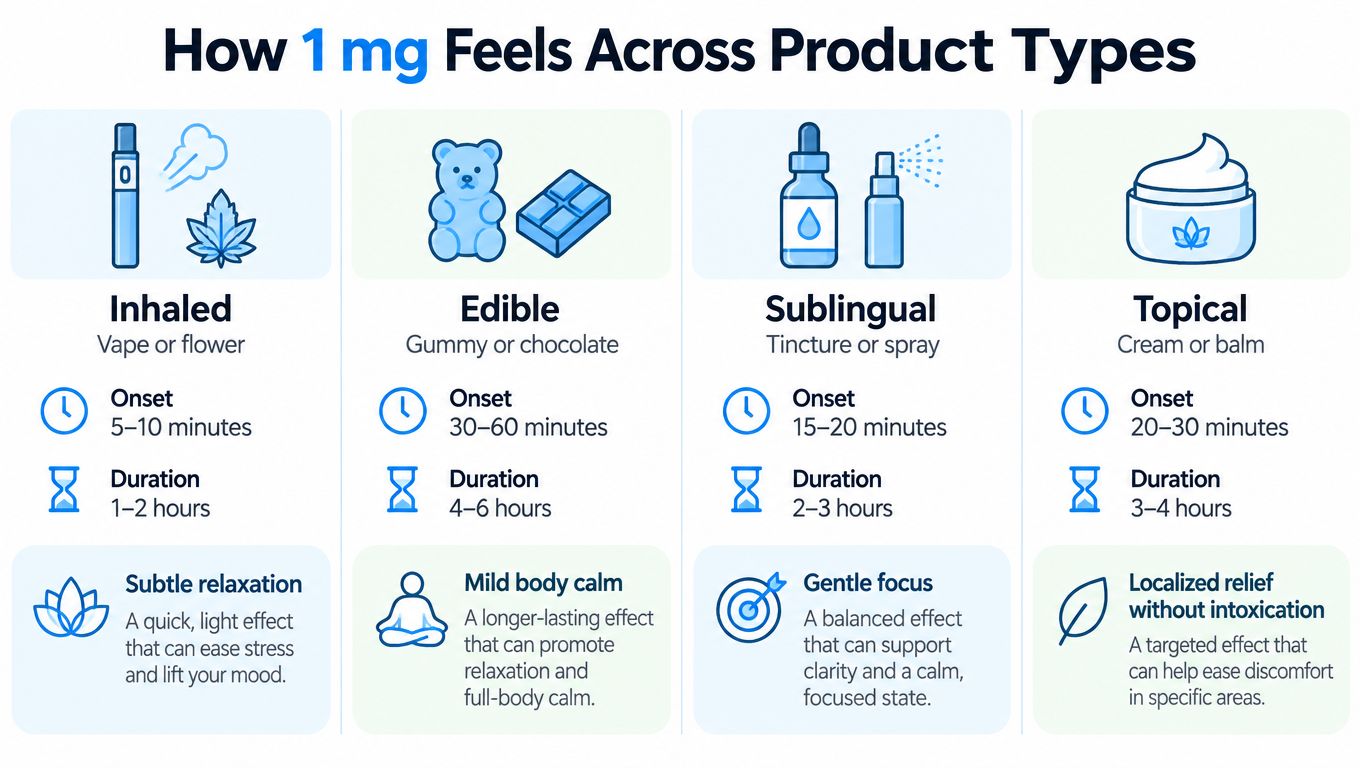
The same 1 mg label can therefore feel fast and brief when inhaled, or slow and persistent when eaten. Treat the amount as a precision starting point, then judge the product's label accuracy, delivery method, and your own response before changing anything.
Effects and Side Effects at 1 mg
A person trying 1 mg THC may notice almost nothing, while another may feel a small shift in relaxation, mood, pain perception, body awareness, or sleepiness. Individual chemistry, prior tolerance, and the delivery method all matter. For someone who is sensitive to THC, even this small amount can be noticeable despite being far below a conventional edible serving.
In a 2021 inhaled-THC study, both active doses reduced reported pain from baseline during the 150-minute observation period. The 1 mg dose also produced a statistically significant reduction compared with placebo. Researchers found no consistent impairment on cognitive-performance tests, yet participants rated the subjective “drug high” as twice as intense at 1 mg as at 0.5 mg. A lower dose, therefore, is not guaranteed to feel imperceptible. The study's full findings also showed substantial variation in blood concentrations between participants, reinforcing the role of individual physiology.
A 2026 systematic review of higher-THC medicinal cannabis products reported reductions in maximum pain scores of 25.0% after 0.5 mg and 39.4% after 1 mg within the evidence it examined. Reported adverse events included feeling high in 20.3% of cases, cough in 10.1%, weakness in 9.2%, restlessness in 8.2%, dry mouth in 7.2%, dizziness in 6.8%, sleepiness in 6.3%, nausea in 4.8%, and moderate blood-pressure reduction in 3.9%. The systematic review does not mean every consumer will experience these effects, and it does not make 1 mg risk-free.
What you might notice
- Subtle relaxation: Muscle tension may ease without a dramatic mental change.
- A mood change: Some people experience a mild lift or respond more softly to everyday stress.
- Sleepiness: Drowsiness may become more apparent with evening use, particularly for a sensitive consumer.
- Very little: A person with established tolerance may notice no meaningful change.
Dry mouth, dizziness, and feeling high still deserve attention at this amount. Alcohol, sedating medications, and other substances can change the experience or increase impairment, so a small label should not be treated as a guarantee of safety.
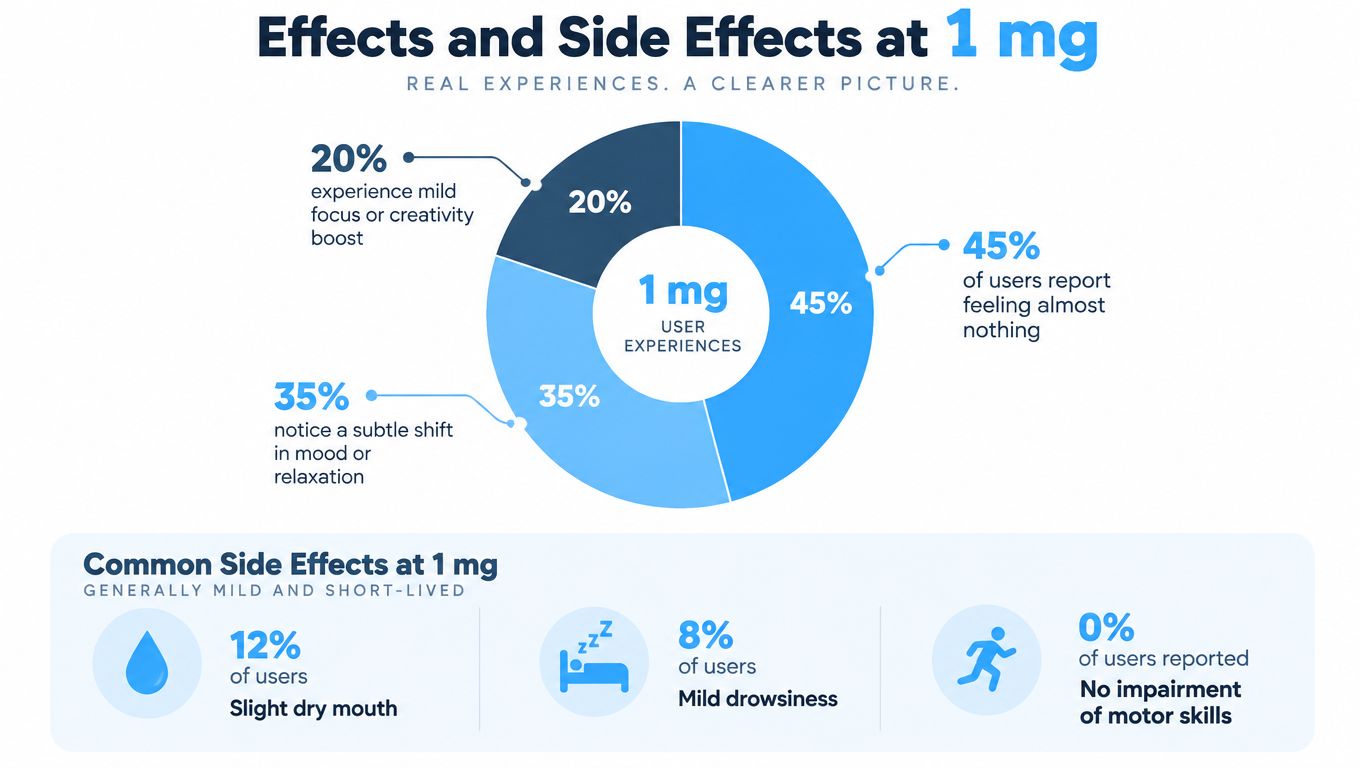
For people exploring low-dose cannabis for sleep, these THC sleep tips from The Sleep Consultant offer general information. Persistent sleep problems merit discussion with a qualified clinician. The practical takeaway is simple: 1 mg is usually gentle, occasionally noticeable, and never risk-free.
How Accurate Is a 1 mg Label, Really
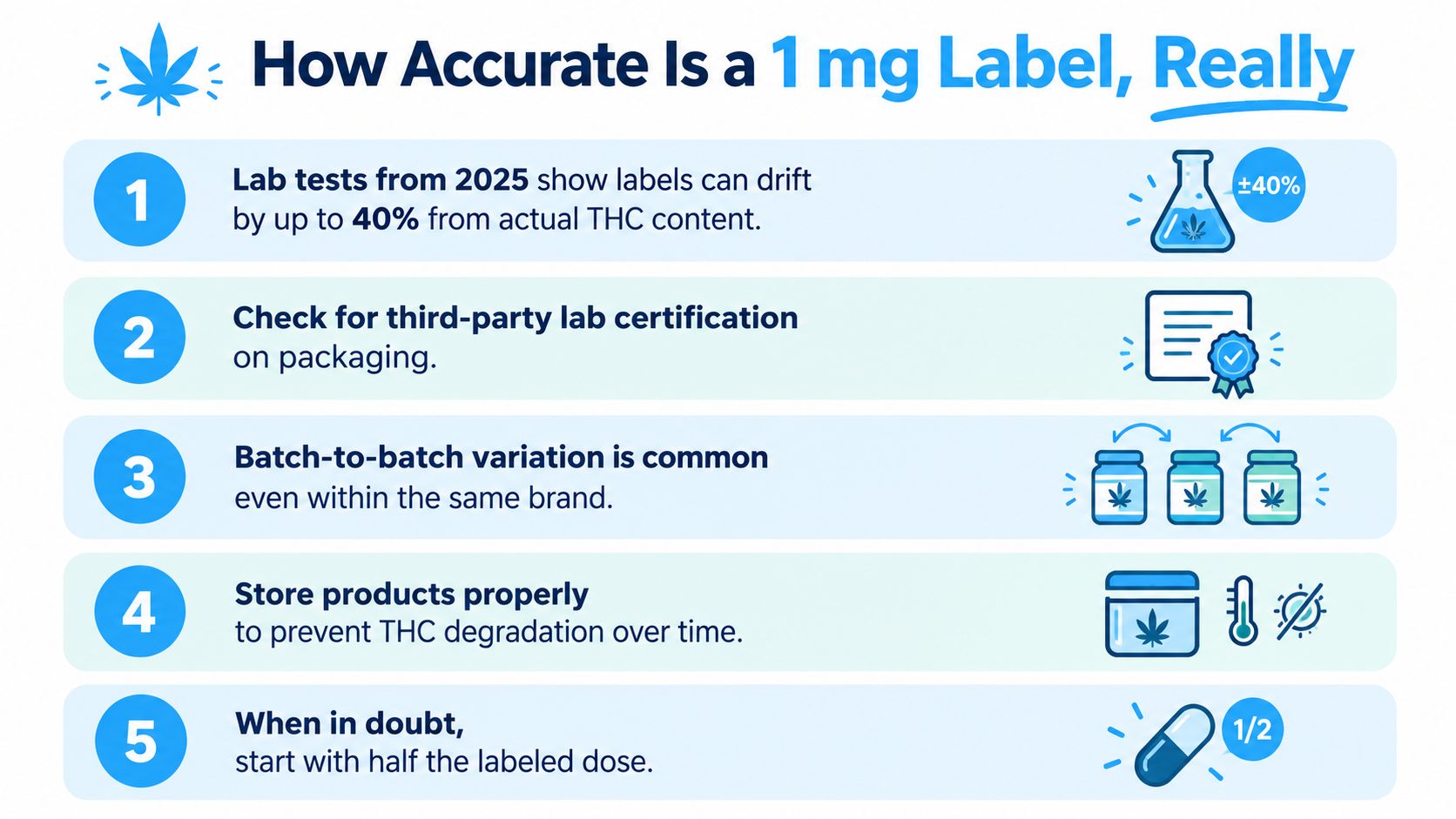
A label that says 1 mg sounds exact. In practice, the amount in a serving and the amount absorbed by your body are separate questions.
A recent laboratory study of commercial cannabis products found that edible labels reported a median of 10 mg THC, while laboratory testing found a median of 9.3 mg, a median difference of 1.22 mg. The study also noted that some regulations allow products containing less than 2.5 mg per serving to vary by plus or minus 40% from the labeled amount. At a nominal 1 mg, that permitted range could represent roughly 0.6 to 1.4 mg before uneven mixing, serving errors, or home measurement mistakes are considered. The laboratory study in PLOS One supports caution, not panic.
What to look for on the package
- A serving-level result: A package total doesn't tell you whether each mint, tablet, or portion contains the same amount.
- A recent certificate of analysis: Look for batch identification, cannabinoid testing, and an independent laboratory name.
- A clear serving size: “One drop” isn't a reliable measurement unless the product explains its concentration and dispensing method.
- Portioned units: Commercially divided mints, tablets, or capsules are easier to measure than a large edible cut into tiny pieces.
- Conservative storage: Heat, light, and time can affect cannabis products, so follow the package storage directions.
Concentrated oils should be measured with a graduated syringe or another calibrated device. One milliliter or one drop can contain different THC amounts depending on the carrier concentration. A practical approach to label reading is similar to the careful process described in this guide for choosing quality supplements, especially its focus on serving size and testing details.
For a deeper look at what laboratory testing can and can't tell you, use this cannabis lab testing resource. A low number on the front of a package is useful only when the product's serving format and testing information support it.
A Simple Microdosing Protocol for First-Timers
A first trial can happen at home on a quiet evening, with no driving, work deadlines, or social commitments ahead. The goal is a controlled observation, not a race to feel an effect. A consistent product, a measurable serving, and enough time between decisions make the experience easier to interpret.
Start with a product you can measure
Choose a commercially portioned edible, capsule, mint, or clearly labeled tincture. Confirm the THC amount per serving rather than relying on the package total. With oil, use the marked measurement device and follow its instructions instead of estimating part of a dropper or drop.
Take the first trial in a familiar setting. Stress, unfamiliar surroundings, and social pressure can change how an effect feels, making it harder to tell what came from the THC.
Let the full timeline unfold
Take 1 mg THC, then wait according to the product format. With a swallowed edible or capsule, effects may begin between 30 minutes and 2 hours and may take up to 4 hours to reach full intensity. Redosing before that window closes can turn a small first trial into a larger cumulative dose. Guidance on lower-risk use is especially important for anyone new to edibles.
Keep a short record:
- Product and serving: Write down the format and labeled THC amount.
- Timing: Record when you took it and when you first noticed a change.
- Experience: Note relaxation, mood, body sensation, focus, drowsiness, or discomfort.
- Next-day response: Record any change in sleep or morning alertness.
Avoid alcohol and other intoxicating substances during the first trial. Do not drive, cycle in traffic, operate equipment, or make important decisions until you understand how that product affects you.
A useful first session may show that 1 mg is enough, rather than create a reason to increase it.
Repeat the same dose on another occasion before changing the amount. If the effect feels comfortable but too subtle, consider a small increase only after you understand the product's complete timeline. If you feel dizzy, anxious, excessively sleepy, or otherwise uncomfortable, remain at the current amount or stop and seek medical advice when appropriate. Individual chemistry can make the same labeled dose feel different from one person to another, so the record helps reveal your own pattern.
Shopping for 1 mg THC Products on Long Island
New York's adult-use framework applies to low-dose cannabis just as it applies to higher-potency products. Adults must be 21 or older, may legally possess up to 3 ounces of cannabis and 24 grams of cannabis concentrate, and may purchase adult-use cannabis only through NYS-licensed dispensaries. New York's Office of Cannabis Management confirms that a 1 mg label doesn't create an age or purchasing exemption.
For shoppers seeking precise servings, ask about categories rather than chasing a particular strain name. Low-dose mints, microdose tinctures, pre-dosed tablets, and clearly divided edibles can make measurement easier. Depending on current inventory, brands such as Wana, Kiva, Wyld, Incredibles, Rythm, and Pax may be relevant starting points, but product availability and exact serving sizes change.
A useful dispensary conversation sounds like this:
- “I'm looking for the lowest clearly labeled THC serving.”
- “Is the amount listed per piece, per serving, or for the whole package?”
- “Do you have a certificate of analysis or batch information?”
- “Is this better for a first trial in the evening?”
- “How long should I wait before deciding whether it worked?”
Strong Strains Cannabis Dispensary in East Setauket offers adult-use cannabis products and budtender guidance across formats such as edibles, tinctures, topicals, vapes, and flower. Its product guides can help shoppers compare product types before visiting.
Microdosing Mindset and Next Steps
The most reliable 1 mg THC routine is deliberately unexciting:
- Do choose a portioned product with clear serving information.
- Do track timing, mood, comfort, sleepiness, and next-day effects.
- Do wait through the product's full onset window before considering more.
- Don't assume 1 mg feels identical for every person.
- Don't mix your first trial with alcohol or other intoxicants.
- Don't drive until you know your response.
A 2022 case report documented submilligram and 1 mg THC amounts in one patient using a plant-derived THC-CBD extract, but the report involved a single patient, had no placebo control, and couldn't separate THC's effects from CBD's. The case report is a historical observation, not proof that 1 mg treats a condition.
Once you understand your baseline, you can discuss cautious changes in amount, format, or formulation with a qualified professional. Cannabis shouldn't replace evaluation for persistent anxiety, insomnia, or pain. For broader non-cannabis mental-health approaches, you can see what Integrative Psychiatry of America offers.
Strong Strains Cannabis Dispensary offers clearly labeled cannabis products, knowledgeable budtender guidance, and convenient in-store pickup or local delivery for adults exploring precise dosing. Visit Strong Strains Cannabis Dispensary to ask about 1 mg-friendly formats and find a measured starting point that fits your experience.