
You're on Long Island, holding a small dropper bottle and wondering whether a THC CBD tincture is supposed to feel calming, intoxicating, or barely noticeable. The label shows milligrams, the bottle mentions a ratio, and the instructions say to place drops under your tongue. The uncertainty usually comes from treating the ratio as the whole story.
A tincture's effects also depend on how you take it, what you've eaten, when you took it, how accurately the bottle is labeled, and how your body processes THC. This guide breaks those decisions into practical steps, so you can compare products more carefully and avoid the common mistake of taking more before the first dose has had time to develop.
What a THC CBD Tincture Actually Is
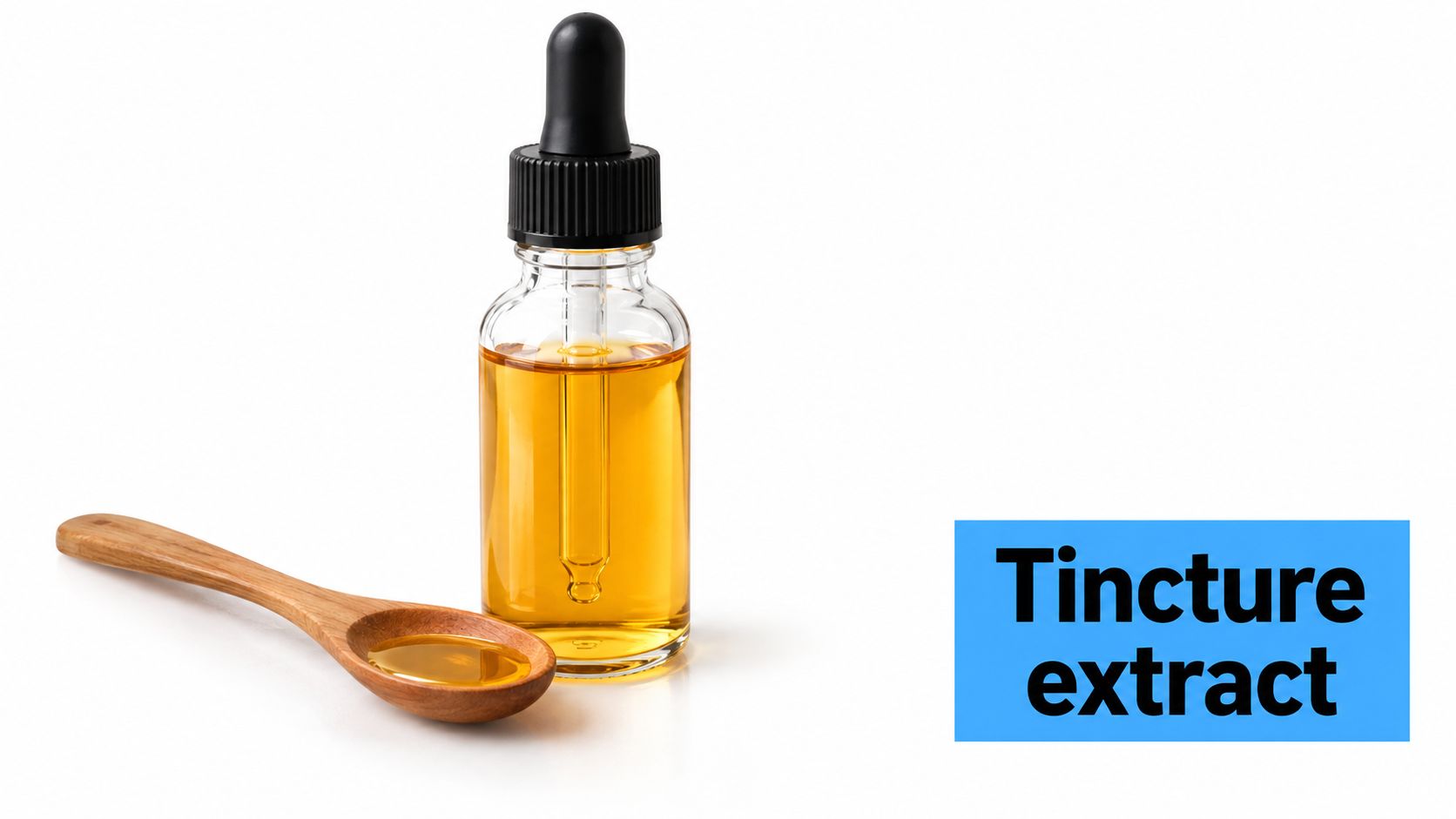
A tincture is a liquid cannabis extract measured with a dropper. The active compounds are carried in a liquid, often an oil, and the product is designed to be placed under the tongue, swallowed, or used in both ways depending on the label. “Tincture,” “oil,” and “extract” can overlap in everyday product language, so focus less on the name and more on the cannabinoid amount, serving size, ingredients, and testing.
If you've used liquid vitamins or a liquid herbal extract, the basic routine will feel familiar. You draw a measured amount into the dropper, place it under your tongue if directed, hold it there, and then swallow or spit according to the product instructions. The important part is measurement. A dropper filled to a marked line is more useful than guessing by drops or treating the entire bottle as one serving.
The label matters more than the bottle shape
Two bottles can look nearly identical while delivering very different amounts of THC and CBD. Look for:
- Total cannabinoids: How many milligrams of THC and CBD are in the entire bottle?
- Serving information: How many milligrams are in the marked serving?
- Volume: How much liquid is in the bottle?
- Directions: Does the product specify sublingual use, swallowing, or both?
- Testing information: Is there a current, batch-specific certificate of analysis?
A product described as “full spectrum” or “CBD-rich” still needs a measured THC amount if THC is present. The practical difference between a tincture and another liquid format is less important than knowing exactly how much cannabinoid you're taking and how your body may absorb it.
For a broader look at product formats, you can browse this liquid tinctures collection, then return to the label questions above before choosing. Strong Strains also explains the fundamentals in its guide to cannabis tincture benefits. The point isn't to buy based on a promising phrase. It's to understand the bottle before you use it.
Strong Strains educates customers before they buy because a measured, informed choice is safer than an impulse purchase. A tincture can be discreet and flexible, but it still deserves the same attention you'd give any product that can affect coordination, alertness, or judgment.
How THC CBD Tinctures Work in the Body
A tincture can feel different from one use to the next even when the bottle and marked serving stay the same. The main variables are where the liquid is absorbed, whether you swallow it, what you recently ate, and how your liver processes THC.
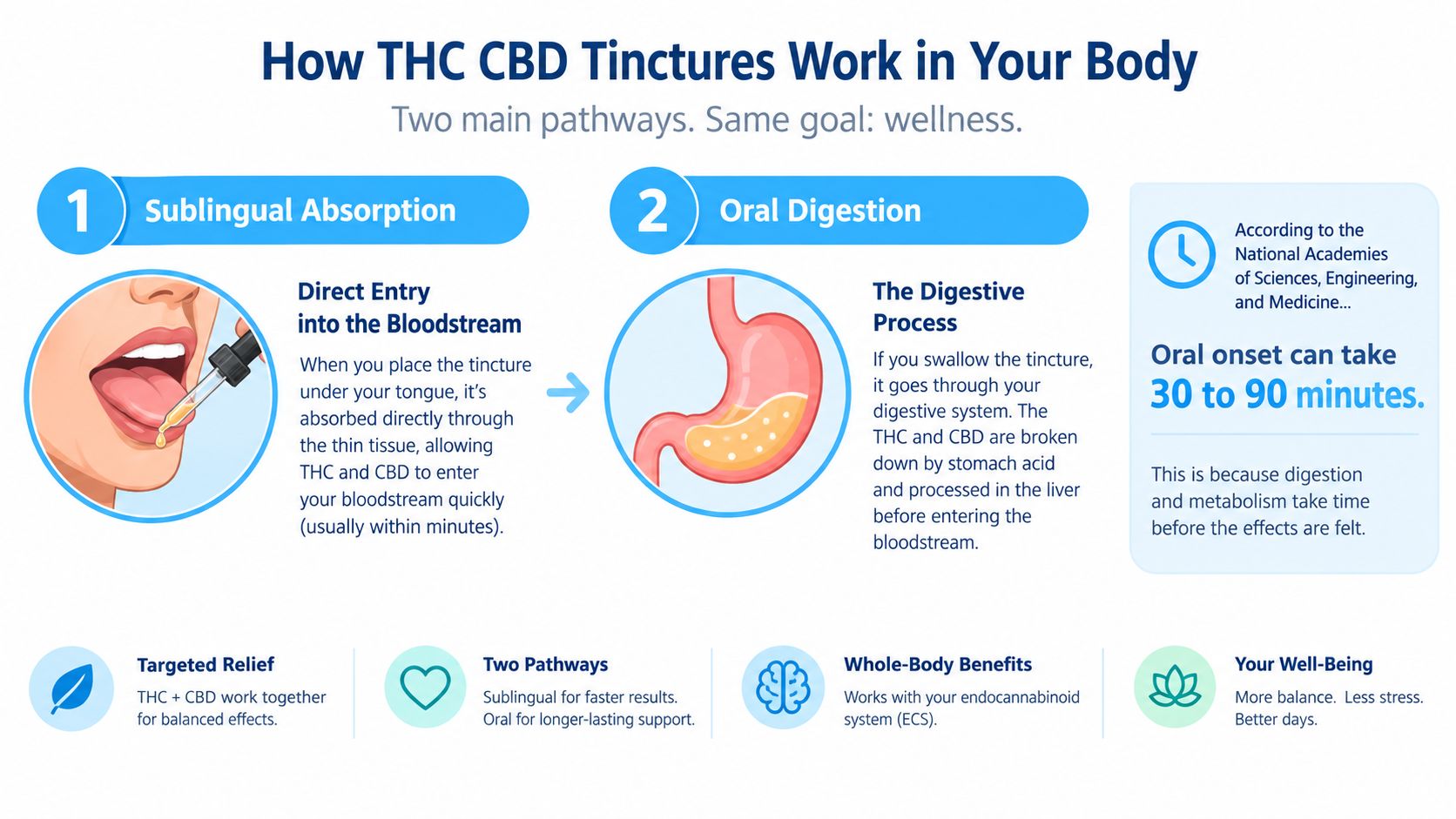
Held under the tongue, some cannabinoids can pass through oral tissue. Swallowed liquid travels through the digestive system and reaches the liver before entering general circulation. That route usually takes longer, and the resulting effect can last longer as well. The National Academies reports that orally consumed cannabis generally begins producing noticeable effects after approximately 30 minutes to 2 hours, with effects lasting about 5 to 8 hours or longer.
A delayed effect creates a common dosing mistake. Someone may decide the serving is too weak, take more, and then feel both servings after the first dose catches up.
Sublingual and swallowed use are not interchangeable
Clinical guidance describes sublingual THC formulations as beginning in approximately 15 to 60 minutes, with peak effects around 45 minutes and duration of roughly 4 to 6 hours (The Permanente Journal). Other regulatory guidance lists drops held under the tongue as beginning in approximately 10 to 30 minutes and lasting about 1 to 3 hours (New York Office of Cannabis Management guidance). The different ranges reflect differences in formulation, product instructions, and how much liquid is eventually swallowed.
Sublingual use therefore does not guarantee a purely mouth-based effect. A portion can enter through oral tissue while the rest follows the digestive route. Research on sublingual products found serum 11-hydroxy-THC-to-THC ratios similar to oral formulations, suggesting that a substantial portion may undergo digestion and liver metabolism.
Why food and liver metabolism change the result
After swallowed THC passes through the intestine and liver, the liver converts delta-9-THC into 11-hydroxy-THC, an active metabolite described as equipotent and longer-lasting than THC itself. Food composition, meal timing, individual metabolism, and whether you swallow the tincture all affect exposure.
Oral THC bioavailability is estimated at roughly 4% to 20%, and it may rise to as much as 25% with a high-fat meal (National Academies). The same labeled serving can therefore feel stronger or last longer after food than on an empty stomach.
Swallowed THC works more like a meal settling than caffeine taking effect. Timing matters as much as dose. Record when you take a serving, give it time to develop, and avoid treating a slow start as proof that you need more.
Understanding THC CBD Tincture Ratios and Effects
Two tinctures can carry similar THC and CBD labels yet feel different in practice. A ratio describes the cannabinoids' relative amounts, not a guaranteed experience. A THC-dominant tincture contains more THC than CBD, a balanced tincture places them closer together, and a CBD-dominant tincture contains substantially more CBD than THC.
| Product category | What the label usually suggests | What it does not guarantee |
|---|---|---|
| THC-dominant | A stronger intoxicating influence may be more likely | It won't affect every person the same way |
| Balanced THC and CBD | Both cannabinoids are present in meaningful amounts | CBD won't reliably cancel THC |
| CBD-dominant | THC may be present at a lower relative amount | It isn't automatically non-intoxicating or THC-free |
Just as two CBD oils with the same milligram label can feel different depending on the carrier fat and serving size, a THC:CBD ratio describes composition but not your personal response. Food, timing, whether you swallow the tincture, and first-pass liver metabolism can all change what the same labeled amount feels like.
CBD is not a guaranteed safety switch
A randomized clinical trial involving 18 adults found that 20 milligrams of oral THC combined with 640 milligrams of CBD produced stronger subjective drug effects, greater cognitive and psychomotor impairment, and a larger heart-rate increase than 20 milligrams of THC alone or placebo (JAMA Network Open). The CBD amount was far above many consumer servings, but the result still challenges the assumption that adding CBD automatically makes THC milder.
CBD may alter the experience, yet it does not remove the THC, change your digestion schedule, or make your response predictable. If THC appears on the label, evaluate the product as a THC product even when the bottle gives CBD the largest headline.
Choose by your actual goal
Begin with the outcome you want to evaluate, then examine the ratio and serving information:
- Relaxation: Compare products with clearly listed THC and CBD amounts, while allowing for possible impairment.
- Daytime function: A lower THC amount may matter more than a prominent CBD claim if you need to stay alert.
- Sleep: A ratio cannot guarantee sleep or a particular next-day experience. Timing and total THC still matter.
- Symptom support: Record the product, serving, food, and effects so you can assess your response without changing several variables at once.
CBD is familiar to many consumers. Survey data found that 71.7% of surveyed US adults had heard of CBD, while 21.1% reported past-year use and 25.2% reported using at least one emerging cannabinoid (JAMA Network Open). Familiarity does not make effects predictable. Even a basic comparison such as diluting oils for everyday skincare points to a useful shopping habit: check concentration and intended use instead of relying on a category label alone.
How to Dose a THC CBD Tincture Safely
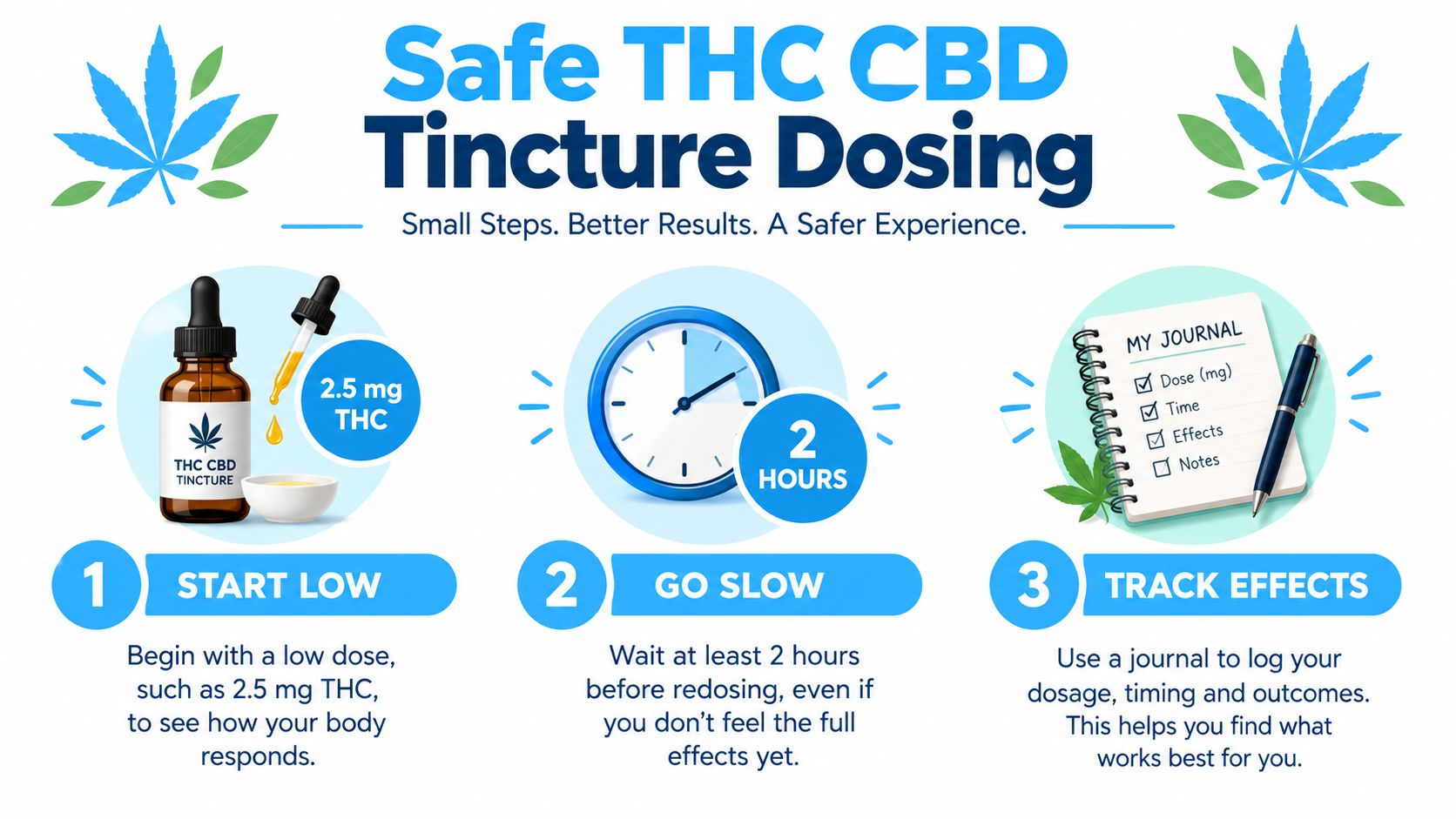
Dosing works best as a controlled experiment, not a test of patience. For people without established THC tolerance, clinical references commonly describe 2.5 to 5 milligrams as a cautious initial oral THC dose (NCBI Bookshelf). That starting point is about the THC amount, not the total amount of liquid or the total CBD in the bottle.
A low-and-slow routine
- Measure the THC. Read the serving line and calculate the THC in that amount. Don't estimate from the bottle's total milligrams.
- Take one small serving. If you're new to THC, begin at the cautious end of the range rather than treating a standard serving as a requirement.
- Write down the time. Note whether you held the tincture under your tongue or swallowed it, and record whether you had eaten.
- Wait before changing anything. Sublingual effects may begin in approximately 15 to 45 minutes, while swallowed doses can take longer and may commonly peak around 2 to 3 hours (The Permanente Journal; NCBI Bookshelf).
- Assess the full window. If the first serving feels manageable, adjust only gradually on a different occasion rather than stacking doses quickly.
Practical rule: If you can't explain how much THC you took and when you took it, you're not ready to redose.
Swallowed THC deserves extra patience because delayed onset can make a person misread tolerance. Don't combine cannabis with alcohol or other intoxicants, and don't drive after use. If you're taking medication, have a health condition, or need to avoid THC exposure, ask a qualified healthcare professional before using a cannabinoid product.
A simple journal can reveal patterns that memory misses. Record the product, THC and CBD amounts, administration method, food, start time, perceived onset, and unwanted effects. Strong Strains' cannabis dosage chart can help you organize those decisions, but your own response remains the deciding factor.
How to Read Lab Tests and Avoid Misleading Labels
A certificate of analysis, or COA, is a laboratory report connected to a specific product batch. It can show cannabinoid potency and whether the batch underwent testing for contaminants and other quality measures. The package describes what the brand intends to sell. A current, batch-specific COA provides evidence about the bottle you are considering.
Begin with the label. Match the product name, batch number, bottle size, and testing date to the report. The connection should be clear enough that you can identify the document for that exact bottle. A generic report without a matching batch identifier does not confirm what is inside your package.
Use the label math
The basic calculation is:
Total cannabinoid milligrams divided by bottle volume equals milligrams per milliliter.
For example, divide the bottle's stated total THC or CBD by its liquid volume. Then compare the result with the marked serving volume. This shows the cannabinoid amount in each milliliter, rather than leaving you to judge vague terms such as “premium,” “strong,” or “full spectrum.” A dropper line is useful only after you know the concentration behind it.
Potency labels can be inaccurate. A 2024 analysis of 202 commercially available CBD products found that 74% differed from their stated CBD potency by at least 10%. 46% contained more than 110% of the claimed amount, while 28% contained less than 90% (Frontiers in Pharmacology). Earlier testing also detected THC in 21.43% of ostensibly CBD products, with concentrations reaching 6.43 milligrams per milliliter. These findings matter for a THC CBD tincture because the same labeled serving can produce a different experience when the actual concentration is off.
What a careful shopper checks
- Batch match: Confirm that the COA identifier matches the package.
- Cannabinoid profile: Review THC, THCA, CBD, and CBDA instead of relying on the product name.
- Serving calculation: Check that the stated serving follows from the bottle's total amount and volume.
- Testing scope: Look for contaminant and quality testing, not only a potency result.
- Date and clarity: Prefer a readable report with clear product details over a vague testing badge.
A cannabis lab testing guide can make COA terminology easier to follow. The report should support the label, not replace careful reading. If the batch, concentration, or serving information is unclear, choose a product with documentation you can interpret clearly.
Safety, Legal Rules, and Choosing Quality Tinctures on Long Island
New York gives shoppers a useful comparison point. Cannabis tincture labels must state total THC and total CBD in milligrams per serving and per package, along with the number of servings and recommended serving size (New York Cannabis Control guidance). That information lets you compare the serving you plan to take, not just the impressive-looking total on the front of the bottle.
New York calculates total THC as THC plus 0.877 times THCA, and total CBD as CBD plus 0.877 times CBDA (New York Cannabis Control guidance). For orally ingested products, each serving may contain no more than 10 milligrams of total THC. A tincture can still contain up to 1,000 milligrams of total THC per package, so serving strength and total bottle contents answer different questions.
A New York shelf check
Before buying, confirm:
- Per-serving THC: Use this number to plan your initial amount.
- Per-package THC: This tells you how much cannabis is in the whole bottle.
- CBD amount: Compare it separately instead of treating CBD as a substitute for THC information.
- Number of servings: Check whether the bottle's serving count matches the volume and directions.
- Batch documentation: Look for testing that corresponds to the product you're purchasing.
The federal hemp framework also needs careful interpretation. The 2018 Farm Bill, signed on December 20, 2018, defined hemp as Cannabis sativa L. and its derivatives containing no more than 0.3% delta-9-THC by dry weight, and removed qualifying hemp from the federal Controlled Substances Act definition of marijuana. It preserved the Food and Drug Administration's authority, so that threshold doesn't automatically mean a finished CBD tincture is safe, effective, accurately labeled, or lawful everywhere (FDA cannabis and CBD regulation).
Store tinctures according to the product label, keep the bottle closed, and use the listed expiration information to guide shelf-life decisions. Keep cannabis products away from children and anyone who might mistake a dropper bottle for an ordinary supplement. Strong Strains emphasizes lab-tested products and informed selection, which is especially relevant when you're comparing cannabinoid ratios, serving amounts, and COAs rather than shopping by packaging alone.
Responsible use means avoiding driving while impaired, avoiding combinations with alcohol or other intoxicants, and giving swallowed THC enough time to take effect before considering more. Product details and regulations can change, so check current New York guidance and the product's own label before purchase.
Strong Strains Cannabis Dispensary offers lab-tested tinctures, including THC and CBD options, with knowledgeable guidance on ratios, serving amounts, and responsible use. Visit Strong Strains Cannabis Dispensary in East Setauket for informed product selection, in-store pickup, or local delivery across Long Island.