
You're standing in a dispensary with a small amber bottle in one hand and a familiar sleep aid in the other. The tincture says indica, which sounds reassuring, but the front label doesn't tell you whether one dropper contains a little THC or a lot, whether CBD is present, or whether the bottle's “indica” description reflects chemistry or just a naming convention.
That's the central question with a cannabis indica tincture. The word may help you browse, but it isn't a dose, a laboratory result, or a guarantee of sleep. A safer buying decision starts with the cannabinoid panel, the measured serving, the ingredients, and the product-specific Certificate of Analysis.
Why the Word Indica Matters Less Than the Label
The word indica carries a strong cultural promise. Many shoppers associate it with quiet evenings, physical relaxation, and a less stimulating experience. That association can influence a purchase before the buyer has checked the THC concentration or asked how much liquid the dropper delivers.
Botany is less tidy than the retail shorthand suggests. Carl Linnaeus treated cannabis as one species, Cannabis sativa, in the 1753 edition of Species Plantarum. In 1785, Jean-Baptiste Lamarck proposed Cannabis indica as a second species for plants associated with India, Southeast Asia, and nearby regions. Later research questioned whether indica and sativa are reliably separate species, with a major review treating them more usefully as subspecies or population groupings within Cannabis sativa (the botanical history and modern qualification are reviewed here).
A heritage label, not a chemical promise
Those early classifications described characteristics such as plant structure and geographic association. They weren't laboratory guarantees about how a tincture would feel after you take it. A modern product labeled indica may reflect cultivar heritage, a terpene profile, cannabinoid concentration, or the retailer's naming system.
That distinction matters at the shelf. Two bottles carrying the same broad label can have very different amounts of THC, CBD, minor cannabinoids, carrier oils, and aromatic compounds. Conversely, a product with a different label may have chemistry that better matches what you want from an evening tincture.
Practical rule: Treat “indica” as a browsing clue. Treat measured milligrams and batch-specific lab results as the evidence.
The label still has useful information. Look for total THC, total CBD, THC per serving, bottle volume, ingredients, expiration date, processor lot number, and a QR code or link to the CoA. If the front says “indica” but the rest of the package leaves those details unclear, the name isn't doing enough work to justify a purchase.
What a Cannabis Indica Tincture Actually Is
A tincture is a liquid cannabis extract prepared for measured use. The cannabis compounds are placed into a carrier, commonly an oil or food-grade alcohol, and the finished liquid is packaged in a bottle with a dropper or another dosing mechanism.
An indica tincture isn't a special extraction category. It's a tincture made with cannabis that the producer or retailer identifies with indica heritage. The same general extraction and blending methods can be used for an indica-labeled product, a sativa-labeled product, or a product marketed as a hybrid.
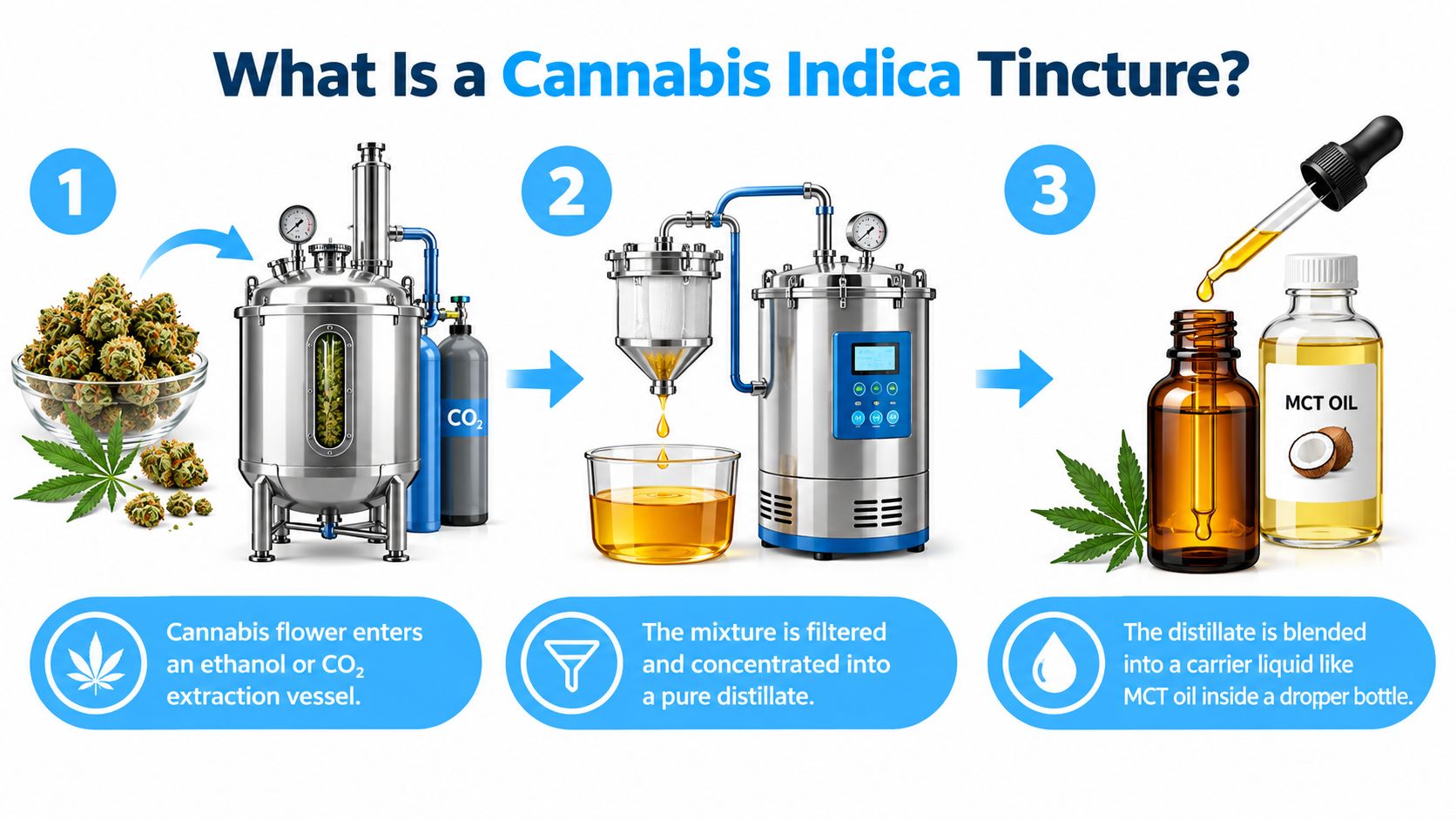
From plant material to finished liquid
Producers first obtain cannabis extract containing cannabinoids such as THC and CBD. Cannabinoids in raw plant material can occur in acidic forms, including THCA and CBDA. Controlled processing can convert those acidic forms into the neutral forms used on a finished product label, although the exact process depends on the producer and formulation.
The extract is then combined with a carrier. MCT oil, hemp seed oil, avocado oil, and food-grade alcohol can create different flavor and handling experiences. The carrier affects texture, taste, storage requirements, and how the product is used, but it doesn't make the word indica more chemically precise.
You may also see these formulation terms:
- Full-spectrum: Contains a broad range of cannabis compounds from the extract, subject to the product's formulation and testing.
- Broad-spectrum: Includes multiple cannabis compounds while being formulated to exclude or minimize a particular compound, depending on the product.
- Isolate: Centers on a single purified cannabinoid, such as CBD, rather than a broad extract.
Read those terms alongside the CoA instead of assuming they predict an effect. A full-spectrum bottle can still be high in THC, while an isolate can have a very different cannabinoid profile despite carrying a familiar product name.
The bottle's identity comes from the whole formulation, not the word on the front. Carrier, cannabinoid content, terpene profile, serving size, and laboratory results tell you far more about what you're buying than a strain category alone.
The Indica Effect Myth and What the Chemistry Shows
Many cannabis shoppers learned a simple rule: indica means sedating, sativa means energizing. That rule is easy to remember, but it doesn't consistently describe the chemistry inside a retail tincture.
Genetic and chemical research has challenged a clean indica-versus-sativa split. In an analysis of more than 100 cannabis samples, products carrying indica and sativa labels were genetically indistinguishable at the genome-wide level, while the labels showed only limited associations with particular terpenes, including myrcene, guaiol, gamma-eudesmol, and beta-eudesmol (the analysis is discussed in this peer-reviewed article). A separate review found no consensus operational definition for either label and reported that products using both labels could have similar concentrations of major cannabinoids such as THC and CBD.
What to inspect instead
The practical replacement for the old shortcut is a chemotype-first approach. Start with the amount of THC and CBD per measured serving. Then look for minor cannabinoids and the dominant terpenes listed on the CoA or package.
Terpenes may contribute to how people perceive different cannabis products, but you shouldn't treat myrcene, linalool, beta-caryophyllene, or any single compound as a guaranteed cause of sleep or calm. The whole formulation matters, and individual response varies.
The interaction among cannabinoids and terpenes is often described as the entourage effect. For a plain-language overview of that concept, read this entourage effect explanation, then return to the product's actual lab report before making a decision.
“Indica” can describe heritage. It can't tell you the exact THC-to-CBD ratio.
A shopper seeking an evening product might prefer a formula with a particular THC level, some CBD, and a terpene profile they've personally tolerated before. Another shopper may find that the same label doesn't suit them. The useful question isn't “Is this indica?” It's “What does this batch contain, and how much will I take?”
How to Take an Indica Tincture for the Best Results
A tincture gives you two basic administration paths. You can place a measured amount under your tongue, or you can swallow it directly or mix it into food or a drink. Those routes can produce different timing and intensity, so choose one method and keep it consistent while you're learning your response.
Sublingual use
Shake the bottle if the label directs you to do so. Draw the liquid to the marked line on the dropper, place it beneath your tongue, and hold it there as directed. The infographic's 60 to 90 second holding guidance is a useful technique cue, but follow the product's own instructions when they differ.
Sublingual use shouldn't be treated as a guaranteed bypass of digestion. Evidence from THC oromucosal formulations found serum 11-hydroxy-THC-to-THC ratios resembling oral dosing, which suggests that some of the liquid is swallowed and undergoes first-pass metabolism. One sublingual THC formulation had estimated relative bioavailability of approximately 13%, and oral THC and CBD bioavailability is generally low and variable, estimated at roughly 5% to 20% (the pharmacokinetic evidence is summarized here).
Avoid rapid redosing just because the first few minutes feel uneventful. Hold the dose as directed, avoid treating onset as immediate, and evaluate the experience over several hours. Food intake, oil composition, metabolism, technique, and tolerance can all change the result.
Swallowing the tincture
When you swallow the liquid, your digestive system and liver handle it as an oral cannabis dose. That route can take longer to develop, and the experience may differ from holding the same amount under your tongue. Food can also change timing and intensity, so record whether you took the product with a meal or on an empty stomach.
The attached comparison visual shows a sublingual onset range of 15 to 45 minutes and an oral range of 30 to 120 minutes. Use those figures as a visual orientation rather than a promise, because the evidence supports meaningful variation between formulations and people.
For either route, use the marked dropper, write down the amount and time, and don't drive or combine cannabis with alcohol while you're assessing the effect. A measured routine is more useful than trying to recreate an experience from a different bottle.
Understanding Potency, Servings, and Dropper Math
A tincture's bottle total can make a product look stronger or weaker than the actual serving. New York's adult-use framework separates THC per serving from THC per package. Oral cannabis products generally have a limit of 10 milligrams of total THC per serving and 100 milligrams per package, while tinctures have a distinct allowance of up to 1,000 milligrams of total THC per package and retain the 10 milligram per serving limit (New York's consumer guidance explains these serving and package distinctions).
That means a bottle with a large package total can still be divided into controlled servings. A 1,000 milligram tincture at the 10 milligram serving limit represents as many as 100 labeled servings, depending on the bottle volume and dosing mechanism.
The calculation that matters
Use the label's total THC and bottle volume:
- Divide total THC by total milliliters to find THC per milliliter.
- Use the dropper's marked volume to calculate the amount in one measured serving.
- Compare that amount with the package's stated serving size.
- Repeat the calculation for CBD if the product lists it.
Don't assume that one milliliter equals a fixed number of drops. Drop size changes with the dropper, liquid thickness, and how you hold the bottle. The marked line on the included device is more dependable than a generic drop-count assumption.
| Total THC in 30 mL Bottle | Approx. mg per 1 mL Dropper | Approx. mg per Drop (20 drops/mL) | New York Legal? |
|---|---|---|---|
| Read the package total | Divide package THC by 30 | Not reliable without the actual dropper | Confirm serving and package limits |
| A bottle labeled within the tincture package allowance | Use the label and bottle volume | Use only if the manufacturer specifies drop volume | Check the matched package label and CoA |
| A bottle with unclear volume or serving information | Cannot calculate safely | Cannot calculate safely | Don't purchase until clarified |
For example, don't turn a package total into a personal dose by guessing how many drops fit in a milliliter. Ask the budtender to identify the labeled serving, or choose a product with clear milligrams per serving. A useful guide to comparing stronger formulas is this THC tincture potency resource, but the same rule applies at every potency level: calculate the measured serving before you use it.
Reading a Certificate of Analysis Before You Buy
The CoA is the document that connects the bottle in your hand to a laboratory test. Find the QR code or web address on the package and confirm that the report identifies the same processor lot number printed on the bottle. A report for a different lot may describe a related product, but it doesn't verify the exact batch you're considering.
Start with the cannabinoid panel
Look for total THC, THC or THCA values, CBD, and any listed minor cannabinoids. New York guidance calculates total THC using THC plus 0.877 times THCA, so don't confuse a raw THCA figure with the final total THC value shown for an active product.
Then compare the laboratory result with the package label. New York processor rules generally require labeled cannabinoid and terpene concentrations to fall between 85% and 115% of laboratory-measured values. The package should also make the serving calculation clear, including the total THC per serving and the total amount in the bottle.
Scan the safety panel
A useful CoA should address the required contaminant categories, including:
- Microorganisms: Check that the product passes the applicable microbial testing.
- Heavy metals: Look for a passing result rather than an unexplained blank.
- Pesticides: Confirm that the tested batch meets the applicable safety standard.
- Residual solvents: Review the result when extraction solvents were used.
- Other analytes: Check for foreign material and any additional categories listed for the product.
For broader context on how to evaluate laboratory paperwork, compare the process with Yuve's supplement safety check. The terminology differs across product categories, but the habit is the same: identify the batch, inspect the testing, and avoid relying on packaging language alone.
Missing lot numbers, vague potency statements, broken PDFs, and QR codes that lead only to a generic brand page are reasons to pause. A product-specific cannabis lab testing guide can help you understand the report format, but the buying rule is simple:
No matched CoA, no purchase.
Tinctures Compared to Edibles, Vapes, and Flower
Format changes the practical experience even when the product contains similar cannabinoids. A Long Island adult choosing a tincture for evening use should compare onset, duration, dose precision, and setting, not just the strain name.
| Format | Typical Onset | Typical Duration | Dose Precision | Best-Fit Use Case |
|---|---|---|---|---|
| Tincture held under the tongue | Variable and technique-dependent | Variable | Strong control when the dropper is clearly marked | Measured home use and gradual calibration |
| Swallowed tincture | Slower and variable | Variable | Strong control if the serving is measured | Planned evening use or adding a measured amount to food |
| Edible | Delayed and variable | Often longer-feeling for some users | Precise only when the package clearly divides servings | People who prefer a pre-portioned product |
| Vape | Usually faster than an oral product | Variable | Less precise than a marked dropper | Convenience and situations where inhalation is appropriate |
| Flower | Rapid inhaled onset | Variable | User-dependent and harder to measure exactly | Adults who already understand inhaled dosing and want rapid feedback |
A tincture sits between inhaled cannabis and a swallowed edible in practical control. The dropper lets you work with a measured liquid amount, while the label can show the cannabinoid content of that serving. That doesn't remove uncertainty, because absorption and individual response still vary, but it gives a new user a clearer record of what went into the dose.
Flower can appeal to someone who wants rapid feedback and already knows how inhaled cannabis affects them. Vapes can be convenient, but cartridge formulations and hardware vary, so convenience doesn't equal uniform dosing. Edibles offer a ready-made serving, yet delayed effects can tempt inexperienced users to take more before the first serving has fully developed.
Match the format to the situation
For sleep, a tincture may appeal to someone who wants to measure a serving and keep notes across several evenings. For daytime relief, a lower-exposure approach and a format that allows careful adjustment may feel more manageable. For social use, the most important factor is whether you can predict your response well enough to remain unimpaired and comfortable.
The adult deciding between a sleep aid and an amber bottle at the start of this guide doesn't need to identify the “strongest” indica. They need to decide whether an oral format, a measurable serving, and a known cannabinoid profile fit the evening better than an inhaled product or a pre-portioned edible.
A Practical Checklist for Your First Indica Tincture
Use this checklist at the counter, then repeat it at home before opening the bottle. Whether the shelf carries Canna Clinicals, Green Revolution, Kiva, Wana, or another maker, the same verification process applies.
Before you pay
- Read total THC and CBD: Find the amount in the full bottle and the amount in one labeled serving. If either figure is missing, ask for clarification.
- Confirm the volume: Identify the bottle's milliliter size and the dropper marking. Don't translate the package total into drops by guesswork.
- Inspect ingredients: Look for the carrier oil, alcohol, flavorings, allergens, and additives that matter to you.
- Check the date and lot: Confirm the expiration date and processor lot number are visible and legible.
- Scan the CoA: Make sure the QR code or link opens a report for the exact lot in front of you.
Before the first dose
- Choose one route: Hold the measured amount under your tongue as directed, or swallow it. Don't change methods while trying to understand your response.
- Start conservatively: Use a small measured amount appropriate to the labeled serving and your experience level. The word indica doesn't justify taking more.
- Wait before redosing: Oral and sublingual cannabis can develop gradually. Give the first measured amount time to show its effects instead of chasing an immediate feeling.
- Record the details: Write down the product, serving amount, time, food intake, and how you felt. Your own notes become more useful than a strain stereotype.
- Store it securely: Keep the bottle closed, in a cool dark place, away from children and pets, and in its original labeled container.
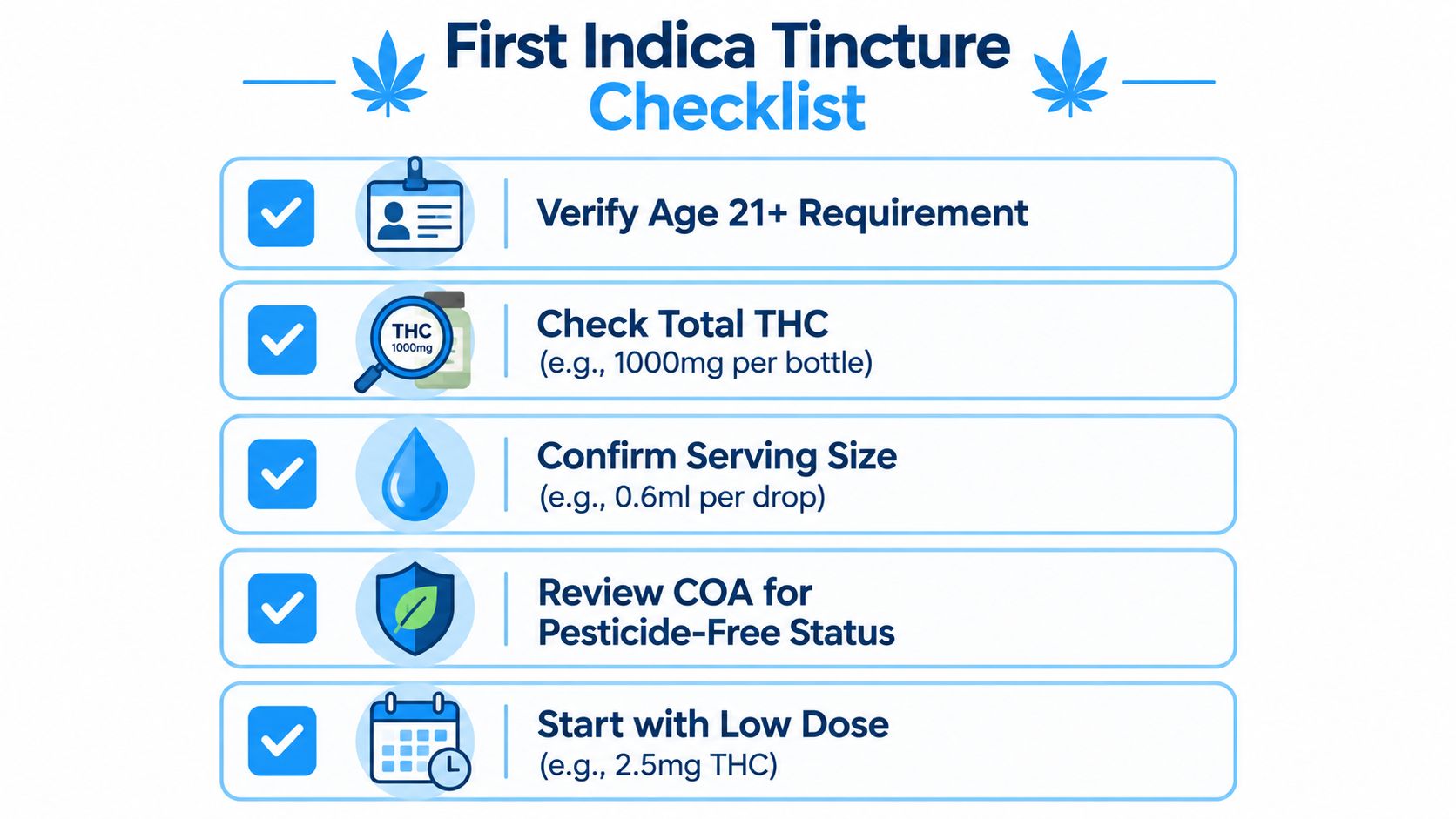
Keep purchase and possession decisions within New York's adult-use rules, and remember that regulated access is for adults 21 and older. Don't drive after using THC, and don't combine it with alcohol while you're learning how the tincture affects you.
A good first purchase isn't the bottle with the most persuasive indica artwork. It's the bottle with clear milligrams, a readable serving, suitable ingredients, and a CoA that matches the lot. The label starts the conversation. The evidence finishes it.
Strong Strains Cannabis Dispensary offers lab-tested tinctures, including options such as Canna Clinicals Unwind Tincture and Green Revolution Good Vibes Tincture, with budtender guidance on cannabinoid profiles, serving calculations, and available testing information. Visit Strong Strains Cannabis Dispensary in East Setauket for help comparing a cannabis indica tincture with other formats and choosing a measured starting point.