
You walk into a dispensary with a simple question, but the room feels rushed. A budtender points toward a display, gives you a potency number without context, and moves on to the next customer. You leave with a product, but not much confidence that it fits what you wanted.
That isn't 5 star customer service. At a Long Island dispensary, excellent service means someone listens carefully, explains options without pressure, respects your privacy, and helps you make a decision you can feel good about. The standard is warm, but it's also repeatable, measurable, and built around reducing customer effort.
What 5 Star Customer Service Actually Looks Like at a Dispensary
A customer enters Strong Strains in East Setauket looking for something to help them unwind. In a weak interaction, the employee offers the most visible product, mentions a high THC figure, and asks whether they're ready to check out. The customer may appreciate the friendly tone, but they still have unanswered questions about onset, dosage, duration, and whether an edible or flower product makes more sense.
A stronger interaction starts differently. The budtender acknowledges the customer promptly, asks whether they've used cannabis before, learns what “unwind” means to them, and checks preferences around potency, format, and timing. A first-time customer may need a plain explanation of serving size and onset. An experienced shopper may want a direct comparison between concentrates, flower, or a vape. Neither person needs a sales pitch.

The experience starts before the recommendation
Five-star service begins at the door. Staff should greet people, acknowledge anyone waiting, and give each customer their full attention when a consultation starts. Cannabis purchases can feel personal, especially for new consumers or people shopping for relief. A customer shouldn't have to compete with side conversations, inventory tasks, or a budtender's phone.
That standard also applies online and after checkout. Clear product information, accessible order support, and dependable communication help customers feel looked after beyond the counter. Businesses looking for useful service patterns outside retail can also review 10 customer experience examples for home services, particularly the examples involving communication, updates, and follow-through.
At Strong Strains, dependable service means guidance without judgment and recommendations without pressure. The objective isn't to push the most expensive item. It's to help each person understand the choice in front of them. That philosophy is also reflected in the dispensary's approach to dependable service, where consistency matters as much as personality.
The practical test: If a customer can explain what they bought, why it fits, and how to use it responsibly, the interaction delivered more than friendliness.
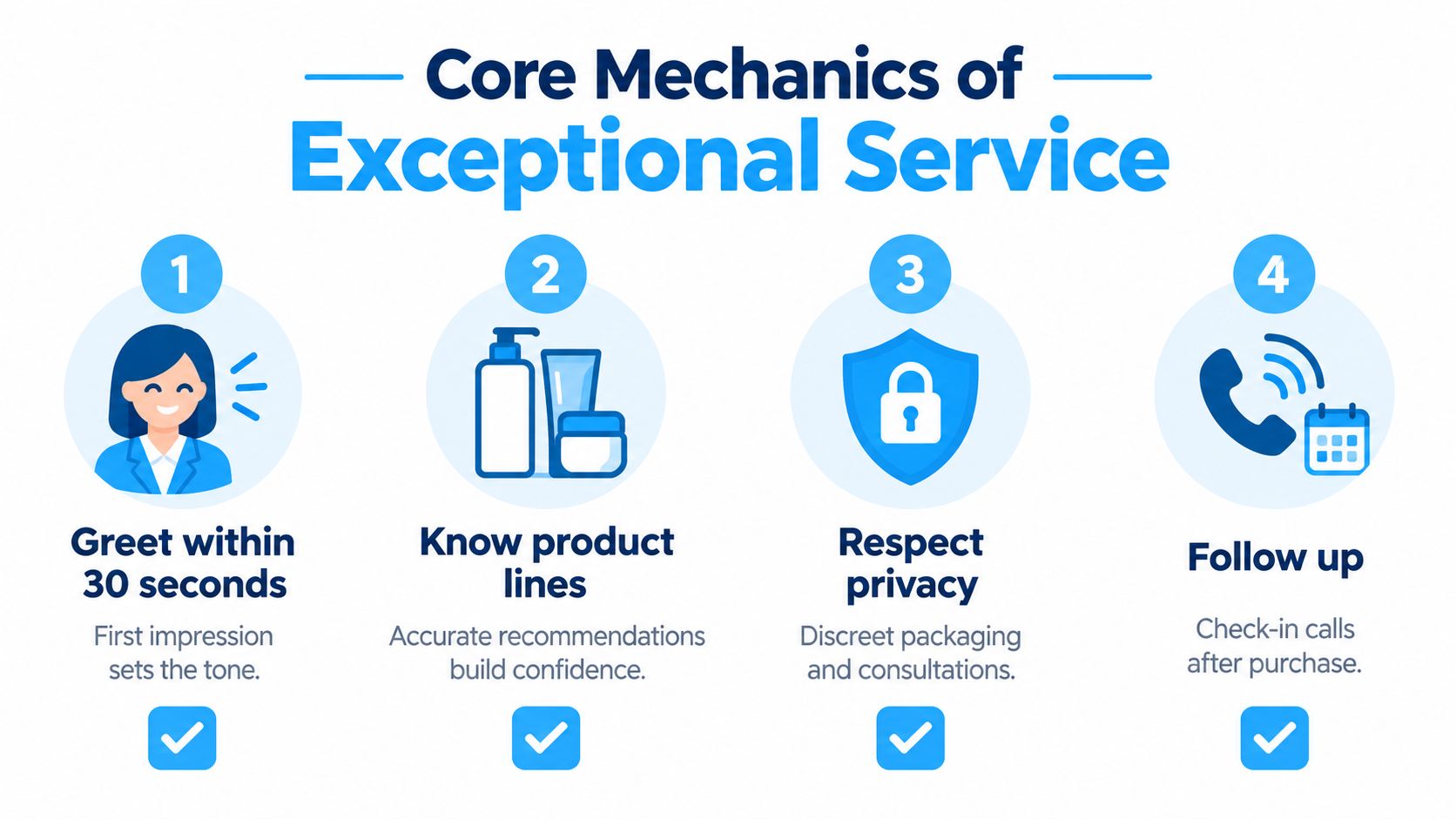
The Core Mechanics Behind Exceptional Dispensary Service
A warm personality helps, but it can't carry a busy retail floor by itself. Five-star service comes from small actions that employees repeat consistently, even when several customers arrive together.
Start with recognition and attention
Acknowledge every person entering the store. If you're already helping someone, make eye contact and let the new arrival know they haven't been missed. A simple greeting lowers uncertainty and gives waiting customers a clear sense of what happens next.
During a consultation, stop avoidable side tasks. Face the customer, let them finish speaking, and ask a follow-up question before reaching for a product. Cannabis-retail guidance specifically emphasizes greeting visitors, acknowledging people who are waiting, maintaining eye contact, giving full attention, and avoiding interruptions during conversations according to front-of-house dispensary guidance.
Reduce effort on the first conversation
The best budtenders gather the information that affects the recommendation:
- Use case: Ask whether the customer wants relaxation, creativity, relief, sleep support, social use, or another goal.
- Experience level: Find out whether they're new to cannabis or already comfortable with particular formats.
- Potency tolerance: Discuss what has worked before and whether the customer wants a gentler or stronger experience.
- Onset preference: Explain the difference between inhaled products and formats that take longer to begin working.
- Format constraints: Check whether the customer prefers flower, pre-rolls, vapes, edibles, tinctures, concentrates, or topicals.
- Practical concerns: Ask about discretion, portability, smell, timing, and whether the order is for immediate use or later.
First-contact resolution matters because every transfer or repeated explanation adds effort. Benchmark material places strong operations around 70% to 79% first-contact resolution, with world-class performance at 80% or higher, while common CSAT benchmarks sit around 75% to 85% in this customer service benchmark guide. Those figures aren't a dispensary promise, but they illustrate the operating principle. Get the customer close to the right answer during the first meaningful conversation.
Treat speed as one part of service
A fast greeting is useful, but rushing the recommendation creates avoidable returns, disappointment, and repeat questions. Recent research describes a resolution gap. Only 9% of respondents said a quick response matters most, while 59% said handoffs are difficult because they have to explain the issue again, and 93% said easy access to a person when automation fails is extremely or very important in the 2026 LivePerson research summary.
That matters for delivery, online orders, and in-store pickup. Automation can handle routine status updates, but a person should be available when an order needs clarification or a product question becomes personal. A smooth handoff is still a handoff, but the customer shouldn't have to start from the beginning.
Why Service Quality Builds Brand Trust and Repeat Visits
A customer can buy cannabis from many retailers. Product selection matters, but selection alone rarely creates a lasting relationship. Customers remember whether someone helped them avoid a poor fit, explained a confusing label, and treated a sensitive question with discretion.
The business case is direct. One 2026 customer-service summary reports that 89% of customers are more likely to purchase again after a positive service experience, while 72% are willing to pay more for a better customer experience. The same summary says consumers are 2.9 times more likely to trust a brand after a five-star experience than after a one- or two-star experience, and independent CX reporting states that customers reporting a good experience are 38% more likely to recommend the company in this customer service statistics summary.

Education creates stronger loyalty than pressure
Discounts can bring someone through the door. Education gives them a reason to return. A customer who learns how potency, format, onset, and personal preference affect a purchase can make better choices over time. They're also more likely to ask for help again because the interaction felt useful rather than transactional.
That distinction is especially important for first-time shoppers. A new customer may not know whether a vape, tincture, edible, or topical fits their routine. An experienced customer may want a specific type of concentrate or a more precise comparison between products. Both deserve clear information, not assumptions.
For service teams, brand trust grows through consistency. One excellent consultation followed by a dismissive pickup experience creates confusion. Customers judge the full journey, including ordering, waiting, payment, packaging, questions, and follow-up.
The experience can be supported by more than a storefront conversation. Product education, clear safety guidance, and accessible support through email, phone, texting, live chat, FAQs, and knowledge centers give customers different ways to get help as cannabis-industry guidance on customer education and support explains.
A customer who recommends a dispensary in Setauket, East Setauket, or elsewhere in Suffolk County is putting their own credibility behind that recommendation. Respectful service makes that personal referral easier because the customer can describe more than a product. They can describe how the business made the decision feel manageable.
How Top-Notch Budtenders Match You to the Right Product
A skilled budtender doesn't begin with a brand name. They begin with the customer's goal and constraints, then narrow the field.
The same approach can apply across products from 1937, 40 Tons, 6 Point Cannabis, &Shine, Aeterna, Airo, Alien Labs, Ayrloom, Botanist, Camino, Cookies, Connected, Edie Parker, ElectraLeaf, Florist Farms, Good Green, Head & Heal, Heavy Hitters, Jeeter, Jetty, Kiva, MFNY, Olios, Pax, Preferred Gardens, Rove, Runtz, Rythm, Stiiizy, Stone Road, Turn, Wana, Wyld, and Zizzle. A name on the package is only one part of the decision. The format, potency, ingredients, serving guidance, and intended use still need to fit the person buying it.
A simple consultation matrix
| Customer priority | Formats worth discussing | Questions that improve the match |
|---|---|---|
| Relaxation | Flower, pre-rolls, vapes, tinctures, or edibles | Do you want a quicker onset or a longer-lasting option? |
| Creativity | Flower, vapes, or lower-intensity formats | Do you prefer a clear, functional experience or something more immersive? |
| Relief | Tinctures, topicals, flower, or other suitable formats | Is the need localized, general, occasional, or part of a routine? |
| Sleep | Tinctures, edibles, flower, or other formats | When do you want the effects to begin, and what has your past experience been? |
This isn't a prescription. It's a structure for a better conversation. A budtender should explain trade-offs, including onset, duration, discretion, dose control, and how easily a customer can adjust their experience.
For example, an edible may suit someone who wants discretion and duration, but it requires patience and careful attention to serving guidance. A vape may offer a more immediate experience, while flower can give an experienced consumer more control over amount. A topical may be worth discussing when the customer wants a non-inhaled format for a localized routine.
Customers who want more background before visiting can review this guide to understanding different cannabis strains. The best recommendation still comes from a conversation that connects that information to the customer's actual needs.
Local Customer Stories That Define Five-Star Experience
The clearest service examples usually happen in ordinary moments. A new customer arrives at the East Setauket shop feeling unsure about the difference between a pre-roll and a vape. Instead of treating the question as basic, the budtender explains the formats, asks about timing and comfort, and lets the customer choose without pressure. The customer leaves with a manageable starting point and a clear reason for the choice.
Another common Long Island situation involves an experienced shopper who knows exactly what they want but still needs transparency. They may ask about a new flower option, a concentrate, or a product from a familiar name such as American Hash Makers, Boutiq, Brass Knuckles, Dank, DTF Hash Co., Ghost, Hashtag Honey, Lost Farm, Lowell Herb Co, Moonlit Hash Co, Papa & Barkley, or Plug Play. Five-star service doesn't slow that customer down with an unnecessary lecture. It answers the question directly, confirms the relevant details, and respects their knowledge.

Pickup and delivery reveal operational discipline
A customer ordering online may value convenience more than an extended consultation. Their five-star experience depends on accurate product information, clear order communication, a sensible pickup process, and help when something changes. A delivery customer needs the same respect for time and privacy, even though the interaction happens away from the sales floor.
A representative Setauket delivery scenario might involve a customer who notices a question about an order after leaving the site. A responsive team doesn't force them to search through multiple channels or repeat the order details to several people. Staff identify the request, explain the next step, and close the loop.
The difference between a standard transaction and a premium interaction is often small. It may be the employee who notices confusion before the customer asks, the recommendation that avoids an obvious mismatch, or the follow-up that confirms the issue was handled. Customers in Suffolk County don't need theatrical luxury. They need competence that feels personal.
Practical Tips for Getting the Best Service on Your Next Visit
You can make a consultation more useful by arriving with a clear idea of what you want to accomplish. You don't need to know the right product name. You only need to describe the outcome, timing, and constraints.
Use these prompts:
- Describe the goal: Say whether you're shopping for relaxation, sleep, creativity, relief, social use, or another purpose.
- Share your experience: Mention what you've tried before and whether it felt too mild, too strong, too short, or otherwise unsuitable.
- Ask about trade-offs: Compare onset, duration, discretion, dose control, and format rather than asking only for the strongest option.
- Request usage guidance: Ask what the label means, how to approach serving information, and what responsible use looks like.
- Mention the setting: Explain whether you need something for home, travel within permitted rules, an evening routine, or occasional use.
If you're ordering ahead, review the online ordering process before submitting the cart. Check the product details, pickup or delivery choices, and the available support route so you know where to turn if an item needs clarification.
Good service shouldn't end when you leave. Save the dispensary's support details and use the channel that fits the question. Email may work for a non-urgent order question, while phone or on-site help may be better for a time-sensitive issue. FAQs and knowledge centers are useful for routine education, but a person should remain available when the answer depends on your circumstances.
Why Strong Strains Treats Service as a Measurable Standard
A service promise only matters when employees can apply it during a busy shift. That requires a written plan, clear expectations, practical orientation, and ongoing coaching. One cannabis-retail operations guide recommends creating a service plan with measurable goals, documenting it, and communicating it through orientation and training in its discussion of dispensary service standards.
The useful measures aren't limited to sales. Managers can review whether staff acknowledge arriving customers, complete consultations without unnecessary transfers, explain product information accurately, and resolve order questions through to the final step. Customer feedback can reveal where the process creates friction, while coaching helps employees correct the behavior without turning service into a rigid script.
Consistency matters more than charisma. One budtender may be naturally outgoing, while another is quieter and highly methodical. Both can deliver five-star customer service if they listen, protect privacy, explain options, and follow through.
Strong Strains Cannabis Dispensary provides in-store support in East Setauket along with online ordering, in-store pickup, local delivery, and customer assistance through its available contact options. Those channels give customers different ways to access product education and order help while keeping the same standard of respectful communication.
Frequently Asked Questions About Dispensary Service Quality
How can I tell whether a budtender is knowledgeable?
A knowledgeable budtender asks questions before recommending a product, explains trade-offs clearly, and admits when they need to verify information. They won't reduce every decision to THC strength or push a product without learning your goal.
What should follow-up support look like?
You should be able to ask a question through an accessible channel and receive a clear next step. Order support, product education, and corrections should remain connected instead of sending you from person to person. Businesses can also use resources such as FAQ as a deflection tool for routine questions, while keeping human help available for complex issues.
Is delivery service as personal as shopping in store?
It can be, but the mechanics differ. Delivery depends on accurate ordering, clear updates, discreet handling, and an easy way to resolve problems. In-store service offers more immediate conversation, while delivery works best when digital support and follow-through are strong.
What are red flags for poor service culture?
Watch for ignored customers, interruptions, pressure to buy, vague answers, repeated handoffs, and staff who can't explain basic product differences. A busy store can still be respectful. Rushed, dismissive behavior is a culture problem, not just a busy moment.
Visit Strong Strains Cannabis Dispensary in East Setauket for lab-tested cannabis products, knowledgeable budtender guidance, in-store pickup, and local delivery. Bring your goal and questions, and let the team help you choose a flower, vape, pre-roll, edible, concentrate, tincture, topical, or accessory that fits your routine.