
You're standing at a dispensary shelf comparing tinctures. One bottle says 1,000 mg THC, another says 600 mg, and a third advertises a concentrated formula in a much smaller bottle. The biggest number looks like the obvious winner, but it may not be the strongest product by the measure that matters when you're holding a dropper.
The useful question is not, “Which bottle has the most THC?” It's how much THC is in each milliliter, how accurately you can measure your dose, and whether you're using the oil under your tongue or swallowing it. This guide breaks down those variables, New York's legal ceiling, certificate-of-analysis checks, and a safer way to evaluate a high-potency tincture.
What Strongest THC Tincture Actually Means
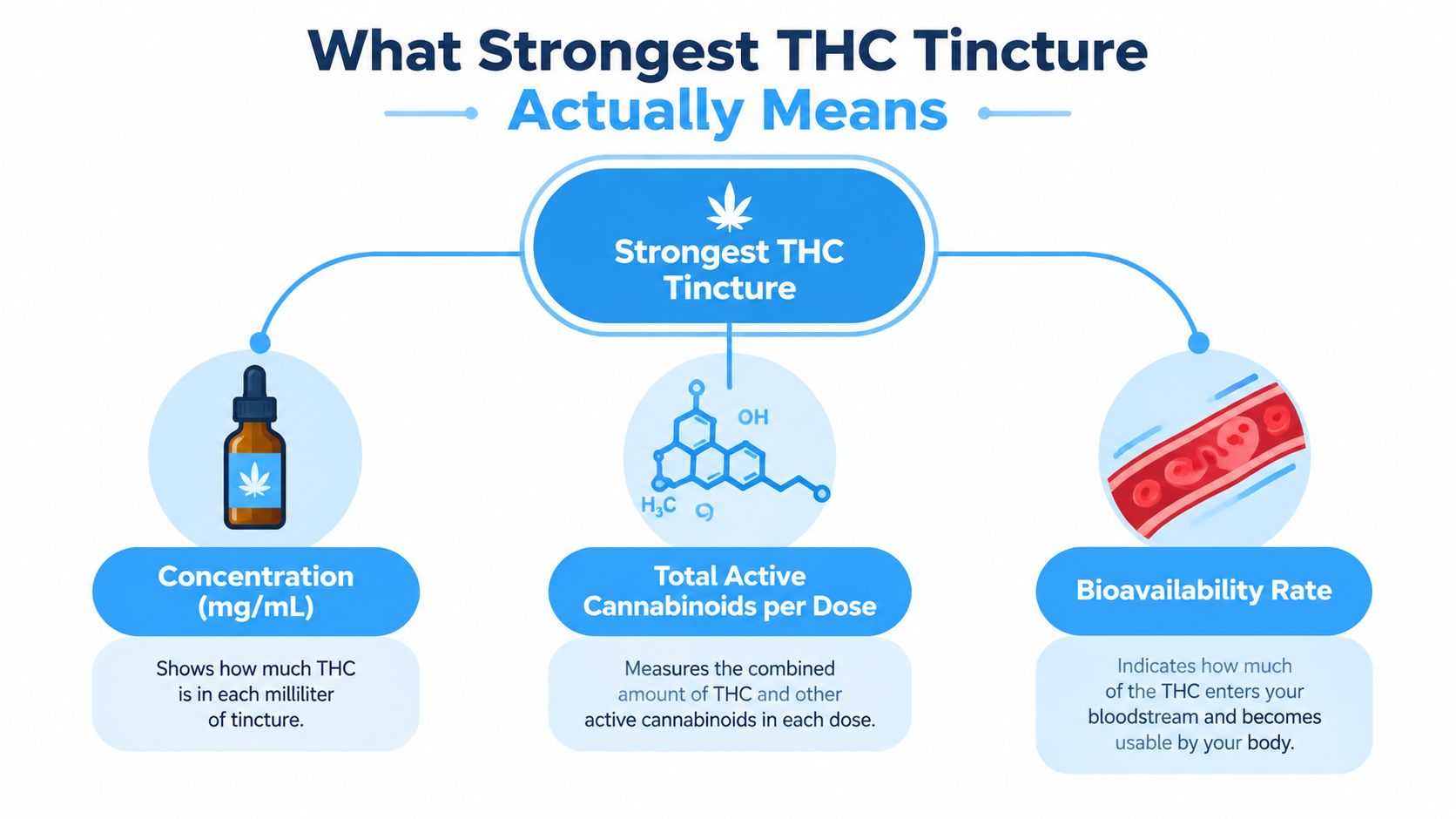
A shopper comparing tinctures may see 1,000 mg THC on one bottle and 600 mg on another. The larger total does not automatically make it stronger for a measured dose. The useful comparison is concentration, absorption, and how precisely the dropper lets you measure fractions of a milliliter.
Concentration means milligrams of THC per milliliter, written as mg/mL. A 30 mL bottle containing 1,000 mg has about 33.3 mg/mL. A 15 mL bottle containing 600 mg has 40 mg/mL. The smaller bottle contains less THC overall, yet each measured milliliter delivers more.
That distinction matters at the shelf. Total milligrams describe the bottle's supply. Mg/mL describes the dose in the dropper. A tincture is only as practical as your ability to measure the amount you intend to take.
Absorption adds another variable. A clinical review described a tincture containing 10 mg THC/mL with maximum bioavailability of 13%, so 1 mL represented about 1.3 mg of absorbed THC at the upper bound in that example (clinical tincture dosing information). That figure is not a promise for every product or person. Administration route, metabolism, tolerance, and whether you hold the oil under your tongue or swallow it can change the result.
Three label questions to ask
- What's the THC concentration? Find the mg/mL listing, or calculate it from total THC divided by bottle volume.
- How much THC is in the full bottle? This helps compare supply and value, but it does not show the amount in each measured dose.
- How will you take it? Sublingual and swallowed use can produce different onset and intensity from the same labeled amount.
The oil's formulation also affects the experience. Full-spectrum oils contain THC with other cannabis compounds. Broad-spectrum products contain multiple compounds with THC removed or minimized, depending on the formulation. Distillate tinctures focus more narrowly on THC. A full-spectrum product may feel more substantial to some consumers at a lower labeled amount, but personal response does not establish a universally stronger format.
Shelf rule: The strongest tincture is the one with a suitable mg/mL and a dropper you can use accurately. The largest front-label number is only one part of the comparison.
Tinctures also have a longer medical history than their modern packaging suggests. A review indexed by the NIH explains that extraction conditions, including ethanol strength, influence the THC and related compounds in the final liquid. Cannabis tincture remained listed in the United States Pharmacopeia until 1942, then later returned as regulated markets improved potency labeling and dosage controls (history and extraction of cannabis tinctures).
How Potency Is Measured and Labeled
A tincture's front-label total can look impressive, yet the practical question is smaller: how much liquid gives me the dose I want? Read the label in this order: concentration, bottle total, serving size, and the unit used for measurement.
- mg/mL: THC in each milliliter. This is the clearest number for setting a dose.
- Total THC per bottle: THC in the entire container, useful for comparing supply but not a single administration.
- THC percentage by weight: Another concentration format that is less direct when measuring with a dropper.
- Serving size in milligrams: The manufacturer's stated THC amount for one serving.
Use this calculation:
Total THC ÷ total liquid volume = THC per mL
A 30 mL bottle with 300 mg THC contains 10 mg/mL. A 30 mL bottle with 600 mg THC contains 20 mg/mL. A 30 mL bottle with 1,000 mg THC contains about 33.3 mg/mL, a documented high-strength retail example (THC tincture serving math).
THC Tincture Label Numbers Compared
| Metric | Bottle A: 300 mg / 30 mL | Bottle B: 600 mg / 30 mL |
|---|---|---|
| Total THC | 300 mg | 600 mg |
| Bottle volume | 30 mL | 30 mL |
| THC concentration | 10 mg/mL | 20 mg/mL |
| THC in 0.5 mL | 5 mg | 10 mg |
| THC in 1 mL | 10 mg | 20 mg |
Bottle B contains twice as much THC in each milliliter, although both bottles hold the same amount of oil. That difference determines whether a small, measurable fraction of a milliliter can reach your target dose or whether the markings feel too coarse.
Treat total cannabinoids as a separate figure. It may combine THC, CBD, CBN, minor cannabinoids, and acidic forms. If you are comparing THC potency, use the THC-specific milligrams instead of reading the combined number as THC.
A marked serving line makes measurement easier. If the label lists total THC but does not explain the liquid volume for one serving, calculate the mg/mL before dosing. Drop size changes with the bottle and oil viscosity, so counting drops without confirming the dropper's calibration can produce uneven amounts.
A strength guide notes that a 30 mL bottle can range from about 3.3 mg/mL at 100 mg total THC to about 33.3 mg/mL at 1,000 mg total THC. Bottle totals therefore cannot provide a fair comparison by themselves (tincture strength and drop calculations). The stronger product is the one whose concentration and dropper let you measure a suitable fraction accurately.
Sublingual vs Swallowed and Why It Changes Strength
The same measured THC amount can produce a different experience based on its route. Sublingual use places the oil under the tongue, where some can be absorbed before you swallow. Swallowed use sends the oil through digestion and the liver, so the onset is slower and the effects may feel heavier for some people. A tincture's “strongest” quality therefore depends on more than bottle totals. It also depends on how precisely you can measure a small fraction of a milliliter and how consistently you use the route.
Sublingual effects may begin in about 15 to 45 minutes, while swallowed tincture may take roughly 60 to 120 minutes to become noticeable (practical tincture potency guidance). Food, tolerance, individual metabolism, and the amount of oil swallowed during the hold can all shift that timing.
A practical comparison
| Route | What you do | Typical onset | Main dosing concern |
|---|---|---|---|
| Sublingual | Hold the measured oil under your tongue before swallowing | About 15 to 45 minutes | Redosing too early |
| Swallowed | Swallow the oil directly or after a brief hold | Roughly 60 to 120 minutes | Delayed effects and dose stacking |
Some product directions recommend holding tincture under the tongue for 60 to 90 seconds. Measure the oil before placing it, keep it there as comfortably as possible, and do not judge the dose by the first few minutes. If most of the oil is swallowed, the route changes and onset may move later.
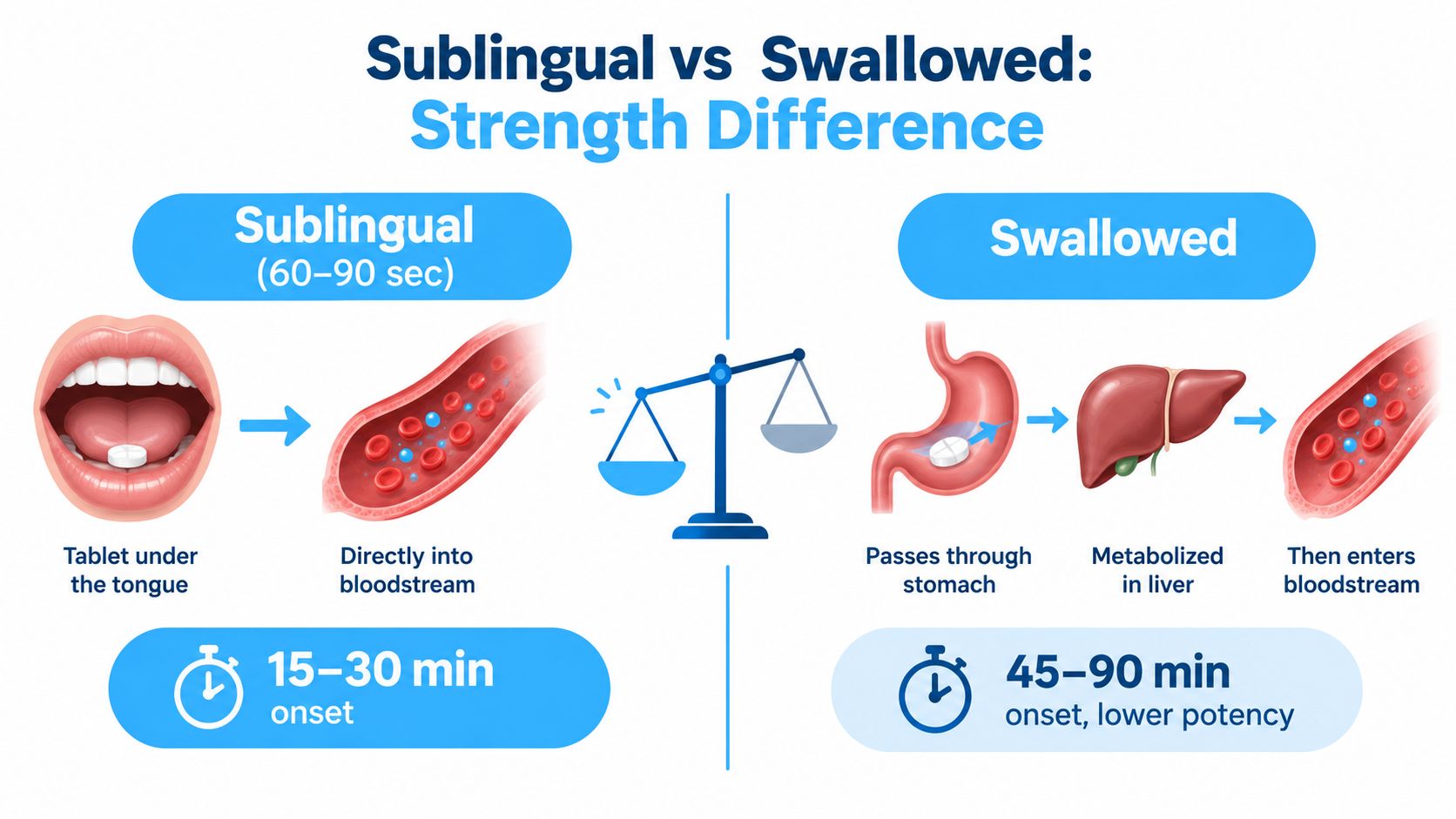
For a fair route comparison, avoid eating immediately before dosing. Measure the same volume, hold it under the tongue, wait through the early onset window, and avoid adding more just because the first sensations are subtle. This delivery method is one reason consumers seek the benefits of cannabis tinctures, but faster onset does not mean a larger dose is appropriate.
Dosing a High Potency Tincture Safely
High-potency tinctures make small measurement errors more consequential. Start with the dropper and the mg/mL number, not the bottle's total milligrams.
A 30 mg/mL tincture contains about 30 mg in a full 1 mL measure. If that dropper produces 30 evenly distributed drops, one drop is approximately 1 mg. A 5 mg dose would then be about five drops. A 10 mg/mL product would require about ten drops for the same labeled amount, assuming the droppers produce comparable drop volumes. Because droppers differ, the marked 0.25 mL, 0.5 mL, and 1 mL lines are more reliable than visual drop counting.
Beginner guidance commonly recommends 2.5 to 5 mg THC, followed by waiting at least 2 hours before redosing (clinical and educational tincture dosing guidance). The safest starting amount may be lower for someone with no THC experience, while an experienced consumer may already know that a particular dose is appropriate. High tolerance doesn't remove the need to account for concentration and route.
Dose Math by Tincture Strength
| User Level | Target Dose | 10 mg/mL Drops | 30 mg/mL Drops | 50 mg/mL Drops |
|---|---|---|---|---|
| New or sensitive user | 2.5 mg | 0.25 mL | About 0.08 mL | 0.05 mL |
| Beginner range | 5 mg | 0.5 mL | About 0.17 mL | 0.1 mL |
| Experienced example | 10 mg | 1 mL | About 0.33 mL | 0.2 mL |
The table shows why a very concentrated tincture isn't always easier to use. A target of 2.5 mg can require a fraction of a milliliter that the included dropper may not mark precisely. If you can't measure that amount consistently, a lower-concentration product may be the more practical choice.
Keep a short log with the product name, mg/mL, route, measured volume, time taken, onset, peak experience, and any unwanted effects. Stop for the day if you notice a racing heart, an anxiety spike, dizziness, or another uncomfortable reaction. Don't combine THC with alcohol, and don't drive after using it.
For a closer look at how a 1,000 mg tincture translates into liquid volume, see this high-potency THC tincture dosing guide.
Reading a Certificate of Analysis Like a Pro
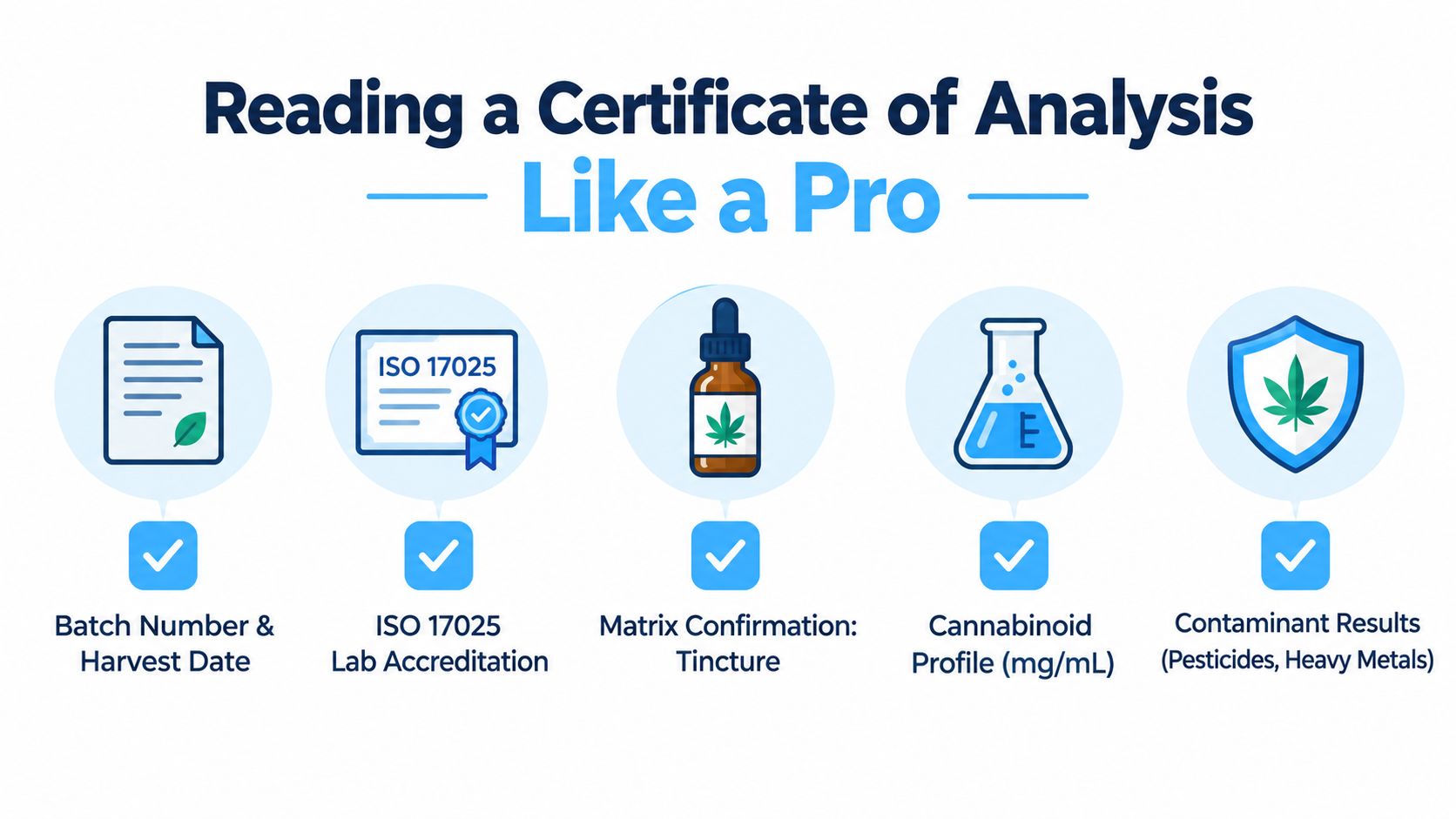
A polished label can't replace a current certificate of analysis, or COA. A COA is most useful when it identifies the exact batch in your hand and tests the same type of product, not a different cannabis material.
Start at the top of the document. Look for the batch number, harvest or production information, testing date, and the laboratory's credentials. The matrix should identify the sample as a tincture, oil, or equivalent liquid preparation. A flower COA can't validate the concentration or contamination profile of a tincture.
Read the panels in order
The cannabinoid panel should separate delta-9 THC, THCA, CBD, CBN, and minor cannabinoids, rather than presenting only one combined total. Check whether the reported concentration makes sense against the bottle's stated mg/mL. If a full-spectrum product makes broad claims about its compound profile, look for more than a THC-only result.
The contaminant panels matter just as much as potency. Residual solvents should show a pass result or non-detectable notation. Heavy-metal results should include limits, and microbial testing should address yeast, mold, and E. coli. Mycotoxin results should indicate that the relevant contaminants weren't detected.
Independent testing can help consumers assess identity, potency, and contamination controls. This overview of third party testing benefits offers useful background on why testing documentation matters across supplement and wellness products.
Use your phone for three quick checks:
- Match the batch: Confirm the COA batch ID matches the package.
- Match the matrix: Make sure the lab tested a tincture, not flower or another format.
- Match the dose: Compare the cannabinoid result with the label's THC amount and mg/mL claim.
You can also review a dedicated cannabis lab testing guide before comparing products.
New York Legal Limits for THC Tinctures
In New York, the strongest legally compliant adult-use tincture is defined by serving and package limits, not by an unlimited race toward higher potency. New York adult-use rules set a ceiling of 10 mg total THC per serving and 1,000 mg total THC per package (New York adult-use regulations).
Those limits change how you read a bottle. A 30 mL package containing 1,000 mg total THC works out to about 33.3 mg/mL, while a 10 mL package at the same total would work out to 100 mg/mL. The package limit stays the same, but the concentration per milliliter changes with bottle volume. A smaller bottle can therefore be more concentrated without containing more total THC.
Massachusetts uses a different structure, allowing no more than 5 mg delta-9 THC per tincture serving and 500 mg per bottle, illustrating why “strongest” depends on the jurisdiction (Massachusetts tincture guidance). Canada's federal rules also set separate limits for ingestible extracts, with no more than 10 mg THC per discrete unit and no more than 1,000 mg THC overall for the container in the specified extract category (Canadian cannabis sales and product information).
New York adults 21 and older may possess up to 3 ounces of cannabis and 24 grams of cannabis concentrate, according to the state's adult-use information (New York adult-use possession information). Tincture shoppers should buy through licensed channels, keep products in their original packaging, and avoid transporting cannabis across state lines. A hemp product sold online with an aggressive THC claim isn't automatically compliant with New York's regulated cannabis standards.
Storage Administration and Questions for Your Budtender
You have a concentrated tincture on the counter and want a repeatable dose. Start with storage: keep the bottle in its original child-resistant container, tighten the dropper, and place it at room temperature away from direct light, heat, and humidity. Amber glass can reduce light exposure, but follow the product's storage directions first.
Shake the bottle briefly if the label instructs you to. Then use the included dropper and read its graduations. One full squeeze is not a universal serving. Dropper output varies, so measure the volume rather than estimating from the bottle's total THC. Precision matters most when the oil is strong enough that a small fraction of a milliliter changes the dose.
A simple administration routine
- Confirm the THC amount per mL and select the intended volume.
- Hold the bottle upright while measuring with the dropper.
- Place the oil under your tongue and keep it there for the product's recommended time.
- Swallow, then wait through the full onset window before considering another dose.
- Wipe the dropper tip and close the bottle securely.
Ask your budtender:
- What is the THC amount per mL, rather than only the amount per bottle?
- Which extraction method and carrier oil does the product use?
- Is a current third-party COA available for this exact batch?
- Does the COA identify the sample as a tincture?
- Does the product include a terpene profile?
- Is the package child-resistant?
- What is the store's return or product-resolution policy?
A missing batch ID, unclear mg/mL information, or a label that lists only “total cannabinoids” should pause the purchase. If the concentration is too high for the dropper to measure comfortably, select a less concentrated oil. A lower bottle total can be the better choice when it lets you measure small, consistent fractions accurately.
For Long Island shoppers, Strong Strains Cannabis Dispensary offers lab-tested tinctures and other cannabis formats. Its budtenders can help compare bottle concentration, serving calculations, and available testing information. Visit the East Setauket dispensary for in-store guidance, or check local pickup and delivery options before choosing a product based only on the number printed on the front label.