
Why can two pre-rolls with similar THC strength feel completely different? The answer may involve more than potency, but it isn't as simple as saying one product has a magical “full-spectrum” advantage. The entourage effect describes a scientific hypothesis about how cannabinoids, terpenes, and other cannabis compounds may influence one another, creating effects that differ from an isolated molecule.
That idea can help you shop more thoughtfully, especially when you compare flower, extracts, vapes, tinctures, and edibles. It can also mislead you if a label uses “entourage” as a promise instead of a possibility. This guide separates the receptor-level findings from the dispensary folklore, then turns the evidence into practical choices you can discuss with a budtender.
What the Entourage Effect Actually Means
The phrase entourage effect refers to the possibility that related molecules work together rather than behaving as completely separate ingredients. In cannabis, that usually means THC, CBD, minor cannabinoids, terpenes, and other plant constituents may alter one another's activity, absorption, or subjective effects.
The term came from endocannabinoid biochemistry, not from cannabis branding. In the late 1990s, Raphael Mechoulam and Shimon Ben-Shabat described how “inactive” endogenous fatty acid glycerol esters could enhance the activity of 2-arachidonoylglycerol, or 2-AG, within the endocannabinoid system. Their widely cited foundational paper appeared in 1998 and proposed that several related molecules could act cooperatively rather than alone. The historical and scientific background is summarized in this PubMed record.
It isn't the same as stronger potency
A stronger product delivers more of an active compound or produces a larger effect through a particular route of administration. An entourage-style interaction is different. It suggests that one molecule changes what another molecule does, so the experience may shift in quality, duration, tolerability, or balance, not just intensity.
Researchers also use the idea broadly. Interactions can be:
- Synergistic: The combined response is greater than expected from adding each response.
- Additive: The compounds contribute effects without producing a special amplification.
- Antagonistic: One compound reduces or changes another compound's activity.
That spectrum matters because “entourage effect” is often used as if it means guaranteed synergy. Modern reviews have found that the plant-level claim remains limited, inconsistent, and difficult to predict in humans. The original biochemical observation is real, but it doesn't automatically prove that every full-spectrum cannabis product will outperform every isolate.
The useful question, then, isn't “Does the entourage effect exist?” in the abstract. Ask instead: Which compounds interacted, at what dose, through which biological pathway, and in which kind of study? The next steps examine the molecules involved, the strongest receptor-level signals, and the reasons clinical certainty remains out of reach.
The Cannabis Compounds Involved in the Theory
Start with the major cannabinoids. THC activates cannabinoid receptors, particularly CB1 receptors in the central nervous system, which helps explain its intoxicating effects. CBD interacts with the endocannabinoid system through different mechanisms and may modify some THC effects. The size and direction of that change can depend on dose, timing, route of administration, and individual biology.
THC and CBD are the clearest pair for shoppers to compare. THC activates cannabinoid receptors directly, while CBD may modulate some of those effects, like a second musician reinterpreting an arrangement. The experience may shift in character, yet CBD does not guarantee a smoother result for every person.
The supporting cast
Minor cannabinoids include CBG, CBN, THCV, and CBC. They often occur in smaller amounts than THC or CBD, leaving researchers with less material to study and consumers with less consistent information across commercial products. Scientists continue examining their receptor activity and possible interactions. A compound listed on a certificate of analysis still cannot confirm a specific effect by itself.
Terpenes add another layer. These aromatic molecules occur throughout the plant world. Spices can change a dish without becoming the main food, which offers a useful comparison for understanding their role in cannabis. Myrcene is commonly associated with earthy, herbal aromas; limonene with citrus; linalool with floral notes; beta-caryophyllene with peppery spice; and pinene with pine-like aromas.
Aroma and biological activity can overlap, but they are not identical. Beta-caryophyllene can bind directly to CB2 receptors, while other terpenes may influence different biological targets. Researchers have not established that every terpene increases THC activity at CB1 receptors. One pharmacology review concluded that the proposed entourage effect could not be explained by direct effects at the classic CB1 or CB2 receptors alone. That receptor-focused critique is available from Frontiers in Pharmacology.
| Compound | Class | Typical concentration | Proposed interaction |
|---|---|---|---|
| THC | Major cannabinoid | Product-dependent | CB1 activity and intoxicating effects |
| CBD | Major cannabinoid | Product-dependent | May modulate THC and other endocannabinoid signaling |
| CBG | Minor cannabinoid | Often present in smaller amounts | Ongoing research into receptor and enzyme activity |
| CBN | Minor cannabinoid | Often present in smaller amounts | Ongoing research into cannabinoid signaling |
| THCV | Minor cannabinoid | Often present in smaller amounts | Ongoing research into dose-dependent receptor effects |
| Myrcene | Terpene | Chemovar-dependent | Proposed modulation of cannabinoid-related effects |
| Limonene | Terpene | Chemovar-dependent | Proposed interaction with cannabinoid and non-cannabinoid targets |
| Linalool | Terpene | Chemovar-dependent | Proposed activity across several neural pathways |
| Beta-caryophyllene | Terpene | Chemovar-dependent | Direct CB2 binding |
| Pinene | Terpene | Chemovar-dependent | Proposed activity at non-cannabinoid targets |
| Flavonoids | Other plant constituents | Variable | Least-studied layer of the hypothesis |
For aroma-rich flower, the terpene profile matters more than a strain nickname alone. This guide to high-terpene strains offers a practical way to compare aroma and chemovar information while treating the label as a clue, not a guarantee.
What Modern Research Shows About Synergy
The strongest evidence doesn't come from the phrase “full-spectrum” by itself. It comes from specific experiments showing that one compound changes another compound's activity under defined conditions.
A particularly relevant 2021 peer-reviewed study tested selected cannabis terpenes at CB1 receptors. Individually, the tested terpenes activated CB1 at roughly 10% to 50% of THC's activation, and some terpene plus THC mixtures produced receptor activation several-fold higher than THC alone. The authors described some combinations as greater than additive, which supports a plausible receptor-level mechanism in at least certain experimental settings. The complete study appears in Scientific Reports.
That result is meaningful, but it doesn't answer every consumer question. A receptor assay isn't the same as inhaling a flower, eating an edible, or using a tincture. The amount reaching the relevant tissue, the timing of exposure, metabolism, and the presence of other compounds can all change the result.
What the broader reviews conclude
A 2023 scoping review described the published evidence as “contradictory, equivocal and inconclusive” and found no sound evidence supporting a reliably assumed cannabis-related entourage effect. A 2024 narrative scoping review similarly characterized the concept as a proposed synergy among cannabis components while finding limited evidence for a stable, predictable effect, as well as limited evidence for clinical efficacy, safety, or regulation based on the hypothesis. The scoping review is available through the National Center for Biotechnology Information.
A separate review reached a similar conclusion. Terpene additivity or synergy remains plausible, but the clinical evidence isn't stable enough to support broad treatment claims or product regulation. This review discusses the current limits of the evidence base.
Evidence-based reading: A promising interaction in a receptor experiment is a reason to study a combination further. It isn't a guarantee that the same combination will produce a predictable feeling or medical outcome in every person.
The practical distinction is simple. Researchers have observed specific signals of interaction, particularly in laboratory models, but they haven't established a universal formula that lets shoppers predict an outcome from a terpene list alone.
Where the Evidence Falls Short
The popular version of the theory often sounds absolute: whole-plant cannabis always works better than an isolated cannabinoid. Current reviews don't support that blanket rule.
The first problem is inconsistent dosing. Studies may use different ratios, delivery methods, extract compositions, and exposure times, making results difficult to compare. A terpene concentration that produces an effect in a controlled laboratory model may not match the amount a person receives from a particular flower or cartridge.
The translation problem
Researchers also rely heavily on cell systems and animal models. Those models can reveal receptor activity or biological mechanisms, but they can't fully capture a human consumer's response, including tolerance, expectations, metabolism, medications, sleep, and environment.
Human comparisons between full-spectrum and isolate products remain limited. That means the claim that isolates are categorically weaker lacks controlled, broad evidence. An isolate can offer precision and consistency, while a multi-compound extract can offer a wider chemical profile. Neither format automatically wins for every goal.
Product quality creates another complication. Cannabis labels may use strain names that don't consistently describe chemical composition, and extraction or storage can change the terpene profile. A careful look at cannabis lab testing helps explain why certificates of analysis and batch-specific information matter more than a catchy product description.
Consumer experiences still have value. If a person repeatedly finds that one profile feels more comfortable than another, that pattern can guide personal selection. But an anecdote can't establish causation, and marketing language often moves faster than randomized clinical research.
The grounded position is neither “the entourage effect is fake” nor “full-spectrum is always superior.” The evidence supports investigating specific combinations under specific conditions. It doesn't justify paying more, taking more, or making medical decisions solely because a package uses the word “entourage.”
Entourage Effect Across Product Formats
Product format determines which compounds remain together by the time you consume them. Full-spectrum products aim to retain multiple cannabinoids and terpenes, including THC when present in the extract. Broad-spectrum products retain several cannabinoids and aromatic compounds while removing THC. Distillates are refined to emphasize selected cannabinoids, although manufacturers may add terpenes back in. Isolates focus on a single purified molecule.
Extraction changes the chemical cast. Steam distillation can separate volatile aromatic compounds, while CO2 extraction can be tuned for different fractions. Winterization removes waxes and lipids from some extracts, which can also affect the final composition. The label “extract” doesn't tell you enough by itself, so batch testing is essential.
A shelf-level comparison
Cured flower contains the plant's native resin profile, but curing, age, heat, light, and storage can affect volatile compounds. Live resin is made from fresher plant material and is often selected by shoppers seeking a more pronounced aromatic profile. Distillate carts can be potent and consistent, yet their original terpene profile may be substantially reduced during refinement or replaced with a formulated blend.
| Format | Cannabinoid profile | Terpene retention | Typical entourage potential |
|---|---|---|---|
| Full-spectrum flower | Multiple native cannabinoids | Native profile may be retained, subject to cultivation and storage | Higher potential for a broad plant profile |
| Full-spectrum extract | Multiple cannabinoids, sometimes including minor cannabinoids | Depends on extraction and handling | Potentially broad, but verify the COA |
| Broad-spectrum extract | Multiple cannabinoids with THC removed | Terpenes may remain, depending on processing | Possible multi-compound interaction without THC |
| Distillate | Refined cannabinoid emphasis | Often reduced or reformulated | More limited native profile |
| Isolate | Single purified cannabinoid | Little to no native terpene content | Minimal multi-compound interaction |
Some full-spectrum products also list CBG, CBN, or THCV, which can make the profile more chemically distinctive. That still doesn't predict a specific effect. A certificate of analysis tells you what's detected in that batch, not how your body will respond.
Label-reading rule: Treat a chemovar's cannabinoid and terpene results as useful context, not a promise printed in laboratory ink.
How to Choose Products With the Entourage Effect in Mind
Use the theory as a shopping lens, not a shortcut. Begin with the product's batch-specific certificate of analysis, then look at the cannabinoid and terpene profile before you compare strain names or front-label potency.
Start with the profile
Ask a budtender for the total terpene content and the dominant terpenes. Myrcene, limonene, beta-caryophyllene, linalool, and pinene can help you compare aromas and chemical profiles, but they shouldn't be treated as guaranteed mood or medical labels.
A practical conversation might sound like this:
- Name the experience you want: relaxation, creativity, daytime use, relief, or sleep.
- Compare chemovars: Look for products with test results rather than relying only on “indica,” “sativa,” or a cultivar name.
- Choose a manageable format: Flower, a measured tincture, a low-dose edible, or a concentrate each has a different onset and duration.
- Change one variable: Don't switch product, dose, and consumption method at the same time.
- Record the result: Note the cultivar, dominant terpenes, dose, time of day, onset, duration, and unwanted effects.
If you're new to a full-spectrum product, start with a low amount and give your body time to respond before increasing it. Combined compounds can alter the experience, but more material doesn't necessarily create a better balance.
A small journal can reveal patterns that memory blurs. You might discover that you prefer a terpene-rich flower for an evening routine, while a more narrowly defined CBD product suits a situation where you want less intoxicating effect. That's personal experimentation, not proof of a universal entourage formula.
For background on how full-spectrum products differ from isolates, see this full-spectrum cannabis guide.
Safety still comes first. Ask a healthcare professional about possible medication interactions, don't drive after using intoxicating cannabis, follow applicable New York adult-use rules, and store products away from children and pets. A local dispensary such as Strong Strains Cannabis Dispensary can provide lab-tested flower, vapes, edibles, concentrates, tinctures, topicals, and accessories, along with in-store pickup or local delivery for adult customers.
A Grounded Takeaway for Cannabis Shoppers
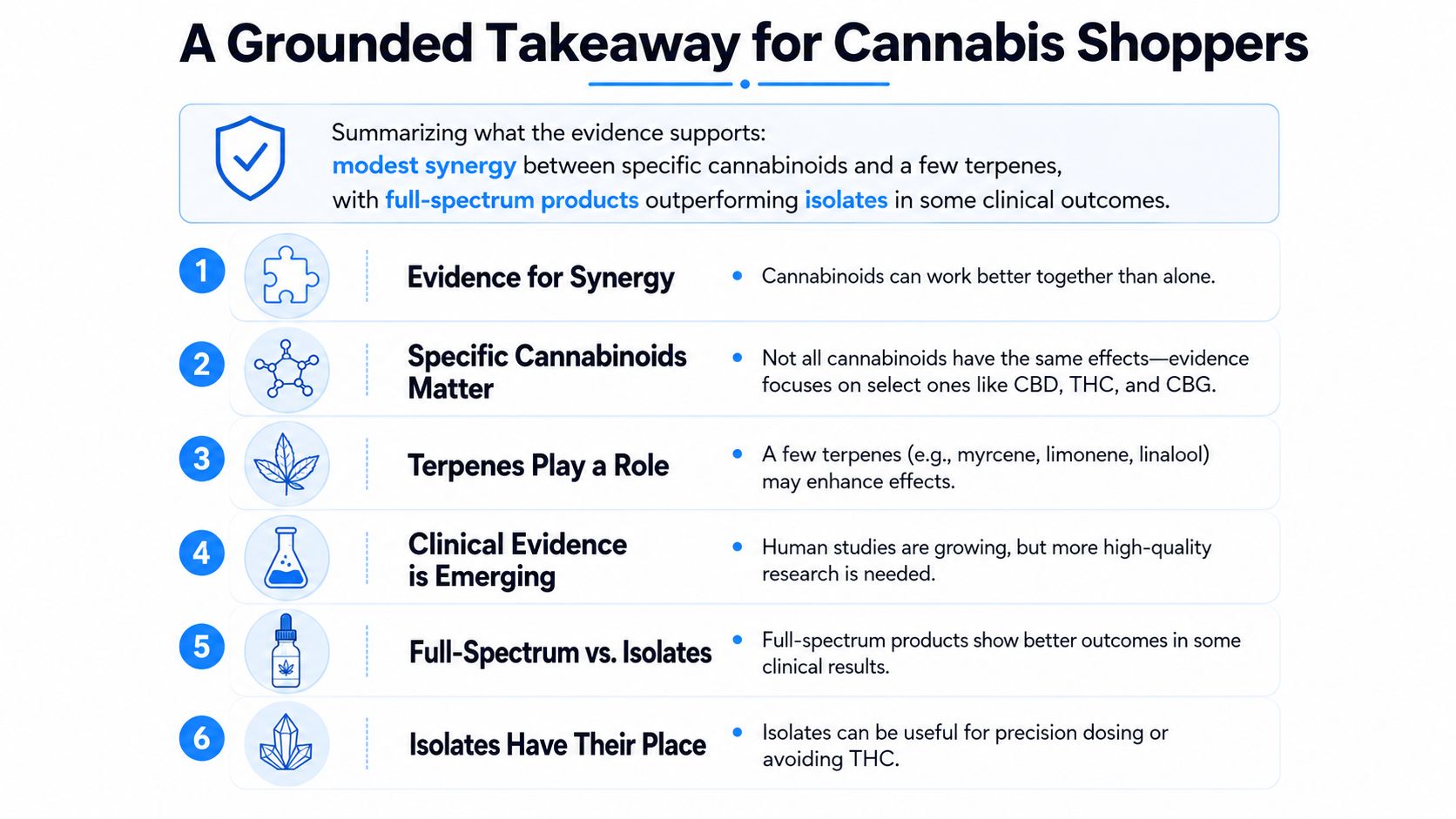
The evidence supports a careful conclusion. Researchers have observed modest or specific interactions among certain cannabinoids and terpenes, including receptor-level findings with selected terpene and THC combinations. Reviews also identify promising signals in some multi-compound preparations, but the overall clinical record remains limited and inconsistent.
The evidence does not establish that whole-plant cannabis always beats an isolate. It also doesn't show that a terpene name predicts the same experience across people, products, doses, and delivery methods. The pharmacokinetic idea that terpenes might influence blood-brain barrier permeability and THC delivery remains a proposed mechanism, not a settled explanation. A 2024 MDPI review discusses that proposal and its unresolved status.
Use this checklist when you shop:
- Prefer information-rich products: Look for full-spectrum or broad-spectrum descriptions supported by a batch COA.
- Focus on chemistry: Compare cannabinoids and dominant terpenes rather than trusting strain names alone.
- Start low: Test a new format or profile cautiously, especially when it contains multiple active compounds.
- Track your response: Record the product, dose, timing, aroma profile, and effects.
- Question premium claims: Don't pay extra solely because a package says “entourage.”
- Stay current: Reassess your assumptions as better human research becomes available.
The best use of the entourage effect concept is as a framework for asking better questions. It can help you compare a terpene-rich flower with a refined distillate or an isolate, but your response, responsible dosing, and reliable testing remain more useful than a marketing slogan.
Visit Strong Strains Cannabis Dispensary to compare lab-tested flower, vapes, edibles, concentrates, tinctures, and topicals with guidance from knowledgeable budtenders. Ask the team about cannabinoid and terpene profiles, then choose a format that fits your experience, goals, and responsible-use plan.