
You're at a Long Island dispensary counter with two pre-rolls in front of you. Both packages promise premium flower, both look polished, and both carry a THC number that sounds impressive. The price difference may feel like the deciding factor, but the more useful question is quieter: what testing supports those claims?
Cannabis testing standards are the system behind a credible label. They help show whether a product's cannabinoid content was measured, whether contaminants stayed within the applicable limits, and whether the certificate belongs to the exact batch on the shelf. They can't promise that every product will feel the same to every person, but they give you a better foundation for choosing flower, vapes, edibles, concentrates, tinctures, or topicals.
Why a Lab Test Should Be the First Thing You Look At
An untested product asks you to trust appearance and marketing. A tested product gives you a document that connects the package to laboratory measurements. That difference matters when you're comparing two products that both use phrases such as top-shelf, craft, or high potency.
A label can suggest strength, but a Certificate of Analysis, or COA, shows what a laboratory examined. The report may include cannabinoids, terpenes, pesticides, heavy metals, microbial impurities, residual solvents, moisture, and water activity. Those categories answer different questions. Potency describes chemical composition, while contaminant testing addresses whether unwanted substances were detected within the rules that apply to that product.
Practical rule: Treat the COA as part of the product, not as paperwork you need to ignore until something goes wrong.
That distinction is especially important because legal cannabis in the United States doesn't follow one national testing rulebook. States set their own requirements for laboratory licensing, sampling, contaminants, remediation, and release decisions. Colorado is widely cited as the first state to introduce mandatory compliance and safety testing after legalization, with potency and microbial testing becoming mandatory there in 2015. Later requirements added residual solvent and pesticide analysis, helping influence other state markets. ASTM listed more than 40 cannabis-related standards by 2026, supporting safety, manufacturing, and quality practices across the industry. These milestones are summarized in this regulatory history of cannabis testing.
For a Long Island shopper, that state-by-state structure explains why a product can be legal and tested while still carrying a COA that looks different from one issued elsewhere. New York's rules determine what must be tested, how samples are handled, and what counts as a pass. A dispensary that reviews batch-level documentation gives the budtender something more useful than a marketing phrase to discuss with you.
If you want a practical look at why lab-tested products deserve closer attention, Strong Strains' overview of lab-tested cannabis products is a useful starting point. The next question is what the COA itself measures.
What a Certificate of Analysis Actually Measures
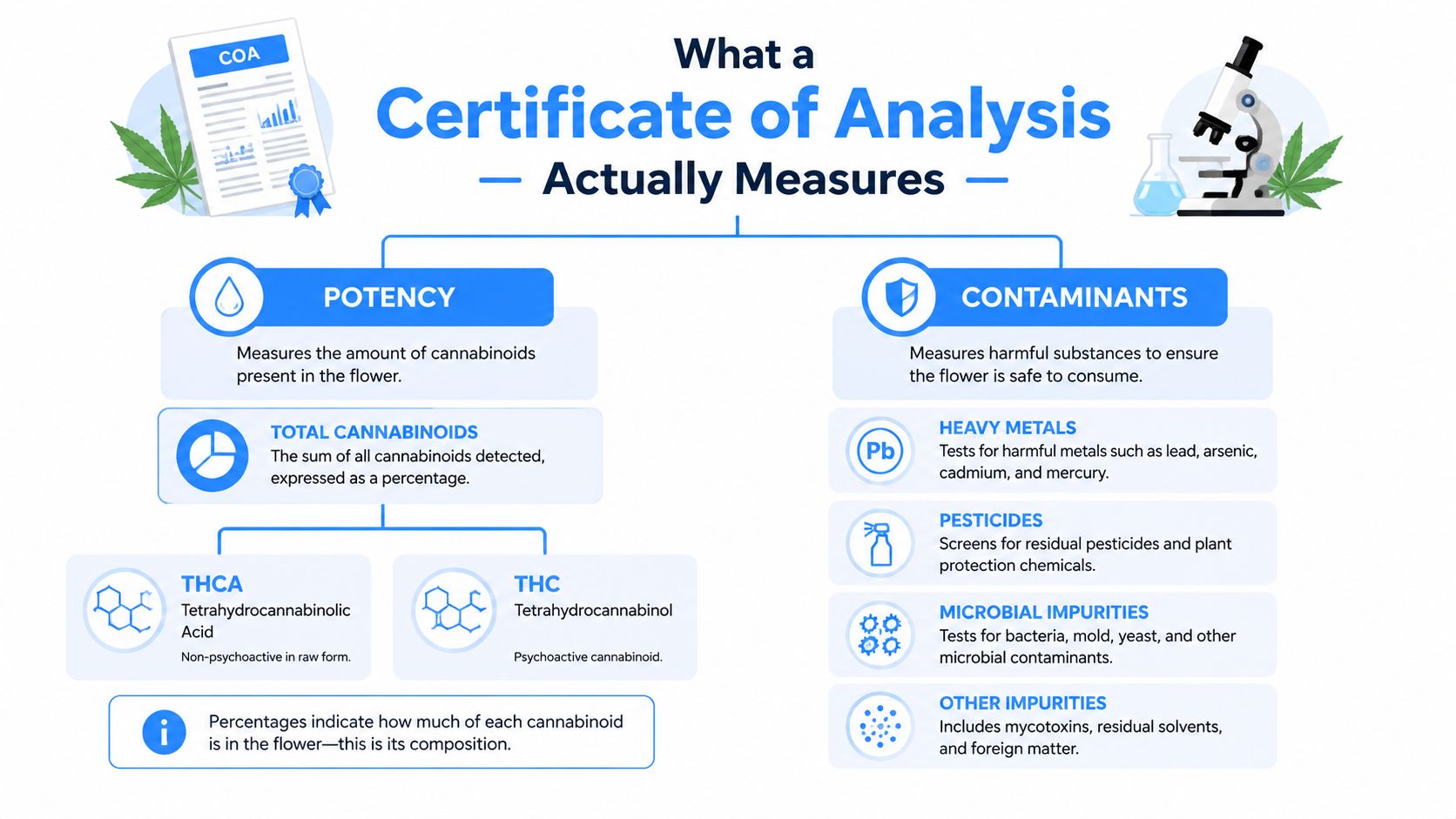
A COA works like a nutrition label combined with a safety inspection. The first half describes the product's chemical profile. The second checks for substances that shouldn't be present above the applicable limits.
Potency describes composition
The cannabinoid panel usually lists THC, THCA, CBD, and CBDA at minimum in the technical guidance used by cannabis laboratories. You may also see CBG, CBN, CBC, or other minor cannabinoids, depending on the lab and the state's requirements.
THCA and THC appear separately because they're different chemical forms. THCA is an acidic cannabinoid found in raw plant material. Heat changes acidic cannabinoids into their neutral forms, so a COA may show both the measured compounds and a calculated total. New York requires potency testing for every cannabis lot, including flower strains, concentrate batches, and infused-product batches. Its measured potency must fall within ±15% of the label claim, and the state specifies a five-sample potency test across each batch or lot regardless of lot size, as explained in New York's COA reading guide.
A percentage describes the share of the product's weight represented by a cannabinoid. It doesn't directly predict how intense the experience will feel. Product format, dose, tolerance, inhalation technique, food intake, and individual response all matter.
Contaminants answer a safety question
The contaminant side commonly includes four major groups:
- Pesticides: Screens for agricultural chemicals that may remain on plant material.
- Heavy metals: Checks for substances such as lead, arsenic, mercury, cadmium, and chromium that plants can absorb from soil or other inputs.
- Microbial impurities: Looks for unwanted microorganisms, including specified bacteria, yeast, mold, and other organisms required by the applicable rules.
- Residual solvents: Evaluates leftover extraction chemicals in concentrates, vape oils, and other processed products.
New York's testing requirements also cover foreign material, moisture content, water activity, mycotoxins, and terpenoids across adult-use and medical product types. Water activity deserves special attention because it isn't the same as total moisture. Water activity helps indicate whether conditions support microbial growth, which is why readers who want broader background may find this guide to water quality testing helpful.
Terpenes are usually a secondary section rather than a basic safety panel. They contribute to aroma, flavor, and the character of a product, but a terpene profile doesn't guarantee a particular effect. Reading these categories separately makes the rest of the document much easier. You can ask what the product contains, what the lab searched for, and whether the result stayed within the relevant limit.
How Accredited Labs Get Results You Can Trust
A trustworthy result begins with the laboratory, but accreditation alone isn't the entire answer. Cannabis testing guidance increasingly points to ISO/IEC 17025 accreditation alongside methods designed for the specific product matrix. In plain English, ISO/IEC 17025 gives a lab a framework for demonstrating technical competence, controlled equipment, qualified personnel, documented procedures, and reliable quality practices. It doesn't automatically prove that every method fits every form of cannabis.
Flower, vape oil, concentrate, tincture, and an infused edible behave differently in a laboratory. A method that performs well on one matrix may need validation or adjustment for another. That's why technical guidance emphasizes matrix-specific methods for potency, pesticides, microbes, residual solvents, water activity, and heavy metals. A lab should also show how it handles the sample from intake through reporting, including identification, chain of custody, preparation, and homogeneity.
What the common methods do
| Analyte Class | Typical Method | What It Detects |
|---|---|---|
| Cannabinoids | HPLC | Separates and measures THC, THCA, CBD, CBDA, and other cannabinoids without relying on the same conditions used for volatile compounds |
| Terpenes | GC-MS | Separates volatile aromatic compounds and helps identify the product's terpene profile |
| Pesticides | LC-MS/MS or GC-MS | Screens for targeted agricultural chemicals at low concentrations |
| Residual solvents | GC-MS | Measures volatile extraction solvents that may remain in processed products |
| Heavy metals | Elemental analysis methods | Measures metals such as lead, arsenic, cadmium, mercury, and chromium |
| Microbial impurities | Culture-based or molecular methods | Evaluates specified microorganisms and microbial counts required by the applicable rules |
Sample preparation can change the result. A flower sample needs to represent the lot rather than a single unusually dense or resinous piece. Concentrates and edibles need thorough mixing so the portion tested reflects the product sold. Duplicate checks, control samples, calibrated instruments, and documented detection limits help laboratories identify problems before a report reaches a manufacturer or dispensary.
A lab report is more useful when it tells you not only the result, but also the method, matrix, units, reporting limit, and batch identity.
Red flags include a missing accreditation reference, no laboratory license or permit information, absent detection limits, unexplained gaps in the required panel, and numbers that look suspiciously perfect without supporting detail. Those signs don't prove a report is false, but they give a budtender or buyer a reason to verify the document before treating it as evidence.
Reading a COA Without Getting Lost
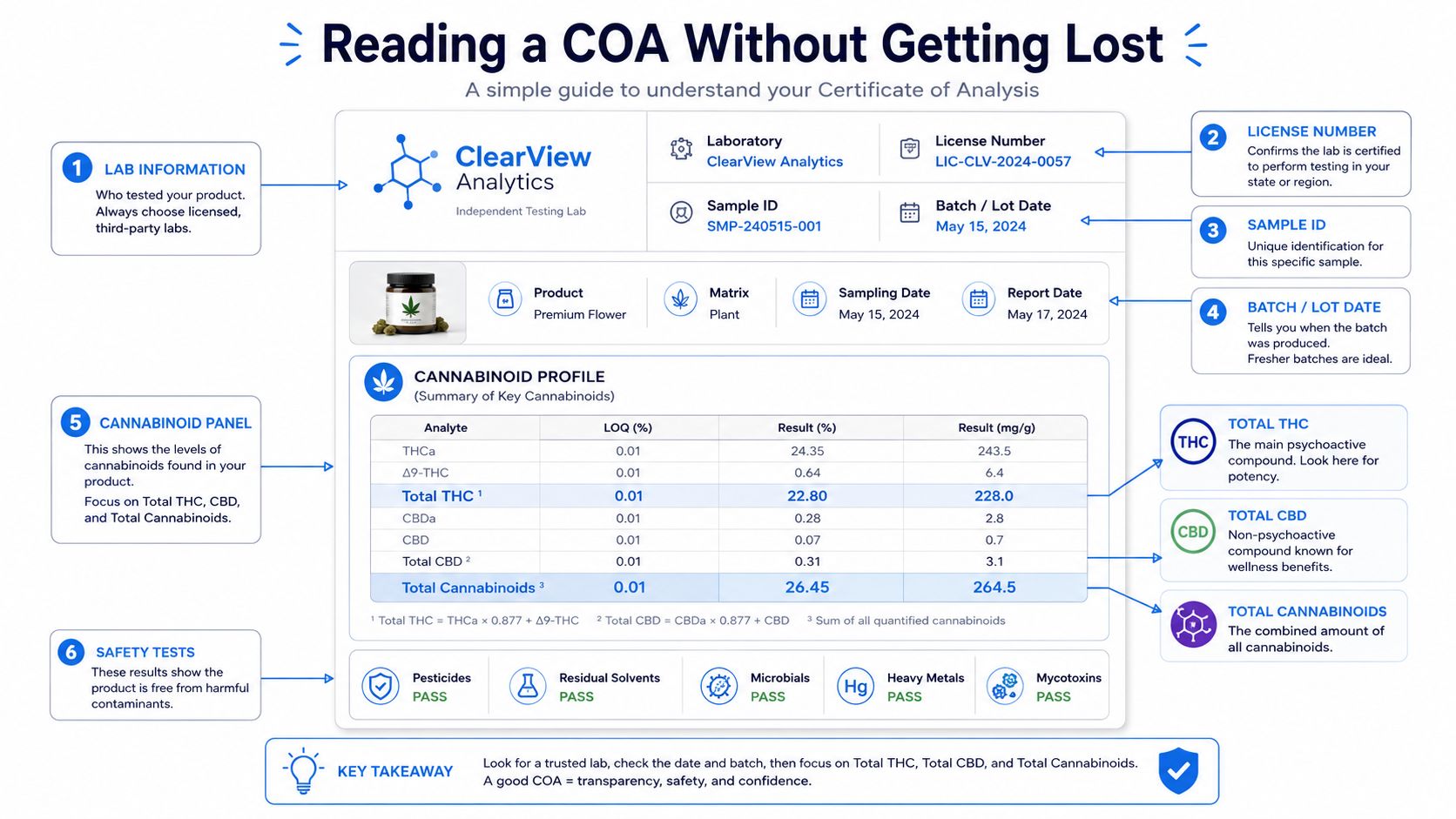
Start at the top, not with the biggest THC number. The header should identify the laboratory, its license or permit information, the sample or lot ID, the product name and form, the received or test date, and the batch date when provided. That information creates the connection between the report and the package in your hand.
Follow the document in order
Next, find the cannabinoid panel. Look for total THC and total CBD, then check whether the report lists the underlying forms, such as THC, THCA, CBD, and CBDA. Minor cannabinoids including CBG and CBN can add useful detail, but their presence doesn't automatically make a product stronger or better.
Raw acid forms and calculated totals can confuse even experienced shoppers. Read the lab's definitions and formulas rather than adding lines yourself. The label may use a total value that reflects post-decarboxylation calculations, while the COA shows the individual measured compounds separately.
The terpene panel comes after the cannabinoid information on many reports. Focus on the dominant three to five compounds when they're listed, then connect them to the product's aroma and flavor. Limonene, pinene, myrcene, and caryophyllene may help describe whether a jar smells citrusy, piney, earthy, or peppery, but they aren't a guarantee of an uplifting, calming, or focused experience.
Find the decision fields
The contaminant sections should show results against applicable limits. Check heavy metals, microbial impurities, mycotoxins, pesticides, and residual solvents, especially for inhaled products such as flower, pre-rolls, and vapes. New York's 2024 testing update added Total Aerobic Microbial Count and Total Yeast/Mold Count, while narrowing pathogenic contaminants for flower and inhaled products to Salmonella, STEC, and four Aspergillus species. The complete state document is available in the New York testing limits update.
Don't treat “not detected” as the same thing as proof that a compound could never exist. It means the lab didn't detect it at or above the method's reporting capability. For a plain-language explanation of laboratory reporting, this guide to lab reagent test results can help.
Watch for a missing accreditation mark, mismatched batch dates, an absent sample ID, unexplained round numbers, or a QR code that leads nowhere useful. A QR code isn't a substitute for the report's contents, but a working batch-level record can make verification easier. Strong Strains also discusses the role of cannabis lab testing in product selection.
How New York's Rules Shape What Hits Long Island Shelves
A cannabis product doesn't carry one universal testing identity across state lines. New York, New Jersey, Massachusetts, and Pennsylvania each establish their own requirements, so the same cultivar or product format can arrive with different panels, limits, sample procedures, and release decisions depending on where it was produced and sold.
New York requires testing for a broad set of contaminants on final adult-use and medical products. The required categories include microorganisms, foreign material, metals, microbial impurities, moisture, water activity, mycotoxins, pesticides, residual solvents, and terpenoids. Potency testing applies to all cannabis lots, while terpene information may be presented in different ways across products because reporting formats aren't universal.
A practical comparison
| State | Required Tests | Permitted Threshold Differences | Practical Impact for Shoppers |
|---|---|---|---|
| New York | Potency plus contaminants including pesticides, heavy metals, microbial impurities, mycotoxins, residual solvents, moisture, water activity, foreign material, and terpenoids | Limits and pathogen requirements follow New York rules and can vary by product type | The COA should be read against New York's specific release standards |
| New Jersey | Requirements are established through the state's cannabis framework | Limits, sample rules, and panels may not match New York | A report from New Jersey shouldn't be assumed to prove New York compliance |
| Massachusetts | Requirements are established through the state's cannabis framework | Contaminant targets and decision rules may differ from New York | Cross-state comparison can be misleading without reviewing the applicable rule |
| Pennsylvania | Requirements are established through the state's medical cannabis framework | The medical-market framework may use different release criteria | A product's Pennsylvania report may not answer every New York testing question |
The most concrete contrast appears in heavy metals. Illinois uses inhaled-product limits of lead less than 1.0 ppm, inorganic arsenic less than 0.4 ppm, mercury less than 0.2 ppm, cadmium less than 0.2 ppm, and chromium less than 0.6 ppm. Washington instead expresses certain limits per daily dose, including lead at 6.0 μg per 5 g, arsenic at 10.0 μg per 5 g, cadmium at 4.1 μg per 5 g, and mercury at 2.0 μg per 5 g. Those examples show why a product can pass in one state and fail in another at the same measured concentration. The state rule is part of the result, as shown in the Illinois cannabis testing regulation.
New York also requires every adult-use processor to use an independent permitted laboratory. Processors and other regulated operators must make reports available to distributors and retailers, while dispensaries must maintain accurate test-report documentation for each product offered for sale. On Long Island, that paperwork influences what can remain on a menu, not just what appears on a package. Strong Strains provides additional context in its discussion of product testing standards.
A Simple Buyer's Checklist at the Counter
You don't need a chemistry degree to ask useful COA questions. A consistent check helps you compare two flower jars, a vape cartridge, or a package of edibles without getting distracted by packaging and strain names.
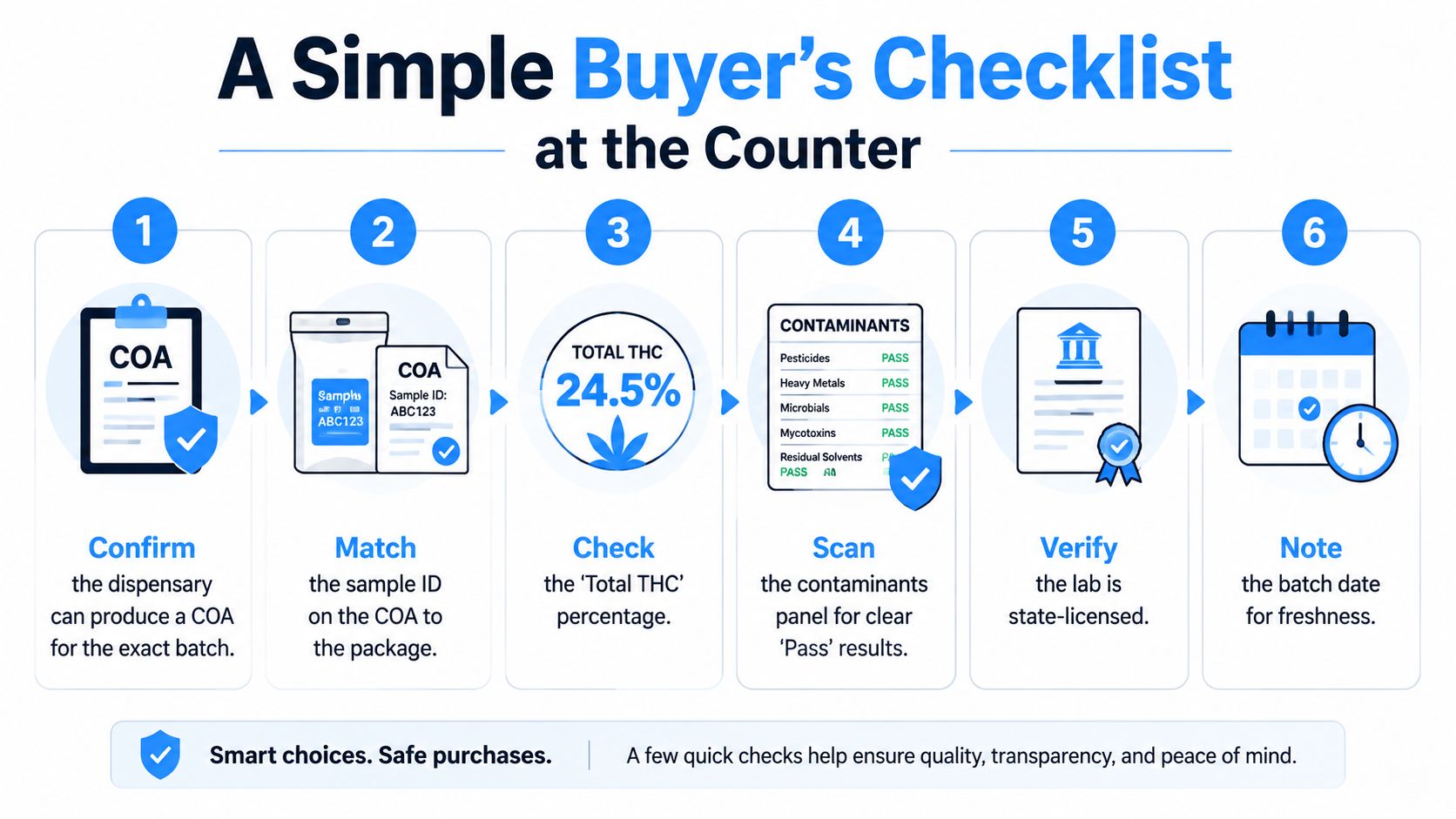
- Ask for the exact batch COA. A generic strain profile isn't enough. Ask whether the report belongs to the lot or batch on the shelf.
- Identify the laboratory. Look for the lab's name, permit or license information, and evidence of ISO/IEC 17025 accreditation where applicable.
- Match the identifiers. Compare the COA's sample ID, lot number, product form, and batch information with the package label.
- Review the cannabinoid claim. Compare total THC and total CBD with the label, then read the underlying cannabinoid lines instead of relying on one large headline number.
- Scan every contaminant panel. Look for clear pass results or results within the applicable limits for pesticides, microbial impurities, heavy metals, mycotoxins, and residual solvents. Inhaled products deserve particular attention because their exposure route makes the relevant heavy-metal limits stricter in many regulatory systems.
- Use terpenes as context. Note the leading terpenes to understand aroma and flavor direction. Use that information alongside your past experience, not as a promise of a specific effect.
If a report is unavailable, the batch information doesn't match, or the contaminant panel is incomplete, pause before buying. A budtender should be able to explain what the report says in everyday language and help you compare a product such as 1937, 40 Tons, 6 Point Cannabis, &Shine, Aeterna, Airo, Alchemy Pure, Alien Labs, Alter, American Hash Makers, Animal House, Ayrloom, Battenkilll Buds, Blazy Susan, Bodega Boyz, Botanist, Boutiq, Camino, Canna Cantina, Cookies, Connected, Dogwalker, Edie Parker, ElectraLeaf, Fernway, Florist Farms, Good Green, Harney Brothers Cannabis, Head & Heal, Jeeter, Jetty, Kiva, MFNY, Pax, Plug Play, Rove, Rythm, Stiiizy, Stone Road, Turn, Umamii, Wana, Wyld, or another available label using the same batch-level standard.
Use this video as a visual companion while you practice the sequence at home or before your next dispensary visit.
The Takeaway for Confident, Lab-Tested Shopping
Cannabis testing standards give shoppers a verification framework. Potency testing helps connect a label claim to measured cannabinoids. Contaminant panels address pesticides, heavy metals, microbial impurities, mycotoxins, and residual solvents. Terpene profiles add information about aroma and product character.
They don't guarantee that a product will deliver a particular feeling, replace responsible dosing, or make every COA directly comparable across state lines. A test result is meaningful only when you also consider the product matrix, the lab's method, the sample identity, the applicable state limits, and whether the report belongs to the package you're holding.
New York's framework gives Long Island shoppers a structured baseline. New York requires independent laboratories permitted under the Cannabis Law, batch-level potency testing, and broad contaminant testing, while dispensaries must retain documentation for products they sell. That framework becomes more useful when a knowledgeable budtender translates the report instead of leaving you to decode a dense PDF alone.
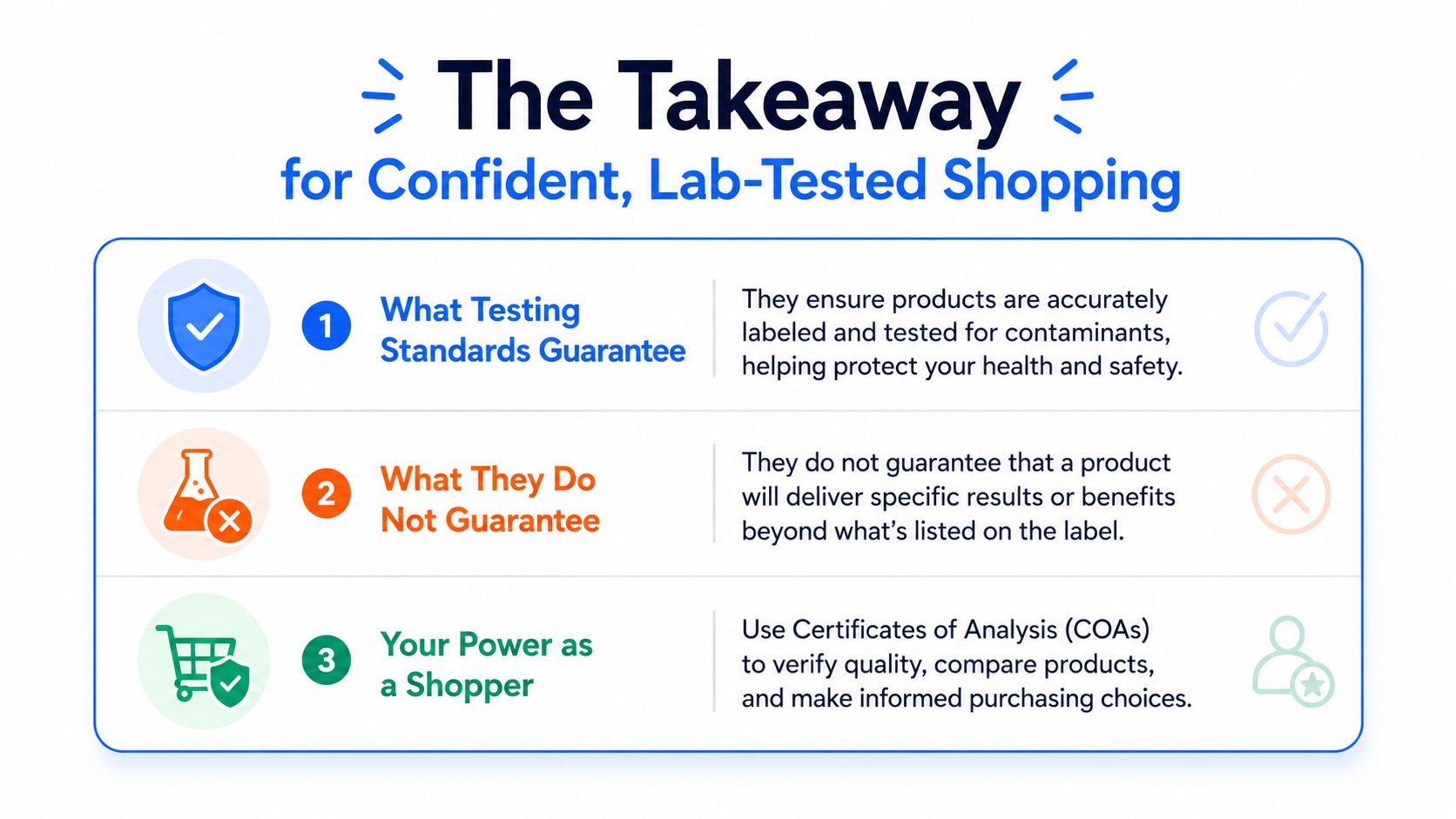
At the counter, ask three questions: What does this COA measure? Does it match this batch? What do the results mean for this product format? Those questions turn lab science into a practical purchase decision, whether you're choosing a relaxing edible, a terpene-rich flower, a concentrate for experienced use, or a precisely labeled tincture.
Visit Strong Strains Cannabis Dispensary in East Setauket to compare lab-tested flower, vapes, pre-rolls, edibles, concentrates, tinctures, topicals, and accessories with help from a knowledgeable budtender. Bring your COA questions, ask about the exact batch on the shelf, and use in-store pickup or local delivery to make your next Long Island purchase with more confidence.