You're standing at the dispensary counter on Long Island, eyeing a jar of flower, a sleek vape, maybe gummies from Wana or a pre-roll from Jeeter, and one question cuts through all the branding and packaging.
Is this actually safe?
That's a smart question. Cannabis can look gorgeous, smell amazing, and still have a backstory you can't see. The fundamental trust signal isn't the frosty buds, the terpene notes, or the premium box. It's the testing behind the product.
Legal cannabis is built around that safety check. A 2022 California market study found an overall failure rate of 5%, with pesticide residues being the most common reason products failed. That's why pesticide testing isn't paperwork for the sake of paperwork. It's the filter that keeps contaminated cannabis from reaching customers.
If you shop premium brands like Cookies, Hudson Cannabis, MFNY, Ayrloom, Pax, Wyld, Rythm, Florist Farms, Stiiizy, Camino, Kiva, Jetty, Airo, Botanist, Jaunty, or Old Pal, you're still relying on the same basic promise. The batch was sampled, tested, reviewed, and cleared before it ever had a shot at the shelf.
Your Guide to Safe Cannabis on Long Island
A lot of people assume “legal” automatically means “perfect.” It doesn't. Legal means the product has to meet rules. The good part is that those rules create a paper trail you can verify.
Say you're choosing between a vape from Heavy Hitters, flower from Hudson Cannabis, and gummies from Wyld. They're different products, but they all raise the same invisible question: what happened before this landed in the display case? Pesticide testing helps answer that.
What pesticide testing really does
Consider airport security for cannabis. It's not judging the passenger. It's screening for what shouldn't come through.
Labs check whether a batch contains pesticide residues above the legal threshold, or pesticides that shouldn't be there at all. If it fails, it doesn't move forward. That matters because contamination isn't something you can spot by sight, smell, or price point.
Practical rule: If a cannabis product doesn't have a verifiable lab record, you're being asked to trust the packaging instead of the proof.
That's why experienced shoppers ask for the COA, or Certificate of Analysis, even when they're buying recognizable names like Cookies, Connected, Alien Labs, Rove, Turn, Plug Play, or Wana. Premium branding and testing should go together.
Why Long Island shoppers should care
Long Island customers are often balancing a few things at once. You want quality. You want consistency. You also want a clean product, whether you're shopping for flower, tinctures, concentrates, topicals, pre-rolls, or edibles.
A premium market should make that easier, not harder.
Here's the simple takeaway:
- Looks don't prove safety because residues are invisible.
- Legal compliance matters because failed batches are supposed to be stopped before sale.
- Lab transparency matters because it gives you something concrete to check.
- Your questions matter because a good dispensary team should be able to explain what the test results mean.
Once you understand pesticide testing, shopping gets a lot less mysterious. You stop guessing and start reading the signs that protect you.
Why Pesticide Testing in Cannabis Is Crucial
Pesticides on cannabis aren't the same conversation as pesticides on produce.
If you buy an apple, you're thinking about something you wash and eat. With cannabis, many people inhale it. That changes the stakes. When a product is smoked or vaporized, you're not dealing with a simple rinse-and-repeat situation. You're relying on upstream controls, and pesticide testing is one of the biggest.
Why “clean growing” isn't enough by itself
A grower can be careful and still run into trouble. That's one of the most confusing parts for consumers.
Recent studies confirmed that over 60% of pesticide residue failures in outdoor cannabis markets come from cross-contamination through wind, water, or neighboring agricultural fields, not from chemicals applied by the cannabis grower, according to this research on environmental contamination and outdoor market failures. People in the industry sometimes call these phantom failures.
That means a farm can follow strict practices and still fail. Pesticide drift doesn't care whether the crop was intended to be low-input, organic-minded, or carefully managed.
Outdoor cannabis can fail even when the grower didn't spray the crop. That's exactly why testing every batch matters.
What customers usually get wrong
Consumers often fall into one of two traps.
The first is assuming contamination only comes from reckless growers. The second is assuming “organic” or “natural” language means testing doesn't matter. Neither one holds up well in practice.
Here's a clearer way to grasp this:
| Situation | What a customer might assume | What pesticide testing checks |
|---|---|---|
| Indoor flower | Cleaner by default | Whether residues are present, regardless of setup |
| Outdoor flower | More natural, so safer | Whether drift or environmental contamination occurred |
| Extracts and vapes | Processing solved the issue | Whether contaminants remained in the final batch |
| Edibles | Ingredients were mixed, so it's fine | Whether the cannabis input passed standards before use |
Testing isn't a punishment system. It's a quality gate.
Why every format still needs scrutiny
The safety conversation isn't only about loose flower. It matters for pre-rolls, vape carts, infused products, and concentrates too. A customer grabbing Camino gummies, a Rove cart, a Dogwalker pre-roll, or MFNY concentrate may not think about the original plant material, but the testing chain still starts there.
A useful rule of thumb is this:
- Flower shows you the plant most directly
- Extracts concentrate the plant's chemistry
- Edibles depend on the quality of the infused input
- Pre-rolls deserve the same confidence as premium jarred flower
That's why pesticide testing is such a core part of legal cannabis safety. It protects customers from the visible mistakes and the invisible ones.
Inside the Lab A Look at Testing Methods
A lab report can feel intimidating until you translate it into plain language.
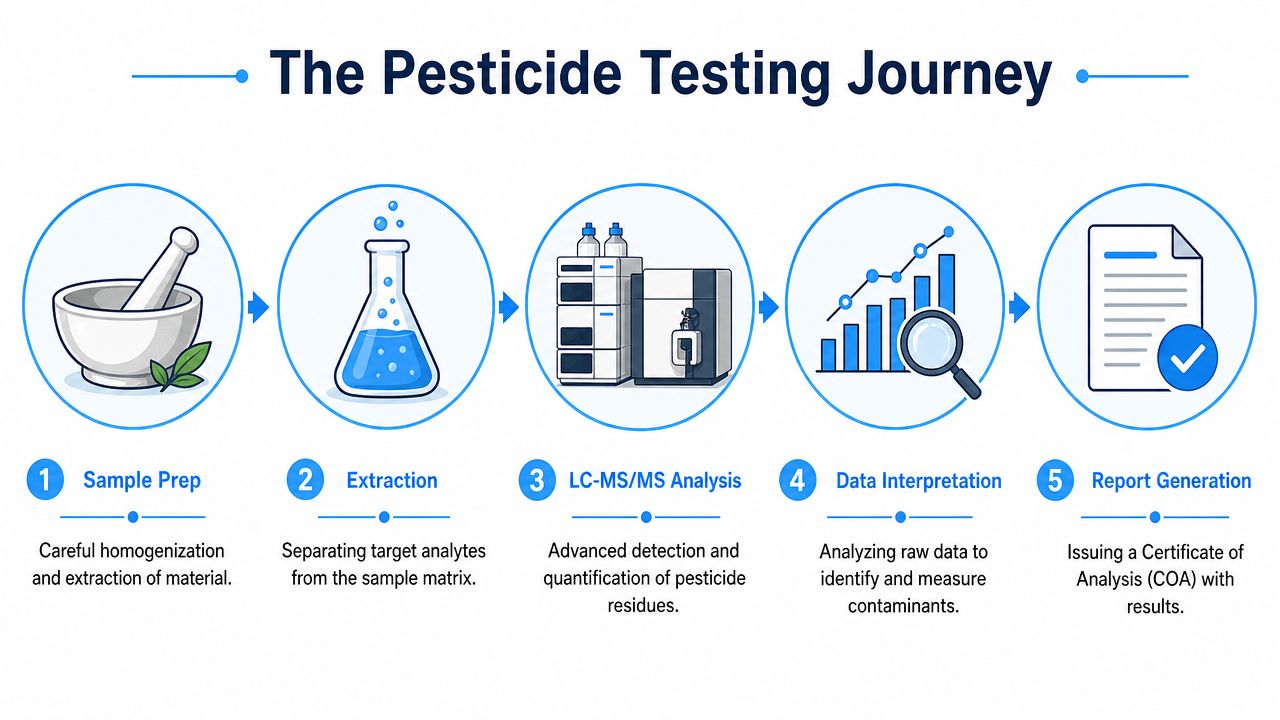
At a basic level, pesticide testing works like a combination of a molecular fingerprint scanner and a sorting machine. The lab takes a sample, separates what's inside it, and checks whether any of those compounds match the fingerprints of banned or regulated pesticides.
What the lab is actually dealing with
Cannabis is a busy plant. It contains cannabinoids, terpenes, waxes, pigments, and other compounds that can get in the way of clean measurement. That's one reason this technical note on cannabis pesticide residue analysis explains that pesticide analysis is technically difficult and that labs must prevent detector saturation from high cannabinoid levels that can mask residues if analysts don't handle the sample correctly.
In regular language, detector saturation means the machine can get overwhelmed by very strong signals from the cannabis itself. If the lab doesn't prep and dilute the sample properly, the instrument may struggle to read the smaller signals cleanly.
Why expertise matters more than most people realize
This is one reason “lab-tested” should mean more to you than a marketing line. Good pesticide testing depends on sample prep, instrument settings, interpretation, and quality control. A careless workflow can create confusion. A strong workflow creates confidence.
If you've ever read about HVAC insights for office air, the basic idea is similar. Air may look clean and still need precise testing because harmful compounds aren't obvious to the senses. Cannabis works the same way. Appearance isn't enough.
The cleanest-looking bud in the room can still require serious lab work to verify what isn't visible.
How this connects to other safety checks
Pesticides are only one part of the wider quality picture. Cannabis can also be screened for other contaminants, and if you want a deeper look at that side of compliance, this guide to microbial testing in cannabis helps show why one “pass” result never tells the whole story.
When customers hear that a product is lab-tested, the useful takeaway isn't “science happened somewhere.” It's this: trained analysts used advanced tools to make sure the product meets the rules before it reaches your hands.
Navigating New Yorks Strict Cannabis Regulations
For Long Island shoppers, New York's rules are where pesticide testing becomes personal.
This isn't just abstract compliance language from another market. It's the framework that determines what can be legally sold in New York dispensaries and what gets stopped before it ever reaches a shelf.
What New York requires
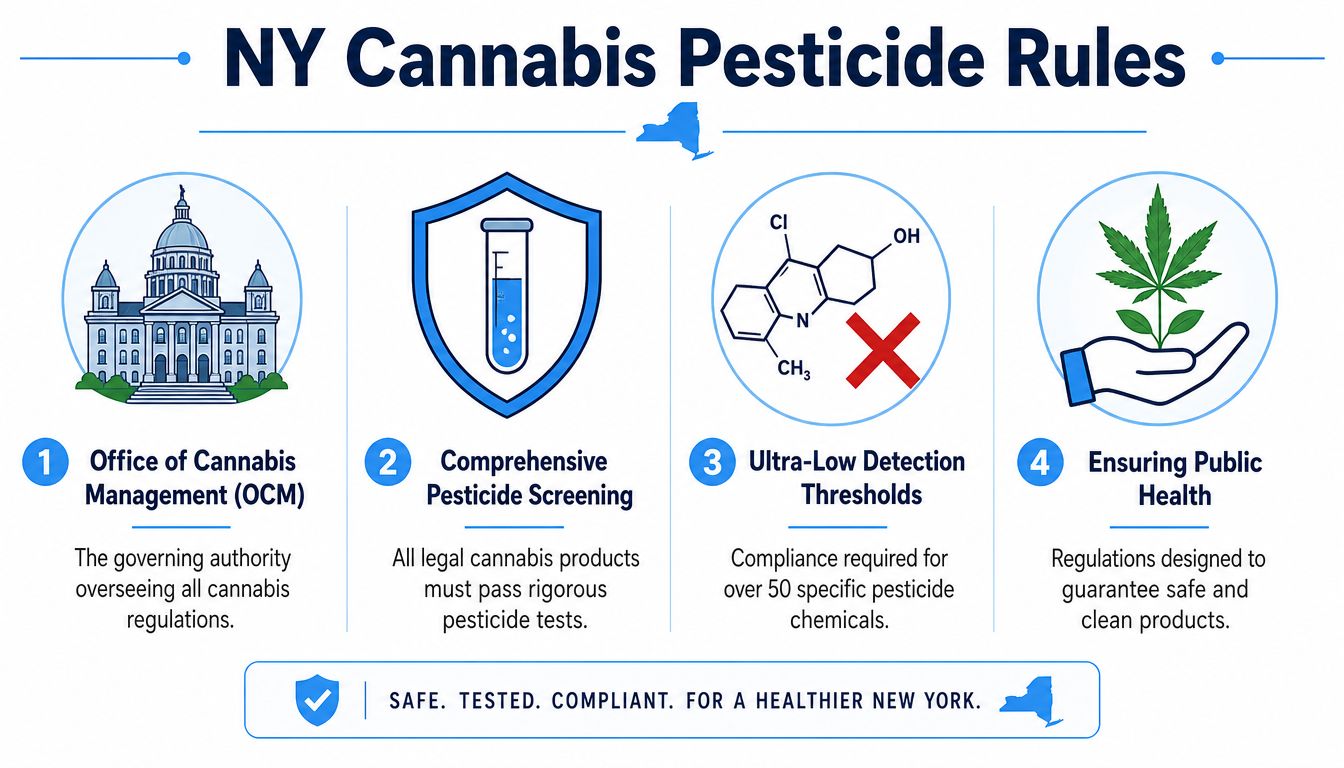
New York takes a strict approach. State law mandates that laboratories test every batch of cannabis for 70 different pesticides, each with a specific actionable limit, and any product with an unapproved pesticide or a level above the legal limit must be destroyed, according to New York compliance guidance on cannabis pesticide testing.
That's a strong pass-fail system. The point isn't to let questionable product slide through with a warning label. The point is to keep it off the market.
How sampling protects the customer
Sampling matters just as much as the lab method.
Under New York's process, every batch must be sampled by an approved third-party sampling firm, sampling is done on video, sealed samples go to the lab, growers and processors can't collect their own samples, and only five samples across any lot or batch are tested regardless of lot size, as described by New York cannabis batch sampling requirements.
That setup is important because it reduces cherry-picking. A producer doesn't get to hand over only the prettiest flower or the cleanest corner of a batch.
What this means in practical terms on Long Island
For a customer in Brookhaven, East Setauket, or anywhere in Suffolk County, these rules create a more reliable buying environment.
Here's what New York's framework is trying to prevent:
- Selective sampling: A producer can't self-choose the “best-looking” test material.
- Vague pesticide screening: The lab must screen for a defined list, not just whatever seems convenient.
- Soft enforcement: Failed product isn't supposed to be reimagined as acceptable retail inventory.
- Loose cultivation habits: Compliance pressure encourages better prevention before harvest.
If you're curious how cultivators reduce pesticide pressure before testing ever happens, MODERN LYFE's IPM insights offer a helpful primer on integrated pest management. It's a good example of how prevention and testing are meant to work together, not compete.
What matters most at the counter: In New York, “lab-tested” isn't a casual label. It points back to defined state rules, controlled sampling, and batch-level accountability.
That's good news for anyone who wants premium cannabis with fewer question marks.
How to Read a Certificate of Analysis Like a Pro
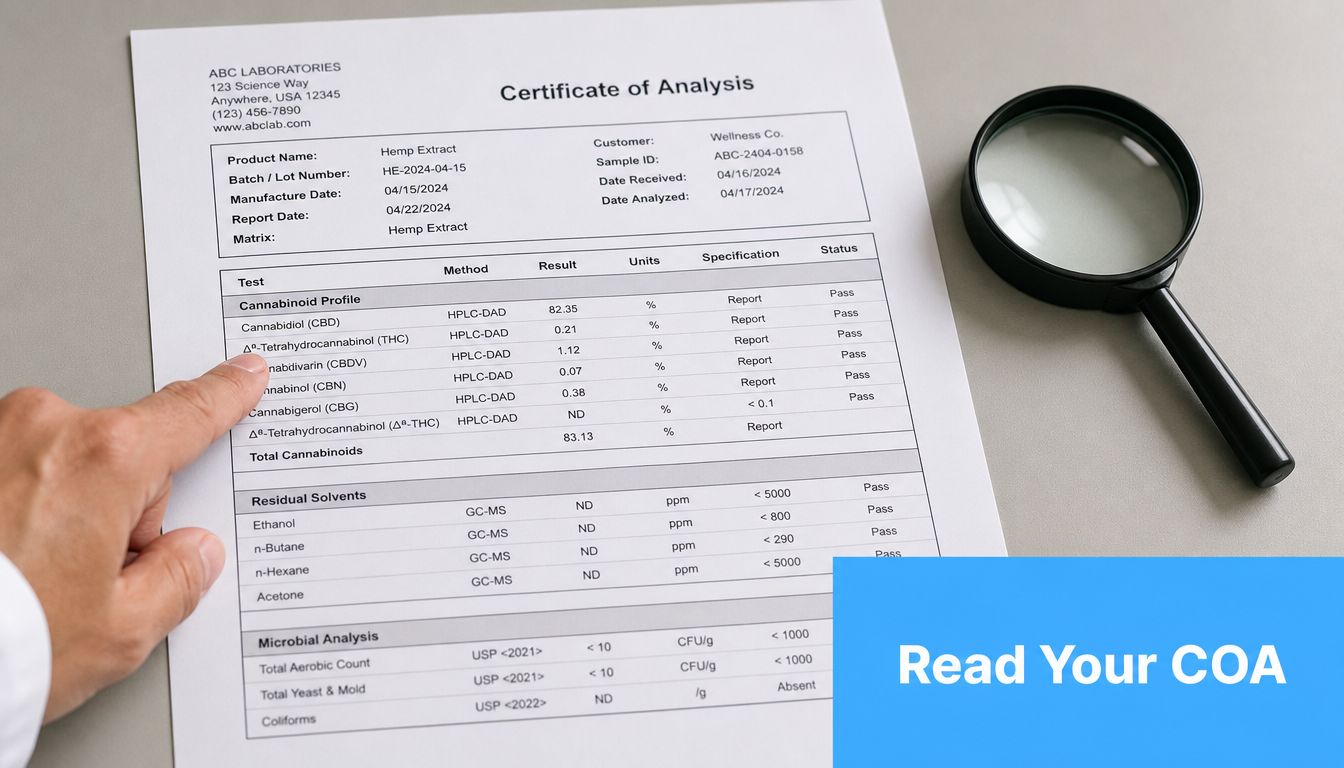
A Certificate of Analysis, or COA, is the receipt for the safety story. If a package has a QR code, that code often leads you to the batch report. You don't need a chemistry degree to read it well.
The fields worth checking first
When you open a COA, start with identity and status before you get lost in the details.
Look for:
- Batch or lot number matching the product in your hand
- Product name so you know the report belongs to that exact item
- Sample and test dates showing when the batch was evaluated
- Lab name so the report comes from a real testing facility
- Pass or fail status for the relevant category
If you want a broader breakdown of report sections beyond pesticides alone, this guide on how to read a cannabis COA is a useful companion.
The pesticide section in plain English
This is the part many shoppers skip, but it's often simpler than it looks.
A pesticide panel usually includes a list of analytes, a result, and a standard the result is judged against. Common terms include:
| Term | What it means in plain language |
|---|---|
| Result | The amount the lab found, or that it didn't find it above the reporting threshold |
| Action level | The legal line the result can't cross |
| LOQ | The level at which the lab can reliably quantify the compound |
| Pass/Fail | Whether the batch met the rule for that pesticide panel |
| ND | Not detected above the lab's reporting threshold |
“ND” can confuse people. It doesn't mean a substance is philosophically impossible to exist in the sample. It means the lab did not detect it above the method's reporting threshold.
A COA is most useful when it answers two questions clearly. Is this the exact batch I'm buying, and did it pass the right safety screens?
For many shoppers, that's enough to make a much better buying decision.
Here's a quick visual walkthrough if you prefer seeing a COA explained on screen:
What to do if a COA looks incomplete
Trust your instincts.
If the report is hard to access, missing a batch number, missing a clear pass status, or doesn't seem to match the product, ask questions. That applies whether you're buying gummies from Camino, a cart from Airo, flower from Florist Farms, or edibles from Kiva.
A confident dispensary team shouldn't get weird when you ask to verify a COA. Transparency is part of the service, not an inconvenience.
The Strong Strains Promise Your Assurance of Safety
Customers on Long Island don't need more mystery in the buying process. They need products backed by clean documentation and people who can explain what that documentation means.
That's the standard at Strong Strains in East Setauket. The shelves are built around verified compliance, not hype. If a product doesn't come with a clean, verifiable COA that meets New York's standards, it doesn't belong in the lineup.
What that means for the menu
That approach shapes the products customers see available for pickup or delivery.
You'll find trusted names like MFNY, Ayrloom, and Pax, alongside a curated mix of premium flower, vapes, pre-rolls, edibles, concentrates, tinctures, topicals, and accessories from brands customers already recognize, including Hudson Cannabis, Wyld, Jaunty, Jetty, Rythm, Botanist, Florist Farms, Camino, Kiva, Airo, Plug Play, Stiiizy, Cookies, Connected, Alien Labs, Rove, Wana, and more.
Why that matters beyond compliance
A premium dispensary should do more than stock popular labels. It should reduce your uncertainty.
That means the team should be ready to walk you through a report, explain what “pass” means, and help you compare formats based on both experience and safety. New users need that clarity. Experienced shoppers appreciate it too.
Good cannabis retail doesn't ask you to choose between luxury and transparency. The best shops treat transparency as part of the luxury.
If you want the local backstory, the Strong Strains reopening announcement gives a sense of how the dispensary has positioned itself around premium service and dependable product standards for adult-use customers on Long Island.
Your Pesticide Testing Questions Answered
Does “organic” cannabis skip pesticide testing
No. It still needs testing.
As covered earlier, outdoor cannabis can fail because of environmental drift from nearby fields, water movement, or airborne contamination. A cultivation style may reduce risk, but it doesn't replace verification.
Can you wash pesticides off cannabis flower
Not reliably.
Cannabis isn't produce you rinse under the faucet. Flower has a delicate surface, sticky resin, and plant structure that make this idea impractical. More importantly, customer safety shouldn't depend on home cleanup experiments after purchase.
Do legal products really get tested batch by batch
In regulated markets like New York, batch-level testing and controlled sampling are part of the compliance structure. That's what gives a COA value. It ties a specific product batch to a specific lab result instead of offering a vague brand-wide promise.
Can a producer dilute a failed batch to make it pass later
No. That's a myth.
The idea of diluting a failed cannabis batch to pass a retest is a myth. Regulators in states like New York have action levels in the low parts-per-million range, and modern lab equipment can trace original pesticide sources even after blending, making dilution an ineffective and illegal strategy, according to this New York pesticide testing explainer on dilution and blending.
That matters because some people assume failed material can be “fixed” by mixing it into a larger batch. That's not a real safety solution, and it's not a legal shortcut.
What should I ask a budtender if I want the safest option
Keep it simple:
- Ask for the COA for the exact batch
- Ask whether the product passed pesticide testing
- Ask who the lab was if you want extra confidence
- Ask for help comparing formats if you're deciding between flower, vapes, concentrates, or edibles
Those questions work whether you're buying Hudson Cannabis flower, a Pax pod, MFNY concentrate, Ayrloom gummies, or a Jeeter pre-roll.
The best cannabis shopping habit is easy to remember. Don't just shop by strain name or THC number. Shop by proof.
If you want premium cannabis with clear testing standards and a team that's happy to walk you through the details, visit Strong Strains in East Setauket or browse online for lab-tested flower, vapes, pre-rolls, edibles, concentrates, tinctures, topicals, and accessories. Whether you're new to cannabis or already know your favorite brands, you'll get friendly guidance, verified quality, and a smoother way to shop on Long Island.