You're at a dispensary counter, holding a jar of flower or a pack of pre-rolls, and you spot the words lab-tested on the label. That usually sounds reassuring. But a common follow-up question remains: what was tested, and what does that mean for what I'm putting in my body?
That question matters more than a lot of shoppers realize. A product can look fresh, smell great, and still need careful screening for microbes that you can't see with the naked eye. For many consumers, especially anyone who cares about clean cannabis and a smooth experience, microbial testing is one of the most important parts of product safety.
If you've ever felt like lab reports look more like homework than helpful information, you're not alone. The good news is that the basics are easier to understand than they seem, and once you know what to look for, you can shop with a lot more confidence. For readers following local cannabis education and store updates, the official reopening announcement from Strong Strains gives a good sense of how much attention premium dispensaries put on transparency and quality.
Why Lab Tested Cannabis Matters
A “lab-tested” sticker isn't there just to make packaging look official. It's there because cannabis is an agricultural product, and agriculture always comes with exposure to moisture, handling, air, surfaces, and storage conditions. Any of those can affect cleanliness.
What that label is really telling you
When a shopper sees lab-tested, they often assume it only means potency. They think THC, CBD, maybe terpenes, and that's it. But safety testing matters just as much as strength, especially for microbes like mold, yeast, and certain bacteria.
That matters for your experience in a practical way:
- Cleaner product: Better handling and better storage usually lead to more consistent flower, pre-rolls, and concentrates.
- More peace of mind: You're not relying on guesswork or someone's opinion about whether a batch “looks fine.”
- Safer choices for sensitive consumers: People with health concerns often want more than a pretty jar and a strain name.
Why premium shoppers pay attention to testing
Luxury in cannabis isn't only about rare genetics or flashy packaging. It's also about how carefully a product is grown, dried, handled, and checked before it hits the shelf. A premium product should feel trustworthy before you even open it.
Practical rule: If a product's quality story starts and ends with “high THC,” that's incomplete. Cleanliness and handling matter too.
This is one of the biggest differences between regulated cannabis and unregulated cannabis. In a legal market, the goal isn't just to sell flower that gets you high. It's to sell flower, vapes, edibles, tinctures, pre-rolls, and concentrates that have gone through real safety review.
Why shoppers get confused
The confusing part is that “tested” can sound broader than it really is. Some consumers assume a passing result means every possible microbial risk has been ruled out. That isn't always how testing works in practice.
A pass can mean the product met the required panel. It doesn't automatically mean every possible pathogen was screened in the most detailed way possible. That distinction matters, and it's the part most labels never explain.
Understanding Microbial Testing in Cannabis
Think of microbial testing the same way you'd think about a restaurant health inspection. You may never see the kitchen, but you still expect someone qualified to check whether the food is being prepared safely. Cannabis works the same way.
The simple definition
Microbial testing checks cannabis for unwanted microscopic organisms and contamination markers that can affect safety and quality. In plain language, labs are looking for things like mold, yeast, and harmful bacteria.
In New York, this isn't optional. All licensed cannabis dispensaries must sell products tested by state-certified third-party laboratories for microbials, including screening for mold, yeast, E. coli, Salmonella, and other microbial contaminants before retail release, according to this New York cannabis testing overview.
Why cannabis needs this kind of screening
Cannabis flower grows in conditions where microbes can show up naturally. Then harvesting, trimming, curing, packaging, and transport all add more chances for contamination or poor storage. Even if nobody did anything reckless, a batch can still need scrutiny.
Here's the easiest way to understand this:
| Everyday situation | Cannabis equivalent |
|---|---|
| A restaurant gets inspected for food safety | A cannabis batch gets screened before sale |
| You can't see germs on a counter | You can't see many microbial issues on flower |
| A clean appearance doesn't guarantee safety | A frosty nug doesn't guarantee clean handling |
What labs are trying to answer
A lab usually isn't asking, “Does this flower look premium?” It's asking more specific questions, such as:
- Are there microbes present that could create a health risk?
- Do the results fit the rules for that product type?
- Do storage-related conditions suggest the product could become unstable?
That's why microbial testing sits alongside potency and pesticide analysis in a regulated market. It protects the consumer in a way visual inspection never can.
You wouldn't trust a restaurant because the menu looks nice. Cannabis shouldn't get a pass just because the jar design is good.
Why this separates legal from illicit cannabis
In the unregulated market, people often buy based on smell, appearance, strain hype, or price. None of that tells you whether a third-party lab checked the batch. In the legal market, microbial testing creates a paper trail and a standard. That doesn't make every brand identical, but it gives you a much stronger starting point as a consumer.
The Unwanted Guests Common Cannabis Contaminants
Some microbes are more of a general quality warning. Others are the kind that deserve immediate concern. Knowing the difference makes lab results much less intimidating.
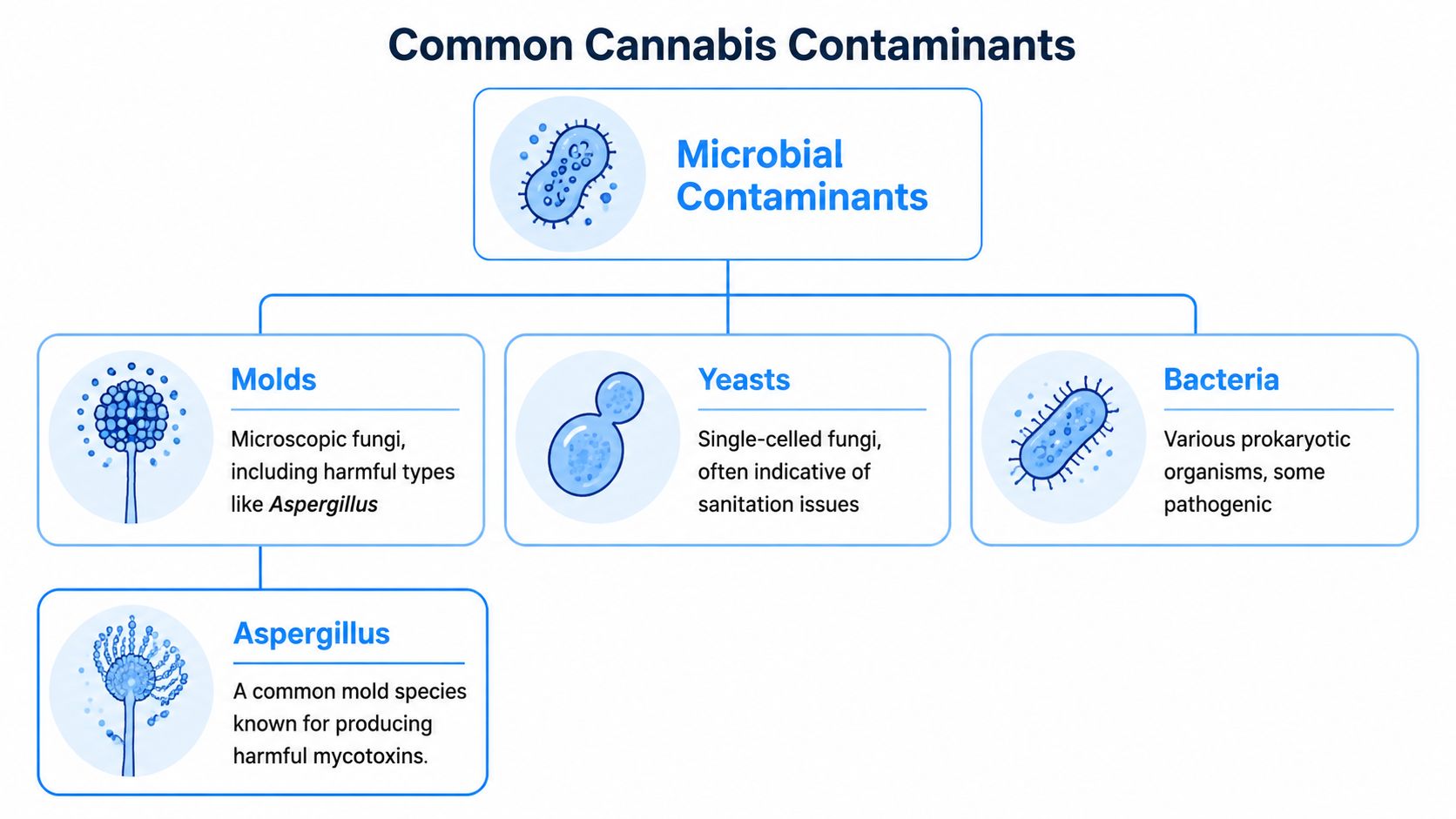
Molds
Molds are microscopic fungi, and cannabis consumers often hear about them first because mold is one of the easiest contamination risks to imagine. You think of moisture, poor drying, or bad storage, and that instinct is usually on the right track.
One of the most important names here is Aspergillus. Microbial testing protocols specifically target dangerous pathogens including Aspergillus spp., E. coli, and Salmonella because their presence poses severe health risks, particularly to immunocompromised individuals, with Aspergillus linked to respiratory infections. The same source notes that the two most common mandated tests across the U.S. are for E. coli and Salmonella, which serve as primary indicators for fecal contamination and unsafe handling practices, as described by Agilent's overview of cannabis microbial testing.
Yeasts
Yeasts are also fungi, but they behave differently from molds. On a lab report, yeast findings often sit in broader count-based categories. Consumers sometimes assume that means yeast is no big deal. That's too casual.
Yeast results can point to sanitation issues, handling problems, or environmental conditions that weren't well controlled. They may not carry the same immediate recognition as a named pathogen, but they still help paint a picture of how carefully a product moved through the supply chain.
Bacteria
Bacteria are where people tend to get nervous, and in some cases they should. E. coli and Salmonella stand out because they are treated as key indicators of contamination tied to unsafe handling practices.
A peer-reviewed review of state medical cannabis program rules across 37 U.S. jurisdictions found that the two most common microbial tests mandated are for Escherichia coli and Salmonella. That same review explains why they matter: these organisms are fecal contaminants, and their presence can trigger immediate sample failure in strict states such as California. It also notes that some states use broader count limits differently, with examples including Massachusetts and Pennsylvania, showing that microbial rules can vary significantly by jurisdiction. That detail comes from this published review of state cannabis testing regulations.
Some microbes suggest a quality problem. Others suggest a direct safety problem. A shopper should know which is which.
Why cultivation and facility design matter
Microbial risk doesn't start in the dispensary. It starts upstream with grow rooms, drying rooms, post-harvest handling, and packaging workflows. Teams that want cleaner product spend serious time equipping cannabis cultivation facilities so air movement, sanitation, storage, and workflow support compliance instead of working against it.
And if you want to understand how the growing medium itself can influence cultivation quality, this guide on pot growing soil is a useful companion read.
How Labs Test for Microbes
A lot of consumers imagine microbial testing as one single machine producing a pass or fail result. In reality, labs can use different methods, and those methods don't all answer the same question in the same way.
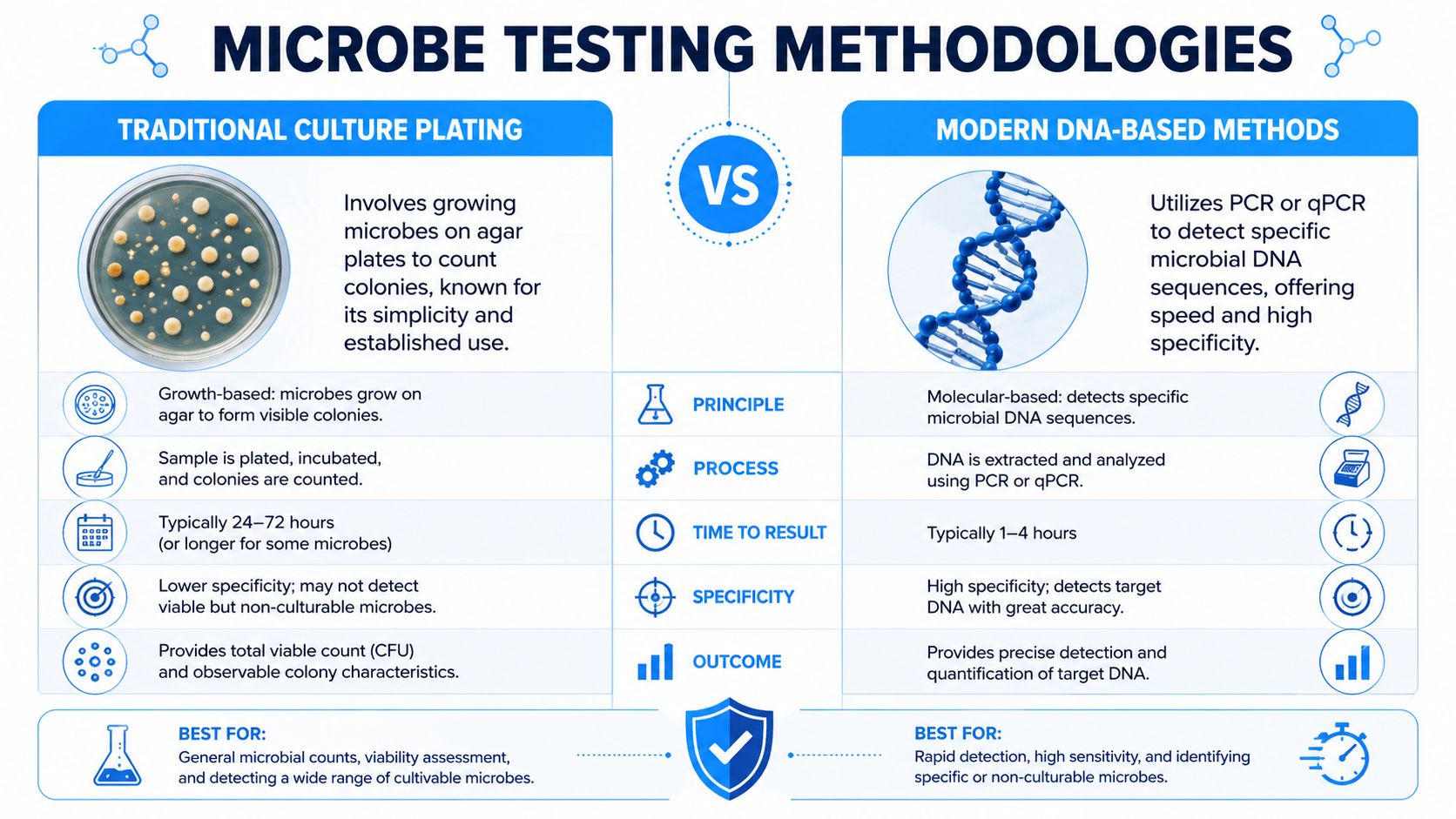
Culture plating
Culture-based testing is the classic approach. A simple way to think about it is planting a mystery seed in a garden and waiting to see what grows. The lab places material under conditions where microbes can grow into visible colonies, then reads those results.
That method has a clear advantage. It helps show viable growth in a direct, established format. But it can also be slower and less specific when the goal is to identify a very particular pathogen.
DNA-based methods
DNA-based methods, including PCR-style approaches, work more like a genetic identification test. Instead of waiting to see what grows, the lab looks for genetic material tied to the organism it wants to detect.
That can make pathogen-specific screening more targeted. If the question is, “Is this specific dangerous organism present?” DNA-based testing can be a strong fit. But shoppers should remember that methods still have to be interpreted correctly within the rules of the product category and jurisdiction.
Side-by-side view
| Method | Helpful analogy | Main strength | Main limitation |
|---|---|---|---|
| Culture plating | Growing a mystery seed | Established and practical for live growth | Can be less targeted and slower |
| DNA-based testing | Running a genetic ID test | Specific and fast for targeted organisms | Requires careful interpretation |
Consumers don't need to memorize lab workflows, but it helps to know why one COA might show broad count information while another highlights named pathogens more clearly. That difference often comes down to testing design, not just formatting.
Why method choice matters beyond cannabis
This same idea shows up in other safety fields too. If you've ever wanted a broader look at essential water quality testing methods, it's a good reminder that contaminant testing usually involves different tools for different questions. One method may be great for broad screening, while another is better for pinpointing a specific risk.
A lab result isn't just about the answer. It's also about what question the method was designed to ask.
How to Read a Certificate of Analysis
A Certificate of Analysis, usually called a COA, is where lab testing becomes real for the shopper. This is the document that tells you what sample was tested and what the lab found. Once you know a few key terms, it gets much easier to scan.
A visual can help before we break it down.
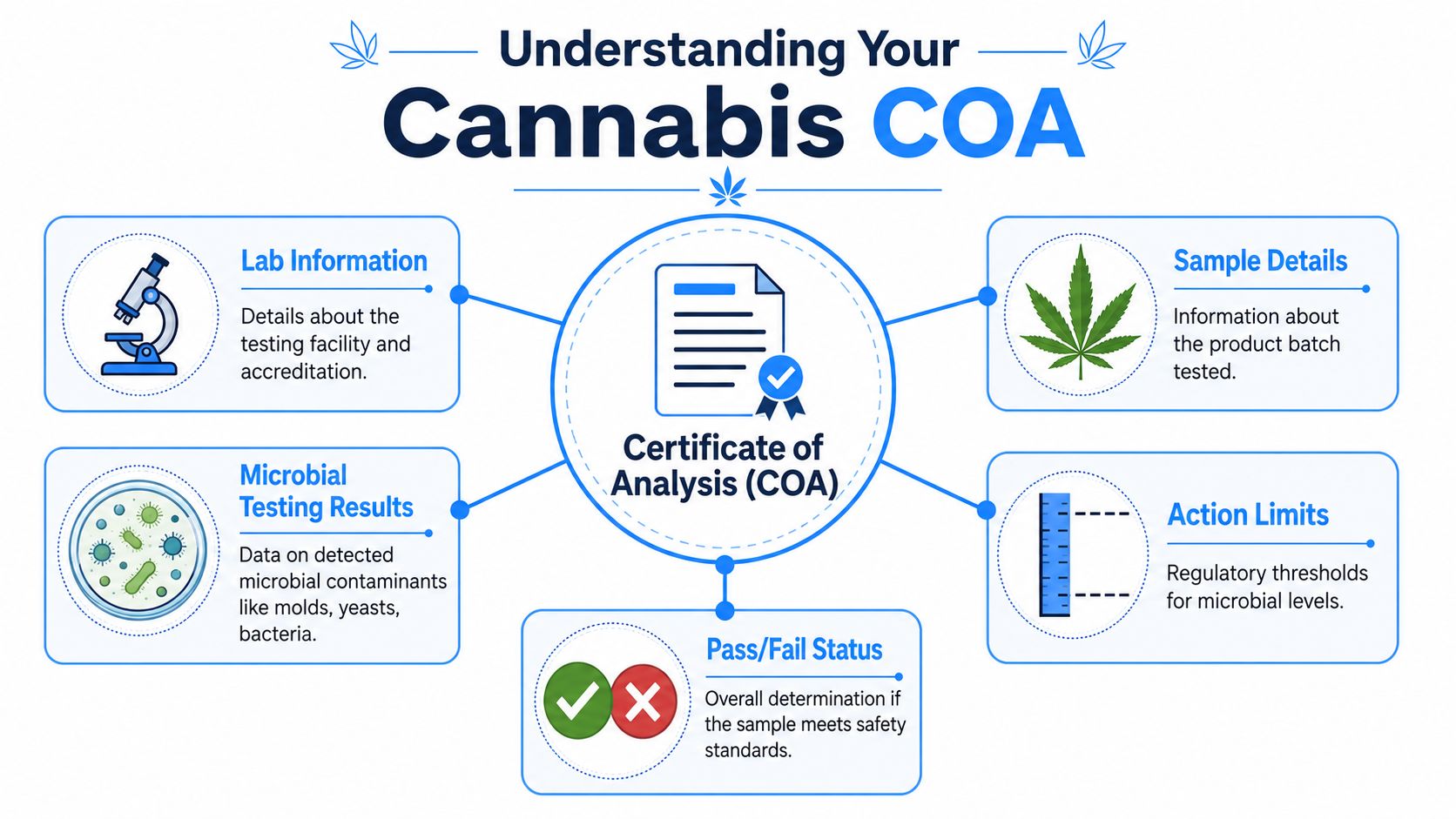
The first things to look for
Start with the basics:
- Lab information: Which licensed lab performed the testing.
- Sample details: Product name, batch, and product type.
- Microbial section: Where you'll see the actual safety panel results.
- Pass or fail status: The summary outcome under the applicable rules.
If you want a broader walkthrough of the document itself, this explainer on the COA certificate of analysis is a useful reference.
Terms that confuse people most
A few terms show up often:
- CFU/g: Short for colony forming units per gram. It's a way of expressing microbial growth in a sample.
- ND: Usually means not detected.
- Pass: The sample met the required action limits for that panel.
- Fail: The sample did not meet the required standard.
Those labels are helpful, but they don't tell the whole story by themselves.
Here's a quick analogy. If you've ever looked at bloodwork or another health panel and felt lost, the skill is similar to learning how to interpret lab results. You don't need a science degree. You just need to know which fields carry the most weight.
The big distinction most shoppers miss
Microbial testing offers an intriguing insight. A product can show acceptable total count results and still leave important questions unanswered about specific pathogens.
A critical gap exists between total count tests such as TAMC and TYMC and true safety. These general tests fail to detect specific high-risk pathogens like Aspergillus, which is a major concern for immunocompromised individuals. The same analysis argues that many labs use methods targeting broad groups, while pathogen-specific screening provides more actionable safety insight. It also notes that total count tests are often more an indicator of curing quality than a guarantee against specific toxic risks, according to Fundación CANNA's review of cannabis microbial methodologies.
That means a “pass” on a broad count doesn't automatically mean “nothing dangerous is present.” It means the product met the limits for the test that was run.
What to remember: Total counts tell you something. They just don't tell you everything.
A short video can make COA reading feel less abstract.
A smarter way to read the microbial section
When you scan a COA, ask these questions:
- Was the product tested for named pathogens, or only broad totals?
- Does the report show “ND” for the pathogens that matter most?
- Is the pass based on a clear threshold, or a broader quality indicator?
That shift in mindset helps you read a COA like a careful shopper instead of just hunting for a green checkmark.
Navigating New Yorks Cannabis Testing Rules
New York's rules can confuse shoppers because they mix strict requirements with some surprising gray areas. A product can still be subject to real microbial oversight, while some familiar count-based tests no longer work the way consumers expect.
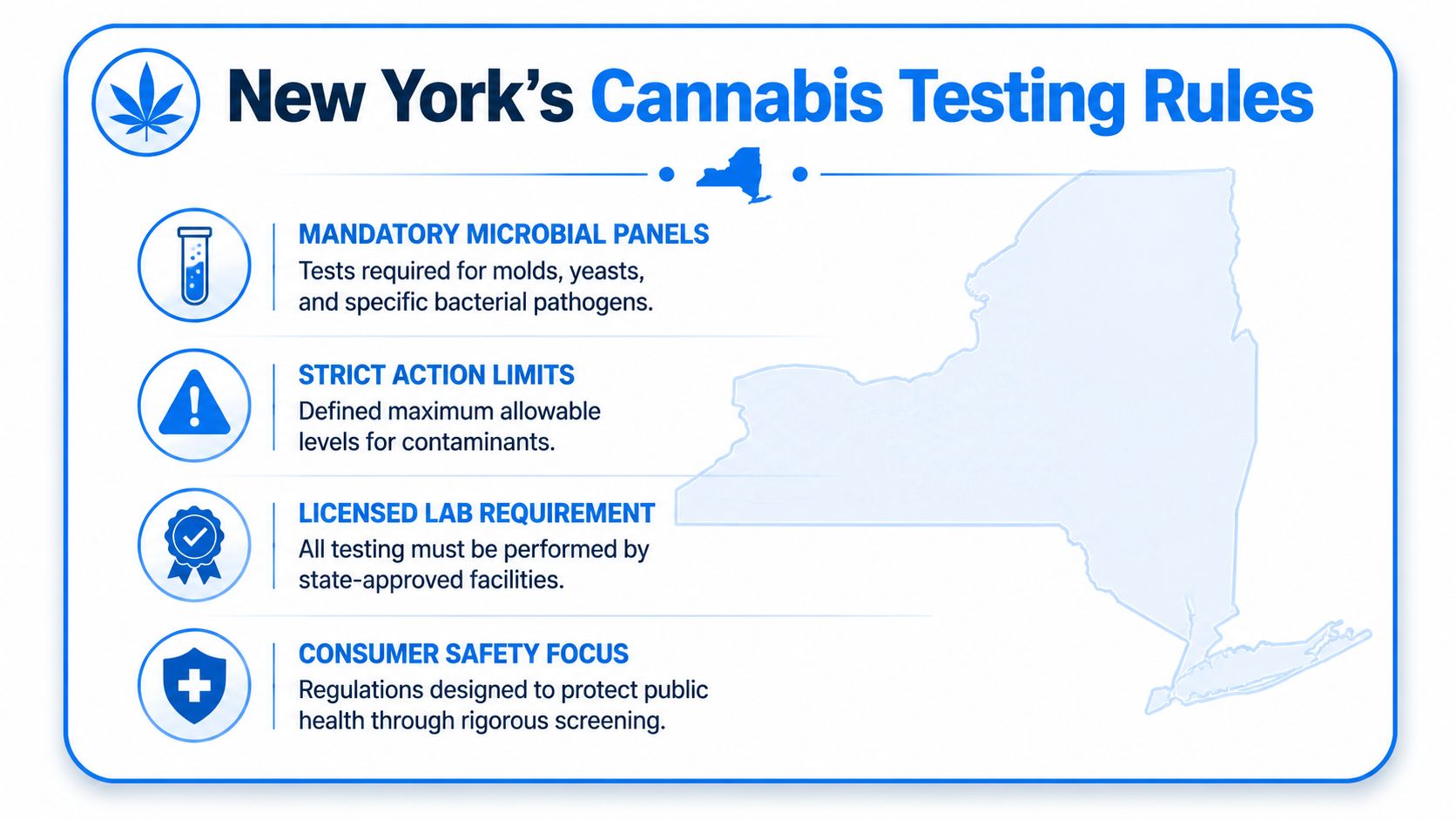
What New York still requires
New York keeps a strong focus on prevention and lab review. One of the clearest examples is moisture control.
New York State has complex rules; it eliminated pass/fail limits for Total Yeast and Mold Count in unextracted products like flower, though labs must still run the tests. However, it strictly caps water activity at 0.65 Aw and moisture content between 5.0% and 15.0% to prevent the conditions that allow mold to grow in the first place, according to this overview of New York pre-roll and flower compliance.
Why that feels confusing
For many shoppers, that sounds backward at first. They hear “the lab still runs the test” and assume there must be a hard fail line attached. But New York changed that for certain unextracted adult-use products.
A legal analysis notes that New York eliminated pass/fail limits for Total Viable Aerobic Bacteria Count and Total Yeast and Mold Count in unextracted cannabis products like flower and pre-rolls, while labs must still perform the tests, as discussed in this New York regulatory update.
What a careful shopper should take from that
Consumers should think beyond the word “pass.” In New York, some microbial data on flower may still be useful as a quality signal even when it doesn't create an automatic state failure threshold.
A practical way to read the situation is:
- Named pathogen screening matters a lot: That's where direct safety concerns become clearer.
- Water activity and moisture matter early: They help reduce the chance that mold-friendly conditions develop.
- Dispensary standards matter too: The state sets the floor, but thoughtful retailers often care about more than the minimum.
New York doesn't remove the need for caution. It makes reading the details more important.
For Long Island shoppers, that means asking better questions. Not just “Did it pass?” but also “What was tested, and what do these microbial results tell me?”
Shop with Confidence at Strong Strains
Shopping confidently starts with knowing that clean cannabis isn't defined by marketing language. It's defined by transparent sourcing, careful review, and a willingness to look past the simplest label on the package.
That matters whether you're browsing flower, pre-rolls, vapes, gummies, tinctures, concentrates, or topicals. It also matters whether you're picking up products from well-known names like Alien Labs, Cookies, Jeeter, MFNY, Rythm, WYLD, Airo, Camino, Florist Farms, Hudson Cannabis, Matter, Off Hours, Old Pal, Pax, Rove, Stiiizy, Turn, Wana, 1937, 40 Tons, 6 Point Cannabis, &Shine, Ayrloom, Botanist, Connected, Dogwalker, Fernway, Good Green, Heavy Hitters, Jetty, Kiva, Papa & Barkley, Plug Play, Raw Paper, Stone Road, Toast, Wyld, or accessory staples like Blazy Susan, Bic Lighter, Glass Pipes, Grinders, Hand Pipe, Puffco, and Raw Paper. Big brand recognition can be helpful, but it shouldn't replace a habit of checking for real testing transparency.
A smart shopper checklist
Before you buy, keep these habits in mind:
- Ask for the COA: A reputable dispensary should be ready to help you understand it.
- Look beyond the pass label: Check whether pathogen-specific results are listed.
- Store products properly: Dry, sealed, and away from excess humidity.
- Be extra selective if you're medically sensitive: Broad total counts and pathogen-specific screening are not the same thing.
Why education changes the experience
When you understand microbial testing, you stop shopping only by strain hype or packaging design. You start seeing the difference between a product that only sounds premium and one that was handled with care all the way through the supply chain.
That's a better way to buy cannabis. It's calmer, smarter, and more protective of your experience.
If you want help choosing lab-tested flower, pre-rolls, vapes, edibles, concentrates, tinctures, topicals, or accessories from a knowledgeable local team, visit Strong Strains. You can stop by the East Setauket dispensary, ask for guidance on COAs and product quality, and shop with more confidence knowing what those test results mean.