You sit down to meditate after a long day. The room is finally quiet, your phone is face down, and your breathing starts to slow. Then your mind does what minds do. It jumps to tomorrow's meeting, a text you forgot to answer, a stiff hip, the laundry, the news, dinner. A lot of people reach this point and wonder whether cannabis might help them settle more fully into the moment.
That question is more common than ever. Meditation has moved from a niche practice into everyday wellness, and cannabis has become part of many adults' relaxation routines. Some people find that combining them helps soften mental chatter and body tension. Others find that too much THC makes them distracted, foggy, or anxious. Both experiences are real.
Cannabis and meditation work best when you treat cannabis like a tool, not a shortcut. The right dose, format, and setting matter. So does your reason for using it. If your goal is to notice your breath more clearly, relax into posture, or support a reflective evening practice, cannabis may have a place. If your goal is to escape difficult emotions altogether, it can pull you away from what meditation is meant to build.
The environment matters too. Small details can change the tone of a session, from lighting to scent to what's on the table beside your cushion. If you want a calming visual anchor in your practice space, you can explore Astro West's luxury decor for pieces that support a more intentional ritual.
Introduction Finding Your Center
A lot of first-time explorers of cannabis and meditation assume the answer is simple. Either cannabis helps you “get zen,” or it ruins concentration. In practice, it's more nuanced than that.
For some adults, a very low dose makes the gap between thoughts easier to notice. Breath feels more interesting. Music fades into the background instead of competing for attention. The body unclenches enough to sit still. For others, the same product at the wrong dose creates looping thoughts or a heavy, sleepy feeling that turns meditation into zoning out.
Why people get stuck
Meditation sounds simple. Sit, breathe, return to the breath. The hard part is what happens in the middle.
Many people aren't fighting a lack of technique. They're fighting activation. Tight shoulders, restless legs, racing internal dialogue, and a nervous system that won't downshift. Cannabis can sometimes lower that barrier, but it can also become a distraction if you use too much or choose the wrong product for the kind of practice you're doing.
Cannabis can support meditation, but it can't replace meditation. Presence still takes practice.
A better way to think about it
Think of cannabis as something that may adjust the volume in the room. Meditation is still the skill that teaches you where to place your attention.
That distinction matters. If you want to explore cannabis and meditation responsibly, start with curiosity instead of expectation. Notice whether it helps you stay with your breath, your body, or a guided practice. Notice whether it makes you more patient with discomfort, or more reactive to it. Those are very different outcomes, and the difference often comes down to dose, timing, and product choice.
The Neuroscience of a Mindful High
The science gets easier to understand when you stop thinking of cannabis as a single “high” and start thinking about systems. Your body already has one that helps regulate stress, mood, and perception. It's called the endocannabinoid system.
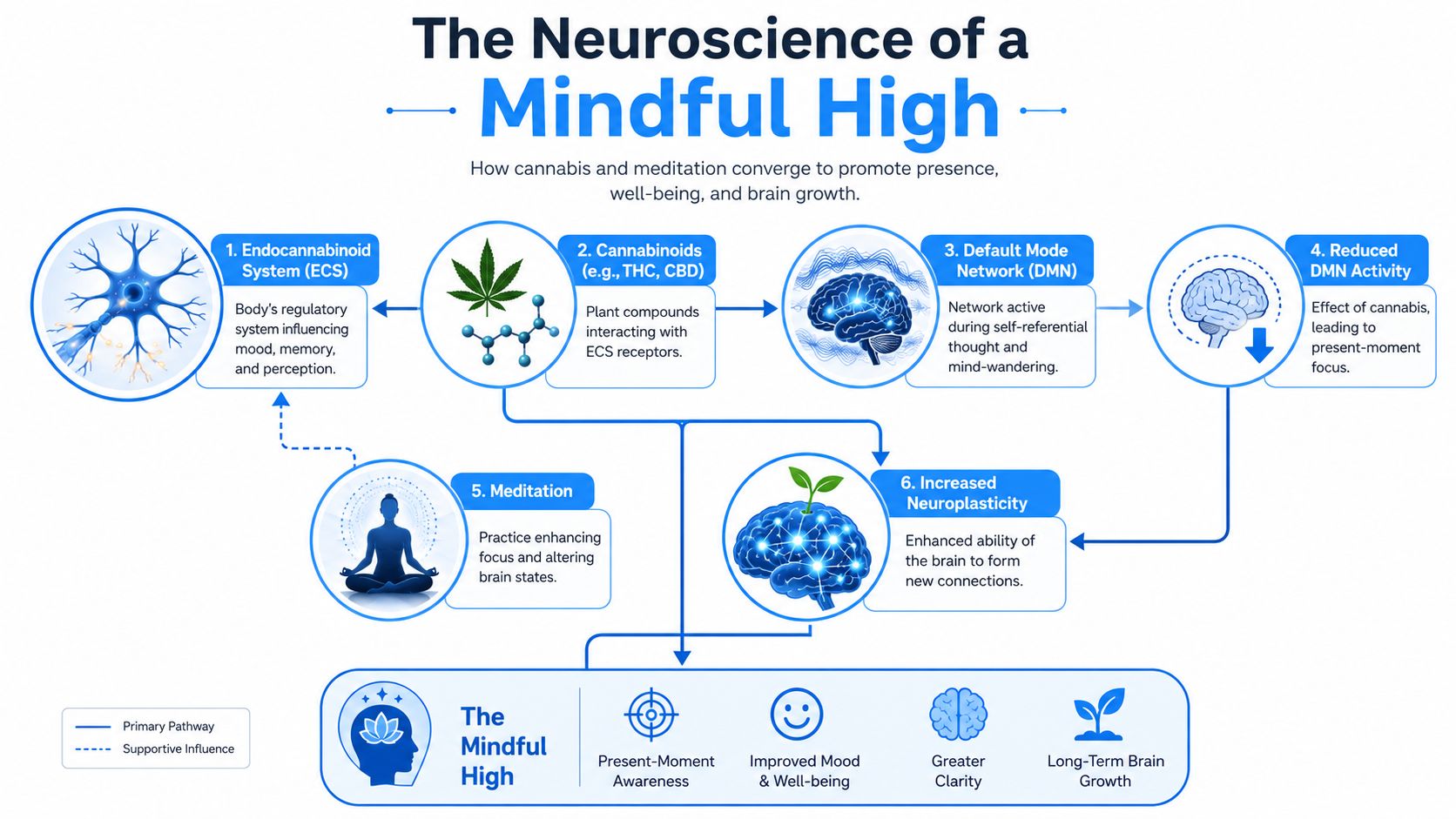
When THC interacts with that system, it can shift how your brain processes threat, attention, and internal chatter. That helps explain why some people feel less mentally scattered during meditation after a low dose.
The two brain functions that matter most
One is the amygdala, often described as part of the brain's alarm circuitry. The other is the Default Mode Network, which is active during self-referential thinking and mind-wandering.
A useful plain-English version looks like this:
- Amygdala activity can make you feel keyed up, watchful, or emotionally reactive.
- Default Mode Network activity often shows up as rumination, replaying old conversations, and drifting away from the present.
- Meditation trains you to notice both without getting pulled around by them.
- Cannabis, in some cases, may make that process feel more accessible at low doses.
A published review explains the mechanism clearly. Increased endocannabinoid signaling, stimulated by cannabis THC, reduces the stress response and improves emotion regulation by quieting the amygdala via prefrontal cortex activation. This pathway is especially relevant for sativa-dominant strains that increase CB1 activation in the prefrontal cortex, leading to narrowed focus and reduced anxiety without sedation (reviewed here).
That's one reason some adults prefer a bright, clear daytime product for mindfulness practice instead of a heavier evening option. A sativa-leaning product from a brand like Ayrloom may feel more suitable for focused breathwork, while a different profile may be better for body scan meditation or bedtime reflection.
For a practical look at how product choice fits into stress support more broadly, this guide on how cannabis can help manage stress and anxiety is a useful companion read.
Why low and intentional usually works better
Meditation asks for awareness, not overload. If cannabis narrows your focus gently, that can help. If it alters perception too strongly, you may spend the whole session following sensations instead of observing them.
A good rule is to ask one question before you begin: “Do I want to feel less distracted, or do I want to feel more intoxicated?” Those aren't the same goal.
This short video gives a helpful visual overview before you experiment with your own routine.
Practical rule: If the dose changes your awareness so much that you can't stay with one breath for more than a few seconds, it isn't helping your meditation.
Choosing Your Meditative Cannabinoids and Terpenes
Most shoppers start with “indica or sativa,” but meditation usually calls for a more precise question. Are you trying to become calmer, more focused, more body-aware, or less reactive?
Those goals can point you toward different cannabinoid and terpene profiles. A beginner who gets anxious easily may want a gentler, CBD-forward option. A more experienced user may prefer a balanced profile that supports introspection without flattening attention.
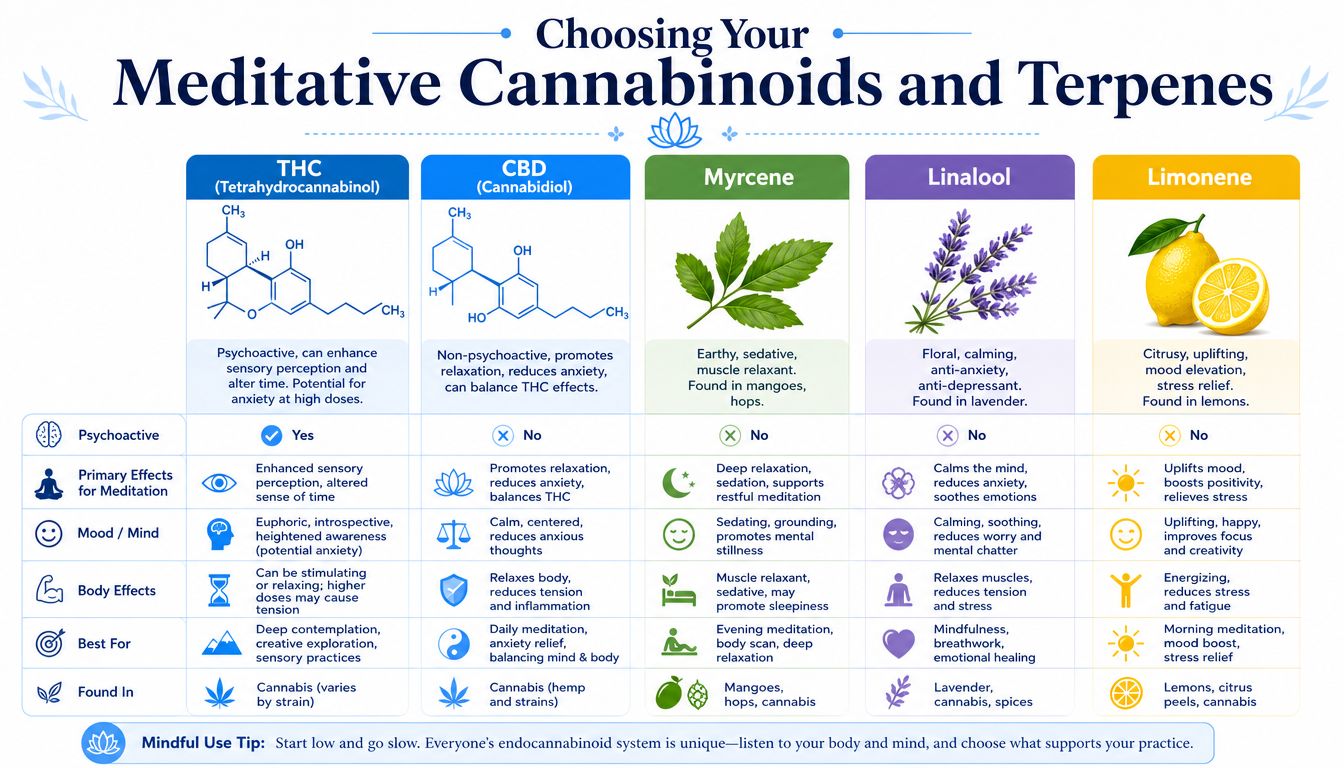
Start with the function, not the label
A practical clinical summary notes that beginners should prioritize indica-dominant hybrids for relaxation and sleep-promoting meditation, while sativa-dominant strains enhance focus for mindfulness practices requiring sustained attention. However, chronic heavy use can lead to attentional deficits that may undermine meditative depth (summarized here).
That doesn't mean every “indica” is ideal for meditation, or that every “sativa” is productive. It means your purpose should drive your selection.
Quick comparison for real-world shopping
| Compound | Potential Meditative Effect | Consider For |
|---|---|---|
| THC | Can heighten sensory awareness and alter perception | Experienced users seeking deeper immersion at low dose |
| CBD | Can feel steadier and less mentally pushy | Beginners, anxious users, guided sessions |
| Myrcene | Often chosen for heavier body relaxation | Evening body scan, restorative practice |
| Linalool | Often associated with a calmer feel | Breathwork, unwinding after stress |
| Limonene | Often chosen for a brighter mood lift | Daytime mindfulness, walking meditation |
What this looks like on the shelf
A few examples help make this less abstract:
- Head & Heal often makes sense for shoppers who want a higher-CBD entry point and a clearer starting experience.
- Rythm can appeal to customers who already know they want a more defined flower or vape profile for focus or relaxation.
- Cookies may interest experienced users who care about cultivar character, but those shoppers should still choose by effect and dose, not by hype.
If you're shopping in a premium dispensary, ask the budtender a direct question: “What would you suggest for a low-intensity meditation session where I want to stay clear?” That gets you closer to the right fit than asking for the strongest product.
A simple way to choose
Use this decision filter before you buy:
- For calming the body: Look for a profile people typically choose for muscle ease and slower pacing.
- For quiet, clear attention: Lean toward a lighter profile that doesn't feel sedating.
- For anxiety-sensitive beginners: Start with CBD-forward products or balanced options.
- For bedtime meditation: Favor something that supports stillness over mental stimulation.
Formats and Dosing for Mindful States
A common Long Island dispensary question sounds like this: “I want help settling into meditation, but I do not want to feel foggy or out of control.” The answer usually starts with format before it starts with strain. The same cannabinoid profile can feel very different depending on whether it comes through a Pax session, a measured tincture, or a gummy that takes an hour to arrive.
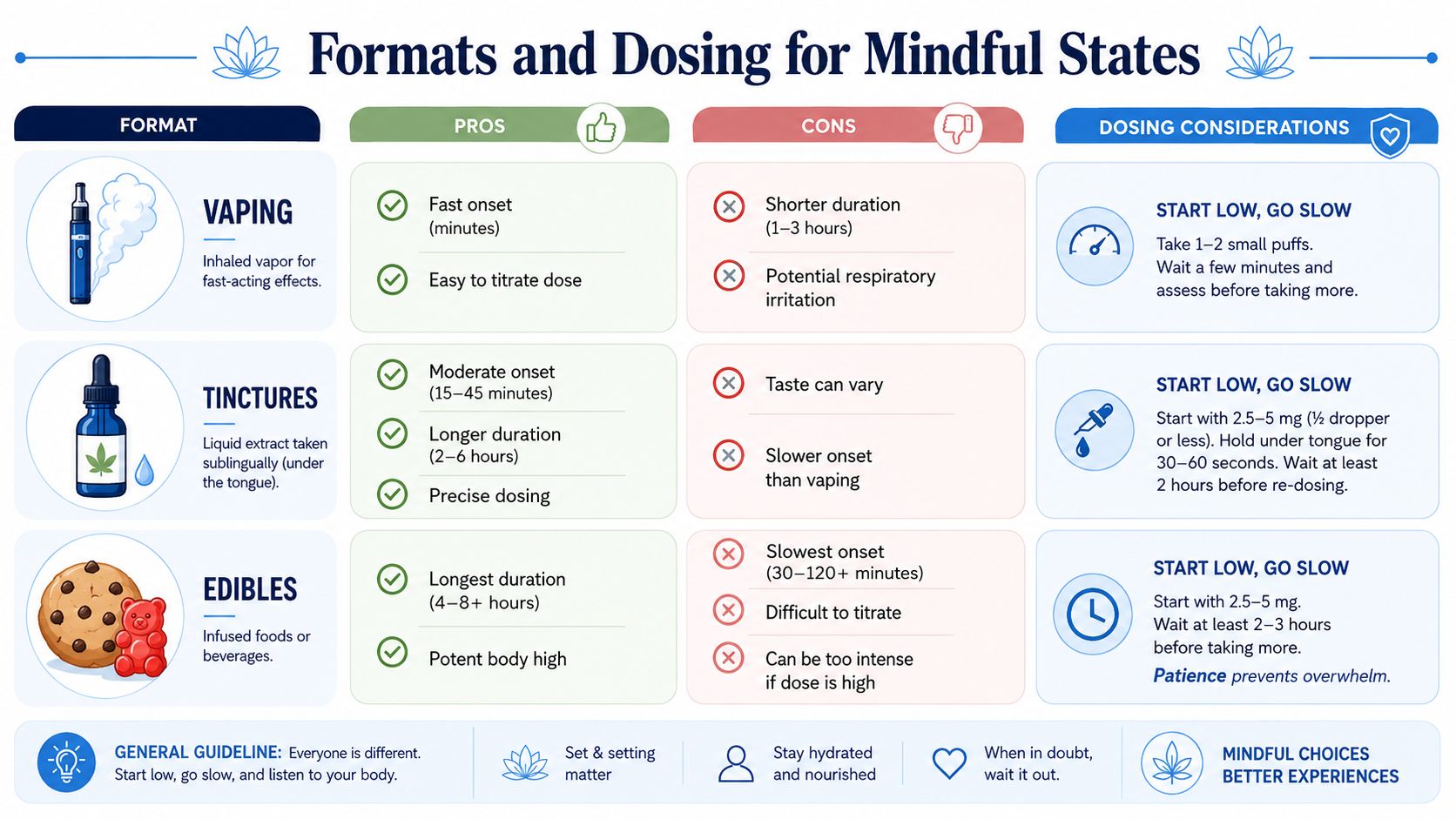
Meditation works best when the dose is predictable enough that your attention can rest on the practice instead of chasing the effect. A useful comparison is coffee. A sip gives you feedback quickly. A large cold brew can keep building long after you have committed to it. Cannabis formats differ in a similar way through onset, duration, and how precisely you can measure your intake.
How each format shapes the session
Vapes, including devices like Pax, give the fastest read on how a product affects you. That makes them useful for short sits, post-work breathwork, or experienced consumers who want one small inhalation and then a pause. The tradeoff is that inhaled cannabis can be easy to stack too quickly if you are impatient.
Tinctures from brands like Head & Heal often give the cleanest middle path for wellness-minded shoppers. You can measure the serving, place it under the tongue, and wait for a more gradual onset than vaping. For many people, that makes tinctures easier to pair with a deliberate meditation routine because the experience feels steadier and easier to repeat.
Edibles such as Wyld or Wana suit a longer evening window, not a spontaneous five-minute sit. They last longer and can support a drawn-out body scan, restorative practice, or quiet nighttime reflection. They also require the most patience, which is why beginners often do better with a very low dose and a clear plan.
For a more detailed comparison of timing, control, and daily use, read our guide to THC tinctures vs edibles.
A dosing ladder that keeps the mind clear
Strong Strains generally advises customers to treat meditation dosing like adjusting room lighting. You are looking for enough change to soften distraction, not so much that the whole room disappears.
- Start at 2.5 mg THC or less if you are new to combining cannabis with meditation.
- Repeat that same dose on a different day before increasing. Consistency matters more than curiosity here.
- Move to 5 mg only if the lower dose still feels clear and manageable.
- Be cautious above 10 mg THC if your goal is presence, breath awareness, and emotional steadiness rather than intensity.
One more practical point. Edibles can take 45 to 90 minutes to fully show themselves, so the waiting period is part of the dose. If you feel nothing at 20 or 30 minutes, that is usually a cue to keep waiting, not to take more.
Match the product to the kind of meditation you actually do
A ten-minute reset before dinner calls for a different tool than a slow Sunday night session. Shoppers often get better results when they buy for the practice itself.
- For a short, focused sit: a very small inhaled dose can be easier to judge in real time.
- For a measured, repeatable session: a tincture often gives better serving control.
- For a long, quiet evening practice: a low-dose edible may fit, as long as you plan the start time.
- For spiritually framed routines: some people like to pair a low, calming dose with breathwork or energy reflection, and BYBS & Thrive on clearing chakras offers one approach.
The goal is not to buy the strongest product on the shelf. The goal is to choose a format and dose that leave enough mental space for the meditation itself.
A Sample Cannabis Enhanced Meditation Protocol
Theory helps, but individuals often want to know what a good session looks like. The safest answer is simple, repeatable, and boring in the best way. Same product, same environment, same low dose, and enough quiet to notice what changes.
Clinical guidance for new medical marijuana patients advises starting with small doses of THC prior to meditating and gradually increasing the amount until a perfect balance is achieved, and it emphasizes using one strain per session and recording experiences to identify the most effective profile (clinical guidance here).
Before you consume
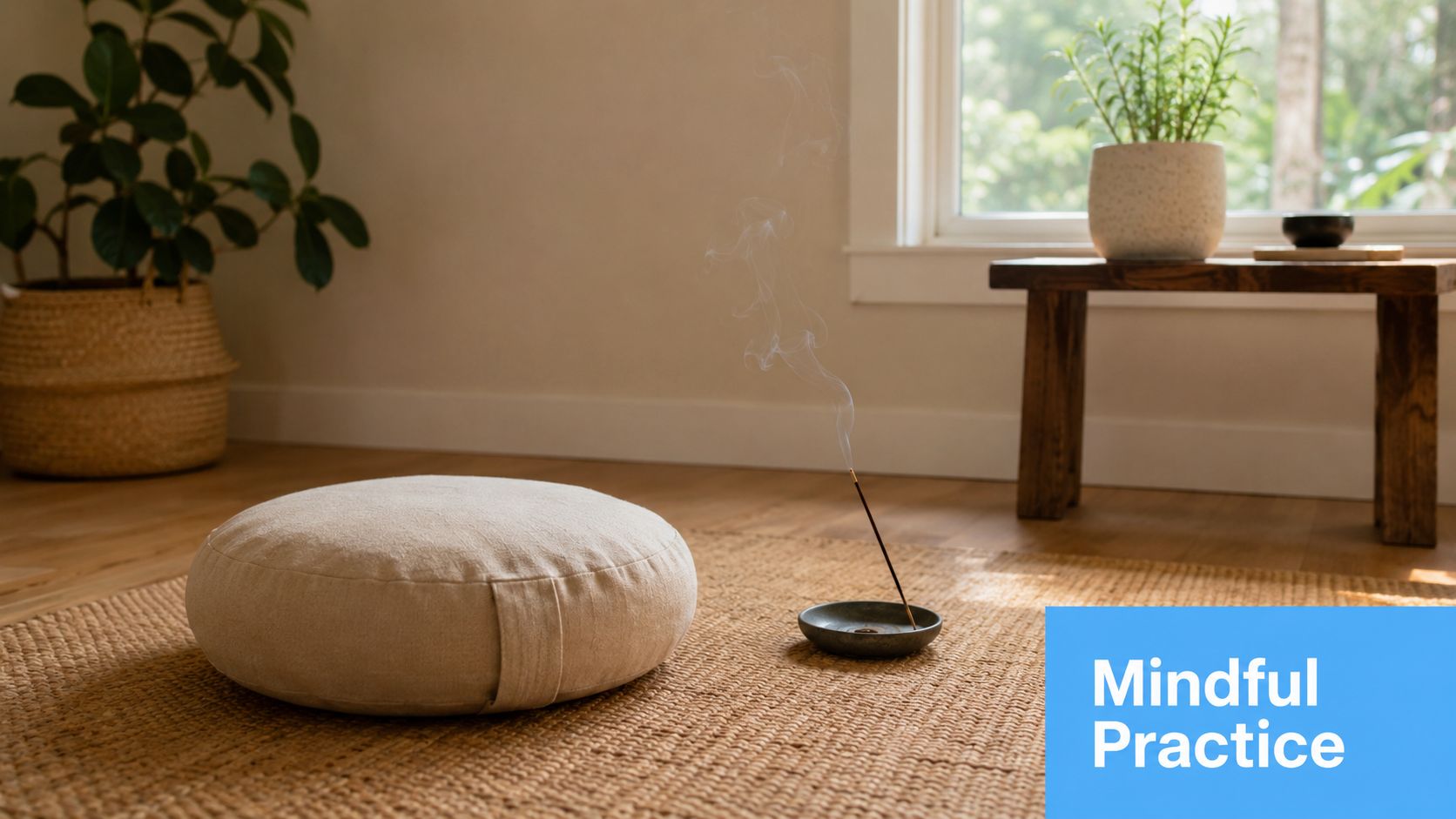
Set up the room first. Cushion or chair in place, water nearby, lights lowered, phone out of reach. If spiritual framing matters to you, some people also like to pair the session with breathwork or energy-based reflection, and BYBS & Thrive on clearing chakras offers a thoughtful perspective you can adapt to your own practice.
Choose one product only. Don't mix flower, a gummy, and a vape pen in the same experiment. If you're trying a product from Old Pal, Good Green, or another familiar line, keep everything else stable so your notes are meaningful.
During the session
A clean beginner protocol looks like this:
- Set one intention: Keep it short. “Notice my breath” is enough.
- Use a low dose: Stay conservative, especially if it's your first cannabis-supported meditation.
- Wait for onset: Let the product settle before you begin.
- Sit for a fixed period: A short, manageable session usually works better than forcing a long one.
- Return to one anchor: Breath, hands, or contact with the floor.
If sensations become more vivid, don't chase them. Let them be part of the field of awareness.
Notice more. React less.
After the session
Write down a few lines while the experience is fresh. Note the product, how much you took, how long you waited, and whether your attention felt steadier, dreamier, or harder to manage.
That journal becomes your best teacher. Over time, you'll start to see patterns. Maybe one tincture supports body scan meditation well but dulls your focus for seated breathwork. Maybe a vape is useful for a short reset but not for evening introspection. That kind of information is more valuable than a broad label on the package.
Navigating Risks and Practicing Responsibly
A calm session can turn uncomfortable fast if the product is too strong, the setting feels off, or your reason for using cannabis is more about escape than attention. That is why honest self-assessment matters here.
Cannabis may not improve meditation for you. For some adults, the clearest and healthiest outcome is realizing their best practice is sober. A major 2026 Lancet Psychiatry review found no strong evidence that cannabis alleviates anxiety or depression, and it also highlighted risks of increased depression or worsened psychotic symptoms for vulnerable groups (reported by NPR). If you are using meditation to support mood, that distinction matters.
Who should be especially cautious
Use extra care if you have a history of paranoia, psychosis, bipolar disorder, or if THC has made you feel panicky, suspicious, or mentally scattered in the past. In those cases, cannabis can pull attention away from meditation instead of helping you settle into it.
Step back if you notice these patterns:
- You can't meditate without cannabis anymore
- Your doses keep climbing
- You feel more avoidant after sessions, not more aware
- You're using meditation as a reason to overconsume
That checklist works like a guardrail. It helps you tell the difference between a supportive ritual and a habit that is subtly taking over.
Product quality matters too
Dose is only one part of the equation. Product quality shapes predictability, and predictability matters when you are trying to notice subtle changes in breath, body tension, or thought speed. At Strong Strains, that is one reason we steer wellness shoppers toward clearly labeled products and brands with consistent manufacturing standards, especially for low-dose use.
If you want a clearer picture of why clean sourcing matters, read our guide to how pesticide testing protects product consistency and safety.
Keep cannabis in the right role
A useful frame is simple. Cannabis can show you what a quieter state feels like. Your regular sober practice is what helps you return there on your own.
For Long Island customers exploring this carefully, that often means limiting cannabis-supported sessions instead of making them the default. A low, measured option such as a Head & Heal tincture may fit occasional use better than frequent, unstructured THC sessions because the dose is easier to repeat and evaluate. For a recovery-centered perspective on staying grounded in the larger purpose of meditation, see Still Water Wellness Group's meditation insights.
The goal is not to chase a special state. The goal is to build steadier awareness, with or without cannabis.
Your Path Forward at Strong Strains
Cannabis and meditation can be a meaningful combination when you stay honest about what you're doing. Start with intention. Choose products by effect, not hype. Keep doses low enough to preserve attention. Repeat what works, and leave plenty of room for sober practice.
That approach fits the bigger picture too. In the United States, 14.2% of adults reported meditating and 19% reported using cannabis, which shows why so many wellness-focused shoppers are looking for precisely dosed options and thoughtful guidance around the overlap between the two (market context here).
What thoughtful exploration looks like
The best cannabis routine for meditation usually isn't the strongest flower or the loudest edible. It's the product that helps you remain observant, comfortable, and emotionally steady.
For some adults, that may mean:
- A low-dose edible from Wyld for a planned evening sit
- A measured tincture from Head & Heal for a more controlled experience
- A Pax session with a light inhalation for a short reset after work
For others, it may mean realizing that cannabis doesn't improve their meditation at all. That's a useful result too.
Why local guidance matters
Shopping in person helps because meditation needs are specific. A shopper looking for yoga recovery, sleep-focused breathwork, or a clear-headed morning sit shouldn't all leave with the same recommendation.
If you're also interested in how meditation supports self-regulation in other wellness contexts, Still Water Wellness Group's meditation insights offer another grounded perspective on why the practice itself matters, with or without cannabis.
The strongest long-term approach is simple. Learn your body. Respect the dose. Choose quality. Keep notes. Let the practice stay bigger than the product.
If you're ready to explore premium, lab-tested cannabis with guidance that matches your goals, visit Strong Strains. Our East Setauket team helps Long Island adults find the right flower, vapes, tinctures, edibles, concentrates, and accessories for a more intentional experience, whether you're building a mindful evening routine or just want a low-dose place to start.