
The most popular advice about a cannabis topical balm is also the least reliable: more THC or CBD on the label must mean deeper, stronger relief. Skin doesn't work like a sponge, and cannabinoids don't move through it merely because a jar lists a higher percentage. A balm may feel soothing, moisturize the area, or create a cooling sensation while delivering most of its cannabinoids near the skin surface.
For adult consumers in New York, the useful question is more practical than “How potent is it?” Ask whether the product is designed for local topical use or engineered for transdermal delivery, whether its ingredients suit your skin, and whether an independent laboratory has verified the contents. This guide is educational, not medical advice. The Strong Strains approach is quality over gimmicks, with transparent testing and realistic expectations.
Why a Cannabis Topical Balm Is Not Automatically Potent
Cannabinoids face a difficult delivery problem. CBD and THC are highly lipophilic, meaning they mix readily with oils but poorly with water. The skin contains both oily and aqueous environments, and the outermost layer, the stratum corneum, acts as a formidable barrier. Reviews of cannabinoid pharmacology explain that formulation, carrier ingredients, application site, and skin condition can materially change absorption, so the headline milligram number can't predict performance by itself (NIH review of cannabinoid pharmacology and topical delivery).
Think of the label as describing what is inside the jar, not necessarily what reaches deeper tissue. An anhydrous balm made with oils and waxes may keep cannabinoids dissolved and in contact with skin for longer, but that doesn't guarantee movement through the viable dermis or into the bloodstream. A lighter cream may spread more easily, while an oil-rich balm may remain in place longer. Neither texture automatically wins.
Potency and delivery are different questions
A product can contain a substantial cannabinoid concentration and still behave mainly as a surface preparation. Most topically applied CBD remains on or near the skin because the water-based tissue beneath the stratum corneum slows deeper diffusion (peer-reviewed review of topical CBD pharmacokinetics). More cannabinoids in the jar don't automatically equal more cannabinoids at the target tissue.
The distinction becomes especially important when shoppers use the word “topical” to describe every product applied to skin. A conventional balm is generally intended for localized application. A transdermal product is formulated to move cannabinoids across the skin and produce systemic exposure. Research on purpose-built systems shows that cannabinoids can cross human skin, but that evidence doesn't prove an ordinary over-the-counter balm will create meaningful blood concentrations.
Practical rule: Judge a balm by its delivery design, ingredients, testing, and your actual response, not by the largest number printed on the front label.
For a first purchase, look for a clear cannabinoid profile, an ingredient list you understand, batch-specific laboratory results, and instructions that tell you where and how to apply it. If a product promises universal relief for pain, inflammation, eczema, recovery, and nerve symptoms without explaining its formulation or evidence, treat the promise as marketing rather than pharmacology.
How Cannabis Balms Interact with Your Skin
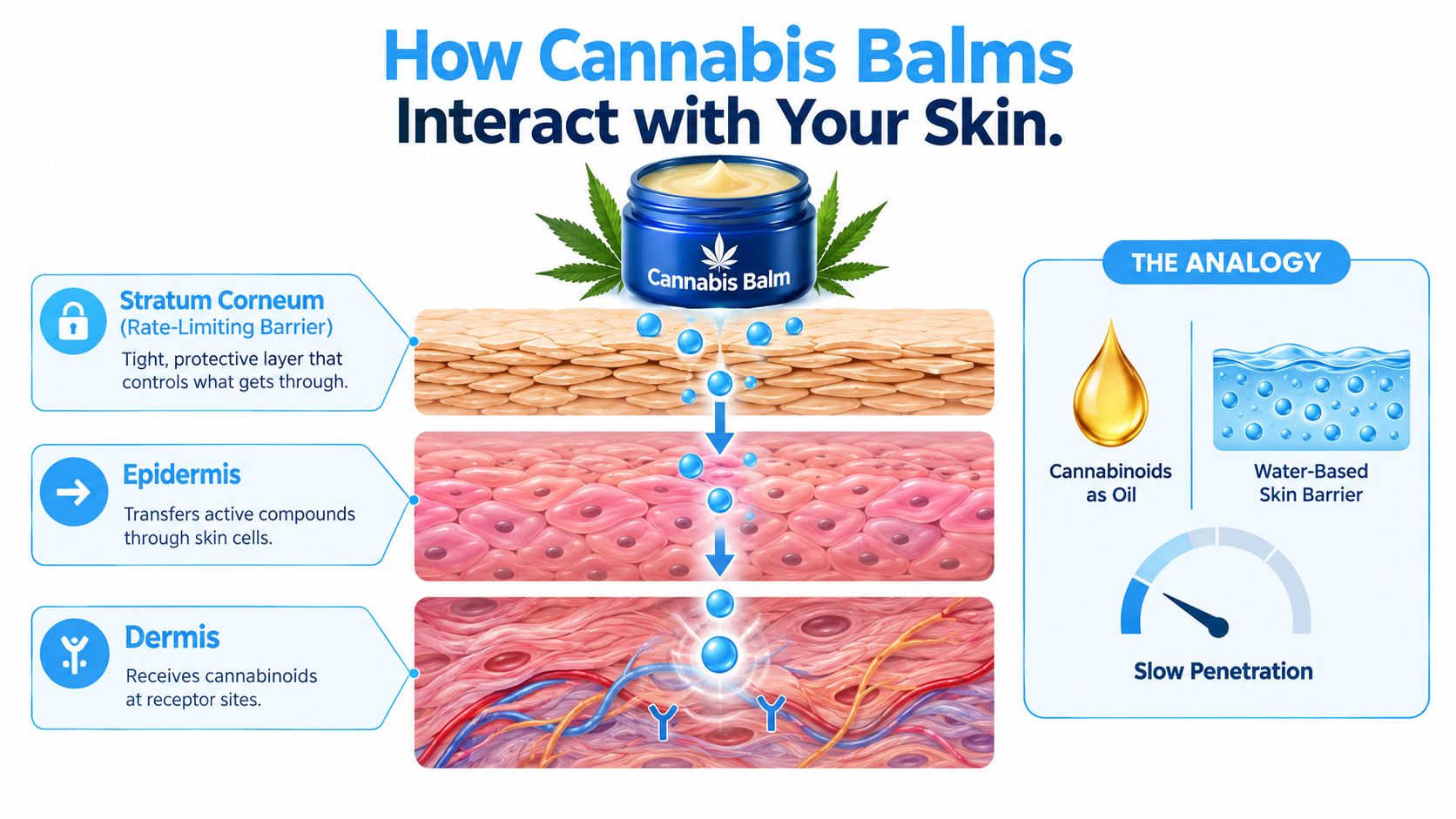
Your skin isn't one uniform sheet. It has an outer stratum corneum, living epidermal layers beneath it, and the deeper dermis, which contains structures such as blood vessels, nerves, and connective tissue. The stratum corneum is the rate-limiting barrier for many topical substances. It protects you effectively, but it also makes cannabinoid delivery difficult.
A useful analogy is oil trying to travel through water. Cannabinoids prefer oily environments, while the tissue beneath the outer barrier contains aqueous layers that don't readily accept them. That mismatch helps explain why cannabinoids can remain concentrated at the application site while only a limited amount moves deeper. Skin hydration, thickness, hair follicles, contact time, and application site can all influence what happens next.
What formulation can and can't change
Manufacturers use delivery strategies such as penetration enhancers, emulsions, encapsulation, and nanoparticles to alter how cannabinoids disperse and move through skin. These are engineering tools, not magic ingredients. They may increase dermal deposition, but they can also make the product more formulation-specific and may increase irritation or unintended systemic exposure (review of topical cannabinoid delivery challenges).
An oil-and-wax balm without water can improve solubilization and skin residence. It may feel richer and stay in place during massage, which can be useful for a small target area. Still, staying on the skin longer isn't the same as reaching deep muscle or a joint. A balm that spreads over the surface may deliver a pleasant skin-care experience without producing a measurable effect in deeper tissue.
Contact time matters, too. Washing the product off immediately gives it less opportunity to interact with the skin. Applying it to clean, intact skin and allowing it to remain undisturbed may change the experience, but it won't turn an ordinary balm into a transdermal patch. Damaged skin can alter absorption and irritation risk, which is one reason cautious product directions usually emphasize intact skin.
For readers interested in the skin-care side of topical formulation, a hemp CBD facial cream recipe can help illustrate how carrier oils, texture, and ingredient compatibility shape a finished product.
The practical takeaway is simple: most of what sits on the surface is what most conventional balms deliver. That doesn't make a balm useless. It means shoppers should buy it for a plausible localized skin experience, not assume that a strong label guarantees deep-tissue penetration.
CBD Balms, THC Balms, and Transdermal Patches Compared
CBD, THC, and the words full-spectrum or isolate describe the cannabinoid profile. They don't, by themselves, describe how far the product will travel through skin.
A CBD-dominant balm is often chosen by adults seeking localized use without the expected intoxicating effects associated with THC. A THC-containing balm may create a different local sensation, particularly when the formula also includes cooling or warming ingredients, but a conventional topical shouldn't be treated like an edible or inhaled product. Full-spectrum formulas contain multiple cannabis compounds, broad-spectrum products are formulated without some compounds such as THC, and isolates focus on a single purified cannabinoid. The label still needs to be checked because these category terms don't tell you how effectively the formula crosses skin.
The format matters more than the buzzword
A topical is intended to work locally at or near the application site. A transdermal product is designed to cross the skin barrier and enter systemic circulation. That difference is the most important buying decision in this category.
A peer-reviewed study of a purpose-built transdermal formulation tested 100 mg of CBD and 100 mg of THC applied to the hand, wrist, and forearm in 18 healthy adults. Blood testing found that both cannabinoids permeated human skin and entered systemic circulation, but the researchers tested a delivery system specifically designed for transdermal absorption, not every ordinary balm (transdermal CBD and THC pharmacokinetic study). Another transdermal CBD formulation produced a mean plasma concentration of 6.3 ng/mL at 15.5 hours and maintained measurable levels for 48 hours after gel application, evidence consistent with a slow skin reservoir rather than a quick surface-only application (NIH review of transdermal CBD delivery).
| Format | Primary Cannabinoids | Onset and Duration | Intoxicating Potential | Best Fit For |
|---|---|---|---|---|
| CBD-dominant topical balm | Mostly CBD, sometimes minor cannabinoids | Local contact develops gradually and varies by formula | Generally low for a conventional topical | Shoppers seeking localized, non-intoxicating use |
| THC-containing topical balm | THC, often with CBD or other cannabinoids | Local experience varies with base and supporting ingredients | Generally limited for an ordinary topical, but not guaranteed for every product | Adults interested in a THC-containing localized format |
| Full-spectrum topical | Multiple naturally occurring cannabis compounds | Formulation-dependent | Depends on THC content and delivery design | Shoppers who want a broad cannabinoid profile |
| Broad-spectrum topical | Multiple compounds, formulated without some cannabinoids such as THC | Formulation-dependent | Usually lower than THC-containing products | Shoppers avoiding THC while preferring more than an isolate |
| CBD or THC isolate topical | One primary purified cannabinoid | Formulation-dependent | CBD isolate is not expected to intoxicate; THC isolate depends on delivery | Shoppers who want a simpler cannabinoid profile |
| Transdermal patch or gel | CBD, THC, or both in a delivery system | Can be delayed and sustained | Can be possible because systemic exposure is intended | Adults specifically seeking systemic delivery |
Before choosing a format, decide whether your goal is skin-level application, a localized massage routine, or systemic cannabinoid exposure. For a related look at how a topical fits into a broader product routine, see CBD relief cream. Don't assume a balm and a transdermal patch have the same dose-response, onset, or safety considerations.
What the Evidence Actually Supports
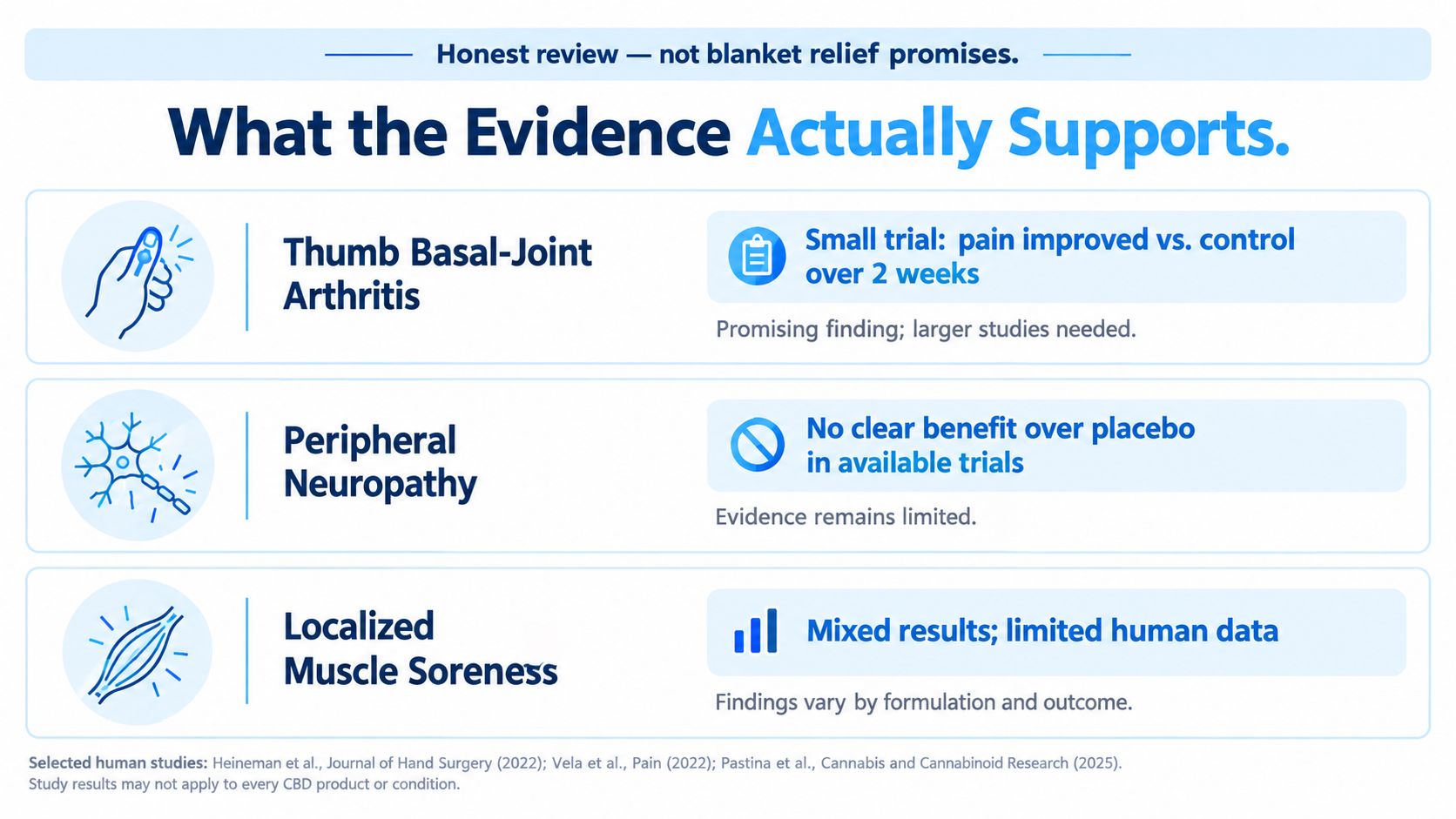
The evidence is promising in places, but it isn't broad enough to justify blanket claims. A randomized controlled trial of topical CBD for thumb basal-joint arthritis reported mean visual-analog pain scores falling from 5 at baseline to 2, a 60% reduction, while the control cream showed no reduction (randomized trial of topical CBD for thumb arthritis00133-2/fulltext)). That result applies to a specific formulation and condition. It doesn't prove that every cannabis topical balm works for muscle pain, nerve pain, eczema, or recovery.
A small pilot randomized trial examined THC- and CBD-predominant balms in 20 women receiving care for breast-cancer-treatment-related joint and muscle symptoms. Participants reported improvements across several symptom and pain measures, adherence through week two was 85%, and no skin toxicity was reported. The study's small sample and short follow-up make the results useful for cautious discussion, not universal treatment claims (pilot trial of THC and CBD balms).
A condition-by-condition reading
Thumb basal-joint arthritis, early but encouraging: The controlled CBD cream result is one of the clearer human signals, but its formulation and diagnosis were specific. It supports cautious localized claims, not a general arthritis promise.
Peripheral neuropathy, limited: A review noted no adverse events in one topical-CBD peripheral-neuropathy study, while the broader clinical evidence remains thin. People looking beyond cannabis products can also review general information about non-surgical nerve pain relief, especially when symptoms persist or have not been diagnosed.
Muscle soreness, early and mixed: The breast-cancer-treatment pilot suggests potential tolerability and symptom benefit, but it doesn't establish a reliable result for post-workout soreness. Massage, cooling ingredients, warmth, and the balm base may contribute to the experience.
Eczema and dermatitis, still under investigation: Laboratory and animal work is more developed than human clinical evidence. A 2024 review identifies ongoing trials involving CBD for acne vulgaris, atopic dermatitis, severe pruritus, and scar healing, including NCT06362889, NCT06022874, NCT06435299, NCT05650697, and NCT06129591 (2024 review of topical cannabinoids in dermatology). Ongoing trials show that these uses are being studied, not that a balm treats or cures them.
Post-workout recovery, unproven: A soothing application may fit a recovery routine, but evidence doesn't establish that cannabinoids speed tissue repair or reliably resolve soreness.
The larger picture calls for restraint. A review covering 16 randomized controlled trials across 12 pain conditions found that 15 of the 16 trials did not show CBD outperforming placebo; the research included oral, topical, and buccal routes and doses from 6 to 1,600 mg (review of CBD pain trials). The same review noted a randomized topical-CBD study after total-knee replacement that found no reduction in pain or opioid use.
For a more practical discussion of how to interpret inflammation claims, see topical cream for inflammation. A balm can be comfortable and useful for some people, but comfort isn't proof that cannabinoids caused every perceived benefit.
How to Apply a Cannabis Topical Balm Safely
A careful application routine helps you separate the product's effect from irritation, scent, massage, or wishful thinking. Start with a small amount and make the first use easy to observe. Don't apply a new balm over a large area immediately.
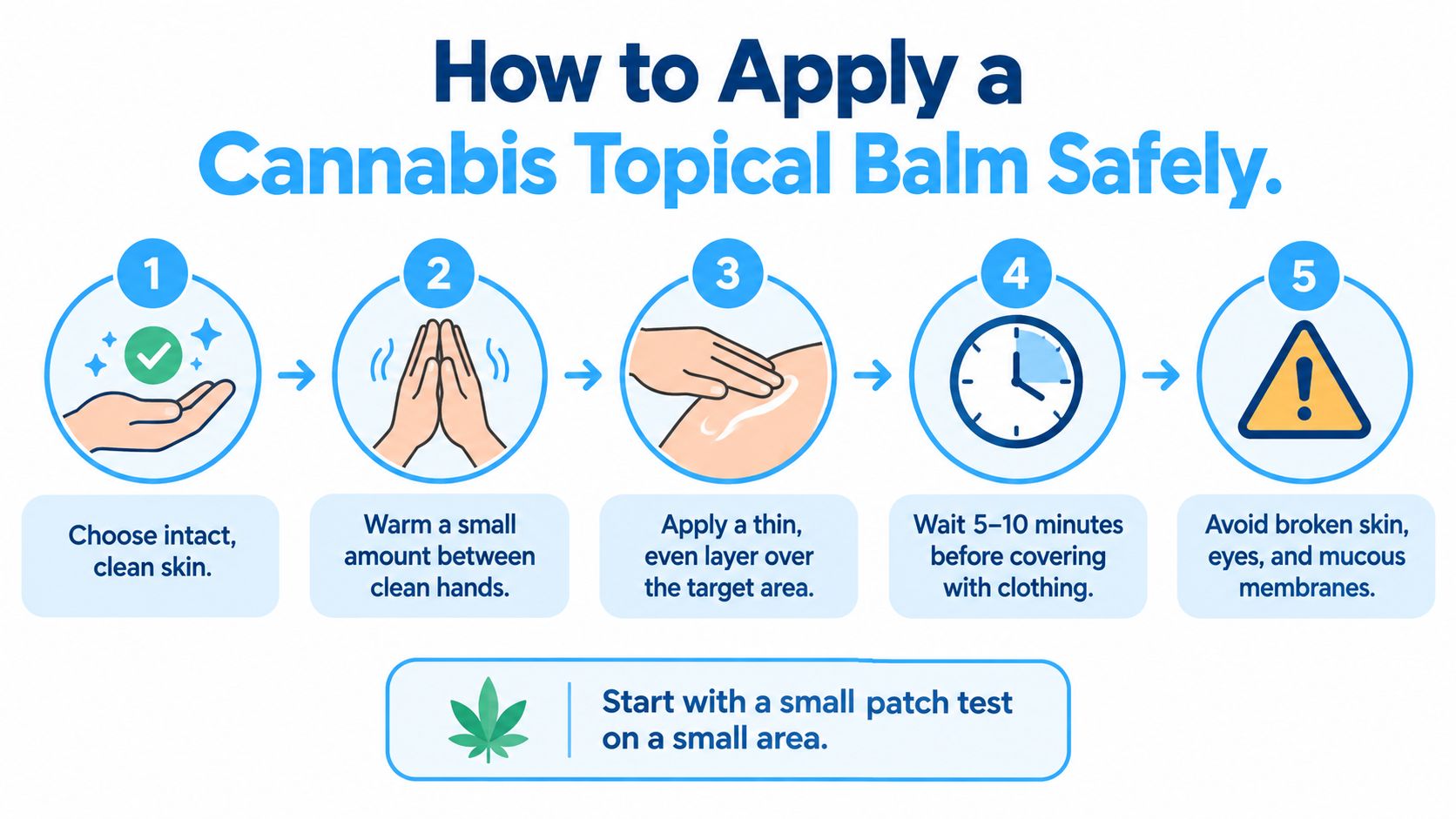
Choose clean, intact skin. Wash and dry the target area. Avoid open wounds, cracked skin, active irritation, eyes, and mucous membranes unless a clinician has specifically advised otherwise.
Patch-test first. For a new product, apply a small amount to the inner forearm and observe the area for 24 hours before using it more broadly. Fragrance, essential oils, menthol, botanical extracts, preservatives, or carrier ingredients can cause a reaction independently of cannabinoids.
Start with a small amount. Warm a little between clean hands, then spread a thin, even layer over the target area. More product isn't automatically more effective, and using too much makes it harder to identify the ingredient responsible for a reaction.
Allow contact time. Let the balm remain on the skin for several minutes before washing your hands. Avoid covering the area immediately if the product instructions advise otherwise, and don't combine it with heat, wraps, or occlusive coverings unless the label permits it.
Track the response. Record when you applied it, when you noticed a change, how long that change lasted, whether the skin became irritated, and whether movement or function improved. A symptom diary is more useful than judging a product solely by its potency claim.
Stop using the product if you develop burning, rash, swelling, worsening irritation, or other concerning symptoms. Seek medical advice for persistent or severe reactions.
Ordinary balms generally aren't expected to produce a traditional cannabis high because they usually have limited systemic penetration. Purpose-built transdermal products are different. Because they are engineered to enter circulation, they may produce systemic or mild psychoactive effects in sensitive users. Read the delivery instructions, and don't treat a transdermal product as interchangeable with a surface balm.
Topicals also shouldn't replace diagnosis or medical care for persistent pain, infection, unexplained rash, or an open wound. If symptoms continue, a clinician can help identify whether the issue is muscular, joint-related, neurological, dermatological, or something requiring prompt treatment.
Reading the Label Like a Pro
The front of the jar is the least useful place to stop. A strong label-reading routine starts with the certificate of analysis, or COA, and ends with the ingredients that will touch your skin.
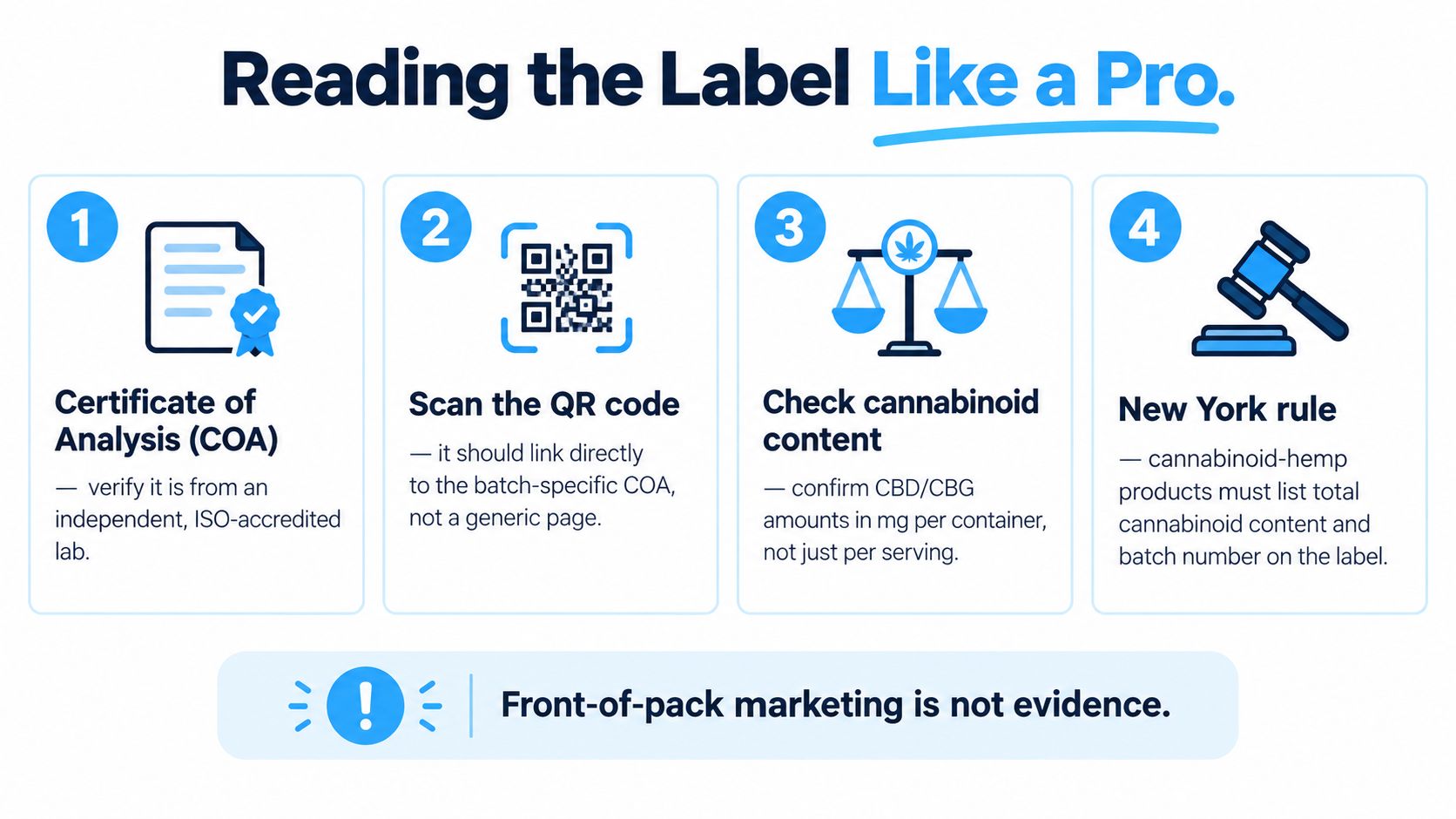
New York's cannabinoid-hemp guidance requires products to contain no more than 0.3% total delta-9 THC, pass third-party laboratory testing before retail sale, and provide a QR code or link to a COA. The stated cannabinoid concentration must fall within 80% to 120% of the amount printed on the package (New York cannabinoid-hemp labeling and testing guidance). Those are useful benchmarks for hemp topicals, but adult-use cannabis products and hemp products can move through different regulatory channels.
A quick label checklist
Find the batch-specific COA: The report should identify the tested batch and show cannabinoid results rather than directing you to a generic brand page.
Scan the QR code: Confirm that the code leads to laboratory documentation for the product in your hand. Check cannabinoid identity, concentration, and relevant contaminant testing.
Read the full ingredient list: Oils, waxes, butters, menthol, camphor, essential oils, fragrance, and preservatives all change the feel and the likelihood of irritation. A cannabinoid-free ingredient can still be the reason a product doesn't suit your skin.
Inspect the packaging: Light- and oxygen-limiting packaging can help protect chemically unstable cannabinoids. A lot identifier, clear storage instructions, and a child-resistant closure are quiet signs of careful product handling.
The New York guidance treats topical products differently from many ingestible products. The general 15:1 CBD-to-THC ratio requirement doesn't apply to topicals, and listed serving-count and milligrams-per-serving disclosure rules include topical products among their exceptions. That doesn't make the label unimportant. It means you should look for the information the product does provide, including total cannabinoid content, batch details, ingredients, and testing.
For a deeper explanation of what laboratory reports can reveal, review cannabis lab testing. Strong Strains' stated focus on transparent lab testing and curated topicals fits this decision process better than selecting a jar because it uses the word “maximum” or displays the largest potency figure.
Choosing a Quality Balm and Finding One Locally
Before buying, answer four questions:
What am I trying to do? Decide whether you want skin moisturization, a localized massage routine, a cooling sensation, or a product engineered for systemic delivery.
Which cannabinoid profile fits? Compare CBD-dominant, THC-containing, broad-spectrum, full-spectrum, and isolate formulas without assuming one category is universally superior.
What does the batch test show? A product should provide accessible documentation, and resources explaining certificates of analysis can help you understand what a laboratory report is meant to verify.
Do the ingredients match the use case? A fragrance-heavy balm may not suit reactive skin, while a richer oil-and-wax formula may feel better for massage than a fast-drying cream.
New York adult-use cannabis balms and compliant cannabinoid-hemp topicals are sold through different channels, so ask a knowledgeable budtender about the product's category, testing, and intended delivery. Online reviews can describe someone's experience, but they can't tell you whether your skin, application site, or medical situation will respond the same way.
Strong Strains Cannabis Dispensary lists topical options including Veterans Choice Creations Warrior Balm 2.0, Papa & Barkley Releaf Balm, and Ayrloom Revive 1:1 Topical, with in-store pickup and eligible local delivery. The East Setauket location at 19 Technology Drive gives North Shore shoppers a place to ask about lab results, ingredient quality, and realistic expectations before choosing a jar.
Visit Strong Strains Cannabis Dispensary to compare lab-tested topicals, review cannabinoid profiles, and ask a budtender which format matches your goal. Stop by 19 Technology Drive in East Setauket for in-store pickup or ask about local delivery across the North Shore of Long Island.