
You're at a Long Island dispensary counter, looking at a jar of pale, crumbly concentrate. It resembles a dry honeycomb, the label shows a THC percentage much higher than flower, and you're wondering whether the white color means it's cleaner, stronger, or better. Those are reasonable questions, but the jar's appearance can't answer them.
White crumble wax is a high-potency cannabis concentrate, so the important decisions involve more than choosing a color or texture. You'll want to understand how crumble is made, how to read its testing information, how to approach dosing, and how to store it without sacrificing its aroma or quality.
What White Crumble Wax Actually Is
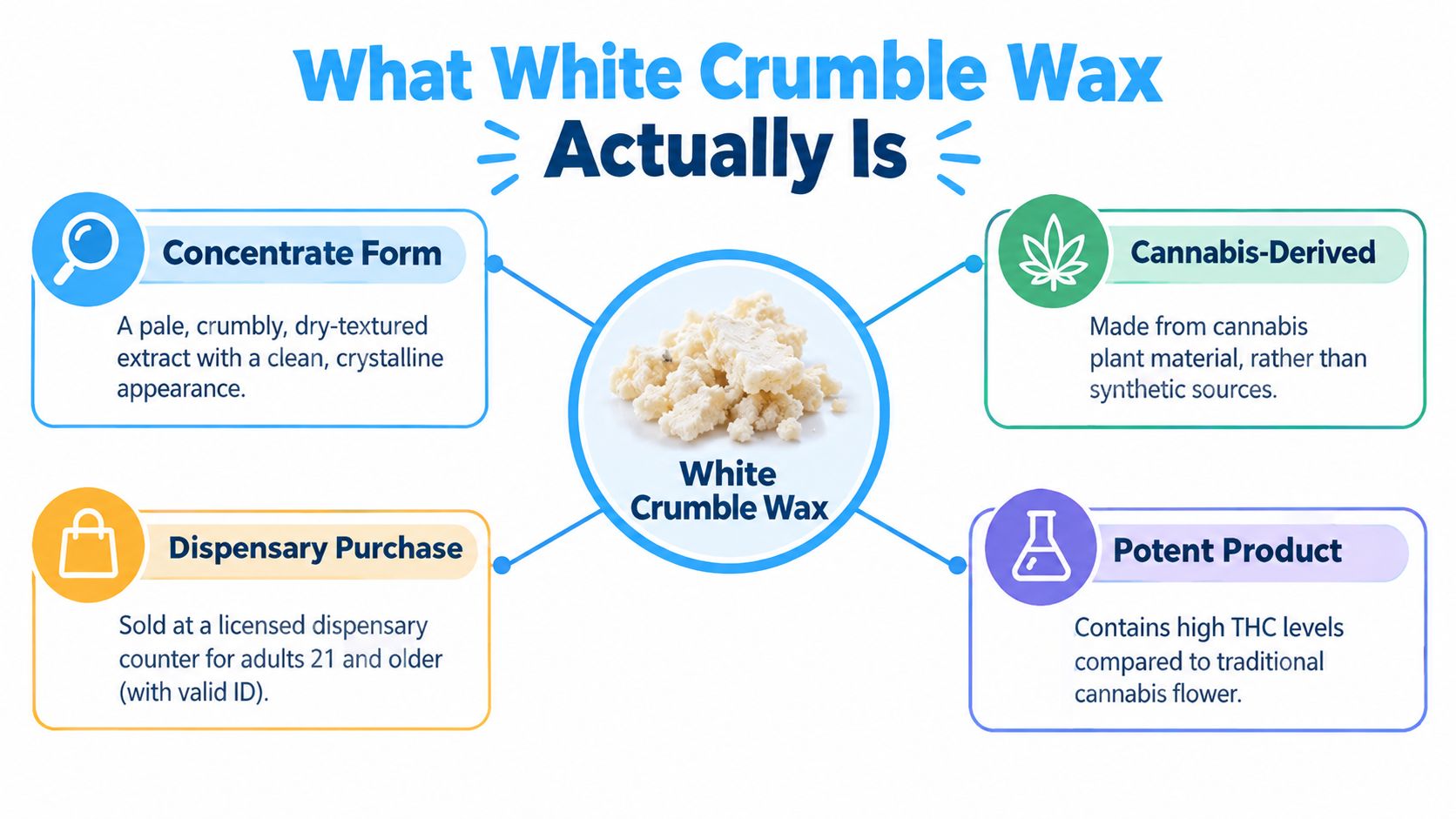
A first-time concentrate shopper might hold a small jar of pale crumble between two fingers and notice how easily it breaks apart. It isn't sticky like some oils, smooth like whipped butter, or glassy like shatter. That dry, porous texture is the main clue that the product is crumble, one form of cannabis wax.
The Canadian Centre on Substance Use and Addiction's explanation of cannabis extracts describes wax, including crumble and budder, as a solvent-based extract named for its appearance and consistency. Crumble is the drier, more crumbly form, while budder retains more moisture. In everyday terms, crumble has a honeycomb-like structure, whereas budder is closer to whipped butter.
The essential rule: White describes appearance. It doesn't certify potency, purity, freshness, or safety.
The word “white” also doesn't identify a cannabis species or a standardized chemical category. Pale color can reflect the starting material, extraction conditions, post-extraction processing, oxidation, or the way the concentrate was stored. A darker product may contain natural pigments or show signs of age, but neither color alone proves contamination. The same logic applies to texture. A crumbly jar may be well made, while another may be dry because it was exposed to heat or air.
Crumble compared with other concentrates
Wax is a broad family, and the texture can change depending on how the extract is processed after extraction.
- Crumble is dry, porous, and easy to break into small pieces.
- Budder is softer and smoother because it retains more moisture and is commonly whipped.
- Shatter is firm and glass-like, often breaking into sharp pieces.
- Rosin is made through heat and pressure rather than solvent extraction.
That last comparison matters because “concentrate” describes a category, not one exact recipe. If you want a plain-language overview of how these formats differ, this guide to different types of cannabis concentrates can help you compare textures and production methods.
The question isn't whether the concentrate looks premium. It's whether the product has a current, product-specific laboratory report or compliant label showing its cannabinoid profile and safety testing. That information tells you far more than a pale color ever can.
How White Crumble Wax Is Made
A useful way to understand crumble is to compare extraction with making a concentrated soup stock. Plant material goes into a process that draws selected compounds out, the liquid portion is separated, and the remaining material becomes thicker and more concentrated. The details are technical, but the reason for each stage is practical.
Licensed producers commonly use a controlled hydrocarbon extraction process. Hydrocarbons such as butane or propane move through prepared cannabis material inside specialized equipment and dissolve cannabinoids and terpenes. The producer then separates the plant material from the solvent-rich extract and removes much of the solvent under controlled conditions.
From extract to dry texture
Post-extraction processing determines whether the finished concentrate becomes a runny oil, a glossy sheet, a soft budder, or a dry crumble.
A producer may use winterization to remove unwanted waxes and lipids from the extract. The material is then filtered and purged, often under vacuum, to encourage volatile solvents to leave at lower temperatures. That step matters because rushed or incomplete purging can leave residual solvent behind, while excessive heat can strip away valuable terpenes.
The final drying stage helps create crumble's porous, honeycomb-like structure. The product may become pale, tan, amber, or another shade depending on the starting material and the processing choices. Color is an outcome of production, not a safety certificate.
Why regulated extraction matters
A licensed facility uses controlled equipment, documented procedures, and batch testing. An unregulated or homemade extraction may provide no reliable information about solvent removal, pesticides, heavy metals, microbial contamination, or the identity of the material used.
Washington's regulatory framework classifies hydrocarbon concentrates as requiring cannabinoid, mycotoxin, residual-solvent, and pesticide testing. It also sets failure thresholds including 2 ppm for certain Class 1 solvents, 50 ppm for Class 2 solvents, and 5,000 ppm for Class 3 solvents in the cited framework, as documented in the Washington concentrate testing report.
Those thresholds aren't something you can estimate by looking at the jar or smelling the concentrate. Ask for the batch report. A strong solvent-like odor, unusual bubbling, visible foreign material, or unclear labeling is a reason to pause rather than guess.
Potency and THC Strength Compared
Concentrates exist to collect more cannabinoids into a smaller amount of material. That efficiency is also what makes white crumble wax a dosing challenge for new users.
Flower commonly averages about 15% to 20% THC, while concentrates such as wax, shatter, and hash oil commonly fall around 60% to 90% THC, according to a Washington State government report. That same report recorded an average concentrate potency of 61.7% THC during the period evaluated, with measured concentrate results ranging from below 1% to 99% THC. Those figures describe a broad concentrate category, not every jar of white crumble wax.
A separate 2025 Colorado study of 277 products from 52 dispensaries across 19 counties found that concentrates averaged 71% THC, with some reaching 84%. The study reported that 96% of tested concentrates were within 15% of their labeled THC value, as summarized by the University of Colorado's report on cannabis label accuracy.
Flower versus wax concentrates at a glance
| Format | Typical THC range | Typical serving | Consumer takeaway |
|---|---|---|---|
| Flower | About 15% to 20% | A small amount in a joint, bowl, or vaporizer | More familiar to many consumers, but still varies by product |
| Wax concentrates | Commonly about 60% to 90% | A very small measured portion | A little material can deliver a large THC exposure |
| White crumble wax | Often falls within the broader concentrate range | Start with a very small portion | Color and texture don't tell you how strong it is |
A piece that looks no larger than a grain of rice can contain considerably more THC than a similarly sized piece of flower because the concentrate has removed much of the plant material. That doesn't mean every grain-sized portion contains the same amount. The actual exposure depends on the product's measured potency, the weight of the portion, the device, the temperature, and your tolerance.
Accurate labeling is useful, but an accurately labeled 70% THC concentrate is still a very strong product.
THC percentage also isn't the whole experience. Terpenes, inhalation technique, device temperature, personal sensitivity, and tolerance can all affect how the session feels. Readers who want to understand the broader cannabinoid picture can explore why TAC matters in cannabis before treating THC as the only relevant number.
Terpene Preservation and Why Flavor Fades
A fresh jar of crumble can smell bright, herbal, citrusy, earthy, or fuel-like depending on its terpene profile. Terpenes are volatile aromatic compounds, which means they move and evaporate more readily than heavier components. They're part of the reason two concentrates with similar THC percentages can smell and taste very different.
Research on wax samples found that monoterpenes decreased by approximately 60% and sesquiterpenes by approximately 37% before the material reached its flash point, indicating that heat can materially change aroma and the sensory profile of the product, as reported in this research on terpene stability in wax.
What speeds up flavor loss
Heat is only one factor. Oxygen, light, and repeated opening also give volatile compounds more opportunities to evaporate or oxidize. A container opened frequently, left in a warm room, or displayed in direct sun may lose aroma faster than a sealed container stored in a cool, dark place.
A flat, hay-like, or unexpectedly solvent-like smell doesn't prove a product is unsafe, but it's a quality signal worth taking seriously. Drying, excessive brittleness, unusual bubbling, or visible contamination should also prompt you to stop and contact the retailer.
Storage habits that protect the profile
- Seal the container: Use airtight packaging with as little unnecessary headspace as practical.
- Block light: Keep the jar in a dark cabinet rather than on a sunny windowsill.
- Limit handling: Open it only long enough to measure a portion and close it again.
- Keep it cool: A cool environment slows volatilization, but avoid temperature swings.
- Use refrigeration carefully: Cold storage may reduce evaporation, but opening a cold container can create condensation.
- Rotate by age: Use older lots first when you're managing more than one container.
Texture changes don't prove that potency has increased or decreased. A drier product may have only lost moisture or volatile compounds, while a softer product may have warmed. Use the test date, storage history, label, and COA to interpret quality rather than treating appearance as a potency meter.
How to Dab White Crumble Wax Safely
Dabbing isn't one decision. You're choosing equipment, temperature, portion size, pacing, and what you'll do after the session. Treat each choice as part of the same safety routine.
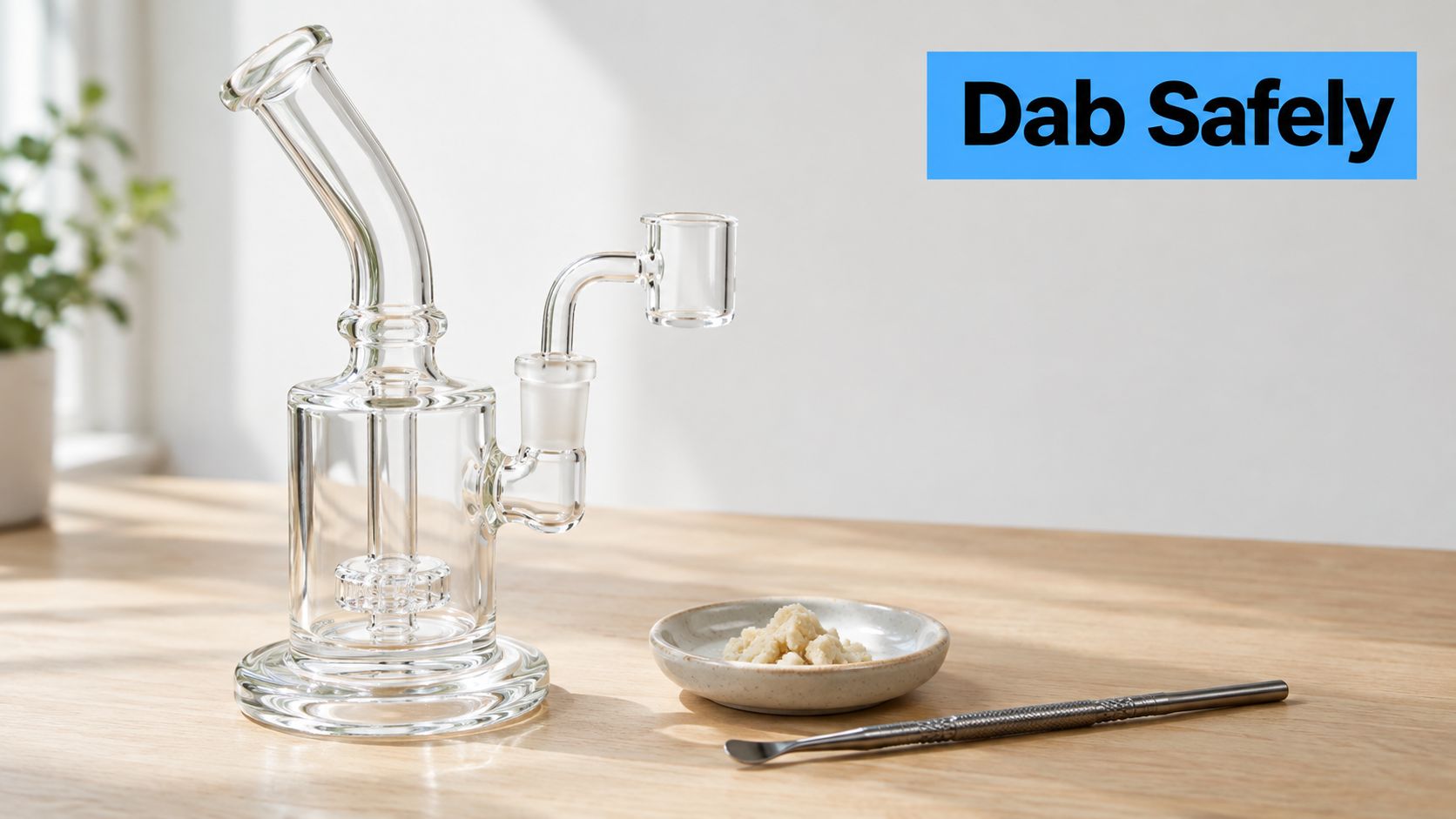
A glass rig, e-rig, or compatible concentrate vaporizer can work, but the device should be designed for concentrates and used according to its instructions. A dab tool helps you handle a measured amount without touching the product directly. If you're new, an e-rig with controlled heat may feel more predictable than manually heating a nail, although every device still requires careful use.
A conservative first session
Start with a portion about the size of a grain of rice if you're inexperienced with concentrates. That isn't a universal dose, because grain sizes differ and products vary, but it's a useful visual reminder to begin very small rather than loading a large amount.
Use the lowest practical heat setting that produces vapor with your equipment, then wait before deciding whether to take more. Higher temperatures can create harsher vapor and drive off more terpenes. Don't stack hits only because the first one feels mild. Concentrates can feel stronger than expected as the session develops.
The CDC's cannabis guidance states that oils and concentrates used for vaping or dabbing often contain highly concentrated THC and may contain additives or contaminants. It also notes that vaping has been linked to lung injury and that concentrated forms may carry a higher risk of cannabis use disorder.
Safety checkpoint: Don't drive, operate machinery, or make other safety-sensitive decisions after using a high-THC concentrate.
If you feel overwhelmed, anxious, dizzy, nauseated, confused, or unusually sleepy, stop using the product. Move somewhere calm, avoid adding alcohol or other intoxicants, and ask a trusted person to stay nearby. Seek urgent medical help for severe or worsening symptoms, trouble breathing, chest pain, loss of consciousness, or a situation that feels medically unsafe.
A practical walkthrough of the best way to smoke concentrates can help you compare compatible devices and handling techniques. Whatever setup you choose, keep the concentrate, tools, and heated equipment away from children and pets.
Reading the Certificate of Analysis Like a Pro
White crumble wax isn't automatically clean because it's pale, and darker crumble isn't automatically contaminated because it has more color. A certificate of analysis, or COA, provides the evidence that visual inspection can't.
A product-specific COA should match the package's lot or batch number. It should also identify the testing laboratory, show the test date, and report numerical results rather than relying only on a phrase such as “lab tested.”
What to look for on the report
Check these categories before buying or inhaling:
- Cannabinoids: Look for THC, THCA, CBD, and other reported cannabinoids. THC and THCA aren't interchangeable, so read the label's total THC calculation carefully.
- Terpenes: A terpene panel helps explain aroma and lets you compare products beyond THC alone.
- Residual solvents: Hydrocarbon-derived products should show results for relevant solvents, including butane, propane, or related chemicals.
- Contaminants: Look for pesticide, heavy-metal, microbial, and mycotoxin results.
- Identity and timing: Confirm the batch number, test date, extraction method when provided, and the laboratory's identity.
A review of concentrate studies reported that more than 80% of tested solvent-extracted concentrate samples showed some contamination, including residual solvents, pesticides, or other compounds. Another review found residual solvents in 71.9% of 57 California concentrate samples, as documented in the review of cannabis concentrate health risks. These findings don't mean every regulated product is contaminated, but they do show why documentation matters.
A counter-side verification routine
Ask the budtender to show the COA or explain where you can access it. Match the report to the package, check the test date, scan the cannabinoid and terpene results, review the contaminant panels, and leave the product behind if the report is missing, generic, or impossible to connect to the lot.
A clearer understanding of cannabis lab testing can make these reports less intimidating. You don't need to become a chemist. You need to know whether the document belongs to your product and whether the required categories have actual results.
Smart Storage, Safety, and Buying in New York
Store white crumble wax sealed, cool, and away from light. Measure a small portion, keep the original packaging and COA information, and secure the product where children and pets can't reach it. Don't combine it with alcohol or other intoxicants, and don't drive after using it.
New York permits adults 21 and older to possess up to 3 ounces of cannabis and up to 24 grams of cannabis concentrate, including products such as oil and other concentrated forms, according to the New York Office of Cannabis Management's adult-use information. The 24-gram limit is a possession ceiling, not a consumption recommendation. New York also requires cannabis products to pass laboratory testing before sale through licensed adult-use or medical dispensaries.
Before you leave the counter, use this checklist:
- Verify the COA: Match the batch number, test date, cannabinoid results, terpene panel, and contaminant testing.
- Dose small: Start conservatively and wait before taking more.
- Protect the product: Store it sealed, cool, dark, and secured.
- Avoid combinations: Don't mix concentrate with alcohol or other intoxicants.
- Plan transportation: Never drive after use.
Strong Strains Cannabis Dispensary offers tested cannabis concentrates, including crumble, with in-store pickup and local delivery options for Long Island customers. Visit Strong Strains Cannabis Dispensary to ask about current concentrate availability, review product information, and get practical guidance from a knowledgeable budtender before you buy.