
There is no single best disposable vape. The strongest starting point is a device with verified testing, a balanced battery and liquid supply, and a legal New York source, rather than the biggest puff number or the lowest price.
So what is the best disposable vape when the box tells you almost nothing about long-term performance? A seasoned budtender doesn't answer with one flashy brand. They look at total cost of exposure, meaning what you pay for usable performance while also considering device reliability, contamination concerns, nicotine or cannabis potency, waste, and legal status.
The category has expanded quickly. One industry estimate places the global disposable segment at USD 5.53 billion in 2023, USD 6.86 billion in 2024, and a projected USD 30.44 billion by 2030, with a projected 28.7% CAGR from 2025 to 2030 (market overview and source links). Another estimate puts the broader disposable vapes market at USD 8.6 billion in 2025, with a projection of USD 25.7 billion by 2035 (separate market estimate). Those estimates differ because market definitions differ, but both point to the same practical reality: specifications, formats, and quality controls are changing fast.
For an adult cannabis consumer in New York, the sensible purchase isn't the newest mega-puff device. It's the product that gives you clear information, predictable draw performance, credible testing, and a source that follows state rules.
Introduction to Disposable Vape Shopping
Searching for a disposable vape can feel like comparing hundreds of nearly identical gadgets. One package emphasizes flavor, another advertises capacity, and a third promises a long-lasting battery. The label may say little about the oil, hardware construction, testing, or whether the product was made for the legal market in your state.
That confusion is why I recommend a Total Value approach. Instead of asking only which device is cheapest or lasts longest, ask four practical questions:
| Decision factor | What to examine | Why it matters |
|---|---|---|
| Safety verification | Testing information, manufacturer transparency, and product origin | A pleasant flavor doesn't tell you what the aerosol may contain |
| Hardware balance | Battery, coil, liquid volume, airflow, and charging design | Poor balance can leave liquid or power unusable |
| Real-world value | Usable life, consistency, leakage, and draw quality | Advertised capacity doesn't guarantee an enjoyable final session |
| Legal fit | Licensed sourcing, age rules, and local possession limits | A product can be attractive yet inappropriate or unlawful to buy |
The broader vaping market has already shown how quickly products can change. A public-health source reports that by 2022, disposable e-cigarettes in the United States had nearly tripled in nicotine strength, quintupled in e-liquid capacity, and fallen in price by nearly 70% after major changes to flavored pod regulation (market and product changes). The same source says many products reached the market without FDA authorization. That makes regulatory status part of product quality, not a minor footnote.
Practical rule: If a seller can't explain what the device contains, where it came from, and what testing supports it, don't let a colorful flavor name make the decision for you.
For cannabis products, the label should also make the format clear. A disposable may be a sealed all-in-one device, a rechargeable hybrid, or a product with a finite battery and oil supply. These formats don't serve every customer equally. Someone who uses a vape occasionally may value portability and a small footprint, while a frequent user may care more about charging behavior and consistent output.
A useful starting point is the Strong Strains cannabis vape guide, but the buying principle is simple: choose the clearest, most accountable product before choosing the most novel one.
Understanding the Hardware, Battery, Coil, and Capacity
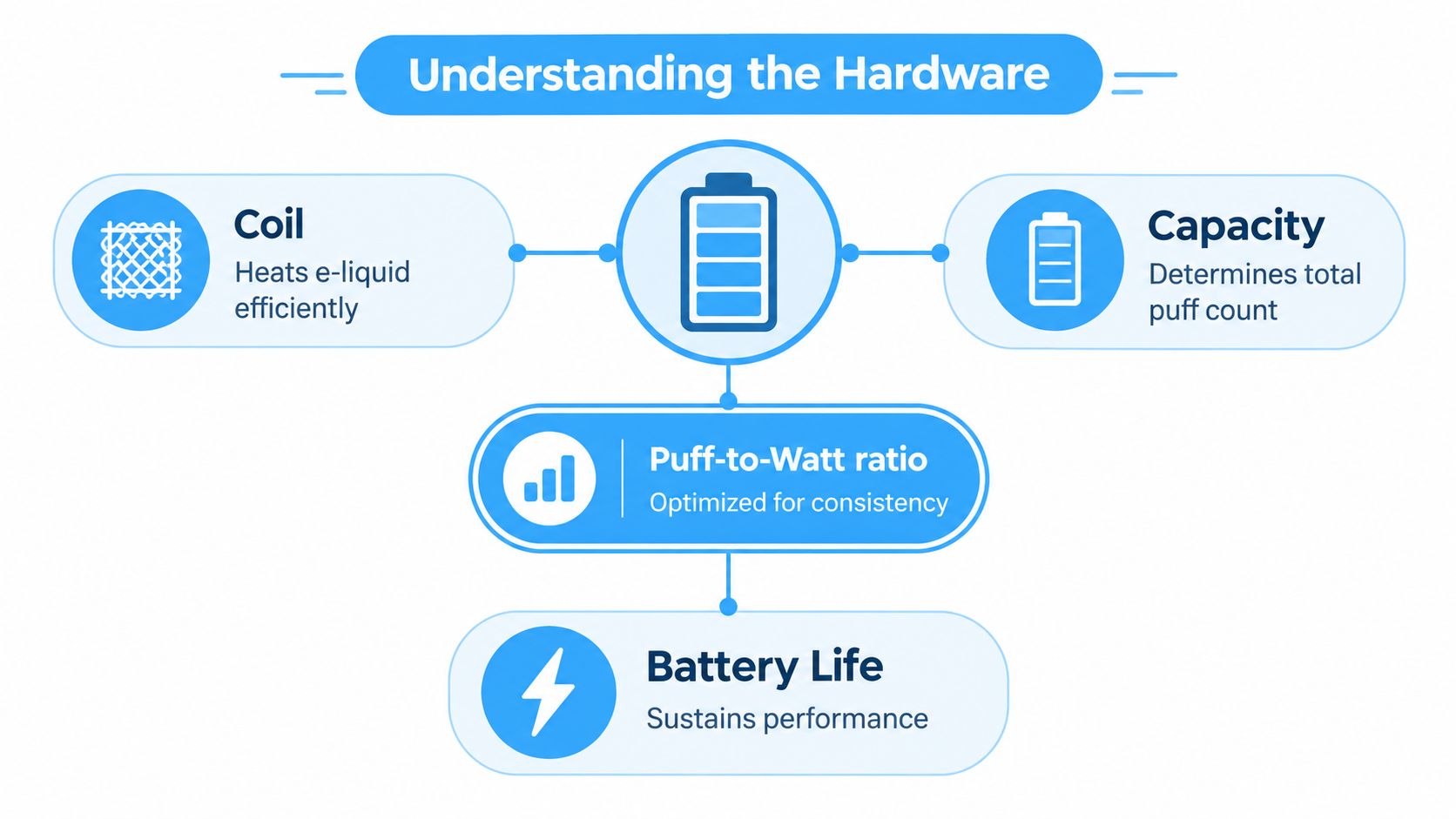
What makes one disposable vape last longer and taste cleaner than another? The answer is the relationship between its battery, coil, oil reservoir, and airflow. A disposable is a small system, not merely a container of oil. The battery supplies power, the coil converts that power into heat, the reservoir feeds the coil, and the airflow controls how vapor reaches you. Battery size, oil volume, power demand, and draw style work together, so a printed puff count cannot establish value by itself.
Consumer guides commonly describe disposable vapes with batteries in the 280–500 mAh range, nicotine strengths of 25–50 mg, and approximate capacities of 500–2,000 puffs, depending on the model (consumer vape mechanics). Cannabis disposables often use different labeling conventions, so nicotine specifications should not be transferred directly to cannabis oil. For cannabis buyers, the useful question is whether the hardware can deliver the labeled contents consistently without making the battery, coil, or oil unusable first.
Why puff count can mislead
A puff rating is a controlled estimate, not a guarantee of daily performance. Longer draws consume more oil and demand more from the battery than short, gentle draws. Heat, storage, restricted airflow, and frequent use also change the result.
Plan around a discount from the printed number. One independent guide recommends expecting approximately 70%–90% of an advertised puff count under typical use, while another review found that some devices labeled for 6,000 puffs stopped around 3,800 puffs (real-world puff-count guidance). A 6,000-puff device that ends near 3,800 puffs is not automatically defective, but it should not be treated as a reliable six-thousand-draw purchase when budgeting for regular use. The figure works best as a comparison signal between similar devices.
A practical buying calculation is total cost of exposure: how much usable product and consistent output you receive before the device is discarded, rather than how impressive its label looks. A larger reservoir may offer better value only if the battery and coil continue working through most of it. If a device loses flavor early, develops a burnt draw, or dies with oil remaining, its nominal capacity understates the cost of replacing it.
Mesh coils and the consistency question
Mesh coils spread heat across more surface area than a simple wire coil. That design can support quicker heat-up and more even vaporization, which may limit the flavor change some users notice as a device ages.
An independent test reported that mesh-coil disposables maintained at least 85% flavor clarity through 80% of their rated puff count (mesh-coil performance observations). The same source identified a 1.0–1.2 ohm range and a roughly 5,000–6,000 puff rating as a practical combination for stable fruit-flavor performance. Treat those observations as evidence from one test, not a rule for every cannabis oil or hardware platform.
Mesh construction does not solve every hardware problem. Thick oil can feed slowly, a dry wick can create a harsh or burnt taste, and poorly matched battery output can shorten coil life. Check for a clean mouthpiece, steady vapor, and normal flavor during moderate draws. These details provide a better indication of usable performance than coil terminology alone.
Rechargeable versus sealed
Rechargeable disposables address one common failure point by allowing the battery to receive more power while usable oil remains. That can suit a frequent user, but USB-C charging does not prove better construction or lower exposure. A sealed, non-rechargeable device is simpler and easier to carry, yet it may become waste before all its contents are usable.
Choose according to your routine. Occasional users may prefer a smaller sealed device because it avoids carrying excess capacity. Regular users may get better mechanical value from a rechargeable design, provided the product has credible testing, charges safely, and shows no signs of battery damage.
The Critical Role of Safety and Lab Testing
Safety should be the first filter, not the final feature on a comparison chart. Flavor, airflow, and price describe the experience, but they don't establish what a device emits or whether the manufacturer has taken quality control seriously.
The FDA states that e-cigarettes and vapes aren't risk-free. They contain nicotine, which is highly addictive, and the agency has received reports involving overheating, fires, explosions, lung injuries, and seizures or other neurological symptoms (FDA information on e-cigarettes and vapes). Cannabis vapes have their own formulation and hardware considerations, but the battery and aerosol concerns still deserve attention.

Testing must match the actual device
A batch report is more useful when it identifies the product, lot, formulation, and relevant contaminants. A generic brand statement is not the same as documentation tied to the device in your hand. Buyers should look for clear product identity and accessible testing rather than assuming that a familiar logo guarantees a clean result.
The FDA's educational materials list potential aerosol exposures from some e-cigarettes, including lead, chromium, nickel, formaldehyde, acrolein, and acetaldehyde, and warn that inhaling these substances can cause irreversible lung damage (FDA aerosol and chemical exposure information). The agency also warns that nicotine-containing liquid can be toxic if swallowed, with accidental exposure in children potentially causing nicotine poisoning. Store every vape away from children and pets, even when the device appears empty.
Recent research makes the device's life cycle especially important. A 2025 ACS Central Science study found that after a few hundred puffs, some disposable devices released more nickel, antimony, and lead than older refillable e-cigarettes and traditional cigarettes, with concentrations increasing as the devices were used (ACS report on metals in disposable e-cigarette vapor). This doesn't prove that every disposable has the same emissions profile. It does show why a single test at the beginning of a product's life may not answer every question about later use.
A product that tastes clean on the first draw can still deserve scrutiny later in its usable life.
What responsible buying looks like
Before buying, check:
- Product identity: Confirm that the package identifies the product and its manufacturer clearly.
- Batch documentation: Look for testing connected to the actual product or lot, not only a broad brand page.
- Hardware condition: Avoid devices with damaged packaging, leaking oil, loose parts, or unusual heat.
- Storage instructions: Keep the device cool, dry, and inaccessible to children and animals.
- Source accountability: Prefer a regulated seller that can answer questions about origin and compliance.
You can also review Strong Strains' information on cannabis lab testing to understand why test documentation should be part of a product conversation, not hidden behind marketing language.
The video below offers additional visual context for evaluating vape hardware and testing considerations.
A strong safety standard also means knowing when not to use the device. Stop if it becomes unusually hot, leaks, tastes persistently burnt, or behaves erratically. Don't modify the battery, puncture the body, or use a damaged charging port.
Evaluating Draw, Airflow, and Flavor Quality
A draw that feels like sipping through a blocked straw is an airflow problem, not a flavor problem. Excessive restriction can make each pull uncomfortable, while airflow that's too open may produce thin vapor and a muted taste. Test the device with short, steady draws. It should activate without force, deliver consistent vapor, and avoid becoming harsh as you continue.
Take three short draws in a row. If the second and third taste thinner than the first, the wicking or power calibration may not be keeping up with the coil. A clean flavor profile should remain recognizable without requiring unusually long pulls. Mesh coils can support even heating, but oil viscosity, wicking, power control, and terpene formulation still determine how that design performs in practice.
Flavor is more than intensity
A powerful first puff does not automatically indicate quality. Too much heat can make citrus, fruit, or dessert notes taste sharp, while weak vapor can flatten the oil's character. Look for balanced output that stays consistent through ordinary draws.
For cannabis shoppers, labels such as live resin, distillate, and all-in-one formats can indicate different formulation approaches. The description still needs support from compliant testing. Available brands and products can change, so ask the dispensary for current information instead of relying on an old listicle.
Flavor also matters to the total cost of exposure. A device that produces thin vapor or requires repeated long draws may use more oil and battery power for less satisfying results. Comparing only capacity or advertised puff count misses that practical trade-off.
Single-use and hybrid designs
A sealed disposable offers a simple routine. The tank, coil, and battery are contained in one device, so there is no separate charging or replacement process. Its limitation is fixed capacity. The battery may fail while liquid remains, or the liquid may run out before the battery reaches its practical limit.
Rechargeable or hybrid designs may suit heavier users because charging can extend operating life. They also require more battery handling and keep the device in use for longer. Recent industry coverage describes a move toward USB-C rechargeable disposables and larger-capacity hybrid formats (2026 disposable vape trend coverage). Longer use can improve convenience, but it does not automatically reduce exposure, waste, or hardware risk.
My buying preference: Choose the simplest hardware that gives you a clean draw, reliable output, and transparent testing. Extra screens and extreme capacity are optional, not proof of quality.
If the device tastes burnt early, shorten the draw and check for an obstructed airflow path. If the problem continues during normal use, return the unit to the seller rather than attempting a repair. A disposable is not designed for home troubleshooting.
Legal Compliance and Local Availability
A technically impressive vape still isn't a good purchase if it comes from an unverified source or doesn't fit New York's adult-use rules. In New York, anyone under 21 can't buy, possess, or use adult-use cannabis. Adults 21 and older may legally possess up to 3 ounces of cannabis and 24 grams of cannabis concentrate, including vape oil (New York adult-use cannabis guidance).
The same state guidance allows adults 21 and older to consume cannabis in a private home or in most places where tobacco can be consumed. It prohibits consumption in a motor vehicle, restaurants or patios, hookah or cigar bars, federal property, and most public parks or beaches. A legal purchase doesn't make every location legal for use, so plan the setting before opening the device.
Why the seller matters
Licensed local purchasing gives you a clearer path to product identity, age verification, testing information, and customer support. It also reduces the risk of buying a counterfeit or mislabeled device that copied a familiar brand name. The market's rapid product expansion makes that distinction important. Independent research found that unique disposable product listings rose from 1,638 in 2022 to 8,339 in 2024 (product-listing research). More variety creates more choice, but it also makes verification harder.
Strong Strains Cannabis Dispensary is one local option with a live menu that includes disposable vape products, live resin disposable vapes, and all-in-one traveler formats. Its team can help customers compare current product details rather than relying on an outdated brand ranking. For delivery-related questions, consult the Strong Strains dispensary delivery information.
Business buyers and operators should also be cautious about ownership, licensing, and transaction claims. The Coto & Waddington fraud resource provides broader legal context around fraud risks in vape-shop and salon business purchases. That isn't a product-testing guide, but it reinforces a useful principle: verify the people and paperwork behind a transaction, not just the product displayed in front of you.
Making Your Final Selection
The answer to what is the best disposable vape depends on what you're trying to optimize. A cautious first-time buyer should prioritize verified testing and a straightforward device. A frequent user may prefer rechargeable hardware, but only after confirming that the battery, liquid capacity, and product documentation make sense together.
Use this decision matrix before you buy:
| Your priority | Look for | Be cautious about |
|---|---|---|
| Safety and transparency | Product-specific testing, clear origin, intact packaging | Vague lab claims or anonymous sellers |
| Consistent flavor | Mesh coil, stable airflow, suitable resistance | Burnt taste, harsh heat, or blocked draws |
| Longer usable life | Balanced battery and liquid capacity, realistic puff expectations | Extreme puff claims without supporting details |
| Occasional use | Compact sealed hardware and simple activation | Paying for capacity you won't use |
| Frequent use | Rechargeable design with a sound charging port | Assuming rechargeability solves every quality issue |
| New York compliance | Licensed adult-use source and correct age verification | Informal products with unclear legal status |
Think in terms of total cost of exposure, not just cost per advertised puff. A device that lasts longer may offer better convenience, yet newer research shows that some disposables release increasing levels of certain metals as they are used. A larger device may also create more waste at the end of its life. Those trade-offs don't produce one universal winner, but they do rule out simplistic advice based only on capacity.
Before checkout, ask yourself:
- Can I identify the manufacturer and product?
- Is testing available for the actual product or batch?
- Does the device feel balanced between battery, oil, and expected use?
- Is the draw smooth without overheating or leakage?
- Am I buying from a source that follows New York adult-use rules?
- Do I have a safe place to store and use it?
If any answer is unclear, choose a different product or ask the retailer for help. Novelty, high capacity, and an attractive flavor list can't compensate for weak documentation or unreliable hardware.
Strong Strains Cannabis Dispensary offers adult-use cannabis vapes, including disposable and live resin options, with in-store pickup and local delivery for eligible customers. Visit Strong Strains Cannabis Dispensary to review the current menu, ask a budtender about testing and hardware, and choose a vape based on real-world value rather than puff-count hype.