
Liquid THC for vape commonly contains concentrated cannabis oil in the 40% to 80% THC range, and it refers to a decarboxylated THC formulation that's heated into an aerosol. For adults 21 and older in New York's regulated market, the important question isn't just “How strong is it?” but “What exactly is in the liquid, what hardware is heating it, and can I verify the product?”
You're standing at a Long Island dispensary vape wall, looking at colorful packages marked distillate, live resin, rosin, and liquid diamonds. One box promises a clean, bright flavor. Another highlights a strain name. A third uses terms that sound technical but don't explain what's in the tank. That's a normal place to pause.
The useful way to think about liquid THC for vape is as a formulation choice, not one guaranteed product. The oil may be refined distillate, terpene-enhanced extract, live resin, or solventless rosin. The cartridge, pod, or disposable is only the delivery hardware. Quality depends on the oil, ingredients, testing, and device working together.
What Liquid THC for Vape Actually Means
A cartridge is a small glass cylinder or tank filled with cannabis oil. You attach it to a compatible battery, and the battery powers an atomizer that heats the oil into vapor or aerosol instead of burning plant material. That basic oil-to-aerosol process is described in this overview of how cannabis vape cartridges work.
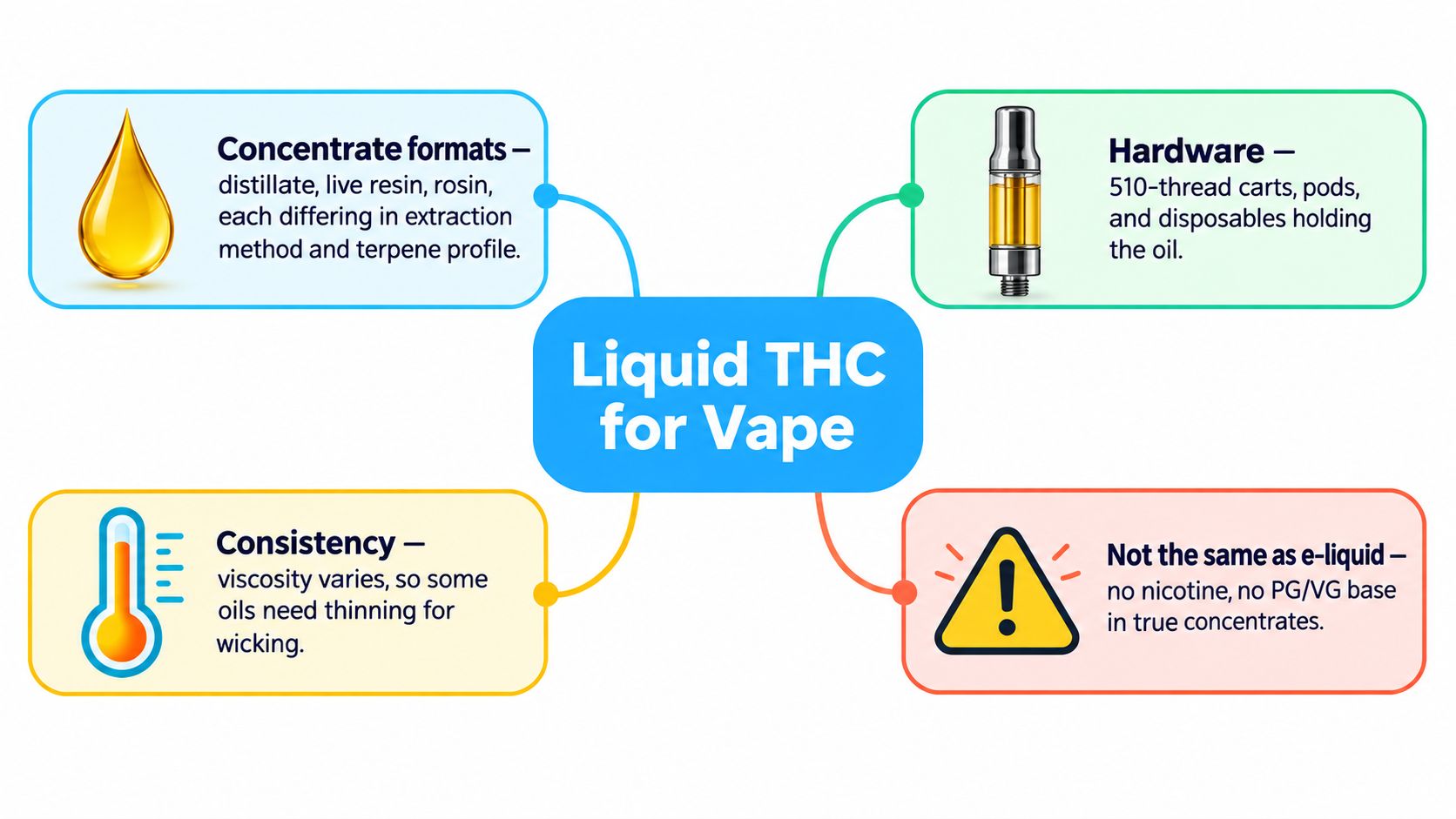
Decarboxylated THC is THC that has been activated through heat during processing. Manufacturers commonly use it in a viscous oil, often a distillate, then blend in terpenes or another compatible ingredient so the liquid can move through the cartridge and reach the atomizer. The goal is a liquid that can wick into the heating element without leaking, clogging, or starving the coil.
The oil is only half the product
Two cartridges can look nearly identical while containing very different formulations. A plain distillate cart may emphasize THC concentration and a simple flavor. A live resin cart may retain more of the plant's natural aroma. A rosin cart may use a thicker, more viscous extract and require hardware designed for that consistency.
That's why “liquid THC” doesn't automatically tell you whether a product is high quality, smooth, flavorful, or appropriate for your experience. It describes the physical format of a THC-containing liquid.
Brands displayed at a dispensary may include names such as 1937, 40 Tons, Airo, Alien Labs, Ayrloom, Boutiq, Camino, Connected, Cookies, Jeeter, Jetty, Kiva, MFNY, Pax, Plug Play, Rove, Rythm, Stiiizy, Stone Road, Turn, Umamii, Wana, Wyld, and Zizzle. The brand name can help you identify a product, but it doesn't replace checking the specific batch, ingredients, hardware type, and lab documentation.
Liquid THC isn't ordinary e-liquid
True cannabis concentrate carts aren't just nicotine vape juice with THC added. A distillate cartridge relies on concentrated oil and, often, terpenes to adjust flavor and flow. PG/VG-style liquids use a different solvent system, so a product marketed as “THC e-liquid” deserves careful label review.
Practical rule: Treat “liquid THC” as a starting description. The label and certificate of analysis tell you whether the formulation is actually suitable for inhalation.
Distillate, Terpene Blends, and Solventless Extracts
The three useful questions at the vape counter are how thick is the oil, what device can handle it, and what kind of experience does the formulation aim to provide? Those questions work better than choosing by a strain name alone.
Distillate
THC distillate is highly refined oil designed for consistency and concentration. It may have little aroma on its own, so producers often add cannabis-derived or botanical terpenes after distillation. That can create a recognizable flavor profile, such as citrus, pine, fruit, or fuel.
Distillate usually works well in standard cartridge hardware because the formulation is designed to flow and aerosolize predictably. Peer-reviewed literature notes that cartridge oils are commonly based on decarboxylated Δ9-THC and may be adjusted with terpenes to manage viscosity and hardware performance, as discussed in this review of cannabis vaping formulations.
Terpene-enhanced liquids
A terpene blend can make a neutral oil taste more like a named cultivar. It can also change the way the liquid moves through the wick. That doesn't mean the product recreates every chemical feature of the original flower. It means the manufacturer has shaped the aroma and physical behavior of the oil.
A buyer who wants a clean, straightforward THC experience may prefer a labeled distillate. Someone who chooses a product for flavor may want the terpene panel, not just the front-of-package strain name.
Live resin and rosin
Live resin and rosin carts are still liquids inside a tank, but they aren't interchangeable with basic distillate. Solventless rosin and hash rosin can be thicker, more aromatic, and closer to the character of the starting cannabis material. That often makes hardware compatibility especially important.
A cartridge that struggles with thick oil may produce weak draws or inconsistent vapor. A well-matched device can preserve more of the intended flavor, but the buyer should follow the manufacturer's instructions rather than forcing a thick extract through an unsuitable battery.
For a deeper look at the solventless side, compare the solventless concentrate guide.
Comparing the Three Liquid THC Formulations
| Formulation | Viscosity | Hardware Fit | Flavor and Effect Profile |
|---|---|---|---|
| THC distillate | Usually formulated for dependable flow | Standard carts, compatible pods, and disposables | Clean, direct THC profile with added terpenes often shaping flavor |
| Terpene-enhanced distillate | Adjusted for flavor and wick performance | Common cartridge and disposable hardware | Strain-inspired aroma with a focused, refined profile |
| Live resin or rosin | Often thicker and more demanding | Hardware designed for heavier oils | Fuller aroma, richer texture, and a closer-to-extract experience |
The best match depends on whether you prioritize potency, flavor, simplicity, or a closer-to-plant profile. No formulation wins every category.
How Liquid THC Differs from Cartridge Oils and Concentrates
People often use “liquid THC,” “cart oil,” and “concentrate” as if they mean the same thing. They overlap, but they describe different layers of the product.
Liquid THC describes the liquid formulation. Cartridge oil describes cannabis oil packaged inside a cart or pod. Concentrate is the broader family, including oils, wax, badder, sauce, crumble, live resin, and rosin.
That means every liquid THC cart contains an oil or concentrate, but not every concentrate belongs in a standard cartridge. A thick slab of wax or badder is meant for a dab pen, e-rig, or rig. It isn't automatically safe or functional to thin it and pour it into a regular 510 cart.
Choose by setting and ritual
A vape cart makes sense when you want a compact device, quick setup, and low mess. A disposable combines the oil and battery in one unit, while a 510 cartridge lets you swap carts on a compatible battery. A proprietary pod may offer a precise fit but limits you to its matching device.
Dabbing offers a different ritual. It can highlight the flavor and texture of a concentrate, but it requires more equipment and more attention to portion size. Flower offers the familiar grinding, packing, and lighting experience, with a different aroma and smoke profile.
| Format | Device Needed | Discretion | Best For |
|---|---|---|---|
| Liquid THC cartridge | Compatible 510 battery or pod device | High portability and low visible setup | Repeatable, pocket-friendly sessions |
| Disposable vape | Built-in battery and tank | High portability | Simple use without a separate battery |
| Wax, badder, or crumble | Dab pen, e-rig, or rig | Better suited to private settings | Experienced users who value concentrate texture |
| Flower | Pipe, joint, or dry-herb vaporizer | More noticeable aroma | Traditional ritual and cultivar-focused sessions |
| Edible or tincture | No inhalation device | Discreet, but slower experience | Adults who prefer non-inhaled formats |
A guide to weed vape pen oil can help clarify the difference between the oil in a cartridge and the hardware that heats it.
Safety, Lab Testing, and Reading a Certificate of Health
A responsible purchase starts before the package is opened. The oil, ingredients, battery connection, heating element, packaging, and documentation all matter. A familiar logo alone doesn't tell you whether a specific batch is suitable for inhalation.
New York buyers should look for a Certificate of Analysis, or COA, connected to the exact product and batch. A useful document may include cannabinoid potency, total cannabinoid content, terpene information, and screening for contaminants. Depending on the product and testing program, buyers may also see results for pesticides, heavy metals, microbial contamination, residual solvents, moisture, or other quality measures.
Read the numbers in context
A label may show a percentage and a total amount in milligrams. Those figures answer different questions. Percentage describes concentration, while milligrams describe the total amount of a cannabinoid in the package or a measured volume.
Independent literature reports that prefilled cartridges and pods commonly contain cannabinoid distillate in a broad range of 700 to 2000 mg/mL, with terpenes sometimes added to adjust flavor and physical properties. The peer-reviewed discussion of cannabinoid vaping products also explains why high-potency oils need hardware designed for viscous concentrates.
Don't compare a cartridge's percentage with an edible's milligram amount as if they're the same measurement. Ask the budtender to explain whether the figure refers to the oil concentration, the entire device, or a serving estimate.
Check the ingredient and hardware story
Look for an ingredient list that makes sense for inhalation. Be cautious about unnamed thinners, vague “proprietary” additives, or packaging that gives no manufacturer, processor, batch, or testing information.
Hardware deserves attention too. A well-made cart should have secure connections and a heating element appropriate for the oil. Ceramic components and lead-free contacts may be among the details listed by a manufacturer, but don't assume a material claim is verified unless the product documentation supports it.
The cannabis lab testing guide offers a useful framework for understanding what testing can and can't establish. If a QR code leads nowhere, the document doesn't match the batch, or the seller can't explain the product, choose a different item.
Using a Liquid THC Vape and Dosing the Right Way
A high-potency vape can feel deceptively simple. You press a button or draw from the mouthpiece, but the oil may contain far more concentrated THC than flower. The safest approach for an adult who chooses to use cannabis is low and slow, with enough time to understand the first draw before taking more.
Start by checking the device instructions. A new cartridge may need a moment for oil to reach the wick. Keep the device upright, avoid pulling hard, and use the lowest compatible battery setting if the battery offers voltage control. Short, gentle draws are easier to manage than long pulls.
Match potency to experience
The DEA describes marijuana concentrates as commonly ranging from 40% to 80% THC in its consumer information on vaping and marijuana concentrates. Consumer guidance also describes many vape cartridges as testing around 70% to 90% THC or higher, as outlined by Leafly's cartridge guide.
Those figures don't predict exactly how a person will feel. Tolerance, inhalation style, product chemistry, and individual sensitivity all matter.
| Potency Range | Typical Draw | Session Limit | User Level |
|---|---|---|---|
| Lower end of the available range | One short, gentle draw | Pause and assess before continuing | Curious adults with little or no vape experience |
| Mid-range cartridge potency | A restrained draw, followed by a long pause | Keep the session deliberately limited | Adults with some cannabis experience |
| Higher-potency cartridge | The smallest practical draw | Avoid repeated draws close together | Experienced consumers familiar with concentrates |
Don't hold vapor in to “make it work better.” It only makes the inhalation more irritating. Have water nearby, avoid combining cannabis with alcohol or other intoxicants, and don't drive or operate equipment after using THC.
A tolerance break can also help an experienced consumer reassess whether the product is doing what they want. If you feel unwell, stop using the product. Seek medical help for serious or persistent symptoms, especially breathing difficulty or chest pain.
New York Legal and Regulatory Notes for Adult Buyers
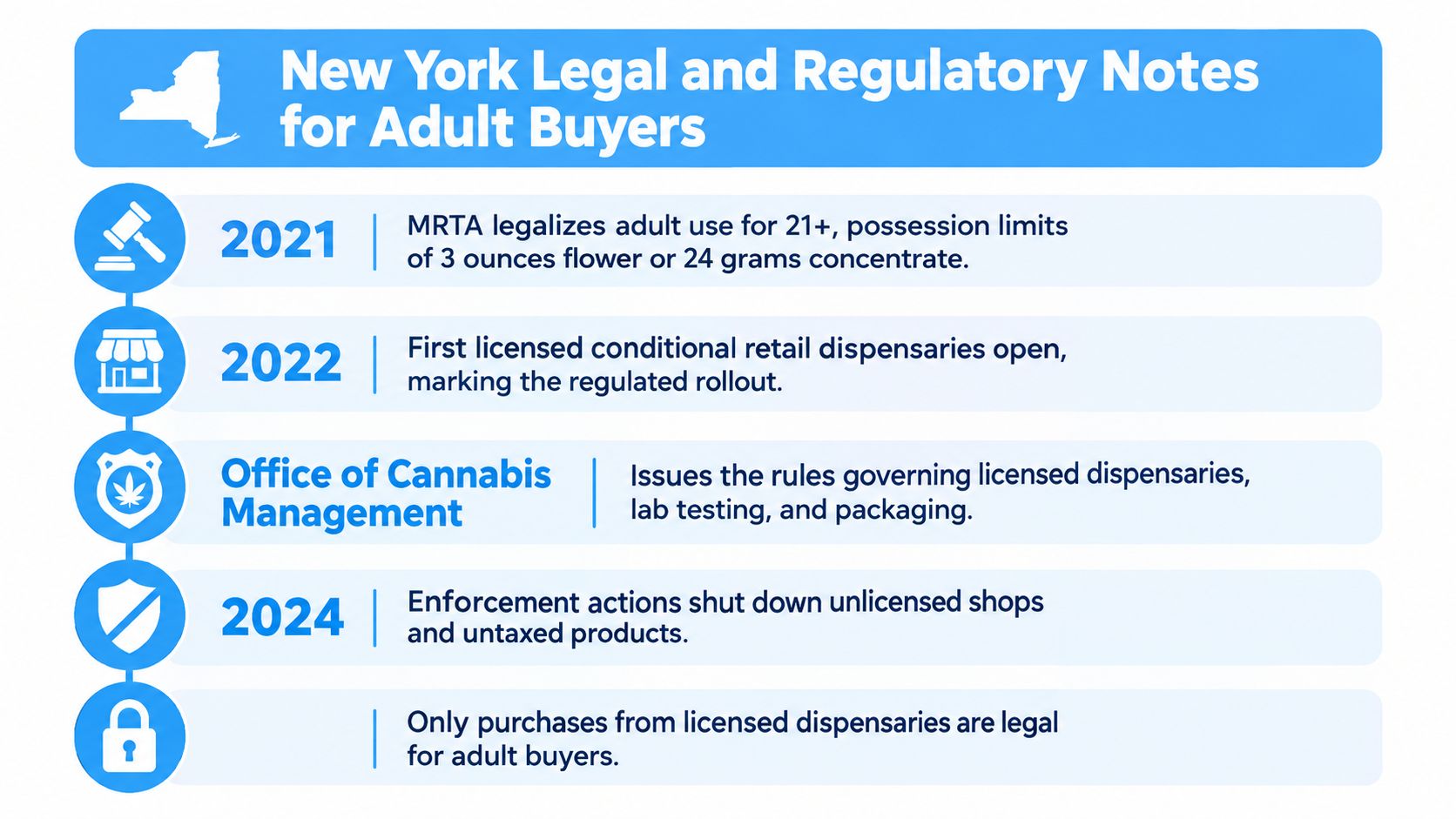
New York's regulated cannabis system gives adult buyers a practical distinction to remember: licensed retail inventory is traceable, while an attractive package in an unlicensed store may not be. Rules can change, so check current guidance from the state's Office of Cannabis Management before buying, possessing, transporting, or cultivating cannabis.
The state framework includes age restrictions, purchase and possession rules, packaging requirements, product testing expectations, and limits on marketing that appeals to minors. Licensed products should come in compliant, child-resistant packaging and display the required universal cannabis symbol. A licensed dispensary should also make its state authorization visible to customers.
What to verify at the counter
Ask whether the product was made for New York's regulated market. Then check whether the package carries a batch identifier and whether the QR code or web address leads to documentation for that same batch.
A legal purchase should be sealed and labeled in a way that identifies the product, cannabinoid content, manufacturer or processor, and relevant warnings. Packaging that looks designed for children, makes exaggerated health promises, or uses cartoon-style marketing deserves extra caution.
New York buyers should also confirm current rules around public use, home storage, transportation, and possession before leaving the store. A product can be legal to purchase but still subject to restrictions on where it may be used.
The practical takeaway is simple. Buy from a licensed dispensary, keep the product in its original packaging, store it securely, and check the current OCM rules rather than relying on an old social media post or an informal shopkeeper's advice.
Red Flags That Separate Regulated from Risky Products
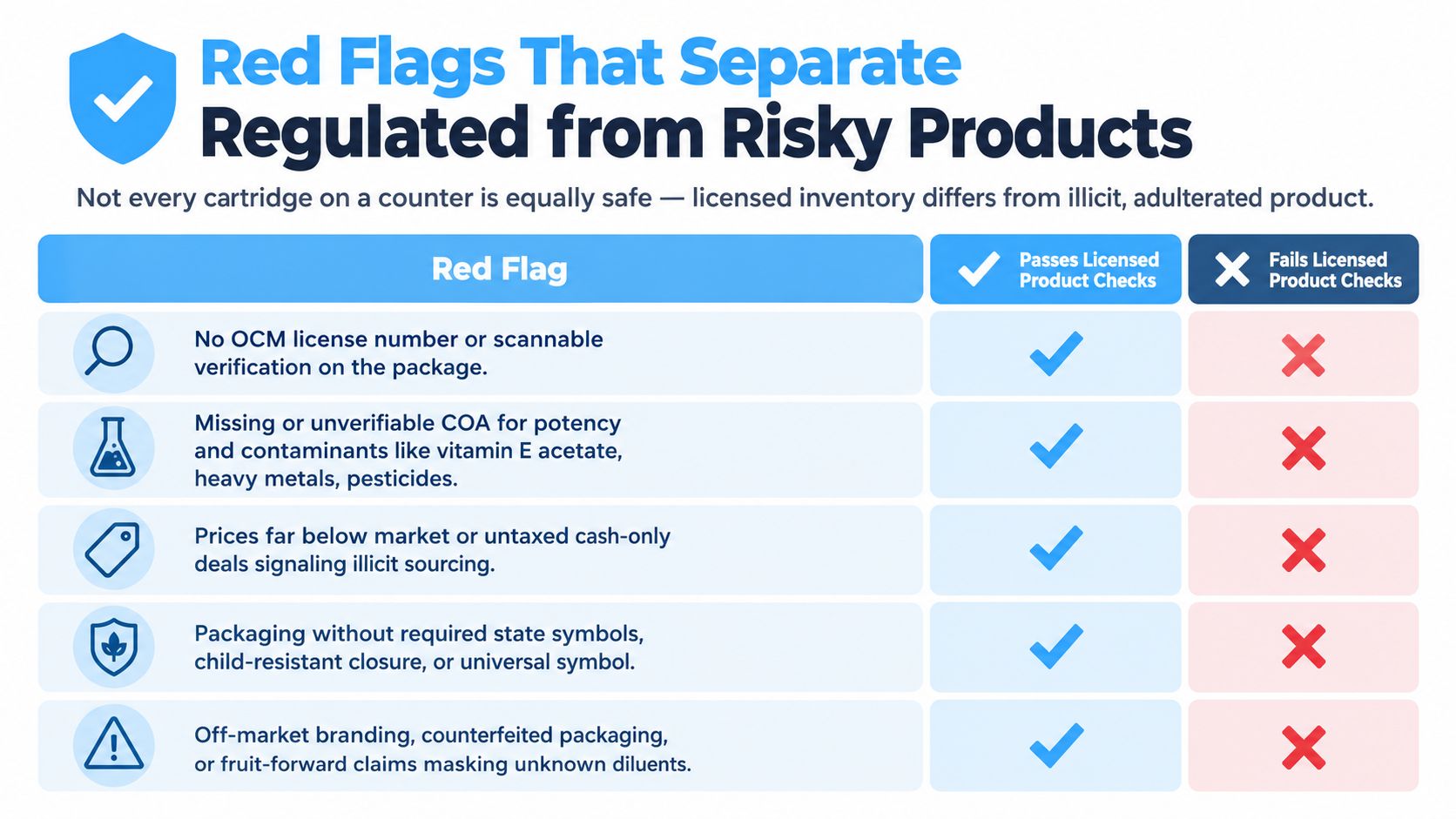
A vape cartridge isn't safe merely because it looks professional. Counterfeit packaging can copy logos, color schemes, and strain names. The strongest protection is a verifiable supply chain connected to a licensed seller and a batch-specific laboratory record.
Public-health guidance warns that THC vape liquids may contain contaminants such as synthetic cannabinoids, synthetic opioids, vitamin E acetate, or industrial solvents. The THC vape safety guidance from WithYou also emphasizes why regulated and illicit products shouldn't be treated as one category.
Walk away if you see any of these signs:
- No verifiable batch information: The package has no usable identifier, or the QR code leads to a generic page rather than the matching product.
- Missing cannabinoid and ingredient details: You can't determine what the oil contains or who processed it.
- Unknown hardware: The seller can't identify the manufacturer, device type, or compatible battery.
- Unusually low pricing: A deal that seems disconnected from ordinary regulated retail may indicate untaxed or illicit sourcing.
- Suspicious appearance or behavior: Oil that changes color quickly, leaks, clogs immediately, or tastes strongly chemical should not be ignored.
- No clear licensed seller: The shop can't show state authorization or explain the product's origin.
The 2019 lung-injury outbreak remains a lesson. The BDSA account of cannabis vape trends reports that the outbreak involved more than 2,800 emergency department visits and 68 confirmed deaths, with patient reports and product testing linking most cases to THC-containing vaping products that also contained vitamin E acetate.
Do not add vitamin E acetate, household oils, or unapproved thinners to a cartridge. If a product seems adulterated, stop using it and report the concern through the appropriate public-health or regulatory channel.
Choosing the Right Liquid THC Vape for You
The right choice starts with the session you want, not the loudest package on the shelf. Think about your experience, preferred flavor, device tolerance, and whether you want a straightforward THC draw or a more expressive extract.
A curious first-timer
A simple distillate with a balanced terpene profile can be easier to understand than a thick, highly aromatic extract. A compatible 510 ceramic cartridge offers flexibility, while an all-in-one disposable keeps the setup simple. Choose a restrained flavor profile and take the smallest practical draw, then give yourself time to assess the effect before taking more.
A returning medical patient
Someone returning to cannabis after time away may appreciate a formulation that balances flavor and consistency. Full-spectrum CO2 oil can be worth discussing with a budtender if the product's documentation clearly explains its cannabinoid and terpene content. Keep the first session conservative, even if you remember having a higher tolerance in the past.
A high-tolerance consumer
An experienced consumer may prefer live resin, live rosin, or another full-flavor extract. High-potency products still require restraint because concentration doesn't make effects more predictable. Hardware compatibility matters more with thick oil, so confirm that the device is intended for the formulation.
| User Profile | Recommended Format | Starting Dose | Price Tier |
|---|---|---|---|
| Curious first-timer | Balanced terpene distillate in a compatible 510 cart | Smallest practical draw | Entry or mid tier |
| Returning medical patient | Clearly documented full-spectrum oil | Conservative draw after a tolerance reset | Mid tier |
| High-tolerance consumer | Live resin or rosin in compatible hardware | Minimal draw with a deliberate pause | Premium tier |
At Strong Strains, labels may include products and accessories from names such as Heavy Hitters, Rove, Pax, Plug Play, Stiiizy, Jetty, Airo, MFNY, Hashables, Kiva, Rythm, and Turn. Product availability changes, so confirm the current menu, formulation, and batch documentation before purchase.
Store every vape upright in a cool, dark place, away from heat, children, and pets. Keep the battery and cartridge away from loose metal objects, follow the manufacturer's charging instructions, and don't share a mouthpiece without cleaning it.
Visit Strong Strains Cannabis Dispensary in East Setauket for lab-tested vape cartridges, live resin options, all-in-one devices, and knowledgeable guidance on liquid THC formulations. Ask a budtender to compare the COA, terpene profile, potency, and hardware fit so you can choose a product that matches your experience and intended setting.