
You're probably here because you bought something labeled “sativa” for a productive morning, took a few pulls before work or errands, and then felt weirdly flat, foggy, or ready for a couch by mid-morning. That's one of the most common cannabis frustrations I hear from adults shopping for strains for energy.
The good news is that you're not imagining it, and you're not bad at picking weed. The label on the jar often tells you less than people think. If you want daytime cannabis that feels bright, functional, and mentally usable, you need a better filter than “sativa.”
A more reliable approach is terpene-first shopping. Instead of asking only for an uplifting strain name, look at the Certificate of Analysis, check which terpenes lead the profile, and match the format and dose to what you want to do. A walk, a workout, a creative block, chores, social energy, or focused desk work all call for slightly different choices.
Why Most People Get Energy Cannabis Wrong
A Long Island commuter stops into a dispensary, grabs a product marked “sativa,” takes it before the train or before the first Zoom call, and expects coffee-with-a-buzz. By 10 a.m., they're wondering why their “daytime” flower feels sleepy.
That mismatch happens because old strain shorthand stuck around long after the market changed. Modern cannabis has been crossed, selected, and re-selected so heavily that a familiar cultivar name doesn't reliably tell you how a specific batch will feel. One grower's “Jack Herer” can land very differently from another's. The same goes for names people associate with energy, like Tangie, Durban Poison, or Sour Diesel.
The label isn't the effect
The broad “sativa for energy, indica for sleep” rule was always rough. It's even rougher now. A large chemical analysis discussed in consumer education found that the classification explained only 1.6% of THC variability. The better question is what's in the chemistry, not what's printed in the family tree. That's why terpene work has become so important for shoppers asking for alertness, focus, and usable daytime lift (AVL's review of why sativa labels can mislead).
A second problem is that people often use “energy” to mean different things. Sometimes they want motivation. Sometimes they want less mental drag. Sometimes they want less anxiety while staying social and clear. Cannabis can affect all of those, but not always in the same way.
Practical rule: If a “sativa” makes you sleepy, don't swear off daytime cannabis. Change the way you shop. Read the lab profile before you read the strain name.
What actually matters at the counter
For most adults shopping for strains for energy, these factors matter more than the old label:
- Terpene profile: Limonene, alpha-pinene, and terpinolene are the most common terpene markers people associate with uplift.
- Myrcene level: Lower myrcene is often preferred for a more alert-leaning experience.
- THC range and personal tolerance: More THC doesn't automatically mean more energy.
- Freshness and preservation: A tired old batch can feel flatter than a bright, fresh one even under the same cultivar name.
You don't need to become a lab tech. You just need a repeatable buying routine.
The Real Science Behind Energizing Cannabis Effects
Cannabis doesn't “contain energy” the way food contains calories or coffee contains caffeine. What it can do is change how effort, mood, tension, and attention feel in the moment. That's why some products feel energizing even though they aren't stimulants in the classic sense.
Think thermostat, not fuel tank
Your endocannabinoid system works more like a thermostat than a gas tank. THC and CBD help nudge signaling between brain cells. They can change how you perceive stress, interest, body heaviness, or mental chatter. If the dose is right and the terpene profile fits, the result can feel like a cleaner, more motivated state.
That's a big reason people confuse “uplift” with “stimulation.” The plant may not be revving you up so much as making your brain and body feel easier to use.
A major scientific review published in 2020 notes that some cannabis terpenes may synergize with cannabinoids and are associated with subjective effects like relaxation, stress relief, an energy boost, and improved focus. The review also treats those effects cautiously. It supports terpene-based interpretation, not guaranteed outcomes, and it helps explain why citrus- and pine-forward profiles get recommended for daytime use, especially around limonene, pinene, and terpinolene (scientific review on cannabis terpenes and the entourage discussion).
Why dose changes everything
Think about the difference between a small coffee and a heavy beer. One tends to sharpen your readiness. The other can drag it down. Cannabis can swing the same way, except the swing often comes from dose plus chemistry, not just the cultivar category.
A modest amount of THC may feel bright and productive for one person. A bigger amount of that same product may feel foggy, anxious, or nap-adjacent. That's why two people can try the same jar and tell two completely different stories.
Why the old labels break down
Independent reviews and clinical summaries show that products sold as “sativa” often lean toward certain terpene patterns, while products sold as “indica” often lean toward others. But the same work found broadly similar THC and CBD levels across both label types. In practical terms, a terpinolene-forward, limonene-forward, or alpha-pinene-forward profile is more actionable than the category itself, while myrcene-heavy flower is more often linked with heavier effects (review of chemotype differences beyond indica and sativa).
Cannabis for daytime use works best when you treat the jar label as a hint and the COA as the map.
The Three Terpenes That Drive Uplifting Effects
When shoppers ask me about strains for energy, I usually steer them toward three terpene families first: limonene, alpha-pinene, and terpinolene. Those aren't guarantees. They're better starting points.
Recent terpene-focused consumer guidance goes a step further and gives practical thresholds people already use at the counter: limonene at 0.8% or higher, pinene at 0.5% or higher, and myrcene under 0.5% for a more alert-leaning experience. That same analysis argues that terpene composition predicts energizing effects better than the label on the jar, and it often places suitable THC ranges for daytime products around 15% to 22% in many shopping scenarios (Cannigma's analysis of energizing cultivars and terpene benchmarks).
Limonene
Limonene usually announces itself before you even read the paper. Think citrus peel, orange oil, lemon zest, or that bright pop you get when you crack a fresh rind.
Why shoppers like it for daytime is less about “stimulant” action and more about usability. A clinical summary cited in industry education reports that inhaled d-limonene reduced THC-induced anxiety in a double-blind, placebo-controlled study of healthy adults, and the effect was described as dose-dependent. That matters because lower anxiety can make THC feel more functional, focused, and clear for some people (summary discussing limonene and pinene findings).
Common cultivar names often associated with limonene-forward shopping include Tangie, Super Lemon Haze, and Tropicana Cookies.
If you want a deeper plain-English read on this terpene, this explainer on limonene terpene effects is a useful companion.
Alpha-pinene
Alpha-pinene smells like crushed pine needles, forest air, or fresh rosemary. People often associate it with alertness and cleaner mental edges.
The caution here is worth knowing. The same clinical summary notes that a Johns Hopkins study on inhaled alpha-pinene found doses at or above those naturally found in cannabis flowers did not mitigate THC-related cognitive impairment in healthy adults. So pinene may still be a helpful marker in an uplifting profile, but it's weaker ground than limonene if you're looking for evidence-based confidence.
Shopper anchor names often include Jack Herer, Dutch Treat, and Strawberry Cough.
Terpinolene
Terpinolene is the funky one. It can smell herbal, floral, fresh, slightly sweet, sometimes almost electric. It's one of the terpene signatures many people connect with classic daytime flower.
It also deserves honesty. Educational sources repeatedly discuss terpinolene as part of the “energy terpene” trio, but controlled human proof is still limited. That makes it a smart clue, not a promise.
Cultivar names people commonly ask about here include Durban Poison, Jack Herer, and certain hazes.
Three Uplifting Terpenes at a Glance
| Terpene | Aroma Cue | Common Effect | COA Marker | Example Cultivars |
|---|---|---|---|---|
| Limonene | Citrus zest, orange peel, lemon | Mood lift, clearer daytime feel | Often sought at 0.8% or higher in energizing shopping | Tangie, Super Lemon Haze, Tropicana Cookies |
| Alpha-pinene | Pine, herbs, fresh resin | Alert-leaning, crisp feel | Often sought at 0.5% or higher in energizing shopping | Jack Herer, Dutch Treat, Strawberry Cough |
| Terpinolene | Herbal, floral, slightly funky | Uplifting reputation, creative feel | Look for it among the top terpenes | Durban Poison, Jack Herer, haze-leaning cultivars |
A quick COA scan helps. Look at the top three terpenes first, then the THC. If the terpene leaders support the feeling you want, the product is at least in the right conversation.
Best Consumption Methods for Daytime Energy
You buy a product labeled “sativa,” take it before a busy afternoon, and an hour later you feel foggy, snacky, or ready for a nap. A lot of that disappointment comes from method, not just the label on the jar.
How you use cannabis changes the ride. The same terpene-forward flower can feel crisp in one format and much harder to steer in another. For daytime use, the best choice is usually the one that gives you feedback fast enough to make a small adjustment before you overshoot.
Fast feedback usually works best
Inhaled methods tend to fit daytime goals because the onset is quick. You can take one small puff, wait, and read the effect like a dimmer switch instead of flipping the whole room to full brightness.
That matters more than many shoppers realize. A University of New Mexico analysis found that over 91% of people who smoked or vaporized flower for fatigue reported higher energy soon after use, while THC and CBD levels were largely uncorrelated with the fatigue change. In plain English, the loudest number on the label was not the best clue in that fatigue context. Other parts of the product, including terpene expression and minor compounds, may have played a bigger role (report on flower use and self-reported energy changes).
That does not mean inhaling is “best” for every person. It means it is easier to steer.
Which format fits a productive day?
Here's the practical version you can use at the counter.
Daytime Consumption Method Comparison
| Method | Onset | Duration | Energy Fit |
|---|---|---|---|
| Flower | Fast | Short to medium | Strong fit if terpene-forward and carefully dosed |
| Dry-herb vape | Fast | Short to medium | Excellent fit for preserving bright aroma and making small adjustments |
| Cartridge vape | Very fast | Short | Good for quick, controlled top-ups |
| Sublingual tincture | Moderate | Medium | Good for steadier coverage when you want more precision |
| Low-dose edible | Slow | Long | Useful if you're patient and conservative |
| Solventless concentrate | Fast | Variable | Better for experienced users. Easy to overdo for daytime |
A simple rule helps here. The slower the onset, the more patience you need. The longer the duration, the more careful you need to be before work, errands, social plans, or anything that asks for clear timing.
How each option behaves in real life
Flower gives you the fullest read on aroma, which matters if you shop terpene-first. If the nose is bright, citrusy, piney, or fresh herb, that often lines up better with the alert daytime profile many shoppers want.
Dry-herb vape works like a cleaner measuring spoon for flower. You still get the plant-based profile, but many people find it easier to keep sessions small and repeatable.
Cartridge vape is convenient and fast, which can be useful for tiny top-ups. The catch is that convenience can make it easy to keep hitting it without pausing long enough to judge the effect.
Sublingual tinctures sit in the middle. They are slower than inhalation but easier to portion than many edibles, which makes them useful for people who want a steadier daytime effect.
Low-dose edibles last a long time. That can be great on paper and frustrating in practice. If the dose lands too heavy, you are stuck with it much longer than you would be with flower or vapor.
Concentrates are usually a poor starting point for “I just want to feel a little more upbeat and functional.” High potency shrinks your margin for error.
Edibles deserve extra caution
Edibles are the format that trips up a lot of daytime shoppers because delayed onset invites second dosing. You take one, feel nothing at 40 minutes, take more, and then both doses arrive at once.
Adult-use education commonly treats 10 mg THC as a dose that can feel strong or uncomfortable for first-time users, while occasional and regular consumers often describe it as a moderate or standard dose (edible dosing guidance used in consumer education). If your goal is energy with function, lower-dose edible options usually make more sense than chasing a big number.
At the dispensary counter, the practical move is simple. Ask for a fast-feedback format first, then match it with a terpene profile that smells bright rather than heavy. That gives you a better shot at buying cannabis that supports your day instead of hijacking it.
How to Choose the Right Strain at a Long Island Dispensary
Shopping well for strains for energy isn't about memorizing every famous cultivar. It's about using the same counter routine every time until your picks get more consistent.
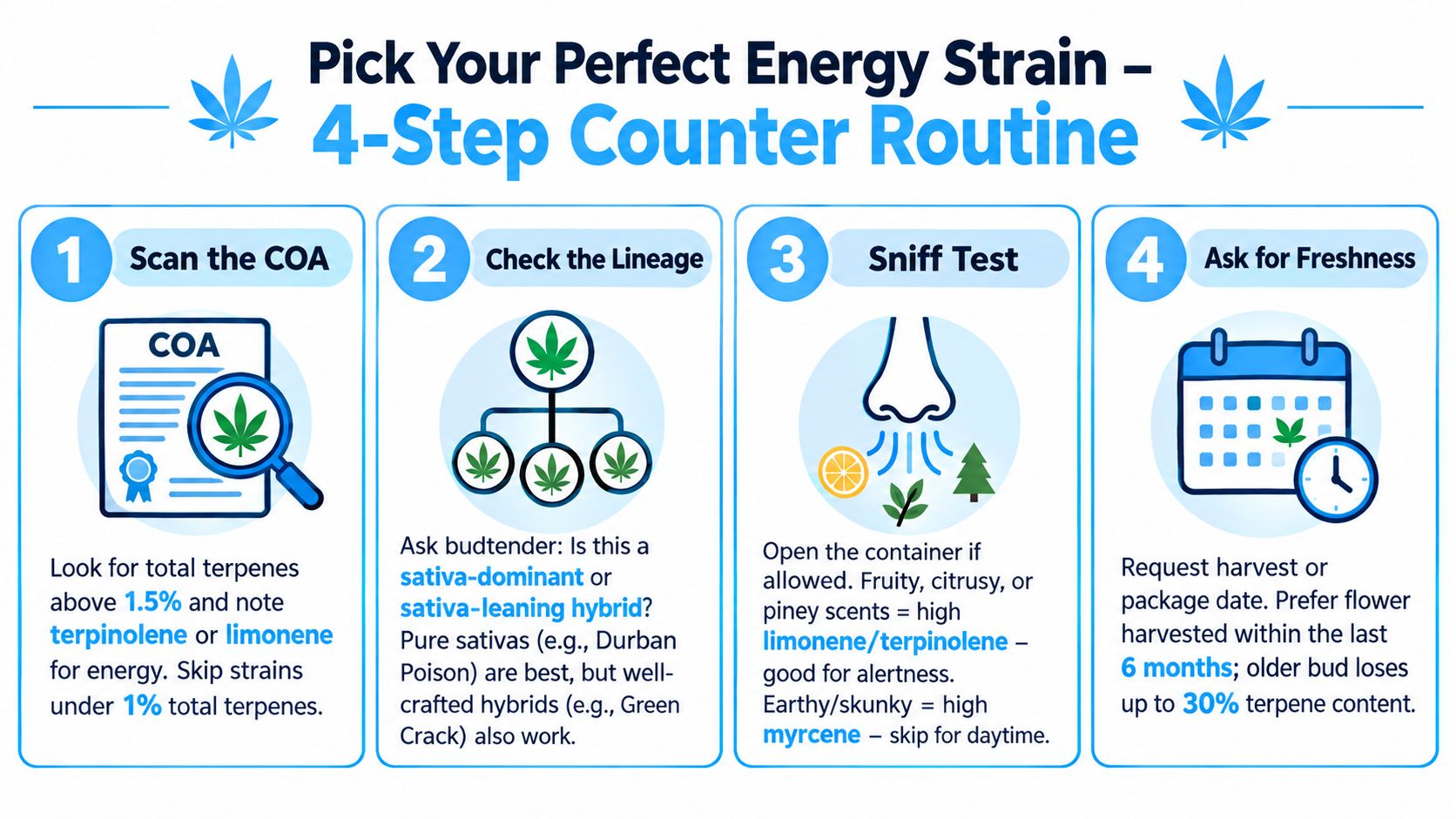
Use a four-step filter
Start with the lab sheet, not the menu art.
Scan the top terpenes first
Look for limonene, alpha-pinene, or terpinolene in the leading spots. If the profile is dominated by heavier, earthy terpenes and you're shopping for productivity, keep moving.Check how the product balances THC and CBD
If you're anxiety-prone, don't assume the strongest THC option is the best daytime option. Many adults do better with a more balanced feel.Ask about freshness
Terpenes are fragile. If the flower is old, the profile may not hit the way the COA suggests.Trust your nose when you're allowed to smell
Citrus, pine, and sweet-tart brightness often line up with the kind of daytime profile many people want.
For shoppers trying to decode mixed genetics, this explainer on hybrid strain effects can help make sense of why some “sativa-leaning” products still feel muddy.
Good families to ask about
Cultivar names are still useful as conversation starters. They're just not the final answer.
A detailed strain guide points shoppers toward Jack Herer, Durban Poison, Dutch Treat, Super Lemon Haze, Tangie, and Strawberry Cough as examples often associated with energy-minded shopping, with THC ranges described as roughly 15% to 25% depending on the cultivar (guide to cannabis strains for energy and motivation).
You can also ask about lineages and product lines built around bright daytime profiles. Depending on what a shop carries, that may include offerings from brands such as Hudson Cannabis, Rythm, Florist Farms, Matter, Botanist, ElectraLeaf, Jaunty, MFNY, Pax, Airo, Fernway, Wyld, Wana, Camino, Kiva, Old Pal, Cookies, Connected, Alien Labs, Rove, Stiiizy, Jetty, Ayrloom, Aeterna, 1937, Good Green, Heavy Hitters, Dogwalker, Harney Brothers Cannabis, New York Honey, Pure Vibe, Sapphire, Toast, Turn, and Weed Water. Brand matters less than the actual batch chemistry, but familiar names can help your budtender search the case faster.
Three questions to ask the budtender
- “Which product here has limonene, pinene, or terpinolene in the top terpene spots?”
- “How fresh is this batch, and does the aroma still match the lab sheet?”
- “What's the lowest functional starting dose for this format if I want daytime use?”
That short script saves a lot of trial and error.
Dosing, Timing, and Safety for Daytime Use
You buy a bright-smelling vape that the menu labels “sativa,” take a few big pulls before work, and an hour later you feel foggy, hungry, or weirdly sleepy. That usually is not a strain-name problem. It is a dose, timing, or product-fit problem.
For daytime use, the goal is simple: get enough lift to feel engaged, without tipping into racing thoughts or a slump. A good way to frame it is volume control. The same terpene profile that feels motivating at a low dose can feel heavy once THC climbs too high.
A practical starting range helps. 1 to 2 mg THC is a true microdose. 2.5 to 5 mg THC is a low functional range for many adults. 5 to 10 mg THC is often the upper edge for experienced daytime users. If you want a simple reference point before you shop, this cannabis dosage chart for beginners and regular consumers lays out the ranges clearly.
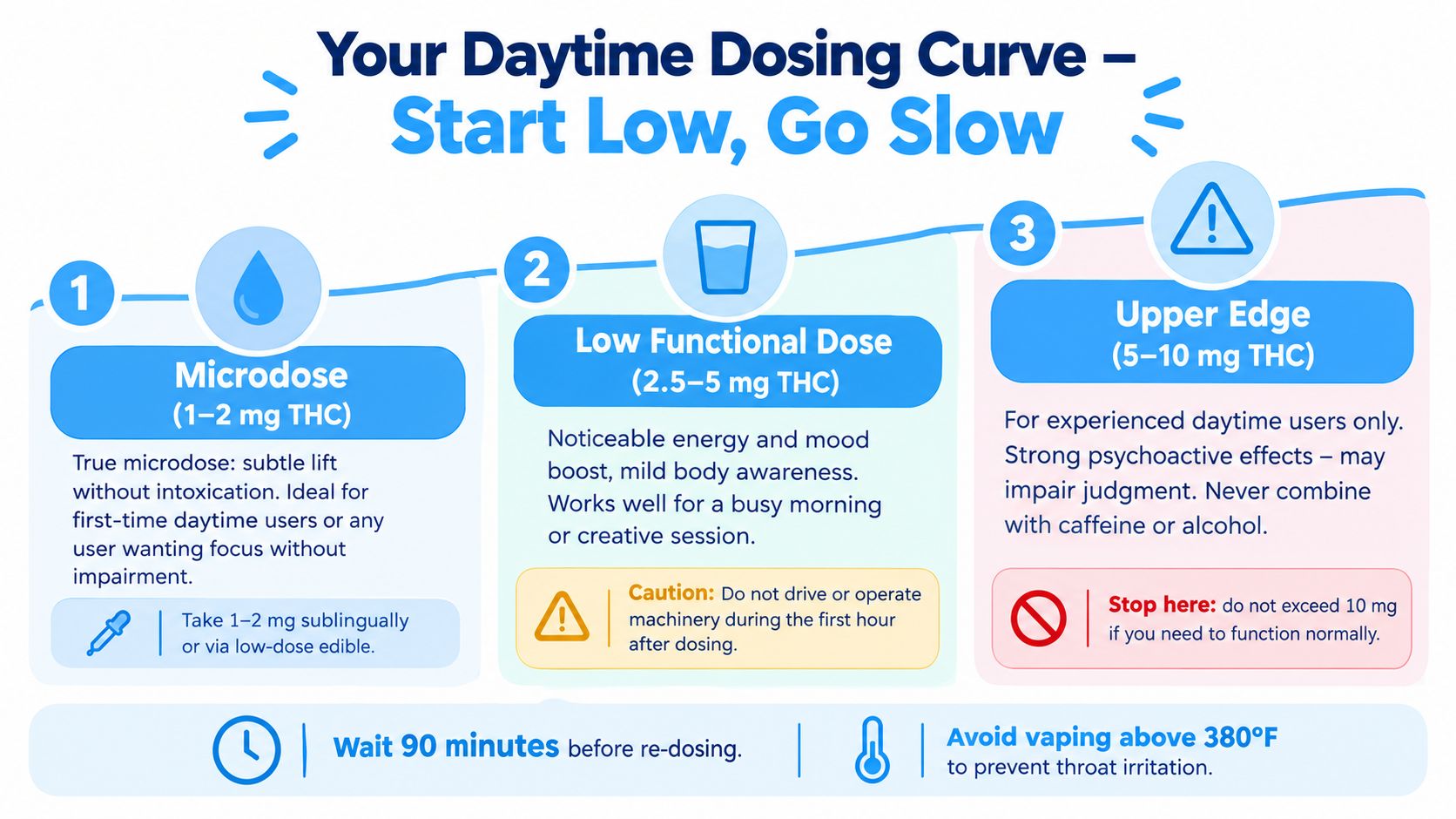
How to avoid the crash
The daytime “crash” usually comes from three predictable mistakes. The first is taking too much THC. The second is redosing before the first dose has fully landed. The third is picking a product whose chemistry does not match your body, even if the label sounds energizing.
That last point trips people up. A terpene-first shopper might do better with a low-dose product rich in limonene or pinene, while the same person could feel flat from a higher-THC option sold under a famous uplifting cultivar name. This is why the COA matters at the counter. It gives you something more useful than the old sativa shortcut.
A safer daytime routine looks like this:
- Pair the dose with an activity: Walk, tidy up, stretch, answer email, or start one creative task. Sitting still and scrolling can make a light dose feel dull.
- Drink water first: Dry mouth, mild lightheadedness, and general roughness often feel worse when you are already dehydrated.
- Eat something steady: A snack with protein or fat usually lands better than cannabis on an empty stomach.
- Wait before adding more: Inhaled products come on faster than edibles, but both can fool impatient users into taking too much.
A few guardrails matter
If you are THC-sensitive or prone to anxiety, a product with some CBD may feel easier to handle than THC alone. CBD does not automatically mean sleepy. In some people, it smooths the edges so the experience feels more usable during the day. That is different from “energizing,” but it can still help you stay functional.
Timing matters too. Morning and early afternoon are usually easier test windows than late day, when poor sleep, a heavy lunch, or general fatigue can muddy the result. Your first trial should happen on a low-stakes day, not before a packed calendar or a long drive.
Keep the rest basic and strict:
- Store products securely: Keep them away from children and pets.
- Skip alcohol: Mixing often blurs the effect and makes dose control harder.
- Test one new variable at a time: New product, same schedule. Or same product, smaller dose. That makes the result easier to read.
This short video is a good companion if you want the dosing basics in a visual format.
Finding Your Personal Energy Profile Over Time
The biggest myth in this category is that one famous cultivar will solve everything. It won't. The better move is to build your own pattern library.
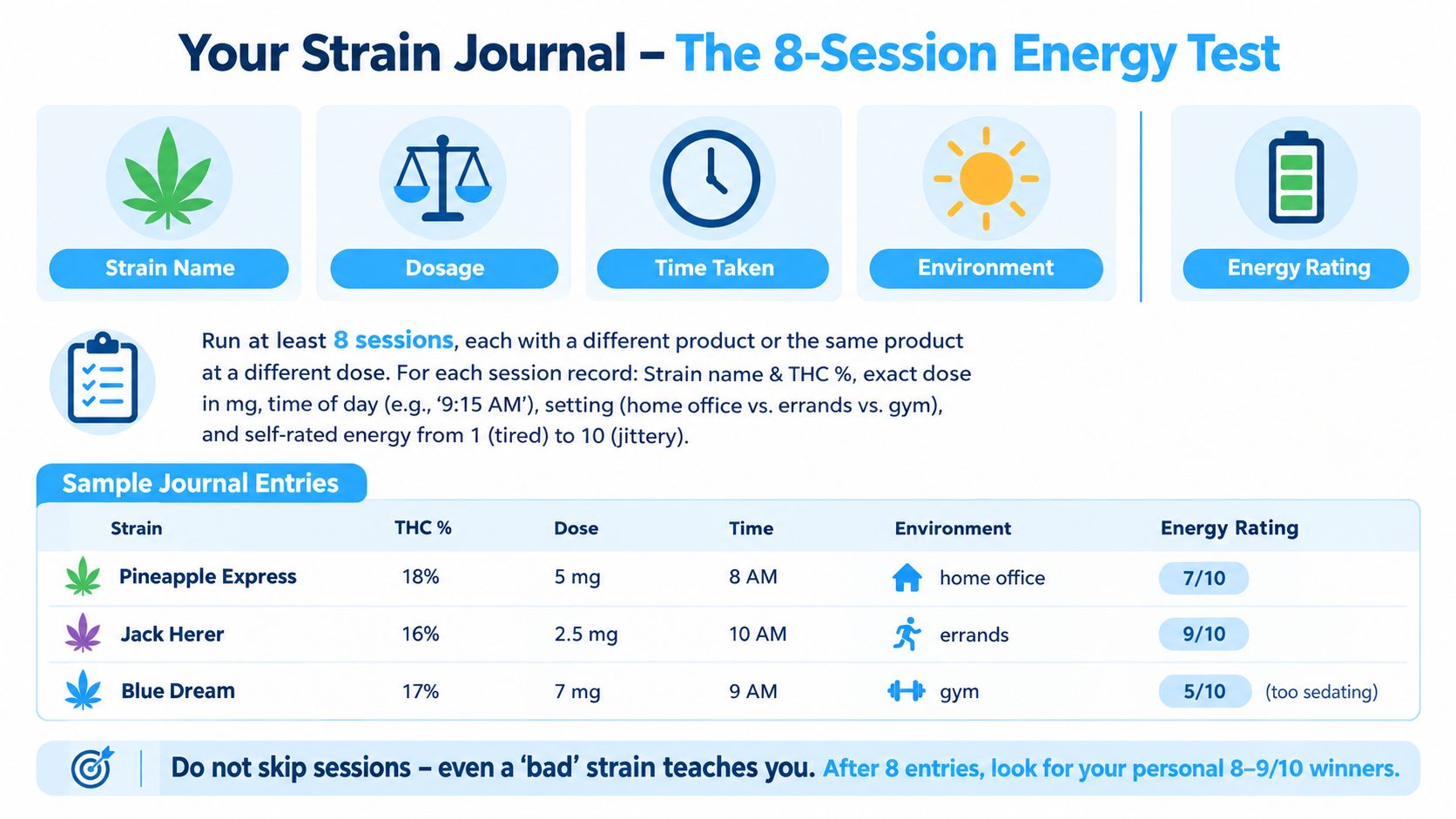
Use an eight-session test
Run at least eight sessions before you decide you've “found your strain.” Track the same details every time so you can spot what changed the result.
Write down:
- Date and time: Morning and early afternoon can feel very different.
- Exact product and batch: Same strain name, different batch, different experience.
- Dominant terpene percentages from the COA: Especially limonene, pinene, terpinolene, and whether myrcene was low.
- Dose: Milligrams, puffs, or inhalations.
- Your ratings: Energy, focus, mood, and unwanted effects at the 30-minute and 2-hour marks.
Change one variable at a time
If you switch strain, format, dose, and time of day all at once, the notes won't teach you much. Keep one thing stable and rotate one variable.
A useful example:
- Keep the same dose, but try a limonene-led product one session and a terpinolene-led product the next.
- Keep the same product, but change from a weekend afternoon to a workday morning.
- Keep the same format, but lower the dose if the last trial felt sleepy.
Your best daytime product is the one that repeats a good result under normal life conditions, not the one with the most hype online.
Sleep quality, caffeine, stress, and what you ate can all shift the outcome. If you already like tracking wellness habits, it can also help to compare your cannabis notes with other energy-support tools. For non-cannabis context, these rhodiola safety and dosage notes are a useful example of how careful adults think about stimulation, tolerance, and timing across different supplements and routines.
Bring your notes to your next dispensary visit. A good budtender can do a lot more with “I did well on low-dose limonene flower at 9 a.m.” than with “I guess sativas make me tired.”
If you want help turning terpene theory into a product that fits your morning, Strong Strains Cannabis Dispensary offers lab-tested flower, vapes, edibles, tinctures, concentrates, and one-on-one guidance from a team that knows how to read a COA, not just repeat strain folklore. Stop in or order for pickup or local delivery and ask for a terpene-forward daytime recommendation built around your tolerance, your goals, and the way you want to feel.