
You're in bed, phone still glowing in your hand, and tomorrow's alarm is getting closer. A dispensary menu promises “restful sleep” in a neat little gummy, but the label raises more questions than it answers. Should you choose THC, CBD, CBN, melatonin, or a blend? How long will it take to work, and will you wake up clear-headed?
Sleep cannabis gummies can fit some adults' nighttime routines, but they aren't automatically restorative just because they make you feel drowsy. The useful distinction is between sleep onset, how quickly you fall asleep, and sleep architecture, the pattern of sleep stages your brain moves through. This guide covers both, including delayed onset, REM changes, morning grogginess, product labels, and practical ways to shop more carefully.
Why People Reach for Sleep Cannabis Gummies Tonight
It's late. You've finished the dishes, answered one last message, and promised yourself you'd stop scrolling several times already. Your mind is still replaying tomorrow's schedule, a stressful conversation, or the travel plans that shifted your normal bedtime. A gummy looks appealing because it seems simple: take one with water, brush your teeth, and let the evening wind down.
That convenience explains much of the format's appeal. Gummies offer a measured serving, avoid smoke and vapor, and generally last longer than inhaled cannabis. They also fit naturally into a routine, especially for someone who doesn't want to prepare a tincture or use a smoking device at night. The tradeoff is that the effects arrive slowly and can linger into the morning.
Sleep is a major reason adults consider cannabis products, not a narrow edge use case. A 2025 National Sleep Foundation analysis estimated that 22 million U.S. adults, or 9%, currently use a cannabis product as a sleep aid, while 45 million adults, or 17%, have used one previously for sleep. Another 23% of adults, about 60 million people, said they're likely to try cannabis products for sleep in the future. Those figures come from the National Sleep Foundation's cannabis and sleep analysis.
The problem shoppers are actually trying to solve
People may reach for sleep gummies because of racing thoughts, jet lag, shift work, discomfort, or a sleep window that keeps getting shorter. A gummy may feel more approachable than a prescription conversation, but approachable doesn't mean risk-free or universally effective.
The practical question isn't only “Will this make me sleepy?” It's “What might it change about my sleep, and how will I feel tomorrow?”
A product can help someone fall asleep faster while also changing REM timing or reducing total sleep. Onset can be unpredictable, especially after a large meal or when someone takes more because the first serving hasn't appeared to work. The rest of this guide keeps those tradeoffs visible rather than treating “sleep” on the front of a package as a guarantee.
THC, CBD, CBN, and Melatonin Explained in Plain Language
You are comparing two gummies at bedtime. One lists THC, another combines CBD and CBN, and a third adds melatonin. The ingredient panel is not just a flavor or branding detail. Each compound can shape sleepiness, alertness, timing, and next-morning effects differently.
THC is the intoxicating cannabinoid. At a low dose, it may help some people settle and fall asleep. A higher dose can feel mentally intense, uncomfortable, or sedating into the next day. THC can also change sleep architecture, the pattern of sleep stages across the night. In an insomnia trial, one oral dose containing 10 mg THC plus 200 mg CBD reduced total sleep time by 24.5 minutes and REM sleep by 33.9 minutes, while increasing REM latency by 65.6 minutes. The findings are reported in Sleep.
That distinction matters: feeling sleepier is not the same as preserving every part of normal sleep. A product may shorten the time it takes to fall asleep while also reducing REM sleep or leaving you impaired the next morning.
CBD is not intoxicating. Shoppers often choose it for a calmer, less altered feeling, especially when tension or anxious thoughts interfere with bedtime. CBD does not guarantee sleep. The amount, formulation, medication interactions, and presence of THC can all change the experience.
CBN is a mildly psychoactive minor cannabinoid commonly positioned as a nighttime ingredient. It often appears with THC, CBD, or both. Evidence remains mixed. One 2026 summary reported that 20 to 50 mg CBN improved self-reported sleep disturbance and performed similarly to 4 mg melatonin, while another source described a rigorous trial in which isolated CBN did not significantly improve sleep-onset latency. The comparison appears in this 2026 CBN gummy review.
Melatonin is a hormone that signals biological nighttime to the brain. It is more closely associated with circadian timing than cannabis-style intoxication, so it may fit a shifted schedule better than every form of insomnia. Adding melatonin to cannabinoids combines separate mechanisms. More ingredients do not automatically make a gummy stronger or more suitable.
Sleep gummy ingredients at a glance
| Compound | Intoxicating? | Reported sleep effect | Typical range in gummies |
|---|---|---|---|
| THC | Yes | May support sleep onset at lower doses, but can alter REM and produce next-day impairment | 2.5 to 10 mg in sleep-onset guidance, Cannabis Dispensary |
| CBD | No | May support calm and reduce anxiety-related barriers to sleep | Varies by product, with no single verified range |
| CBN | Mildly, depending on the product | Marketed for drowsiness and sleep disturbance, but clinical results are inconsistent | 5 to 20 mg |
| Melatonin | No | Helps signal bedtime and may support circadian adjustment | 5 mg in a product example |
A simpler formula usually gives new users clearer feedback. If a gummy causes benefit, anxiety, grogginess, or no effect, fewer active ingredients make the likely cause easier to identify.
How Long Sleep Gummies Take to Work and How Long They Last
A gummy has to travel through the digestive system before its cannabinoids become active. Oral products are absorbed through the gastrointestinal tract and then processed through first-pass metabolism in the liver, so they don't behave like inhaled cannabis. Traditional edibles usually begin working in about 30 to 120 minutes, with effects often lasting 4 to 8 hours, according to this edible CBN timing guide.
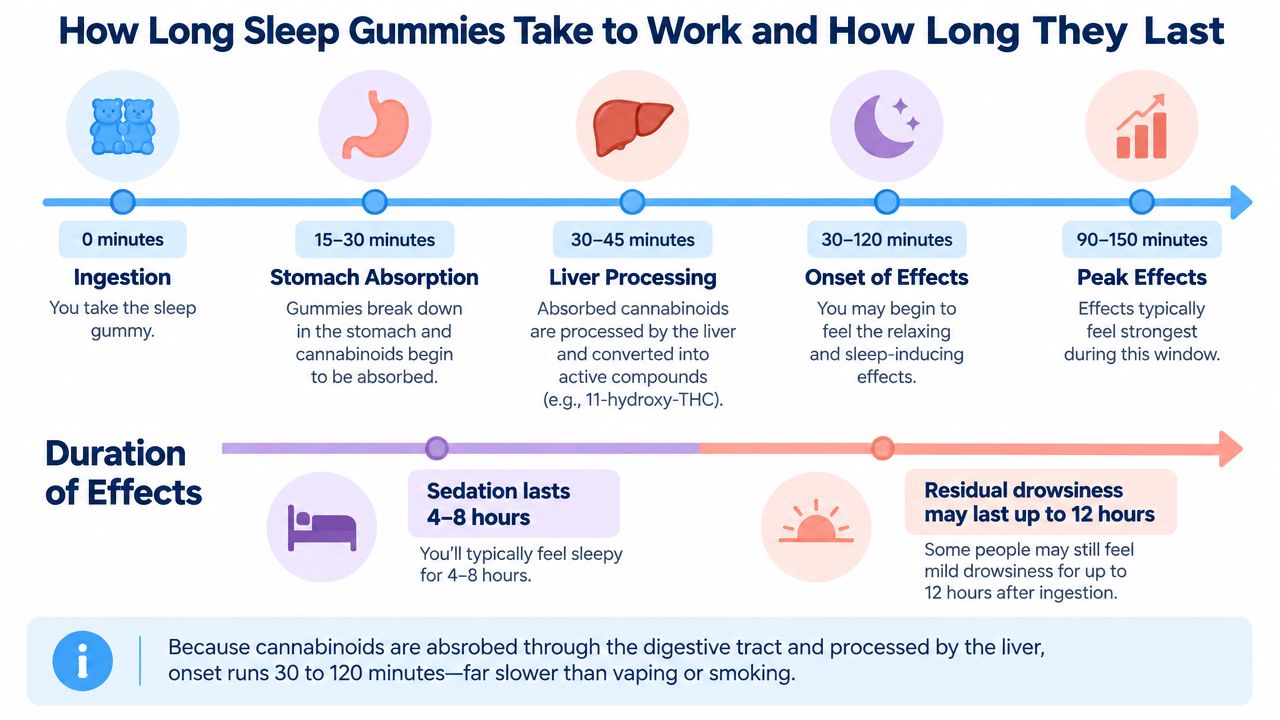
The range is broad because the same gummy can feel different on different nights. A full meal may delay absorption, while an empty stomach can make the peak arrive more abruptly or feel more intense. Metabolism, body chemistry, product composition, and serving size also influence the timeline.
Why bedtime timing matters
Taking a gummy immediately before turning out the light may leave you waiting, checking the clock, and wondering whether it worked. Taking another serving during that wait can create a delayed stack of effects, with the strongest sedation arriving after you're already asleep or close to morning.
Take the timing seriously in both directions. A gummy taken too late may contribute to sunrise grogginess. A gummy taken too early may feel active before you're ready for bed, or may not match the part of the night you're trying to support.
For a deeper explanation of edible duration, review this guide to how long edibles last. As a practical starting point, take a carefully measured serving at least 60 minutes before intended sleep, then give the product time to develop before judging it.
Dosing and Timing for a Better Night
At 10:30 p.m., you take a gummy, turn off the light, and wait. Nothing seems to happen, so another piece starts to look tempting. Edibles can develop slowly, making that second dose the source of an unexpectedly strong effect later.
A cautious first trial asks one question: what does the smallest reasonable serving do for you? For THC-containing sleep gummies, the commonly cited sleep-onset range is 2.5 to 10 mg THC. CBN-forward products commonly use 5 to 20 mg CBN, with 10 to 15 mg often presented as a starting range for new users. The CBN range and timing guidance are discussed by TribeTokes.
A measured starting approach
Read the label for milligrams per gummy, not only milligrams per package. If one piece contains more than you want to try, choose a product that allows accurate portioning or divide it carefully. Half a gummy does not necessarily contain half the stated amount unless the mixture is evenly formulated and the piece can be divided reliably.
| User experience | THC per serving | CBN per serving | Timing before bed |
|---|---|---|---|
| New to THC | Start at the low end of the 2.5 to 10 mg range | Start at the low end of 5 to 20 mg if CBN-forward | 30 to 90 minutes |
| Sensitive or uncertain | Use the smallest labeled serving | Choose a lower CBN serving | Take earlier rather than adding more |
| Returning user | Stay with the lowest effective serving | Adjust only after observing the response | Keep timing consistent |
If the effect feels too mild, change one variable at a time. Wait through two or three nights before stepping up, then consider an increase of 2.5 mg THC or 5 mg CBN only when the label and your previous response support it. A stronger sleepy feeling is not automatically a better night, because sedation can arrive before you know whether your sleep quality or sleep stages have improved.
Avoid the impatient second dose. Edibles can feel inactive while the first serving is still developing.
Take the gummy 30 to 90 minutes before bed. A light snack may make the experience more predictable for some people, while a heavy meal can shift onset. Keep alcohol out of the experiment because combining it with cannabinoids can increase sedation and impairment in ways that are difficult to predict.
Keep the serving, timing, meal pattern, and bedtime similar while you learn your response. For additional context on edible potency and serving sizes, see this 100 mg THC guide.
What Sleep Gummies Actually Do to Your Sleep
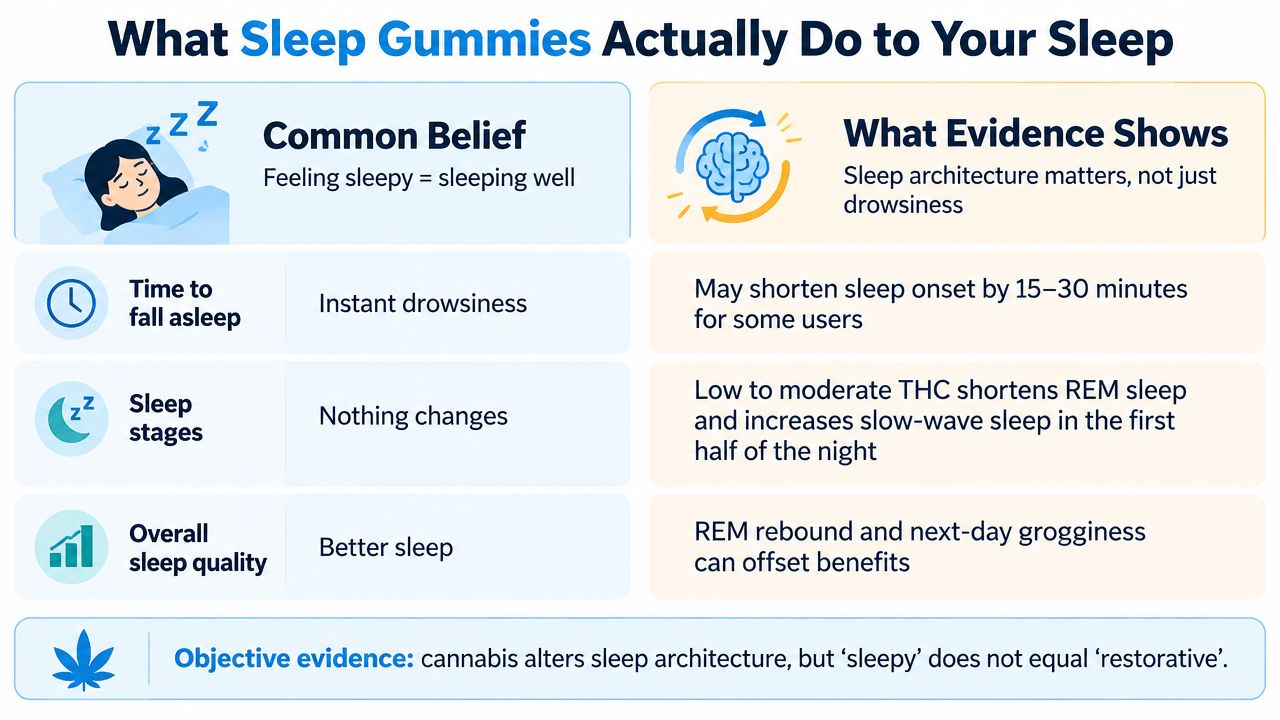
Feeling heavy-eyed is not the same as getting better sleep. Cannabis can change the transition into sleep and the distribution of sleep stages, which means a person may report falling asleep more easily while objective measures tell a more complicated story.
A controlled insomnia study found that nightly sublingual cannabinoid extract for two weeks reduced insomnia severity by 5.07 points and self-reported sleep-onset latency by 8.45 minutes compared with placebo. That result supports a carefully dosed evening product when the immediate goal is falling asleep faster, but it doesn't prove that every gummy improves overall sleep quality. The trial is available through this controlled cannabinoid insomnia study.
The architecture tradeoff
The oral 10 mg THC plus 200 mg CBD trial described earlier reduced total sleep time and REM sleep while delaying the point at which REM began. That doesn't mean every low-dose gummy will create the same result, but it does show why “I felt sedated” can't stand in for a complete sleep assessment.
Research also suggests a biphasic response. Lower acute doses may reduce sleep-onset latency and wake after sleep onset, while higher or repeated exposure can suppress REM sleep and create next-day tradeoffs. A broader 2026 review concluded that trial evidence doesn't support cannabis or cannabinoids for insomnia in most cases, as summarized by M&W Sleep.
Some people also experience disrupted sleep and vivid dreams after stopping frequent high-THC use. That rebound pattern matters if a gummy becomes a nightly requirement rather than an occasional tool.
A quieter bedroom, a stable temperature, and comfortable bedding can support a routine without adding another active compound. Shoppers building that foundation may find an eco-friendly sleep setup useful alongside, rather than instead of, careful product evaluation.
For a product-focused discussion of how an indica gummy may feel, compare this indica gummy effects guide. Treat strain language as a starting clue, not proof of a specific sleep-stage outcome.
Side Effects, Safety, and Tolerance to Watch For
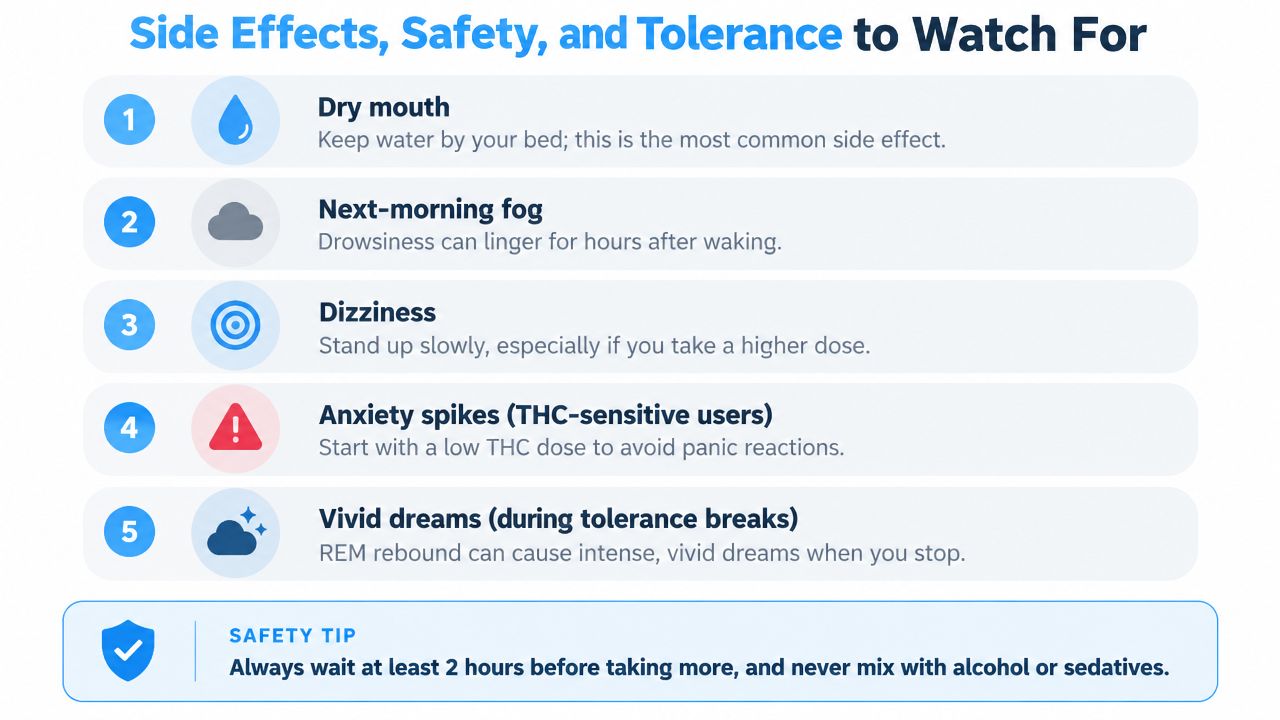
The most common problem isn't that a gummy does nothing. It's that the serving feels manageable at bedtime and excessive by morning. Dry mouth, dizziness, lingering fog, and anxiety are realistic possibilities, particularly with THC-sensitive users or people who misjudge the delayed onset.
Vivid dreams can also appear during tolerance breaks or after frequent use, as REM sleep changes rebound. That response can make someone think the gummy was “protecting” sleep when it may have been suppressing part of the normal sleep pattern.
Who should pause before trying one
Pregnant people, anyone taking sedatives or SSRIs, and people with a history of substance use disorder should speak with a qualified clinician before using cannabis for sleep. CBD can also affect how some medications are metabolized, so a pharmacist or prescribing clinician can help identify interaction risks.
Tolerance can develop when someone uses cannabis nightly. The person may need more to produce the same effect, then sleep worse on nights without it, creating a dependence loop. A consistent log can reveal that pattern before the serving escalates.
Regulation and household safety
New York adult-use edibles are capped at 10 mg THC per serving and 100 mg THC per package, which often shapes a standard package as 10 gummies at 10 mg each. This New York edible buying guide explains how those limits influence portioning and shelf formats.
Use a locked storage location that children and pets can't access. Don't combine gummies with alcohol or opioids, and don't drive after taking one. For the first two weeks, record the product, serving, time taken, estimated onset, wake-ups, dreams, and morning alertness. That information is more useful than relying on a vague memory of whether the night “felt good.”
Choosing the Right Gummy and Building a Bedtime Routine
A dispensary shelf can make sleep gummies seem interchangeable. They are not. Start by identifying the problem you want to address, then read the label for ingredients, serving size, and testing rather than choosing by the word “sleep.”
Read the label in four passes
Cannabinoid ratio: Record the THC, CBD, and CBN amounts separately. A THC-dominant gummy may feel intoxicating, while a CBD-forward or CBN-forward product can feel different. The ratio provides more useful information than the product name.
Serving versus package: Check how many milligrams are in one gummy, then compare that with the package total and number of pieces. Regulations can shape these formats, so the total amount on the front does not tell you what one serving contains.
Terpene information: Some shoppers look for myrcene, linalool, or terpinolene when seeking a more relaxing profile. Terpenes may influence the experience, but they do not guarantee sedation. A strain name also cannot predict how your body will respond.
Recent lab testing: Look for a current, independent Certificate of Analysis, often available through a scannable QR code. Confirm that it reports cannabinoid potency and checks for relevant contaminants, rather than relying only on marketing language.
A budtender can help clarify four practical points:
- How quickly might this ratio begin to feel noticeable?
- Does it tend to feel energizing or relaxing in practice, beyond an indica or sativa label?
- What is the smallest reasonable serving for someone with my experience?
- Is pickup or same-day delivery available in my area?
Product names help with comparison, but the label numbers should guide the decision. You may see sleep-focused options such as Wana Stay Asleep Indica Gummies, Camino Midnight Blueberry 5:1 Sleep Gummies, Nama Sleep Gummy Tin, Nanticoke Sleep Blueberry Gummies, Off Hours Sleep Cherry Berry, or Florist Farms Blueberry Sleep Edible. Availability changes, so ask for the current menu and latest testing information.
Build a repeatable wind-down
Keep the routine deliberately boring. Dim screens, prepare a light herbal tea, take one measured gummy 30 to 90 minutes before lights out, write down one worry, and leave the phone away from the bed. Keep the serving consistent across two weeks before changing it, unless you experience a concerning reaction.
A melatonin-only option gives you a comparison point for a circadian signal versus a cannabinoid effect. For shoppers reviewing that category, this 5mg melatonin gummies for sleep resource presents a clearly labeled example. Melatonin should not be treated as interchangeable with THC, CBD, or CBN.
Track morning alertness, not only how quickly you fall asleep. Feeling sleepy sooner does not prove that sleep quality or sleep architecture improved. Someone may fall asleep quickly yet wake foggy, while another person falls asleep slowly and wakes rested. That difference matters because a gummy that changes sleep onset may also involve tradeoffs, including altered dreaming or REM sleep, rather than delivering an across-the-board improvement.
A simple log can make those patterns easier to discuss with a budtender or clinician. Strong Strains Cannabis Dispensary offers lab-tested edibles, including sleep-focused gummy options, for adults comparing THC, CBD, CBN, and melatonin-based routines. Visit Strong Strains Cannabis Dispensary for current product availability, in-store pickup, or local delivery options across Suffolk County and Long Island.