
Most strain pages tell you to pick New York Haze if you want energy, creativity, or a daytime lift, as if the name works like a formula. That advice puts the label ahead of the actual product in the package. New York Haze is better treated as a regional cultivar family, not one standardized strain with fixed chemistry, so two jars carrying that name can smell similar while testing differently for THC, CBD, and terpenes.
That doesn't make the name useless. It signals a style, a history, and an aroma you can expect to explore. What it can't do is set your dose or promise how you'll feel. The batch in front of you, with its own certificate of analysis, harvest date, and format, is the product you're really choosing.
New York Haze Profile in Numbers
The numbers attached to New York Haze do not add up to a strain specification. They describe a range you can test a batch against. New York Haze works as a regional market label, and the useful question is what this particular jar measured. A Joint Commerce strain profile puts commonly reported flower potency near 19-23% total THC, with a broader Haze-dominant range around 18-24% and exceptional batches possibly higher. That same profile lists total terpene content at roughly 1.5-3.0% by weight, which helps explain why aroma is often the first thing people judge at the counter.
New York Haze Profile Rows to Check
| Compound | What to look for on the batch COA | What it signals |
|---|---|---|
| Total THC (flower) | 19-23 percent (broader Haze range 18-24 percent) | Potency; exceptional batches can be higher |
| Total terpenes | 1.5-3.0 percent by weight | Aroma intensity |
| Terpinolene | Batch-specific level | Fresh, piney and citrus top notes when it leads |
| Beta-caryophyllene | Batch-specific level | Peppery, spiced character |
| Myrcene | Batch-specific level | Earthy, herbal base |
| Ocimene | Batch-specific level | Sweet, floral lift |
Treat the terpene rows as a scent map, not a fixed recipe. If terpinolene is the top terpene on a certificate, the flower tends to open with pine needles, bright citrus peel, and a clean herbal edge. Beta-caryophyllene adds the peppery bite, close to cracked black pepper or warm spice. Myrcene sits lower and gives the earthy, herbal base that keeps the aroma from feeling thin. Ocimene lifts the finish with a sweet, floral touch, so the same flower can read piney at first and softer a few seconds later.
Treat these ranges as an expectation to test against, not as a promise printed on the bag.
What the Numbers Actually Tell You
- Potency signal: Total THC tells you how strong the flower may feel. It does not tell you how aromatic or fresh it is.
- Aroma signal: Total terpenes tell you how much aromatic material the lab measured. A higher total often means a louder smell, though storage and age still matter.
- Character signal: The order of the top terpenes matters more than any single one. A terpinolene-led batch usually smells brighter than a myrcene-led batch.
If you want to compare this profile with other aromatic cultivars, our guide to high terpene strains shows how totals and leading terpenes differ across products.
Use the table to form a starting expectation. Then check the specific batch for total THC, total cannabinoids, terpene percentages, harvest date, and contaminant results. The certificate turns New York Haze from a legend into a measurable product you can dose with care.
Origins, Lineage and Why the Name Varies
New York Haze is not one plant with one birth certificate. What the name describes is a style, an incense-forward Haze family that older smokers in the city still call Piff, kept alive by memory and by clones far more than by paperwork.
The Weedmaps NYC Haze page treats New York Haze, also called NYC Haze, Piff, Black Haze, or Piff Haze, as a regional cannabis cultivar family rather than a single genetically standardized strain. Its cultural roots are generally placed in New York's underground cannabis scene during the late 1990s and early 2000s, when that phenotype became associated with Manhattan, the Bronx, and uptown neighborhoods.
No single breeder or definitive release record settles the story. Before legalization, clones and seeds moved informally through trusted circles, names changed as material moved, and growers rarely kept public records. Exact parentage stays disputed even when the cultural identity feels clear.
The Wider Haze Lineage
Haze lines descend from tropical sativa landraces that California growers worked with decades ago, and the family's reputation rests on two traits that pull in opposite directions: a bright, incense-like aroma and a very long flowering time. Original Haze carried so much breeding value precisely because that flowering window was so hard to manage. Later breeders crossed Haze lines with faster, sturdier plants to keep the aroma while shortening the grow.
For New York Haze, reported theories include Haze combined with Northern Lights, Skunk, or related Dutch hybrid lines. Treat those as theories, not a pedigree certificate. A grower can repeat a plausible family story without proving that a modern jar descends from one original mother plant.
Practical rule: The name tells you the style people are aiming for. The lab report tells you what they actually produced.
Does Every Product With This Name Match
That's the question shoppers often skip. A Nature Plants analysis of more than 100 cannabis samples found that products sharing a cultivar name could be as genetically and chemically different from one another as products with different names. The same analysis found indica and sativa labels were genetically indistinct at the genome-wide level, while differences were more meaningfully associated with a limited set of terpene-related genes.
That finding changes how you shop. A sativa label doesn't lock in an energetic experience, and an indica label doesn't lock in sedation. Terpene patterns may help explain why one jar smells sweet and herbal while another leans earthy, but they're tendencies, not guarantees.
Format widens the gap further. Flower, a pre-roll, a vape cartridge, and a concentrate can all start from similarly named material and still deliver different aroma, onset, and intensity because processing changes what reaches you. A vape may emphasize a clean top note, while flower keeps more of the layered incense character people associate with Piff.
Packaged goods usually work the opposite way. A named soda tastes the same in every store because one company controls one recipe. Cannabis cultivar names grew up without that control, so New York Haze works more like a regional dish: restaurants can share ingredients and intent while seasoning, freshness, and final flavor still vary.
Origin explains the style. The name signals a family with a recognizable New York history. Only the batch establishes genetics as grown, cannabinoid levels, terpene percentages, and safety results, and that's the level at which you should make a buying decision.
How to Read a Certificate of Analysis Before You Buy
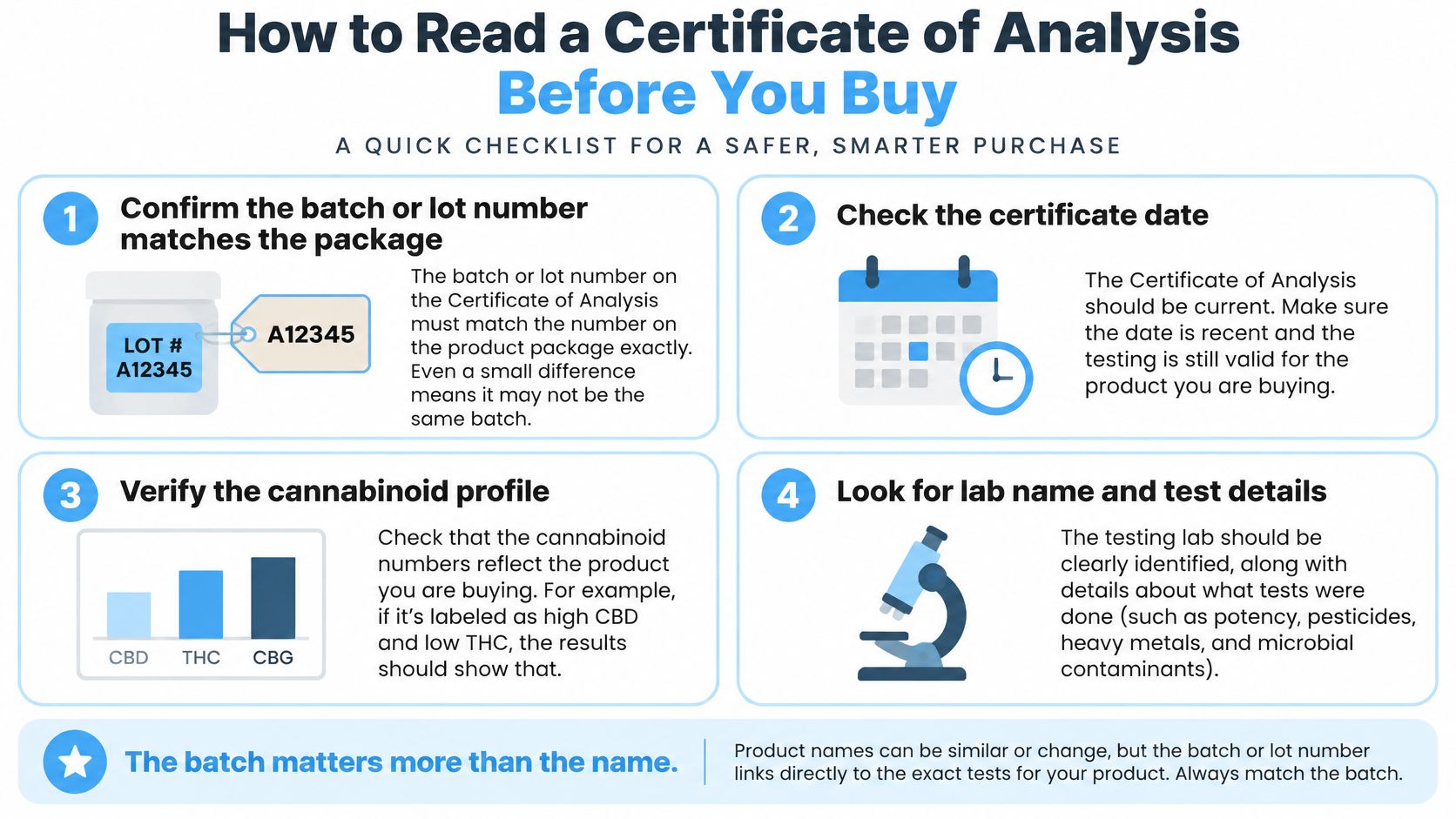
A certificate of analysis, or COA, is the lab report for one batch or lot. Read it like a recipe card for that specific jar, not for every jar that carries the same name. The goal is to confirm the numbers on the menu belong to the package in your hand and that safety testing is complete.
Use this visual checklist as a quick scan before you work through the details.
Read It in This Order
- Match the batch or lot number. The COA and package must match exactly. Another batch with the same name can test differently.
- Check the harvest or package date. A fresher date gives you a better chance of strong aroma, since terpenes fade with time and poor storage.
- Read total THC, total cannabinoids, and CBD. Total THC guides potency. CBD helps you judge balance.
- Note the top three terpenes by weight. Those percentages explain the smell better than a long list of trace compounds.
- Confirm contaminant panels passed. Look for pesticides, residual solvents, metals, microbials, and mycotoxins.
- Check moisture and water activity. These results help show whether flower was dried and stored within the required testing framework.
New York sets a clear baseline. The New York Office of Cannabis Management testing guidance requires every final adult-use cannabis product to pass laboratory testing before sale through a licensed dispensary. The required categories include microorganisms, foreign material, metals, moisture and water activity, mycotoxins, pesticides, residual solvents, and terpenoids. The same guidance sets batch sampling and testing requirements, so the report should connect to the lot you are buying rather than to a general product name.
The video below shows how those lab fields appear in practice.
As an illustrative example, not a reported batch, Bag A lists 21% total THC and 2.4% total terpenes led by terpinolene. Bag B lists 23% total THC but only 1.6% total terpenes led by myrcene. If aroma and a brighter profile matter more to you than the highest THC number, Bag A is the closer fit even though the THC number is lower. Both bags say New York Haze. The batch report, not the name, tells you what you are choosing.
If the COA is missing, blurry, or tied to a different lot, ask for the correct report before you buy. Our explainer on lab test results and interpretation can help you compare panels once you have the right document in hand.
Choosing New York Haze by Goal and Format
Start with your goal, then pick a format you can control. Don't start with the words indica or sativa and hope they'll do the thinking for you. For New York Haze, the useful question is which measurable trait in this batch fits the occasion.
A terpinolene-led profile is often associated with daytime, social, or creative use because the aroma reads bright and fresh. That's still an association, not a prescription. A high-THC batch can overwhelm a new user at any time of day, and a myrcene-heavy batch may feel less suited to a focused afternoon.
Goal and COA Check and Starting Format for New York Haze
| Goal | What to Check on the COA | Format to Start With |
|---|---|---|
| Alertness or daytime focus | Terpinolene share, reported around 0.4-1.2 percent | Flower in small amounts or a low-dose vape |
| Creativity or social daytime use | Total THC and terpene total; avoid the highest THC batch on a first try | Flower or pre-roll |
| Relief | THC and CBD ratio, plus myrcene and beta-caryophyllene shares | Clinician conversation first; then a low-dose format chosen with a professional |
| Sleep or evening use | Myrcene share and harvest date; a fresher batch | Low-dose flower or a tincture, with a clinician conversation first |
How Format Changes Control
- Flower: You control the amount most directly, since you can take a small puff, stop, and decide later.
- Vape: Effects can arrive quickly and repeated draws add up fast, so a single low-dose draw is the cautious starting point.
- Edible: Onset is slower and the experience lasts longer, which makes it the easiest format to overdo by taking more too soon.
- Pre-roll: It's convenient, but you don't need to finish it. Put it out once you've reached your intended amount.
Brands on a menu, from MFNY and Fernway to Rythm, Jeeter, or Cookies, don't change that logic. You're still comparing the format, dose per serving, and batch data, not buying an effect from a logo.
The common mismatch is buying a bright, terpinolene-led New York Haze while expecting it to help you sleep. If sleep or relief is tied to a health condition, medication, pregnancy, or ongoing symptoms, talk with a clinician first. A strain name never replaces that conversation, and a budtender shouldn't diagnose or promise treatment.
Use the table as a starting checklist for a counter conversation. It helps you ask better questions about freshness, terpene order, and dose control, but it doesn't predict how any one batch will feel in your body.
How to Dose New York Haze Step by Step
Dosing works best as a routine you can repeat. You're building your own reference point for one batch and one format, not chasing the strongest possible first session.
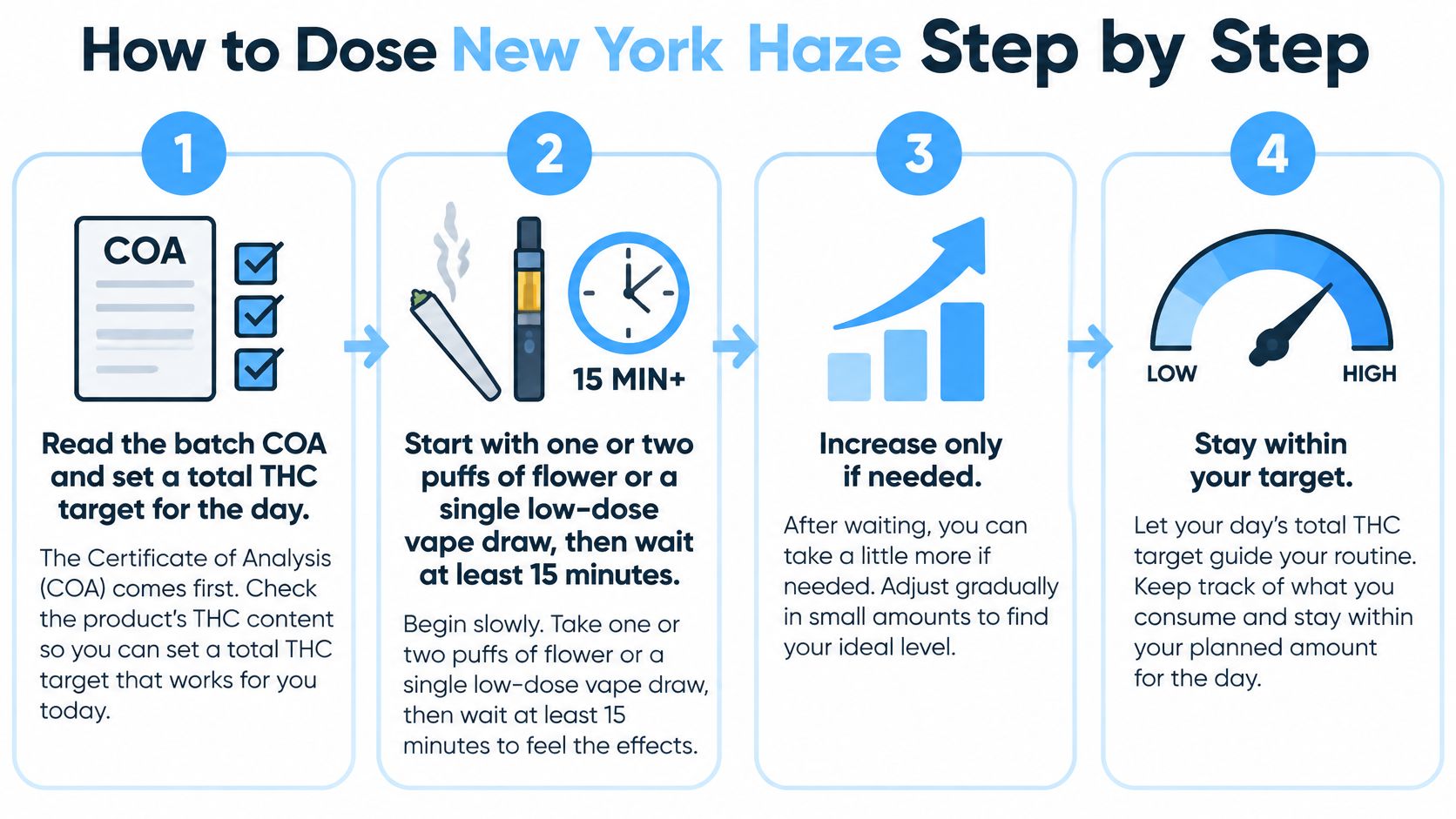
This dosing flow reduces the routine to its core steps.
A Low and Slow Routine
- Read the batch COA and set a total THC target for the day. Decide your ceiling before you start, while you're clear-headed and can compare formats calmly.
- Start with one or two puffs of flower or one low-dose vape draw, then wait at least 15 minutes. Inhaled effects begin quickly and peak early, so waiting tells you whether that amount was already enough.
- For edibles, start low and wait at least two hours before taking more. Edibles take longer to absorb and can feel stronger than expected once they arrive.
- Skip alcohol, driving, and machinery until effects are fully known. Mixing intoxicants makes your response harder to read and raises risk.
- Log the batch, format, amount, time, and response. Notes turn one session, good or uncomfortable, into usable data for the next purchase.
- Increase only in a later session, in small steps. A new day gives you a clean comparison instead of stacking doses on a rising effect.
Your log is personal lab data. It won't predict everyone else's response, but it can make your next choice much more precise.
The terpene profile helps explain aroma and may help you describe what you liked, but it doesn't set the dose. The Nature Plants PDF on cultivar labels and terpene-related differences describes sativa-labeled samples showing higher levels of some sweet, herbal, and fruity-associated terpenes, while indica-labeled samples tended to show more earthy-associated compounds such as myrcene, as patterns rather than guarantees. That's why your measured amount and waiting time matter more than the Haze story.
If you want a broader reference while you calibrate, use a cannabis dosage chart alongside the actual milligrams or percentage printed for your product.
Stop if you notice a racing heart, rising anxiety, dizziness, nausea, or confusion. Sit down, drink water, and avoid taking more. Seek urgent medical help for chest pain, trouble breathing, fainting, severe vomiting, or symptoms that frighten you or keep getting worse.
Buy New York Haze on Long Island Within Legal Limits
Legal limits decide how much you can carry before flavor or potency enters the conversation. The New York Office of Cannabis Management adult-use information page states that adults who are at least 21 years old may possess up to 3 ounces of cannabis flower and up to 24 grams of cannabis concentrate. Adults may also transfer cannabis to another person who is at least 21 without payment or compensation, provided the transfer stays within the legal possession limit, while selling cannabis or using a purported gift to promote a paid service or commodity is prohibited.
New York Adult Use Possession and Delivery Limits
| Category | Possession Limit | Single Delivery Day Limit |
|---|---|---|
| Flower | 3 ounces (85 grams) | Up to 3 ounces (85 grams); a retailer may set a lower limit |
| Concentrate | 24 grams | Up to 24 grams |
| Gift transfer to another adult 21+ | Within the same possession limit, no payment | No separate delivery allowance; the recipient must stay within the possession limit |
Delivery follows its own location rules. The New York cannabis delivery FAQ for consumers says a customer who is 21 or older may purchase up to 3 ounces, or 85 grams, of cannabis flower and up to 24 grams of concentrated cannabis in a single delivery day, although an individual licensed retailer may impose a lower limit. It also says delivery must go to a physical address in New York and may be made to residential properties, temporary residences, or private businesses, but not to public buildings, parks and other public spaces, schools, day-care centers, houses of worship, or a motor vehicle.
You'll also attest that you're at least 21 when ordering, and the recipient named in the order must be verified. All flower purchases in Setauket-East Setauket require a valid, government-issued ID showing the buyer is 21 or older, so keep that ID ready for pickup or delivery.
Pickup or Delivery on Long Island
Our dispensary is located on Long Island, New York, and we deliver cannabis to 105+ neighborhoods and cities across Long Island. Before you order, confirm that your town is in the listed delivery area and decide whether same-day pickup or delivery fits your schedule better. Pickup gives you a chance to ask about a COA at the counter. Delivery gives you convenience, provided the address qualifies and the named adult recipient is present.
- Check the batch first: Match the lot number and review THC, CBD, terpenes, and safety panels.
- Pick the format second: Choose the amount and onset pattern you can control for your goal.
- Confirm the limit last: Make sure flower and concentrate totals stay within the possession and single-day delivery caps.
That order keeps you from falling for a famous name and then scrambling to justify the purchase. Check the batch COA, pick the format and amount for your goal, choose pickup or delivery, and confirm your legal limit before buying New York Haze.
Ready to shop New York Haze by batch data instead of by legend? Visit Strong Strains Cannabis Dispensary to browse lab-tested flower, pre-rolls, vapes, and other adult-use products for pickup or Long Island delivery, and bring your COA questions to our budtenders before you choose.