
If putting cannabis oil under your tongue makes it fast-acting, why can you feel almost nothing at first and noticeably more later? The missing distinction is onset versus peak. The first sign of an effect doesn't tell you how strong that dose will eventually feel.
Taking cannabis oil under the tongue means giving some cannabinoids an opportunity to cross the tissues inside your mouth. It isn't a guarantee of speed or predictable intensity. A useful first routine combines an accurately measured dose, a consistent hold, and enough uninterrupted time to observe what happens.
Confirm Eligibility and Safety Before Your First Dose
Cannabis products are for adults 21 and older only. Don't drive, operate machinery, or handle tools that require full attention while under the influence. Cannabis can impair concentration and coordination, even when you haven't yet noticed a strong effect.
Cannabis isn't recommended during pregnancy or while nursing. Customers who take medications, are pregnant or nursing, or have underlying health conditions should consult a doctor before using cannabis products.
Clear the medical and scheduling checks
Tell your doctor about prescription medicines, nonprescription products, and other substances you use. Mention heart, liver, mental health, or seizure conditions rather than assuming a small dose makes those details irrelevant. Health Canada's adverse-reaction guidance warns that oral cannabis can interact with medications and other substances.
Set up your first week around observation, not escalation:
- Reserve an unhurried session. Choose a setting where you won't need to leave, work, or supervise a demanding task.
- Plan a single dose. Write down the intended amount before opening the bottle.
- Leave alcohol out. Don't combine substances to make a mild initial response feel stronger.
- Record your response. Note dose, time, food, and effects, and stop to reassess if you feel dizzy, anxious, confused, or unwell.
Check the label before committing
Buy from a licensed dispensary and choose a label that identifies THC and CBD concentrations, not just a prominent bottle total. Our guide to interpreting cannabis lab-test results can help you understand what testing information does, and doesn't, establish.
Before your first dose, confirm that the product's timing fits your available downtime. Pick the lowest labeled starting amount, verify how to measure it, and put that plan in your log.
How to Take Cannabis Oil Under the Tongue
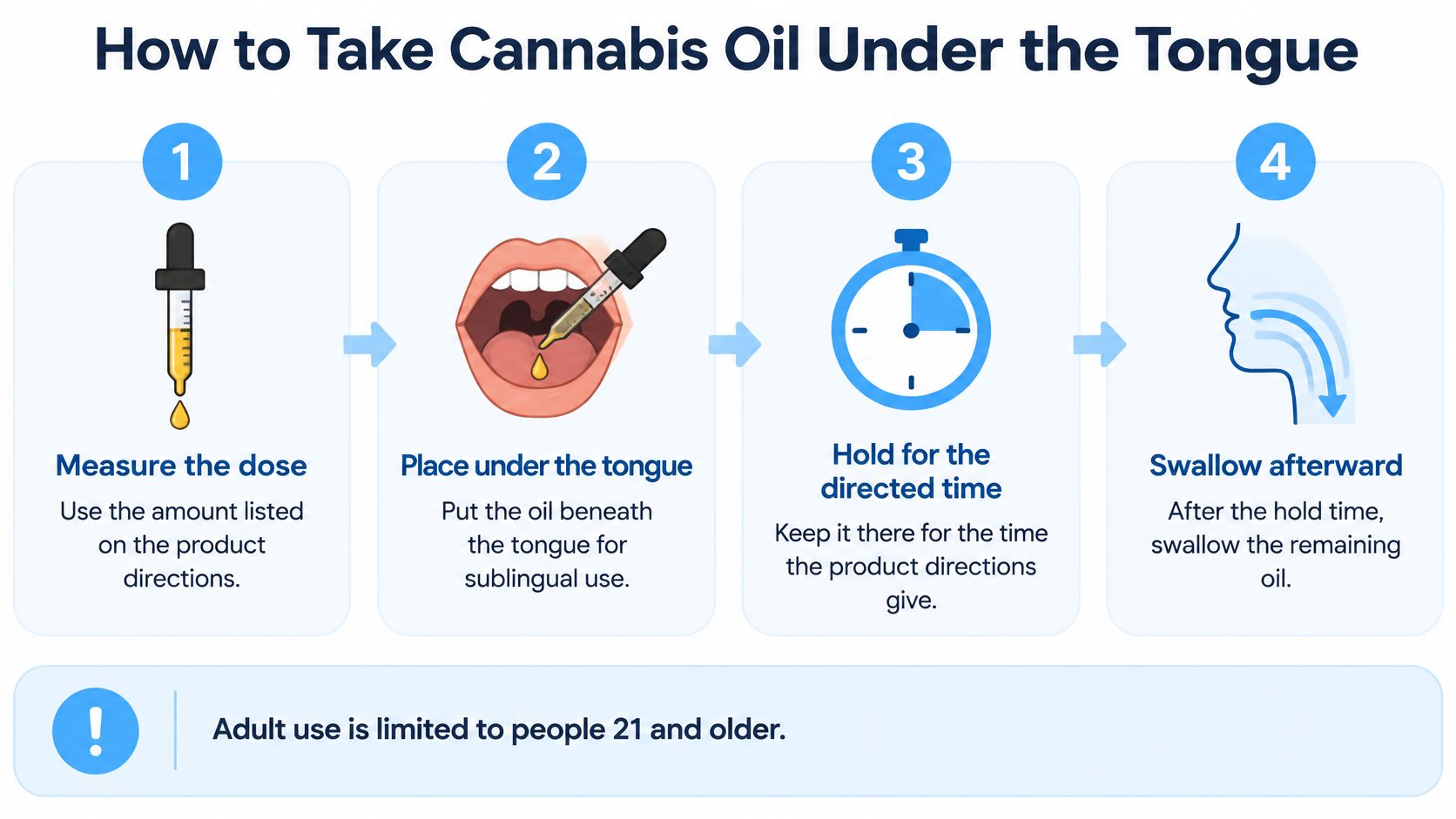
What matters most when placing cannabis oil under your tongue? Measure the dose accurately, follow the product's instructions, and give the liquid time to stay in contact with the tissue.
Measure before placing the oil
Read the concentration. Check how many milligrams of THC and CBD are in each milliliter and, if listed, in a measured dropper. The bottle's total cannabinoid content is not the same as the amount in one dose.
Prepare your mouth. Finish eating, remove gum, and set aside your drink before measuring. This makes it easier to keep the oil beneath your tongue.
Use the supplied measuring tool. Hold a syringe or graduated dropper as its instructions specify, and read the measurement at eye level. A dropper bulb does not necessarily draw a standard volume.
Place the oil beneath your tongue. Direct it toward the floor of your mouth rather than spreading it over your tongue. Keep the dropper tip from touching your mouth to avoid returning saliva to the bottle.
Hold the oil in place. Keep your head level, breathe normally, and avoid talking or swallowing deliberately before the hold is complete. A sip of water can wash the oil away from the contact area.
Finish as directed. Swallow any remainder when the hold is complete, unless the product instructions say otherwise. Record the amount, time, meal status, and how you felt before dosing.
Put the bottle away. An effect may be subtle at first. Don't use that as a reason to take more before you have allowed time to assess the dose.
Hold time and milligram conversion
A controlled Phase I study of an oromucosal nanoparticle spray had participants hold each application for 90 seconds before swallowing. That was the protocol for a specific spray, not proof of an ideal hold time for every retail oil.
Follow the product's stated hold time. If none is given, 60 to 90 seconds is a practical fallback, not a proven optimum. A dispensary educator can help clarify how to use a particular product.
Calculate the amount before drawing the oil:
Dose in milligrams = concentration in milligrams per milliliter × volume in milliliters.
For example, a hypothetical oil labeled 20 mg/mL supplies 5 mg of that cannabinoid in 0.25 mL. This is a calculation example, not a recommended starting THC dose. If the label lists THC and CBD separately, calculate each amount separately.
Drops can vary in size between droppers, so use the calibrated syringe when one is supplied. Keeping a written record can also help you notice patterns; a guide to tracking the effects of mushroom tinctures offers a separate example of documenting a session. Mushroom and cannabis dosing are different, so the example does not establish a cannabis dosing method.
End the routine with a measured dose and a recorded time. Allow time to observe the response before considering another dose.
How Fast Sublingual Oil Works Compared With Other Routes
Onset, peak and duration by route
| Route | Onset | Peak | Duration |
|---|---|---|---|
| Sublingual oil held under the tongue | 15–40 minutes | 1.5–4 hours to strongest felt effect | Up to 12 hours, according to Health Canada's medical cannabis guidance |
| Swallowed oil or edible | Commonly 30–90 minutes | Commonly 2–4 hours for oral cannabinoids | Up to 8 hours or longer, as summarized in Health Canada's product-use guidance and associated dosing context |
| Inhaled cannabis | Within minutes | Usually reached sooner than with swallowed products | Generally shorter than oral-mucosal products; not a reliable clearance clock |
These are planning ranges, not personal predictions. Peak blood concentration and peak felt effect describe different things, so timing for one does not establish timing for the other.
Some cannabinoids may pass through tissue under the tongue into the bloodstream. Any oil you swallow still follows the digestive route. Sublingual delivery is a route, not a guarantee of a faster or uniform response; sublingual delivery explained by Optimal Native offers more background on the distinction.
Match the route to your actual schedule
Suppose you plan to spend the evening at home without driving or other responsibilities. You can allow time to observe how the effect develops. A hoped-for quick onset does not make a dose compatible with a later drive.
Swallowed products can take longer to reach their strongest effect than the first noticeable change might suggest. Read more about how long edible effects can last when planning around an edible.
Onset is the first noticeable change. Peak is the strongest part of the response. Neither tells you automatically that you're safe to drive.
Log when you first notice an effect, then allow for the full onset-to-peak range before judging the experience. Do not treat the first sensation as the final result or as a signal to take more.
Finding Your Dose and Controlling the Variables
Fix the conditions before changing the amount. If you change the oil, meal, timing, and dose together, you won't know which change affected the result.
A controlled CBD-oil pharmacokinetic study published in the Journal of Analytical Toxicology found approximately dose-proportional exposure, but wide confidence intervals limited precise prediction of individual response. A larger labeled dose doesn't translate into an equally predictable experience for every person.
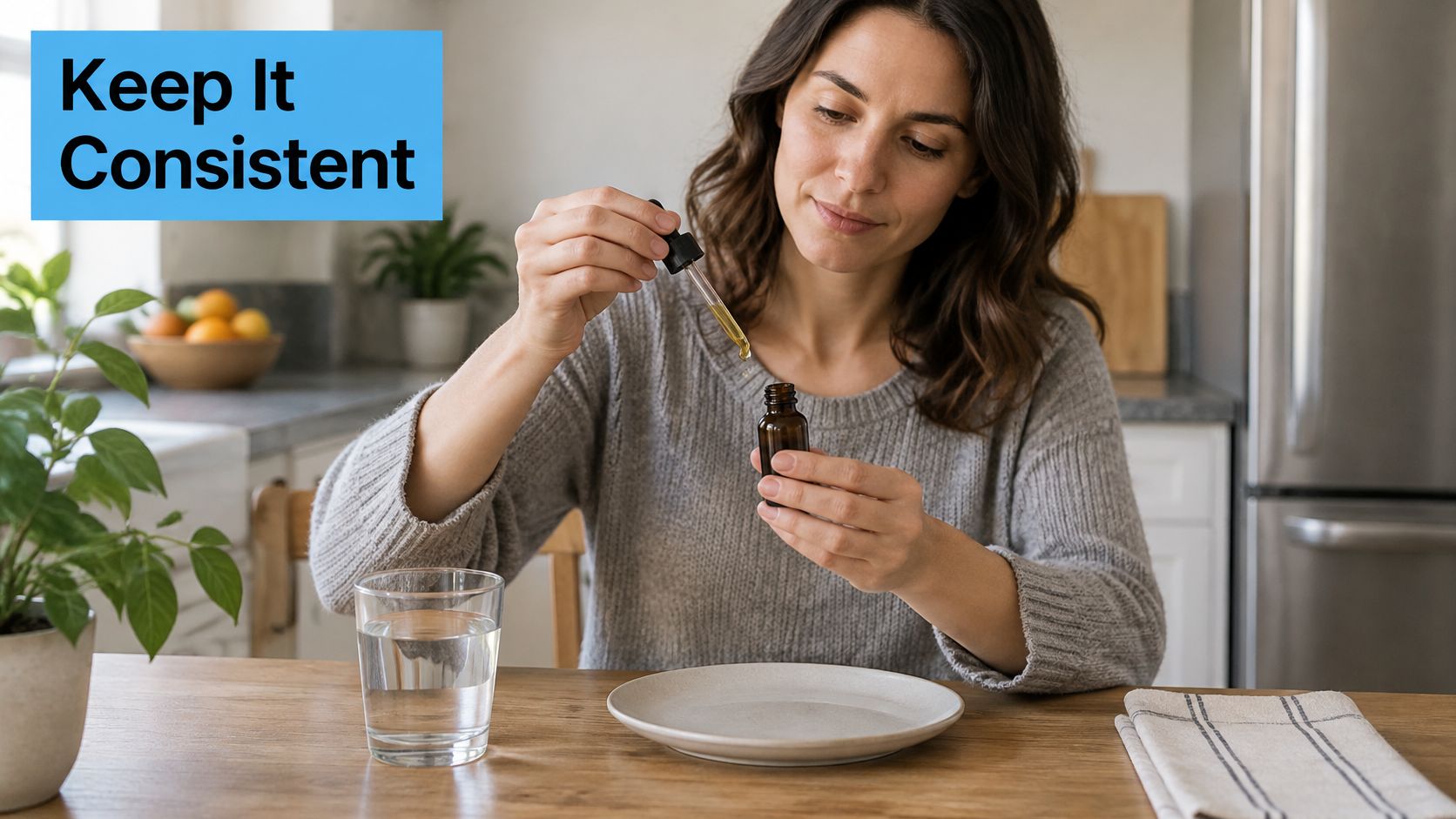
Make sessions comparable
Food is a major variable. A fatty meal can increase oral THC and CBD exposure, so don't compare a session after a rich dinner with another taken without food and conclude that your tolerance changed.
Keep your meal relationship consistent rather than using fat as a way to intensify effects. Record whether you dosed before or after eating and roughly what kind of meal you had.
Your administration technique also matters. A session in which you immediately swallowed the liquid isn't a clean comparison with a session in which you maintained the full directed hold.
Use this checklist before opening the bottle:
- Same product and formulation. Keep the cannabinoid concentration and THC-to-CBD ratio unchanged.
- Same measuring tool. Use the supplied graduations rather than an uncalibrated replacement dropper.
- Comparable food conditions. Keep meal timing and composition reasonably similar.
- Comparable time of day. Choose sessions when fatigue and responsibilities won't differ dramatically.
- One planned change at most. If you're adjusting dose, don't also switch the product or route.
Brand names don't replace this check. Whether you're comparing Ayrloom, Head & Heal, Papa & Barkley, or another brand, read the actual format and concentration rather than assuming the name identifies an equivalent oil.
Use a later-session step-up
Dose step-up across sessions
| Stage | Dose to use | Wait before judging | Action |
|---|---|---|---|
| First session | Lowest labeled THC amount, using the smallest measurable drop or syringe graduation | Through the full onset and peak window | Log dose, time, food, and effects; don't add more |
| Second session | One smallest available increment above the first dose, only if the first was too mild | Through the peak, on a later comparable day | Change dose only and keep food conditions the same |
| Later sessions | Smallest available step up, only on a later day when appropriate | Full onset and peak window before judging | Stop increasing if sedation, anxiety, or confusion appears |
Australian oral-cannabinoid guidance advises allowing at least three hours between oral doses. Treat that as a minimum spacing precaution, not permission to add more while effects are still building or while you remain impaired. For a new user following this routine, a separate later-day session is easier to interpret than repeated dosing in the same session.
If the lowest marked volume already exceeds the starting amount you intend to use, don't estimate a partial drop. Choose a concentration and measuring tool that let you measure accurately. Our guide to understanding a small THC dose can help frame that discussion.
Read a quiet session correctly
Say you notice nothing after 40 minutes. That hypothetical observation doesn't establish that the dose failed, so don't add oil to force a response.
Continue observing, record what happens through the strongest part of the session, and consider repeating the same dose on a comparable later day before increasing it. A repeat provides more useful information than changing several conditions after an uncertain first attempt.
The goal isn't to reach the highest tolerable amount. It's to identify the lowest amount that fits your purpose without unwanted effects.
Utah's evidence-based guidance flags roughly 20–30 mg THC per day as a level above which adverse events or tolerance may increase without added benefit. That isn't a target or a universal safe ceiling, and higher dosing belongs under clinical supervision.
Keep separate notes for onset, strongest effect, and recovery afterward. If the amount caused anxiety, poor coordination, confusion, or unwanted sedation, don't escalate because it didn't produce the experience you expected.
Symptom Fixes When Oil Does Not Behave as Expected
The most common mistake is declaring a dose ineffective before it has finished developing. A faint initial response can still become a stronger experience, so troubleshooting should begin with the timeline, not another squeeze of the dropper.
A review of cannabinoid delivery places typical oromucosal peak blood concentrations around 45–120 minutes, compared with roughly 1–5 hours for conventional oral products. Those figures describe concentration timing, not a promise about when you'll feel the strongest subjective effect.
Symptom, likely cause and fix
| Symptom | Likely cause | Fix |
|---|---|---|
| Nothing noticed after the onset window | Dose still building or too small | Wait through the peak before considering any additional dose; log the time |
| Effects much stronger than expected | Uncalibrated measure or a previous dose still peaking | Stop further doses, sit or lie down somewhere safe, and seek help if unwell; next time measure in milligrams |
| Effects late and lingering | Oil swallowed, or taken with a fatty meal | Don't add more now; use the full directed hold and consistent meal conditions next session |
| Dizziness, anxiety, or confusion | Dose above tolerance, or combined with alcohol or other substances | Don't redose; avoid alcohol; seek medical help if symptoms are severe |
Respond now, adjust later
Nothing noticeable yet: Leave the bottle closed and continue your log. If the session remains uneventful, check the concentration and measuring marks before making a later-session adjustment.
Unexpectedly strong effects: Stop dosing and move to a safe, quiet place. Review the total amount taken, including other cannabis products, rather than assuming the oil itself was unusually potent.
Late or lingering effects: Cancel activities that require coordination or judgment. At the next session, standardize the meal and technique instead of compensating with an earlier or larger dose.
Dizziness, anxiety, or confusion: Treat these as reasons to stop, not as evidence that you should push through. If you're unwell, contact a healthcare professional; severe symptoms, trouble breathing, chest pain, loss of consciousness, or inability to stay safe warrant emergency help.
Saliva, tissue permeability, formulation, and contact time can all affect mucosal absorption. For Long Island shoppers comparing tinctures, under the tongue identifies a route, not a guarantee of speed. The practical fix is usually better measurement and a clearer observation plan, not faster redosing.
Strong Strains Cannabis Dispensary offers lab-tested, handpicked tinctures and knowledgeable guidance on formats, potencies, and label reading. Visit Strong Strains Cannabis Dispensary in East Setauket with your intended starting amount and questions about the dropper, so our team can help you choose a product that supports a measured routine.