
An 80% THC label doesn't tell you how much THC you inhale per puff. Under studied device conditions, THC aerosol yield has been estimated at approximately 50–90%, or roughly 3–5 mg THC per puff, but puff length, battery power, coil temperature, oil viscosity, and cartridge design can change that result substantially. Frontiers in Chemistry
You're standing at a Long Island dispensary counter, looking at cartridges labeled distillate, live resin, hybrid, and high potency. One package promises an intense THC percentage, another highlights terpene-rich flavor, and a third comes as a sleek all-in-one device. The natural question is simple: which cannabis vape pen oil will give you the experience you want?
The answer starts with a distinction many labels blur. Total THC in the cartridge is not the same as THC delivered in one inhalation. A long draw on a high-voltage battery can produce a very different aerosol from a brief pull on a lower setting, even when both devices use oil with the same labeled concentration.
What Cannabis Vape Pen Oil Actually Is
A Long Island shopper browsing the display at StrongStrains might see cartridges from brands such as Stiiizy, Jetty, Muha Meds, or Rove alongside disposable devices and 510-thread options. The packaging can make cannabis vape pen oil look like one straightforward product category, but the oil inside can differ in extraction method, cannabinoid profile, terpene content, viscosity, and hardware compatibility.
At its simplest, a cartridge is a reservoir filled with concentrated cannabis extract. A battery heats that oil, and the resulting aerosol travels through the mouthpiece. The experience depends on more than the percentage printed on the front. The oil's composition determines much of the flavor and effect profile, while the device determines how that mixture becomes an inhaled aerosol.
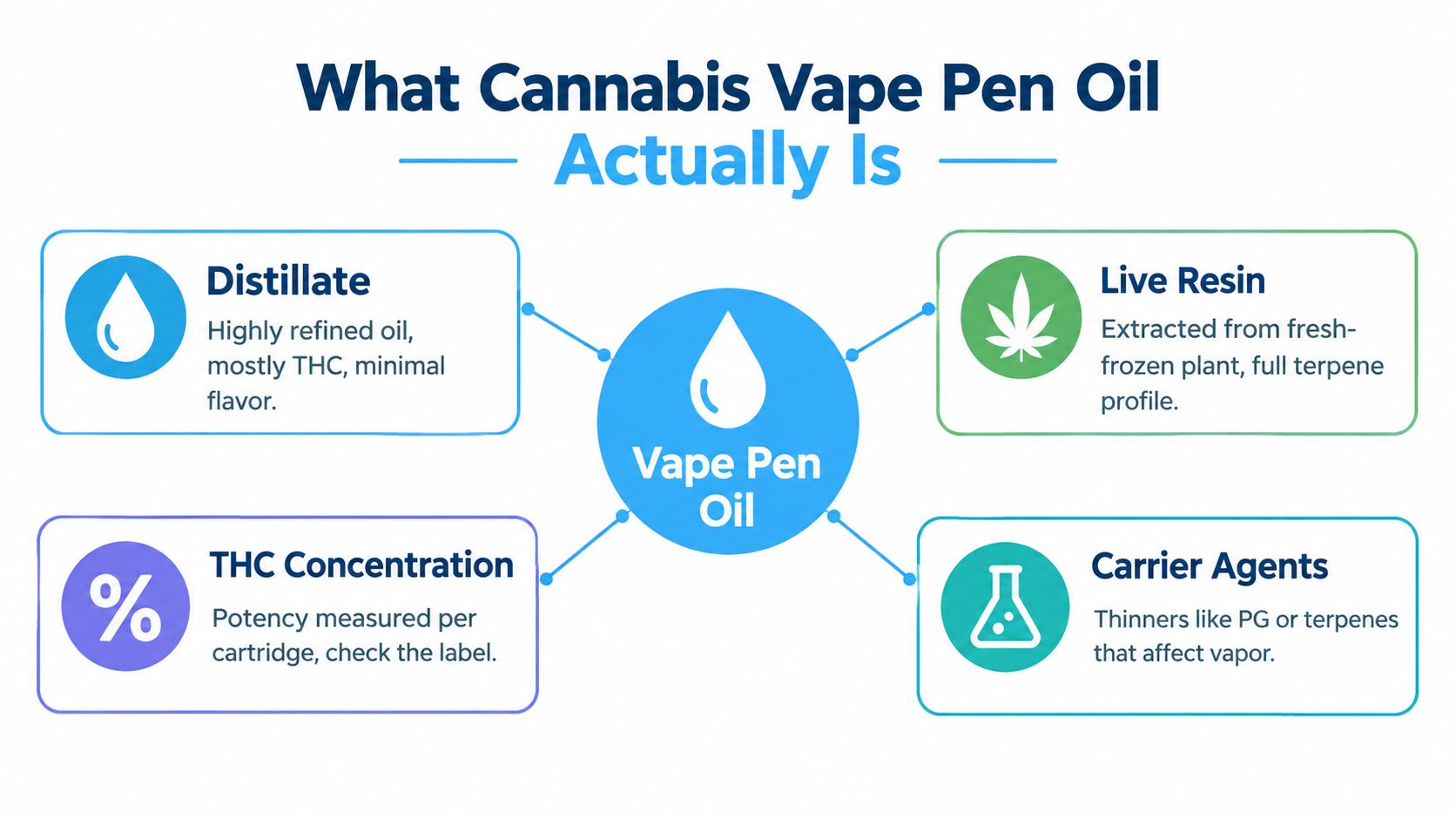
The main ingredients shoppers encounter
Distillate is highly refined oil, often centered on THC with a simpler flavor profile. Manufacturers may add terpenes afterward to create a strain-inspired taste or aroma. Live resin begins with fresh-frozen cannabis and aims to preserve more of the plant's terpene character. Other products may use broader cannabinoid blends or formulations designed around particular sensory effects.
The label may also identify terpenes, CBD, CBG, or other cannabinoids. Those details matter because two oils with similar THC concentrations can feel different when their supporting compounds and flavor chemistry differ. A cartridge marketed around citrus, pine, or dessert notes isn't necessarily stronger than a neutral distillate. It may just contain a different terpene formulation.
Why the percentage can mislead
Suppose a cartridge contains 0.5 grams of oil at 80% THC. That equals approximately 400 mg of THC before incomplete vaporization and user losses are considered, based on the practical dosing framework described by New York consumer guidance. New York Office of Cannabis Management That figure describes the cartridge's total content, not a standardized dose per puff.
Your draw length, airflow, battery voltage, oil thickness, and cartridge design all influence how much aerosol forms. A shopper who takes a long inhalation may receive a very different amount from someone taking a brief pull. This is why reading the label is only the beginning.
For hardware basics, a guide to the Ooze Twist Slim Pen can help explain how adjustable battery settings affect cartridge use. You can also review this overview of liquid THC for vape products before comparing oil formats.
Practical rule: Treat the THC percentage as a concentration signal, not as a promise of what one puff will deliver.
Distillate versus Full-Spectrum Vape Oils
Distillate and full-spectrum oil can both work well, but they serve different priorities. Distillate emphasizes refinement and predictable cannabinoid concentration. Full-spectrum oil places more emphasis on preserving a wider range of the plant's naturally occurring compounds.
Distillate typically undergoes substantial refinement. That process can reduce much of the original terpene character, so manufacturers may add terpenes later for flavor and aroma. The result is often a clean, direct profile that suits shoppers who want a familiar level of THC without a particularly complex taste.
Full-spectrum products retain a broader combination of cannabinoids and terpenes from the source material. Live resin is one example, because producers extract from fresh-frozen cannabis rather than starting with traditionally dried flower. Consumers often describe the resulting experience as more layered, although individual responses vary and the label still can't predict a universal effect.
| Oil Type | THC Range | Terpene Profile | Flavor | Best For |
|---|---|---|---|---|
| Distillate | Check the package and CoA | Often added after refinement | Clean, direct, sometimes flavor-forward | Shoppers prioritizing straightforward potency |
| Full-spectrum | Check the package and CoA | Broader profile preserved from the plant | More layered and strain-specific | Shoppers seeking nuanced aroma and effects |
The table avoids treating a category as a guaranteed potency range because the product's current label and batch-specific Certificate of Analysis are more reliable than a generic category description. A distillate cartridge can vary from another distillate cartridge, just as two live resin products can differ in cannabinoid and terpene composition.
Match the oil to your goal
Choose distillate when you want a simple format, recognizable flavor, and an uncomplicated way to compare products by labeled cannabinoid content. It can be easier for a new shopper to understand, especially when a budtender explains the total THC, terpene list, and hardware requirements together.
Choose full-spectrum or live resin when flavor and a broader chemical profile matter more than a highly simplified formula. That doesn't automatically make the product safer, more potent, or better. It means the oil was designed around a different balance of refinement and plant character.
Terpene content deserves careful attention. A stronger flavor isn't proof of superior quality, and very high terpene loading can affect emissions during heating. The right comparison is not “Which one has the biggest percentage?” but “Which oil, profile, and device fit my tolerance and intended use?”
For a broader explanation of concentrate formats, see different types of cannabis concentrates. The same principle applies here: extraction style changes the experience, but it doesn't replace batch documentation or thoughtful dosing.
Reading Labels and Understanding Potency
You take one short pull from a cart labeled with a high THC percentage and feel almost nothing. Your friend takes a longer draw from the same cartridge and feels it quickly. That confusion starts with the label. A percentage tells you how much THC is in the oil, not how much THC reaches you in one puff.
A cartridge label gives several measurements, and each answers a different question. Total cannabinoid content refers to how much of a cannabinoid is in the package. THC concentration refers to the share of the oil made up by THC. Those numbers help you compare products, but they do not convert neatly into a standard inhaled dose. Puff length, battery output, and how quickly the oil feeds the coil can change what a single draw delivers.
Start with the package, not the strain name on the front. Check the product weight, THC and CBD percentages, cannabinoid totals, lot or batch number, ingredient list, manufacturing details, and expiration or production information where provided. A catchy product name may be useful for recall, but it does not confirm what is inside the cartridge.
What the Certificate of Analysis tells you
New York regulated cannabis products are tested by laboratories, and regulated products should provide a Certificate of Analysis, usually called a CoA. As described in the New York Office of Cannabis Management consumer guidance cited earlier in this guide, consumers should be able to find a QR code or link to the product's CoA, along with the New York universal symbol on regulated products.
A CoA is batch-specific. Match the batch or lot number on the report to the one on the package in your hand. Then read across the cannabinoid results, contaminant categories, ingredient information, laboratory identity, and testing date. A passing result means the batch met the applicable testing requirements. It does not mean the oil is identical from puff to puff, and it does not remove all uncertainty once the cartridge is heated.
Use this quick store-counter checklist:
- Match the batch: Confirm the CoA matches the exact lot number.
- Review cannabinoids: Compare THC, CBD, and other listed results with the package.
- Inspect ingredients: Look for disclosed terpenes and any thinning or carrier materials.
- Check the source: Buy through a licensed, traceable retailer.
- Inspect the hardware: Reject a cartridge that leaks, looks damaged, or appears altered.
One more point trips up new users. The label cannot tell you whether your battery is running too hot for that oil. A higher voltage setting can create a bigger cloud, but bigger clouds can also mean more material inhaled in less time. Thick oil may also wick more slowly, so two people using the same cartridge can end up with very different doses even when the THC percentage is identical.
The Science Behind Inhalation Dose
A THC percentage on the package can sound precise, but the number does not translate neatly into what reaches your lungs in one draw. Once the cartridge is heated, the oil changes state, and some compounds move into the aerosol more readily than others. Laboratory work has identified more than 100 terpenes and natural extracts, 19 cannabinoids, and additives such as vitamin E acetate, polyethylene glycols, and medium-chain triglycerides in cartridge samples. The same research reports that vaporization can shift the composition toward relatively higher terpene concentrations and lower cannabinoid concentrations than the starting liquid, with delta-9-THC aerosol yield estimated at about 50–90% under studied conditions. Frontiers in Chemistry
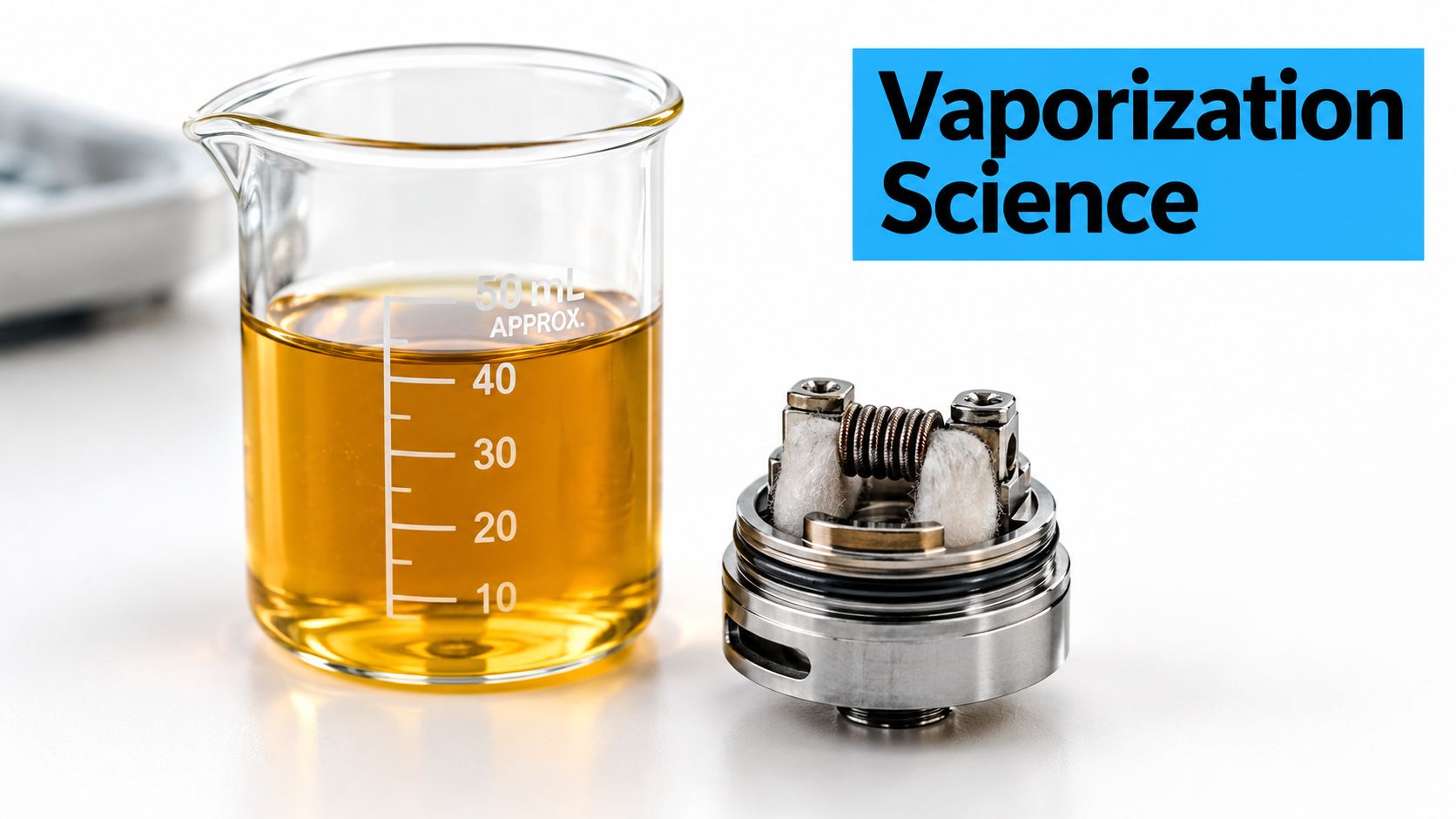
A cartridge functions as a small heating system, not a passive tube. The coil heats oil at the wick, volatile compounds enter the aerosol, and the device setting changes how fast that process happens. Oil thickness matters here. A thinner formula may feed the coil quickly, while a thicker one may need a pause between pulls before the heating area is fully saturated again.
Why one puff isn't a standard dose
For new users, this is the part that usually causes confusion. Two cartridges can carry similar THC percentages and still feel very different in use, because inhalation dose depends heavily on how the aerosol is produced. Under studied device parameters, researchers estimated roughly 3–5 mg THC per puff, but that figure belongs to those testing conditions. It is not a universal consumer dose.
A few variables change the result fast:
- Puff duration: A longer draw usually gives the coil more time to generate aerosol.
- Battery voltage: More power can increase heating intensity and aerosol output.
- Coil temperature: Excess heat can increase degradation and create a harsh, burnt taste.
- Oil viscosity: Thick oil can feed the coil differently from a thin formulation.
- Cartridge design: Airflow, wick structure, chamber size, and mouthpiece shape all affect delivery.
Terpenes add another trade-off. A 2025 controlled emissions study found that adding terpene mixtures at 7.5% and 15% by mass to delta-8 and delta-10 THC distillates increased carbonyl emissions by as much as ninefold, with the authors attributing most of those carbonyl products to terpene oxidation during vaping. ACS ES&T Air
Start with a brief inhalation, then wait before taking more. There is no universal “one puff” dose.
In plain terms, a lower percentage product with a manageable draw can be easier to dose than a stronger oil running hot through the wrong battery setting. Use the lowest practical setting recommended for the hardware, keep early puffs short, leave time between draws if the oil is thick, and stop if the vapor tastes burnt or feels unusually harsh.
Safety, Testing, and What Lab Results Mean
“Lab-tested” is useful information, but it isn't a synonym for risk-free. The 2019–2020 EVALI outbreak showed why consumers need ingredient transparency and source verification, especially with THC cartridges from informal supply chains.
By December 17, 2019, health authorities had reported 2,506 hospitalized EVALI cases across all 50 states, the District of Columbia, Puerto Rico, and the U.S. Virgin Islands, with 54 deaths across 27 states. CDC surveillance found that 82% of patients reported using a THC-containing vaping product, while 33% reported using THC products exclusively. CDC surveillance report
The investigation strongly connected vitamin E acetate with the outbreak. The substance appeared in bronchoalveolar-lavage fluid from 48 of 51 EVALI patients and not in healthy comparison subjects. The CDC advised that vitamin E acetate should not be added to vaping products, while also cautioning that more than one toxicant could contribute to lung injury. CDC laboratory evidence
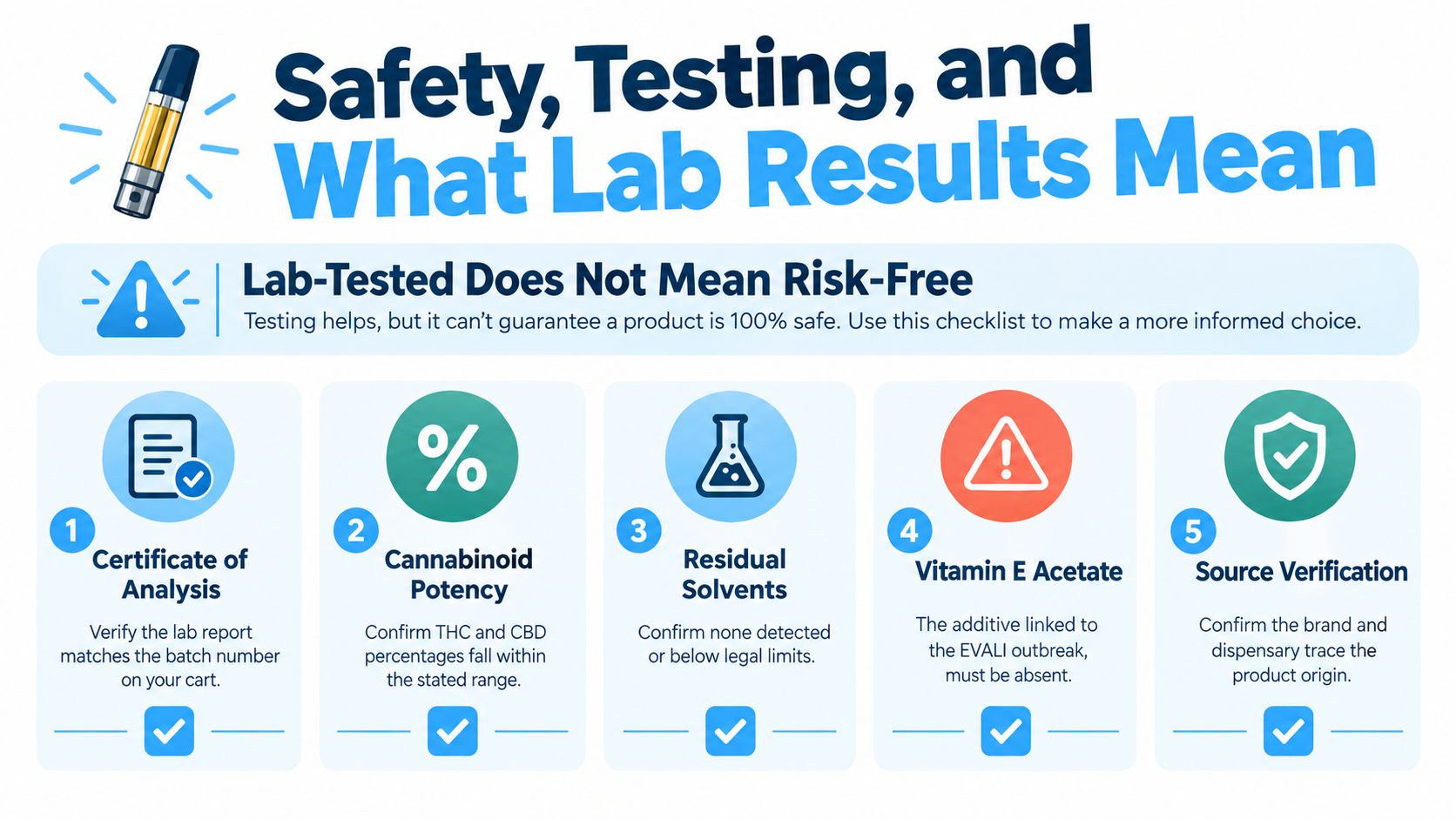
What testing can and can't establish
Testing can examine cannabinoid potency and specified contaminant categories. It can provide documentation for a particular batch. It can't guarantee that every puff from every device will have identical exposure, and it doesn't erase concerns caused by overheating, damaged hardware, undisclosed ingredients, or informal sourcing.
Minnesota testing during the outbreak illustrates why composition mattered. Among 46 THC-containing products obtained from 12 patients, vitamin E acetate appeared in 24 samples, or 52%, while MCT appeared in 20 samples, or 43%, and CBD appeared in 20 samples, or 43%. In North Carolina, 54 of 82 products, or 66%, contained vitamin E acetate. CDC product investigation
These historical findings don't mean every regulated cartridge has the same problem. They show why a shopper should reject products with unknown provenance, missing ingredients, or no accessible laboratory documentation. The CDC specifically advised people not to use THC vaping products obtained from friends, family, or in-person or online dealers. CDC guidance on informal THC sources
Reviewing cannabis lab testing can help clarify the difference between a batch report and a broad safety promise. For readers comparing other regulated wellness products, it can also be useful to compare approved pain relief products, while keeping cannabis product rules and testing systems distinct.
Stop using a cartridge that tastes burnt, leaks, overheats, or appears altered. Seek medical care for serious breathing symptoms, chest pain, or worsening respiratory discomfort.
Choosing Vapes at StrongStrains in East Setauket

At Strong Strains Cannabis Dispensary in East Setauket, a shopper can compare regulated vape cartridges and all-in-one devices by oil type, cannabinoid profile, hardware format, and available batch information. Brands such as Stiiizy, Jetty, Muha Meds, and Rove may suit different preferences, but the right choice depends on the product's current label, CoA, device compatibility, and your experience level.
A budtender can help translate the package into a practical choice. Explain whether you want a simpler distillate profile or a terpene-forward live resin option, whether you need a 510-thread cartridge or disposable device, and whether you're new to inhaled cannabis. Ask how to access the CoA, then compare total THC with the way you plan to use the device.
Use the same cautious approach at home. Begin with a brief inhalation, avoid repeated long draws, and follow the hardware's recommended settings. Pickup and local delivery options across Suffolk County can make regulated purchasing more convenient, but convenience shouldn't replace checking the source and documentation.
Here's a short video reference for shoppers who want a visual introduction to vape hardware and use:
Choose the cartridge you can understand, not merely the one with the largest THC claim. A traceable product, clear ingredient information, compatible hardware, and a measured first inhalation give you a more useful starting point than potency alone.
Visit Strong Strains Cannabis Dispensary in East Setauket to compare lab-tested cannabis vape cartridges, live resin options, and all-in-one devices with help from knowledgeable budtenders. Review the CoA, match the oil and hardware to your experience, and use convenient in-store pickup or local delivery across Suffolk County to shop with greater confidence.