
You're standing at a Long Island dispensary counter, looking at a jar marked Kiwi Kush. The name sounds specific, but the label may not tell you which Kiwi Kush you're getting. One batch can lean toward a European Afghani and Hash Plant line, while another may be an OG Kush-forward fruit cross, and a third may carry a completely different breeder's interpretation.
That's why the useful question isn't "Is Kiwi Kush good?" Ask instead: What are the genetics, potency, terpene profile, and product format in this particular batch? This guide breaks down the competing origins, the earthy-fruity aroma, the realistic THC range, the likely effects, and the checks that help you choose a fresher, more consistent product.
What Kiwi Kush Actually Is and Why the Name Confuses Shoppers
A shopper points at the jar and asks, “What exactly is Kiwi Kush?” A careful budtender won't pretend there's one universal answer. Kiwi Kush is best treated as a market label for several related, fruit-forward, indica-leaning cannabis lines, not as one fixed genotype with identical chemistry everywhere.
The confusion starts with naming. Different breeders and seed sellers have used “Kiwi” to signal tropical or green-fruit aroma, while “Kush” suggests an Afghani or Hindu Kush influence and an evening-leaning effect. Retail menus then carry those names into new markets, sometimes attaching them to local crosses or branded formats. The result is a familiar name with an inconsistent family tree.
This isn't unusual in cannabis. Major listings conflict about Kiwi Kush's identity. One describes a Cresco indica with unknown parentage and a 21% to 25% THC range, another connects the name to Wookie #15 and Loompa's Headband, and another ties a separate version to Grapefruit Kush with 14% to 18% THC. Those conflicting records are documented in Weedmaps' Kiwi Kush strain listing.
How to read the name at the counter
Start with the current package, not the name alone. Look for the breeder or producer, the batch-specific certificate of analysis, the harvest or packaging information, and the listed terpenes. A product called Kiwi Kush from 1937, Rythm, Jeeter, Rove, or another brand may deliver a different experience because the underlying genetics and format differ.
Practical rule: Treat “Kiwi Kush” as a starting point for questions, not as a guarantee of one exact high.
For a plain-language primer on why strain names vary, see this guide to understanding different cannabis strains. The rest of the label still matters more than the fruit-themed title. Lineage can explain the style, but batch chemistry tells you what's in the jar today.
Lineage and Genetics Behind Kiwi Kush
The cleanest way to discuss Kiwi Kush genetics is to place the competing claims side by side. No single lineage should be presented as the uncontested answer because the name has been used for more than one related line.
One widely circulated account identifies a European, indica-dominant version connected with Kiwi Seeds' Mt. Cook, drawing from Afghani and Hash Plant heritage. That version fits the classic Kush description, compact structure, dense flowers, and a heavier body profile. A separate U.S. interpretation is described as a Kiwi-inspired cross that brings OG Kush genetics into a fruit-forward hybrid. Another commercial seed listing reports Critical Mass × OG Kush × Blue Kiwi, with a 65% indica and 35% sativa profile, THC up to 19%, and CBD up to 2.0%, as documented in JointCommerce's Kiwi Kush strain guide.
| Claim Source | Reported Parents | Dominant Type | Notes |
|---|---|---|---|
| European Kiwi Seeds interpretation | Mt. Cook, Afghani, Hash Plant heritage | Indica-dominant | Often associated with a traditional Kush structure |
| U.S. market interpretation | Kiwi-inspired fruit line and OG Kush | Indica-leaning hybrid | More likely to show tropical notes with an OG edge |
| Commercial seed listing | Critical Mass × OG Kush × Blue Kiwi | 65% indica, 35% sativa | Reports THC up to 19% and CBD up to 2.0% |
| Market-specific listings | Varies by producer | Usually indica-leaning | Parentage may be unknown or inconsistently documented |
What the plant expression can tell you
When breeder documentation is thin, shoppers can still use phenotype as a practical clue. Kiwi Kush flowers are commonly described as dense, resin-heavy, and indica-leaning, with broad leaves and a compact structure in the traditional versions. OG-forward expressions may show a slightly more open shape and sharper fuel or pine notes.
That doesn't prove genetics. Appearance can be influenced by cultivation, trimming, curing, and storage. A frosty nug isn't automatically a particular Kiwi Kush cut, and a softer fruit aroma doesn't rule one out.
The reliable proxy in a regulated market is the batch record, not the nickname.
A certificate of analysis won't usually prove the full genetic history, but it can confirm the cannabinoid and terpene profile attached to the product you're buying. If the package lists the producer, lot information, and a QR code leading to testing, you've got a much stronger basis for comparison than a menu description alone.
Aroma, Flavor, and Terpene Profile
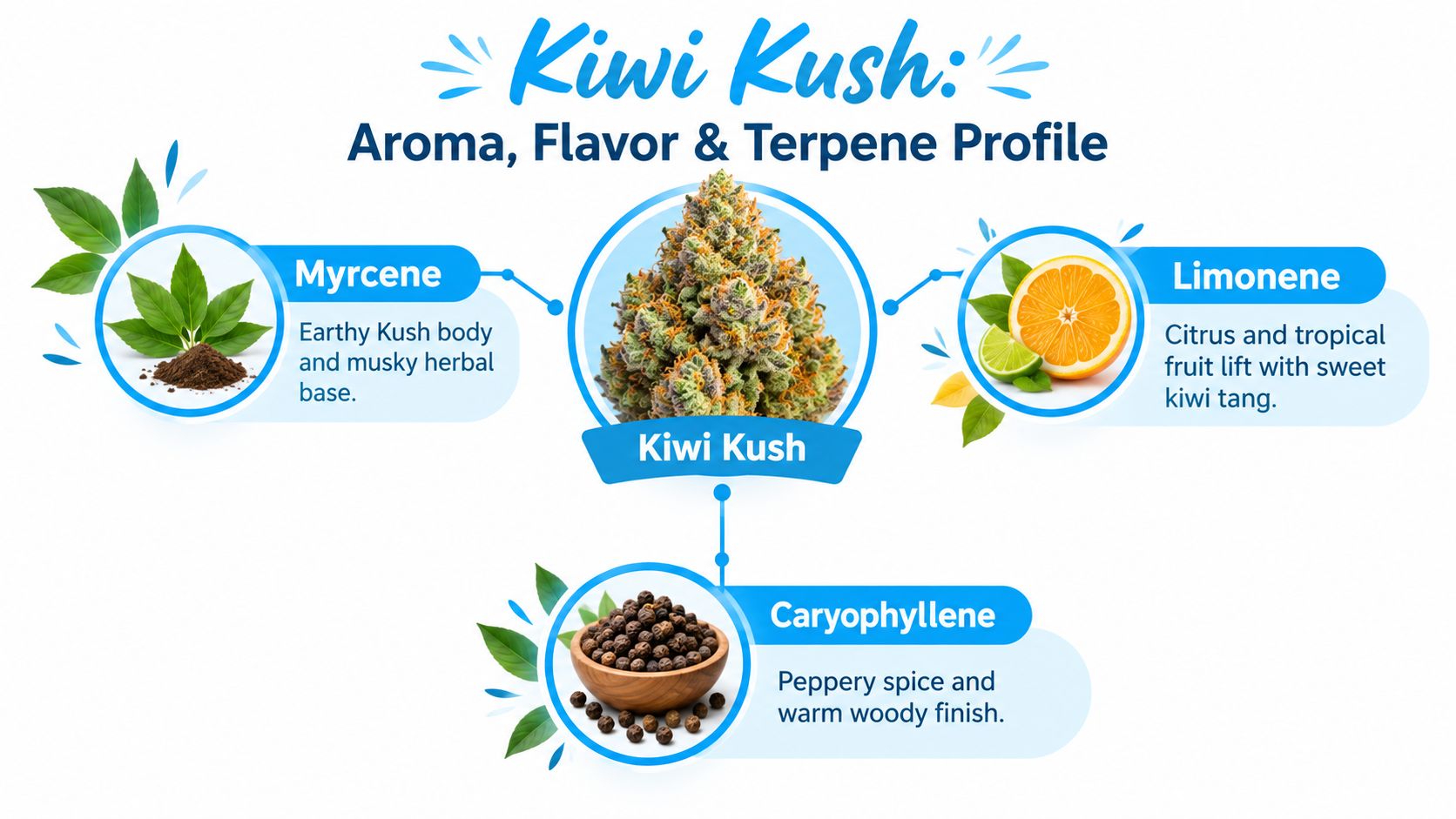
Most Kiwi Kush batches make their impression through three recurring terpenes: myrcene, beta-caryophyllene, and limonene. Myrcene supplies the earthy, musky Kush body. Limonene lifts the nose with citrus and tropical fruit. Beta-caryophyllene adds pepper, spice, and a warm woody finish.
Independent guides report total terpene content around 1.5% to 3.0% by weight, with myrcene commonly around 0.3% to 1.2%, beta-caryophyllene around 0.2% to 0.8%, and limonene around 0.2% to 0.6%, according to JointCommerce's Kiwi terpene guide. Another listing reports total terpenes at 1.01%, which shows why the jar's actual laboratory panel matters more than a generic strain description, as shown in AskGrowers' Kiwi Kush review.
What those numbers can smell like
A myrcene-forward report usually points toward a heavier earthy-herbal aroma. Break the flower apart and you may find damp soil, soft musk, hash, or a creamy Kush note under the brighter fruit. A stronger limonene presence can push the profile toward citrus peel, green fruit, and a sweet-tart tropical lift.
Caryophyllene is often easiest to recognize on the finish. It can read as cracked pepper, warm spice, or dry wood rather than a candy flavor. Some batches also carry a faint fuel or diesel edge, especially when OG Kush influence is present.
Terpenes can guide expectations, but they don't work like a simple effects calculator. They're more useful for comparing two jars than for promising a specific reaction. If one Kiwi Kush label shows myrcene leading and another shows limonene much closer to the top, expect the first to smell deeper and the second to feel brighter in the aromatic profile.
For a visual breakdown of the flower's terpene-led character, watch this Kiwi Kush terpene profile video.
THC Potency, Effects, and What the High Feels Like
Kiwi Kush potency varies enough that a single “average THC” claim can mislead shoppers. Independent reports commonly place it around 14% to 18% THC, while other Kiwi Kush-style Kush cultivars are reported in the 17% to 24% range, with standout batches reaching about 26% under optimized growing conditions, according to Cannaconnection's Kiwi Kush listing. Related listings can fall near 13.5% or reach 21% to 25%, depending on phenotype, producer, and testing lot.
That spread changes how the same name feels. A lower-potency flower may offer a gentler introduction, while a batch in the upper range can bring a quicker transition from mental calm to a heavy body finish. The myrcene-led profile often supports an evening direction, but a limonene-brighter batch may feel less immediately sedating.
| Tolerance Level | Typical THC % | Onset Time | Expected Effects |
|---|---|---|---|
| Lower tolerance | 14% to 18% | Gradual after inhalation | Calm mood, noticeable relaxation, possible sleepiness |
| Moderate tolerance | 17% to 24% | Builds steadily | Heavier body comfort, quiet euphoria, couch-oriented finish |
| Higher tolerance | Up to about 26% in standout batches | May feel slower or more subtle at first | Stronger dose may be needed for intensity, with relaxation still prominent |
The onset can feel like a slow creep rather than an immediate wallop. First comes a quieter mental state, followed by loosened body tension and a deeper, more settled finish. Some people call that couch-lock, while others experience it as comfortable stillness without complete sedation.
Use the number on the package as a comparison point, not a guarantee. Inhaled cannabis can feel different based on tolerance, amount, draw size, product freshness, and terpene balance. For more context on why terpene content can shape how a high is perceived, read Strong Strains' guide to high-terpene strains.
Medical Benefits, Side Effects, and Smart Dosing
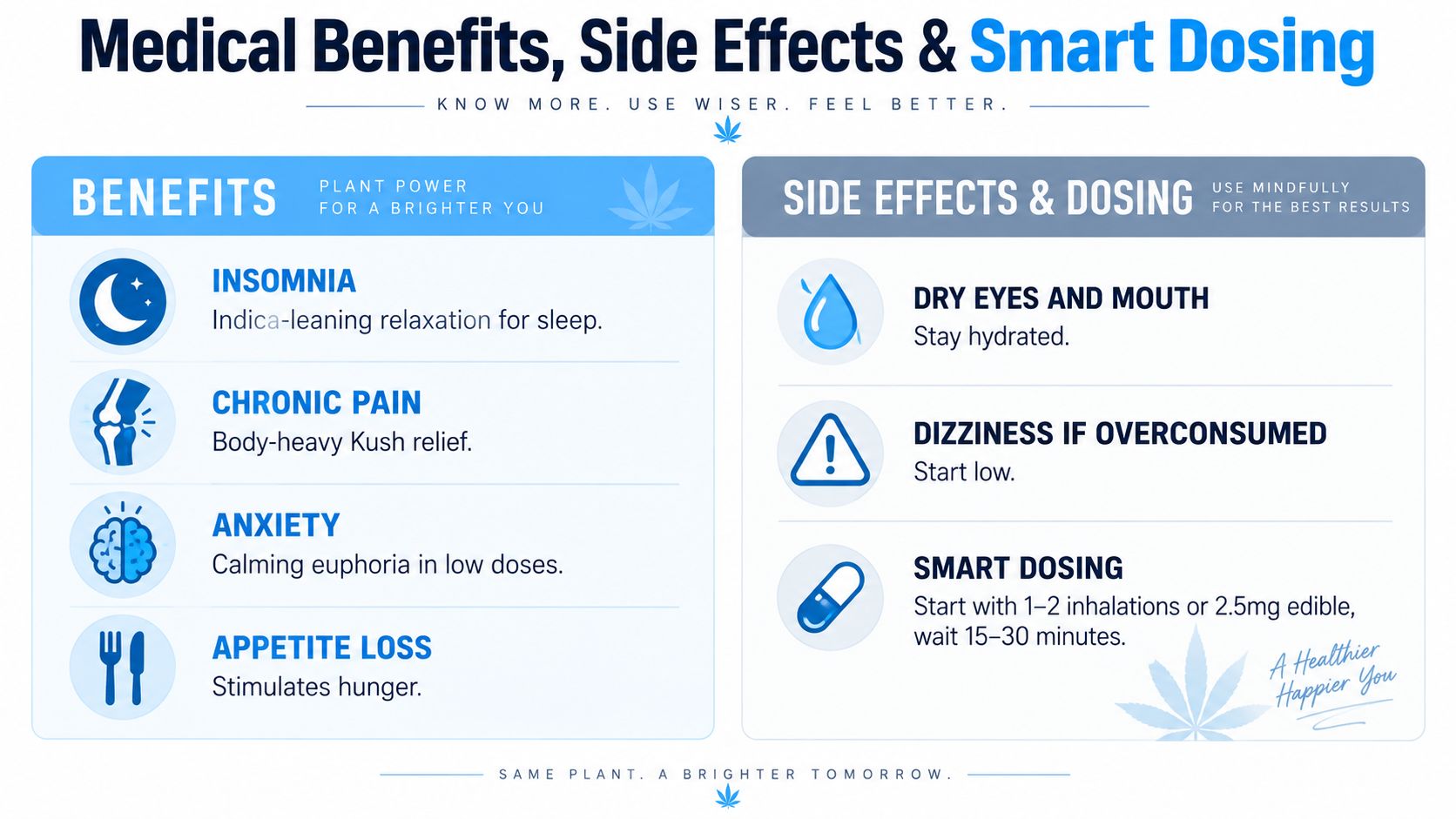
People often look toward indica-leaning Kush profiles for sleep support, chronic pain, anxiety, and appetite loss. Those are potential use cases, not promises, and cannabis affects people differently. The low-CBD pattern reported for many Kiwi Kush products also matters. CBD is commonly unknown or below 1%, so shoppers seeking a balanced CBD experience shouldn't assume the name provides it, as noted in Cannaconnection's cannabinoid overview.
The most common concerns are familiar: dry mouth, dry eyes, drowsiness, dizziness, and an uncomfortable mental edge after taking too much THC. A heavy flower can be especially unforgiving when someone treats an infused preroll or concentrated product like ordinary flower.
Match the format to your experience
Flower gives you the clearest view of the cultivar's baseline aroma and effect. A new consumer can take one or two small inhalations, then pause and assess before adding more. The infographic's conservative starting guidance also mentions 2.5 milligrams for an edible and waiting 15 to 30 minutes, but edible onset can be unpredictable, so follow the product label and don't redose too quickly.
Standard prerolls offer convenience, but they make it harder to control the amount once the session starts. Put it out early if the first portion is enough. Infused prerolls and minis can add concentrates, hash, rosin, or diamonds, so their effect may reflect the added material more than the flower's original Kiwi Kush chemistry.
Keep water nearby, avoid mixing cannabis with alcohol or other intoxicants, and choose an evening when you don't need to drive or operate equipment. If you take medication or use cannabis for a medical condition, speak with a qualified healthcare professional before making it part of your routine.
Comparing Kiwi Kush to Similar Strains
Kiwi Kush sits in a recognizable lane, earthy Kush structure with a fruit-tinted top note and a relaxing finish. OG Kush usually reads sharper and more fuel-forward, while Kiwi Kush tends to soften that edge with citrus or green-fruit character. Grape Kush points in a darker, berry-like direction, whereas Kiwi Kush is more likely to suggest tart tropical fruit over the Kush base.
Northern Lights is the closer comparison for shoppers who want a body-heavy, evening-oriented experience. Kiwi Kush can share that settled physical feel, but its aroma often brings more citrus, fruit, or pepper. The difference may be obvious when you smell the jar, even when the effect category overlaps.
Exact cannabinoid comparisons aren't reliable without matching batch data. Kiwi Kush reports can range from about 13.5% THC to the mid-20s, while a separate commercial listing reports 19% THC and up to 2.0% CBD, so the product label should decide the comparison rather than a strain chart alone, as outlined in JointCommerce's market guide.
| Strain | Avg THC % | Dominant Terpenes | Aroma | Typical Effect |
|---|---|---|---|---|
| Kiwi Kush | Varies widely by batch | Myrcene, beta-caryophyllene, limonene | Tart tropical fruit, earth, pepper, possible fuel | Relaxed, body-heavy, potentially sleepy |
| Northern Lights | Check current batch | Often Kush-style earthy terpenes | Earthy, herbal, classic Kush | Deep relaxation and evening calm |
| OG Kush | Check current batch | Often caryophyllene, limonene, and myrcene | Diesel, pine, earth, spice | Relaxed with a sharper mental edge |
| Grape Kush | Check current batch | Varies by producer | Grape, dark fruit, earth | Calming and physically settled |
A quick menu recognition guide
If the description emphasizes kiwi, citrus, tropical fruit, and Kush earth, it may fit the Kiwi Kush lane. If the nose leads with gas and pine, you may be looking at an OG-forward interpretation. If grape or dark berry dominates, the product may be a different fruit-Kush line altogether.
Crossover batches can blur those boundaries. Ask whether the product is plain flower, a hybrid cross, or an infused format before comparing it with an uninfused strain.
Buying Kiwi Kush at Strong Strains on Long Island
Walk into a Long Island dispensary and ask for Kiwi Kush, and the budtender may point you toward a specific flower jar, a preroll, or a concentrate-based product on the current menu. The right choice depends on whether you want to taste the cultivar itself, control your dose, or explore a stronger format.
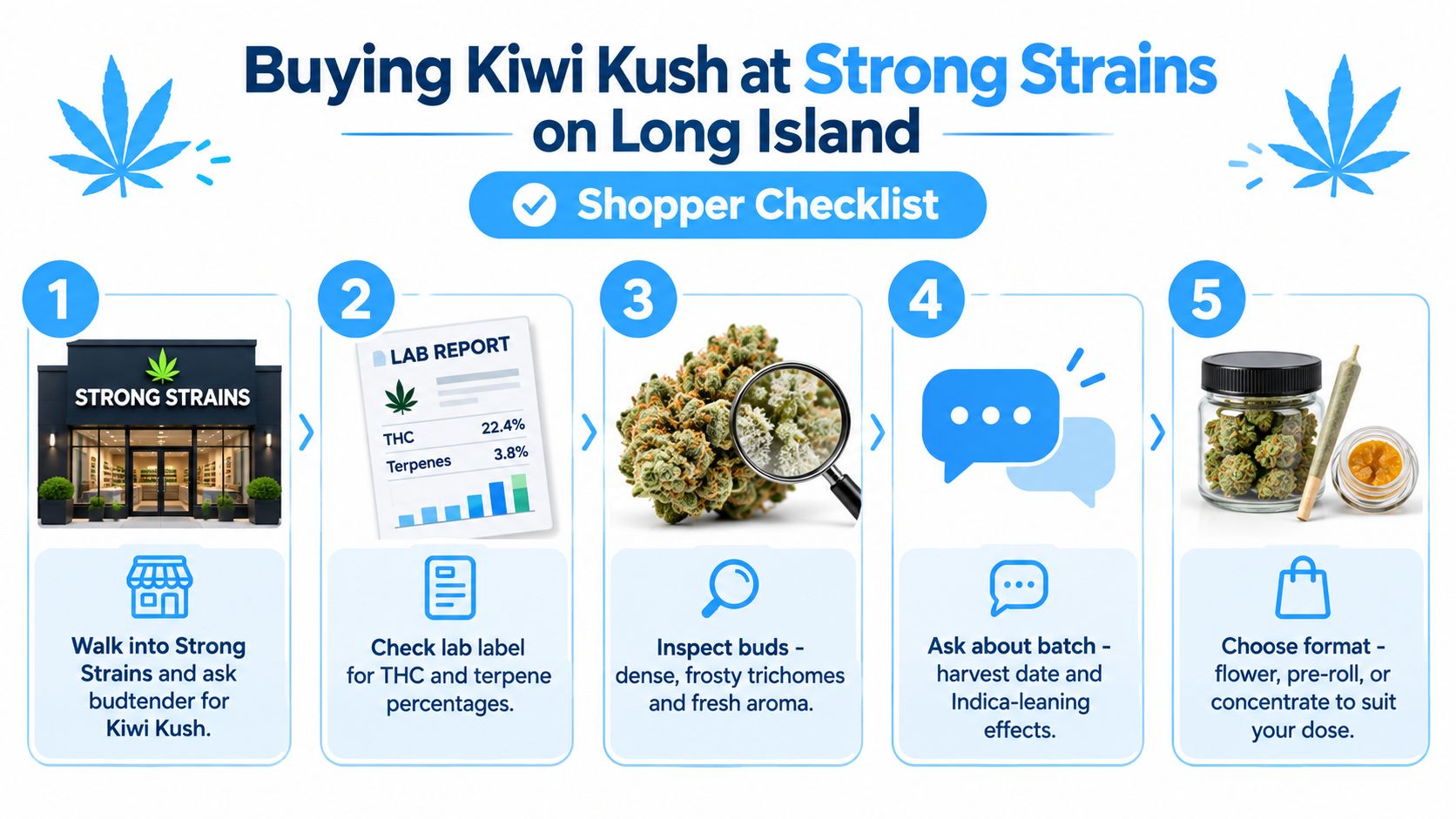
Start with the package. Check the producer, lot information, harvest or packaging date, THC percentage, CBD result, and the top three terpenes. Then scan the QR code or use the available certificate-of-analysis lookup. A clear COA can show whether the batch is closer to the lighter end of the reported range or carries a stronger profile.
Ask one direct question: “Is this Kiwi Kush flower, or does the product add concentrate that changes the baseline effect?”
Use this counter checklist
Verify the testing. Look for a third-party lab panel and match the lot number on the package to the report. Strong Strains' explanation of cannabis testing standards can help you understand what those results are meant to document.
Read the terpene panel. Myrcene, limonene, and beta-caryophyllene are the key names to look for. A myrcene-led batch may suit a slower evening session, while more limonene can make the aroma feel brighter.
Inspect the flower when possible. Look for intact, dense buds with visible trichomes and a fresh aroma. Avoid flower that smells like hay, feels brittle, or has lost its character in an overpacked container.
Compare formats. Plain flower gives the most useful read on Kiwi Kush itself. A standard preroll is convenient but less precise for dose control. Infused products, including rosin, hash, or diamond formats, can be substantially more intense and should be approached with extra caution.
Ask about the current batch. A budtender can tell you whether the product is newer stock, how customers describe its body feel, and whether it's better suited to an experienced consumer. Ask about available pricing tiers and loyalty options before checking out, since menus and promotions change.
Strong Strains Cannabis Dispensary offers lab-tested flower, vapes, prerolls, edibles, concentrates, tinctures, topicals, and accessories, with in-store pickup and local delivery options for Long Island shoppers. Check the Strong Strains Cannabis Dispensary menu before visiting, reserve a Kiwi Kush product that matches your preferred format, and ask the staff for the freshest batch and its current terpene report.