Edibles typically take 30 to 120 minutes to kick in, and the strongest effects usually show up around 2 to 4 hours after you take them. If you're sitting there wondering whether it's working yet, that waiting period is normal, and it's exactly where a lot of people get impatient and accidentally take too much.
That moment is familiar to almost every first-time edible user. You had a gummy, a chocolate, or a drink, maybe from brands like Wyld, Kiva, Wana, Camino, Incredibles, Ayrloom, Gron, or Tune | Infused Seltzers, and now you're checking the clock every few minutes. You don't feel much. Maybe you feel nothing. So the temptation is obvious. Take another one and “get things going.”
That's the mistake to avoid.
The best edible experiences usually come from patience, a comfortable setting, and a simple understanding of what your body is doing in the background. Once you understand the delay, the peak, and the longer tail of the experience, the whole process feels much less mysterious and much more manageable.
Your Essential Guide to Edible Timelines
If you've been searching how long do edibles take, the practical answer is straightforward. The first signs are typically felt somewhere in the 30 to 120 minute window, but that range is only the start of the story.
Edibles work more slowly than inhaled cannabis because your body has to process them through digestion first. They don't move straight from your lungs into your bloodstream the way smoking or vaping does. That slower path is why the wait can feel confusing, especially if you expected a fast lift.
What most people are actually feeling while they wait
There's often a strange in-between period with edibles. You might notice nothing at all. Or you might feel subtle shifts that are easy to second-guess, like a slightly lighter mood, a looser body, or a bit of mental drift.
That uncertainty is why experienced consumers set expectations before they dose. They don't keep asking, “Is it happening yet?” They give the edible room to arrive on its own schedule.
Practical rule: If you're not sure whether it's kicking in, that's usually a sign to wait longer, not take more.
A lot of people who want smoother daytime support also look for other routines that promote enhanced focus and energy, especially when they're trying to separate a wellness routine from a cannabis session. That mindset helps with edibles too. Treat the timing with intention instead of improvising.
A simple mental model that helps
Think in three stages:
- Early window. Your body is digesting and absorbing.
- Build phase. Effects become clearer and continue rising.
- Main experience. The edible settles into its full character.
The confusion happens because people expect an edible to behave like a puff from a vape or pre-roll. It won't. A gummy from Wana, a fruit chew from Wyld, or a chocolate from Kiva may feel polished and predictable in dosing, but the body still sets the pace.
The key safety takeaway
What gets people in trouble isn't usually the first dose. It's the second dose taken too soon.
Government guidance and medical observations discussed later in this guide make the same point in different ways. The biggest risk window is the period before the edible has fully declared itself. If you respect that window, you're far more likely to have a calm, enjoyable experience.
The Journey from Bite to Buzz Explained
Smoking is the highway. Edibles are the scenic route.
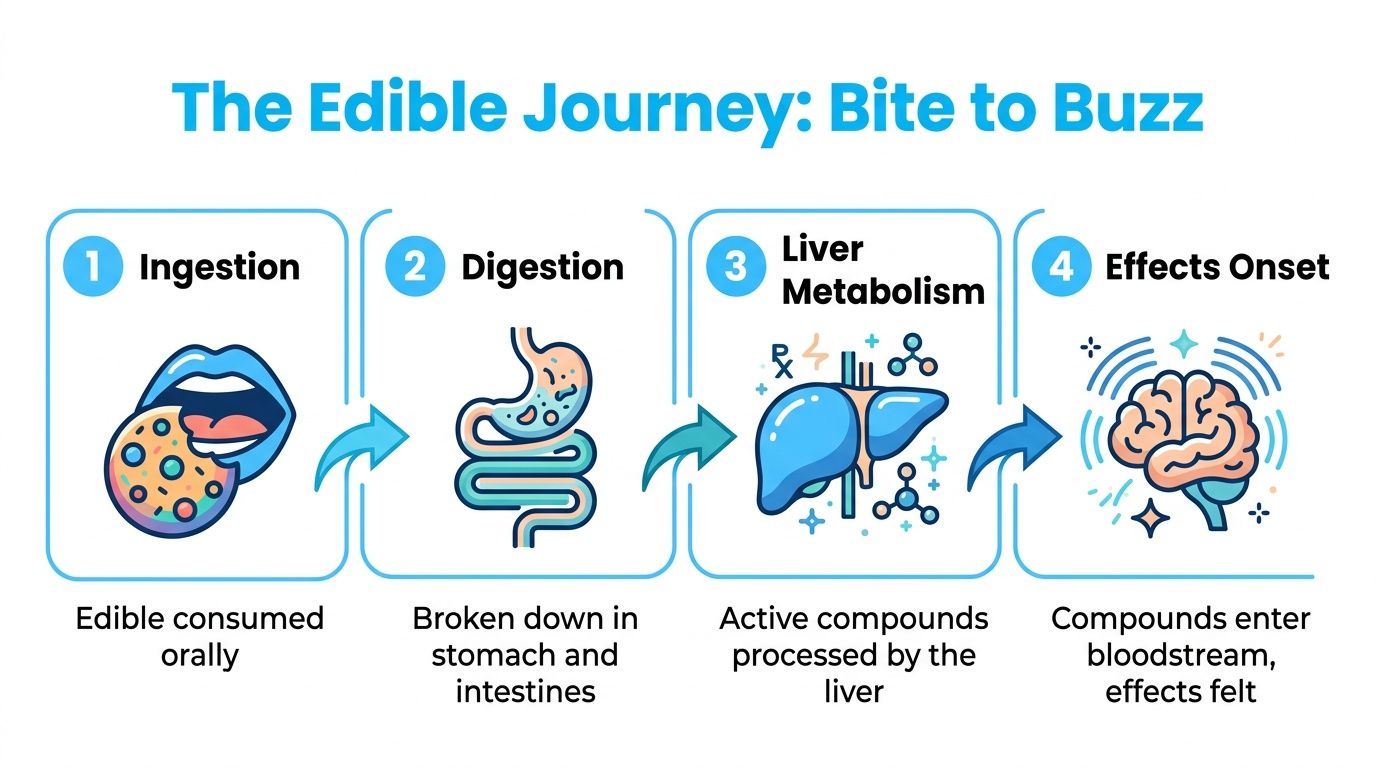
When you inhale cannabis, the effects come on quickly. When you eat cannabis, your body has more work to do first. Edible cannabis typically demonstrates a delayed psychoactive onset, requiring approximately 30 to 120 minutes for initial effects to manifest, with peak intoxication occurring between 2 to 4 hours after consumption. This is because cannabinoids must pass through the stomach and liver before entering the bloodstream according to this explanation of how edibles move through the body.
The scenic route in plain English
First, you eat the edible. Then your stomach and intestines break it down. After that, your liver processes the cannabinoids before they circulate more fully and you begin to feel the effects.
That liver step matters. It's one reason edible experiences often feel deeper, fuller, and longer than people expect from the same category of product.
Here's the easiest way to remember the timeline:
| Stage | What it means |
|---|---|
| Onset | The first noticeable effects |
| Peak | The strongest part of the experience |
| Duration | How long the overall effects stick around |
A lot of new consumers blur those together. They'll feel a tiny shift at onset and assume they've reached the full experience. Then the edible keeps building.
Edibles don't just turn on. They ramp up.
Why product format can feel different
Even within the edible category, not every product feels exactly the same. A gummy, lozenge, chocolate, or beverage may hit differently in practice because of how it's formulated and how your body handles it. Some products are designed to feel more predictable or easier to time, which is why many shoppers compare options like Wana fast-acting gummies with more traditional edible formats before choosing.
That doesn't mean the laws of digestion disappear. It means the experience may feel a bit smoother or a bit different at the front end.
The point most guides rush past
People usually ask one question. “How long do edibles take?”
The better question is, “What part of the edible timeline am I in right now?” Once you know whether you're waiting for onset, approaching peak, or coasting through duration, you stop guessing and start reading the experience more accurately.
Factors That Influence Your Edible Timeline
Two people can take the same edible and have very different nights.
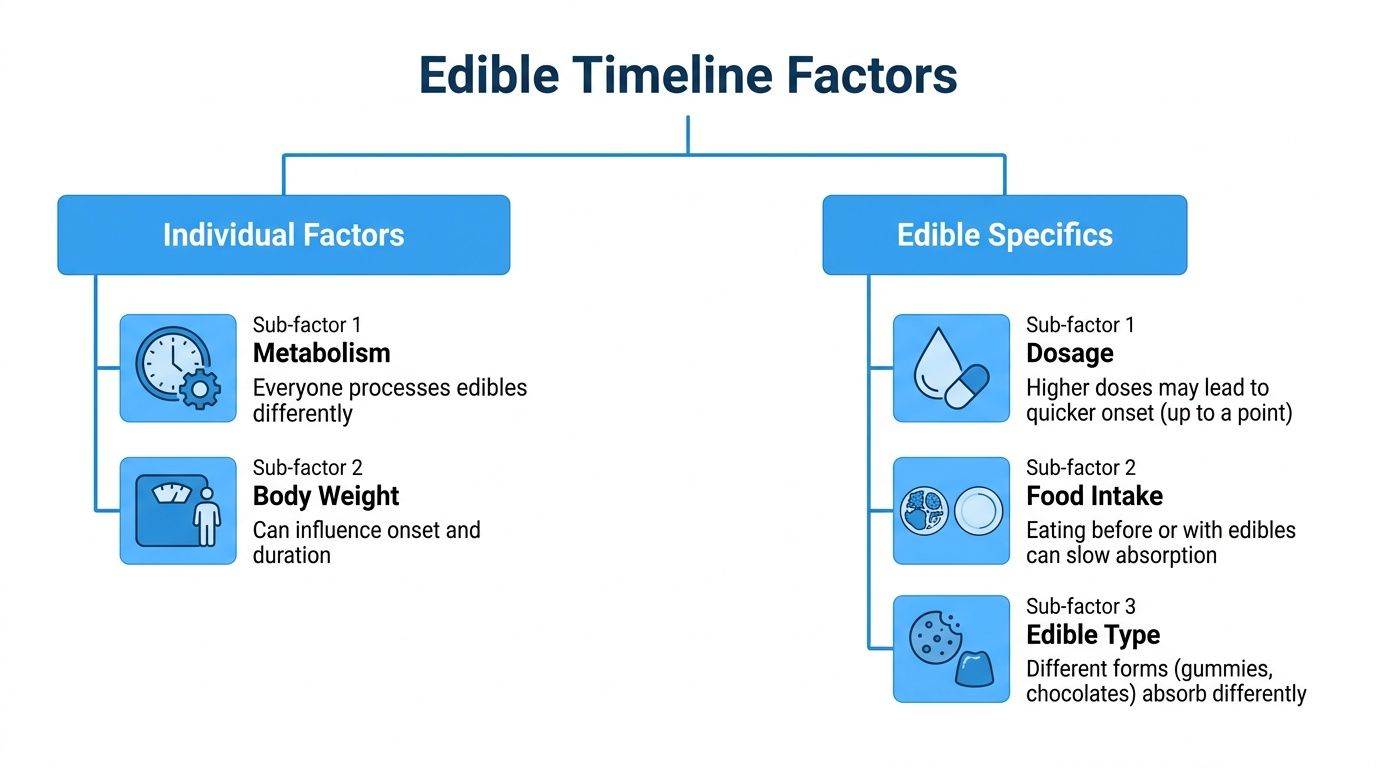
That isn't unusual. It's normal. Your edible timeline depends on your body, what you ate, how much you took, and the form of the product itself.
Your body sets the tempo
The biggest wildcard is metabolism. According to this Healthline overview of edible timing variability, individual metabolism can vary timing by up to 4x, and many emergency room visits for edible overconsumption happen after people take a second dose within the first two hours, even though their body may need up to 4 hours to reach peak effects.
That's the phantom on-off window. Nothing obvious seems to be happening, so the person assumes the edible failed. In reality, their body is still processing.
Body weight can also influence how an edible feels and how long it stays noticeable. It's one reason comparing your experience to a friend's usually isn't helpful.
Food changes the pace
Your stomach contents matter more than generally recognized.
- Empty stomach: Effects may show up sooner, and they can feel sharper.
- Full stomach: Digestion often takes longer, so onset may be delayed.
- Heavier meal: A richer meal can slow things down and stretch the waiting period.
If you've ever heard someone say, “These gummies didn't do anything,” and then an hour later they're suddenly very high, food is often part of that story.
Dose changes more than intensity
A bigger dose doesn't just affect strength. It can change how the whole experience feels over time. More THC can make the climb feel heavier, the peak feel broader, and the tail feel longer.
That's why precision matters. Lab-tested products from names like Wyld, Kiva, Camino, Incredibles, Ayrloom, Wana, Good Tide, Off Hours, and Snoozy are easier to work with than homemade edibles, where the dose can be uneven from piece to piece.
Your goal isn't to prove you can handle more. Your goal is to find the smallest amount that gives you the experience you want.
Product type matters too
Format can influence timing. Solid edibles may feel slower than products that spend more time in the mouth before swallowing, and beverages can feel different from gummies or baked goods.
If you're choosing between forms, it helps to compare THC tinctures vs edibles so you know whether you want the longer, slower edible arc or something that may feel easier to dose in smaller increments.
A Wana gummy, a Kiva Camino chew, a Wyld fruit gummy, or a Tune | Infused Seltzers drink can all be quality options. The right one depends less on hype and more on whether its format matches your patience, setting, and goals.
The Golden Rules for Safe Edible Dosing
The best edible advice in cannabis is still the simplest. Start low and go slow.
That isn't old-fashioned caution. It's practical. Once you take an edible, you can't untake it, and the timeline unfolds much more slowly than people expect.
What starting low actually means
For a new or cautious consumer, a small THC dose is the smart place to begin. Government guidance says THC edibles can produce effects lasting up to 12 hours, and a minimum 2-hour wait is required before considering a second dose of 2.5 mg THC or less to avoid compounding effects.
That gives you a very usable rule. If your first edible is 2.5 mg THC or less, wait at least 2 hours before even thinking about more.
For many people, waiting longer is wiser, especially if they're new, had a meal beforehand, or tend to metabolize edibles slowly.
Why lab-tested products matter
Branded, regulated edibles excel in consistency. A clearly dosed gummy from Wyld, Kiva, Wana, Camino, Gron, Incredibles, Ayrloom, or Level gives you a better shot at consistency than a homemade brownie cut into uneven squares.
If you're trying to build a repeatable routine, measured products make that much easier. Some consumers also like to pair edibles with a more exact tool such as a tincture dosage calculator when they're comparing formats and trying to understand how a controlled cannabis routine should feel.
Here are the rules I'd give a first-time customer at the counter:
- Choose a light starting dose: Small is easier to adjust than too much.
- Pick one format: Don't mix gummies, chocolates, beverages, and a vape on your first run.
- Protect your schedule: Don't take an edible before driving, work, errands, or anything with a deadline.
- Set your room up first: Water, snacks, a comfortable seat, and a calm playlist go a long way.
A short explainer can also help if you're visual and want the safety basics reinforced before trying your first product.
The dosing mindset that leads to better nights
A lot of people approach edibles like they're chasing a finish line. That usually backfires.
A better approach is to treat your first few sessions as information gathering. Learn what a low dose feels like in your body. Learn how long it takes you personally to notice onset. Learn whether a gummy, beverage, or chocolate suits you best.
That patience is what turns edibles from unpredictable to enjoyable.
What to Do If an Edible Is Too Strong
If an edible feels too strong, the first thing to know is simple. You are very likely going to be okay, and the feeling will pass.
Most bad edible experiences get worse because the person gets scared by the intensity and starts fighting it. A calmer response helps.

What helps in the moment
Start with the basics:
- Sit somewhere comfortable: A couch, bed, or quiet room is better than a busy environment.
- Drink water: Small sips are enough. You don't need to force it.
- Have a light snack: Something familiar can help you feel grounded.
- Reduce stimulation: Lower the lights, turn off stressful media, and keep the room calm.
- Stay with a steady person: If you're anxious, having a calm friend nearby helps.
Breathe slowly and stop checking whether you're “normal” every minute. The constant self-monitoring can make the experience feel more intense.
Some people find that CBD feels supportive when THC is hitting harder than expected. Keep expectations reasonable, though. The main solution is time, a safe place, and not adding anything else into the mix.
Don't make next-day assumptions
A point many guides skip is the residual window. According to this guide on responsible edible timing and lingering effects, residual effects from edibles can last up to 24 hours, and overconsumption can lead to extended anxiety or impairment. That means you shouldn't drive or work until you feel fully back to baseline, which may be the next day.
That lingering feeling isn't always dramatic. It can show up as fogginess, slower reactions, or a body-heavy aftereffect.
When to get extra help
If someone is panicking hard, can't be reassured, or seems unsafe, stay with them and contact appropriate medical help if needed. It's better to be cautious than to leave someone alone while they're overwhelmed.
Generally, though, the right move is the boring move. Rest, hydrate, lower stimulation, and wait it out.
Find Your Perfect Experience at Strong Strains
The biggest lesson with edibles is that timing shapes everything.
If you understand that onset can take a while, that the experience builds in phases, and that the tail can linger, you're already ahead of most first-time consumers. You stop guessing. You stop stacking doses too early. You start choosing products with a clearer sense of what kind of session you want.
That's especially useful when shopping a premium menu. Brands like 1937, 40 Tons, 6 Point Cannabis, &Shine, Aeterna, Airo, Alchemy Pure, Alien Labs, Alter, American Hash Makers, Animal House, Ayrloom, Battenkilll Buds, Blazy Susan, Blizzards, Bodega Boyz, Botanist, Boutiq, Camino, Canna Clinicals, Cannabals, Cheech & Chong, ChocLit, Circle Hill, Claybourne Co., Connected, Cookies, CRU Cannabis, Crispy's, Dank, Dogwalker, Dompen, Doobie Labs, Dubbs, Edie Parker, Eaton Botanicals, ElectraLeaf, ERVA, Eureka, Fernway, Flav, Florist Farms, Good Green, Good Tide, Green Revolution, Head & Heal, Heavy Hitters, HER Highness, Hudson Cannabis, Hybrid Theory, INDI, Incredibles, Jaunty, Jeeter, Jetty, Jenny's, Kiva, Kings & Queens, Leal, Level, LivWell, Lowell Herb Co, Matter, MFNY, Muha Meds, Nama, New York Honey, No Bad Days, Nova, OFF Hours, Old Pal, Olios, Papa & Barkley, Pax, Platinum Reserve, Preferred Gardens, Presidential, PUFFCO, Pure Vibe, Purps, Revival, Rove, Royal Leaf, Ruby Farms, Runtz, Rythm, Silly Nice, Snoozy, Soft Power Sweets, Stiiizy, Sticky's Weed Farms, Stone Road, SunDrfit, THE HIGH LIFE, Toast, To The Moon, Trout & Co., Tune | Infused Seltzers, Turn, Umamii, UrbanXtracts, Veterans Choice Creations, Waavy, Wana, Weed Water, White Rabbit, WURMZ, Wyld, Xiaolin, and Zizzle can all look appealing, but the smartest choice is the one that fits your timeline, dose comfort, and setting.
A final piece worth keeping in mind is duration. According to this overview of how long edible effects can last, once edibles kick in, their effects typically last between 6 to 12 hours, with some residual effects extending up to 24 hours. That longer arc is a real benefit for people who want sustained relief or a long, steady evening. It also makes thoughtful dosing more important from the start.
If you want a luxury cannabis experience, the sweet spot isn't taking the most. It's taking the right amount, in the right format, at the right time.
If you're ready to shop with confidence, visit Strong Strains for premium, lab-tested cannabis in East Setauket. Whether you're exploring edibles for the first time, comparing brands like Wyld, Wana, Kiva, Camino, and Incredibles, or looking for pickup and local delivery across Long Island and Suffolk County, the team can help you choose a product that matches your goals, comfort level, and schedule.