
You're standing at the counter, looking at two clean, appealing options. One is a small bottle with a measured dropper. The other is a pack of gummies or chocolates that sounds a lot more familiar. Both contain THC. Both are smoke-free. Both can be excellent. But they don't behave the same way once they're in your body.
That's a common point of deliberation concerning THC tinctures vs edibles. The question usually isn't “Which one is better?” It's “Which one is better for what I need tonight?” A customer who wants a controlled, low-commitment experience often needs something very different from a customer who wants longer coverage for the evening.
I've found that the smartest way to compare these formats isn't just speed versus duration. It's predictability. If you care about staying functional, easing into a social setting, or building a sleep routine you can repeat, reliability matters more than hype.
Choosing Your Cannabis Experience
A lot of cannabis decisions look simple until they aren't. Someone wants help relaxing after work, sees a tincture and an edible, and assumes they're interchangeable because the label says THC on both. Then the essential questions begin. How fast will it hit? Will it feel manageable? Will it last through the evening, or hang around longer than expected?
That's the main difference in THC tinctures vs edibles. These are two different tools for two different jobs. Tinctures are usually chosen by people who want tighter control over timing and dose. Edibles are often chosen by people who want a longer runway and don't mind waiting for it.
Budtender perspective: The best product isn't the strongest one. It's the one that fits the job you're asking it to do.
A newer consumer might want a measured, low-pressure option for a first experience. An experienced shopper might want something they can build into a routine, like a small evening edible or a carefully measured tincture before dinner. A social user may want a format that's easier to adjust in the moment. A sleep-focused user may care far more about staying covered later into the night than getting fast onset.
That's why blanket advice usually fails. “Edibles are stronger” isn't enough. “Tinctures work faster” isn't enough either. What matters is how those traits affect your actual use case.
The Core Differences Onset Duration and Potency
A shopper trying to choose between a 5 mg gummy and a low-dose tincture is usually asking three practical questions. How quickly will I feel it, how long will it last, and how predictable will the experience be if I use it again for the same purpose?
That last question matters more than people expect. In real dispensary conversations, reliability is often the deciding factor. A product that fits your schedule and gives you a repeatable outcome is usually more useful than one that only sounds stronger on paper.
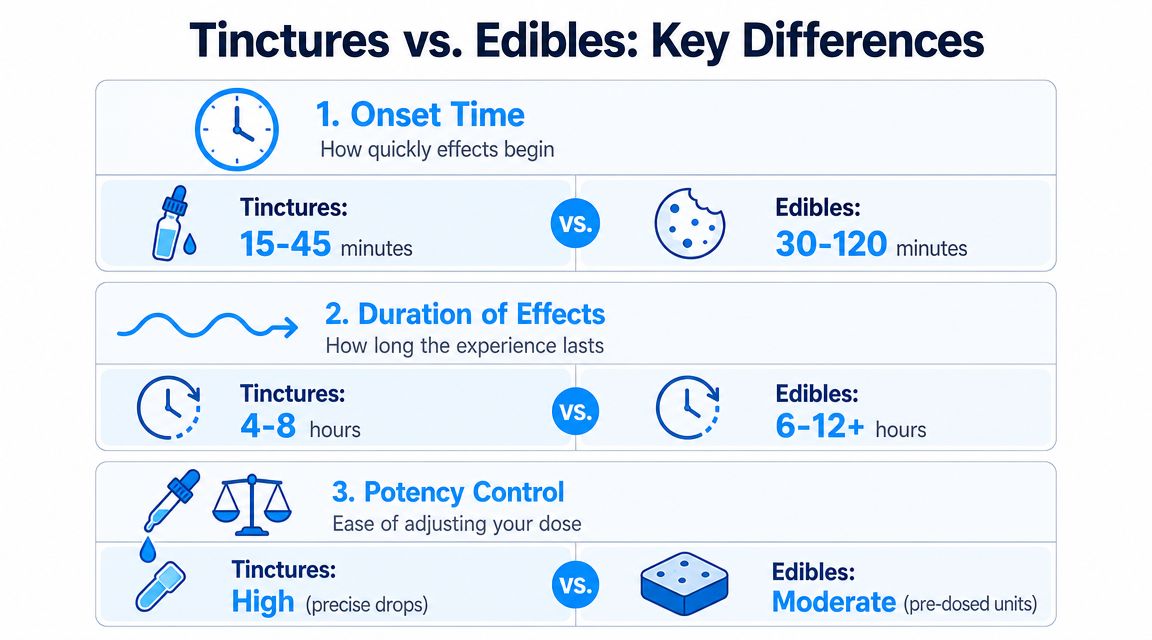
| Characteristic | THC Tinctures (Sublingual) | THC Edibles |
|---|---|---|
| Onset | Usually felt sooner when held under the tongue | Usually slower because the dose goes through digestion first |
| Duration | Often shorter and easier to fit into a narrower time window | Often longer-lasting and better suited to extended coverage |
| Effect profile | Easier to assess earlier in the session, which helps with consistency | More affected by meal timing, digestion, and liver metabolism |
| Best fit | Measured use, daytime control, lower-commitment sessions | Longer evenings, overnight support, people comfortable waiting |
Why tinctures feel different
A tincture used sublingually enters the experience on a shorter timeline than a standard edible. For many customers, that faster feedback makes the product easier to read. You can judge whether the dose is landing where you want it to land without committing to a long, drawn-out session.
That is a big reason tinctures tend to feel more predictable for functional use. Someone trying to take the edge off before dinner, settle into a movie, or ease into sleep without waking up groggy often prefers a format that gives clearer feedback earlier.
Method matters here. Hold the tincture under the tongue and the session usually behaves more like a true tincture experience. Swallow it immediately or mix it into food, and it can start acting more like an edible.
If you want to compare specific food-based formats, this guide to weed edibles candy options and formats is a useful next reference.
Why edibles can feel stronger and less consistent
Edibles pass through digestion and then the liver before the effects fully develop. That route changes both timing and feel. As noted earlier, edible THC is metabolized into 11-hydroxy-THC, which is a major reason many consumers describe the effect as heavier, longer, and harder to fine-tune once it starts building.
Predictability gets tricky because the same gummy can feel steadier on an empty evening at home and much stronger after a large meal, with alcohol, or when someone gets impatient and redoses too early. Label potency still matters, but digestion adds variables that tinctures often avoid when used properly.
That trade-off is not a flaw. It is part of why edibles are a strong fit for shoppers who want longer coverage for sleep, a night in, or sustained body effects that do not require quick adjustment.
Potency is only useful if it matches the job
Potency gets too much attention by itself. The better question is how dependable that potency feels in practice.
For daytime use, social plans, or any situation where staying composed matters, tinctures usually offer better control. For long evenings or sleep support, edibles often give more staying power. The right choice depends on whether you value quick course correction or longer, heavier coverage.
Dosing With Precision and Safety
The biggest mistake people make with THC tinctures vs edibles isn't choosing the wrong format. It's misreading the waiting period.
According to this consumer guide on tinctures vs edibles and redosing, tinctures can act within roughly 15 to 45 minutes, while edibles may begin anywhere from 30 minutes to 2 hours. That gap creates a classic user error with edibles: taking more before the first dose has fully declared itself.
A practical framework for tinctures
With tinctures, the first question is how you're taking them. If you hold the liquid under your tongue, you're using the format as it is primarily intended for tinctures. If you swallow it right away or mix it into food, the timing can shift and feel less like a true sublingual experience.
Use a simple routine:
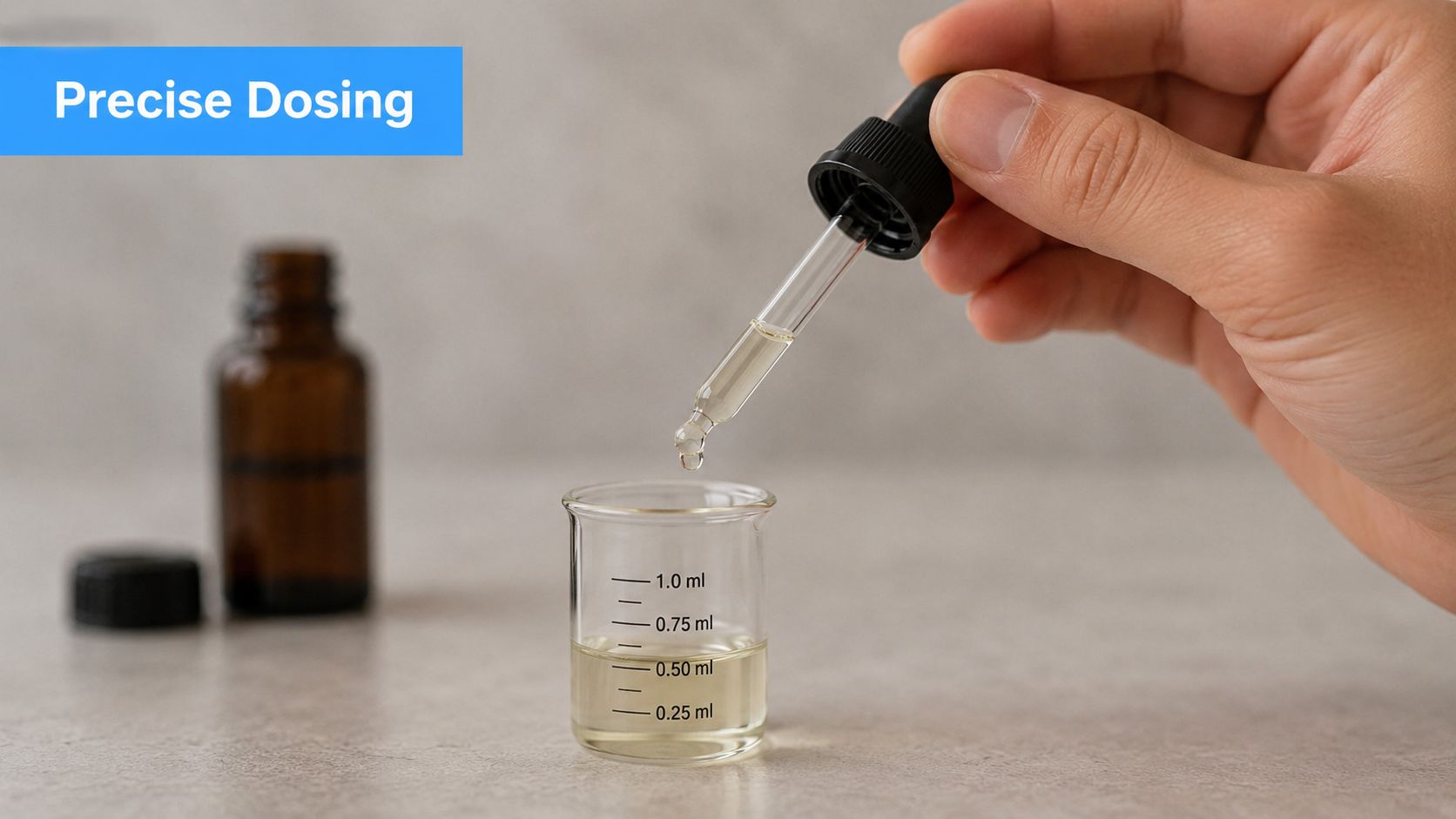
- Measure carefully: Use the dropper markings and know what one serving means on that specific label.
- Stay consistent: Take it the same way each time if you're trying to judge reliability.
- Reassess before adding more: The advantage of tinctures is that you can often evaluate the session earlier than you can with edibles.
If you want help translating bottle information into a more practical serving plan, this tincture dosage calculator is a useful tool.
A practical framework for edibles
Edibles demand patience. That's the whole game.
If you take an edible and feel almost nothing at first, that doesn't mean it failed. It often means digestion, food intake, and your own metabolism are still shaping the outcome. Because the delayed window is wider, the safest decision is usually to wait until the full arc is clearer before adding more.
Practical rule: If an edible feels mild early, that's not permission to stack doses quickly.
This walkthrough gives a useful visual explanation of measured dosing and timing:
What works and what doesn't
What works:
- Choose one format per session when you're still learning your response.
- Take notes on timing, amount, and whether you had food beforehand.
- Build familiarity with one product before switching to another brand or format.
What doesn't work:
- Chasing effects too early
- Assuming every 5 mg experience feels the same across formats
- Treating a swallowed tincture exactly like a sublingual tincture
- Taking more because someone else says they “didn't feel much”
The safest consumers aren't always the most cautious. They're the most consistent.
Matching the Product to Your Purpose
Instead of focusing on format, consumers typically shop by outcome. They want sleep that holds, a daytime dose that stays manageable, or something that takes the edge off a social plan without hijacking the night.
That's why the best question in THC tinctures vs edibles is this one: Which format is more reliable for the effect I care about?
According to this discussion of repeatable daytime dosing versus overnight coverage, tinctures are often better for measured, repeatable daytime use because they bypass digestion, while edibles are often better for overnight coverage when variability in onset matters less.

For sleep routines
Edibles often make more sense when the goal is staying covered longer into the night. A gummy from brands like Wana, Kiva, or Camino may suit people who care less about immediate onset and more about a longer tail.
The trade-off is timing uncertainty. If your evening schedule moves around a lot, that delayed onset can become frustrating. But for people who take cannabis as part of a predictable nighttime routine, the longer-lasting profile often fits better.
For daytime focus or low-key functioning
Tinctures are usually the more practical tool here. A measured tincture from brands such as Papa & Barkley, Ayrloom, or Head & Heal is often easier to adjust because the experience tends to reveal itself sooner and with less digestive variability.
This matters when you still have things to do. Workdays, errands, creative sessions, and low-dose wellness routines all benefit from products that are easier to titrate without turning the whole day into a waiting game.
If your goal is function, the “best” product is usually the one that lets you stop exactly where you want.
For pain support or extended evening relief
This one depends on timing. If someone wants coverage that stretches for a longer block of time, an edible can be the better fit. If they want the chance to build gradually and reassess, a tincture often gives them a cleaner feedback loop.
A lot of experienced consumers keep both on hand for that reason. One format handles precision. The other handles duration.
For social ease
Many people overestimate edibles. A social plan usually rewards control, not mystery. If you're going to dinner, an event, or a friend's place, tinctures are often easier to manage because they don't ask you to commit to a long delayed curve.
Edibles can work socially, especially for experienced users who know their window. But if someone wants a format with less surprise and less chance of overshooting, tinctures generally earn the nod.
How to Choose Quality Products at Strong Strains
A customer standing at the counter deciding between a 30 mL tincture and a 10-pack of gummies usually asks about potency first. The better question is whether the product will behave the same way each time you use it. If you want dependable sleep, steady daytime control, or a social dose you can trust, label quality matters as much as THC itself.
Read the dose where it actually counts
Start with THC per serving, not the biggest number on the package. A bottle may contain a high total amount of THC and still be designed for small, repeatable doses. That matters with tinctures in particular, because the format often encourages measured use instead of one large serving.
As noted in the Massachusetts Cannabis Control Commission's guidance on tincture serving limits and bottle totals, tinctures are regulated differently from edibles in that state. For shoppers, the practical takeaway is simple. Total THC tells you how much is in the package. Serving THC tells you what kind of experience you are buying.
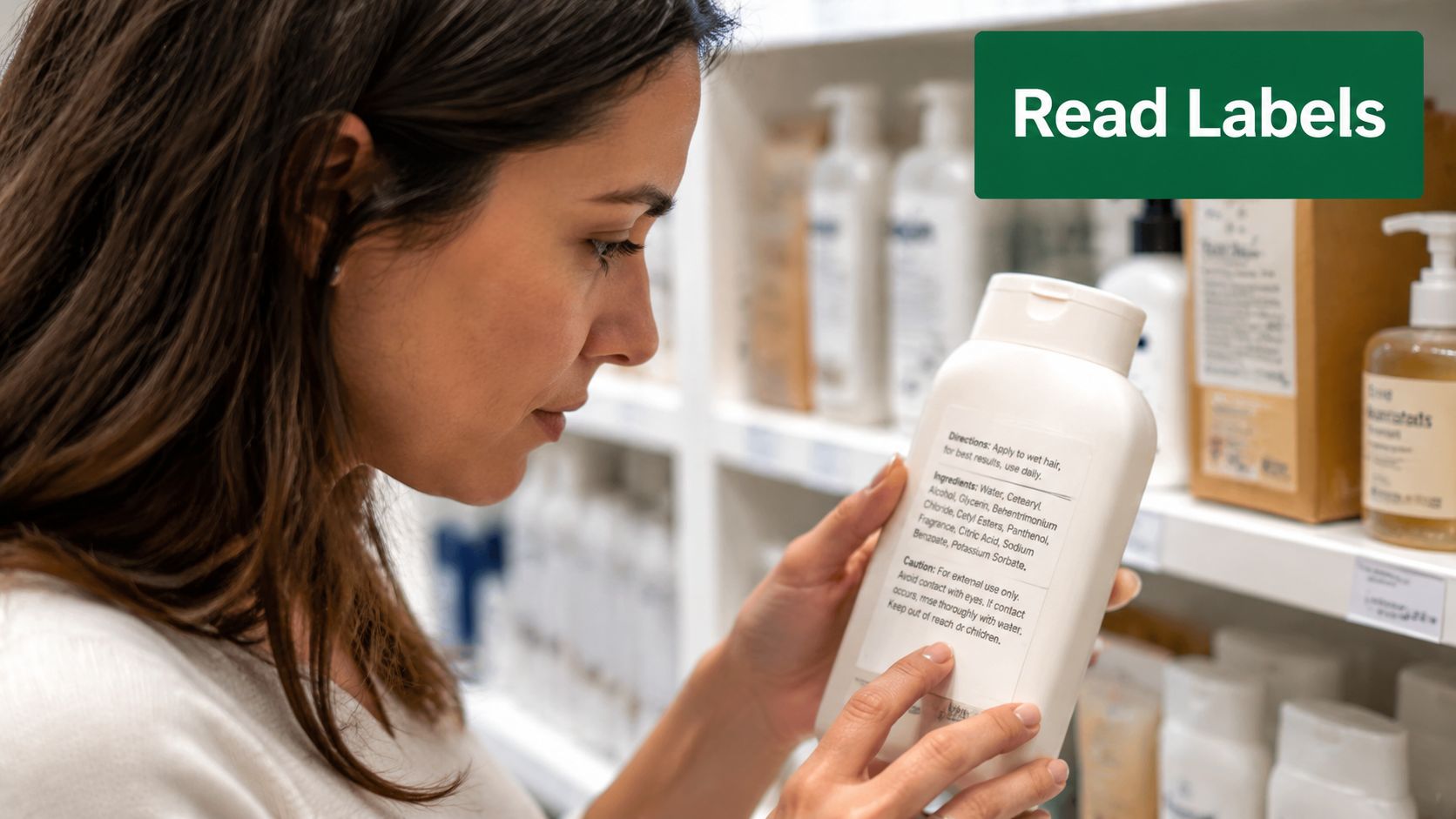
At the shelf, I tell customers to find three numbers before anything else: milligrams per serving, servings per package, and the cannabinoid breakdown. If those are hard to spot, I usually pass.
Check the details that affect repeatability
With tinctures, product quality shows up in the mechanics:
- Clear dropper markings: You should be able to measure the same dose tonight and next week without guessing.
- Carrier oil or base: Oil-based tinctures are common, and the base affects taste, mouthfeel, and how easy the product is to use consistently.
- Cannabinoid profile: A THC-only formula behaves differently from one balanced with CBD or other cannabinoids.
With edibles, consistency depends on a different set of details:
- THC per piece: This is the number that determines whether the product is easy to portion.
- Uniform pieces: Even sizing helps support more reliable dosing.
- Ingredients and format: Gummies, chocolates, and baked products can fit different routines, but the best option is usually the one you will portion the same way every time.
For shoppers comparing categories across brands and seasonal releases, our guide to the best cannabis products in Long Island for summer 2025 gives useful context on what is worth a closer look.
What a strong purchase decision looks like
Good shopping habits reduce surprises. At Strong Strains, the customers who get the most reliable results usually ask practical questions, not just strong-versus-stronger questions.
Ask:
- How many milligrams am I taking in one serving?
- Can I measure that serving the same way every time?
- Is this product built for precise adjustment or for a longer, fixed ride?
- Does the formula match the outcome I want, like sleep, daytime calm, or social ease?
That last point matters. A quality product is not just clean and properly labeled. It is predictable enough to earn a place in your routine.
Storage Safety and Legal Considerations
Tinctures and edibles both need boring, disciplined storage. That's a good thing. Good storage protects product quality, reduces accidental consumption, and keeps your routine predictable.
Keep products in their original, child-resistant packaging. Store them in a cool, dark place away from heat, direct sun, children, and pets. With edibles, that matters even more because gummies and chocolates can look like ordinary food. With tinctures, it's easy to forget that a small bottle may contain many measured servings.
Safety habits that matter
- Separate cannabis from regular snacks: Don't put infused gummies next to standard candy.
- Keep labels visible: You should be able to identify the product and serving information at a glance.
- Avoid casual transfers: Don't move tinctures into unlabeled bottles or edibles into random containers.
- Store for consistency: Heat and light can make products less pleasant to use and harder to evaluate from session to session.
Buy legal products, keep them labeled, and store them like medication, not like snacks.
For New York adults, the legal side is straightforward in principle. Stick with licensed dispensaries, buy tested products, and follow adult-use rules for possession, transport, and consumption. That won't just keep you compliant. It also gives you a much better shot at getting accurate labels, consistent serving information, and the kind of product support that makes cannabis easier to use responsibly.
Frequently Asked Questions About Tinctures and Edibles
Can I take a tincture and an edible at the same time
You can, but I rarely recommend stacking formats if your goal is a reliable outcome. Once you combine a faster, easier-to-adjust product with one that builds through digestion, it becomes much harder to read the session clearly. If you are testing what works for sleep, social use, or daytime function, use one format first and learn its pattern on your body.
What's the best way to take a tincture for faster results
Use it sublingually. Measure your dose, hold it under your tongue for a short period, then swallow.
That method usually gives a more consistent result than taking it like a regular drink. Tinctures are often easier to titrate in small steps, while edibles can feel heavier at the same labeled dose because digestion and liver metabolism change how THC is processed, as explained in this tinctures versus edibles guide focused on potency and dose control.
Why do edibles affect my friend differently than me
Edibles pass through digestion first, so food intake, timing, metabolism, and individual sensitivity all affect the experience. Two people can eat the same gummy and get very different results.
This is one of the biggest reliability issues with edibles. They can work well, especially for longer-lasting effects, but they are not always the best choice if you need the same feel every time for a functional purpose.
Are tinctures always more predictable
No. They are usually easier to dose with precision, but consistency still depends on how you use them. If you hold the tincture under your tongue one night, swallow it immediately the next, and change your dose each time, you should expect different results.
Predictability comes from matching a quality product with a repeatable routine. In practice, that is why many customers use tinctures for tighter dose control and save edibles for times when a slower build and longer duration make more sense.
Strong Strains is East Setauket's premium destination for adult-use cannabis on Long Island, with a curated menu of lab-tested tinctures, edibles, flower, vapes, concentrates, and more. If you want help choosing the right format for sleep, daytime control, or a smoother first experience, browse Strong Strains for expert guidance, convenient pickup or local delivery, and a better cannabis shopping experience built around quality and clarity.