
The most popular advice about crumble vs budder is also the least reliable: drier doesn't automatically mean stronger. A crumbly jar and a soft, whipped jar can come from the same refined extract, with the meaningful differences created during purging, curing, and handling rather than by a built-in potency advantage.
For a shopper, the better question isn't “Which one gets me higher?” It's “Which texture fits how I dose, what I want to taste, and how I plan to use it?” The answer depends on the product's THCa, total THC, terpene profile, residual-solvent results, and consistency, not its appearance alone.
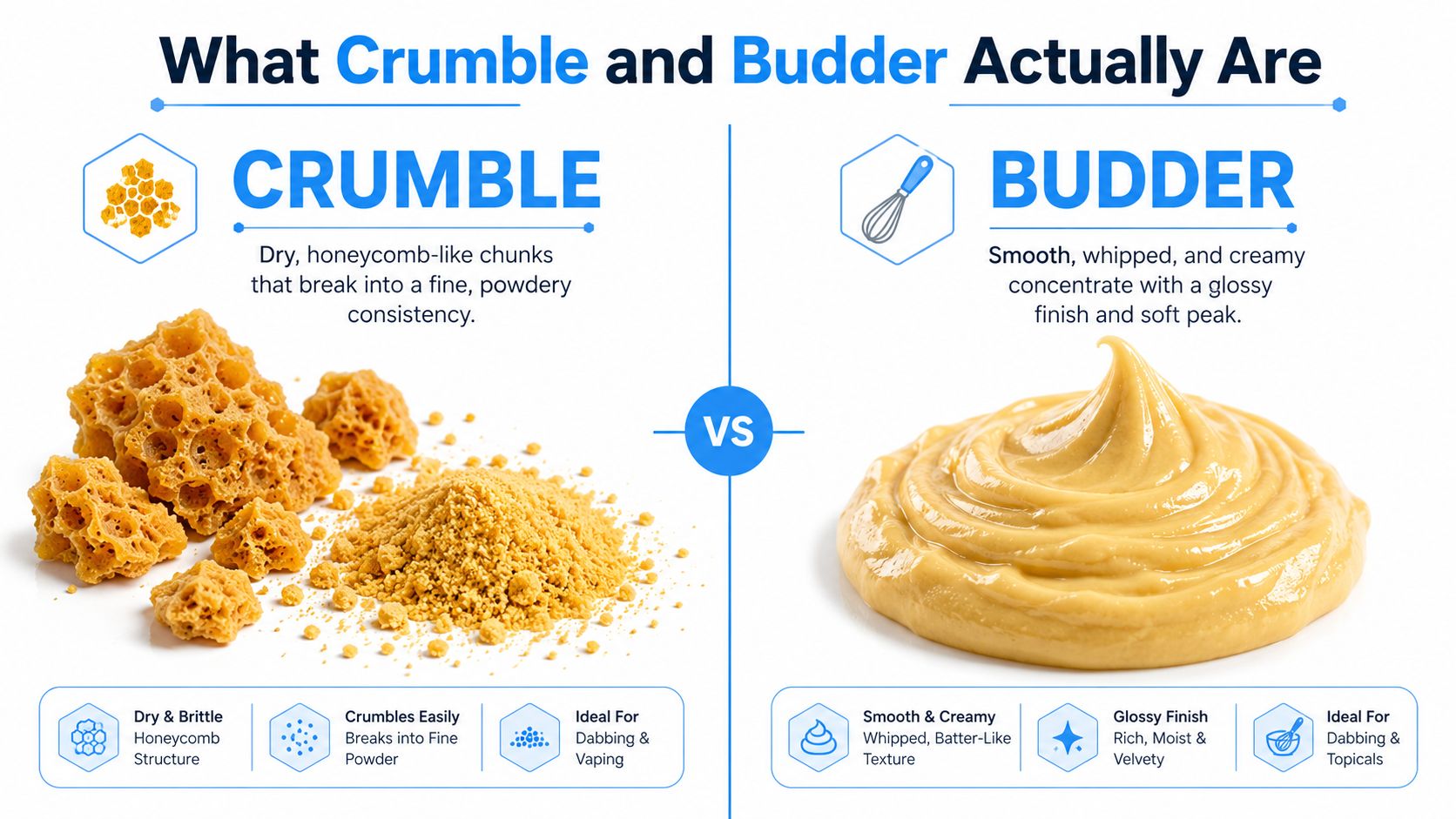
What Crumble and Budder Actually Are
Crumble is a dry, porous concentrate that breaks into flakes, powdery chunks, or honeycomb-like pieces. It's less compact than many other wax textures, so a dab tool can pull it apart rather than stretch it into a sticky strand. That makes it appealing to shoppers who want to portion small amounts without fighting a tacky surface.
Budder sits at the softer, whipped end of the wax spectrum. Producers agitate the extract so it develops a creamy, glossy, butter-like consistency that's easy to scoop and spread. Some jars look like frosting, while others are fluffier or slightly wetter, so “budder” describes a texture family more than one perfectly uniform finish. You can compare this format with other wax textures in this guide to different types of weed wax.
Both formats belong to the modern concentrate world shaped by hydrocarbon extraction. Crumble and budder emerged as extractors refined post-processing techniques during the 2000s, while early hash oil products began appearing at the High Times Cannabis Cup in 2010. Budder had already been publicly highlighted in 2005, which shows that today's texture categories developed during the first commercial wave of concentrate innovation. Traditional hashish is far older, with some historical summaries tracing concentrate use back centuries and even to around 10,000 B.C. in China. These historical points are summarized in this overview of cannabis concentrates.
The myth to leave behind
Potency comes from the cannabinoid content shown on the lab report. Moisture level, aeration, and firmness affect texture and handling, but a dry surface doesn't prove that a jar contains more THC. Industry references commonly place crumble around 60% to 90% THC and budder around 70% to 90% THC, with substantial overlap in concentrate texture comparisons.
That overlap gives you a useful shopping framework. First, understand how the producer made the texture. Then read the lab data. Finally, choose the format that works with your preferred ritual, whether that's a measured dab, a flower topper, or a portable vape.
How These Textures Get Made
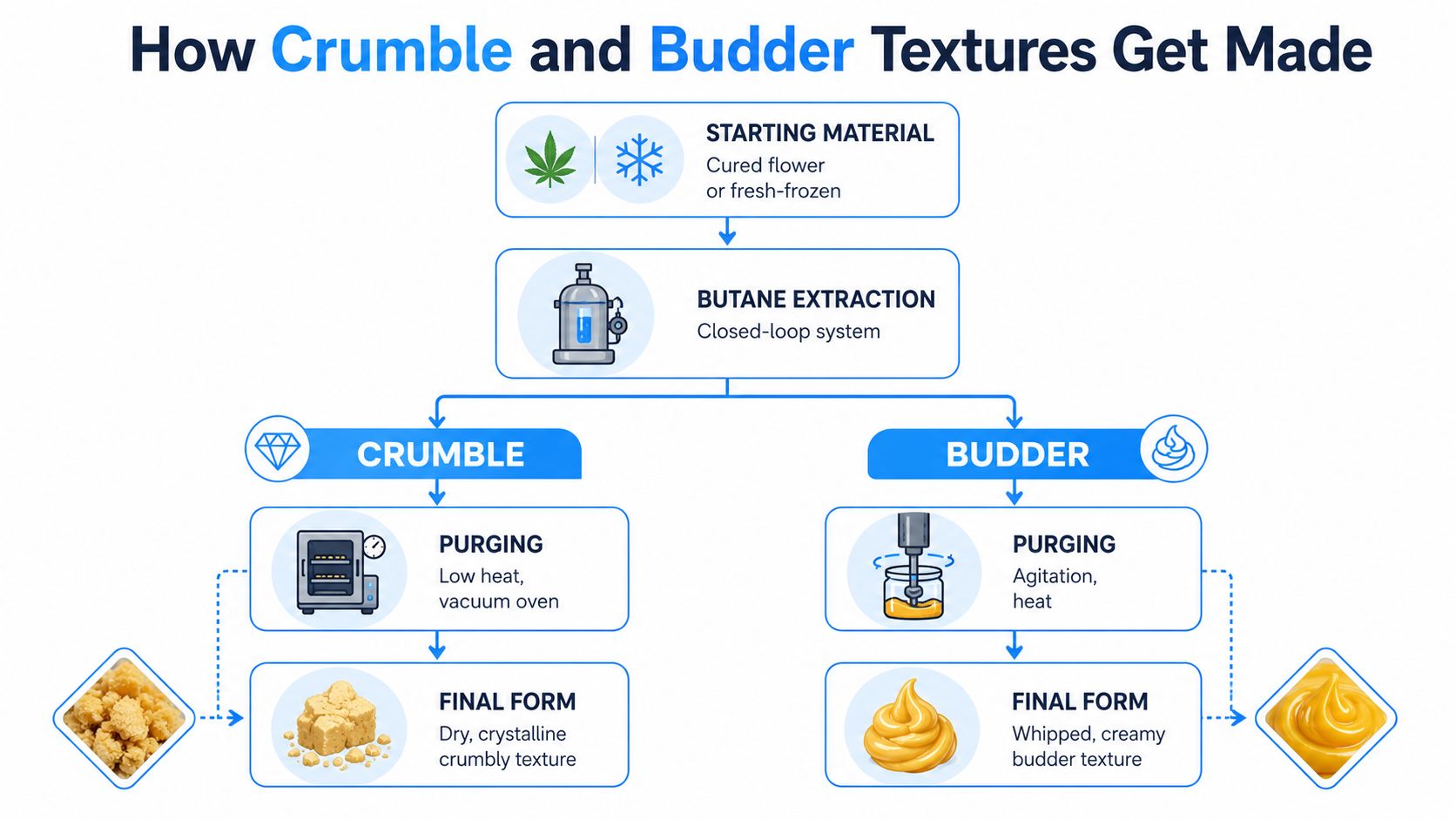
The process starts with cannabis material, usually cured flower or fresh-frozen material, placed into a closed-loop hydrocarbon extraction system. Butane moves through the plant material and dissolves cannabinoids and terpenes, creating a concentrated oil that still needs careful post-processing before it becomes a stable retail product.
The extract's final texture develops after extraction. Producers control how much solvent and moisture leave the oil, how quickly that happens, and whether the material is agitated during the finish. Those choices can turn a shared starting extract into either a dry crumble or an airy budder.
Three controls shape the finish
- Purge conditions: A longer purge, often managed at a lower temperature under vacuum, tends to remove more moisture and produce the porous, brittle structure associated with crumble. A shorter or warmer cycle can leave the extract softer, depending on the producer's formulation and handling.
- Moisture retention: Budder keeps a softer consistency when the producer avoids drying the extract as aggressively. Crumble's open, fragile structure reflects a drier post-purge profile.
- Agitation: Whipping or stirring introduces air and changes the oil's structure. That mechanical action helps create budder's creamy, moldable feel rather than a compact slab.
The distinction is mainly about the final purge and cure, not a different extract class. A producer can intentionally engineer a texture for portioning, aroma presentation, storage, or a particular dabbing experience. That's why an attractive crumble jar isn't necessarily a failed budder batch, and a glossy budder jar isn't automatically fresher or more potent.
The broader history follows the same pattern. Early jar-tech and shatter-style products emphasized preserving a firm, glassy finish. As extractors gained more control over vacuum, heat, and agitation, they developed textures that were easier to scoop, crumble, spread, or combine with flower. Modern concentrate lines treat consistency as a deliberate product choice, not an accidental result of poor purging.
Texture, Aroma, and Potency Compared
Texture signals how a concentrate handles, while the COA provides the better basis for judging potency. Side by side, crumble vs budder shows a practical difference in the shopping experience. Crumble feels dry, porous, flaky, and brittle, often breaking into loose pieces. Budder feels soft, glossy, whipped, and spreadable, usually staying together on a dab tool.
The useful question is how each format fits your routine. Crumble's loose structure makes it easy to divide across sessions or sprinkle over ground flower, though small fragments can scatter. Budder can be scooped into a compact portion and spread into a thin layer, but its stickiness may leave more residue on a tool or container.
| Attribute | Crumble | Budder |
|---|---|---|
| Physical feel | Dry, porous, flaky, and brittle | Soft, whipped, creamy, and moldable |
| Aroma presentation | Can be bright and flavorful, although more aggressive drying may reduce some volatile terpenes | Often offers a pronounced aroma when moisture and aromatic compounds remain better preserved |
| Portioning | Breaks into flakes or small pieces for flexible dosing | Scoops readily and can offer repeatable portions when the texture is consistent |
| Loading a tool | Less sticky, but loose pieces may scatter | Easy to collect, though it can cling to a cold or textured tool |
| Topping flower | Convenient to distribute across ground flower without large clumps | Suits a spreadable layer or a concentrated center |
| Cleanup | Often leaves less stringy residue, although dry fragments may migrate | May leave sticky residue around the tool or container |
| Melt behavior | Can vaporize quickly if overheated | Usually melts into a smooth pool with appropriate heat |
Aroma depends on the terpene profile and the producer's handling choices, not appearance alone. Budder is often linked with fuller terpene expression because its softer finish may preserve more moisture and aromatic compounds. Crumble can still taste expressive when the producer controls the purge carefully. The discussion of budder's aroma and processing explains how temperature and moisture management influence both appearance and flavor.
Heat and handling also change the experience. Dry crumble may load cleanly but vaporize quickly if overheated. Softer budder spreads easily, while its residue calls for more frequent tool cleaning. These differences affect convenience and dosing more directly than the texture's visual appeal.
For a flexible, sprinkle-friendly routine, crumble may be the simpler choice. For scoopable portions and a terpene-forward dab, budder may fit better. Compare the product's terpene results and cannabinoid data on its COA, then choose the texture that matches how you plan to use it.
Reading the Lab Sheet Before You Choose
A striking jar and a high THC number can steer you wrong. The Certificate of Analysis, or COA, gives you a better basis for comparing crumble and budder. Read the cannabinoid panel, terpene results, safety tests, report date, and laboratory identity together. Texture describes how the concentrate handles. The lab sheet describes what was measured.
Read the main cannabinoid result carefully
Many reports list THCa separately from total THC. The common conversion uses the 0.877 multiplier, because THCa loses mass as it converts into THC during decarboxylation. If the COA provides a calculated total THC result, use that figure instead of treating raw THCa as the exact amount you will experience.
Terpenes add another useful comparison. Two jars with similar cannabinoid results can differ in aroma and flavor if their total terpene levels are different. A jar with the higher total terpene result may offer more noticeable flavor, while the named dominant terpenes help indicate what that flavor may resemble. This does not predict effects by itself, and it does not prove that a drier concentrate is stronger.
| Metric | What It Tells You |
|---|---|
| THCa | The acidic cannabinoid used in total THC calculations |
| Total terpenes | A point of comparison for aroma and possible flavor intensity |
| Dominant terpenes | The specific compounds shaping the product's aromatic profile |
| Residual solvents | Whether the finished extract meets the applicable testing standard |
| Minor cannabinoids | Additional profile information, including compounds such as CBGa, CBG, or CBN |
For a closer explanation of report terminology, use this guide to cannabis lab testing. If the dispensary only shows a product page, ask whether you can inspect the complete COA.
Use a quick counter checklist
- Check the test date: A missing date makes it harder to judge how current the report is.
- Review the full cannabinoid panel: Look for a single large cannabinoid figure that does not match the rest of the results.
- Compare total terpenes: Between two jars, the higher result may point to more pronounced aroma and flavor.
- Read the named terpenes: They provide more detail than total terpene weight alone.
- Open the residual-solvent results: A dry texture does not prove that the extract had a clean purge.
- Verify the lab: The dispensary should identify the testing laboratory and provide a report you can inspect.
A 92% crumble and a 78% budder may still offer less contrast than the labels suggest if the crumble has a thin terpene profile and the budder has a much fuller one. Use the figures to compare batches, then match the result to your handling preference and dosing style. That approach replaces the weak “drier means stronger” shortcut with evidence you can examine.
Dabbing, Vaping, and Topping Your Flower
Your device and ritual should influence the purchase. A soft budder may be effortless in a quartz banger, while crumble can be easier to divide for a joint, bowl, or several small sessions. Neither format is universally superior, and the same jar can behave differently depending on heat, tool temperature, and how long it sits exposed to air.
Low-temperature dabbing
For a low-temperature dab, the target range is 480 to 530 degrees Fahrenheit as described in this concentrate-use overview. Budder generally melts cleanly from a dab tool onto a quartz banger, creating a smooth pool that can be capped and vaporized gradually.
Crumble needs a gentler touch. Its loose pieces can scatter, and a hot surface can scorch the outside before the interior melts evenly. Place a small amount onto the heated surface rather than dropping a large slab onto an already overheated banger.
Flower topping and portable devices
Crumble works well as a flower topper because it can break into a sand-like layer without forming one sticky lump. Sprinkle it lightly across ground flower in a bowl or joint, then avoid putting loose concentrate directly against an open flame. Budder behaves better as a spreadable twax layer, a pre-roll center, or a transfer made with a warmed hot knife.
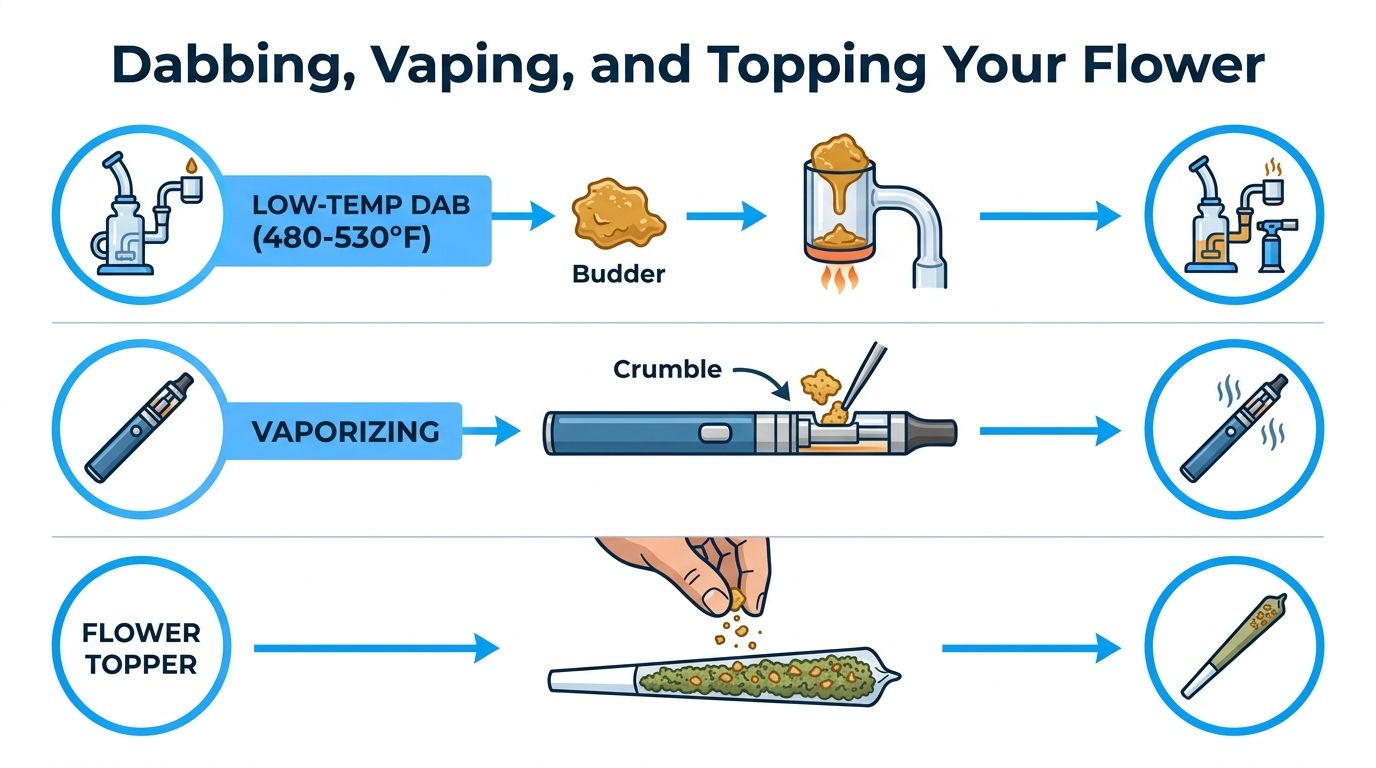
For 510-thread cartridges and pod systems, use only products designed and labeled for that device. Budder may need gentle warming before filling, while crumble generally needs further processing before it can flow through a cartridge. Don't put raw concentrate into a chamber rated only for dry herb. For broader device guidance, see this overview of the best vape options for pot.
Avoid three common waste points:
- A cold crumble slab: Forcing a rigid piece with a sharp tool can launch fragments across your tray.
- A cold dabber and budder: A chilled tool can pull and smear the concentrate instead of releasing it cleanly.
- Too much heat: High heat can flatten flavor and leave a harsh residue, regardless of the texture.
Matching Each Format to Your Goal
The best format depends on the experience you're trying to build and how consistently you want to repeat it. Texture can make a ritual easier, but strain lineage, cannabinoid content, terpene profile, and current lab data should lead the decision.
Relaxation and sleep
For evening use, shoppers often look for terpene-forward products with profiles associated with a heavier, calmer experience, including myrcene- or linalool-dominant batches. A soft budder can suit a low-temperature dab when you want one controlled scoop and a flavorful session.
Fresh crumble can also work when you want to portion several smaller amounts instead of taking one larger scoop. For an edible, the extract must be properly decarboxylated and prepared according to the product and recipe requirements. Don't assume a texture is ready to eat because it's easy to break apart.
Daytime creativity
A terpene-forward sativa in either format may fit a daytime routine, but the practical advantage can go to crumble if you're trying to ration small amounts. Its flakes can be divided across sessions without the concentrate sticking to every surface.
Budder may be preferable when your routine is simple. Scoop, load, cap, and finish. That repeatable movement matters when you don't want to weigh or chase loose fragments.
Symptom-focused routines
For symptom relief, consistency often matters more than texture. Budder can make repeatable dab sizes easier when the jar has a stable, scoopable consistency. Crumble can help someone distribute a similar amount across multiple flower sessions, particularly when the product breaks cleanly.
| User Goal | Better Pick | Why | Ritual It Suits |
|---|---|---|---|
| Deep relaxation | Terpene-forward budder | Soft texture supports a controlled, flavorful scoop | Low-temperature dab |
| Sleep routine | Budder or fresh crumble | Choose by terpene profile and measured portioning, not dryness | Dab or properly prepared edible |
| Daytime creativity | Either, with crumble for flexible portions | Crumble can be divided into smaller amounts more easily | Small dabs or flower topping |
| Consistent relief | Budder for repeatable dabs, crumble for repeated topping | Each format supports a different dosing habit | Dab session or flower enhancement |
| Flexible weekly use | Crumble | Loose structure can make several small portions practical | Multiple sessions or topping |
A useful default rule is simple: choose budder for one reliable ritual dose, and choose crumble for flexible portioning. Then let the COA and terpene profile break the tie.
Storage, Dosing, and Buying Locally
Concentrates keep their character best when you control heat, light, air, and moisture. Store crumble or budder in an airtight container, away from direct light and humidity swings. A temperature-stable environment around 60 to 70 degrees Fahrenheit is commonly recommended for concentrate storage, and silicone or parchment-lined jars can reduce sticking and handling problems.
A refrigerator often creates trouble for a daily-use jar. Repeatedly moving a cold container into warmer air can cause condensation, which changes texture and can make budder greasy or crumble clumpy. If you refrigerate a product according to the manufacturer's instructions, let the sealed container return to room temperature before opening it.
Build a measured routine
Edibles require particular care. A conservative starting point is 5 mg of THC equivalent for an edible, while newcomers to inhalable concentrates may start around 10 to 25 mg according to the dosing guidance in the supplied concentrate reference. Increase slowly, using a single dab's worth rather than treating a full gram as a serving.
Keep a suitable dabber, carb cap, and heat source together so you don't improvise. A carb cap helps manage vapor after the concentrate melts, while a clean tool keeps old residue from changing the flavor of a new jar. Torch etiquette matters too. Heat the banger or device as directed, keep the flame away from the concentrate container, and never re-melt wax in a chamber designed only for dry herb.
Ask for the complete paperwork
A reputable dispensary should be able to pull a concentrate's COA on request and explain the results in plain language. Strong Strains Cannabis Dispensary describes its concentrate curation around full-panel COAs covering cannabinoids, terpenes, residual solvents, heavy metals, and microbials. Its stated process also rejects extracts above 100 ppm in residual solvents and rotates stock so jars don't sit past 90 days.
Those are specific purchasing standards to ask about, not substitutes for reading the report yourself. Staff should also be able to point shoppers toward terpene-forward batches for an evening routine or THC-forward batches for daytime relief without presenting either texture as automatically stronger.
The best concentrate is the one with clean test data, a texture that fits your ritual, and a price that reflects the work behind it. Don't let a dry appearance, glossy finish, or social-media trend make the decision for you.
Visit Strong Strains Cannabis Dispensary to compare lab-tested concentrates, including soft budder-style options and easier-to-portion crumble, with guidance from knowledgeable Long Island budtenders. You can shop in person at the East Setauket dispensary or use convenient pickup and local delivery to find a format that matches your dosing routine.