
You're standing in a dispensary comparing a gummy with a small dropper bottle. You want something that feels manageable before bed or after work, but you don't want to wait for an edible to surprise you later, and you may not want the smell or ritual of smoking. That's where cannabis tincture benefits become practical rather than theoretical. A tincture can give adults a measured, discreet way to use cannabinoids, but the result depends on the formula, the dose, and whether you hold it under your tongue or swallow it.
Why a Tincture Belongs in Your Cannabis Routine
A tincture earns shelf space because it sits between inhalation and traditional ingestion. You can measure a small amount for daytime use, take a carefully chosen dose while winding down, or add it to a routine without creating a smoke or vapor cloud. The bottle also gives you more control than a fixed-dose edible, provided the label clearly states how much cannabinoid is in each milliliter.
The first advantage is adjustability. A gummy arrives in a predetermined portion. A dropper bottle lets you change the volume in small steps, which makes it easier to learn how your body responds. That doesn't guarantee a stronger or better effect. In fact, a patient-reported dosing analysis found no statistically significant relationship between milligrams per day and perceived symptom effects, so increasing the amount isn't a dependable shortcut to greater benefit (patient-reported cannabis dosing analysis).
A flexible middle ground
The second advantage is route choice. Held under the tongue, a tincture can begin entering the bloodstream through the oral mucosa. Swallowed, it behaves more like an edible, with digestion and liver metabolism shaping the experience. That lets one format serve different preferences, although the timing becomes less predictable when you treat the dose like food.
The third advantage is discretion. Tinctures don't require combustion, a vape battery, or a conspicuous smoking routine. You can keep the process quiet and repeatable, which matters to adults who want a low-profile option at home or during a private break.
Practical rule: A tincture is a control tool, not a promise of instant relief. Read the label, choose the route, and give the dose enough time before changing it.
The useful question isn't whether tinctures “work.” It's whether the product's cannabinoid profile, carrier, onset, and dose fit the reason you're using it. The rest of this guide keeps those variables in view, especially where evidence for sleep, pain, and anxiety remains limited.
What a Cannabis Tincture Actually Is
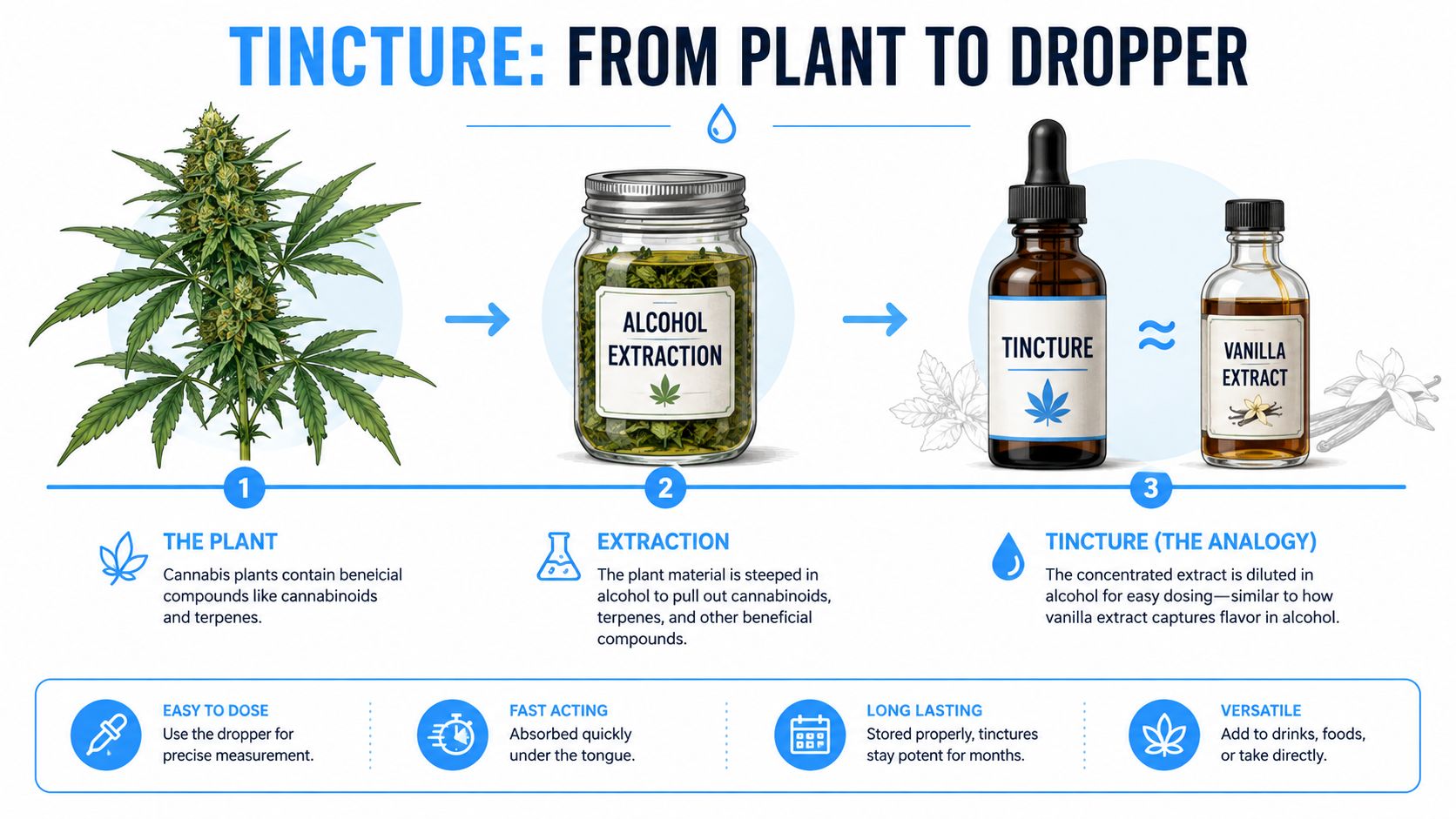
Think of a tincture as the cannabis equivalent of vanilla extract or herbal bitters. Plant material gives up selected compounds to a liquid, and the finished extract goes into a bottle with a dropper so you can measure a serving. Traditionally, alcohol carried the extraction, although modern products may use MCT oil, glycerin, or other medium-chain fatty acid carriers.
The bottle can contain THC, CBD, other cannabinoids, terpenes, or a combination of these. THC can produce intoxicating effects, while CBD generally doesn't create the same intoxication. The carrier matters because it affects taste, texture, storage, and how the liquid behaves in the mouth.
The label language that changes expectations
Full-spectrum usually means the extract retains a broad range of naturally occurring cannabis compounds, including THC when present. Broad-spectrum generally means several cannabis compounds remain, but the manufacturer has removed or minimized THC. Isolate means the formula focuses on one purified cannabinoid, such as CBD.
Those terms help you predict the product's composition, but they don't replace a certificate of analysis. A full-spectrum label doesn't tell you how strongly the formula affects you, and a CBD isolate doesn't automatically make a product appropriate for every person or medication regimen. You'll need the actual cannabinoid panel and serving information.
For a deeper explanation of the label distinction, read this guide to full-spectrum cannabis. The important takeaway is simple: a tincture is a concentrated liquid extract with measured delivery, not a single standardized product category. Formula, carrier, route, and dose all shape the experience.
The Practical Benefits Adults Care About Most
Adults usually choose tinctures for control. The value comes from what the format lets you manage, including amount, timing, privacy, and the balance between a shorter sublingual experience and a longer swallowed one.
Dose control without changing formats
A marked dropper can help you measure a repeatable volume. That's especially useful for beginners and medical-leaning consumers who want to adjust gradually instead of breaking apart a fixed-dose edible. The measurement is only meaningful if the bottle gives clear potency per milliliter and the dropper markings are reliable, so treat vague packaging as a warning.
A route that can change the experience
Sublingual use may offer a more predictable systemic exposure than swallowing an oil. Published pharmacokinetic reviews report oromucosal cannabinoid peak blood concentrations roughly 45 to 120 minutes after administration, while oral THC is typically detected in blood after about 30 to 60 minutes and peaks around one to two hours (pharmacokinetic review of oromucosal and oral cannabinoids). The practical benefit is repeatability, not a marketing guarantee of immediate effects.
Holding the liquid in your mouth also avoids smoke and vapor. That makes tinctures useful for adults who want a quiet routine, though the flavor and alcohol sensation may take some getting used to. You can compare tinctures with other approaches in this guide to tinctures for sleep, especially if your main concern is timing rather than just potency.
| Benefit | Why It Matters | Underlying Mechanism |
|---|---|---|
| Measured dosing | You can adjust the amount gradually | Dropper-based liquid delivery |
| Potentially more repeatable onset | Timing may be easier to track than with a swallowed edible | Oral-mucosal absorption |
| Discreet use | No combustion, vapor cloud, or lingering smoke ritual | Liquid administration |
| Flexible duration | The route can be chosen for a shorter or longer experience | Sublingual absorption versus digestion |
| Formula variety | THC, CBD, and blended profiles fit different preferences | Cannabinoid and carrier selection |
Comfort goals still need realistic expectations
People often ask about tinctures for pain, sleep, and recovery. Those goals can overlap with broader self-care, including non-cannabis resources such as Thermo Recovery Wear on pain care. A tincture may fit into a personal routine, but it shouldn't replace medical evaluation for persistent or worsening symptoms.
A water-soluble CBD formulation reached a Cmax of 2.82 ng/mL at a Tmax of 90 minutes and was about 4.5 times more bioavailable than a lipid-soluble comparator in a healthy-adult study, demonstrating that formulation chemistry can materially affect exposure (healthy-adult CBD formulation study). That's why two bottles with similar front-label language can feel different.
How Sublingual Use Changes Onset and Duration
The phrase “take under the tongue” describes a route, not a guarantee. Oral mucosa can absorb cannabinoids before the liquid reaches the digestive tract, partly bypassing first-pass hepatic metabolism. The portion you swallow still travels through digestion, so the final experience may combine sublingual and edible-like effects.
Technique matters. Place the measured liquid beneath the tongue, spread it across the mucosal area, and hold it there as long as the label recommends. Avoid immediately washing it down with a drink. If you hold it only briefly, swallow most of the dose, or use a formula that absorbs poorly through the mouth, onset may shift toward the slower oral pattern.
Alcohol-based formulas often feel more consistent for sublingual use because alcohol can keep cannabinoids in solution and spread the liquid across the mouth. Oil-based formulas can still work, but their absorption depends more heavily on formulation and contact with the mucosa. Eating beforehand can also change the swallowed portion's timing and intensity.
| Factor | Sublingual, held under tongue | Swallowed, treated as edible |
|---|---|---|
| Main route | Oral mucosa plus any swallowed liquid | Digestive tract |
| First-pass metabolism | Partly bypassed | More prominent |
| Typical peak timing | Roughly 45 to 120 minutes for oromucosal preparations | Oral THC commonly peaks around one to two hours |
| Experience | Often easier to track for repeat dosing | Usually slower and more variable |
| Duration | Can feel shorter or more controllable | Often behaves like a longer edible experience |
The available pharmacokinetic evidence supports a route-based explanation, not a promise that every tincture will act identically. For another plain-language discussion of sublingual versus oral bioavailability data, focus on the distinction between where the liquid is absorbed and what happens after you swallow it.
Hold time changes the route. Swallowing changes the timeline.
Where the Evidence Is Strong and Where It Is Still Thin
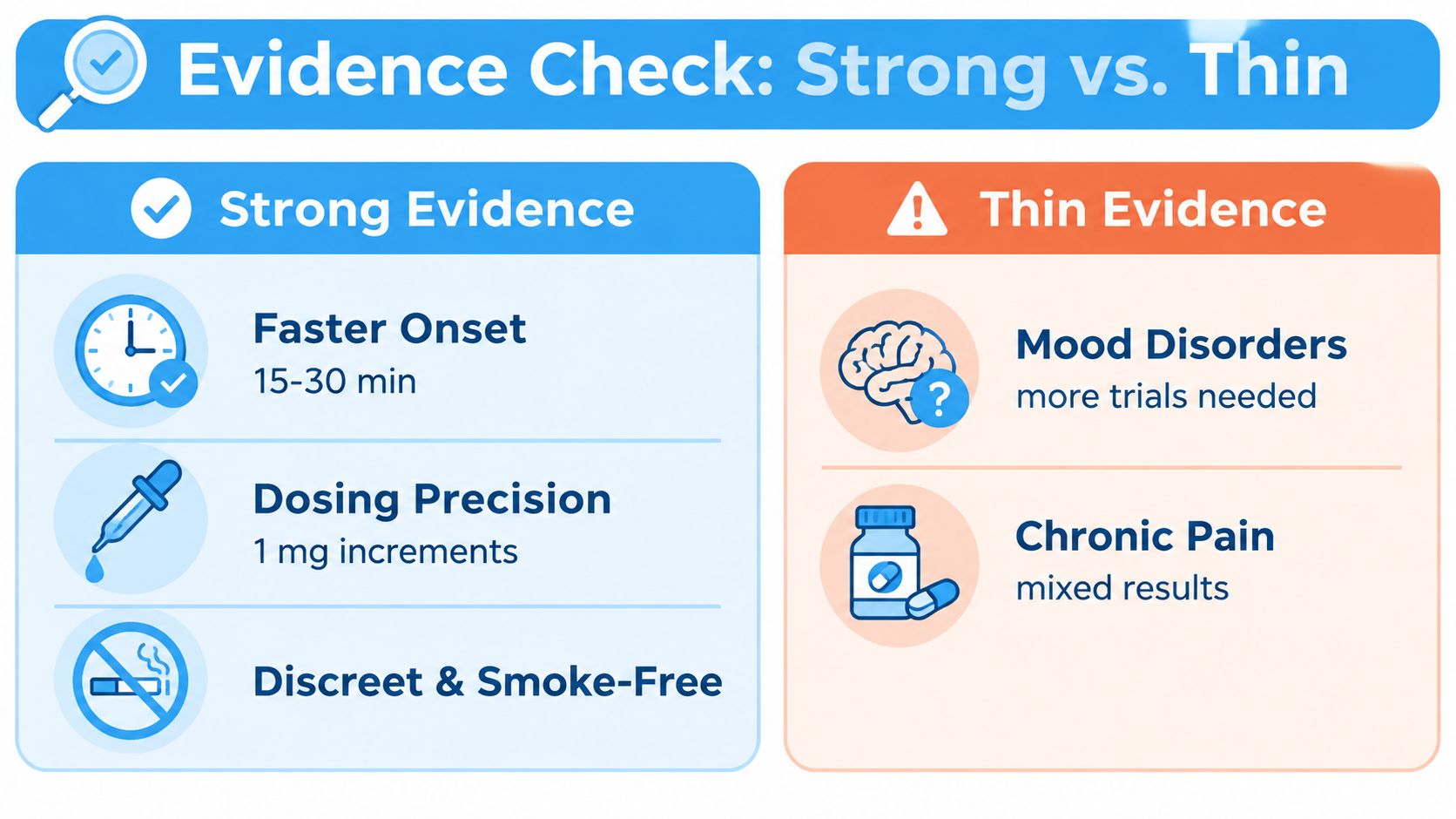
The strongest cannabis tincture benefits are practical. A measured liquid can support repeatable dosing, a smoke-free format can be discreet, and sublingual administration can alter exposure compared with swallowing. Those claims describe how the product is delivered. They don't prove that a particular cannabinoid blend will solve a particular health condition.
Clinical evidence is more convincing for some cannabinoid uses than for others. The National Academies found conclusive or substantial evidence of benefit from cannabis or cannabinoids for chronic pain, chemotherapy-induced nausea and vomiting, and patient-reported multiple sclerosis spasticity (National Academies evidence review). A systematic review reported high confidence for multiple sclerosis spasticity and pain, but low or very low confidence for nausea and vomiting outcomes, including extracts and tinctures.
That distinction matters because dispensaries frequently recommend tinctures for sleep and pain. A 2025 UC San Francisco-linked study reported that dispensaries most often recommended tinctures for sleep, 29%, and pain, 20%, while also noting limited evidence for cannabis in sleep disorders and recurring pain (UC San Francisco-linked dispensary study). Consumer demand can outpace the evidence, especially when products vary in THC, CBD, minor cannabinoids, carrier oils, and dose.
A more responsible way to test a goal
If you're exploring sleep or pain, choose a clearly labeled CBD-forward or balanced product only after considering your own health history. Keep a simple record of dose, route, timing, food, and perceived effect. Change one variable at a time, and don't interpret one comfortable evening as proof of a disease-level benefit.
A dosing review reported that THC-related adverse events are usually kept lower when total daily THC remains at or below 30 mg per day and titration proceeds slowly over about two weeks (clinical cannabis dosing review). That's a clinical reference point, not a personal target. Your starting amount may need to be far lower, particularly if you're new to THC or take medications.
Choosing a Lab-Tested Tincture You Can Trust
Treat a tincture's certificate of analysis, or COA, as the product's report card. Start by checking that the test date is recent and that the batch number on the COA matches the bottle in your hand. The cannabinoid panel should identify THC, CBD, and any listed minor cannabinoids clearly enough for you to compare the result with the package.
Read beyond the front label
A useful COA should also show testing for residual solvents, heavy metals, pesticides, and microbial contamination. Third-party laboratory accreditation adds context, while a scannable QR code makes the document easier to verify. If the bottle makes broad-spectrum or full-spectrum claims without showing the actual cannabinoid profile, ask a budtender to help interpret the paperwork.
Be cautious with packaging that uses strong potency language but doesn't state the amount per milliliter or serving. You also want the extraction method and ingredient list. MCT oil, olive oil, glycerin, and alcohol don't taste or feel the same under the tongue, and sensitive users may prefer one carrier over another.
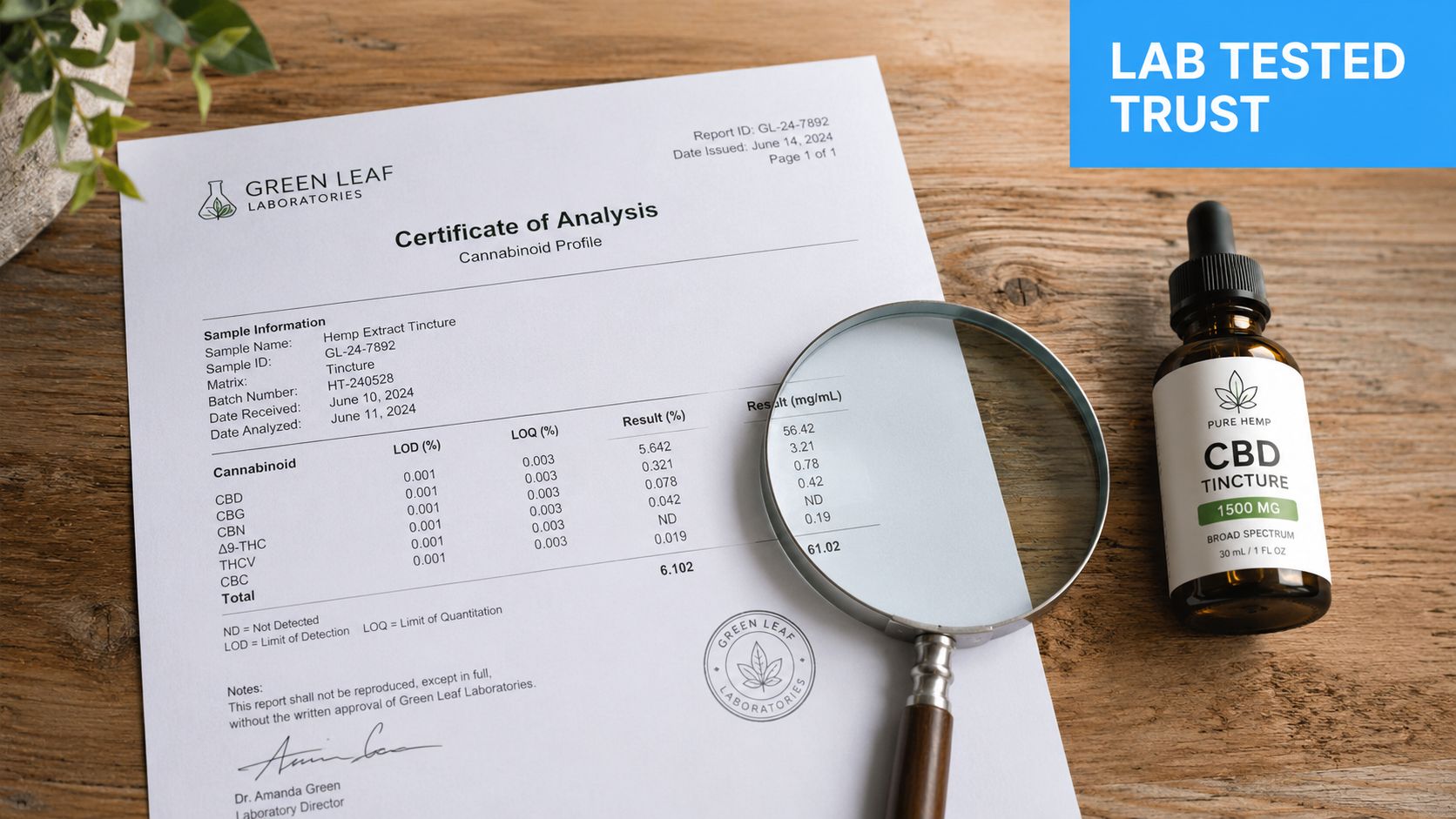
A lab-tested product still deserves careful use. Testing can confirm what's in the bottle and whether it passed specified safety screens, but it can't predict your response, eliminate medication interactions, or establish that the product will treat a medical condition.
COA check: Match the batch first, then review potency, contaminants, ingredients, and the cannabinoid profile.
A Safe Starting Protocol for First-Time Users
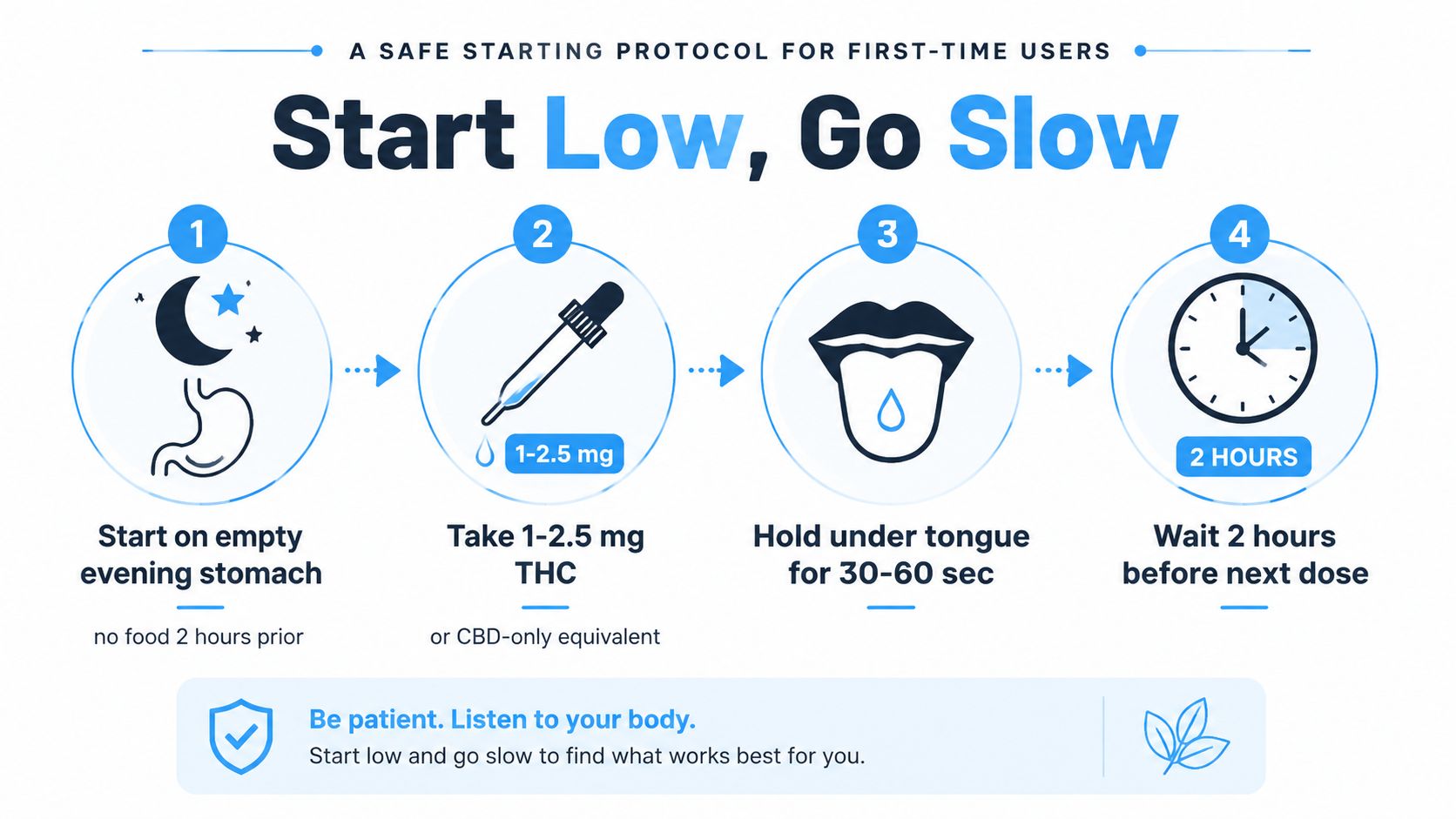
Start with less than you think you need. A conservative beginner protocol uses 1 to 2.5 mg of THC, or a matched CBD-only equivalent, on an empty evening stomach. Hold the liquid under your tongue for 60 to 90 seconds before swallowing, then wait two hours before considering another dose.
The timing isn't busywork. It creates a record of what happened before you add more, and it helps separate an early sublingual response from a later swallowed effect. If you want a slower, longer-lasting experience, swallow the measured dose rather than relying on under-the-tongue absorption, but expect edible-like timing and avoid rushing the next decision.
Keep a simple dose log
Write down:
- Dose: Record the cannabinoid amount, not only the number of drops.
- Time: Note when you took it and when you swallowed.
- Hold time: Record how long the liquid stayed under your tongue.
- Food status: Note whether your stomach was empty or recently fed.
- Effect ratings: Describe subjective intensity at 30, 60, and 120 minutes.
Use the stop-and-call signals seriously. Seek urgent medical help for chest pain, sustained tachycardia above 120 beats per minute, extreme anxiety, or vomiting. Don't combine the trial with alcohol, don't drive during the titration window, and keep the bottle away from children and pets.
People taking blood thinners, SSRIs, or seizure medications should speak with a pharmacist or physician before using a cannabis tincture. For product-specific concentration questions, a guide to THC tincture dosing can help you understand the label, but it isn't a substitute for medical advice.
Bringing It All Together at Strong Strains
A tincture works best as a precision tool within a broader cannabis routine. Its main advantages are measured dosing, a smoke-free format, route flexibility, and a potentially more trackable onset than a swallowed edible. Its limits are just as important. Product chemistry varies, and popular goals such as sleep and recurring pain still need more direct evidence for specific tincture formulas.
Long Island shoppers can compare cannabinoid profiles, carriers, and COAs with help from Strong Strains Cannabis Dispensary, which offers lab-tested cannabis products and budtender guidance in East Setauket. The dispensary carries tinctures alongside flower, vapes, pre-rolls, edibles, concentrates, topicals, and accessories, with in-store pickup and local delivery options. That broader menu matters when a tincture isn't the right route for your timing, tolerance, or goal.
Ask practical questions before buying. How much THC or CBD is in each milliliter? Is the product full-spectrum, broad-spectrum, or isolate? Does the batch number match the COA? Should you hold it under your tongue, or would swallowing better fit the longer duration you want?
Minor-cannabinoid formulations and balanced THC to CBD products may give adults more options over time, but more choice makes careful labeling and slow titration even more important. Start with a small measured amount, track the response, and return to a trusted retailer for questions instead of escalating blindly.
Strong Strains Cannabis Dispensary offers lab-tested tinctures, clear product information, and knowledgeable budtenders who can help you compare cannabinoid profiles and dosing formats. Visit Strong Strains Cannabis Dispensary in East Setauket to review current options, arrange pickup or local delivery, and choose a tincture that matches your experience level and intended route.