
You arrive at a dispensary after work, already knowing what you want. The staff is friendly, the music is right, and the counter conversation feels welcoming. Then the product you came for is out of stock, the replacement has different potency than expected, or the label doesn't match what you were told online. A pleasant interaction can't rescue an unreliable purchase.
Dependable service in cannabis retail means more than a smile. It means accurate inventory, verified products, clear communication, compliant fulfillment, and advice that remains useful after you leave the store. For Long Island customers, those details protect your time, money, and confidence.
Redefining Dependable Service in Cannabis Retail
A friendly budtender matters, but friendliness is only one part of the experience. If a dispensary gives you confident advice and hands you the wrong product, the service failed. If an online menu shows a favorite vape that isn't available, the service failed before you reached the store.
Dependability is operational consistency. The business should deliver the same basic promise across its menu, packaging, staff recommendations, checkout process, pickup counter, and delivery handoff. You shouldn't need to guess whether the product is genuine, whether the listed potency is accurate, or whether an order will be ready when promised.
What customers should be able to verify
A reliable dispensary makes quality visible rather than asking you to trust vague language. Look for:
- Accurate menus: Product names, formats, sizes, and availability should reflect what the store can sell.
- Clear product information: Staff should explain potency, format, ingredients, and intended use without exaggeration.
- Traceable packaging: Regulated products should have identifying information that connects the package to testing records.
- Consistent recommendations: A returning customer shouldn't receive completely different guidance just because another employee is working.
- Straight answers: If a product is unavailable or a delivery window changes, the store should tell you promptly.
This standard applies whether you're choosing flower from Alien Labs or Cookies, a pre-roll from Dogwalker or Jeeter, an edible from Camino or Wana, or accessories such as a PUFFCO device, a Grinder, or a Glass Pipe. Brand recognition doesn't replace responsible retail practices.
Practical rule: Judge a dispensary by what it can prove, not by how polished the counter feels.
A premium cannabis experience also respects the customer's purpose. Someone seeking relaxation may need a different format from someone exploring creativity, sleep, or relief. A wellness-focused shopper may want a tincture, topical, or precisely labeled edible, while an experienced enthusiast may be comparing concentrates from Connected, MFNY, or Preferred Gardens.
That distinction sets dependable service apart from simple selling. A dependable team asks enough questions to reduce mistakes, checks the product details before completing the order, and treats compliance as part of hospitality. The best interaction feels easy because the operation behind it is disciplined.
The Trust Gap and Why Consistency Matters
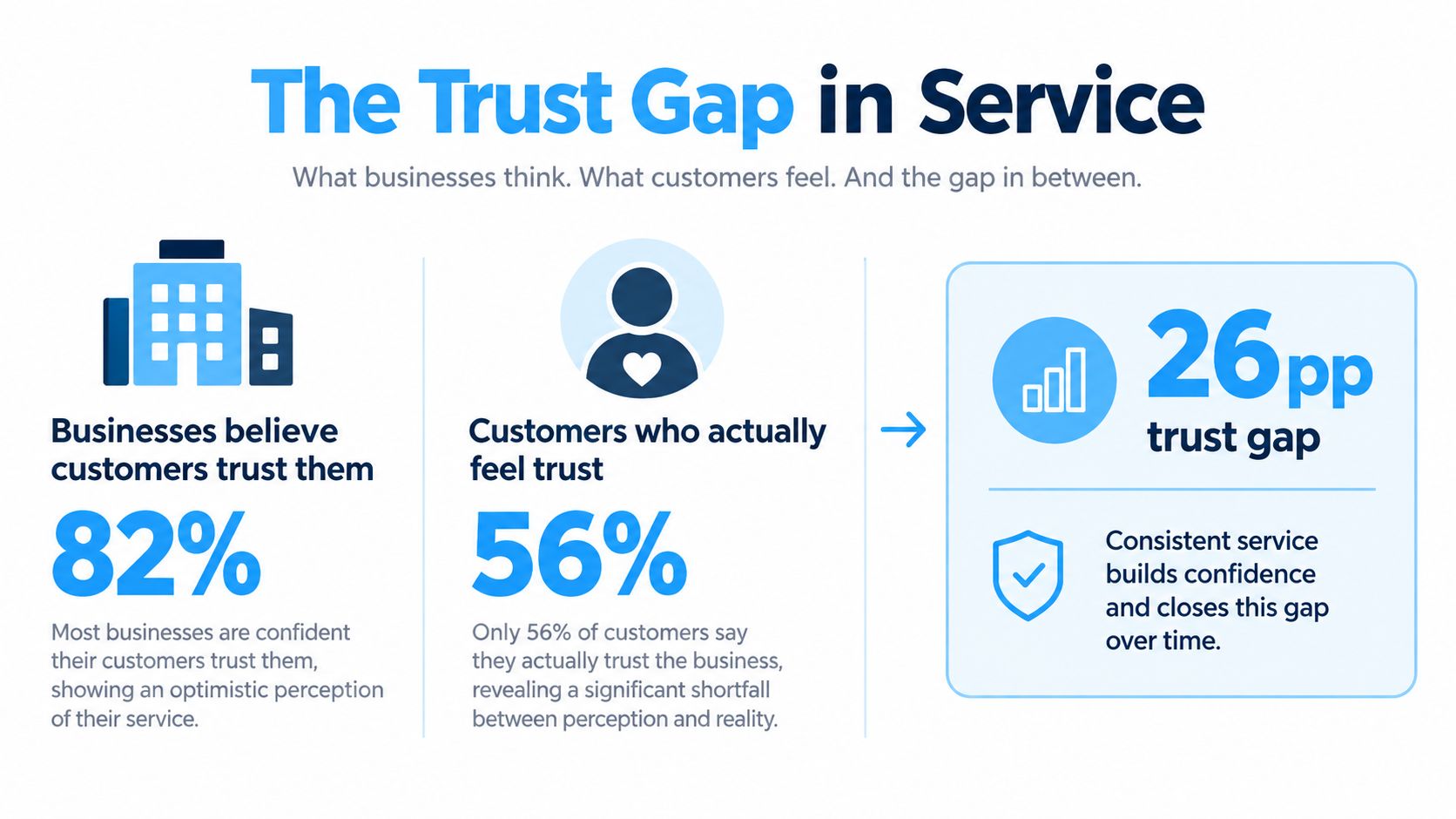
Businesses often assume customers trust them more than they do. PwC's 2024 Trust in US Business Survey found that 90% of business executives believed customers highly trusted their companies, while only 30% of consumers did, a 60-point gap. That difference matters in cannabis retail because internal confidence doesn't verify a label, correct an inventory error, or resolve a missed handoff.
A dispensary can believe it offers excellent service while customers experience something else. The customer sees whether the menu is current, whether the recommendation fits the stated goal, whether the order is complete, and whether the business takes responsibility when something goes wrong. Those repeated details shape trust more powerfully than a single impressive visit.
Reliability is a repeatable promise
The Institute of Customer Service reports that 94% of customers consider trust in an organization's customer service important or very important, 67% agree that high trust makes their experience better, and 41% strongly agree that customer service strongly influences their trust in an organization. These figures come from the Institute of Customer Service customer trust research, which describes reliability as consistency in delivering the service promise and accountability for putting things right.
For a local retailer, the practical lesson is direct. A dispensary that gets your order right repeatedly is more dependable than one that creates a memorable first visit but becomes unpredictable afterward. Customers value accurate information, steady communication, and issue resolution across employees and channels.
That same principle applies to internal operating standards. Businesses that need a more formal framework can study how to enforce accountability with SLA compliance, then adapt the idea to response times, inventory updates, order readiness, and delivery communication. A dispensary doesn't need corporate jargon to work this way. It needs clear promises and a process for checking whether the team keeps them.
What consistency looks like locally
For Long Island shoppers, consistency might mean the following:
- The online menu reflects the products that are available.
- A staff member confirms the product, format, and potency before checkout.
- A pickup order is organized so the customer doesn't have to rebuild it at the counter.
- A delivery issue receives a clear response instead of silence.
- A product concern is handled with accountability and practical next steps.
Dependable service closes the trust gap through repeated proof. Customers don't have to take the business's confidence on faith. They can observe whether the operation follows through.
Verifying Lab Testing and Product Transparency
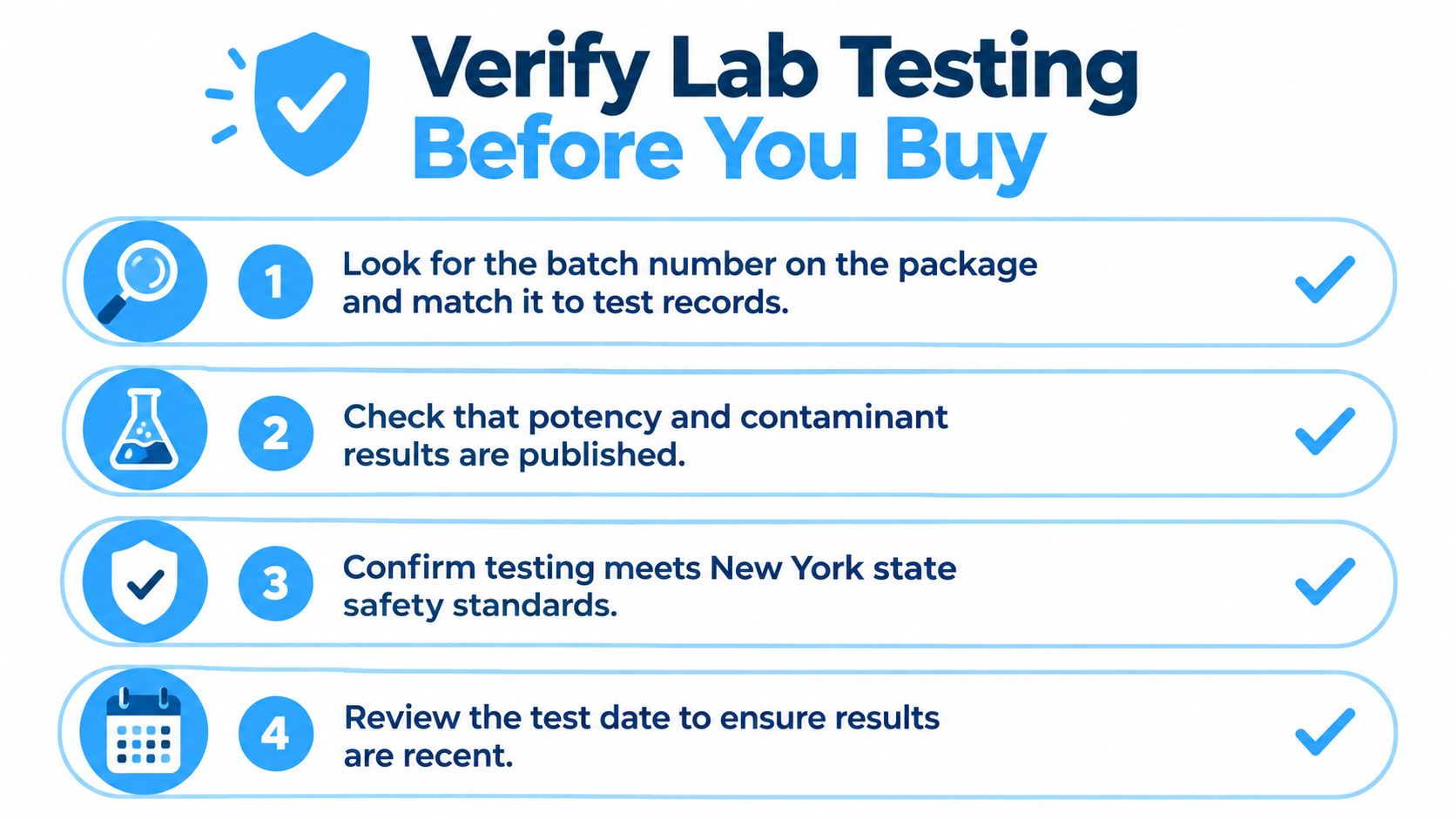
“Lab-tested” should never be the end of the conversation. New York requires regulated adult-use cannabis products to carry a universal symbol and a QR code or link to a Certificate of Analysis, or CoA, so consumers can verify that the product was tested and accurately labeled for potency. The New York consumer delivery FAQ explains this verification path.
Four checks before you buy
Start with the package. Find the batch or lot information, product name, and required universal symbol. The information should be legible and consistent with the item displayed in the store.
Scan the QR code or open the linked CoA. The report should correspond to the product and batch in your hand. If the code leads nowhere, points to unrelated information, or doesn't provide meaningful test results, ask the dispensary to explain why.
Read beyond potency. New York's testing standards cover contaminants including microorganisms, foreign material, metals, microbial impurities, moisture content and water activity, mycotoxins, pesticides, residual solvents, and terpenoids. The New York adult-use cannabis testing limits show why a CoA represents more than a generic purity claim.
Compare the report with the label. Check that the product identity and potency information align. For flower, vapes, concentrates, and edibles, the format changes how the information should be understood, but the basic principle stays the same: the package and test record should tell the same story.
Quality check: If a store can't help you locate the CoA, don't let a premium-looking package make the decision for you.
You can also use the broader concept of transparent operational documentation as a useful benchmark. A resource such as OrderOut's Labs page for restaurants illustrates how businesses can organize information about testing and operational support for customers. The cannabis-specific requirement remains the important standard here, not the category of the comparison.
Strong Strains' guide to cannabis lab testing offers another consumer-focused reference for reviewing test information. The goal isn't to turn every purchase into a laboratory exercise. It's to make verification a normal part of buying regulated cannabis.
A dependable dispensary won't treat testing records as hidden paperwork. Staff should be comfortable showing customers where the information is, explaining what the report covers, and acknowledging when a question requires a closer look.
Budtender Expertise and Personalized Guidance
A knowledgeable budtender doesn't start with the product they want to move. They start with your intended experience. Are you looking for relaxation, creativity, relief, or sleep? Do you prefer flower, a vape, a pre-roll, an edible, a tincture, a topical, or a concentrate? How familiar are you with the format and potency?

Consider a first-time customer who wants an approachable evening option. A responsible consultation might compare a lower-intensity format with a tincture or edible, explain how the format affects the experience, and encourage the customer to follow the package directions. The budtender shouldn't promise a specific feeling or pressure the shopper toward the strongest item.
An experienced customer may ask about concentrates, terpene profiles, or high-potency flower. That person might want to compare Alien Labs, Cookies, or Connected with a different option from MFNY or American Hash Makers. Dependable guidance doesn't only list brand names. It connects the product's format and characteristics to what the customer already knows and what they want to do next.
Advice should be consistent, not scripted
Good questions reveal whether the employee is advising or upselling:
- What outcome do you want? Relaxation, sleep, creativity, relief, or something else?
- What formats work for you? Flower, vapes, edibles, tinctures, concentrates, or topicals?
- What have you tried before? Past experience helps avoid unsuitable recommendations.
- How important is convenience? A pre-roll may suit one routine, while a tincture may suit another.
- What does the label tell us? The package and CoA should support the recommendation.
The customer should leave with a clear understanding of the selection, not a blur of strain names. Strong Strains Cannabis Dispensary is one local option that offers handpicked cannabis products, accessories, pickup, delivery, and guidance from experienced budtenders. Its approach is practical, with recommendations organized around the customer's preferred format, potency, and intended use.
For introductory product education, this guide to cannabis strains for beginners can help new shoppers prepare better questions before visiting.
A short visual explanation can reinforce the same principle:
The reliable budtender also knows when to slow down. Cannabis advice should respect adult-use rules, responsible consumption, personal differences, and the limits of what a retail employee can promise. Expertise is not sounding certain about everything. It's giving accurate information and making the customer's decision easier.
Navigating Pickup and Delivery Reliability
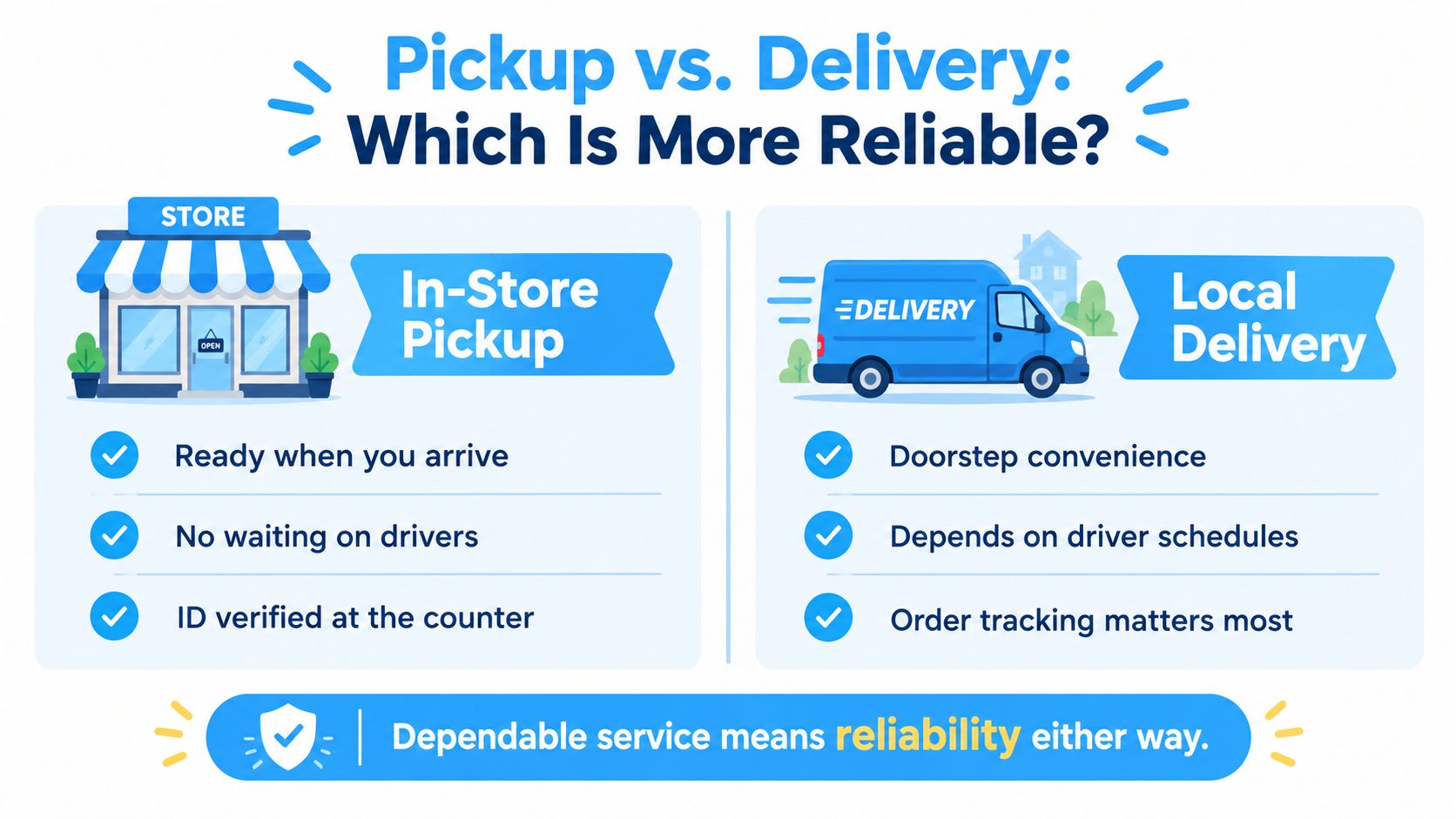
Pickup and delivery solve different problems. In-store pickup gives you more control over timing at the final handoff. Local delivery saves a trip and can suit customers who value privacy or convenience. Neither option is automatically dependable. The deciding factor is whether the dispensary manages the order accurately from menu selection through identity verification.
Pickup works best when preparation is real
A dependable pickup process confirms the product, quantity, and customer details before arrival. The order should be packed correctly, held securely, and ready for a straightforward counter check. The customer shouldn't discover that the menu listing was stale or that a substitute was made without communication.
Review the online ordering process before placing an order if you want to understand what information to have ready. Bring the required identification and check the order before leaving. A quick review catches errors while the staff can still correct them efficiently.
Delivery requires tighter handoffs
New York delivery rules prohibit cannabis delivery to public spaces, public buildings, community centers, school grounds, day-care centers, and houses of worship. Delivery must go only to the person who placed the order, with identity and age verified at delivery, as stated in the New York Office of Cannabis Management compliance reminders.
That makes delivery reliability a compliance issue as well as a convenience issue. The store must pack the right order, communicate where the handoff can occur, coordinate the driver, and verify the recipient at the door. If any part of that chain is vague, the customer experiences uncertainty.
Choose pickup when you want direct control over arrival and inspection. Choose delivery when the convenience outweighs the need to coordinate a compliant handoff. In both cases, dependable service means accurate order records, clear status updates, secure packaging, and a support contact that responds when something changes.
Hours, Communication, and Community Perks
Dependable service has to fit real schedules. A dispensary that closes before customers finish work or takes too long to answer basic questions creates friction even when its products are strong. Extended evening hours, responsive contact options, and accurate order updates make the relationship usable rather than merely attractive.
Communication should be specific. A good reply confirms whether an item is available, explains what happens next, and gives the customer a clear way to follow up. A vague “we'll look into it” doesn't help someone deciding whether to drive across Suffolk County or wait for delivery.
Accessibility is part of quality
Local customers may need help with a product question, an online order, or a delivery detail. They shouldn't have to repeat the entire issue across multiple messages. Staff should keep the relevant context, use plain language, and correct errors without making the customer argue for attention.
A practical operating standard includes:
- Visible hours: Customers can see when the store is open, including evening availability.
- Useful contact options: Email, phone, and on-site support should lead to real assistance.
- Order visibility: Customers can check whether an order is received, being prepared, or ready for handoff.
- Clear changes: Substitutions, delays, and unavailable products should be communicated before they become surprises.
Loyalty perks should reinforce that consistency. A newsletter can give members early notice of new releases, exclusive deals, top sellers, and premium drops. That communication is valuable when it remains accurate and doesn't turn into a stream of unclear promotions.
Customer retention works the same way in other appointment-based local businesses. A resource on beauty salon customer retention offers a useful comparison, because repeat business depends on recognition, timely communication, and a reason to return. Cannabis retailers should apply those principles without compromising responsible education or regulatory compliance.
Strong local relationships grow from small promises kept repeatedly. Customers remember whether staff respected their time, whether recommendations made sense, and whether the store remained helpful after checkout.
Your Quick Checklist for Choosing a Dispensary
Use this checklist before you place an order or make a purchase. You don't need to interrogate the staff. A dependable dispensary should make these answers easy to find.
Product checks
- Check the package: Look for the New York universal symbol, product identity, batch details, and a QR code or link to the CoA.
- Match the records: Confirm that the CoA corresponds to the product and batch you're holding.
- Read the full testing scope: Don't stop at potency. Look for information addressing contaminants covered by New York standards.
- Inspect the label: Product format, potency, ingredients, and other required information should be clear and consistent.
Service checks
Ask one useful question and watch how the employee responds. A strong budtender will ask about your desired effects, experience, preferred format, and tolerance rather than immediately pushing the most expensive or potent option.
The recommendation should come with practical context. You should understand why a flower, vape, pre-roll, edible, tincture, topical, or concentrate fits your needs and how to approach the product responsibly. If the answer relies on hype instead of information, keep looking.
Customer test: You should leave knowing what you bought, why it fits, and where to find the supporting information.
Fulfillment checks
For pickup, confirm that the order is accepted and that the listed products are being held for you. For delivery, confirm the permitted destination, recipient requirements, identification process, and how the dispensary communicates status changes.
A compliant retailer won't treat age verification as an inconvenience. New York adult-use cannabis sales are for customers 21 and older, and a responsible business makes that requirement clear before the handoff. The same business should explain what happens if nobody eligible is available to receive the order.
Finally, evaluate the recovery process. Ask yourself whether the staff would help if an item were missing, the menu were inaccurate, or the delivery plan changed. Dependable service isn't the absence of every problem. It's accurate prevention, prompt communication, and accountable resolution when problems occur.
Visit Strong Strains Cannabis Dispensary at 19 Technology Drive in East Setauket for lab-tested cannabis, knowledgeable product guidance, and convenient pickup or local delivery. Check the product details, ask the questions that matter, and choose a cannabis experience built on transparent testing and dependable follow-through.