
You're staring at a package labeled 100 mg THC, trying to work out whether that means one powerful gummy, ten ordinary servings, or something in between. The label can be confusing, especially when a friend says the same amount feels manageable while another person spends the evening anxious, nauseated, and unable to focus.
The honest answer to what will 100 mg edible do is that the number alone doesn't predict the experience. Tolerance, product design, onset timing, and dose accuracy all matter. For most adults, though, 100 mg is a very high amount, not a beginner serving. The safest way to understand it is to treat 100 mg as a predictability problem first and a potency question second.
What 100 mg Actually Means as an Edible Dose
A person sees “100 mg” on a wrapper and may assume the entire product is one serving. In a regulated product, that label often refers to the total THC in the package, not the amount intended for one sitting. If the package contains ten 10 mg pieces, eating the whole package means consuming ten separate 10 mg servings at once.
That comparison matters because a typical intoxicating edible dose is commonly described as 10–30 mg THC, while Canada's regulated market limits an individual edible package to 10 mg THC. Canadian lower-risk guidance also advises ingesting no more than 10 mg THC when choosing edible cannabis products. These figures are summarized in a peer-reviewed edible cannabis review and the accompanying public-health discussion at this guide to 100 mg THC edible effects and dosing.
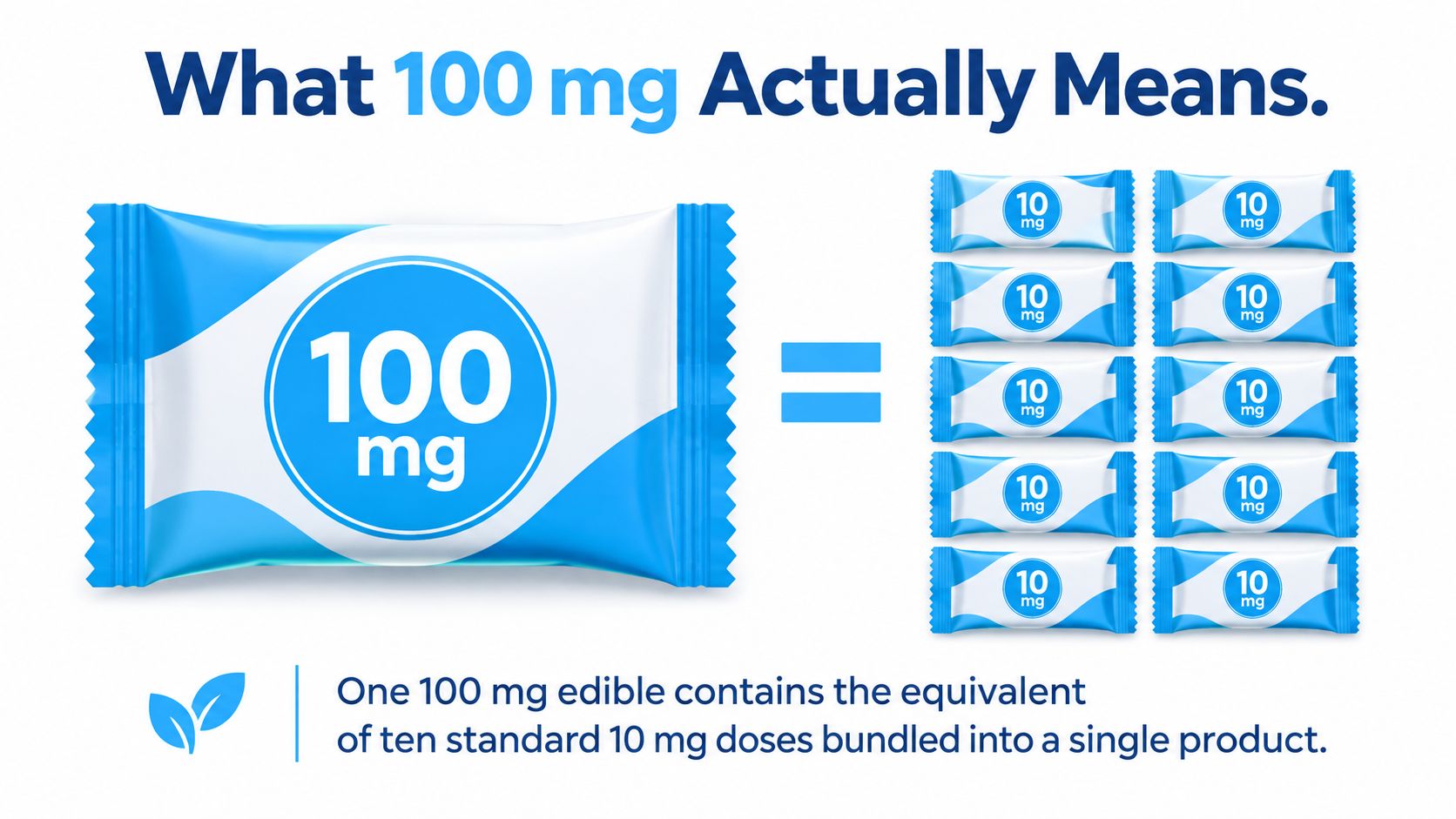
The simple math
Think of a coffee cup. One cup may feel ordinary to someone who drinks coffee regularly. Ten cups in a short period is a completely different experience, with a much greater chance of unpleasant effects. The same basic logic applies when you consume ten 10 mg THC servings together.
| Amount | Plain-language meaning |
|---|---|
| 10 mg | One common regulated serving |
| 10–30 mg | Typical intoxicating range described in the review above |
| 100 mg | Roughly three to ten typical intoxicating doses |
Milligrams measure the amount of THC in the product, not a personalized dose based on body weight. A 100 mg edible contains the same labeled amount whether the consumer weighs 120 pounds or 220 pounds. Weight, metabolism, tolerance, food intake, and other factors can influence the experience, but they don't change the THC content printed on the package.
For a clearer way to compare products, use this cannabis dosage chart. The central takeaway is simple: 100 mg is generally a high-dose format, and it sits far above the single-sitting amounts used in many harm-reduction recommendations. Some legal markets sell 100 mg as a package maximum, with the contents divided into smaller servings, rather than presenting the entire amount as a normal individual dose.
Onset, Peak, and Duration You Should Expect
Swallowed THC doesn't behave like inhaled cannabis. With an edible, your digestive system processes the product before THC reaches the bloodstream, and the liver converts some THC into 11-hydroxy-THC, a metabolite associated with the delayed, extended character of oral cannabis effects.
The first effects often begin after 30 to 90 minutes, although some people may wait up to about 2 hours, as described in this edible potency and effects timeline. A full stomach may make the timing feel less predictable. The delay doesn't mean the edible isn't working. It means absorption is still unfolding.
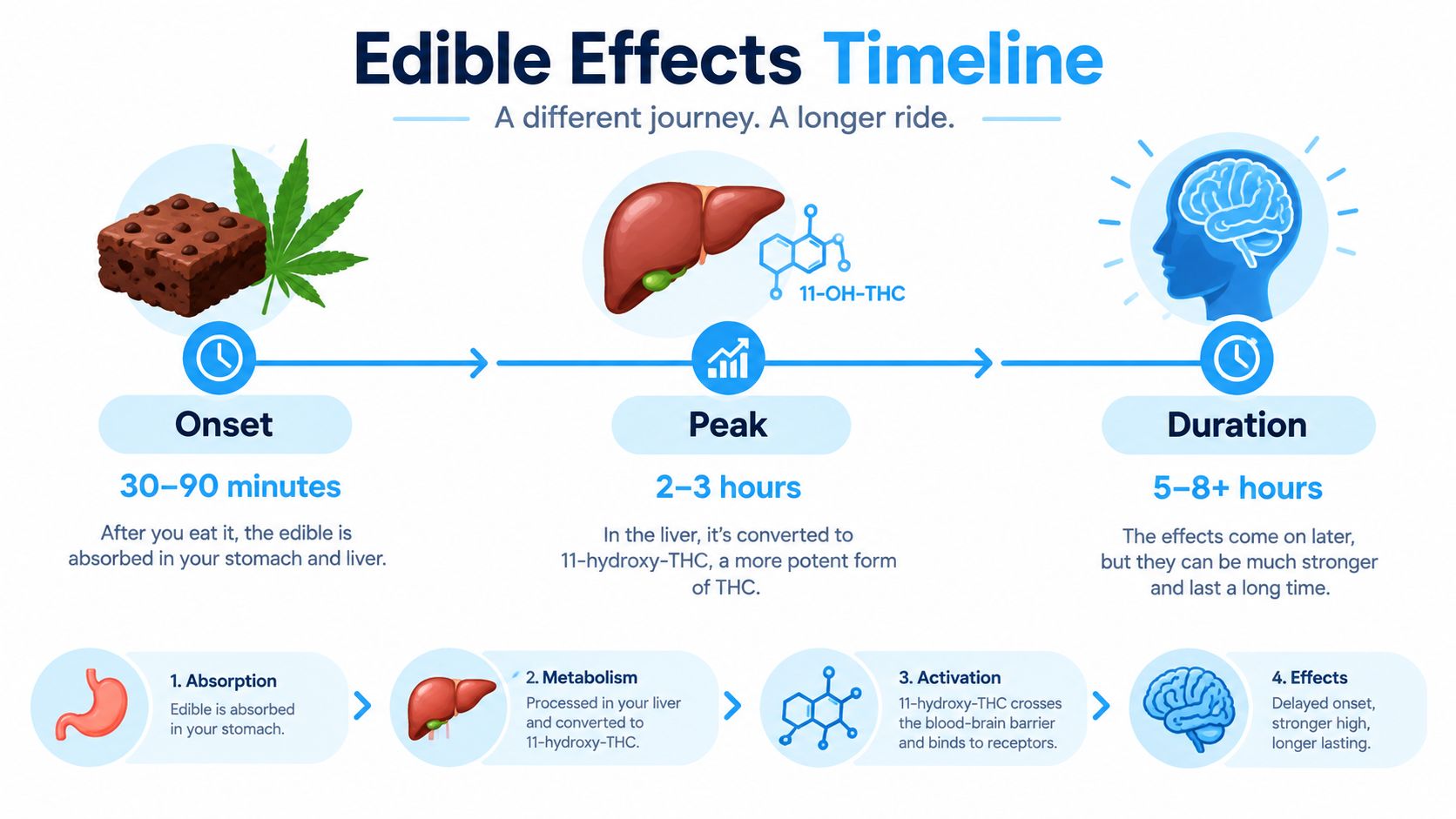
A practical clock
- First hour: You may feel nothing, or you may notice subtle warmth, relaxation, or a change in mood. This is the point when many people make their biggest mistake by assuming the dose was too weak.
- Two to four hours: Effects commonly become strongest during this window. For someone with limited edible experience, this is when sedation, altered time perception, anxiety, disorientation, or nausea may become much more obvious.
- Six to twelve hours or longer: High-dose effects can continue for much of the day or night. Oral THC research describes subjective and cognitive effects lasting roughly 6–8 hours, with impairment sometimes lasting 8 hours or longer, while high-potency dosage guides commonly describe a 6–12+ hour experience. See the peer-reviewed review of oral THC pharmacology and effects.
The classic stacking mistake looks like this: someone eats 100 mg, feels little at 60 minutes, and takes more. The original dose may still be moving toward its strongest point, so the second dose lands on top of an experience that hasn't peaked.
Practical rule: Don't use the first hour as your measuring stick. Edibles reward patience, not impatience.
British Columbia's public guidance explains that edible effects may not be felt for 2 hours and may take 4 hours to peak, so consumers shouldn't take more right away. You can find that advice in the provincial cannabis edibles safety sheet, and you can use this guide to how long edibles last when planning a session.
How It Feels for First-Time, Occasional, and Tolerant Users
The same labeled amount can feel very different across three people. That doesn't make the label meaningless. It means the label tells you how much THC is present, while tolerance and individual sensitivity help determine how that amount feels.
A first-time consumer with no tolerance may experience a heavy, disorienting high. Euphoria can shift into anxiety or paranoia, coordination may become difficult, and a racing heartbeat, dizziness, nausea, or vomiting can occur. The person may spend much of the 8–12+ hour period wanting the effects to end rather than enjoying them.
An occasional consumer, someone who uses cannabis only now and then, may recognize the effects but still find 100 mg far beyond their comfortable range. Expect pronounced cognitive fog, impaired coordination, strong sedation, and a possible next-day sluggish feeling. Occasional inhaled cannabis experience doesn't automatically translate into edible tolerance because the body processes the two formats differently.
A daily consumer with established high tolerance may describe 100 mg as mild to moderate, perhaps comparable to a single beer for a heavy drinker. That comparison describes subjective intensity, not safety. Tolerance may reduce how impaired the person feels, but it doesn't eliminate concerns about delayed redosing, medication interactions, cardiovascular symptoms, or being unable to respond well if the product is stronger than expected.
Likely effects by profile
| User Profile | Subjective Effects | Duration | Risk of Overwhelm |
|---|---|---|---|
| First-time user | Intense euphoria, dizziness, anxiety, paranoia, racing heart, possible nausea or vomiting | Often a long, uncomfortable ride lasting many hours, with high-potency guides describing 8–12+ hours | Very high |
| Occasional user | Strong intoxication, cognitive fog, impaired coordination, heavy relaxation, possible next-day sluggishness | A substantial portion of the day or evening, with residual effects possible | High |
| High-tolerance daily user | Potentially milder relaxation, sedation, or functional effects, though the response remains individual | Extended oral effects remain possible even when the high feels manageable | Lower, but not absent |
Tolerance is also not a reliable shield against product inconsistency. A survey cited in peer-reviewed research found self-reported THC doses ranging from 0 to 500 mg across product types, and many participants didn't know their typical THC dose, particularly with baked goods. The broader lesson is that “I can handle 100 mg” may describe one product and one day, not every edible carrying that label. Read the research on edible cannabis use, dosing knowledge, and product variability for that wider context.
Common Adverse Reactions and When to Get Help
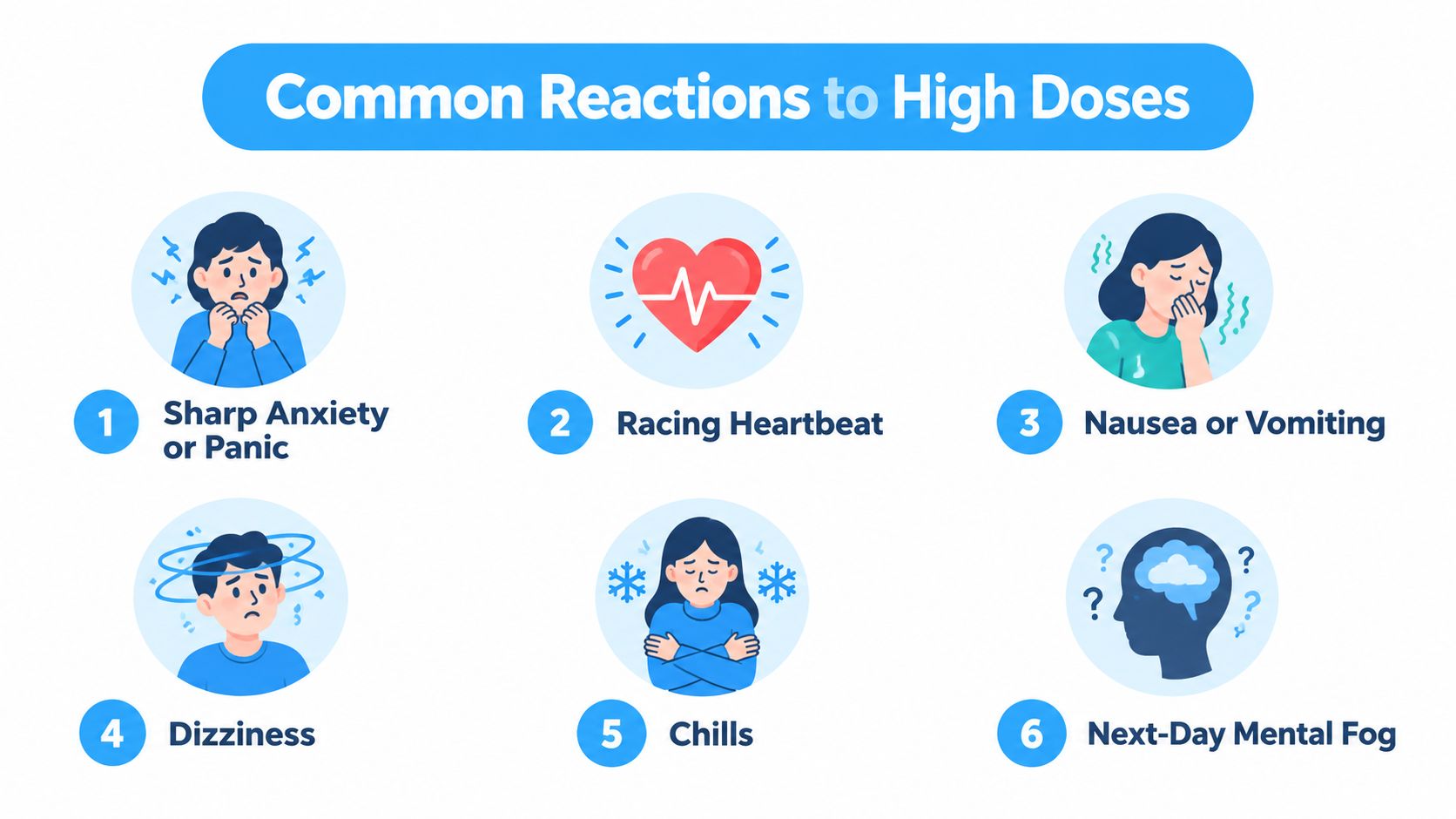
A high-dose edible can feel physically and mentally intense without automatically meaning something catastrophic is happening. Common reactions include sharp anxiety or panic, a racing heartbeat, nausea or vomiting, dizziness, chills, and next-day mental fog. The experience can be frightening because THC changes time perception, so a short period may feel much longer.
A calm setting helps. Move away from bright screens and noisy rooms, sit or lie somewhere comfortable, take small sips of water, and eat a light snack if that feels manageable. Fresh air can help some people feel grounded, and a sober, trusted person can provide reassurance without adding more stimulation.
Uncomfortable versus urgent
Usually manageable: anxiety, drowsiness, mild dizziness, temporary paranoia, dry mouth, chills, and nausea that settles with rest and hydration. Time is the main remedy, and the strongest effects generally ease as the peak passes.
Get medical help: chest pain that doesn't ease, vomiting that prevents hydration, fainting, confusion that continues for hours, or any suicidal thoughts. Don't let embarrassment delay care. Tell medical professionals what was consumed and when, especially if alcohol, prescription medicine, or another substance was involved.
A person who feels overwhelmed should not drive to seek help alone. Call emergency services for an immediate danger, severe chest symptoms, loss of consciousness, or a mental-health emergency. Keep the product package available so responders can see the labeled THC amount and other ingredients.
The best response isn't to fight the sensation with another intoxicant or take more cannabis to “balance it out.” Reduce stimulation, stay with the person, monitor their condition, and allow the body time to process the edible.
Splitting the Dose and Microdosing 100 mg Edibles Safely
A 100 mg package becomes more manageable when you treat it as a supply of smaller portions rather than one serving. The goal is repeatable dosing, not perfect precision from a kitchen knife. If the product is already divided into labeled pieces, use the per-piece amount shown on the package instead of guessing from the total.
For an unscored gummy, chocolate, or baked item, use a clean cutting tool and work on a stable surface. A 100 mg product divided evenly into ten portions would produce portions of 10 mg each, while smaller cuts can create lower amounts such as 5 mg or 2.5 mg. Those amounts are arithmetic targets, not a guarantee, because homemade or unevenly infused products may not distribute THC perfectly.
A safer portioning routine
- Check the label first. Confirm whether 100 mg refers to the entire package, one piece, or a serving group. Look for serving guidance and testing information.
- Score or cut carefully. Use the product's existing lines when available. For gummies, a clean knife can help. For chocolate or baked goods, cut along natural sections, but remember that visual size doesn't prove equal THC distribution.
- Choose a small portion. A 5 mg portion gives many adults a more controllable starting point than the entire product. Don't treat it as permission to redose quickly.
- Store leftovers securely. Put remaining pieces in a clearly labeled, child-resistant container, away from children and pets. Keep the original packaging nearby so the product identity and THC information aren't lost.
The same principle applies when comparing edibles with other formats. A guide to cannabis tincture benefits can help explain why some adults prefer formats that allow more direct control over a serving.
If you're portioning an edible, use a labeled container and avoid leaving loose pieces on a counter, nightstand, or refrigerator shelf. Never describe an infused item as ordinary candy or food. Accidental ingestion is especially concerning for children and pets, whose response may differ sharply from an adult's.
This short visual walkthrough reinforces the same process:
Why Most Adults Do Better with Lower-Dose Edibles
Lower-dose products offer something a 100 mg single piece can't: control after the first serving. A 2.5 mg, 5 mg, or 10 mg portion lets an adult observe the onset and decide whether that experience fits the evening. Once someone swallows 100 mg, the choice is no longer adjustable.
That control also suits the way many adults use cannabis. A person may want gentle relaxation after work, a calmer social setting, help winding down, or a measured wellness routine. A maximum-intensity experience can interfere with all of those goals, particularly when the peak arrives hours after the product seemed mild.
Industry reporting cited in the brief says 42% of edible consumers prefer 10 mg or less, with 2.5–5 mg described as the most popular range. That finding points toward a broader shift from maximum potency to functional, repeatable dosing. You can review the source's discussion of cannabis industry trends and edible preferences.
Comparing the practical tradeoff
| Factor | Single 100 mg Edible | 5–10 mg Lower-Dose Pack |
|---|---|---|
| Control | Limited once consumed | Easier to adjust between servings |
| Onset decision | A single high-stakes choice | More gradual decision-making |
| Portion accuracy | May require cutting | Individual labeled pieces can simplify serving control |
| Likely fit | Consumers with established high tolerance | Beginners, occasional users, and adults seeking repeatability |
| Waste and value | Can be useful when intentionally divided | Often easier to match to the amount actually wanted |
Comparing cost per active milligram can help, but the cheapest labeled THC isn't always the best value. A product that sits unused because each serving feels too strong may offer less practical value than smaller pieces that fit your routine. Likewise, a 100 mg package can make sense as a bulk format for careful splitting, but it shouldn't be mistaken for a recommendation to consume the package at once.
Lower dose doesn't mean no effect. It means the consumer has more room to learn their response without committing the entire evening to an amount that may be difficult to reverse.
Smarter Shopping and Responsible Use Checklist
The shopping decision starts before the checkout counter. Look for products with clear THC labeling per serving, not only a total package amount. Products from a regulated dispensary should provide packaging information that helps you distinguish a 100 mg total package from a 100 mg individual piece.
Use this checklist when comparing products:
- Read the serving panel: Confirm the THC amount per piece and the total amount in the package.
- Look for testing details: Prefer products with accessible batch-testing or lab-report information.
- Compare practical value: Consider the price per milligram, but also whether the serving size fits how you actually use cannabis.
- Choose smaller increments: Options around 2.5–10 mg can provide more control than a single high-potency piece.
- Question uncertain potency: Homemade or black-market edibles may not provide dependable serving information, so their labeled amount shouldn't be treated like verified regulated packaging.
- Plan the setting: Eat a meal if that normally helps your stomach, clear your schedule, and remain somewhere you don't need to drive.
- Avoid combinations: Don't mix THC with alcohol or other sedating substances, since combined effects can become harder to predict.
- Secure the product: Keep edibles in their original, clearly labeled packaging and store them away from children and pets.
A legal package limit doesn't automatically make the full package a sensible serving. Oregon's rules illustrate the distinction clearly: recreational edibles may contain up to 100 mg THC per package, while the serving limit is 10 mg THC, as described in the Oregon potency and resource bulletin. In other words, “available for sale” and “appropriate to consume at once” are separate questions.
For Long Island shoppers, Strong Strains Cannabis Dispensary offers lab-tested edibles and product guidance, including lower-dose options and packages that identify per-piece THC amounts. Ask a budtender to help compare the label, serving format, and timing rather than choosing only by the largest milligram number.
The most responsible answer to what will 100 mg edible do is that it may produce a long, intense, and unpredictable experience, especially without established edible tolerance. Start with a product and portion you can measure, wait through the delayed onset, and keep the rest secured for another day.
If you're shopping on Long Island, visit Strong Strains Cannabis Dispensary to compare clearly labeled edibles, lower-dose formats, and other cannabis products with guidance from knowledgeable budtenders. Ask the team to help you choose a serving size that matches your tolerance, schedule, and comfort level.