
Most kief tests between roughly 40% and 70% THC, with grinder kief often landing closer to 30% to 45% and refined dry sift pushing past 70%. The label alone doesn't tell the whole story, because the reported number may describe THCA, total THC, or a product mixed with enough plant material to lower its concentration.
What does a kief THC percentage really tell you when two jars use the same word but look, feel, and test completely differently? A scoop from a grinder catcher isn't the same material as carefully screened dry sift, and neither should be judged by the same expectations as a lab-verified full-melt product.
The practical answer is to treat kief as a concentrated cannabis product, not as loose flower dust. Its strength depends on trichome purity, collection method, storage, and the way the laboratory reports cannabinoids. Once you understand those pieces, a number such as 39.09%, 60%, or 75% becomes useful rather than confusing.
What Kief Is and Why THC Numbers Vary So Much
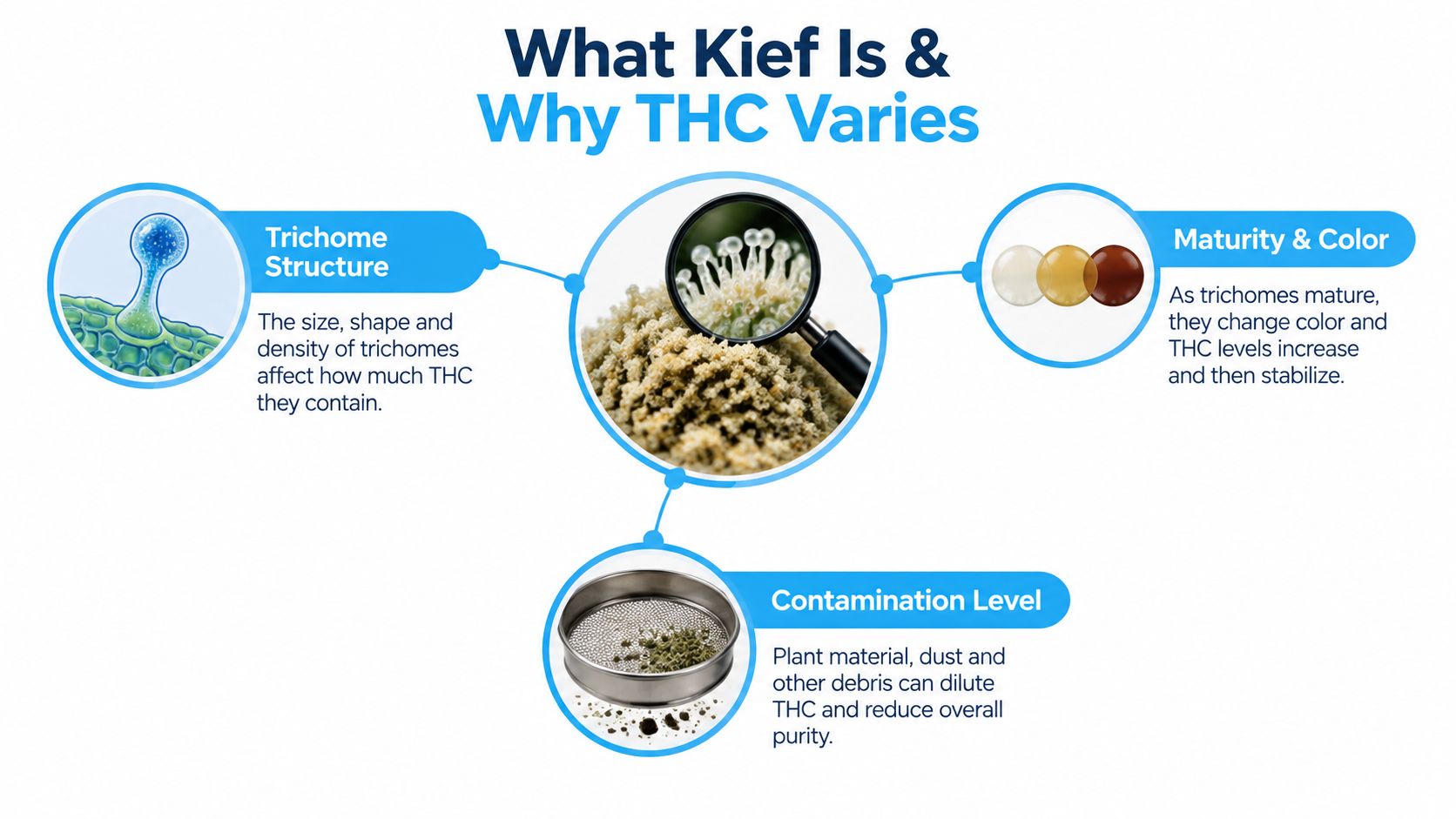
What does a kief THC percentage mean when the same label can cover grinder dust, dry sift, or full melt? Kief is a category of cannabis material, not one standardized product. It consists of loose trichome heads and stalks, the small resin-producing structures that separate from flower during grinding, agitation, or sifting. These glands hold much of the plant's cannabinoids and terpenes. Leaf and flower tissue add plant matter, which lowers the concentration. Mood's explanation of kief describes kief as a concentrated collection of cannabis trichomes and discusses commonly cited potency around 40% to 80% THC.
The collection method changes what lands in the jar. A household grinder catcher may contain resin glands, green particles, and fine flower dust. Screened dry sift separates material more selectively. Full melt represents a cleaner, more resin-rich form, although the label alone cannot confirm its grade. In practical terms, these products share a name but can differ like loose flour, sifted flour, and compressed dough.
The variables behind the label
Several factors shape the final reading:
- Genetics: Cultivars produce different amounts and types of resin.
- Trichome maturity: Harvest timing affects gland condition and cannabinoid content.
- Drying and curing: Handling can preserve or damage resin and aroma compounds.
- Collection method: Grinder catchers, dry sift, and other mechanical processes gather different proportions of trichomes and plant matter.
- Storage: Heat, light, air, and age can change the product before testing or use.
A kief pollen press guide shows how pressure turns loose material into a denser form. Pressing changes texture and handling, but it does not remove plant matter or correct a lower-purity starting material.
Practical rule: Read “kief” as a description of material, not a potency guarantee.
That is why 35% and 75% can both be plausible results. The lower figure may reflect more plant matter, while the higher one may come from carefully separated, resin-rich material. To judge the number, check whether the certificate reports THCA, THC, or total THC, then look for the product type, laboratory result, and testing details. The front label rarely identifies all of them.
Typical Kief THC Percentage Ranges and What the Numbers Mean
A useful working range for kief is about 30% to 80% THC, but each tier reflects a different product. Contemporary product education repeatedly places commercially common kief around 50% to 60% THC, with high-grade examples often described in the 60% to 80% range. Oregon Hempflower's potency guide also emphasizes that collection method and product quality can produce a broad spread.
The lower end often describes grinder-collected material, which may test around 25% to 40% THC when plant matter makes up a larger share. A separate practical breakdown places commercial dry sift around 35% to 50%, while high-end full-melt dry sift can exceed 60%. Royal King Seeds' kief glossary provides those distinctions. Because the verified sources use overlapping categories, it's better to think in bands than to treat any one cutoff as universal.
| Kief Grade | Typical THC % | Texture and Color | Best Use |
|---|---|---|---|
| Grinder-collected kief | About 25% to 40% | Often greenish, dusty, and loose | Lightly topping flower |
| Commercial dry sift | About 35% to 50% | Tan to golden, sandy, and more uniform | Mixing into bowls or joints |
| Common commercial kief | About 50% to 60% | Powdery, resinous, and moderately clean | Controlled enhancement of flower |
| Refined dry sift | About 60% to 80% | Pale gold, soft, and more melt-prone | Experienced concentrate users |
| Older or heavily handled material | Variable, potentially below earlier readings | Dry, darkened, or compacted | Only with current testing and cautious dosing |
The texture gives you clues, but it can't replace a COA. Green material usually suggests more plant contamination, while pale, uniform material often indicates cleaner separation. Neither appearance proves potency, and a visually attractive sample can still have an unhelpful or outdated test result.
Higher THC also doesn't automatically mean a better experience. Some shoppers prefer a lower-potency sift with a clear aroma and manageable dose control. A higher result can make a small mistake more uncomfortable, especially when the product is sprinkled unevenly through a joint or bowl. A dispensary may stock multiple kief products at different price points because they represent different levels of separation, source quality, and testing transparency.
How Labs Measure Kief Potency and What the Label Really Shows
The most important COA calculation is the conversion from THCA to total THC:
Total THC = (%THCA × 0.877) + %delta-9 THC
That formula appears in current kief potency education from Oregon Hempflower. Raw kief commonly contains THCA, the acidic precursor that converts into active THC when exposed to heat. The 0.877 factor accounts for the mass lost during that conversion, so a label showing THCA isn't identical to a label showing already active delta-9 THC.
Suppose a COA lists 60% THCA and no meaningful delta-9 THC figure. Applying the formula gives a potential total THC contribution of 52.62% before considering practical losses during smoking, vaporization, or cooking. That calculation is more transparent than treating the raw THCA number as if every gram becomes the same weight of active THC.
What to inspect on a COA
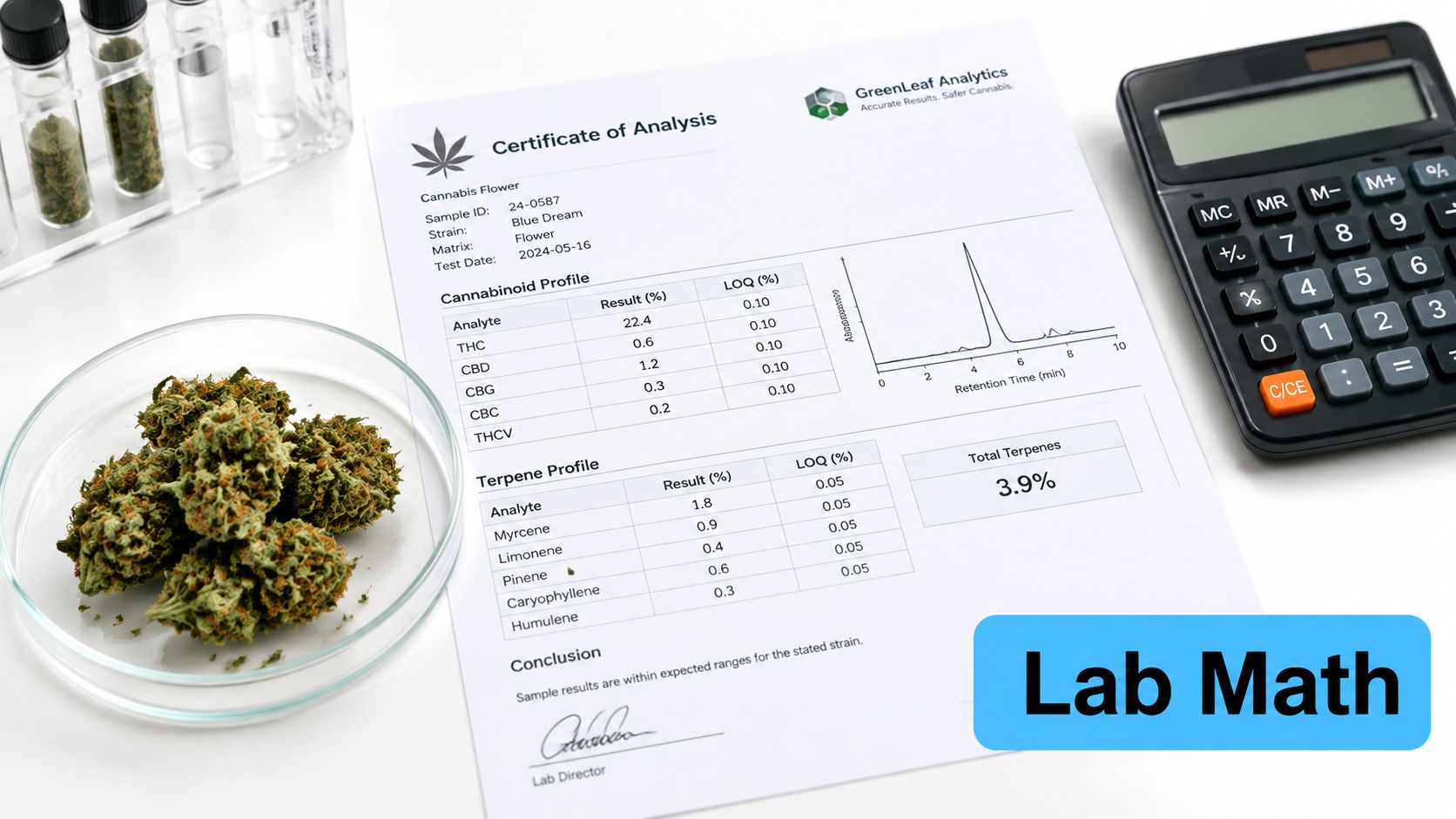
Look for these fields before you compare products:
- THCA: The acidic cannabinoid measured in the unheated sample.
- Delta-9 THC: THC already present in the sample.
- Total THC: The calculated potential after THCA conversion.
- Testing method: HPLC generally distinguishes THCA from delta-9 THC without heating the sample, while GC uses heat and can change that relationship during analysis.
- Sample and batch identifiers: These should match the package you're holding.
Some people use a shortcut based on assumed decarboxylation efficiency, but that shortcut can blur the difference between lab potential and what your method delivers. The formula above is the cleaner way to compare labels. A potency panel also isn't the same thing as a complete safety panel, so review separate results for pesticides, heavy metals, microbes, and residual solvents when available.
A current cannabis lab testing overview can help you understand why the COA matters beyond the headline percentage. Before buying, scan the package QR code or ask the budtender for the batch document. If the batch number doesn't match, you're looking at the wrong test.
How Kief Compares With Flower and Other Cannabis Concentrates
Where does kief fit when you compare cannabis products by strength and handling? It usually sits between ordinary flower and more refined concentrates, but the label alone does not tell the whole story. Flower is commonly described around 12% to 25% THC, while kief can fall across a broader 30% to 70% range, depending on how much plant material remains and how the resin was collected. A grinder's dusty collection, controlled dry sift, and full-melt sift may all be called kief, yet they are not equally refined.
Hash overlaps with kief because both can preserve mechanically separated resin. Pressing changes the material's density and handling, though, so hash may burn and dose differently. Live resin, rosin, and shatter use different extraction or refinement processes, which makes their potency figures poor one-to-one comparisons with kief.
| Product | Typical THC % | How It Is Used | Equipment Needed |
|---|---|---|---|
| Flower | About 12% to 25% | Smoked or vaporized directly | Pipe, bong, joint, or dry-herb vaporizer |
| Grinder kief | About 25% to 40% | Topped onto flower or mixed into a bowl | Grinder, pipe, or rolling supplies |
| Commercial dry sift | About 35% to 50% | Mixed with flower or used in a concentrate setup | Pipe, joint, or concentrate-compatible device |
| Refined kief or full-melt sift | About 60% to 80% | Used carefully with flower or suitable vaporization | Concentrate-compatible device may help |
| Hash | Variable and overlapping | Smoked with flower or vaporized | Pipe, joint, or hash-capable vaporizer |
The product form also changes the routine. Kief can be sprinkled over flower or mixed through a joint, while a fluid or glassy concentrate may call for a dedicated vaporizer or dab rig. Kief often feels familiar because it rides on flower, but a thick layer can melt, restrict airflow, and burn unevenly. Mixing a small amount through the flower usually spreads the resin more consistently than placing it all on top.
For a broader format comparison, compare cannabis concentrates can help distinguish mechanically separated products from other concentrate types. At a Long Island dispensary counter, ask about the collection method, texture, onset, and dose control. Choosing a lower percentage with even, workable material may make more sense than chasing the highest number. Kief can suit someone who wants more strength than flower without adopting a specialized concentrate routine.
Estimating Kief THC at Home Without Lab Equipment
Without a COA, you can make an educated guess, but you can't produce a reliable lab result from appearance alone. Mesh size offers one useful clue. Finer screens around 73 to 90 microns tend to collect cleaner trichome heads, while screens at 150 microns and above can let more plant material through with the desired resin. These collection details are discussed in the broader kief potency reference from Newsweed.
Start with the collection method. Material gathered passively in a grinder is usually less refined than sift separated through a controlled screen. Then inspect the sample:
- Color: Milky, pale, or amber material may indicate cleaner resin, while green material suggests more plant matter.
- Texture: Fluffy or sandy kief often has loose separation; sticky or compact material may have experienced pressure or warmth.
- Aroma: A strong, fresh scent suggests better terpene preservation, though aroma doesn't establish THC concentration.
- Uniformity: Consistent particles generally make dosing easier than a mix of powder, stems, and leaf fragments.
A sensible home estimate
Use the starting flower and collection method as your baseline, then adjust qualitatively for cleanliness. Grinder material with visible green contamination belongs toward the lower end of the known range. Pale, finely screened material with mature-looking resin belongs higher. A home estimate should be treated as a rough range of 15 to 20 percentage points, not a precise result.
That uncertainty is large enough to change your dose. New York's regulated adult-use market requires legal products to carry testing information, so a dispensary product should offer a printed label or accessible COA. Home testing can't confirm contaminants, batch identity, or the difference between THCA and total THC.
New York possession limits apply to cannabis products regardless of whether you tested material at home. Keep personal estimates for cautious decision-making, not for bypassing regulated product information or legal limits.
Practical Dosing and Safety Guidance for Higher THC Material
How much kief is enough when the label shows a high THC number? Convert the percentage into milligrams first, then remember that the result is a ceiling, not a promise about the amount your body absorbs.
A 0.1 gram portion contains 100 milligrams of material. At 60% potency, that material could contain up to 60 milligrams of THC, calculated as 100 milligrams multiplied by 0.60. Combustion, airflow, inhalation technique, and uneven burning all affect how much reaches you. A whole gram at 60% could contain about 600 milligrams of potential THC, so a small-looking scoop can matter far more than a similar pinch of flower.
Dose slowly: A gram may look small, but high-potency kief can contain hundreds of milligrams of potential THC.
Match the method to the timing
Smoking or vaporizing kief on flower usually produces effects quickly, often within minutes. Edibles follow a slower path. Kief must be activated and infused appropriately, and edible effects may take one to two hours to become clear. Taking more before the first portion has fully developed is a common way to overshoot.
Use the material and your tolerance to set the pace:
- New or low-tolerance consumer: Begin with a rice-grain-sized amount mixed into flower, rather than a dense mound of pure kief.
- Occasional consumer: Use a measured, modest portion and wait at least 15 minutes between inhalations before deciding whether to continue.
- Experienced consumer: Weigh the material, check the total THC value, and increase gradually. A scoop's appearance is a poor measuring tool.
Avoid combining high-THC kief with alcohol. Store it in a cool, dark, airtight container, and keep it away from children or anyone who should not access cannabis. For nighttime use, these THC insomnia insights offer broader context about cannabis and sleep, without replacing individualized medical guidance.
A calculated milligram ceiling does not equal a guaranteed inhaled dose. It describes what the material could contain, while the amount entering your bloodstream depends on the consumption method and your body. If the experience becomes uncomfortable, stop consuming, move somewhere calm, hydrate, and seek medical help for severe or concerning symptoms.
How to Buy Lab Tested Kief at a Local Dispensary
At a licensed counter, ask to see the COA before you compare jars. At Strong Strains in East Setauket, a shopper can ask whether the document matches the package's batch number, product name, and harvest or production information. The point isn't to chase the biggest figure. It's to confirm that the figure belongs to the product you're buying.
Your counter checklist
- Match the batch: The package and COA should use the same batch identifier.
- Separate the measurements: Ask whether the headline number is THCA, delta-9 THC, or total THC.
- Review safety panels: Look for microbial, pesticide, heavy-metal, and residual-solvent results where those panels apply.
- Check the date: A current test is more useful than an unrelated document from an older batch.
- Inspect the package: Missing batch information or a QR code that leads nowhere should prompt questions.
- Compare value: Weigh the gram amount, total THC percentage, and price together instead of using sticker price alone.
Claims above 80% deserve documentation because the verified education range already places refined high-grade kief near the upper end of 60% to 80%. That doesn't prove a higher claim is false, but it does mean the seller should show a matching lab result rather than relying on packaging language.
Ask the budtender where the material came from, whether it is grinder-style collection or dry sift, whether it originated from flower or trim, and what mesh grade was used. You can also ask how the texture is expected to behave in a joint, bowl, or vaporizer. Terpene results are useful when you care about aroma and vaporized flavor, but they don't replace the cannabinoid and contaminant panels.
New York's regulated system is designed to give adult-use shoppers tested, labeled products. The lab-tested cannabis products guide offers additional context for evaluating those documents. Start with the smallest available quantity when trying an unfamiliar kief, then use your own response to guide a later purchase. Legal purchase limits still apply, and a high percentage doesn't change that.
Key Takeaways for Kief Potency and Smarter Buying
Kief THC percentage is a range, not a single identity. Grinder-collected material may fall around 25% to 40%, commercial dry sift often sits around 35% to 50%, common commercial products are frequently discussed around 50% to 60%, and refined material can reach 60% to 80%. Those ranges come from the different proportions of resin and plant matter in each product, not from a universal rule that every jar labeled kief must meet.
The simplest rule at the counter is this:
Estimate milligrams by dividing the percentage by 100, multiplying by the grams you plan to use, then multiplying by 1,000.
For example, 0.1 gram at 60% equals a theoretical 60 milligrams of THC before practical delivery losses. When a COA lists THCA, apply the 0.877 conversion before comparing it with a total THC figure. The calculation helps you avoid treating raw THCA as though it were already the same quantity of active THC.
Three habits make shopping safer and more rational:
- Match the COA: Confirm the batch, product, and cannabinoid values.
- Compare concentration and cost: Look at the amount of material and total THC, not just the package price.
- Dose incrementally: A product that tests at 60% contains roughly three times the THC concentration of flower at 20%, based on the verified comparison ranges, so the same-looking amount can produce a very different experience.
No percentage predicts exactly how you will feel. Your tolerance, method, inhalation habits, storage conditions, and the product's terpene profile all matter. A transparent label gives you a better starting point, but careful personal dosing remains the final safeguard.
Strong Strains Cannabis Dispensary offers lab-tested kief, concentrates, flower, pre-rolls, edibles, tinctures, topicals, and accessories with in-store pickup and local delivery across Long Island. Visit Strong Strains Cannabis Dispensary in East Setauket to review current potency information with a knowledgeable budtender and choose a product that fits your experience level.