You're probably here because you want cannabis to feel more predictable.
Maybe you want something discreet before a stressful afternoon. Maybe smoking feels too harsh. Maybe edibles have left you waiting, guessing, and then suddenly feeling too much. That's where tinctures often earn their place. They give you a measured liquid dose, a dropper, and far more control over how you use cannabis in real life.
A good cannabis tincture review shouldn't stop at “put it under your tongue and start low.” Consumers need a more useful answer. They want to know which method fits a work night, a pain flare, or a sleep routine. They want to know how to read the label, how to compare products, and how to tell whether a tincture will match the effect they're chasing.
The Modern Answer to Controlled Cannabis
A lot of adults come to tinctures after getting frustrated with the usual formats. Flower can be fast, but it isn't always practical. Edibles can be convenient, but the waiting game throws people off. Tinctures sit in the middle. They feel more deliberate.
Think about two common situations. One person wants clear-headed support before a social event and doesn't want the smell or ritual of smoking. Another wants a steady evening product they can measure carefully instead of taking a whole gummy and hoping it lands right. Both are looking for the same thing, really. Control.
Why tinctures feel more manageable
Tinctures are one of the easiest cannabis formats to personalize because the dose is measured in liquid. That matters if you're sensitive to THC, curious about CBD, or trying to repeat the same routine night after night.
A few reasons people gravitate toward them:
- Discretion matters: A small bottle and dropper fit easily into daily life.
- Dose adjustments are easier: You can make smaller changes than you usually can with pre-portioned edibles.
- The method changes the experience: The same tincture can behave differently depending on whether you use it under the tongue or swallow it.
Tinctures work well for people who don't just want cannabis. They want a repeatable routine.
That's also why they appeal to wellness-focused shoppers. The format encourages attention. You notice the label, the cannabinoid ratio, the serving size, the timing, and your own response. That makes tinctures less about novelty and more about intentional use.
A better way to review tinctures
Most cannabis tincture review articles stay too broad. They explain what a tincture is, mention sublingual use, and leave you there. The more useful question is different: what should you do with a tincture once it's in your hand?
That's where product selection gets clearer. The right tincture isn't always the fastest one. Sometimes a slower oral route makes more sense for long coverage. Sometimes a sublingual approach fits a short, specific window. The quality of the review depends on whether it helps you make that decision with confidence.
What Exactly Is a Cannabis Tincture
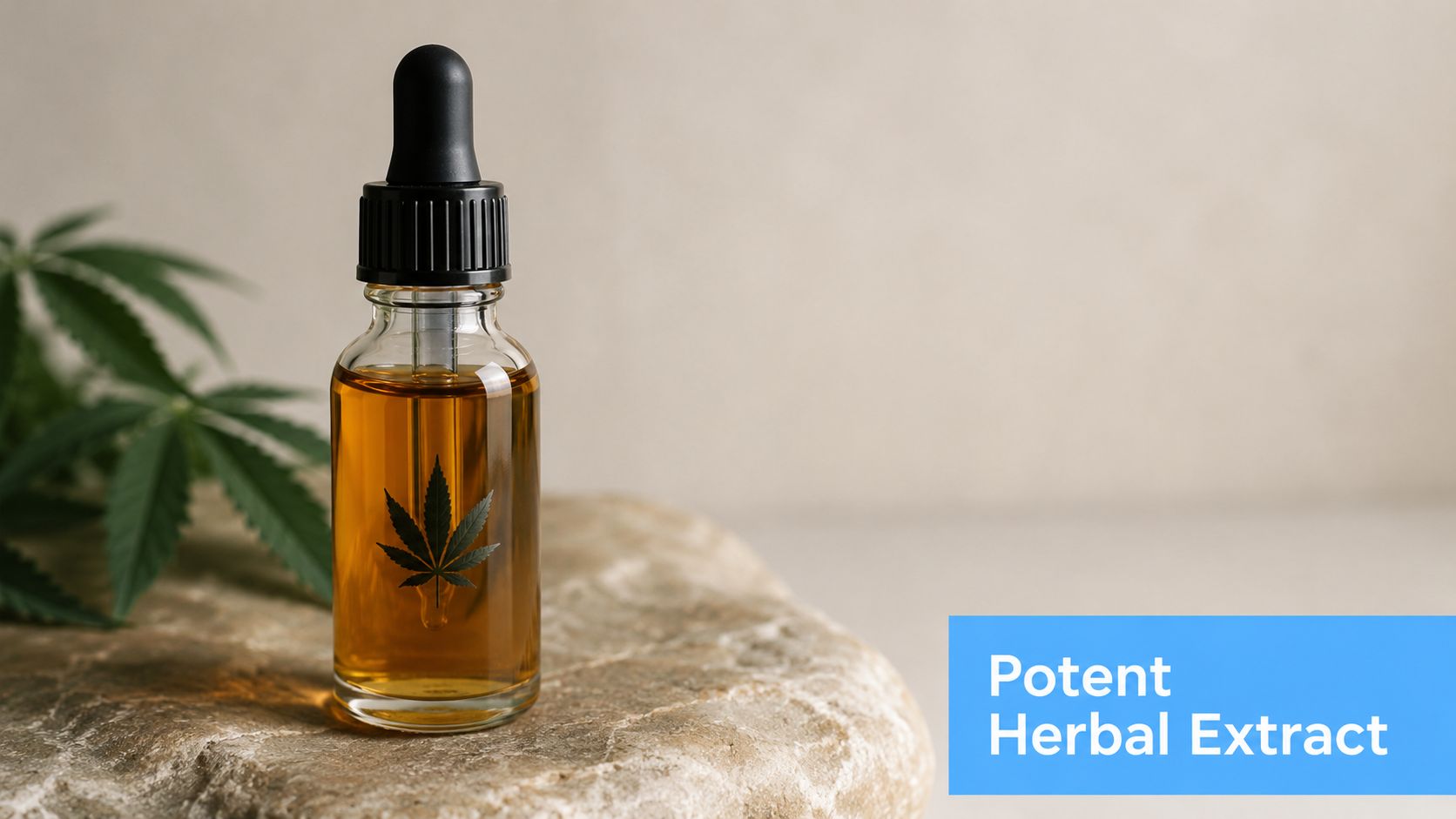
A cannabis tincture is a liquid cannabis extract designed for measured dosing. It usually comes in a small bottle with a dropper, and that dropper is what makes the format so practical. You're not guessing with a bite size or trying to split a gummy neatly. You're measuring liquid.
Some tinctures use alcohol as the extraction base. Others use a carrier oil such as MCT oil. Either way, the idea is the same. The cannabinoids and other plant compounds are suspended in a liquid that you can take directly or mix into food or drink.
How tinctures differ from other cannabis products
People often lump tinctures together with oils, edibles, and concentrated extracts. That can get confusing fast. Here's the plain-language version.
| Product type | What it's like | Why people choose it |
|---|---|---|
| Tincture | Liquid extract with dropper | Precise, flexible dosing |
| Edible | Fixed serving in food form | Familiar and simple |
| RSO or dense extract | Thick concentrate | Very different use style and texture |
| Standard cannabis oil | Broad category that may vary | Depends on formulation |
The important distinction is function. Tinctures are built for measured, adaptable use. They're easy to take in small amounts, easy to hold under the tongue, and easy to work into a routine.
Oil-based versus alcohol-based
Many shoppers often get stuck. They see “tincture” on the label and assume they all feel the same. They don't.
- Oil-based tinctures: These are common in modern dispensaries. Many people find them easier on the palate.
- Alcohol-based tinctures: These have a more traditional extract style and may feel sharper under the tongue.
- Your preference matters: Some shoppers care most about taste. Others care more about how the liquid feels and fits their routine.
Historical tinctures often leaned on high-alcohol extraction, while newer formats commonly use carrier oils such as MCT. That shift has helped make tinctures more approachable for everyday use.
If you dislike the feel of one tincture, don't assume you dislike all tinctures. The base can change the experience a lot.
Sublingual vs Oral How to Get the Effect You Want
The biggest mistake people make with tinctures is assuming there's only one “correct” way to take them. There isn't. How you take the tincture changes the result. That's the core of any useful cannabis tincture review.
For a quick visual, this comparison helps:
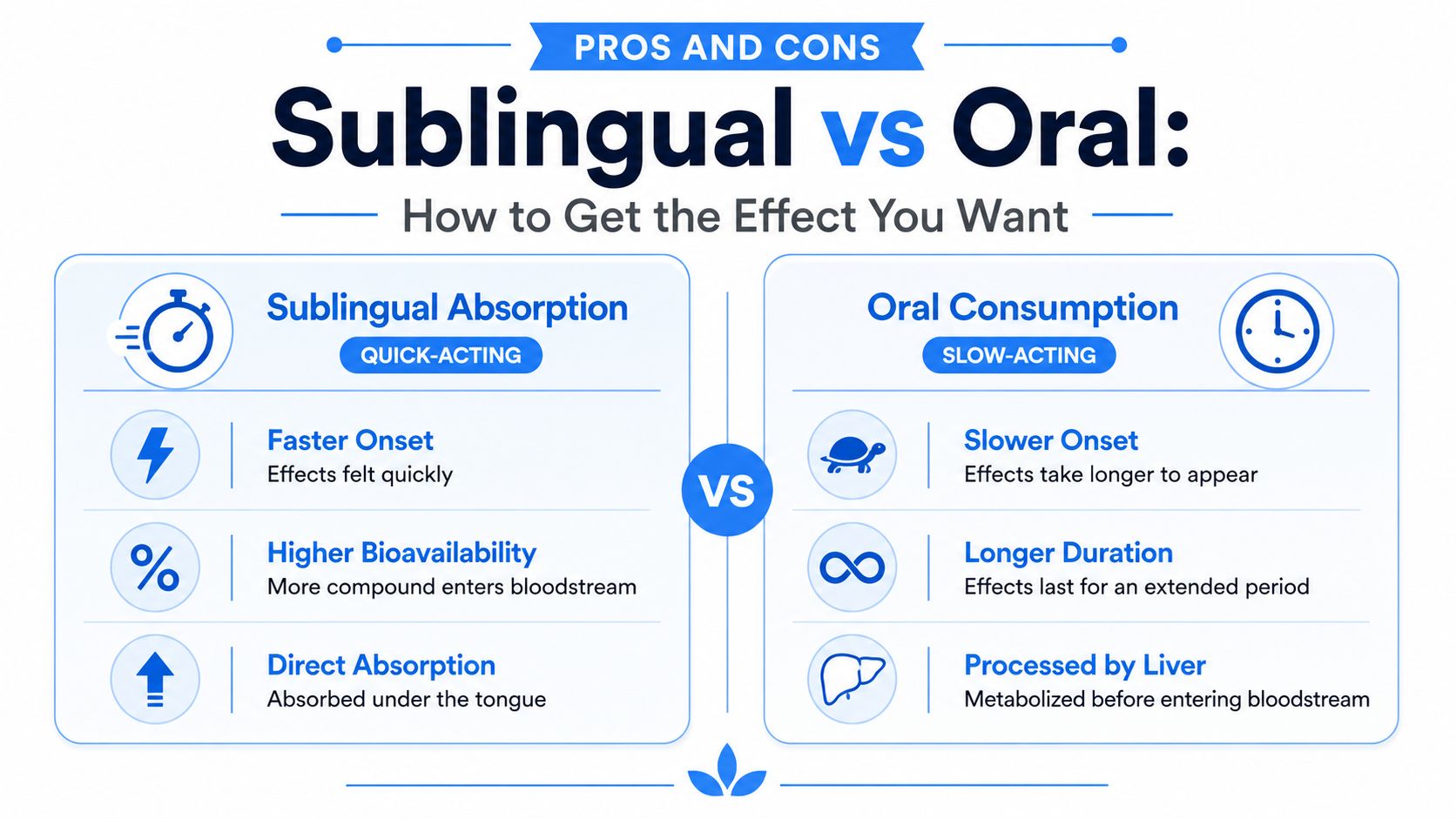
For faster relief
When you take a tincture sublingually, you place it under your tongue and hold it there briefly before swallowing. Verified data shows that cannabis tinctures can produce effects in 15 to 30 minutes when taken sublingually, while standard edibles often take 45 to 90 minutes to kick in, because sublingual use bypasses the slower digestive route (timing details on tincture and edible onset).
That makes sublingual use a smart fit when timing matters more than duration.
Use cases often include:
- Daytime stress: You want effects to arrive on a more predictable timeline.
- Breakthrough discomfort: You don't want to wait through the full edible delay.
- Testing a new product: Faster feedback makes it easier to judge your dose.
A related point from the available evidence matters here too. The “best” tincture isn't always the fastest-acting one. It depends on whether you want quick support or longer coverage, a gap highlighted in this discussion of practical tincture-use decisions.
For longer coverage
If you swallow the tincture or mix it into food or a drink, the experience shifts. The onset is slower because digestion becomes part of the process. The tradeoff is duration.
Verified guidance in the provided data notes that tinctures usually last three to six hours, and oral use may stretch the experience toward the longer end for some people. That's useful when the goal isn't speed.
Oral use can make more sense when you want:
- Evening support: A gentler ramp that carries further into the night.
- Longer sessions of relief: Less urgency, more staying power.
- A familiar routine: Some people prefer adding it to tea or a small snack.
Here's a helpful rule of thumb.
Practical rule: Choose sublingual use when you care most about onset. Choose oral use when you care most about duration.
A quick explainer can make the distinction even easier to picture:
Match the method to the moment
At this point, people stop guessing and start building a routine.
If you want support before a short, specific event, sublingual often makes more sense. If you want a longer runway for winding down, swallowing may be the better move. The same bottle can serve different purposes depending on the method. That flexibility is one of the strongest reasons tinctures stay popular with both newer consumers and experienced shoppers.
Precision Dosing Finding Your Perfect Drop
“Start low and go slow” is solid advice, but it doesn't tell you what's in the dropper. Once you understand the math, tinctures get much less intimidating.
Here's the verified example. A 30 mL bottle with 1,000 mg of CBD contains about 33.3 mg per mL, and because 1 mL contains roughly 20 drops, each drop delivers about 1.66 mg of cannabinoid. That's why tinctures are so useful for micro-adjustments. You can move in increments of less than 2 mg instead of jumping straight to a larger fixed edible serving.
The simple calculation
Use this formula:
- Find total milligrams in the bottle
- Divide by total milliliters
- That gives you mg per mL
- Estimate mg per drop if your bottle uses a standard dropper
Using the verified example:
- Bottle size: 30 mL
- Total cannabinoids: 1,000 mg
- Per mL: about 33.3 mg
- Per drop: about 1.66 mg
That gives you a realistic way to titrate. If one drop feels too light, you can increase gradually instead of making a big leap.
Why titration matters
Titration means adjusting your dose in small, repeatable steps until you find your minimum effective amount. Verified guidance in the provided data notes that this “go slow and start low” approach is often most effective when begun with 1 to 2 mg doses.
That's especially helpful for:
- New consumers: Small changes lower the chance of overshooting.
- THC-sensitive shoppers: Fine control matters more than speed.
- Routine users: Repeating the same dose becomes easier when the math is clear.
If you want a deeper walkthrough for serving-size math and practical dosing examples, this guide on how much tincture to take is a useful companion.
The goal isn't to take more. The goal is to find the smallest amount that reliably gives you the effect you want.
A common point of confusion
People often ask whether they should count by drops or by droppers. The answer depends on your sensitivity and your experience. A full dropper may be convenient, but drops give you finer control. If you're dialing in a THC dose, that can make the difference between “just right” and “too much for a Tuesday.”
How to Read a Tincture Lab Report
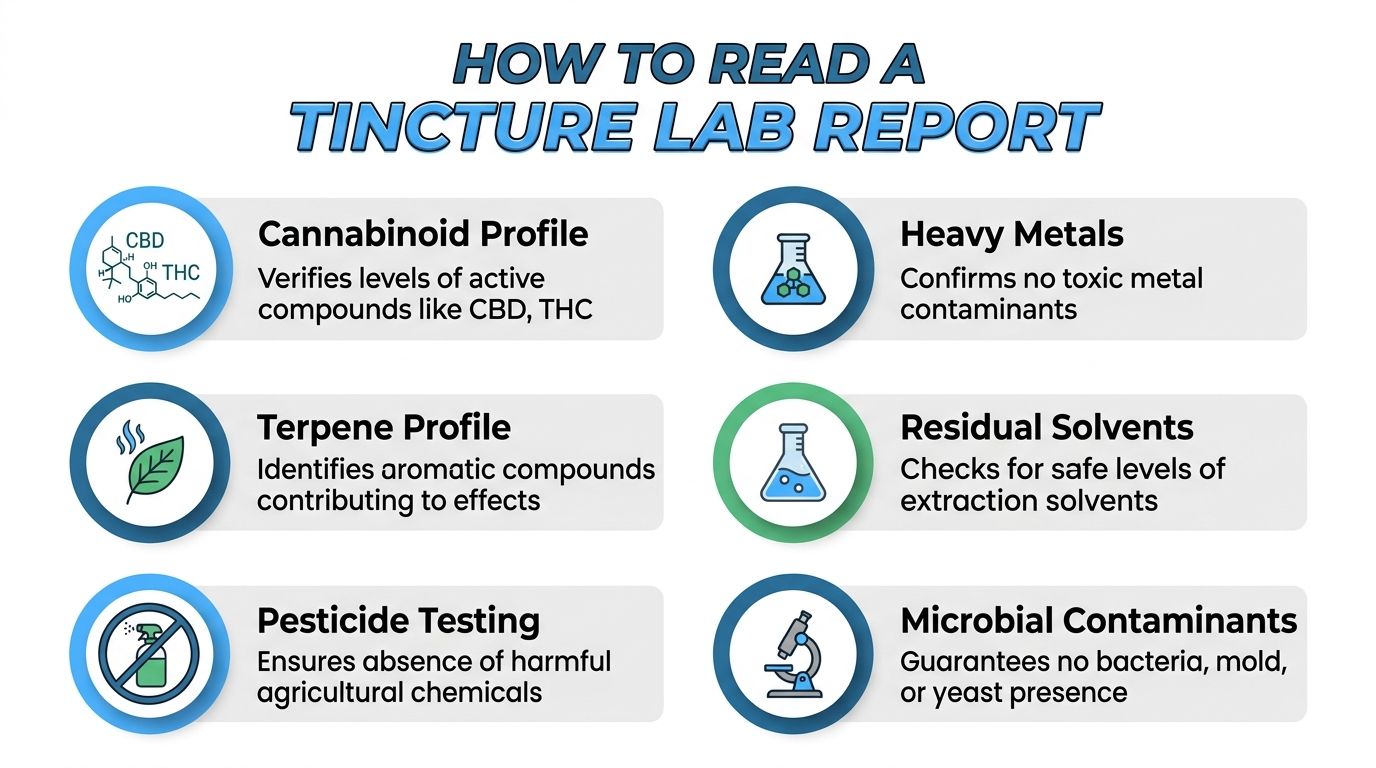
If dosing is about control, the Certificate of Analysis, or COA, is about trust. This is the document that shows what's in the bottle and whether the product passed safety testing.
That matters because product variability is a real concern for tincture users. Verified background from a mixed-methods study of chronic pain patients shows that some people use tinctures in structured daily routines and rely on precise milligram dosing. In that context, learning to read a COA is one of the most practical ways to verify potency and improve predictability (study discussion on routine tincture use and reliability concerns).
Potency comes first
Start by checking whether the cannabinoids on the lab report line up with the label.
Look for:
- Total THC or CBD: Does the report support the advertised potency?
- Serving clarity: Can you tell what that means per mL?
- Batch-specific results: A real COA should correspond to the exact product batch.
If the bottle claims a certain amount of THC or CBD, the COA should help you confirm it. That's the baseline for a predictable experience.
Then look at the full profile
Potency tells you how much. The profile tells you more about what kind of product it is.
A careful shopper should scan for:
- Cannabinoid profile: Is it THC-dominant, CBD-dominant, or balanced?
- Terpene profile: If listed, this can help explain aroma and character.
- Formula consistency: The report should look like a professional testing document, not vague marketing copy.
Some shoppers skip this section because they only care about milligrams. That's understandable, but the profile helps explain why two tinctures with similar label strength can still feel different.
Read the COA the same way you'd read a nutrition label on something you use daily. It's not extra homework. It's part of buying carefully.
Safety is non-negotiable
The last section to check is the safety panel. It is at this point that quality-minded consumers slow down and look for evidence of proper screening.
A strong COA should include checks for:
| COA area | Why it matters |
|---|---|
| Pesticides | Confirms the product was screened for agricultural contaminants |
| Heavy metals | Helps rule out toxic contamination |
| Residual solvents | Important for extracted products |
| Microbial contaminants | Screens for mold, yeast, bacteria, and related issues |
If a tincture doesn't offer clear lab transparency, it's harder to trust the label and harder to build a repeatable wellness routine around it.
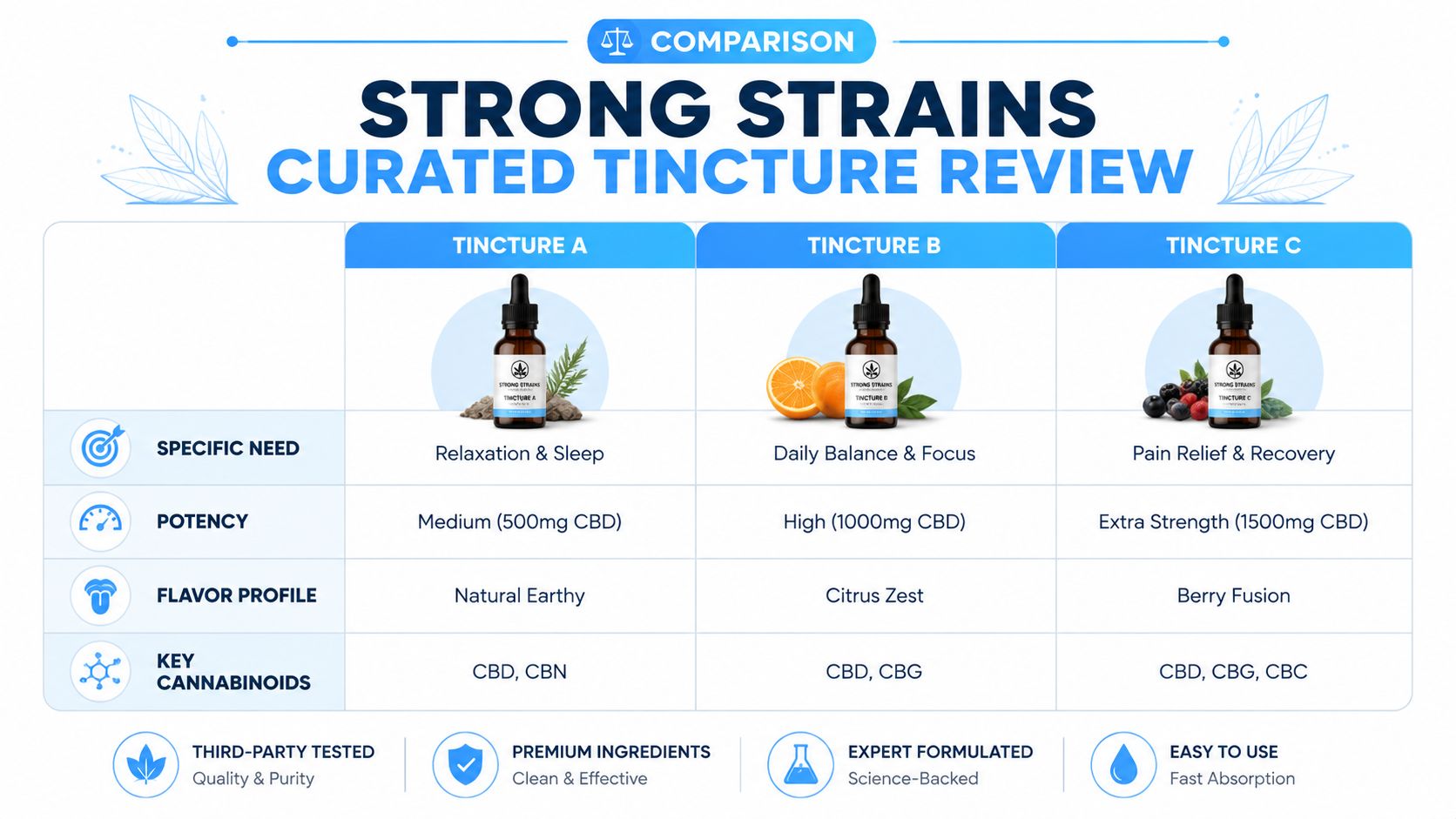
Strong Strains Curated Tincture Review
A practical cannabis tincture review should help you match product style to actual life use. Not every shopper needs the same bottle. Some want a THC-forward evening tincture. Others want a balanced ratio they can approach more gently. Others want a CBD-dominant formula they can measure with precision.
A dispensary menu shifts from being about browsing to being about fitting the right format to the right routine. At Strong Strains, tinctures are offered across THC, CBD, and balanced options, which gives shoppers room to choose based on timing, tolerance, and desired effect rather than just picking the first bottle that looks familiar.
Three useful tincture lanes
Instead of treating every tincture the same, it helps to think in categories.
THC-focused tincture for evening use
This type makes sense for shoppers who already know they want a stronger psychoactive effect and plan to use it later in the day. It often fits best with oral use if the goal is a slower, longer unwind.
Best for:
- End-of-night routines
- Experienced THC consumers
- People who want flexible dosing instead of a fixed edible
Balanced THC and CBD tincture for measured daytime support
A balanced formula can be easier for some shoppers to approach because the experience often feels more moderated than a THC-only option. This is the bottle many people reach for when they want versatility.
It can be a smart fit for:
- Careful daytime experimentation
- Consumers who want a middle ground
- People comparing sublingual and oral methods
CBD-dominant tincture for low-intensity wellness routines
A CBD-led tincture often appeals to adults who want precision without chasing a strong intoxicating effect. It also tends to make drop-by-drop titration feel less intimidating for first-time shoppers.
Good candidates include:
- New consumers
- Routine-focused users
- People who want very small adjustments
Cost matters differently with tinctures
Verified pricing data adds useful context here. A standard 30 mL THC tincture averages $40 to $60, which works out to about $1.33 to $2.00 per day if you use 1 mL daily. A package of 10 THC gummies with 10 mg each averages $20 to $25, or roughly $2.00 to $2.50 for a single gummy dose. Tinctures also allow dose adjustments in 1 to 2 mg increments, which is harder to do with fixed edible servings.
That doesn't mean tinctures are automatically the right value for every shopper. It means the higher shelf price can hide better daily flexibility.
If you care about tailoring your dose instead of accepting a fixed serving, tinctures often make more economic sense over time.
Your Long Island Tincture Questions Answered
Local shoppers usually don't just ask what tincture to buy. They ask how to buy it, whether they need extra paperwork, and what the easiest option is if they live nearby.
Do you need a medical card
For New York adult-use purchases, you must be 21 or older. Adult shoppers don't need a medical card to purchase from a licensed recreational dispensary. You should still bring valid identification and be ready for age verification.
Is pickup easy if you live near East Setauket or Stony Brook
Yes. If you're in East Setauket, Stony Brook, Brookhaven, or nearby parts of Suffolk County, in-store pickup is usually the simplest path if you want to browse with a little guidance and get your product the same day.
A few reasons people choose pickup:
- You can ask questions in person: Useful if you're comparing THC, CBD, and ratio options.
- It's easier to clarify dosing: Especially if you're new to tinctures.
- You can verify the format you want: Some people prefer to double-check bottle size, ingredients, or flavor notes before checkout.
What about delivery
Delivery is often the better fit if convenience matters most. Many adult consumers prefer tinctures precisely because they're easy to build into a home routine, so discreet local delivery makes sense for that audience.
Common delivery questions usually come down to three things:
- Service area: Check whether your address in Suffolk County falls within the active delivery range.
- ID on delivery: Expect age verification at handoff.
- Planning ahead: If you rely on a tincture as part of an evening routine, don't wait until the bottle is almost empty.
What should you ask before buying
If you're standing at the menu and unsure what to pick, ask practical questions, not abstract ones.
Try these:
- Should I take this sublingually or swallow it for my goal?
- Is this better for a daytime routine or evening use?
- How easy is it to measure a low dose from this bottle?
- Can I see the lab report for this product?
Those questions usually lead to better recommendations than asking for the “strongest” tincture. Stronger isn't always better. More predictable is usually better.
If you want help choosing a tincture that fits your routine, browse Strong Strains and ask for guidance based on your goal, whether that's fast support, longer coverage, or precise low-dose control.