
Aim for 60–62% relative humidity for cured cannabis flower storage, while growers need stage-specific conditions rather than the same setting from seedling through harvest. Water activity, not just the humidity reading, is the more useful measure of available moisture and microbial risk.
You get home, open your jar, and the flower crumbles before it reaches the grinder. Or you notice something more concerning: unusual dampness, an ammonia-like smell, or visible fuzz. Those situations call for different responses, and neither should start with blindly adding a humidity pack.
For Long Island customers, the practical skill is knowing what to adjust, what to leave sealed, and when to stop using a questionable product.
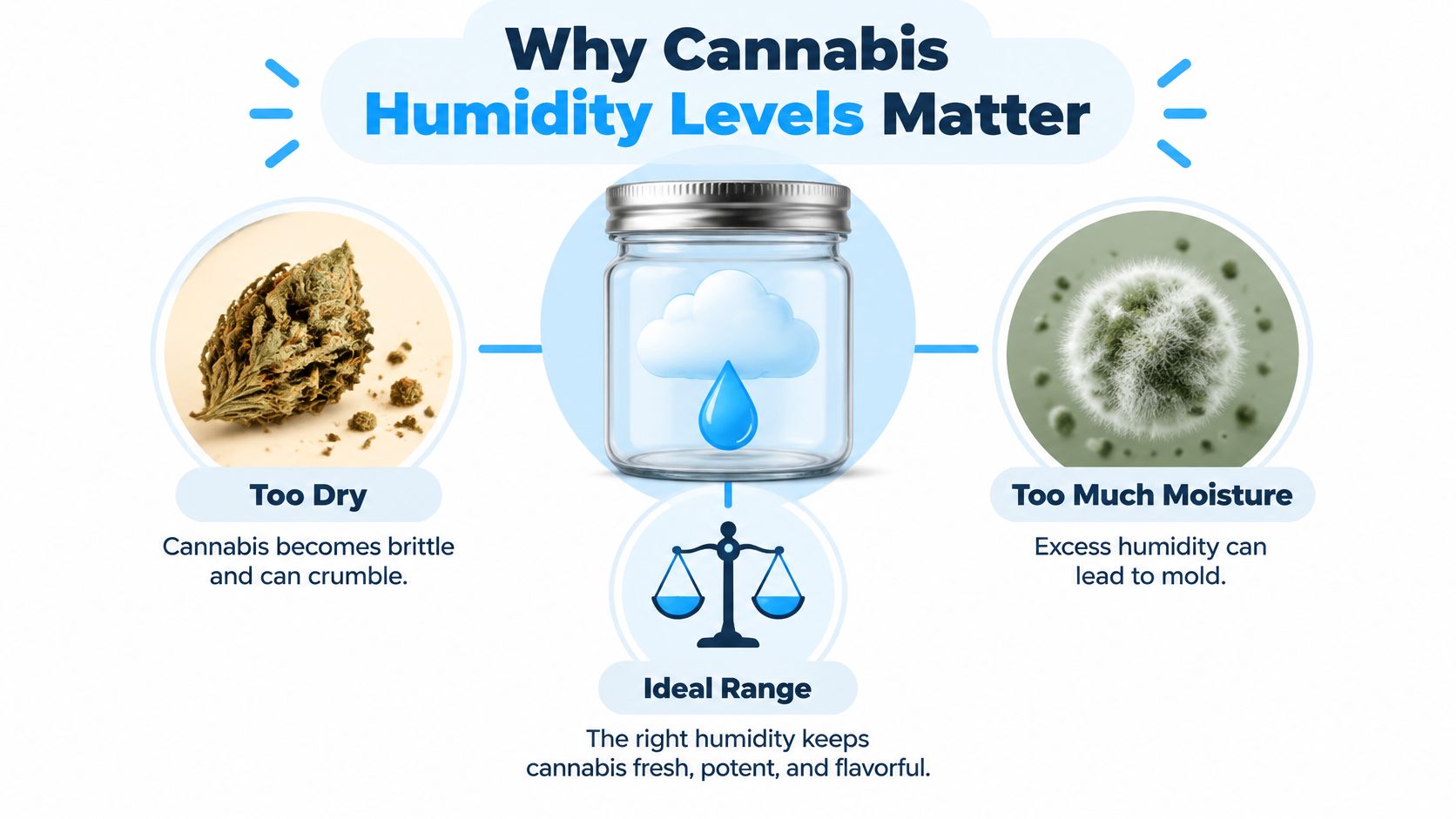
Why Cannabis Humidity Levels Matter More Than You Think
Cannabis humidity levels affect more than softness. They influence how flower handles, how well it retains its character, and whether storage conditions support deterioration. Your fingers can tell you something about texture, but they can't certify safety.
Think of humidity management as matching the environment to the material. A living plant, freshly harvested flower, and a finished retail product aren't interchangeable. Applying a growing-room setting to a sealed storage jar confuses different jobs.
A stage-by-stage starting point
Use this quick-reference framework before reaching for equipment:
- Seedlings and clones: Favor a more humid propagation environment, adjusted to rooting conditions.
- Vegetative growth: Balance moisture with temperature, airflow, and plant development.
- Flowering: Reduce excess environmental moisture and watch dense flower carefully.
- Drying: Control moisture removal rather than drying as aggressively as possible.
- Curing: Stabilize the flower under a deliberate postharvest protocol.
- Storage: Protect properly finished flower from environmental swings and unnecessary exposure.
The distinction matters because drying removes moisture, while curing manages the transition toward storage. A peer-reviewed review of cannabis postharvest operations describes a recommended curing protocol using 18°C and 60% RH for 2 weeks, with the container opened after 6 hours to release moisture. That's a specific protocol, not permission to treat every retail jar as unfinished flower.
Protect the purchase, don't restart production
For a dispensary customer, the objective is preservation. You're not supposed to finish a producer's drying process in your kitchen.
Practical rule: Treat finished flower as something to preserve, not something to continually wet, dry, and “improve.”
If your home gets damp in summer or dry when the heating runs, start by checking the storage location and container. A sensible setup should reduce the need for constant intervention.
Ideal Humidity Ranges for Every Cannabis Stage
A “Goldilocks” approach is useful, provided you don't mistake it for a universal recipe. Too much available moisture creates problems, but aggressively removing moisture can compromise the qualities you bought the flower for.
Growers also need to interpret RH alongside temperature and plant condition. The following growing ranges are working environmental guidance, not laboratory safety thresholds or guarantees for every cultivar.
For a cultivation-focused reference alongside your own observations, consult Seed Cellar's seedling to cure environment chart. Keep grow-room guidance separate from instructions for storing finished retail flower.
Cannabis Humidity Targets by Stage
| Stage | Ideal RH | Temperature | Common Mistake |
|---|---|---|---|
| Seedlings and clones | 70–80% as a working propagation range | Match the propagation setup | Keeping the environment wet without checking plant condition |
| Vegetative growth | 50–70% as a working range | Coordinate with lighting and plant response | Adjusting RH without considering temperature |
| Flowering | 40–55% as a working range | Avoid unstable conditions | Ignoring moisture trapped around dense flowers |
| Drying | 55–65% as a working range | Controlled and consistent | Rushing the exterior dry while neglecting the interior |
| Curing | Follow a validated curing protocol | Protocol-dependent | Treating repeated opening as a substitute for measurement |
| Finished-flower storage | Maintain a stable, moderate jar environment | Cool, dark, and consistent | Treating a target reading as proof of safety |
The numerical cultivation ranges above are starting recommendations rather than findings from the postharvest studies discussed here. Equipment, plant structure, and the actual environment determine whether a setting is suitable.
Harvest changes the task
While a plant is growing, you're managing its environment. After harvest, you're managing the condition of the harvested material. That transition deserves its own procedure, not an improvised adjustment to a thermostat.
For more context on the harvest step, Strong Strains' guide to harvesting hemp provides a related starting point. Don't assume that a harvesting guide replaces cannabis-specific testing or a validated postharvest process.
For shoppers, the simpler takeaway is this: buy properly finished flower and preserve its condition. If the product seems unfinished or abnormally damp, ask the retailer about it rather than attempting a home cure.
How Humidity Damages or Protects Your Flower
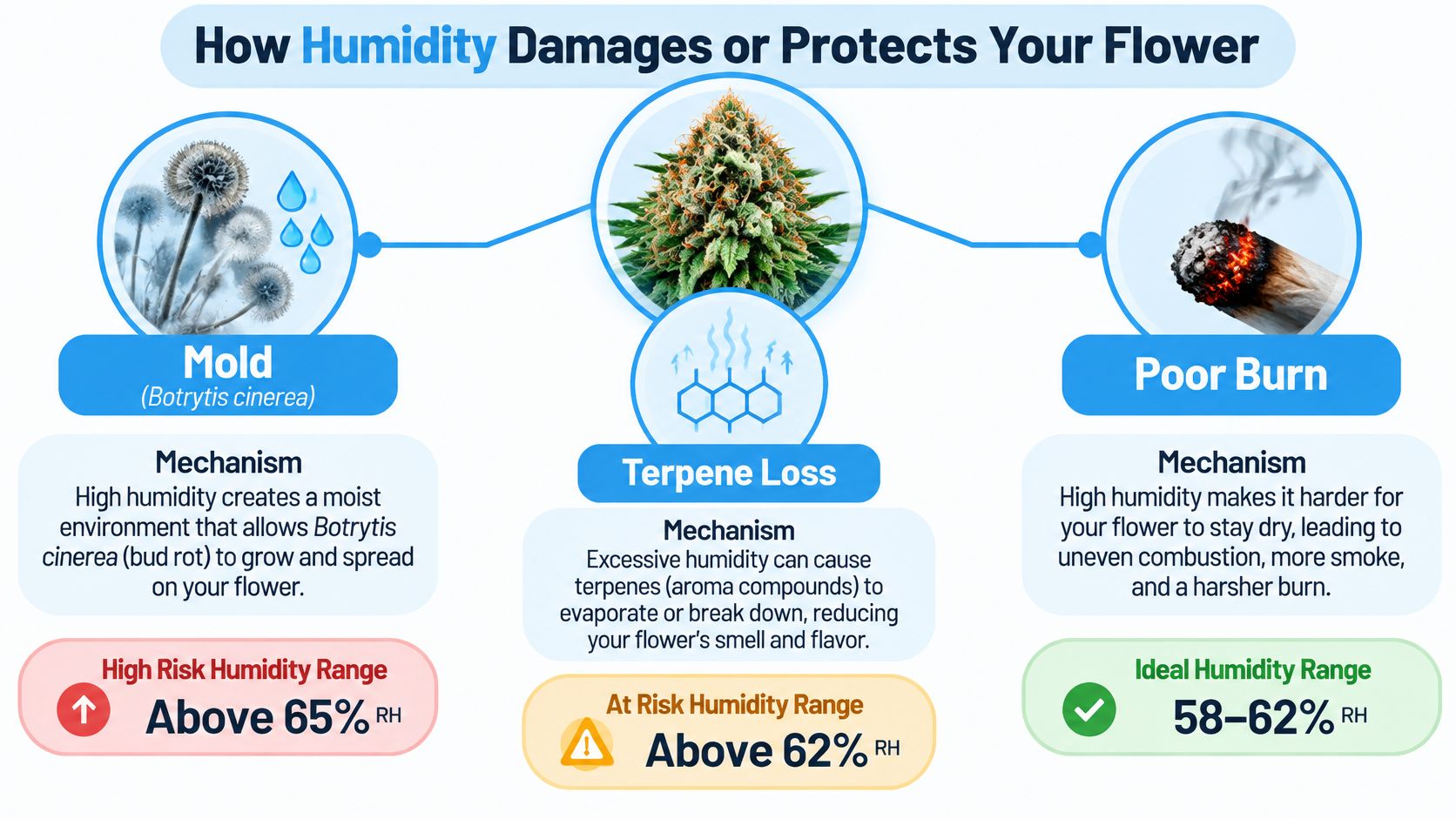
A jar's air and the flower inside it are related, but they're not the same measurement. Relative humidity describes the surrounding air; water activity describes how available water is within the material.
That's why moisture percentage alone can mislead. It tells you how much water is present, not necessarily how available that water is for biological growth or chemical change.
What water-activity research actually tells us
A cannabis-flower study comparing water-activity conditions tested 0.45, 0.65, and 0.85 aW. The 0.65 condition corresponded to approximately 9% moisture content, produced the highest terpene content among the tested conditions, and delivered cannabinoids comparably to the drier condition.
The same study associated 0.45 aW with roughly 5% moisture content, while 0.85 aW significantly reduced cannabinoid levels. Those results don't establish a magic number for every product, but they do show why wetter doesn't automatically mean better.
Keep aW and moisture percentage separate. Results expressed on different moisture bases or obtained through different methods shouldn't be casually compared.
Separate safety concerns from quality complaints
Use different responses for different observations:
- Suspected contamination: Stop using the product and contact the retailer. Don't experiment with drying it.
- Weak aroma or brittle texture: Consider storage history and product age before assuming a strain characteristic.
- Disappointing smoking quality: Evaluate the whole product rather than diagnosing humidity from ash appearance alone.
Aroma, color, texture, and smoking behavior can prompt questions, but none substitutes for testing. Strong Strains' discussion of brown cannabis flower and appearance is useful context when visual changes raise concerns.
A pleasant texture is a quality observation, not a microbial test.
The practical goal isn't the softest possible bud. It's properly processed flower kept in conditions that preserve its intended qualities without introducing avoidable risk.
Measuring Humidity the Right Way
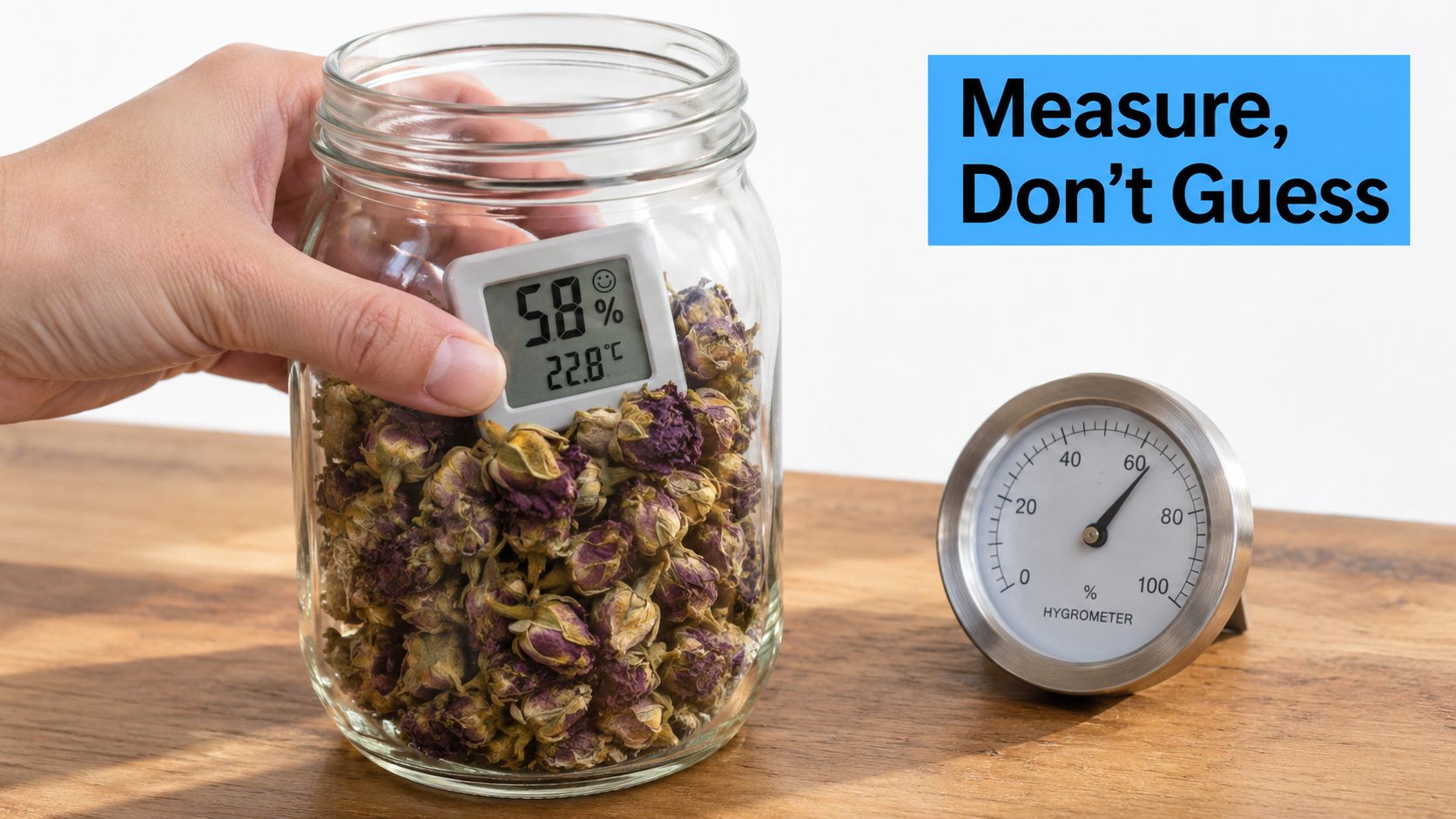
A hygrometer gives you a repeatable observation instead of a finger test. Choose a model that fits the container without crushing flower and displays temperature alongside humidity when possible.
A basic jar setup looks like this:
Make the reading useful
Start with the manufacturer's instructions. Check the sensor's stated accuracy, calibration procedure, operating conditions, and whether it can be adjusted or only checked against a reference.
- Verify before relying on it: Use a manufacturer-approved calibration kit or procedure. If the instructions permit a salt-based check, follow that procedure rather than an improvised internet recipe.
- Keep the sensor unobstructed: Position it in the jar's airspace, not buried beneath flower or pressed against a moisture-control pack.
- Read under stable conditions: Avoid making decisions immediately after moving the jar between noticeably different temperatures.
- Track patterns: A log or connected sensor can help distinguish a recurring storage problem from an isolated reading.
An analog dial may be convenient, while a digital display may be easier to read. Neither format automatically establishes accuracy. A connected logger adds a history of conditions, not a laboratory safety certificate.
For a video supplement to the measurement discussion:
Know when home tools aren't enough
A properly operated water-activity meter evaluates a prepared sample under controlled measurement conditions. It isn't interchangeable with dropping a household hygrometer into a jar.
Research on cannabis moisture, packaging, and shelf-life conditions found glass screw-top containers were the most consistent over 12 weeks, maintaining aW below 0.65, and identified approximately 15.6°C with 50–60% ambient humidity as favorable conditions. That's evidence about a storage system, not validation of any individual household jar.
If contamination is a concern, a budtender can help with product records and return procedures, but professional testing is the appropriate way to investigate microbial safety. This distinction is especially important for customers whose health makes uncertain products unacceptable.
Tools and Methods for Controlling Humidity
Buy the tool for the space you're managing. A household jar, a cultivation tent, and a storage room don't need the same intervention.
For an ordinary opened jar, start with a sound container and a stable location. Room equipment makes more sense when the room itself has a persistent environmental problem.
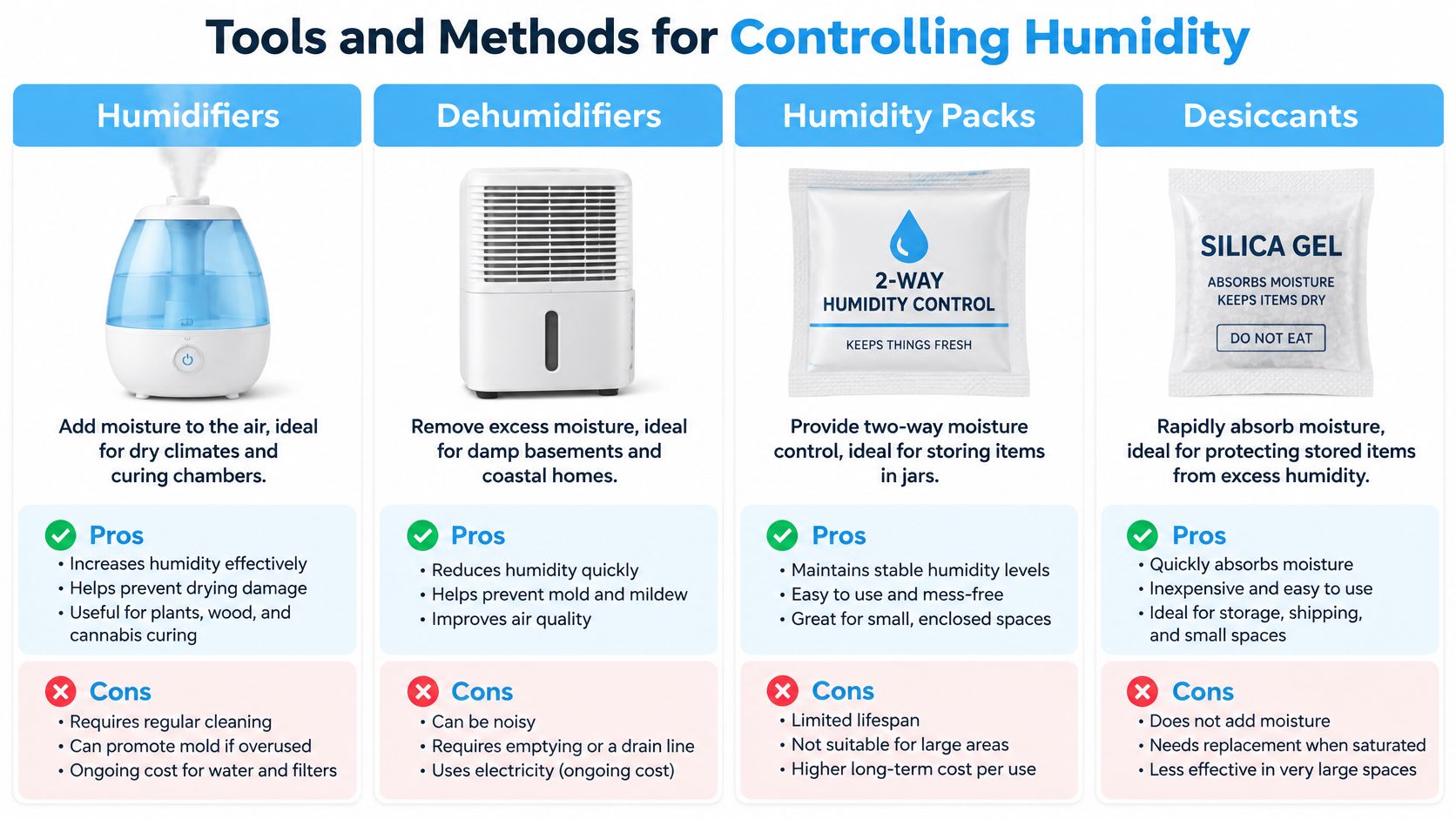
Humidity Control Tools Compared
| Tool | Best For | Watch Out For |
|---|---|---|
| Humidifier | A dry controlled room or growing environment | Overshooting conditions and neglected cleaning |
| Dehumidifier | A persistently damp room or basement | Excess drying, drainage problems, and maintenance |
| Two-way humidity pack | Managing the environment inside a suitable sealed container | Wrong sizing, exhausted packs, or expecting restoration |
| Room-level controller | Coordinating environmental equipment | Poor sensor placement and conflicting settings |
| Desiccant | Applications specifically requiring moisture removal | Using aggressive absorption where preservation is the goal |
Boveda and Integra are examples of humidity-control products to evaluate using their own instructions. Select the intended application and appropriate size rather than assuming every packet works the same way.
A medical consumer seeking consistent product condition should prioritize dependable packaging and clear testing information, not a complicated home equipment setup. A small-scale grower may need coordinated controls because the environment itself is part of production.
Maintenance matters more than extra features
Compare purchase cost, upkeep, sensor reliability, and failure modes, not just the display. A device that needs frequent attention may be the wrong fit if you want simple household storage.
For a Long Island home using ductless climate equipment, Bender's Oil Service Inc.'s DIY mini split upkeep tips offer a maintenance reference. Treat HVAC upkeep as room management, not a substitute for evaluating the cannabis container.
Equipment check: Before adding another device, confirm that your existing container closes properly and your sensor is giving a trustworthy reading.
Don't place flower in the direct output of a humidifier or dehumidifier. Adjust the environment deliberately, and avoid alternating between adding and removing moisture because you're reacting to every small display change.
Home Storage Strategies That Actually Work
Unopened professional packaging and an opened household jar deserve different decisions. If the original package is intact and suitable for storage, don't open it to add a gadget.
After opening, use a clean, well-sealing container that suits the amount of flower. Glass is a sensible household option, but avoid declaring every flexible professional package inferior. Packaging design, seal quality, and how the package was prepared all matter.
Build a repeatable home routine
- Choose the location: Use a cool, dark, stable place, away from a sunny windowsill, parked car, or damp bathroom.
- Keep products identifiable: Retain labels, batch information, and original packaging details.
- Limit unnecessary handling: Open the container when needed instead of repeatedly checking by touch.
- Match the season: If indoor conditions change, reconsider the location before changing the flower's treatment.
For deliveries, inspect package integrity and follow any supplied storage instructions. Let a package that has experienced a temperature change settle into the storage environment before opening it.
Cold storage isn't an automatic household upgrade
A postharvest study of cannabis storage conditions found 4°C best preserved original phytocannabinoid and terpene content over long periods, while 25°C produced the largest cannabinoid changes; terpenes declined rapidly across conditions.
That finding doesn't make repeated refrigerator trips the ideal routine for an everyday jar. Household handling introduces a separate concern: condensation when cold material encounters warmer conditions. Stable storage and thoughtful handling matter alongside temperature.
Travel accessories need similar scrutiny. Grainmark Leather's leather travel humidor options illustrate a different storage category, but a cigar-oriented product shouldn't be assumed suitable for cannabis without checking its design, cleanliness, and intended conditions.
Keep flower guidance separate from other formats. Follow the manufacturer's instructions for Airo, Pax, or Rove devices; Camino, Wana, or Wyld edibles; and MFNY or American Hash Makers concentrates. These are format examples, not a statement of current inventory, and a flower humidity target isn't a universal instruction for them.
Common Humidity Myths Worth Forgetting
A precise number guarantees a good product
Say a jar of flower spent a month on a warm shelf, dried out, and then got a humidity pack plus a week to recover. The hygrometer inside might now read exactly 62% RH. That number describes conditions at this moment. Nothing else.
A jar reading 62% RH after you re-hydrated overdried flower says nothing about whether the terpenes lost during the original dry can come back. Water activity measures what moisture is doing right now. It holds no memory of the product's past.
A reading is a snapshot. Quality is the whole history: how the flower was dried, how it was stored, and how many times it swung between wet and dry before reaching you.
The same logic applies to what is printed on the package. Brand names and catalog listings tell you nothing about how an opened package has been handled. Check the batch label instead, where the harvest date, test date, and batch-specific details live.
A humidity pack can rescue anything
Humidity control isn't restoration. A two-way pack works like a thermostat for moisture: it can hold conditions steady from here on, yet it cannot undo what already happened. Lost terpenes stay lost, oxidation keeps its effects, and contaminated flower stays unsafe. Don't confuse an improvement in feel with recovery of the original product.
Drier isn't automatically better either. The postharvest findings covered earlier tie excessive drying to quality loss, so pulling out as much moisture as possible misses the point. The goal is stable water activity inside a sensible range rather than the absence of water.
Ash color proves humidity problems
Ash color gets treated as a storage report card. It can't do that job. How completely material burns depends on mineral content, combustion temperature, and how tightly it was rolled, right alongside moisture. Pale ash can come from overdried flower, and well-stored flower can burn dark for reasons unrelated to humidity.
If you want to read the burn, ask better questions: did it stay lit evenly, did it taste harsh? Combustion describes the moment of smoking. It can't testify about months of storage.
Judge the storage system and the product's condition over time, not the reassuring number on a packet or the color of the ash.
Troubleshooting Guide for Long Island Customers
Use this checklist before changing anything:
- Brittle but otherwise unremarkable flower: Check the seal and sensor. Consider an appropriately selected two-way pack, while accepting that lost aroma may not return.
- Visible fuzz, ammonia-like odor, or abnormal dampness: Stop using it. Keep it separated and contact the retailer instead of attempting a fix.
- Readings that change with household conditions: Reassess the storage location and equipment before repeatedly adjusting the jar.
- A questionable delivery: Preserve the packaging and batch label, document the concern, and ask about the return or replacement process.
For a purchase from Strong Strains, bring the concern to the team on Technology Drive in East Setauket and ask how to present the product for assessment. Staff can discuss the applicable return or exchange process, but a visual assessment can't replace laboratory testing.
Humidity management is a preservation skill, not a rescue trick.
Strong Strains Cannabis Dispensary offers lab-tested flower, other cannabis formats, accessories, and knowledgeable guidance for choosing and caring for your purchase. Visit the East Setauket team for product-specific storage advice, or choose convenient pickup or local delivery and ask which humidity-control approach fits your flower and home setup.