
You're settling into a Long Island afternoon, considering an edible before dinner, a movie, or time with friends. The package says Afternoon Delight, but that name alone doesn't tell you how much THC you'll receive, which extract was used, or how long the effects may last. The reliable answer is on the current package label and its lot-specific Certificate of Analysis, not on the strain name.
For New York shoppers, the smartest approach combines measured dosing, delayed-onset planning, and lab transparency. Afternoon Delight edibles can be enjoyable, but a responsible choice starts by separating marketing language from verified product information.
What Makes Afternoon Delight Edibles Unique
A customer may request Afternoon Delight after remembering citrus-forward flower, a dispensary menu, or a relaxed social experience. The name sounds precise, but Afternoon Delight is not one globally standardized cannabis cultivar or edible recipe. Market records describe different lineages and releases, including a reported Crockett Family Farms lineage with Tangie-family influence and a separate Afternoon Delight #4 release associated with RYTHM. Strain documentation describes these as distinct market references rather than one fixed chemical profile.
The name doesn't identify the formulation
One Afternoon Delight edible may contain distillate; another may use a fuller-spectrum extract. A third may use the name for a flavor or branded release. The formulation can change the cannabinoid profile, terpene content, ingredients, and resulting experience.
Reported flower records also vary by lineage, batch, and testing record. Some citrus-focused batches were listed in an 18% to 26% THC range by dry weight, with many around 20% to 24%. RYTHM Afternoon Delight #4 records showed 23% to 28% total THCA, with occasional batches at 29% to 30% and estimated activated THC around 20% to 26%. These figures describe flower records, not a universal edible specification.
That difference matters in New York, where an edible label should be read as a measured serving claim. Flower reports cannabinoid concentration by weight, while edibles identify milligrams of THC per serving and per package. A flower percentage cannot be converted directly into the THC content of a gummy.
The practical check is the current package label and its lot-specific COA. Confirm the product's actual THC amount, extract type, and test results rather than treating the strain name as a potency promise.
The practical rule: Treat “Afternoon Delight” as a product name to investigate, not as proof of a fixed potency or effect.
Understanding Dosage and Onset Timing
Edibles behave differently from inhaled cannabis because your body has to absorb and process them before meaningful systemic effects develop. Peer-reviewed evidence places initial psychoactive effects from oral cannabis commonly at roughly 30 to 90 minutes, with peak effects around 2 to 4 hours. The pharmacokinetic explanation involves gastrointestinal absorption and hepatic first-pass metabolism.
Why early redosing causes trouble
Suppose someone eats a serving, feels nothing after half an hour, and takes another. The first serving may still be moving through absorption and metabolism. The second dose can arrive before the first reaches its peak, creating a stacked experience with stronger or longer-lasting impairment than intended.
Food composition, individual metabolism, tolerance, prior cannabis exposure, and formulation can all shift onset and intensity. The label gives you a quantitative starting point, but it can't guarantee exactly how the experience will feel or how long it will last.
A conservative routine is simple:
- Measure the amount. Use the serving identified on the package, or a smaller accurately divided portion when appropriate.
- Record the time. A note on your phone prevents guesswork later.
- Wait through the expected peak window. Don't judge the first serving too quickly.
- Avoid driving and safety-sensitive activities. Delayed impairment can outlast the moment when you first feel effects.
For a broader dosing reference, review this cannabis dosage chart alongside the product's current label and COA. The chart can't replace individualized medical advice, but it can help organize the information you're comparing.
New York Regulations and Lab Testing Essentials
A package called Afternoon Delight may sound specific, but the name does not verify its potency. In New York's regulated adult-use market, orally ingested cannabis products are limited to 10 milligrams of total THC per serving and 100 milligrams per package under New York's product requirements. Multi-serving solid edibles must be scored or clearly divided so each serving can be identified.
State consumer guidance says edible effects can take up to 2 hours to fully develop and identifies 2.5 milligrams as a possible starting amount for newer cannabis consumers. Use the state guidance as a conservative reference, not as a promise that a particular dose will feel mild. The product name may suggest a strain or mood, but the labeled milligrams and the lot-specific COA provide the more useful evidence.
Read the package in order
Begin with the serving information, then check the total amount in the package. One compliant product might contain ten separate 10-milligram servings, while another could contain substantially less THC in each serving.
Before opening the package, check:
- THC per serving: Confirm the labeled milligrams rather than relying on the product name.
- Total THC per package: This shows the maximum amount contained in the package.
- Serving count: Make sure the pieces or divisions correspond with the stated servings.
- Ingredients and expiration: Review allergens, inactive ingredients, and freshness information.
- Lot number: The lot connects the package to its laboratory report.
- QR code or COA link: Use it to find the current test results.
Regulated New York products must pass laboratory testing before sale, and the package must provide a route to the COA. The state's testing guidance explains why package-specific laboratory information matters.
Match the lot before trusting the result
A COA applies to a particular product lot, not to every item sold under the same name. Compare the lot number, product identity, cannabinoid results, and contaminant-panel status. New York calculates total THC as THC plus 0.877 times THCA, so the final figure may differ from a simple reading of the THCA amount. For a closer look at how products are verified before reaching the shelf, review our product testing standards guide. Review the state's product-testing standards for the relevant labeling and testing framework.
New York allows a labeled cannabinoid concentration ranging from 85% to 115% of the stated amount. A labeled 10-milligram serving may therefore correspond to approximately 8.5 to 11.5 milligrams under that rule. People who are new to cannabis or sensitive to THC may choose less than a full serving when the edible can be divided accurately.
How to Choose a Safe and Quality Product
A good Afternoon Delight edible should answer more questions than “How strong is it?” Start by asking what the product contains and whether the package provides enough information to verify it.
Use a formulation-first comparison
A distillate-infused gummy may offer a different cannabinoid and terpene profile from a full-spectrum extract. Neither label automatically makes a product better. The important point is that the formulation should be disclosed, and the COA should support the package claims.
Compare products using this checklist:
- Identity: Does the package identify the producer, product type, lot, and serving count clearly?
- Cannabinoids: Are THC and other reported cannabinoids easy to find?
- Ingredients: Can you identify sweeteners, flavorings, allergens, and other inactive ingredients?
- Testing: Does the COA show cannabinoid results and passed contaminant panels?
- Consistency: Does the lot-specific report match the label in your hand?
- Fit: Does the serving size suit your experience level and the time you have available?
Terpenes can add context, but they shouldn't substitute for dose verification. A flower listing for Afternoon Delight reported 27.41% THC and 2.76% total terpenes, including limonene, beta-myrcene, and beta-caryophyllene, while also showing 30.86% THCA and 0.34% delta-9 THC. That listing demonstrates why consumers should read the complete analysis rather than rely on one headline number.
A dispensary budtender can also help distinguish a strain-specific release from a product that uses the name for branding. Ask to see the current label and COA, especially if an older review describes a different package.
A trustworthy purchase gives you enough information to identify the product, measure the serving, and verify the batch.
Maximizing the Afternoon Experience
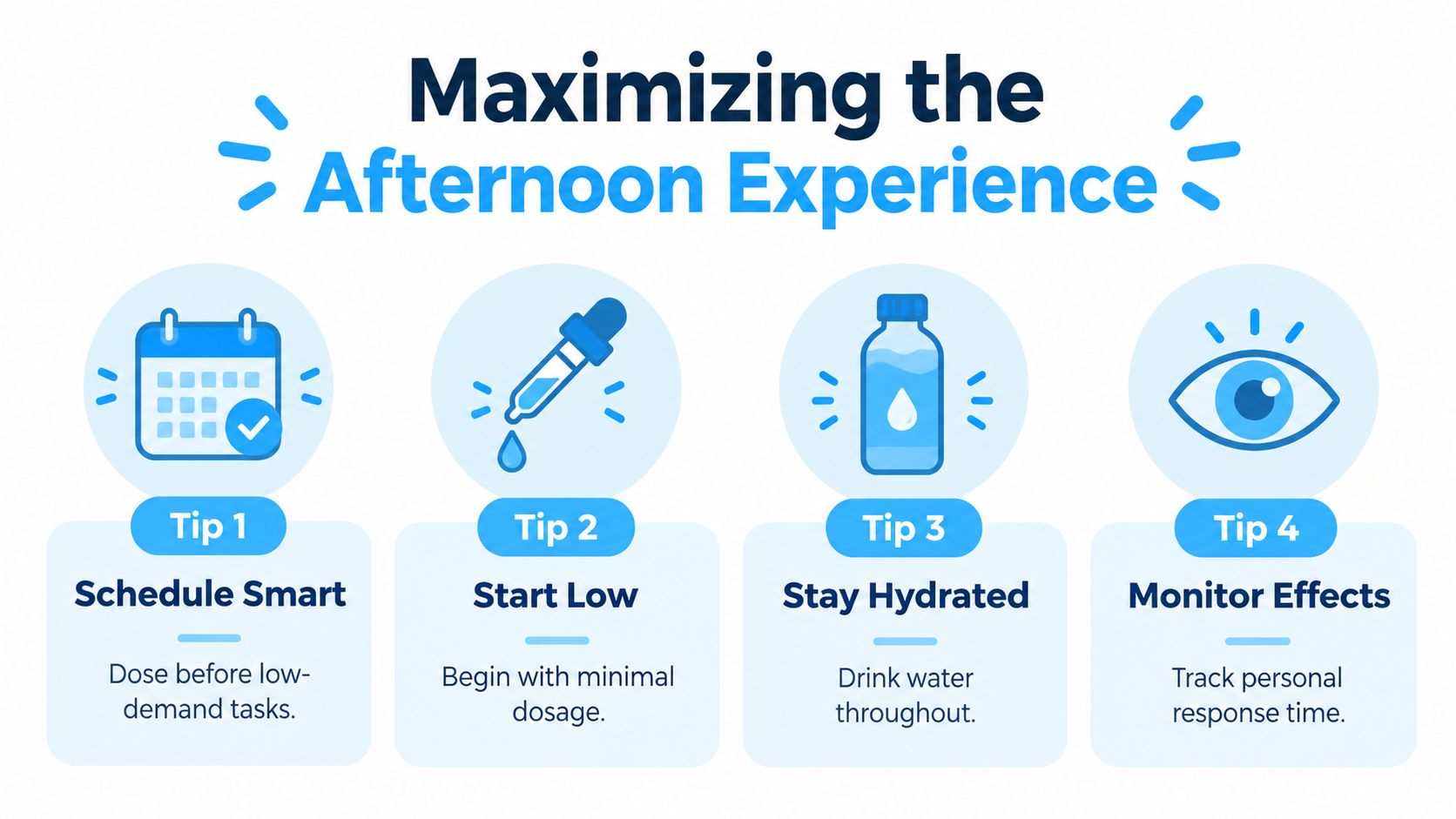
A daytime edible works best when you plan around the possibility of delayed and prolonged impairment. Choose a low-demand period rather than fitting the experience between driving, work, exercise, childcare, or another responsibility. A legal serving isn't automatically a comfortable serving for you.
Use a simple schedule:
- Schedule Smart: Dose before low-demand tasks, not before driving or a safety-sensitive obligation.
- Start Low: Begin with a measured amount that matches your experience and tolerance.
- Stay Hydrated: Keep water available throughout the experience.
- Monitor Effects: Track when you consumed the product and how your response develops.
Food can influence the experience, and alcohol or other intoxicants can make impairment harder to predict. Keep the setting comfortable, have a meal or snack available if that suits you, and don't redose just because the first effects haven't appeared yet.
For a non-cannabis snack to prepare ahead of time, these Pep Tea no-bake energy balls offer a convenient food option without turning your edible plan into an improvised kitchen project.
The best product choice is a New York-compliant, lab-tested package with a readable label and accessible COA. That transparency lets you plan around the actual serving instead of guessing from a strain name or a promising flavor description.
If the experience becomes uncomfortably intense, stop consuming cannabis, move to a calm environment, and avoid driving. Seek medical help for severe or concerning symptoms.
Common Misconceptions About Afternoon Delight Edibles
Myth one, higher THC is always better. More THC can mean more impairment, not a better afternoon. A lower measured amount may fit a social setting or a day when you need to remain more functional, while a higher amount may be inappropriate for a new or occasional consumer.
Myth two, every Afternoon Delight product tastes and feels the same. The name may cover different cultivars, extract types, flavors, producers, and batches. One product can be citrus-forward, while another may reflect added flavoring or a different botanical profile. The package ingredients and COA matter more than the shared name.
Myth three, edibles hit instantly. Oral cannabis commonly takes time to produce initial effects, and peak effects arrive later. Redosing after a short wait can stack servings before the first dose has reached its strongest point, which is a central reason people experience more intensity than planned.
Compare the label, not the promise
A strain-labeled edible and a flavor-labeled edible may look similar on a menu, but the relevant questions are different. For the first, ask whether the producer identifies the extract and provides meaningful cannabinoid and terpene information. For the second, focus on serving size, ingredients, total THC, and the current lab report.
CBD, CBG, terpenes, allergens, and inactive ingredients aren't guaranteed by the Afternoon Delight name. If they matter to your choice, verify them directly instead of assuming they're present.
A familiar name can guide your curiosity, but it can't replace the label.
Where to Buy Afternoon Delight Edibles on Long Island
A customer looking for Afternoon Delight on Long Island should begin with a licensed dispensary, not an old menu screenshot or an unverified product listing. Ask the staff to show the current package, confirm the serving size, and provide the QR code or COA link. A knowledgeable budtender should be able to explain whether the product is strain-specific, how it was formulated, and what the lot report says.
Consider pickup or delivery based on your schedule, but keep the same standards either way. A convenient order still deserves a clear label, identified servings, expiration information, lot details, and access to the laboratory report. This Long Island dispensary delivery guide can help shoppers think through local purchasing options.
A responsible real-world plan might look like this: an adult consumer chooses a low-demand afternoon, checks the package and matching COA, measures less than a full serving if appropriate, records the time, keeps water nearby, and waits rather than redosing early. They don't drive, combine the edible with alcohol, or judge the product by the Afternoon Delight name alone.
That process is less flashy than chasing the strongest item on a menu, but it gives you something more useful, a repeatable way to make informed decisions.
Strong Strains Cannabis Dispensary offers lab-tested edibles, flower, vapes, concentrates, tinctures, topicals, and accessories with knowledgeable guidance for Long Island shoppers. Visit Strong Strains Cannabis Dispensary to review current products, ask about Afternoon Delight packages and COAs, and choose convenient in-store pickup or local delivery.