
Happy Day Juice is Rauch's European fruit-juice brand, not a cannabis product, and no verified THC, CBD, terpene, or cannabis-dose figure exists for it. Its documented international launch began in 1994, not in a dispensary.
Advice about choosing a Happy Day strain or finding its ideal dose starts with the wrong product. A cheerful name and tropical flavor don't establish cannabis content. For Long Island shoppers, the useful distinction is between a grocery carton with nutrition information and a licensed infused beverage with traceable cannabinoid testing.
What Happy Day Juice Actually Is
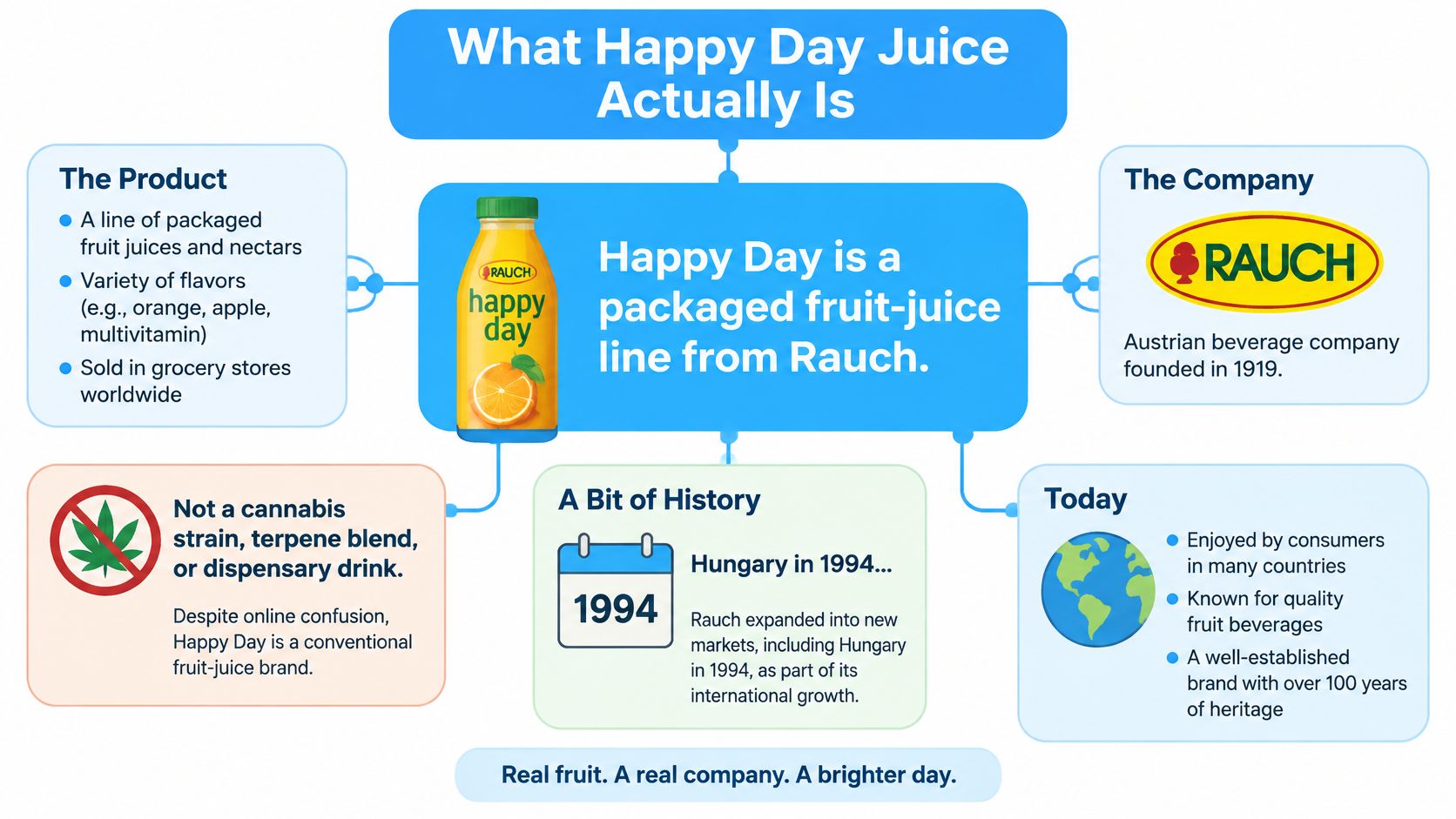
Happy Day is a packaged fruit-juice line from Rauch. It isn't a cannabis strain, terpene blend, or dispensary drink.
Say someone sends you a picture of a tropical Happy Day carton and asks whether it will help them relax. Before discussing effects, identify the manufacturer. A mood-sounding product name tells you much less than the company name and ingredient panel.
According to Rauch's account of Happy Day's international launch, the Austrian beverage company was founded in 1919, and its Budapest team introduced six varieties in Hungary in 1994. Rauch identifies 2002 as a major repositioning year for a broader international market.
A beverage history, not a strain history
Hungary matters because that launch established Happy Day beyond a local product line. Rauch subsequently described it as its premium fruit-juice brand, encompassing both pure juices and lower-fruit-content nectars. The expansion explains why shoppers encounter different flavors, recipes, and packaging rather than a single universal drink.
Think of a hypothetical soda called Sunrise. The name suggests a feeling or occasion, but it doesn't change what the bottle contains. Happy Day works the same way: the identity comes from the manufacturer and recipe, not the emotional association.
This brand overview makes the distinction clear.
Compare it with groceries
A sensible comparison is another packaged fruit beverage, not cannabis flower. For example, Vitamin Planet's listing for Biona organic cranberry juice offers a separate grocery product to examine for fruit ingredients, serving information, and nutrition labeling. It isn't evidence of any relationship between those brands.
Identity comes first: Establish what the product is before discussing what it might do.
That distinction also keeps ordinary nutrition questions separate from intoxication questions. Calories, sugars, and fruit content are meaningful comparisons for Happy Day. Cannabis potency isn't a field to fill in when the product has no documented cannabinoid declaration.
Calories and Sugar by Happy Day Variety
Nutrition figures depend on the specific Happy Day variety. The table separates published figures from fruit and recipe descriptions, so compare like with like.
| Variety | Style | Energy | Sugars or carbs | Fruit note |
|---|---|---|---|---|
| Multivitamin | Juice with added vitamins | 49 kcal per 100 ml | 11 g carbohydrate, including 10 g sugars | Vitamins A, B6, and E listed |
| Pineapple | Single-fruit juice | About 54 kcal per 100 ml | About 12 g sugar per 100 ml | Higher sugar than the listed pomegranate drink |
| Pomegranate mixed fruit | Mixed-fruit drink | About 40 kcal per 100 ml | About 9.1 g sugar per 100 ml | Lower energy than the listed pineapple juice |
| Exotic | Mixed nectar-style drink | About 49 kcal per 100 g | 11 g carbohydrate per 100 g | Grape, mango, passion fruit, added sugar |
| Orange | Pure juice carton | Not stated | No added sugar on the retail description | Pure orange juice |
| Apple | Pure juice carton | Not stated | Not stated | From concentrate |
| Coconut and pineapple | Conventional packaged juice | Not stated | Not stated | Fruit beverage, not an identified infused drink |
Happy Day nutrition by variety. The multivitamin, pineapple, and pomegranate figures accompany Rauch's portfolio history and associated product information. Exotic uses a weight-based declaration, so its figures are not directly comparable with values given per 100 ml.
Why the flavor name matters
Rauch's historical account describes seven varieties in 1999, a pure-juice offering still limited to seven flavors in 2000, and just under 50 products by 2019. The range includes different recipes, not one drink with different fruit pictures.
A multivitamin drink, a single-fruit juice, and a nectar can differ in fruit proportion, ingredients, and sweetness. The flavor name alone does not show those differences.
Total carbohydrate and sugars are separate label fields. For a sugar comparison, use the sugars value rather than treating all carbohydrate as sugar.
Translate the label into your glass
For a hypothetical 250 ml glass, multiply a per-100-ml figure by 2.5. Using the pineapple row, that gives about 30 g of sugar. It is a serving calculation based on the listed figure.
A glass's capacity may differ from the carton's reference quantity. Measure your usual pour once, then use that amount when estimating what you drink.
- Match the units. Compare per-100-ml figures with other per-100-ml figures.
- Match the recipe. Check the exact flavor and package.
- Treat unstated values as unknown. They do not mean zero calories or zero sugar.
- Separate fruit content from sweetness. Fruit proportion alone does not give the total sugar value.
Ingredients Behind the Happy Day Flavors
Happy Day Exotic offers a useful ingredient-reading example. Its listed recipe includes grape-juice concentrate, mango purée, passion-fruit juice from concentrate, water, sugar, an acidity regulator, and lotus-flower flavoring. Those ingredients explain a sweet, tropical beverage without requiring any cannabis interpretation.
Start with the ingredient nouns rather than the front-label mood. Juice concentrate and purée identify fruit components. Water, sugar, acidity regulation, and flavoring describe other parts of the formulation.
Pure juice and nectar aren't identical recipes
Lyreco's Happy Day retail descriptions identify 1-liter orange, apple, and multivitamin formats, describing orange as 100% juice with no added sugar and apple as 100% apple juice from concentrate.
Those descriptions answer different questions. From concentrate describes how the juice was prepared. No added sugar describes whether sugar was added, not whether naturally occurring sugars are absent.
Mango nectar belongs to a different recipe category. Its lower fruit proportion means you need the full ingredient list to establish what makes up the remainder. Don't assume that every nectar uses the same sweetener or that the remaining ingredients can be calculated from the fruit picture.
- If avoiding added sugar is your priority, start with the ingredient panel and look for sugar or other added sweetening ingredients.
- If comparing fruit content, use the declared fruit proportion rather than the size of the fruit illustration.
- If choosing for vitamins, read the nutrient declaration without interpreting fortification as a cleanse or detox claim.
Keep nutrition language separate from cannabis language
For broader food-label reading, Navilo Health's nutrition articles provide a separate place to explore nutrition topics. They shouldn't replace the exact ingredient panel on the carton you're considering.
The multivitamin version's added nutrients don't establish a therapeutic effect. Likewise, a floral flavoring doesn't establish a cannabis terpene formulation.
There's no verified cannabis terpene profile to report for Happy Day. Fruit aromas aren't a basis for assigning a cannabis chemotype, predicting intoxication, or describing the drink as indica-like or sativa-like.
A mango drink and a mango gummy can share a flavor description without sharing an active ingredient. Flavor similarity is not evidence of infusion.
How to Tell It Apart From a Cannabis Drink
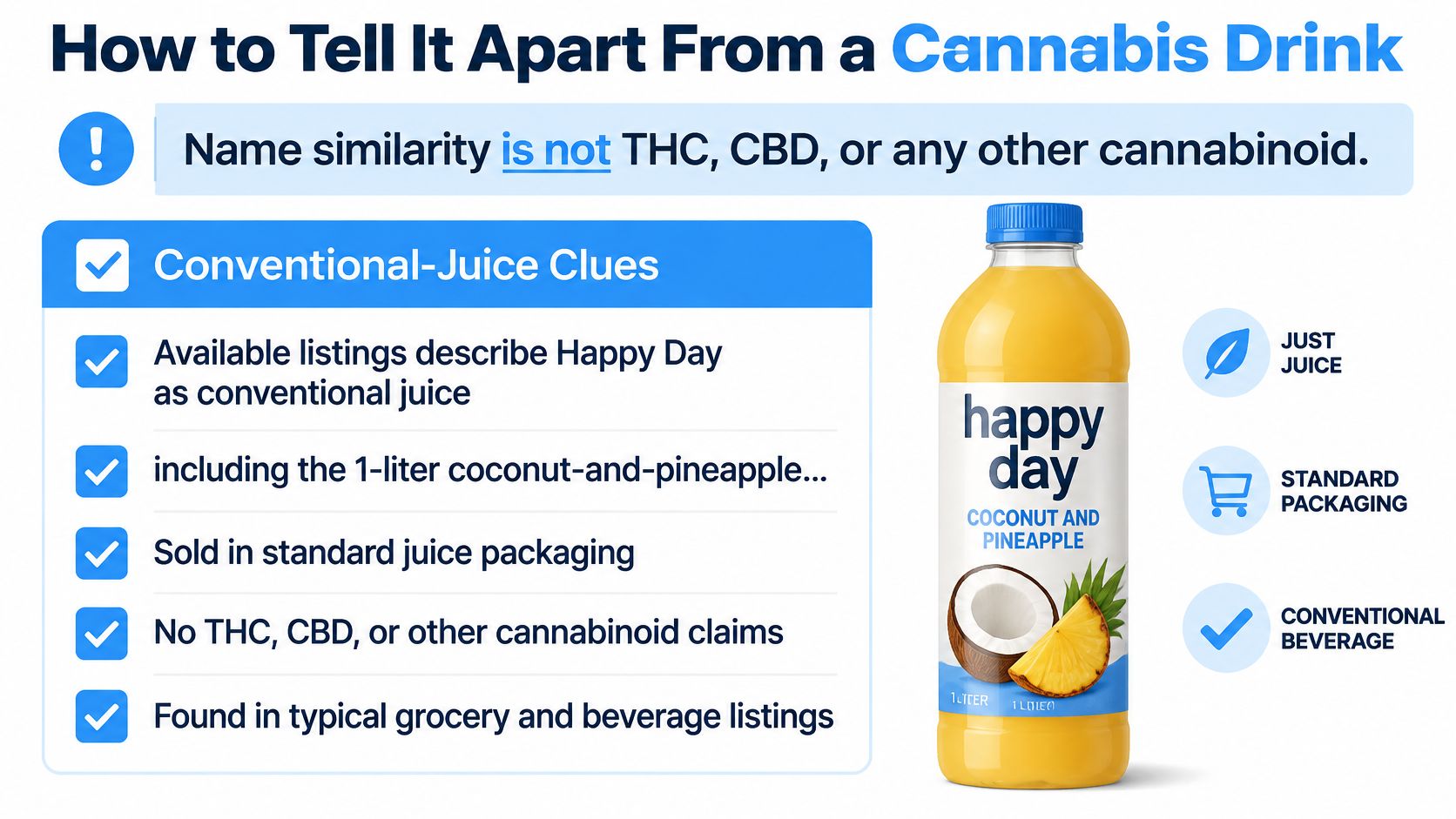
Name similarity isn't evidence of THC, CBD, or another cannabinoid. The Happy Day coconut-and-pineapple retail listing describes a conventional 1-liter fruit beverage, not a verified cannabis product.
Use package evidence rather than a search result or a seller's casual description. This visual checklist highlights the distinction.
| Check | Happy Day fruit juice | Licensed NY cannabis drink |
|---|---|---|
| Maker | Rauch, Austrian beverage company | Licensed New York processor |
| Cannabinoid line | None established by conventional listings | THC and CBD amounts required |
| COA | No cannabis certificate established | QR code or link to the COA |
| Lot | Grocery production traceability | Processor lot must match the COA |
| Potency test | Not applicable as cannabis testing | Lot-based potency testing |
| Who may buy | Ordinary retail rules | Adult-use age restriction applies |
| Dose to publish | Don't assign one | Verified labeled milligrams after COA match |
Follow the package to the laboratory result
Before identifying a lookalike beverage as infused, check its manufacturer, package size, Universal Product Code, ingredients, cannabinoid declaration, and lot number. Then open the jurisdiction-appropriate Certificate of Analysis, usually abbreviated COA.
New York's enforcement guidance says regulated dispensary products must pass laboratory testing and provide a QR code or COA link, with ingredients, expiration information, THC and CBD amounts, and the processor's lot number on the package.
New York's compliance reminders describe representative lot testing, packaging within six months of the laboratory test date, and five samples per batch or lot for potency testing. A headline potency claim alone doesn't replace that traceability.
What the test establishes
ACS Laboratory's soluble-beverage testing service describes liquid-chromatography mass spectrometry for measuring cannabinoids, including THC, CBD, THCA, and CBDA. Unlike gas chromatography, this approach avoids the same heat-related complications when measuring acidic cannabinoids; testing can also address contaminants and residual solvents.
For a real infused drink, reconcile the label's milligrams per serving and container with the matching COA. Record the serving volume so the customer knows how much liquid contains the stated amount.
Missing cannabis documentation means no assigned cannabis dose, not a laboratory-confirmed zero.
If someone markets an undocumented bottle as intoxicating, don't consume it on that assurance. Treat the claim as unverified.
For additional beverage context, the following video is available.
How to Dose a Real Cannabis Beverage
Dosing guidance belongs to a verified, licensed cannabis drink, not Happy Day fruit juice. Once you've established the product's identity, the practical task is controlling how much THC you consume and resisting the temptation to add more too soon.
Orally consumed cannabis can act more slowly and less predictably than inhaled cannabis. Reporting on cannabis beverage use highlights the problem with treating fast-acting positioning as a guarantee: formulation and individual circumstances can change the experience.
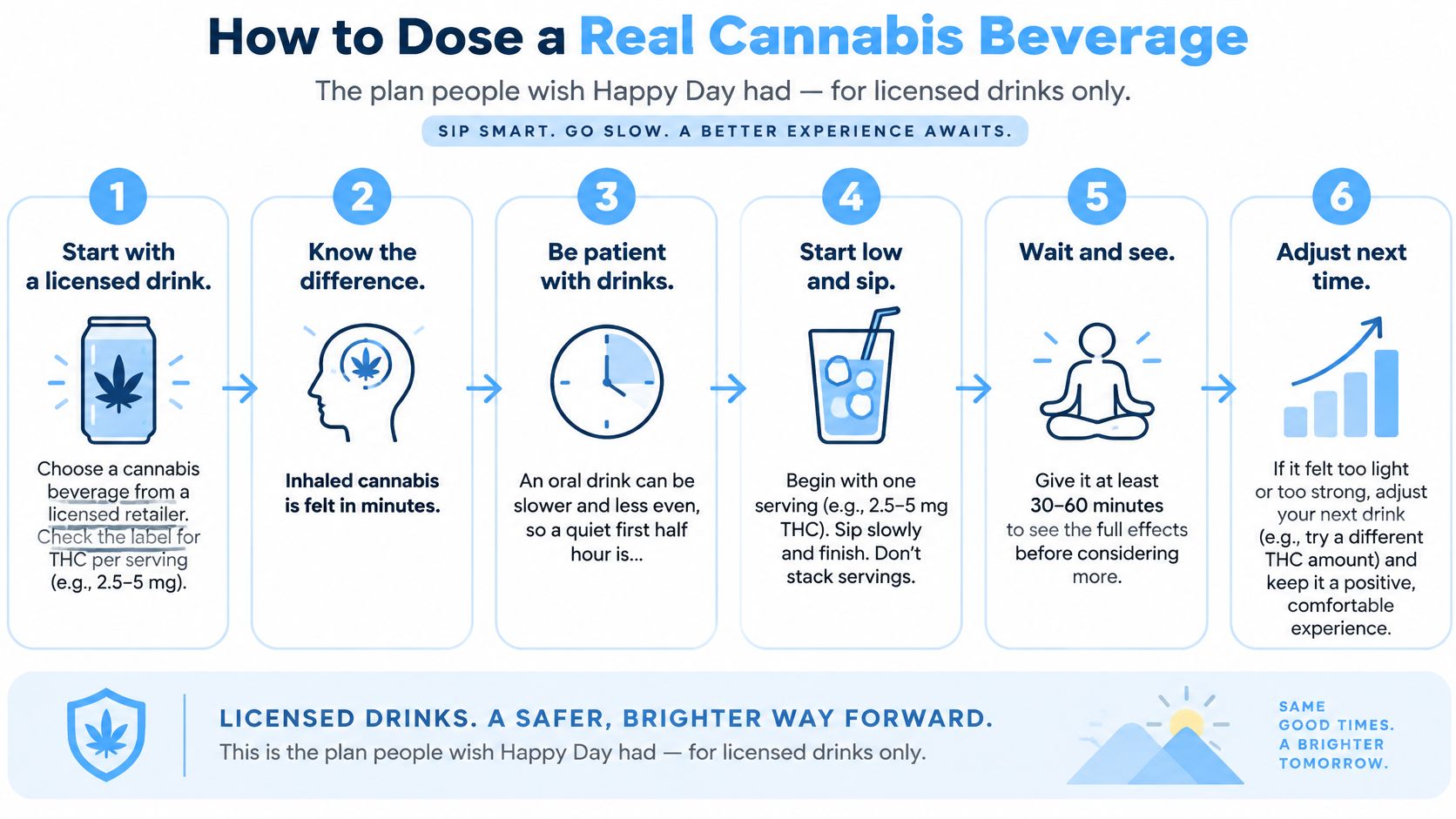
The routine below keeps the decision focused on the labeled serving and your response.
Use a deliberate serving routine
Read the whole container label. Identify the THC amount per serving and per container. Don't assume a can is a serving just because it looks like a soda.
Choose a low initial amount. If you're new to THC, use the low end of the package's serving guidance. Only measure a partial serving when the product's instructions support doing so accurately.
Measure before drinking. Use the declared serving volume and a marked measuring cup when needed. Pour your planned amount separately rather than estimating repeated sips from a larger bottle.
Give the serving time. As a conservative planning rule, set a timer for at least two hours before even considering more, and wait longer if effects are still developing or you've had a heavy meal. This isn't a guarantee that all effects have peaked.
Don't compete with someone else's response. Your friend feeling something first doesn't establish that your serving was weak. Food, tolerance, body characteristics, and formulation can affect the experience.
Keep the rest of the evening simple. Skip alcohol, avoid additional THC products, and arrange transportation before consuming. Don't drive because you feel less affected than expected.
Our edibles dosing chart offers another way to think about labeled oral servings. Product-specific directions and verified potency still take priority over a general chart.
If the effects feel too strong
Stop consuming THC. Sit somewhere calm with a trusted person, sip water, and avoid alcohol or other intoxicants. Don't attempt to drive yourself home or use another substance to counteract the experience.
Seek urgent medical help for severe symptoms, including difficulty breathing, chest pain, loss of consciousness, or an inability to stay safely oriented. Keep the package available so responders can identify what was consumed.
The National Institute on Drug Abuse notes that some dispensary flower and concentrates exceed 40% THC and associates higher THC concentrations and chronic heavy use with cannabis-use-disorder concerns. That's context about potent cannabis products, not a beverage concentration estimate.
A sweet flavor or familiar bottle shape doesn't make THC gentle. Judge the serving by verified milligrams, not by how ordinary the drink tastes.
When a Cannabis Drink Replaces a Cocktail
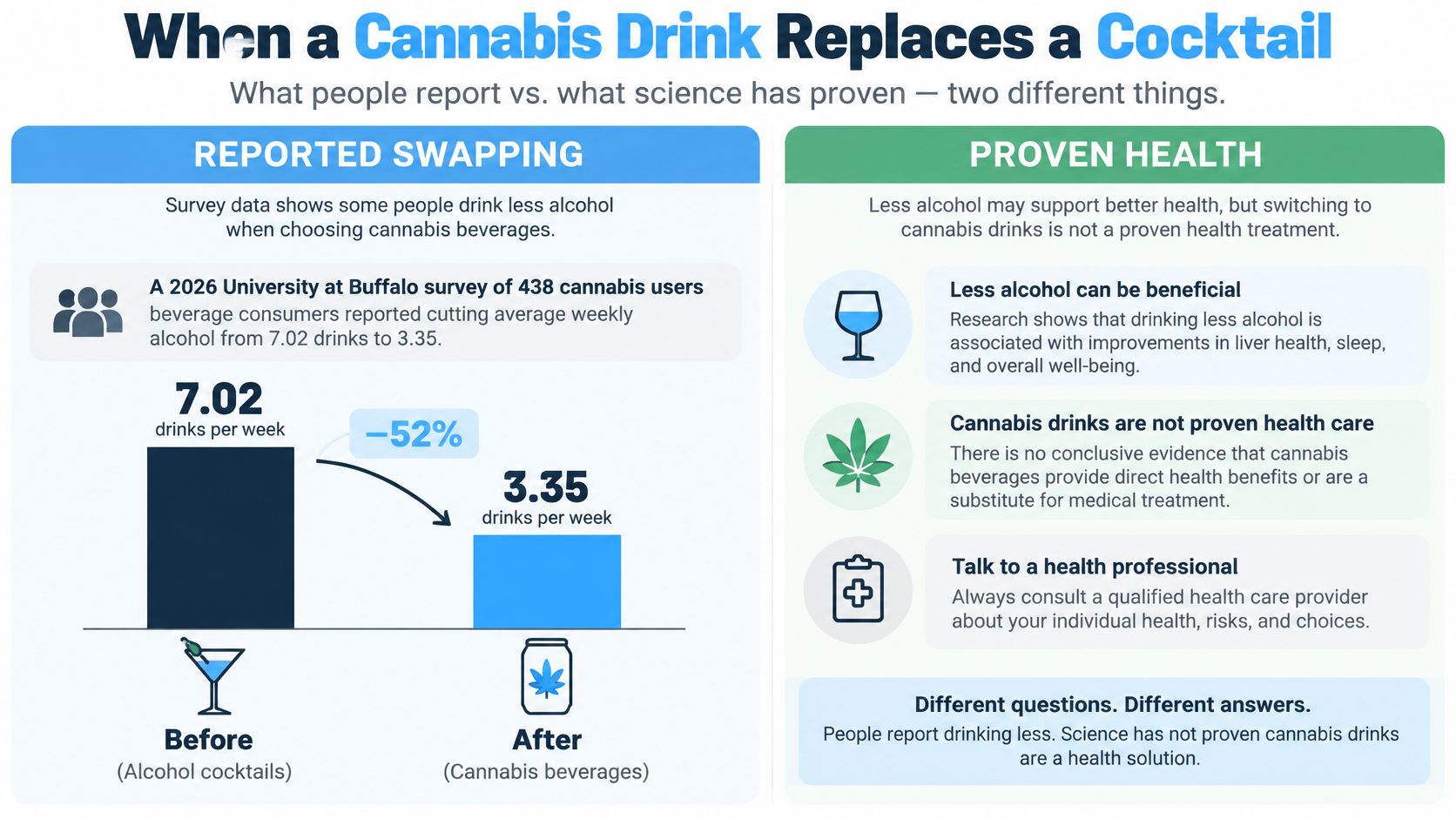
A 2026 University at Buffalo survey reported by ScienceDaily, involving 438 cannabis users, found that beverage consumers reported reducing average weekly alcohol intake from 7.02 drinks to 3.35, while 62.6% said they reduced or stopped drinking. Those are reported behavior changes, not proof that cannabis beverages caused the reduction or improved participants' health.
The same account says nearly half of beverage users didn't know the CBD content of what they consumed. That gap matters when a drink is presented as balanced, gentle, or wellness-oriented.
The visual comparison separates the survey result from a health conclusion.
Substitution doesn't mean sobriety
A person can drink less alcohol while continuing to use an intoxicating substance. THC can impair reaction time, judgment, coordination, and driving. Changing the format doesn't eliminate those concerns or dependence-related risks.
Consider a dinner guest who wants to avoid alcohol but remains comfortable with cannabis intoxication. A carefully selected, labeled drink may fit that preference if the person plans not to drive and understands the serving. Someone who wants no impairment has a different goal.
Alcohol-free and impairment-free aren't the same choice.
The distinction also changes how you evaluate the label. Flavor matters for enjoyment, but cannabinoid ratio, serving size, sugar content, and tolerance matter for suitability.
Choose for the actual occasion
Ask what you're trying to change. If you're avoiding alcohol specifically, don't automatically add THC without considering its effects. If you're avoiding intoxication, choose a clearly non-intoxicating beverage instead.
- For a sober social evening, choose a non-intoxicating drink and keep the occasion separate from cannabis dosing.
- For intentional cannabis use, select a verified serving and plan the evening around possible impairment.
- For a lower-sugar preference, inspect the nutrition panel rather than assuming seltzer, juice, or wellness branding answers the question.
A flavored mixer presents another common confusion. Our guide to a good chaser for Crown Apple concerns a different beverage decision; juice used alongside alcohol doesn't make the combination non-intoxicating, and adding cannabis creates another impairment concern.
Happy Day belongs in the grocery-beverage decision. Whether you enjoy its flavor or prefer another juice has no bearing on whether a THC beverage suits your health, transportation plans, or intentions for the evening.
Find a Real Cannabis Drink on Long Island
A cheerful juice name does not establish that a product contains cannabis. Buy Happy Day as fruit juice; for a cannabis beverage, look for a licensed dispensary product with clear information about its ingredients and THC content.
New York's adult-use information states that adults 21 and older may possess up to 3 ounces of cannabis flower and 24 grams of cannabis concentrate, including applicable oils and edibles. Those are possession limits, not suggested amounts to consume.
Plan where you'll consume
New York restricts where cannabis may be consumed. Check the state's adult-use rules and guidance before choosing a location, and plan how you'll get home. A restaurant visit, beach outing, or parked car should not be treated as an automatic place to consume.
- Choose the format deliberately. A drink, gummy, and inhaled product each have different serving considerations.
- Ask about the package. If a name is unclear, show the exact item rather than asking about flavor alone.
- Confirm availability before ordering. A menu listing can change.
Make the comparison concrete
Strong Strains Cannabis Dispensary is at 19 Technology Drive, East Setauket, NY 11733, and offers flower, vapes, pre-rolls, edibles, concentrates, tinctures, topicals, and accessories, with in-store pickup or local delivery. For example, Ayrloom lemonade with 10mg THC and 5mg CBD is a listed cannabis beverage. Edible alternatives include Wana Quick Peach Bellini Gummies, 100mg THC, listed at $11.14, Wana Blueberry Indica Gummies 100mg, listed at $11.14, and Hashtag Honey Mango Live Resin Infused Gummies 100mg, 10 pack, listed at $14.40.
The gummies are not drinks, and the package total is not a recommended single dose. Comparing product format and labeled potency gives you a clearer starting point than comparing cheerful names or fruit flavors.
Strong Strains' budtenders can help explain product labels and options. Bring questions about THC, your familiarity with cannabis, and the occasion you have in mind.
If a Happy Day package presents ordinary juice information without cannabis labeling, treat it as grocery juice. A fruit flavor alone does not indicate an infusion.
At Strong Strains Cannabis Dispensary, you can ask about cannabis products, serving information, and available pickup or local delivery. Our team serves East Setauket and Long Island with friendly, knowledgeable guidance.