
Rosin is a cannabis concentrate made by pressing trichome-rich flower, kief or hash with controlled heat and pressure and no added solvent, so the resin flows out of the glands. Flower rosin usually comes off the plates at 200-220°F (93-104°C) for 45-90 seconds, and what you scrape up is a sticky, aromatic oil rather than a stripped high-potency distillate.
At the counter, a small glass jar of amber rosin sits above the wax and shatter, and the price gap is wide enough that people pick it up, turn it over, and ask what the extra money buys. Fair question. The honest answer isn't "it gets you higher." It's a story about how the oil came out of the plant, and how much of the plant survived the trip.
What follows covers the press, the categories, the trade-offs, and the piece most explainers skip: how to read a batch's lab report before you commit to a premium gram.
What Rosin Is and Why It Matters
The same word shows up on a violin bow and on a dispensary menu, which is enough to make a first-time shopper pause. They are not the same material.
Pine rosin is the brittle amber resin violinists and baseball pitchers use for grip. Encyclopaedia Britannica's entry on abietic acid describes it as the nonvolatile residue left after pine oleoresin is distilled for turpentine. That older, industrial use is why "rosin" sounds like a hardware-store item. Cannabis borrowed the word for a pressed plant resin and gave it a new shelf.
Cannabis rosin is the flower's own resin, moved from gland to jar. Warm a trichome, the tiny gland on the flower, and the resin inside softens. Pressure bursts the gland wall. Cannabinoids, terpenes, and a share of plant waxes travel out with the oil. No solvent is added, and the oil is not run through a distillation step that strips the aroma and rebuilds it. That is why a good jar still smells like the flower it came from, waxes and all, rather than like a cleaned-up chemistry product.
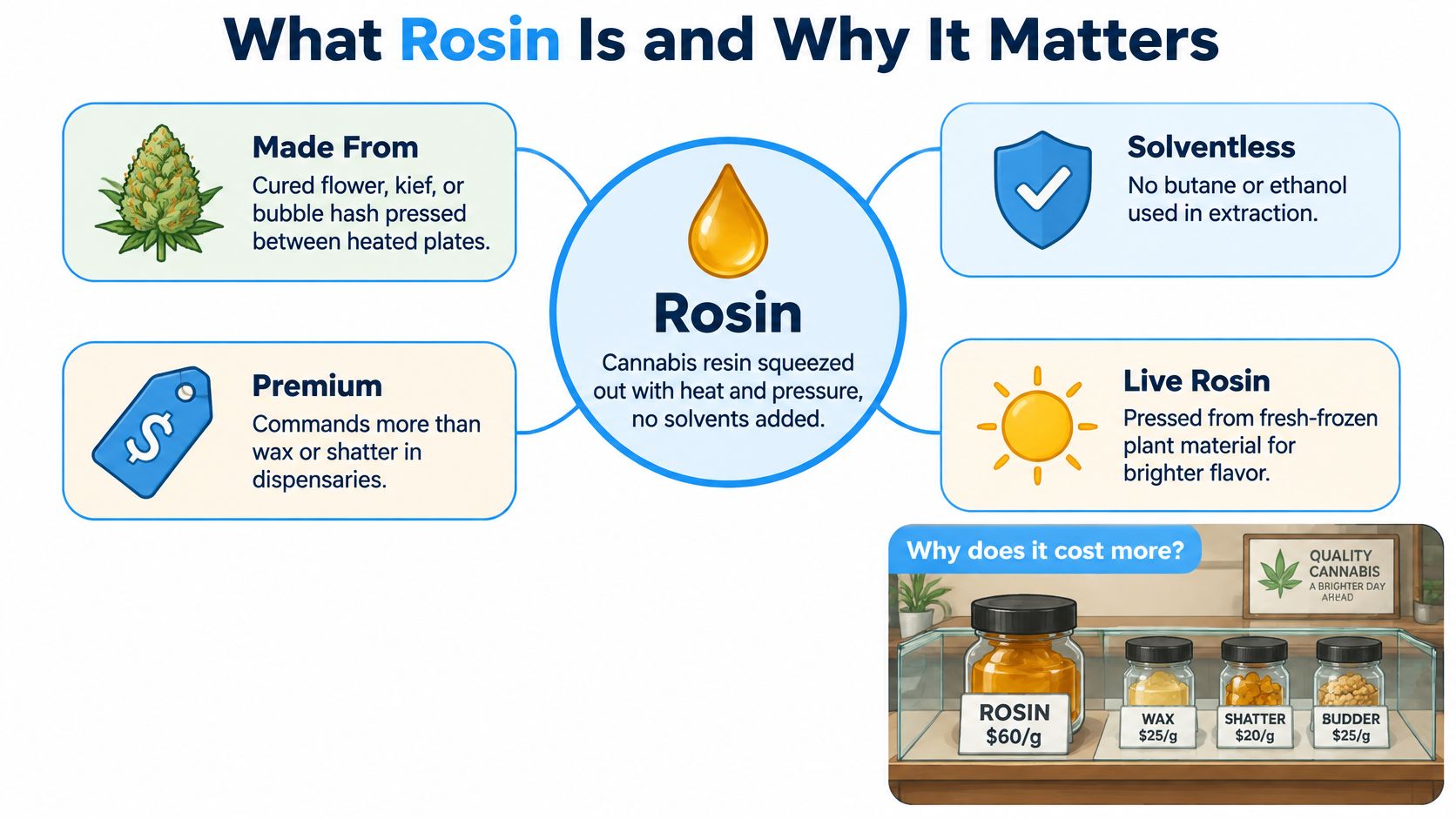
The price mostly tracks labor and loss. A press run returns a small fraction of the starting material. Live rosin, pressed from fresh-frozen plants, returns even less. You are paying for small batches, low output, and a texture that is harder to ship and store than a stable shatter.
A one-screen read, for anyone trying to place it on the menu:
| Question | Quick answer |
|---|---|
| What is it? | A cannabis concentrate pressed from trichome-rich flower, kief or hash |
| How is it made? | Controlled heat and pressure, with no butane, ethanol or other added solvents |
| Texture | Sticky sap, whipped batter or glassy shards depending on input and temperature |
| Typical potency | Wide range; a licensed 1g example tests at 40% THC, above flower and below many distillates |
| Flavor | Terpene-forward, closer to the original flower than many solvent extracts |
| Legality in New York | Legal adult-use concentrate for buyers 21+, batch-tested by OCM-permitted labs |
Rosin lands in a specific spot: more flavor-forward than a distillate, costlier than a wax, and often less potent than the distillate jars beside it. In New York the word is a product category on the licensed menu, so the gram should come with a batch certificate of analysis, not only a strain name on the lid. That COA is the shopper's check on cannabinoids and terpenes before paying a premium for a 1g example that tests at 40% THC. "Solventless" describes how the oil was pressed. It does not, by itself, prove the jar matches the label.
How Rosin Is Pressed and Which Type You Get
Every cannabis flower wears a coat of tiny mushroom-shaped glands called trichomes, and those glands hold the resin that carries cannabinoids and aromatic oils. Rosin is what happens when you warm that resin until it softens and then squeeze until the gland walls give way. The plant matter stays behind. The oil leaves.
The mental model that helps is cold-pressed olive oil. Heat makes the oil fluid enough to move, and pressure pushes it out of the fruit. Push too hard or too hot and you get more volume at the cost of the bright, peppery character that made the oil worth pressing in the first place. Rosin works the same way, with terpenes playing the role of that fragile aroma.
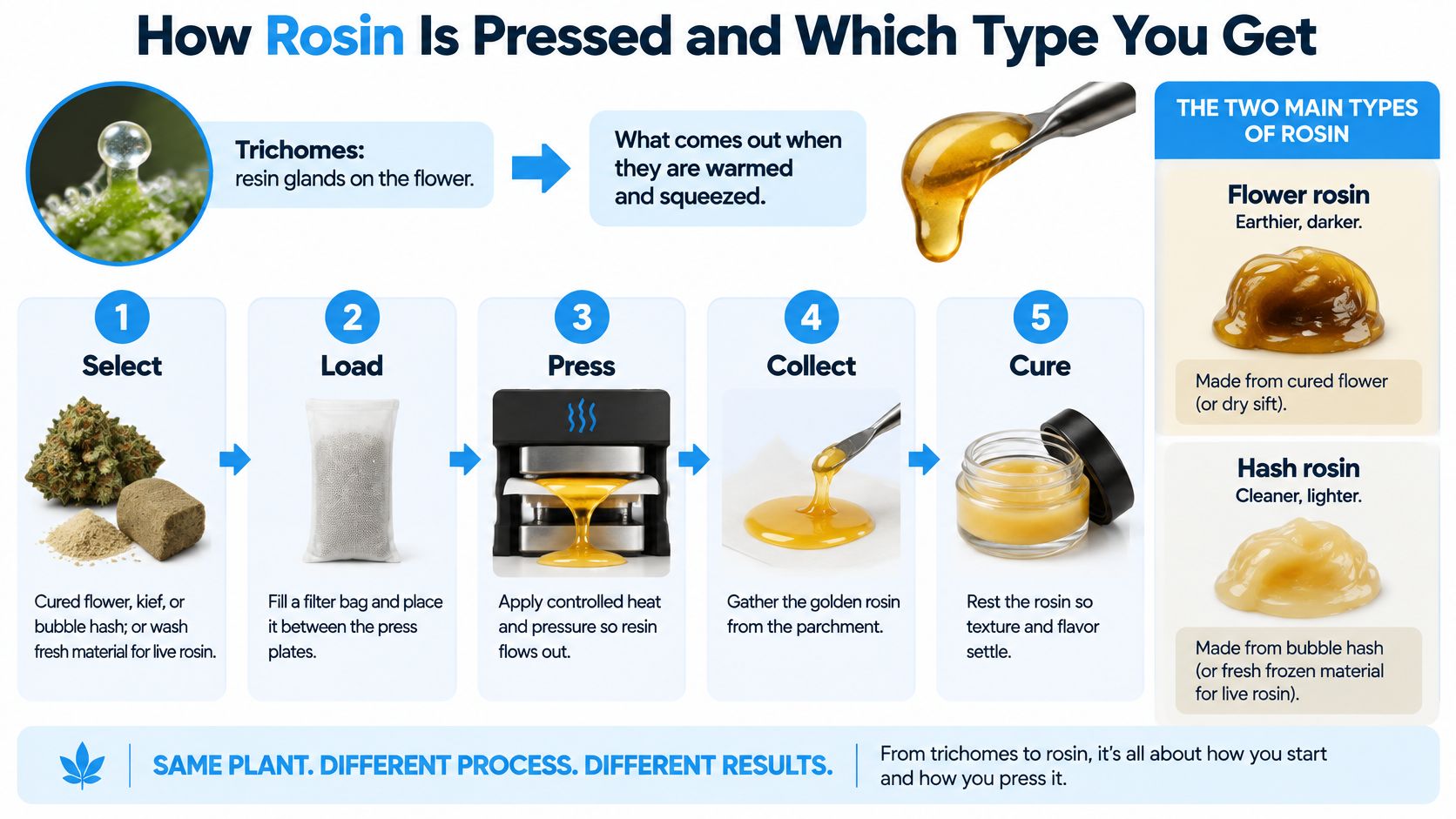
From trichome to jar in five steps
- Select the input. Cured flower, dry-sifted kief or bubble hash all press. For live rosin, fresh-frozen flower gets washed in ice water first to knock the trichomes loose from the plant.
- Load it. The material goes into a fine mesh filter bag, which sits between two sheets of parchment on the press plates. The bag is what keeps plant matter out of the finished oil.
- Press. Plates close at a set temperature, pressure and duration. These three variables decide almost everything about the result.
- Collect. The softened resin flows through the mesh and pools on the parchment, where it's gathered with a scraping tool while still warm and pliable.
- Cure and jar. The rosin rests so texture and flavor settle, then goes into glass. What looked like sap can stiffen into batter or shatter over the following days.
If you'd rather watch the plates close than read about it, this short clip shows a press running from load to scrape.
Which type fits your bench
Flower rosin is the entry point. Dried buds go straight onto the plates, and published press guidance places it around 200-220°F (93-104°C) for roughly 45-90 seconds. Choose it if you want to try solventless without paying the top tier, and expect an earthier, darker result with a modest return.
Hash rosin starts from bubble hash or kief, so most of the plant material is already gone before the press. Industry manufacturing guidance puts hash rosin at roughly 140-180°F (60-82°C), cooler than flower because the terpene fraction is more delicate once it's concentrated. Choose it if you want more potency and a cleaner flavor in the same gram.
Live rosin washes fresh-frozen flower into ice-water hash, then presses that hash at the low end of the hash range. Choose it if aroma is the reason you're buying concentrate at all, and accept that the yield is the lowest of the three, which is exactly why the jar costs what it does.
Practical rule: if a menu line mentions a low press temperature, that's a flavor decision, not a potency boast. The grower gave up grams to keep the smell.
The trade-off runs in both directions. More heat and pressure raise yield but pull extra waxes, darken the oil and drive off the volatile compounds you came for. Gentler settings protect the aroma and cost you material.
| Starting material | Typical temperature and time | Yield vs. flavor | Result |
|---|---|---|---|
| Dried flower | 180-220°F (82-104°C), about 45-90 seconds, often near 200-220°F | Higher heat raises yield but darkens flavor | Flower rosin |
| Bubble hash or kief | 140-180°F (60-82°C), gentle press | Lower heat protects delicate terpenes | Hash rosin |
| Fresh-frozen flower washed into hash | Bottom of the hash range | Maximum freshness, lowest yield | Live rosin |
The same solventless hash shows up on edible menus too, including hash gummies, where the texture argument disappears and only the flavor and dose matter.
Rosin Compared With Other Concentrates
The question is never "what is rosin" in the abstract. It's whether rosin is worth more than the wax or live resin sitting next to it, and the answer depends on which of three distinctions you care about.
| Concentrate | How it's made | Added solvent? | Texture | Known for |
|---|---|---|---|---|
| Rosin | Heat and pressure on cured flower, kief or hash | No | Sap, batter or shards | Solventless flavor, small-batch appeal |
| Live rosin | Heat and pressure on ice-water hash from fresh-frozen flower | No | Creamy batter | Freshest terpene profile, premium tier |
| Live resin | Hydrocarbon extraction from fresh-frozen flower | Yes (butane or propane) | Sauce, sugar or wax | Loud aroma, high terpene retention |
| Shatter or wax | Butane or CO2 extraction, then purged | Yes, or CO2 | Glassy shatter, crumble or honeycomb | High potency, stable, lower price |
| Bubble hash | Ice-water agitation through micron filter bags | No, ice and water only | Granular powder to paste | Traditional full-melt hash |
| Kief | Dry-sifting trichomes from flower | No | Fine powder | Entry-level potency, sprinkled on flower |
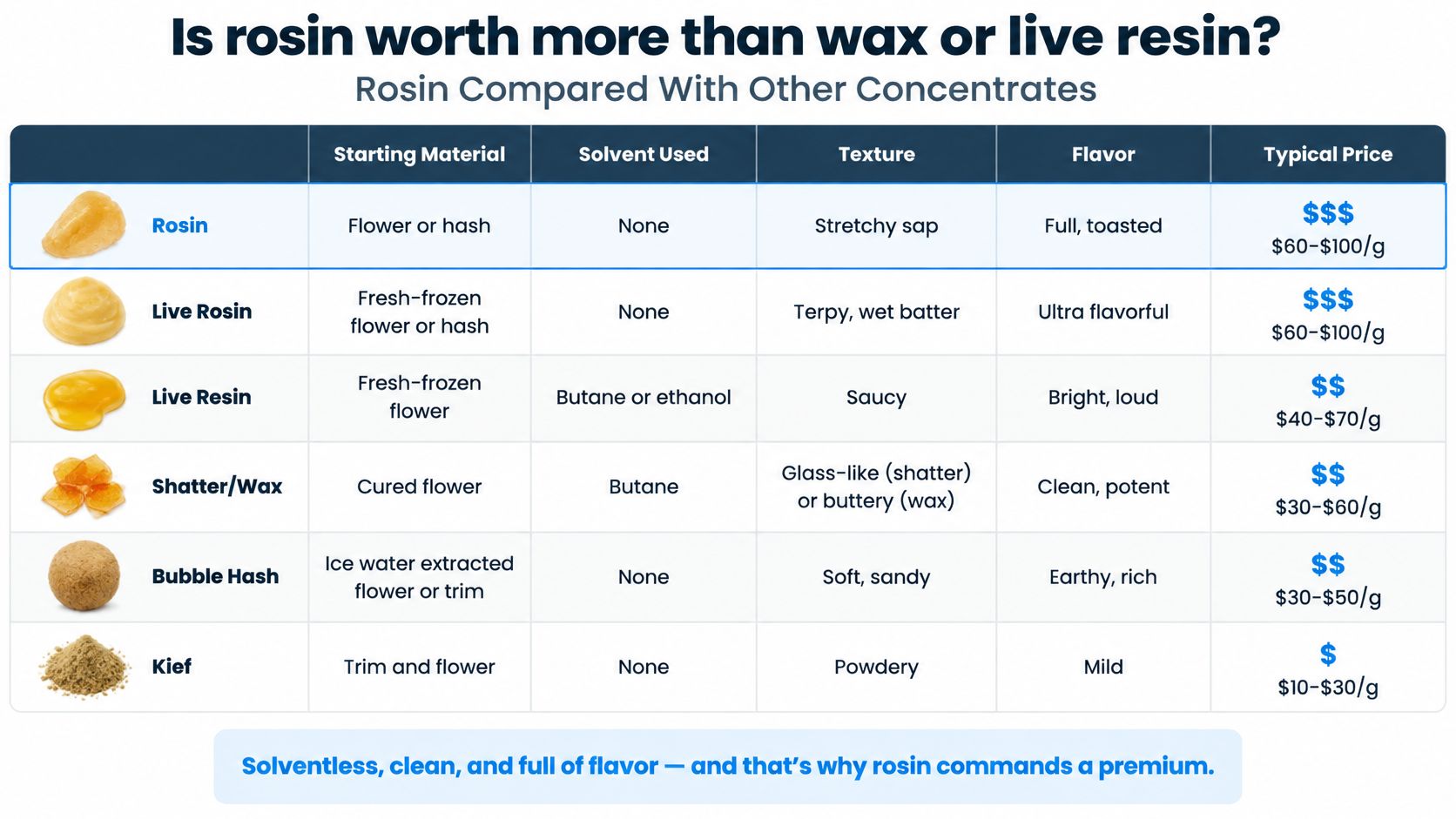
Process is the first split. Rosin, bubble hash and kief all rely on mechanical separation: heat, pressure, ice or screens. Live resin and shatter come out of licensed labs running hydrocarbon or CO2 equipment, then purging the solvent back out. Neither route is dirty by default, and neither is clean by default. If you want the wider lay of the land, our rundown of the different types of concentrates covers the formats that don't fit neatly into either column.
Flavor and stability pull in opposite directions. Rosin's reputation comes from preserving the plant's aromatic profile, but that same richness makes it soft, tacky on a tool and sensitive to heat. Shatter is stable and easy to keep; rosin wants a cool, dark spot and a little care.
Price and potency overlap less than people assume. Small-batch solventless runs cost more per gram because they yield less, yet a solventless gram can outclass flower on potency without matching the ceiling of a distilled oil. Nobody should buy rosin expecting the strongest jar in the store.
If you're chasing the biggest number on the label, spend your money elsewhere. If you're chasing the smell of the plant, rosin earns its premium.
Match the row to the buyer: the flavor chaser takes live rosin, the potency seeker takes a distillate or a strong live resin, and the budget shopper is well served by kief or a decent wax.
What Solventless Does and Does Not Guarantee
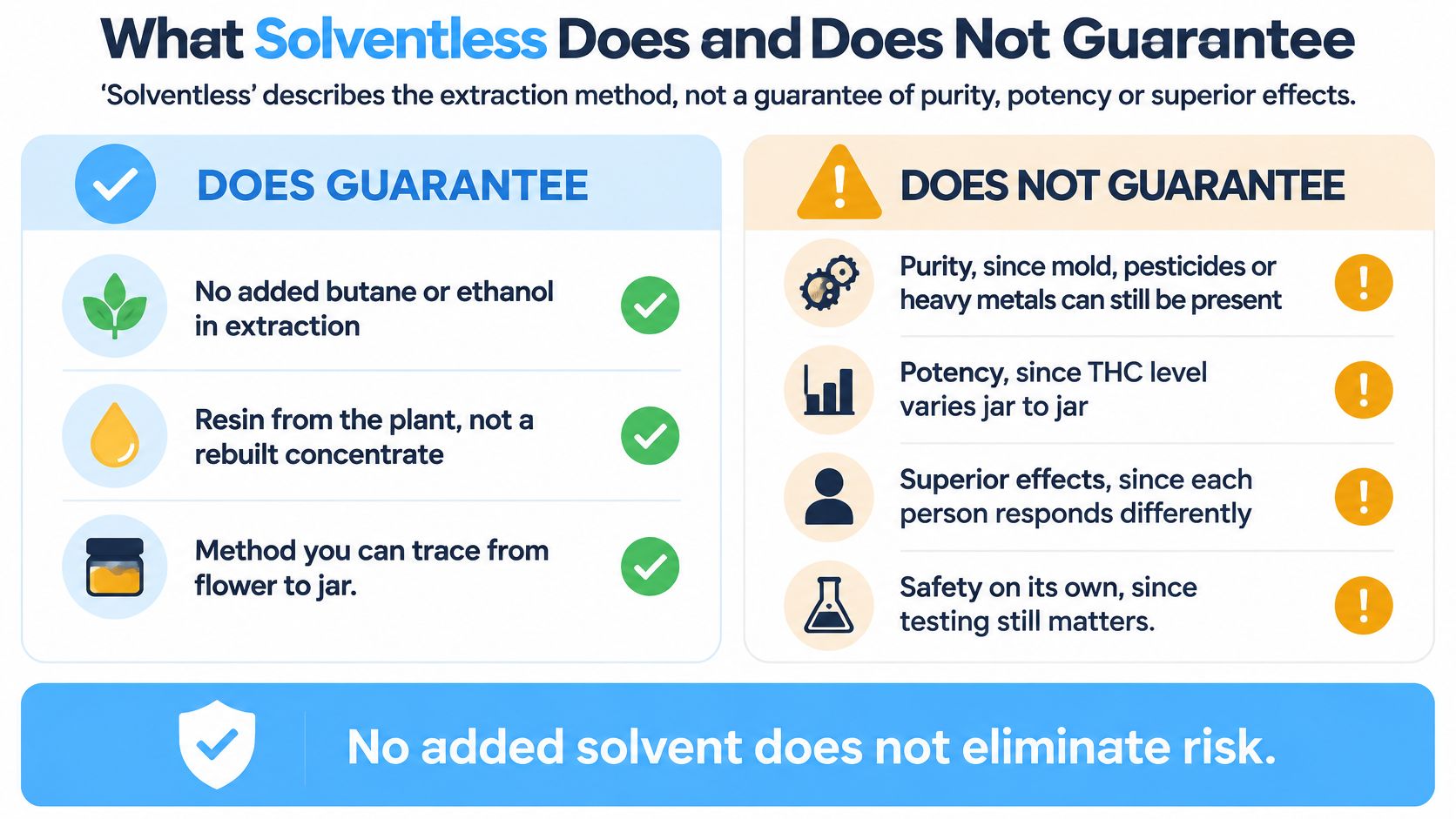
A jar labeled “solventless” tells you how the resin was separated from the plant. It does not tell you whether the finished product is pure, potent or safe. Removing residual hydrocarbons does not remove mold, pesticide residue, heavy metals or problems that may arise while hash dries.
Contamination can enter at many points, including the plant material, wash water, processing environment, packaging and storage. Extraction method is only one part of product quality. Cultivation controls, manufacturing hygiene and reliable testing matter, too.
What New York actually requires
New York classifies rosin as concentrated cannabis extracted without solvents. The Office of Cannabis Management guidance for licensed processors requires each batch or lot to be tested by an OCM-permitted laboratory. Testing covers cannabinoid potency, terpenes, pesticides, heavy metals, mycotoxins and microbiology.
Label accuracy matters as well. The state's testing limits document sets a ±15% tolerance between the tested potency and the labeled cannabinoid value. Products outside that range must be relabeled, repurposed or destroyed. A jar labeled 40% that tests at 30% falls outside the allowed window.
Use the certificate of analysis (COA) as a practical quality check. Match it to the jar in your hand, then read what the results cover.
- Match the lot number. The COA should correspond to that specific batch, not just the brand.
- Compare labeled and tested THC. Check the reported result against the package label. The ±15% tolerance is a limit, not a target.
- Read the terpene panel. It shows which terpenes were detected after processing and storage. THC alone cannot tell you that.
- Check contaminant results. Confirm that pesticides, metals, mycotoxins and microbiology are reported and pass.
Every Solventless Concentrates Tier 2 product sold at Strong Strains includes full cannabinoid and terpene analysis. That gives shoppers product-specific information to review, though the solventless label itself still cannot answer every quality question. Buy licensed products, check the batch report and consider the full set of results.
Using Rosin Responsibly
Concentrates concentrate more than flavor. Flower generally lands well below a solventless concentrate on potency, and a 1g jar on our shelf, RYTHM's Bubba Fett Solventless Concentrates Tier 2 indica, tests at 40% THC. That's a different experience from a joint, and it deserves a different approach.
- Start with a grain of rice. A piece that size is a real dose at this potency.
- Wait before redosing. Inhaled concentrate hits within minutes but keeps building, so give it at least 15 to 30 minutes before deciding you want more.
- Keep the evening clean. Skip alcohol and skip stacking edibles on top, since both blur your read on how strong the first dose was.
- Sit down for the first one. A small dab is fast, strong and terpene-rich, and beginners do better seated than standing in a kitchen.
- Don't drive. No getting behind the wheel or running machinery after dosing.
- Store it cool and dark. Airtight glass or parchment, away from sunlight and heat, keeps texture and aroma intact for months.
Lock everything away from children and pets. Rosin is sticky, aromatic and appealing in exactly the way a curious animal investigates.
If you're still working out hardware and technique, our guide to how to use rosin walks through temperatures and tools before your first session.
Finding Quality Rosin on Long Island
You are at the case in East Setauket. Two jars look alike, and the label only says solventless. That word describes the process. Potency, the terpene mix, and whether this lot matches the last one you liked all sit on the batch COA, the lab sheet for that specific batch.
Strong Strains, at 19 Technology Drive, East Setauket, carries lab-tested, handpicked products, with in-store pickup or local delivery. Budtenders will walk the solventless shelf without pushing a sale. Ask them which tier fits your experience, then request the batch COA before you buy.
Two products make that comparison concrete. RYTHM's Bubba Fett Solventless Concentrates Tier 2 is a 1g indica at 40% THC for $69.91, with limonene leading the terpene profile. Jaunty's Orange Swirl Solventless Hash Gummies are 10 count, 100mg, for $17.00: solventless hash in edible form. Each Solventless Concentrates Tier 2 product includes full cannabinoid and terpene analysis, so you can compare the paperwork instead of a photo.
The shop is open daily with extended evening hours. If the numbers on a COA still feel opaque, our explainer on how to read lab test results walks through the sheet. Stop by Strong Strains Cannabis Dispensary, or order for in-store pickup or local delivery.