
A 1-gram dab weighs 1,000 mg of concentrate; its total THC equals 1,000 mg multiplied by the THC percentage on the lab report, so a product labeled 70% THC contains about 700 mg of total THC. That figure describes what's in the jar, not how much enters your body in one session.
The popular shortcut “one gram is one dose” gets the math wrong. Weight tells you how much concentrate you have, while potency and the portion you use determine the THC exposure. A 1-gram container can hold hundreds of milligrams of THC, so read the label, measure a small portion, and don't treat the whole jar as a serving.
Why One Gram Measures Weight, Not Strength
Say two jars both say 1 gram. One tests at 50% THC and the other at 85%. They contain the same amount of concentrate by weight, but the second holds substantially more THC.
A 1-gram dab weighs 1,000 mg of concentrate. To estimate its total THC, multiply 1,000 mg by the THC percentage shown on the lab report. At 50%, that's about 500 mg of THC in the jar; at 85%, it's about 850 mg, before accounting for testing variation or what happens during use.
That's why a gram is a quantity, not a dose. Concentrates can be far stronger than flower, and a dab is difficult to judge by eye. Two portions that look similar may weigh differently, and identical weights from different jars may contain very different amounts of THC.
A package's potency label also doesn't tell you precisely how much THC you'll inhale. In this guide, total THC means the amount calculated from the product's weight and reported potency. Inhaled THC refers to THC that enters the vapor stream during use. The certificate of analysis, or COA, is the lab report you can use to check potency and test results. For New York readers, the adult possession limit for concentrate is 24 grams, a legal amount that's separate from the product's potency.
The practical rule: Read the THC percentage before comparing jars by weight. A gram label alone can't tell you how strong a product is.
Once you understand that distinction, it's easier to estimate milligrams from a label, plan a cautious starting portion, compare concentrates with other formats, and check a batch and its price per milligram before buying.
How Much THC Is in a One-Gram Dab
A gram tells you how much concentrate is in the jar, not how strong it is. To estimate the total THC, multiply the product's weight in milligrams by its labeled THC percentage, written as a decimal:
Total THC in milligrams = 1,000 mg × THC percentage
For example, 70% becomes 0.70. A 1-gram dab labeled 70% THC therefore contains about 700 mg of total THC by this calculation. That number describes THC in the product, not the amount you'll inhale.
Potency varies between products, so the percentage on a specific jar is more useful than a broad average. The New York Office of Cannabis Management's enforcement information reports average THC potency in cannabis concentrates rising from 46% in 2014 to 68% in 2020. NIDA reports that solvent-based concentrates commonly average about 54% to 69% THC and can exceed 80%. These figures offer context for reading a label, not a prediction for any individual product.
Total THC in one gram at common potency levels
| Labeled THC | Total THC in 1 g | Where it sits in the research |
|---|---|---|
| 46% | 460 mg | Average concentrate potency reported for 2014 |
| 54% | 540 mg | Low end of NIDA's typical solvent-based range |
| 68% | 680 mg | Average concentrate potency reported for 2020 |
| 70% | 700 mg | Common labeled value used in consumer examples |
| 80% | 800 mg | NIDA notes some products exceed 80% THC |
| 90% | 900 mg | High-potency concentrate |
The arithmetic is straightforward: 1,000 mg × 0.54 equals 540 mg, while 1,000 mg × 0.90 equals 900 mg. Each result estimates the total THC based on the labeled percentage. It does not measure what your body absorbs.
A label is still an estimate. Laboratory variation, moisture, and the difference between total and active THC can affect how closely the calculated amount reflects the jar's contents. The percentage gives you a useful starting point for comparing products, while the product's own lab information is the more relevant guide to that particular jar.
To estimate a gram, read its THC percentage, convert it to a decimal, and multiply by 1,000 mg. Then use the table to see how the result compares with other labeled potency levels.
Total THC Versus What You Actually Inhale
The jar's total THC and the THC entering your body during a session aren't the same measurement. Total THC is a calculated amount in the product. Inhaled THC depends on how much concentrate you vaporize and how efficiently the device transfers THC into the vapor.
A 1-gram product labeled 70% THC contains about 700 mg of total THC. In controlled vapor-transfer experiments, up to 40% of theoretically available THC entered the inhaled vapor stream, according to research on concentrate composition and vapor transfer published in ACS Omega. Applying that upper figure to 700 mg gives up to about 280 mg in the vapor stream if the entire gram were used. That example is not a recommended serving or a prediction of how much your body absorbs.
The actual amount consumed in a session varies with the size of the dab, the device and its efficiency, and the heat applied. A full gram should never be treated as one serving. The same study analyzed 57 concentrates and found THC concentrations ranging from 23.7% to 75.9%, another reason a jar's weight alone can't predict what a session will deliver.
Your own use pattern matters, too:
- Portion size: A smaller measured dab starts with less concentrate than a large one.
- Heat and device efficiency: The vapor produced can change with the device and the way it's used.
- Frequency: Sessions across the day change your overall exposure.
- Personal tolerance: The same amount can feel different to different people.
A useful personal estimate starts with the COA and the portion you use, not the full container weight. Measure a very small amount, avoid loading the whole gram, and wait to judge its effects before considering more. Dabbing can deliver THC rapidly, and taking too much can bring on acute anxiety, panic, paranoia, or hallucinations.
That's also why there's no fixed answer to “How long will one gram last?” A gram may last very different amounts of time depending on potency, portion size, device, frequency, and tolerance. Track what you use in a session rather than relying on a universal count.
How to Dose a Dab Without Overdoing It
A jar's milligram estimate is useful only if you make a deliberate plan for the portion. This routine keeps the math tied to what you measure.
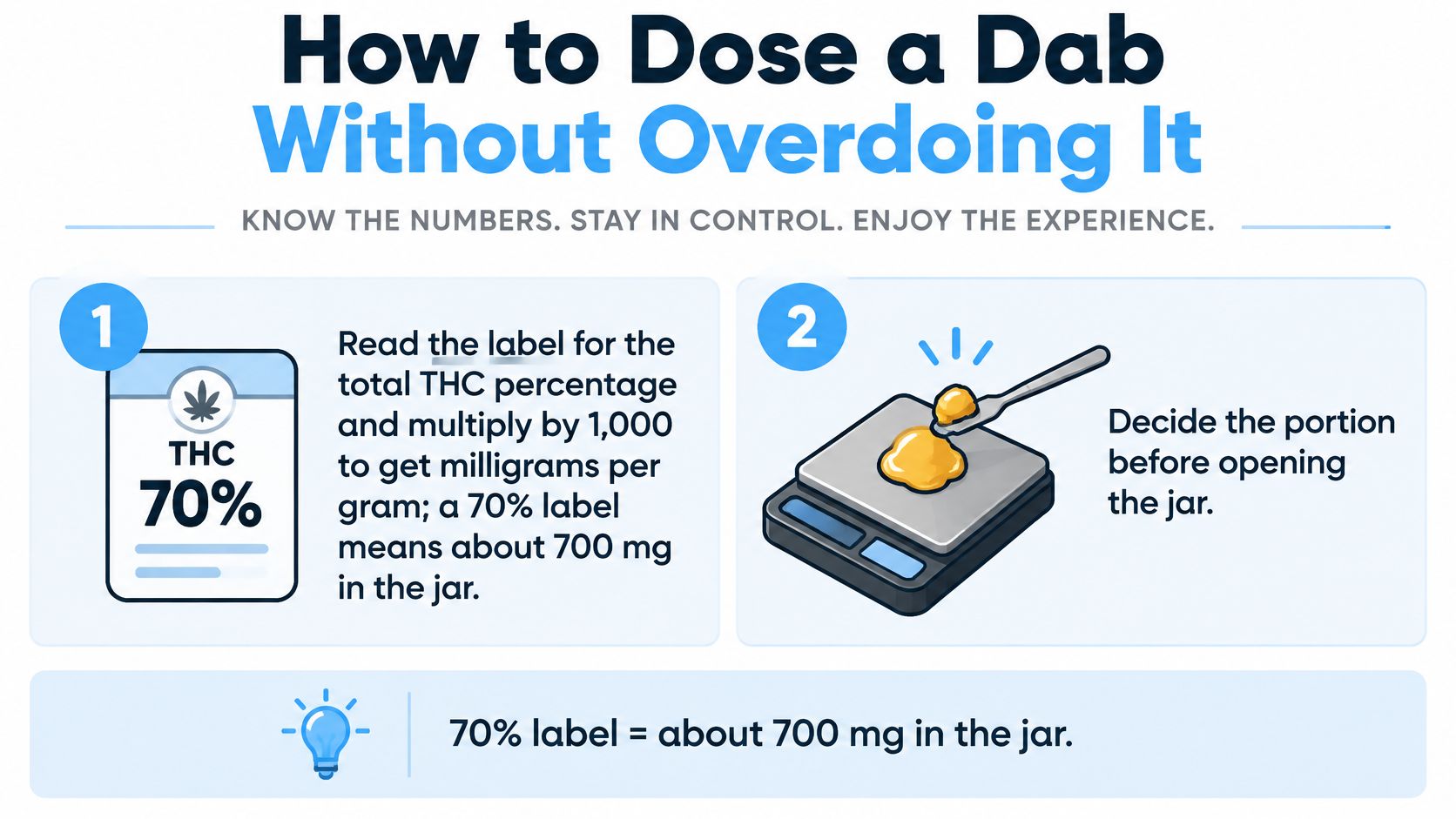
Read the label and calculate the jar's total. Multiply the THC percentage by 1,000 mg; a 70% label means about 700 mg in the jar. This prevents mistaking the package weight for the THC amount.
Choose your portion before opening the container. Decide what you'll use ahead of time, so you're less likely to keep adding concentrate without noticing how much you've taken.
Measure with a scale that reads to 0.01 g. Don't estimate by eye, because portions that look alike can have different weights. A scale gives you a record you can compare across sessions.
Start with the smallest portion you can measure. A full gram can hold hundreds of milligrams of THC, so using the entire container as a starting amount risks taking far more than intended.
Wait for the effects before taking more. The first noticeable effects don't necessarily tell you how the session will feel as it develops. Waiting helps prevent rapid redosing.
Don't combine the dab with alcohol or other intoxicants. Combining substances can make the overall effects less predictable, so use the concentrate on its own.
Log the portion, time, and effects. A short note gives you a more reliable reference for the next session than trying to remember how much you used.
Redose only after the previous session has fully settled. For practical guidance on equipment and technique, read our guide to the best way to smoke concentrates.
Use the same measured, deliberate approach for any concentrate. It's more reliable than trying to judge a dab by its appearance or treating a gram jar as a single serving.
Storing Dabs and Handling the Safety Risks
Concentrates can contain much more THC than lower-concentration cannabis, and dabbing can deliver THC quickly. NIDA reports that concentrates sold through dispensaries can contain more than 40% THC; higher THC concentrations are associated with a greater likelihood of cannabis use progressing to cannabis use disorder and other health concerns, as described in the New York City Department of Health's cannabis guidance.
Keep the container in its original airtight packaging, away from heat, light, and moisture, and out of reach of children and pets. Concentrates can be sticky and adhere to packaging, so handle them with clean, dedicated tools rather than fingers or utensils used for food. Always secure the lid after use.
Taking too much THC can cause anxiety, agitation, paranoia, or a racing heart. If that happens, stop using cannabis, rest somewhere safe and quiet, and don't drive. Seek medical help if symptoms are severe or don't resolve. Avoid trying to manage an uncomfortable reaction by taking more cannabis or combining it with another intoxicant.
Cannabis use is for adults 21 and older. In New York, cannabis may generally be consumed in a private home or in places where tobacco use is permitted. The state's official guide to cannabis consumption says consumption is prohibited in motor vehicles, restaurants and their patios, hookah or cigar bars, federal property, and many public parks and beaches.
One Gram Compared With Other Sizes and Formats
A gram label tells you the product's weight. Potency tells you how much THC that weight may contain, while the format determines how the dose is presented. Compare those details separately:
| Format | Typical weight or label | THC information | What the weight tells you |
|---|---|---|---|
| Solvent-based dab | 1 g | Research reports averages of 54% to 69%, sometimes above 80% | 1,000 mg of concentrate; the THC amount depends on its labeled potency |
| Flower | 3.5 g | Varies by strain; check the label | Plant weight, not a stated THC dose |
| Pre-roll | 1 g | Varies by product; check the label | Product weight, not a stated THC dose |
| Edible | Labeled in mg per piece | The label states milligrams per serving | The dose is expressed in milligrams, not grams |
| NY concentrate possession limit | 24 g | Not applicable | One gram is 1/24, or about 4.17%, of the limit |
For a concentrate, 1 g equals 1,000 mg of product. If the label gives THC as a percentage, multiply that percentage by 1,000 to estimate the total THC in milligrams. For example, a concentrate labeled 60% THC contains about 600 mg THC in the gram. That is the amount in the product, not necessarily the amount that reaches your body when you dab.
Flower and pre-roll weights work the same way: they tell you how much product there is, while the label gives the potency. Strong Strains offers flower in 1 g, 3.5 g, 4 g, 5 g, 7 g, 14 g, 28 g, and 84.0 g sizes. A larger package contains more flower, but its total THC also depends on the product's potency.
Edible labels state THC in milligrams per serving, so the number describes a dose more directly than a gram label does. Still, an edible's stated milligrams are not a direct conversion to an inhaled dose. The route of use matters, so don't treat an edible serving as an equivalent dab session.
New York adults 21 and older may possess up to 24 grams of concentrate, including oils and vapes, under the state's guide to cannabis consumption. One gram is one twenty-fourth, or about 4.17%, of that concentrate limit. The limit counts concentrate weight, not THC content. The guidance sets a separate limit of up to 3 ounces of flower.
If you're new to concentrates, a smaller format or portion makes it easier to begin cautiously. If you use concentrates regularly, compare cost per milligram rather than price per gram alone. For a clearer comparison of concentrate formats, see this guide to different types of concentrates.
How to Read a Certificate of Analysis
“Lab-tested” matters most when you can match the report to the jar and understand what it checks. New York's 2025 testing guidance requires contaminant testing for final adult-use and medical products and potency testing of five samples across each concentrate batch or lot, regardless of batch size. In the state's 2025 annual report, 97.1% of 20,953 adult-use products tested from January 1 through November 30 passed mandated testing. The figure means most tested products passed, but it also means failures weren't just a theoretical concern.
Read the COA by checking each part:
| COA section | What to verify | Why it matters |
|---|---|---|
| Product and batch identity | Product name and batch or lot number match the jar | Ties the results to the tested batch |
| THC and CBD results | Total THC and CBD percentages | Sets the milligrams per gram |
| Terpenes | Total terpene percentage | Helps describe flavor and the experience |
| Residual solvents | Named solvents listed as within limits | Concentrates can carry solvent residue |
| Pesticides | Pass or fail for each compound | Checks for contamination from cultivation |
| Heavy metals and microbials | Pass or fail results | Addresses safety concerns for an inhaled product |
| Harvest and manufacturing dates | Dates printed on the report | Helps you judge freshness and storage time |
A solventless label doesn't remove the need to check testing. The extraction method doesn't tell you the potency or establish that every contamination result is acceptable. A COA should still identify the product and batch, show cannabinoid results, and report the relevant safety tests.
Research on 57 concentrates in a separate study found residual-solvent or pesticide contamination in more than 80% of the samples, but those findings came from a different market and shouldn't be applied directly to compliant New York products. The practical move is to check the actual report for the product in front of you.
Before your first session, match the batch or lot number printed on the jar to the number on the COA. If the identifiers don't match, the report doesn't establish that those results belong to your product. For more help understanding the lab report, read our guide to interpreting lab test results.
Compare Price per Milligram and Buy with Confidence
To compare concentrate value, divide the product price by the total milligrams of THC in the jar:
Cost per milligram = price ÷ total THC milligrams
Use a hypothetical price of $60 to see how potency changes the result. At 54% THC, a gram contains about 540 mg, so the cost is about $0.11 per mg. At 70%, the jar contains about 700 mg, or roughly $0.09 per mg. At 85%, it contains about 850 mg, or roughly $0.07 per mg.
That math doesn't make the strongest jar the best choice for everyone. A higher-potency product can make it easier to use more THC than intended, so consider whether you can measure a suitable portion and whether the COA meets your expectations. Compare products at the potency you're comfortable using, rather than treating the lowest price per milligram as an automatic recommendation.
For a market reference, LeafLink's 2023 wholesale pricing guide reported an average concentrate price of $12.52 per gram for 2022. That's a wholesale figure, not a direct comparison with a current retail price. If a retail jar costs much more, compare its tested milligram amount and product details before deciding what the premium means.
For a concrete product example, RYTHM's Bubba Fett Solventless Concentrates Tier 2 Indica 1g is listed at 40% THC and $69.91. A 1-gram product at 40% contains about 400 mg of THC, making the listed price about $0.17 per mg. Prices and inventory can change, so confirm the current listing before purchasing.
Before you buy, check the COA against the batch number, calculate the milligrams, and compare the price using the same formula. Confirm the 21+ requirement and choose in-store pickup or local delivery if that suits your plans.
Visit Strong Strains Cannabis Dispensary in East Setauket for lab-tested concentrates, flower, vapes, edibles, and knowledgeable budtender guidance on labels and potency. Compare a product's COA and THC milligrams before you choose, then place an order for in-store pickup or local delivery.