
You've probably had that moment after a long walk, a hard workout, or a day on your feet when the ache is enough to make you reach for the nearest CBD relief cream and hope for the best. The problem is that the jar on the shelf might promise a lot, yet the question is simpler: does it match what your skin can use, and is it built for the kind of relief you're after?
A good topical can be a smart part of a wellness routine, especially when you want to focus on one sore spot instead of taking something that works all over the body. The market has grown fast, with one industry report valuing the global CBD pain cream market at about USD 1.8 billion in 2024 and projecting USD 4.2 billion by 2033, with North America at about 45% of global share and topical creams making up 62.3% of product sales in 2024 according to DataHorizzon Research. That growth matters, because it explains why shelves are crowded, claims are louder, and choosing well takes more than reading the front label.
What CBD Relief Cream Actually Is
A CBD relief cream is a topical product infused with cannabidiol and applied directly to the skin for localized relief. People usually reach for it after a workout, for tight shoulders, or for an area that feels irritated and stubborn, not because they want a whole-body effect. That's the core difference from tinctures or gummies, which are designed to work through digestion and enter the bloodstream in a much broader way.
A useful way to think about it is this, cream is for the spot you can point to with a finger. If your knee is nagging you, your wrists feel overworked, or your neck stays tense, the product is meant to stay focused there. A plain-language guide to how topical pain relievers work helps frame that idea well, because the skin isn't just a barrier, it's also the place where the product has to stay, spread, and feel useful.
Why the category took off so fast
This space is still relatively new compared with older wellness categories. The modern market grew in the post-2018 era, after hemp-derived CBD became more accessible in major markets, and that timing explains why so many brands look new and why product quality can vary a lot. The upside is choice. The downside is that shoppers now have to separate real formulation from flashy marketing.
Practical rule: if you want body-wide effects, a topical cream usually isn't the first form to look at. If you want to target one sore area, it can make sense as part of a more local routine.
That's also why pain management is the most common reason people buy it. The best products don't promise magic. They give you a more targeted way to support an area that needs attention.
How Topical CBD Works on Your Skin
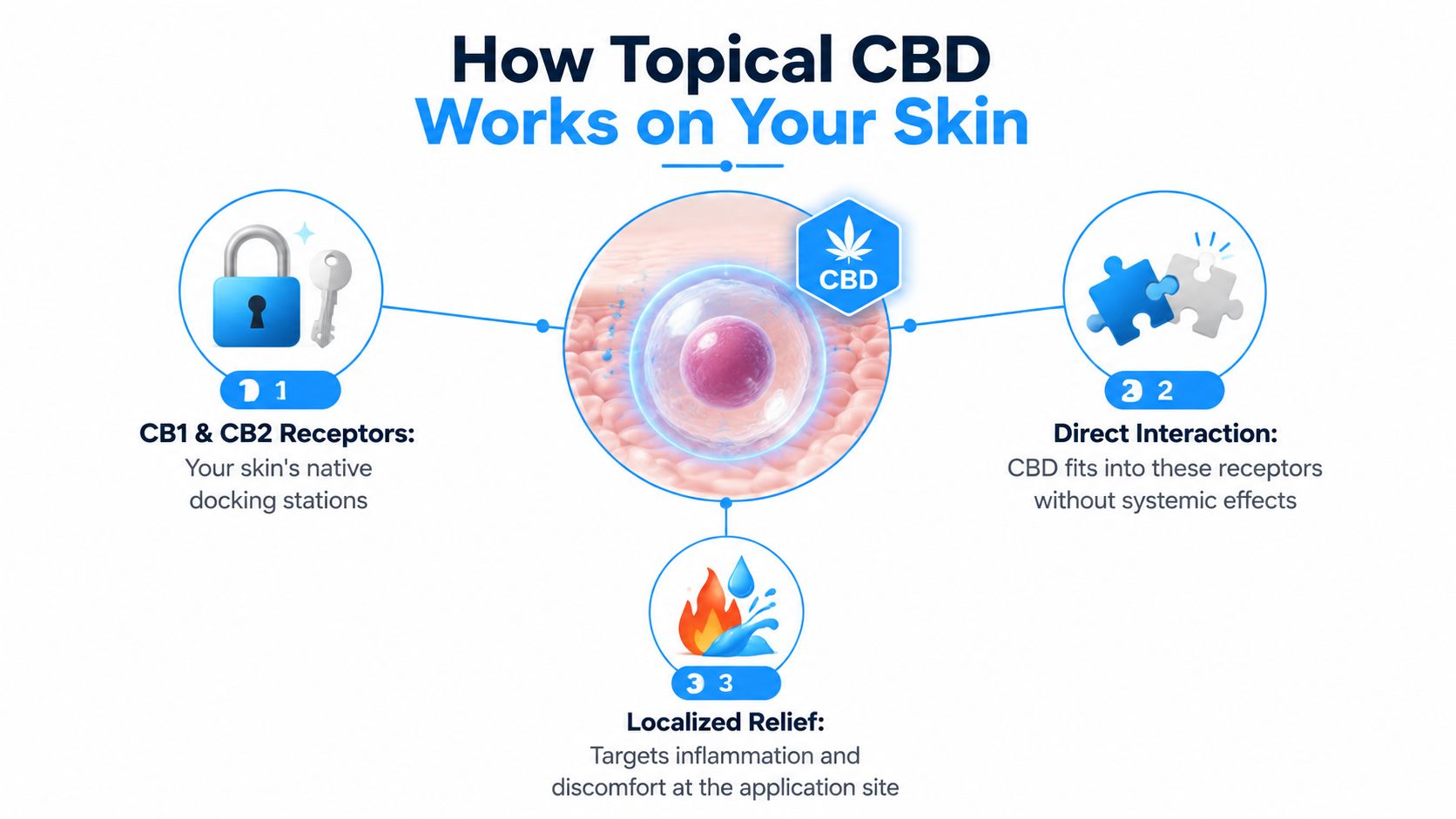
CBD cream works best when you stop thinking of it like a swallowed supplement and start thinking of it like a local delivery system. Your skin is the entry point, and the product has to stay on that surface long enough to interact with the area you're targeting. That's why formulation matters so much, the ingredients around the CBD often influence how the cream feels and how long it sits where you put it.
Standard creams are not the same as transdermal products
A regular cream or balm usually stays on or near the skin surface. It can feel soothing, especially when it includes emollients or cooling ingredients, but that doesn't mean it's moving through tissue in a dramatic way. A transdermal product is designed differently, with a stronger goal of penetration.
The sponge analogy works here. A standard cream is like water absorbed into the top of a sponge. A transdermal formula is closer to water trying to pass through to the other side. Those are not the same job, and shoppers often blur them together.
GoodRx notes that CBD is usually not well absorbed through the skin into the bloodstream, so most topicals are more likely to help skin-related concerns than deeper muscle or joint issues, while transdermal products may reach deeper tissue but evidence is still limited GoodRx. That distinction matters more than branding language. If a label doesn't say transdermal, don't assume deep penetration.
What actually creates the feeling of relief
Many creams use ingredients such as glycerin, shea butter, methyl gluceth-20, polysorbate 20, and peppermint oil, or other water-based carriers and cooling agents, to improve spreadability and skin contact time. A DailyMed-listed topical can pair cannabidiol from hemp extract with those kinds of ingredients, and another OTC topical combines trolamine salicylate 100 mg/g with cannabidiol in a cream matrix DailyMed. Those extras can matter just as much as the CBD itself.
Cooling ingredients can make a cream feel effective quickly, even before any slower skin-level interaction is noticeable.
That doesn't make the product fake. It just means the sensation of relief can come from a mix of formulation design, not CBD alone. If you're comparing products, look beyond the cannabinoid and ask what else is doing the work.
What the Clinical Evidence Shows
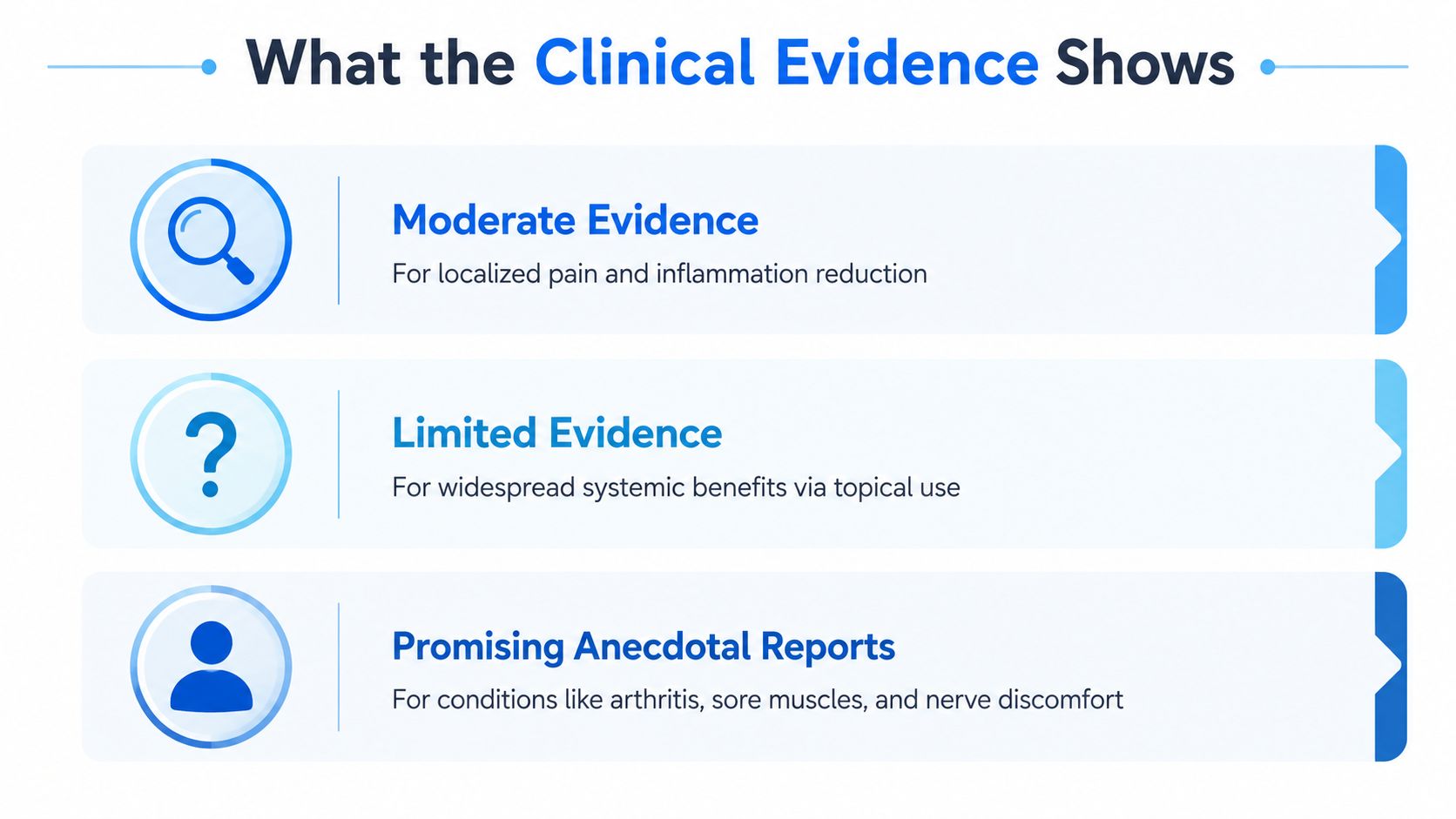
The strongest evidence for topical CBD sits in localized musculoskeletal pain and related discomfort, not in broad, all-purpose medical treatment. UCLA Health says early clinical studies suggest topical CBD may help symptomatic peripheral neuropathy and localized pain, and it notes that some pain reductions have been observed only when CBD is combined with THC UCLA Health. That nuance gets lost in a lot of product copy, which tends to make every cream sound equally powerful.
Pain, inflammation, and the limits of the evidence
Arthritis Foundation says animal studies and small human studies suggest pain-relieving and anti-inflammatory effects, but these still need validation in larger, high-quality human trials Arthritis Foundation. That's a careful way of saying the idea is promising, but not settled. If you see a label implying it has already been proven for every type of pain, that claim is running ahead of the evidence.
The practical takeaway is simple. CBD cream appears most plausible for localized pain, especially where the user wants a focused application, not a systemic effect. Claims about deep joint relief or nerve pain should be read with more caution, because the product type and the research don't always line up neatly.
Skin conditions are an emerging area, not a finished one
Topicals are also being studied for inflammatory skin conditions, including acne, psoriasis, eczema, and itchy disorders. A peer-reviewed review in PMC reports that topical cannabis has shown anti-inflammatory, anti-itching, analgesic, wound-healing, and anti-proliferative effects on skin, and it cites a 3-week open-label study in which more than 38% of 21 patients had total elimination of uremic pruritus while another 52% reported significantly reduced itching after twice-daily topical use PMC. That's encouraging, but it's still a narrow study and not the same as a broad clinical verdict.
What matters most: the evidence is most believable when the claim stays narrow, localized, and specific.
A lot of shoppers want one cream that handles sore muscles, dry skin, and deeper pain at once. The science isn't there yet. The smarter read is that different products may be better suited to different problems, and the label should match the goal.
Key Ingredients and Formulations to Evaluate
A front label that says 1,000 mg CBD sounds impressive until you ask how much CBD that really gives you per application. Potency changes the feel of a product, the size of the dose you're spreading, and how easily you can compare one jar with another. The concentration is often more useful than the headline milligram count.
Compare concentration, not just total milligrams
Here's the part that gets missed most often. A 2,200 mg in 1.7 oz jar is roughly 44 mg CBD per mL, while a 1,000 mg in 4 oz product comes out to about 8.47 mg/mL. That's a wide gap, and it changes how much cream you need for the same cannabinoid load.
| Product Size | Total CBD | Concentration (mg/mL) | Best For |
|---|---|---|---|
| 2.2 oz example | 2,200 mg | about 44 mg/mL | Smaller areas where you want a stronger concentration |
| 4 oz example | 1,000 mg | about 8.47 mg/mL | Broader, lighter use when you want a lower-density cream |
Marked examples on the market also range from 300 mg CBD per 2 oz to 5,000 mg and even 10,000 mg bottles in higher-strength formulations Flower Power Botanicals. Higher potency doesn't guarantee a better result, but it can make dosing more practical when you're applying to a small, targeted area.
Read the base ingredients like a formulation engineer
The base matters because cannabinoids in topicals are usually blended with emulsifiers, humectants, and penetration aids to improve spreadability and skin contact time. Ingredients like shea butter and glycerin can help the product sit comfortably on the skin, while cooling agents such as peppermint oil can create an immediate sensory effect that feels like relief.
If you're comparing options, a premium mature-skin approach can be useful to study because those formulas often prioritize texture, barrier support, and less aggressive sensory additives. CBD cream ideas for mature skin is a helpful example of how ingredient balance changes the feel of a topical, even when the cannabinoid itself stays the same.
Formulation tells you whether you're buying a rich cream, a cooling balm, or something closer to a transdermal style product.
For a practical comparison, the internal product page for Ayrloom Revive topical is a good reminder that some topicals are built around blended cannabinoid formats, not CBD alone. That's not automatically better, but it does mean you should read the label closely and know what kind of experience the product is designed for.
How to Apply CBD Relief Cream Safely
Start small. There are no standard dosage recommendations for topical CBD, so the safest way to trial it is with a patch test and a modest amount on one small area first Good Housekeeping. That matters more than chasing the strongest jar on the shelf, because skin sensitivity is a real variable and you won't know how your body reacts until you try it.
A practical way to test a new cream
Apply a small dab to a limited patch of skin and wait to see how it feels. If there's no irritation, you can slowly increase the amount on the same area during later uses. Avoid broken or irritated skin, because that increases the chance of a reaction and makes it harder to judge whether the product is helping or just stinging.
Common short-lived side effects in human observations have included dryness and rashes, so it's smart to stop use if the area becomes more irritated instead of assuming you just need to push through it. If you feel spreading redness, persistent burning, swelling, or anything that looks more serious than temporary dryness, stop and ask a healthcare provider.
Timing and frequency should stay simple
Use a small amount first, then give the skin time before you add more. The point is to learn how much product your body responds to, not to coat the area repeatedly in one session. With topicals, overuse usually doesn't make sense, especially if the cream is already rich in occlusives or cooling ingredients.
A quick self-care pairing can also help. Some people like to build a routine around muscle recovery, hydration, and targeted topical use, and if you're curious about other external comfort products, add magnesium to self-care is a useful lens for thinking about how simple application habits can change the experience.
Why Lab Testing and Quality Verification Matter
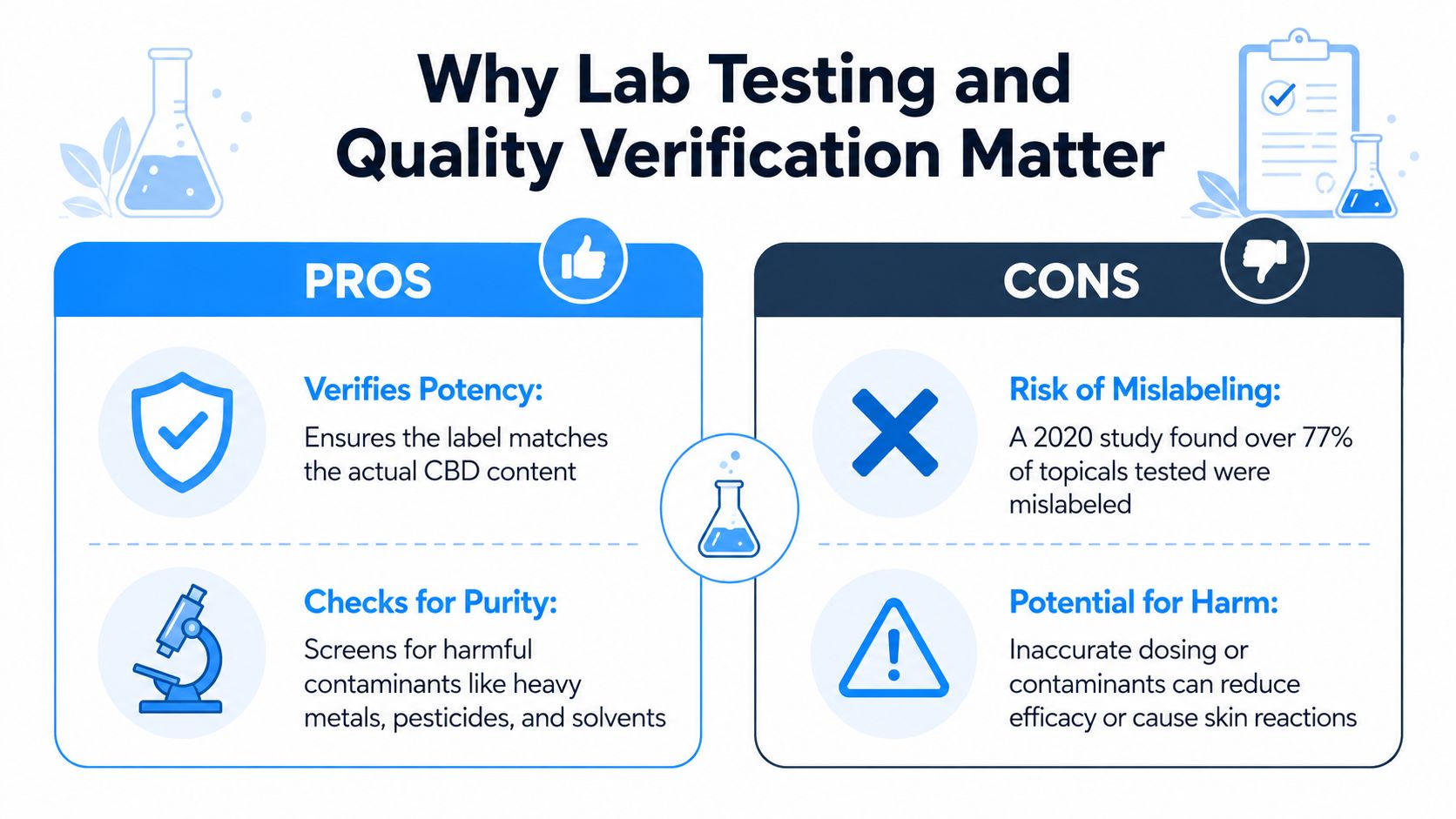
A lot of people assume the number on the jar tells the whole story. It doesn't. In one CBD topical testing report, 31 of 40 products, or 77.5%, contained the wrong amount of CBD on the label, only 9 of 40 were within 10% of labeled content, and measured CBD content ranged from 12% to 99% off the claim, with 11 products rated worst, F, for being off by 30% or more Leaf Report. That's not a small rounding error, it's a trust problem.
What a Certificate of Analysis should tell you
A real Certificate of Analysis should confirm cannabinoid potency and show contaminant screening, including checks for heavy metals, pesticides, and solvents. If a brand can't provide that paperwork, or if the report is vague, outdated, or missing batch information, you don't know whether the cream matches its label. The same goes for products sold as premium, because price alone doesn't verify anything.
That's why I'd treat lab testing as a buying filter, not a bonus. A company that publishes batch-specific results is showing you what went into the jar. A company that only talks about wellness is asking you to trust the packaging.
How to shop with more confidence
The cleanest approach is to ask for the report before you buy, then check whether the CBD amount on the report matches the label on the front. After that, look for contaminant screening and a recent batch date. If those pieces are missing, the product might still work, but you're buying with less information than you should have.
For brand-specific transparency, the Canna Clinicals collection is a useful example of how topical buyers can look for products that come with clearer testing expectations. The big lesson is not that every mislabeled cream is dangerous, it's that the buyer deserves enough data to know whether the jar is worth the money.
Bottom line: the label is marketing, the lab report is evidence.
Finding Quality CBD Relief Cream at Strong Strains
If you're shopping locally, the best move is to ask direct questions before you buy. A good budtender should be able to tell you whether a product is a standard topical or a transdermal-style formula, whether a current Certificate of Analysis is available, and what concentration makes sense for your intended use. That conversation matters more than the front-of-pack hype.
At Strong Strains, the topical selection is part of a broader catalog that includes topicals and related products, so you can compare formats without guessing which jar is worth trying. If you're looking for post-workout comfort, a joint-focused application, or a skin-soothing routine, the right product should match the job, not just the label.
Questions worth asking before you check out
Ask which creams are best for a small area versus a broader application. Ask whether the product leans on cooling sensation, richer emollients, or a stronger cannabinoid concentration. Ask for the batch-specific lab report and take a minute to read it before you commit.
That's the difference between buying a pretty jar and buying a product with a clear purpose. In a category where quality can vary so much, the shop matters because the guidance matters.
Strong Strains in East Setauket makes it easier to compare lab-tested topical options with help from people who know the category. If you're ready to find a CBD relief cream that fits how you plan to use it, visit Strong Strains for premium products, knowledgeable guidance, and convenient pickup or local delivery across Long Island.