
You're standing at the dispensary counter, looking at a tiny 1 gram jar of concentrate next to an eighth of flower. The flower looks like more. The concentrate looks expensive. And the question lands fast:
How can that little jar possibly compare to all that bud?
A lot of people hear a shortcut like “1 gram of concentrate equals an eighth of flower.” That rule of thumb is common, and it's useful as a rough starting point. But it also leaves out the part that matters most when you're deciding what to buy, how much to use, and what kind of experience you want.
The better way to think about 1 gram of concentrate to flower is to stop comparing size alone and start comparing milligrams of THC. That's the universal language. It helps you compare a dab to a jar of flower, a vape cart to a pre-roll, and a premium extract to a top-shelf eighth without guessing.
The Concentrate Conundrum at the Counter
You're at the counter with two very different options in front of you. One is a 1 gram jar of live rosin. The other is an eighth of flower. The flower takes up more space, so it feels like the larger purchase at first glance.
That first impression trips up a lot of shoppers.
The primary question usually is not, “Which one weighs more?” It's, “How much THC am I receiving, and how will that translate to the way I like to consume?” That shift matters, because cannabis products can look completely different while delivering a similar amount of THC on paper, or a very different experience in practice.
A gram of flower is mostly plant material with cannabinoids spread throughout it. A gram of concentrate is extracted resin, so the cannabinoids are packed much more tightly into the same weight. It works like comparing regular coffee grounds to espresso concentrate. The cup size can fool you. The concentration is what changes the strength.
If you are comparing products by package size alone, concentrate will almost always look confusing. A small jar can hold the THC equivalent of several grams of flower, depending on the label potency. That is why simple gram for gram shortcuts only get you so far.
If you want a quick primer on forms like wax, shatter, budder, and rosin, this guide to different types of weed wax and cannabis concentrates helps clarify what you are buying.
Why shoppers get mixed signals
Part of the confusion comes from the fact that people are often asking three different questions at once.
- Potency: How much THC is in this product?
- Value: How far will it go for the price?
- Experience: Will this feel like a bowl, a joint, a vape session, or a dab?
Those answers do not always line up neatly. A purchase-limit rule might group 1 gram of concentrate with multiple grams of flower. A product label might show a much larger potency gap. Your actual session can feel different again because inhaling a dab is not the same as taking a few puffs from a joint.
That's why milligrams of THC are the cleanest starting point. Milligrams give you a common measuring cup across flower, concentrates, vapes, and edibles. From there, you can make a smarter choice based on label accuracy, your tolerance, and how you plan to consume it.
The package size catches your eye. Total THC in milligrams gives you the clearer comparison.
That perspective keeps the counter conversation grounded in what matters to the customer. You are not just buying a gram. You are choosing a dose range, a format, and an experience.
Why Potency Trumps Weight
Comparing cannabis by weight alone is like comparing a shot of whiskey to a pint of beer just by liquid volume. The pint is bigger, but that doesn't mean it's stronger. What matters is how much alcohol is in it.
Cannabis works the same way. What matters isn't just the grams. It's the concentration of THC inside those grams.
THC percentage is the part that matters
When you see flower labeled at 20% THC or concentrate labeled at 70% THC, that percentage tells you how much of the product is THC by weight. That makes it much easier to compare products that look completely different.
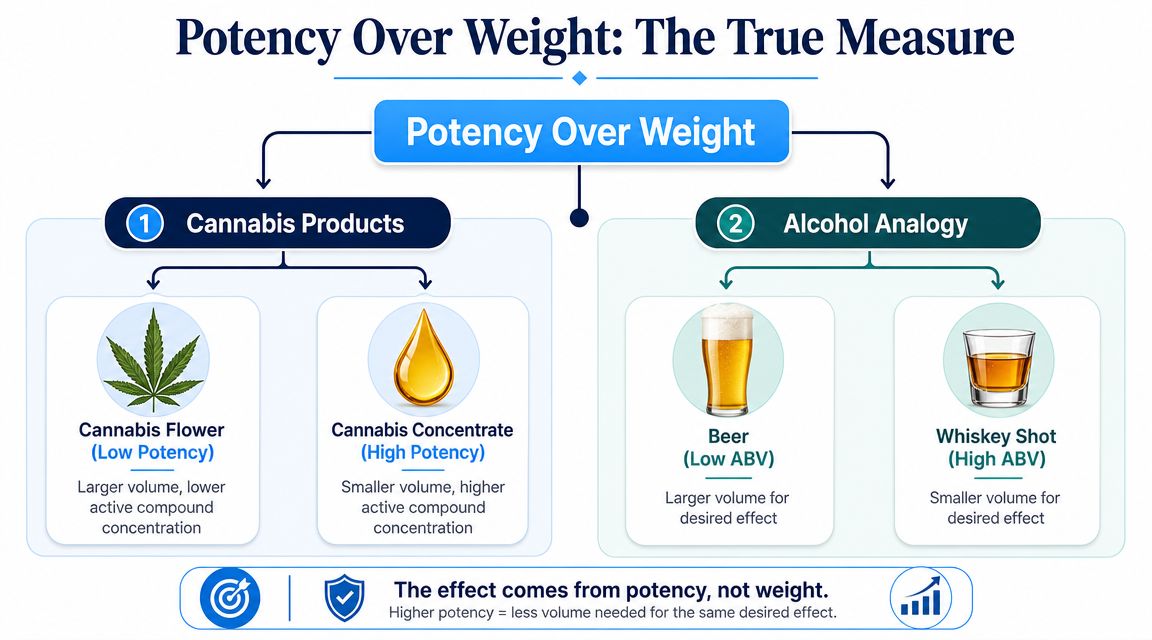
Measured potency data show how large that gap can be. One recent analysis found mean observed THC potency of 20.8% for flower versus 70.7% for concentrate, and the same paper notes that 1 gram of 25% THC flower contains about 250 mg THC, while 1 gram of concentrate at 70% THC contains about 700 mg THC, or roughly 2.8x the THC mass of that high-potency flower example analysis of observed THC potency in flower and concentrates.
A simple analogy that usually clicks
Think of flower as orange juice concentrate before dilution versus a full glass of juice. The glass may be bigger, but the concentrated form packs more active material into less space.
That's why a dab, a live resin cart, or a rosin gram can look tiny and still carry a serious punch.
If you're still learning the different extract styles, a quick guide to types of weed wax helps make sense of how texture, extraction style, and potency can vary across products.
Weight is packaging math. Potency is effect math
Use weight when you want to know how much product you physically have.
Use potency when you want to estimate how strong it may be.
Those are not the same thing.
Here's the practical takeaway:
- A larger flower package may contain less total THC than a smaller concentrate package.
- A 1 gram concentrate can be much more potent than 1 gram of flower.
- Visual size is one of the least useful ways to compare cannabis products.
Practical rule: If you want an apples-to-apples comparison, convert both products into THC milligrams first.
The Universal THC Conversion Formula
At the counter, two products can both say “1 gram” and still live in completely different strength ranges. The clean way to compare them is to convert each one into THC milligrams.
Grams of product × THC percentage as a decimal × 1000 = total THC in milligrams
Milligrams are the universal language here. Weight tells you how much material is in the jar or package. Milligrams tell you how much THC is in that material.
Why this formula works
A percentage is just a slice of the whole. If a product is 70% THC, that means 70% of its weight is THC. Since 1 gram equals 1000 milligrams, you multiply the grams by the THC decimal, then convert to milligrams.
It works like checking how much caffeine is in different drinks. A bigger cup does not always mean more caffeine. You need the actual amount of the active ingredient. THC works the same way.
How to run the math
Use the label and follow three steps:
- Start with the product weight in grams
- Convert the THC percentage into a decimal
- Multiply by 1000 to get total THC in milligrams
Here is the same math side by side.
| Product Type | Weight | THC % | Calculation | Total THC (mg) |
|---|---|---|---|---|
| Concentrate | 1 g | 70% | 1 × 0.70 × 1000 | 700 |
| Flower | 1 g | 25% | 1 × 0.25 × 1000 | 250 |
| Flower | 3.5 g | 25% | 3.5 × 0.25 × 1000 | 875 |
| Flower | 3.5 g | 20.8% | 3.5 × 0.208 × 1000 | 728 |
A quick shortcut helps. In a 1 gram product, you can move the decimal and read the percentage as milligrams times ten. So 70% lands at about 700 mg THC, and 25% lands at about 250 mg THC.
What the numbers actually mean
The table shows why gram-for-gram comparisons can mislead shoppers. A one-gram concentrate can carry THC totals that rival several grams of flower, even though the package looks much smaller.
That does not mean the concentrate should be consumed in the same sized session. It means the product is more densely packed with THC.
The shortcut people use, and why it drifts
You will hear shorthand comparisons like “a gram of concentrate is about an eighth of flower.” That can be a useful ballpark in some cases, especially when someone wants a fast mental reference.
But it is still a shortcut. The moment the flower potency drops, the concentrate potency rises, or the package size changes, the comparison shifts. Milligrams keep you accurate across flower, carts, wax, rosin, and other extracts without relying on a rough rule.
One more reality check: labels are estimates
Lab labels are useful, but they are not a promise of the exact effect you will feel. Testing variation, product age, and how evenly cannabinoids are distributed can all affect the actual experience. So use the formula as a comparison tool, not as a guarantee.
That point matters for safe, enjoyable shopping. A jar with a high total THC number may last a long time if you use very small dabs, while a lower-potency flower product may be easier to pace over a session. The formula tells you how much THC is in the product. Your serving size and your body decide the experience.
Applying the Math at the Dispensary
At the counter, this math turns a confusing shelf into a clear comparison.
Say you usually buy flower and today you are curious about a gram of badder or a half-gram cart. The package sizes look different, so weight alone does not help much. Milligrams of THC do.
Scenario one for the flower regular
A shopper who usually buys Rythm or Cookies flower does not need to guess what a concentrate means for their routine. Start with the flower label they already know. If an eighth is testing at 25% THC, that works out to about 875 mg of THC in the whole 3.5-gram package. A 1-gram concentrate at 75% THC comes out to about 750 mg.
That comparison helps in a practical way. The concentrate may weigh less, but it can sit in the same potency neighborhood as several sessions of flower. The better question at the dispensary is not “Which one weighs more?” It is “How many milligrams am I bringing home?”
A good budtender will then bring it back to serving size. Flower is like a lower-proof drink poured into a bigger glass. Concentrate is closer to a spirit. The total THC may be similar, but the amount you use at one time should usually be much smaller with the concentrate.
Scenario two for carts, flower, and infused products
Another shopper wants a half-gram cart, an eighth of flower, and maybe one of these infused pre-roll options for the weekend. Shoppers can get tripped up, because there are really two separate calculations happening at once.
First, there is potency. A half-gram cart at a high THC percentage can hold a large amount of THC in a very small package. Second, there is the legal purchase-limit calculation at checkout. In regulated cannabis markets, 1 gram of concentrate is often treated as roughly 3.54 grams of flower for purchase-limit equivalency, based on a legal and accounting calculation rather than direct potency measurement Maryland flower equivalency calculation in Dutchie POS.
Those are different systems. One helps you estimate strength. The other helps the store stay compliant.
What to ask before you add it to the cart
Use three checkpoints:
- THC milligrams to compare products across flower, carts, and concentrates
- State equivalency rules to understand how the purchase will count at checkout
- Your usual session size to judge whether the product fits your tolerance
That last point matters because labels are close estimates, not a perfect forecast of how hard something will hit. A cart, jar of rosin, and eighth of flower can all look reasonable on paper and still fit very different routines.
A simple question helps: “How many milligrams are in this package, and what would a small starter serving look like?”
A better way to compare premium products
When you are looking at brands like MFNY, Rythm, Airo, Jaunty, or Connected, scan the label in this order:
- Total THC or THC percentage
- Net weight
- Product format, such as flower, live resin, rosin, distillate, or badder
- How you plan to use it, whether that means one quick pull, a full joint, or a tiny dab
That order keeps the focus on what you will consume. It also protects you from the common mistake of treating every gram like it behaves the same way.
Strong Strains can still be useful here as a menu reference for comparing categories before you visit. Just keep using THC milligrams as the common language, because that is the cleanest way to compare what is really in the package.
How You Consume Changes Everything
The label tells you what's in the product. It doesn't tell you exactly how the experience will feel.
A dab and a joint can contain comparable THC on paper and still land very differently in the body.
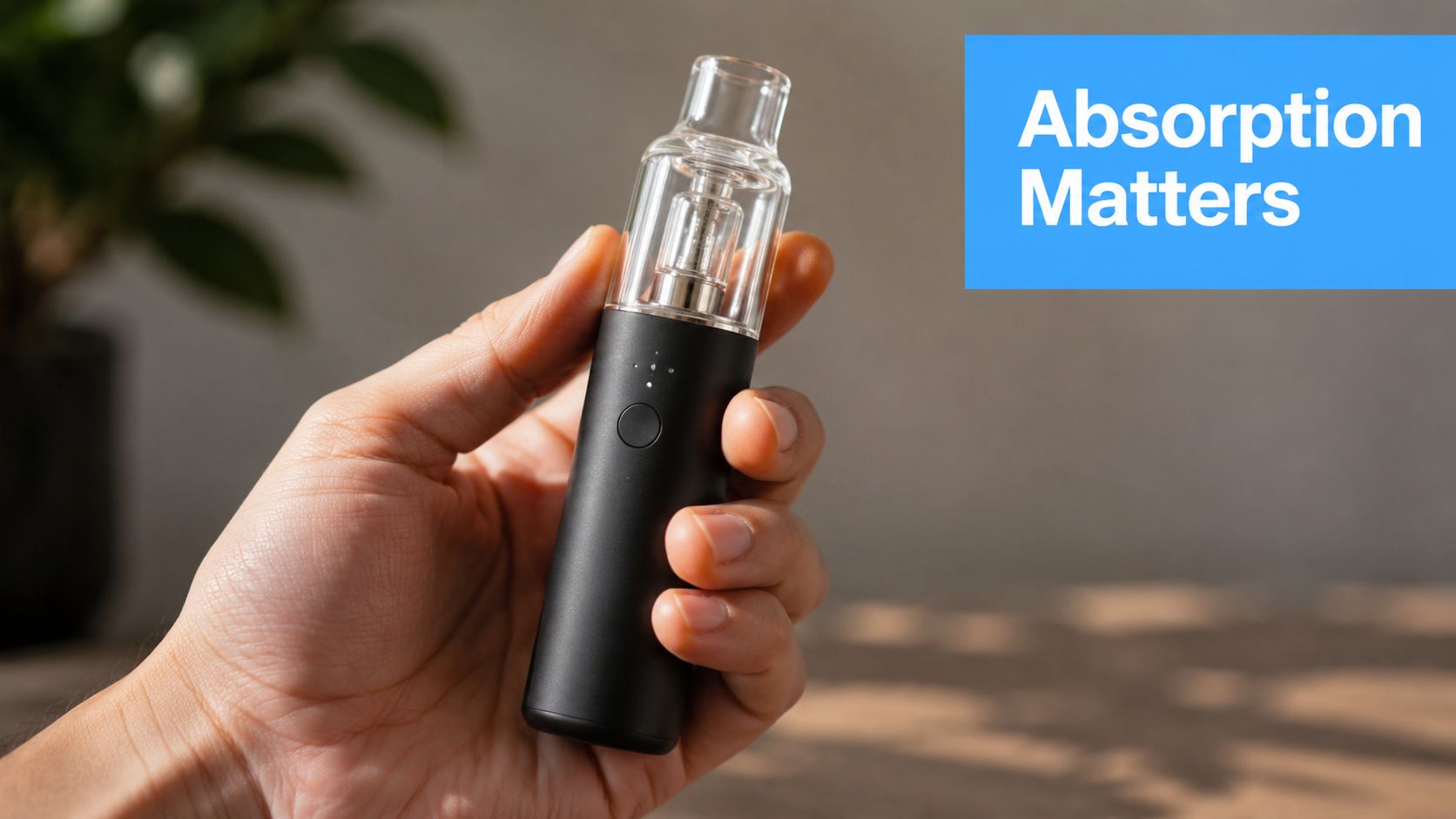
Joints, dabs, and vape pulls aren't interchangeable
Research on cannabis-use measurement points out that translating exposure across product types is difficult because real-world intake depends on both grams and number of hits, and inhalation efficiency can vary a lot between something like a joint and a dab research on measuring cannabis use across methods.
That matters because people often assume equal THC on the label means equal effects. In practice, the delivery method changes the pace and feel.
A joint tends to build gradually over a session. A dab from a PUFFCO device or similar e-rig can feel faster and more concentrated. A live resin cart sits somewhere else in the middle for many consumers.
Why the same math can feel different
If you smoke flower, some of the session is spread out over time. You might share it. You might pause between pulls. You may never finish the whole joint.
With concentrate, a small amount can be inhaled much more quickly. That can create a more immediate and sometimes sharper experience, even before you get into individual tolerance.
People asking about equivalency often also ask about infused formats for similar reasons. If that's you, this guide to infused pre-rolls helps show why added concentrates can change the feel of a flower-based product.
A short visual explainer can help make that difference easier to picture:
The safer mindset
Don't ask only, “How much THC is in the jar?”
Also ask:
- How fast am I taking it in?
- How many hits am I likely to take?
- Am I using this in one intense session or over time?
That's why equal milligrams don't always mean equal intensity.
Your Strong Strains Guide to Smart Dosing
Once you understand the math, the smartest move is simple. Start low and go slow, especially with concentrates.
That advice isn't about fear. It's about giving yourself room to enjoy the product instead of accidentally overshooting.
Why trusted labels matter
One overlooked part of the 1 gram of concentrate to flower question is that the comparison only works as well as the label does.
A 2025 study found that 96% of concentrate products tested within 15% of their labeled THC, while only 56.7% of flower products did, which is a meaningful accuracy gap when a customer is trying to compare potency across categories report on THC label accuracy in flower and concentrates.
That doesn't mean flower is bad or that concentrates are always the better fit. It means a simple “this eighth should equal that gram” comparison can get shaky when flower labels are less reliable.
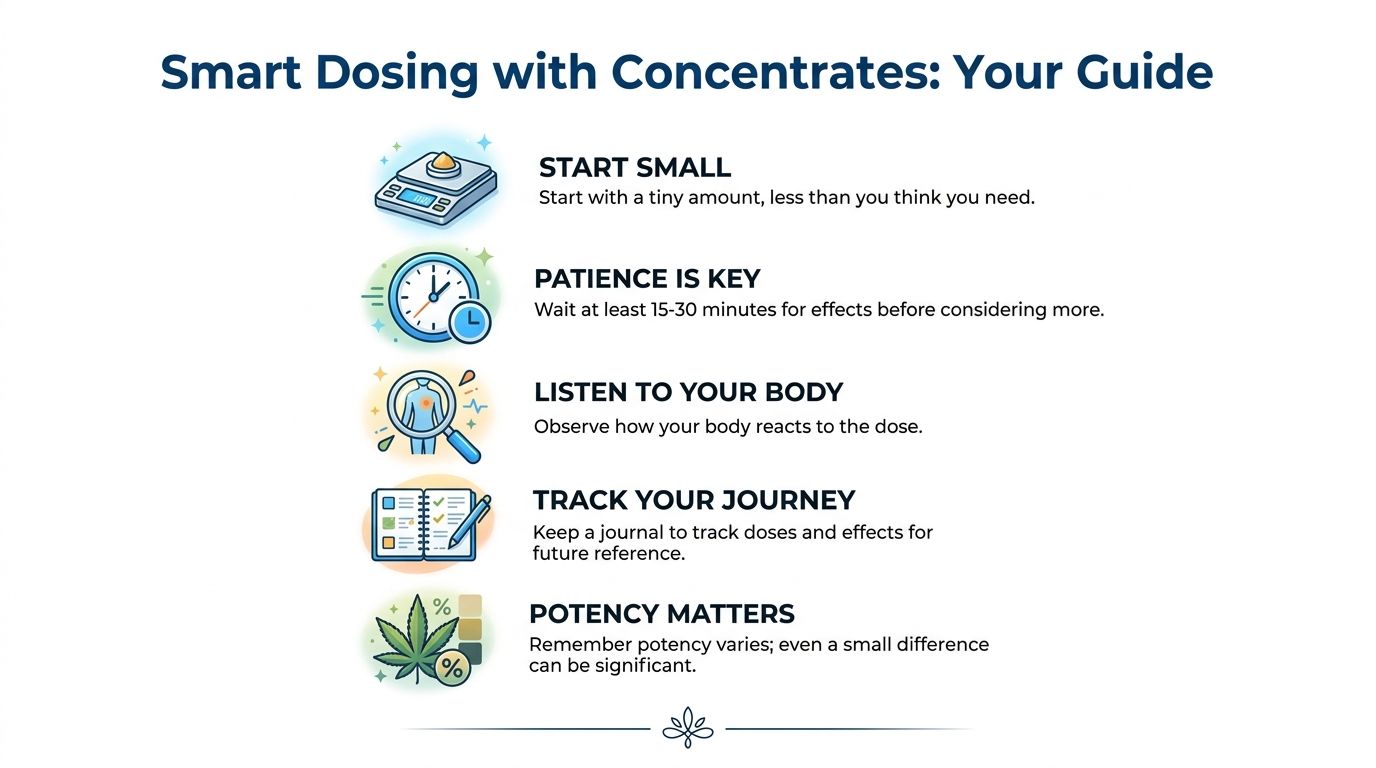
A practical dosing checklist
- Use less than your eye thinks you need. Concentrate portions are small for a reason.
- Wait before going back in. Give the first inhalation time to settle.
- Track what worked. Product name, format, and how it felt matter more than memory the next day.
- Compare by milligrams first. Then adjust for method and your own tolerance.
- Ask for a similar experience, not just a stronger product. That usually leads to a better recommendation.
“I usually like a smooth evening flower. What concentrate gives me that same lane without jumping too far up?” That's one of the most useful questions you can ask a budtender.
Good fit matters more than chasing the highest number
A beginner might be more comfortable with a familiar vape format from Airo or Jaunty than with a full dab setup. A seasoned concentrate shopper might prefer the flavor and texture of MFNY live rosin. Someone who wants precision may do better with a tincture or other measured format than with inhalation at all.
If you're comparing inhaled products with measured oral products, a tincture dosage calculator can help you think in milligrams just as clearly.
The smartest shoppers don't just chase the highest THC percentage. They match the product to the moment, their tolerance, and the kind of experience they want.
Conclusion Beyond the Gram for Gram Comparison
You are standing at the counter, looking at a gram of live resin and an eighth of flower, and the jars make the choice feel like a weight comparison. It is really a milligram comparison.
Milligrams of THC give you the common unit, the same way ounces and cups both become a recipe measurement once you convert them. A small amount of concentrate can hold as much THC as several grams of flower, while two products that look close in size can land very differently once you read the label closely.
That is why gram for gram thinking misses the point. Labels carry estimates, not promises carved in stone, and your body does not respond to inhaled flower, a vape cart, and a dab in the same way. The smarter question is simpler: how many milligrams am I likely taking in, and how fast will this method hit?
Keep that frame in mind at the dispensary. Start with total THC in milligrams. Then adjust for the format, your tolerance, and the kind of session you want.
Strong Strains can help you compare flower, carts, dabs, tinctures, and infused products in practical terms, so your next purchase fits the experience you are after, not just the biggest number on the package.