
You've got the project open. The cursor is blinking. Maybe it's a blank page, a half-finished beat, a pitch deck that still feels flat, or a painting that looked better in your head than it does on the canvas.
That's usually the moment people start searching for the best strains for creativity.
The honest answer is that cannabis can help, but not in the lazy, cliché way the internet often presents it. It doesn't “give” you talent. What it can do is loosen a tight mental grip, soften self-editing, and make it easier to explore an idea before you judge it. That's useful when you're stuck in polish mode and need to get back to play mode.
Creative work also needs more than cannabis. Good inputs matter. If you're brainstorming with a team or trying to break out of repetitive thinking patterns, this guide to innovative thinking for teams is a solid companion read because it focuses on how people generate and develop ideas. Cannabis can support that process, but it works best when the process already exists.
A lot of shoppers still walk in asking for “a strong sativa for creativity.” Sometimes that works. Sometimes it sends them straight into racing thoughts, distraction, or a nap. The better approach is understanding how dose, cannabinoids, and terpenes shape the experience. If you want a useful primer on the basics before dialing in your preferences, this breakdown of different cannabis strains gives you a good foundation.
Tapping into Your Creative Flow with Cannabis
Creative blocks rarely feel dramatic from the outside. They feel annoying. A writer keeps rewriting the first sentence. A designer keeps changing fonts instead of solving the actual problem. A musician scrolls through old voice notes and still can't land on a direction.
Cannabis can be helpful in exactly that kind of moment because it may shift your perspective enough to get you moving again. The key word is shift, not overwhelm. When the dose and profile are right, people often describe the effect as less internal friction. The work feels less stiff. Ideas connect more freely. You stop trying to force originality and start noticing it.
That's where a lot of “best strains for creativity” advice falls short. It treats all creative work as one category, even though writing a script, editing photos, planning a campaign, and sketching a concept all ask different things from your brain. Some sessions need brighter mood and quick association. Others need calm focus and enough clarity to stay on task.
Cannabis works best for creativity when it supports the task in front of you, not when it becomes the task.
The practical goal isn't to get as high as possible. It's to find a product that opens the door without knocking you off your feet.
How Cannabis Can Spark New Ideas
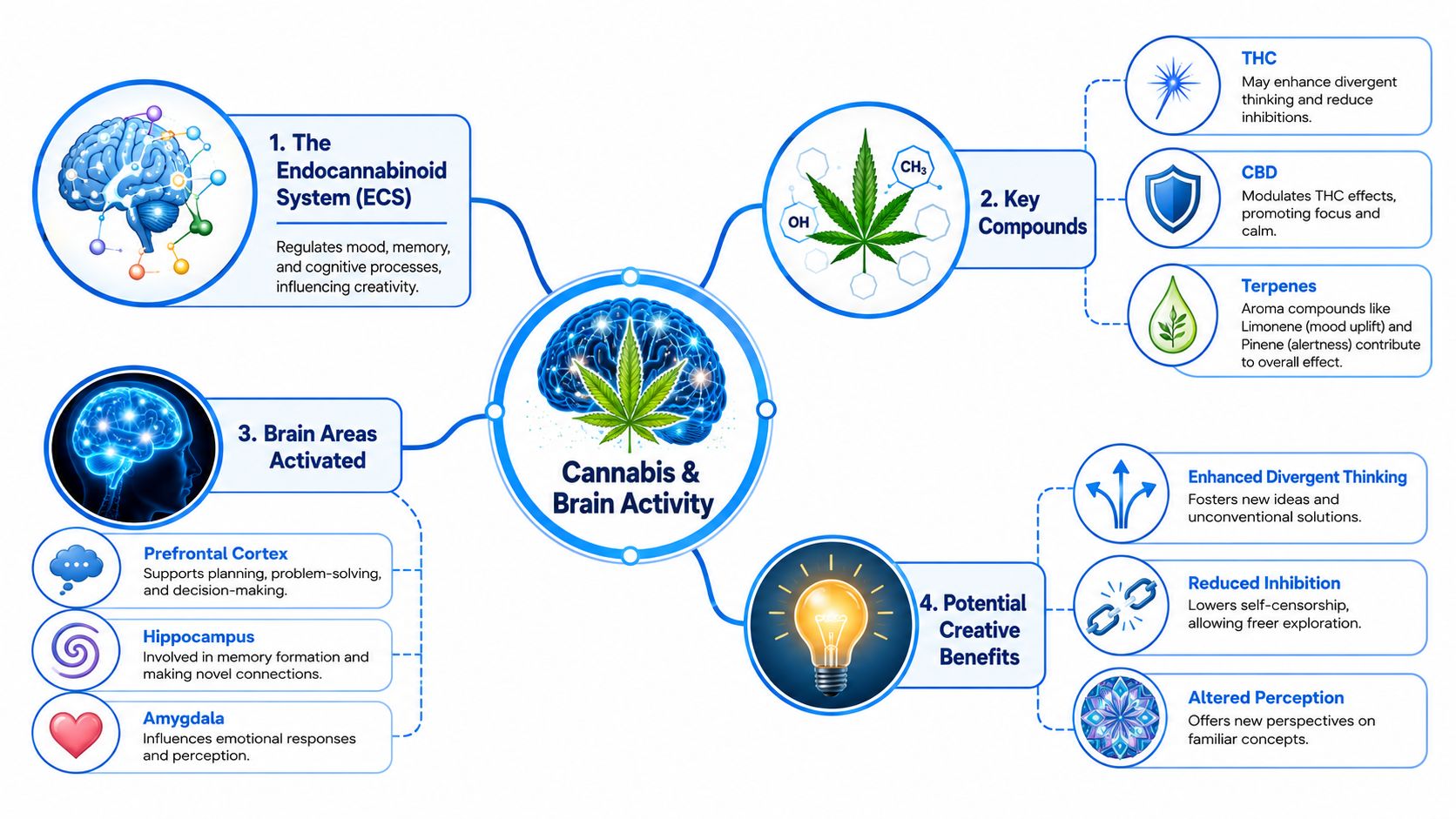
Creativity usually isn't one big lightning strike. It's a mix of mood, attention, memory, and the ability to connect things that didn't seem related a minute earlier. Cannabis can influence that mix, which is why the right product sometimes feels helpful when you're brainstorming or trying to get out of your own way.
Divergent thinking matters most
One of the most useful creativity terms to know is divergent thinking. That's the part of thinking that generates many possible ideas instead of narrowing down to one answer too early. It's the brainstorm phase, not the edit phase.
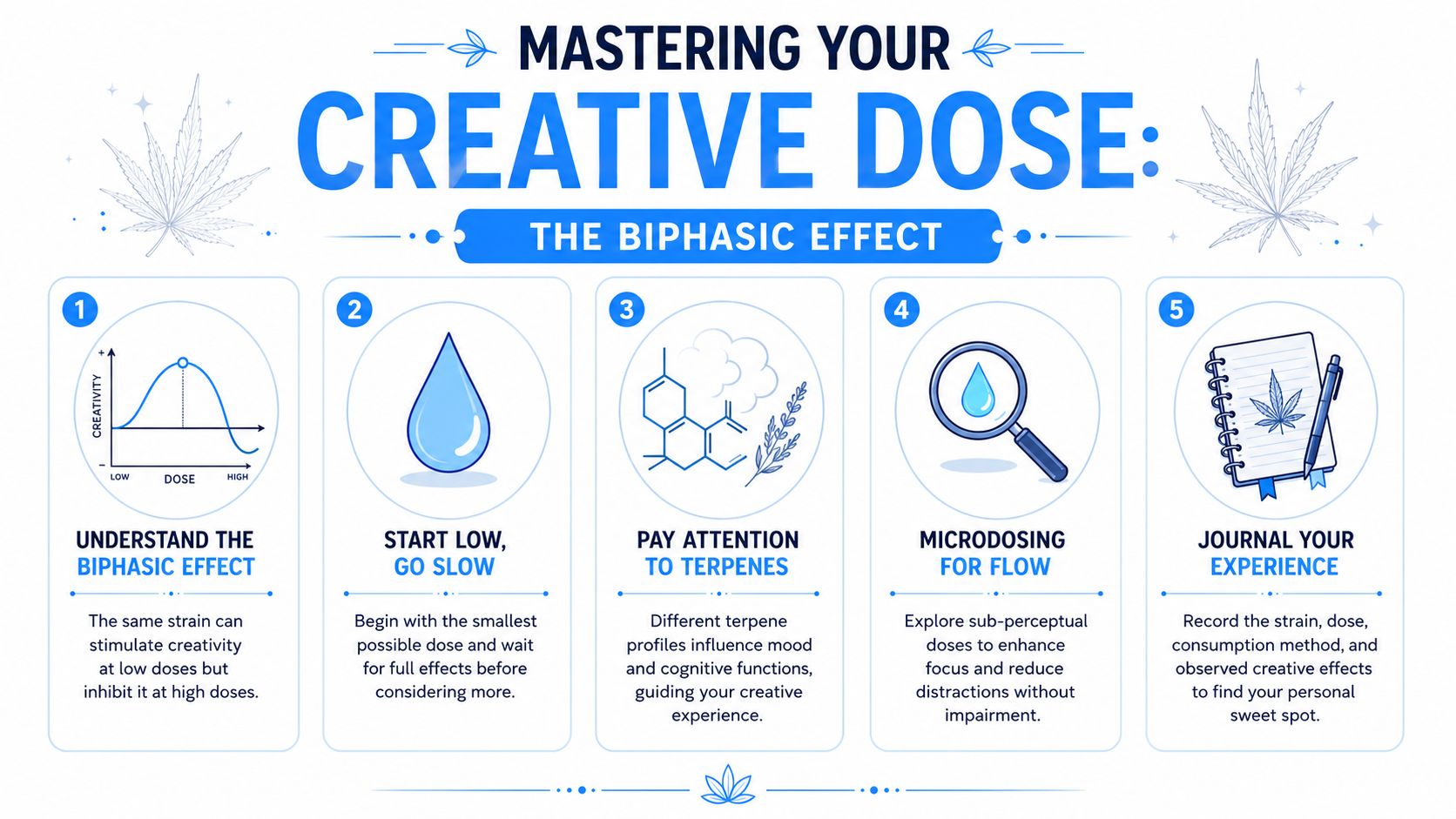
A 2017 review discussed in Healthline's overview of sativa strains found that cannabis can have biphasic effects on cognition. Lower doses are more likely to increase subjective energy and divergent thinking, while higher doses more often impair attention, working memory, and originality. That's a practical point for any creative session. The product that helps you riff can become the same product that makes you lose the thread if you keep pushing.
Think in ingredients, not hype
For creativity, I like to explain cannabis as a small team with different jobs.
- THC is the engine. It's often the part that changes perception, lowers inhibition, and gives ideas a little lift.
- CBD is the steering. In balanced products, it can make the experience feel less jagged and more manageable.
- Terpenes are the mood-setters. They help shape whether a product feels bright, grounded, sharp, or mellow.
For shoppers chasing creative support, a few terpene directions come up often in conversation:
- Limonene-forward profiles tend to attract people who want a lighter, more upbeat headspace.
- Pinene-forward profiles are popular with shoppers who want to stay clearer and more task-oriented.
- Caryophyllene-forward options often appeal to people who want less tension in the experience.
Those aren't guarantees. They're patterns people use to narrow the field.
If you're trying to kickstart a writing session, it can help to pair the right product with an actual prompt source instead of waiting for inspiration to arrive. A list of viral horror story prompts is a good example of a simple creative tool that gives your brain something to react to. Cannabis often works better when it has material to work with.
Some strains become popular for a reason
Certain names stay in the creativity conversation because their profiles often land in that uplifting, functional lane. Sour, citrusy, and bright-leaning cultivars are common examples. If you want to see how one of those profiles is typically described in practice, this Lemon Sour Diesel guide is a useful reference point.
Practical rule: If a product makes you curious, talkative, and mentally flexible without making you scattered, you're probably closer to a creative fit than if it simply feels “strong.”
Moving Beyond the Sativa and Indica Myth
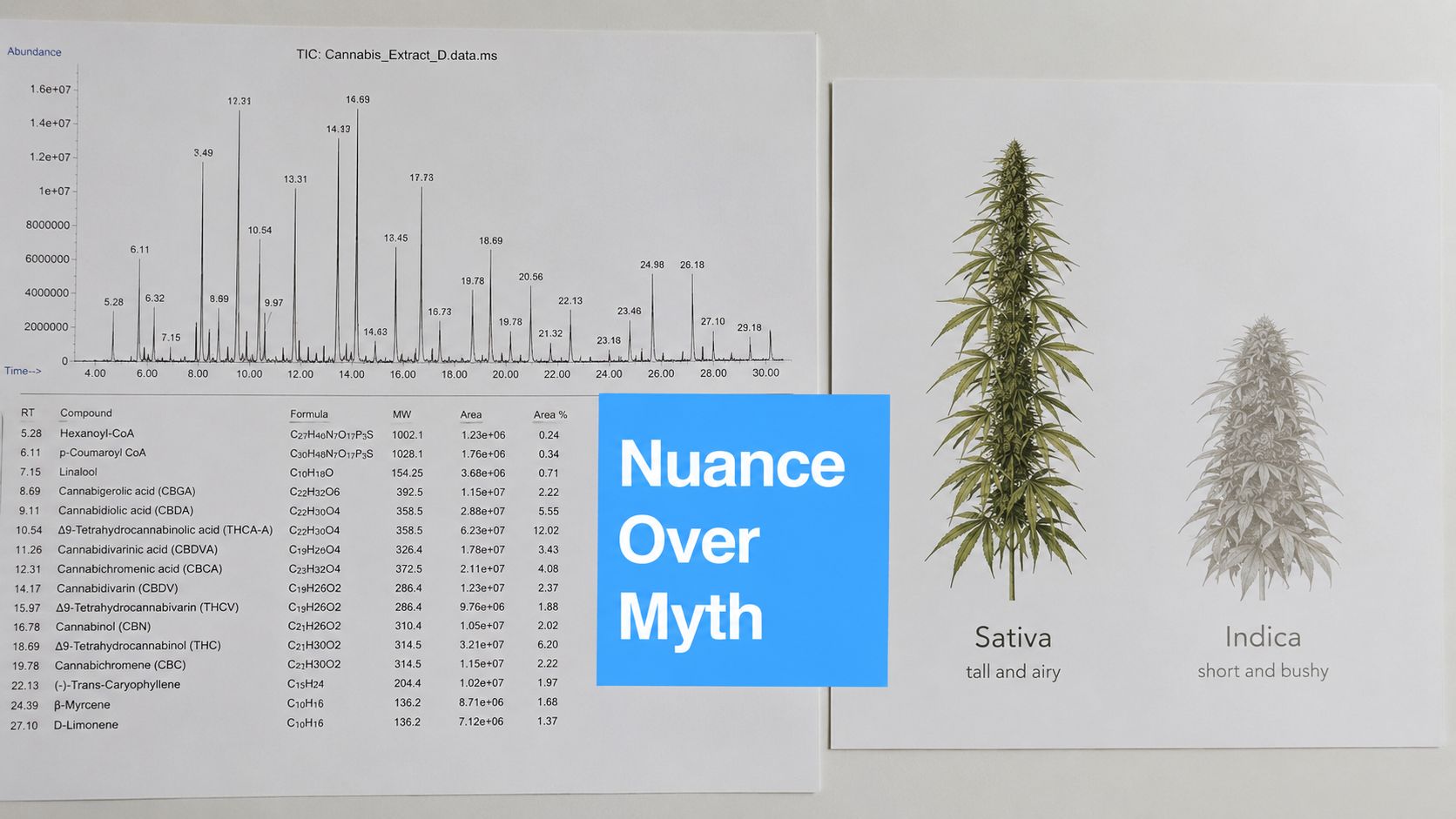
A lot of bad cannabis shopping starts with a tidy rule that sounds useful but doesn't hold up very well. The classic version is simple. Sativa is for energy and creativity. Indica is for sedation and sleep.
That shortcut is everywhere, and it's one of the main reasons people end up with the wrong product.
Labels don't tell the whole story
A major gap in cannabis coverage is that many “best strains for creativity” lists still rely on the old sativa equals creative, indica equals sedating formula. But newer guidance summarized by Nama CBD points to a more useful way to think about effects. Chemotype, meaning the combination of THC, CBD, minor cannabinoids, and terpenes, is a better predictor than the marketing label alone.
That matters because the same strain name can show up with different lab results from one producer to another, and even from one batch to another. If you shop by label only, you're relying on branding. If you shop by chemotype, you're using the actual measurable profile.
What to look for instead
If your goal is creative function, stop asking only “Is it a sativa?” and start asking questions like these:
| Better shopping question | Why it helps |
|---|---|
| What's the THC and CBD balance? | It gives you a clue about how intense or manageable the experience may feel. |
| Which terpenes stand out? | It helps you sort uplifting, focused, or grounding profiles more intelligently. |
| Is this batch likely to feel sharp or heavy? | Budtenders often know which products feel clean and workable versus dreamy or sleepy. |
| Is there lab data available? | It lets you compare products beyond strain mythology. |
A customer looking for a brainstorming flower and a customer looking for a late-night movie strain might both get handed “sativa” products in different shops. That doesn't mean both are good fits. One might feel bright and useful. The other might feel edgy or mentally cluttered.
Here's a quick visual that helps explain why old strain categories only get you so far.
The smarter way to read a menu
When I'm helping someone shop for creativity, I care more about the experience they want to protect than the category printed on the jar. Usually that means some combination of:
- Mental mobility so ideas can branch out
- Enough focus to stay with the idea
- Low enough stress that self-consciousness doesn't take over
If you've ever had one “sativa” make you productive and another make you restless, that isn't weird. It's exactly why chemotype matters.
That shift in thinking is what separates random strain chasing from informed shopping.
Finding Your Ideal Creative Dose
The right product can still fail if the dose is wrong. Consequently, many creative sessions go sideways. People don't choose a bad strain. They choose too much of a decent one.
Less often works better
For creative use, less is often more. The same 2017 review noted earlier found that cannabis can produce biphasic cognitive effects, meaning lower doses are more likely to support subjective energy and idea generation, while higher doses more often interfere with attention, working memory, and originality. In plain language, the same product can feel inspiring at one dose and foggy at another.
That's why experienced consumers who use cannabis for creative work often think in terms of a creative window. Too little, and nothing shifts. Too much, and the session turns into distraction, overanalysis, or couch drift.
Match the format to the task
Different formats give you different kinds of control.
- Flower or vape works well when you want quick feedback. You can take a small amount, pause, and decide whether you're in the right place before adding more.
- Tincture is useful if you want a more measured, repeatable routine. It's one of the easiest formats for people who like consistency.
- Edibles can be great for longer sessions, but they demand patience and restraint. They're the least forgiving if you get impatient.
If precision matters to you, a tincture dosage calculator can help you think more clearly about how much you're taking instead of estimating.
A simple testing method
Try a product on a day when the stakes are low. Don't test a new edible before a deadline or a client presentation. Use a notebook, voice memo app, or project file and track what happens.
- Choose one task. Freewriting, sketching, sound design, ideation, or mood boarding all reveal different things.
- Use one product only. Mixing formats makes it harder to learn what's doing what.
- Pause before redosing. Give the experience room to arrive.
- Notice quality, not just feeling. Ask whether you generated more ideas, stayed with the task, or just felt pleasantly altered.
The best dose for creativity is the smallest amount that changes your approach without stealing your attention.
What usually doesn't work
People often assume stronger equals better. For creativity, that's a common mistake. Very heavy doses can make every idea feel profound while making it harder to execute anything clearly. The session feels exciting, but the actual output gets thinner.
Another weak strategy is dosing reactively. If you're stalled for ten minutes and keep adding more, you can overshoot quickly. Creative work has natural pauses. Not every lull means you need another hit.
A better habit is to build a repeatable pattern. Same format. Similar setting. One task. Honest notes. That's how you find a dose you can trust.
Curated Profiles for Your Next Creative Project
The best strains for creativity aren't one universal list. They're better understood as profiles that fit the kind of work you're doing and the kind of experience you want. A copywriter trying to brainstorm headlines usually needs something different from a guitarist looking to improvise for an hour.
The focused writer
This shopper usually says some version of, “I want to loosen up, but I still need to stay coherent.”
For that person, I'd steer toward a balanced, terpene-forward profile with enough lift to reduce self-editing but not so much THC weight that sentence structure falls apart. Pinene-leaning or citrus-forward products tend to get attention here, especially when the effect feels clean rather than heavy.
Good format fits for this profile include:
- Airo vape options when quick control matters and the user wants to take a small pull, write, then reassess.
- Matter flower for people who prefer a more traditional ritual and can keep the session measured.
- Pax-compatible formats for shoppers who like precision and a low-fuss setup.
This is also the kind of person who benefits from outside structure. If you're writing scenes, shorts, or scripts, pairing cannabis with real constraints can help. A roundup of AI screenwriting software can be useful here because prompts, outlining tools, and revision support give the stimulated brain something concrete to shape.
The brainstorming artist
Painters, brand designers, illustrators, and visual thinkers often want more openness than precision, at least at the start. They aren't editing copy. They're trying to get beyond the first obvious concept.
This profile usually does well with a bright hybrid feel. Not too sharp, not too sleepy. Limonene-forward products are often the first place I'd look, especially if the shopper says they want uplift without a racing edge.
Products that make sense in this lane can include:
- Lowell Herb Co pre-rolls when the goal is a light, intentional creative session rather than a big smoke.
- Lost Farm edibles for people planning a longer studio block and willing to wait patiently for onset.
- Cookies flower when the shopper enjoys exploring nuanced cultivars but still needs to read the label beyond the name.
What doesn't usually work for this profile is overcommitting too early. If the product gets too dreamy, the mood board gets full while the actual project stays untouched.
Some of the best creativity sessions produce messy raw material, not polished work. Judge the output later.
The mellow musician
Musicians often describe a different target. They want emotional access, rhythm, and room to explore, but they don't want to lose timing, phrasing, or the ability to notice what's working.
For them, I often think in terms of softened tension. A profile that feels grounded but not dulled can help. Caryophyllene-leaning or more rounded hybrids often come up when someone says they want to jam, layer sounds, or listen more attentively without getting pinned to the couch.
Examples that fit this mood might include:
- Rythm carts for players who want a controlled inhale before practice or recording.
- Connected flower for shoppers who like richer cultivar expression and don't mind spending more for a premium batch.
- Jaunty tinctures if repeatability matters more than ritual.
This profile often benefits from separating phases. Use cannabis for exploration, then revisit arrangement or technical edits later with a clearer head.
The creative beginner
Some shoppers aren't looking for a legendary strain name. They just want a safe first step that won't ruin the evening. That's often the smartest approach.
For a beginner, the ideal creative profile is usually:
- Low-dose
- Balanced in feel
- Terpene-forward rather than brute-force potent
- Easy to titrate
Practical brand categories for this kind of shopper include Wana, Wyld, Camino, and Ayrloom when they want approachable edible or beverage-adjacent options, and Botanist or Hudson Cannabis when they prefer flower and want to ask more questions at the counter.
The key is expectation. A beginner shouldn't chase a dramatic mental transformation. They should look for a mild shift that makes the task feel more inviting.
The overthinker who needs less intensity
This is the shopper who says, “I want creativity, but I'm prone to getting anxious.” That changes everything.
The answer usually isn't a stronger “creative” strain. It's a more balanced product, often with a gentler THC approach and enough grounding character to keep the experience functional. Tinctures, small edible doses, and carefully paced flower sessions tend to work better than diving into a high-octane cart because a friend said it was amazing for art.
In practice, the best strains for creativity often aren't the loudest products on the shelf. They're the ones that leave enough of you intact to make something.
Putting Your Knowledge into Practice at Strong Strains
A good cannabis menu gets much easier to read once you stop shopping by stereotype. You don't need to memorize every terpene or walk in sounding like a lab tech. You just need to know what outcome you want.
If you're shopping for creativity, ask direct questions that lead to usable recommendations:
- “Can you show me a terpene-forward option that feels functional, not sleepy?”
- “I want something for brainstorming, not for getting heavily intoxicated.”
- “Do you have a balanced hybrid that's good for a low-dose session?”
- “What would you suggest for writing versus visual art?”
Those questions tell a budtender much more than “What's your strongest sativa?”
What to check on the label
When you're comparing products, give yourself a simple checklist:
| What to review | What you're trying to avoid |
|---|---|
| Cannabinoid balance | Assuming THC alone predicts a good creative session |
| Dominant terpenes | Choosing by strain name only |
| Format | Picking an edible when you actually need fast, controllable onset |
| Your own plan | Taking a new product without a clear activity in mind |
A premium dispensary experience should make this process easier, not more confusing. Lab-tested inventory, clear product information, and staff who can explain trade-offs are what separate useful guidance from trendy guessing.
How to shop with more confidence
If you've read this far, you already know more than the average shopper browsing “best strains for creativity” lists online. You know the label isn't the full story. You know dose changes everything. You know the best product depends on whether you're trying to brainstorm, focus, improvise, or quiet the part of your mind that keeps saying the first draft isn't good enough.
Bring the task into the conversation. “I need help outlining a project” gets better recommendations than “I want something creative.”
That's how you turn a vague cannabis question into a useful one.
A Final Note on Safety and Responsible Use
Creative cannabis use should still be responsible cannabis use. The safest sessions happen when the environment is calm, the timing is right, and you're not trying to squeeze experimentation into a busy or high-pressure day.
If you're new, stay with the conservative approach. A practical creativity-oriented profile is low-dose, terpene-forward, and balanced, and consumer guidance recommends starting at 1 to 2.5 mg THC, then waiting 60 to 120 minutes for edibles or 20 to 40 minutes for tinctures before increasing, according to Hyperwolf's guidance on cannabis strains for creativity. That waiting period matters. A lot of uncomfortable experiences start with impatience, not the product itself.
A few safety habits make a big difference:
- Choose the right setting. Start somewhere familiar where you can focus on the project.
- Keep your plan simple. One product, one task, no mixing just because you don't feel it instantly.
- Respect your own patterns. If you're prone to anxiety, shop for balance and lower intensity.
- Stay off the road. Never drive under the influence.
- Follow the law. Adult-use cannabis is for people 21+.
Cannabis can be a useful creative tool. It can also be distracting, sedating, or uncomfortable if you ignore dose, setting, or your own limits. The goal isn't to force inspiration. It's to create the conditions where your mind has a little more room to move.
If you want help finding the right product for your creative style, browse Strong Strains for lab-tested flower, vapes, tinctures, edibles, and more, or stop by the East Setauket dispensary and talk with a budtender who can help you shop by effects, terpene profile, and dose instead of hype.