Somewhere on Long Island right now, a curious grower is standing in a spare bedroom, basement corner, or cleaned-out closet wondering if a small home setup is doable. It is. A good microgrow doesn't start with expensive gear or hype genetics. It starts with restraint, a plan, and the patience to learn the plant before trying to push it.
That's the appeal of Microgrow. You get hands-on control over quality, cure, smell, structure, and the whole rhythm of the plant from seed to jar. You also start noticing why some flower hits clean and flavorful while some feels rushed. If you've ever opened a jar from Connected, Alien Labs, Cookies, or Runtz and thought, “I want to understand how growers get flower to this level,” a small home grow is the fastest education there is.
Your Journey into Home Cannabis Cultivation
A lot of first-time Long Island growers come in with the same mindset. They're already buying quality flower, maybe rotating between brands like Rythm, Florist Farms, Hudson Cannabis, or MFNY for concentrates, and they want to know what separates average flower from something memorable. The answer usually isn't one magic trick. It's dozens of small decisions made well.
A microgrow gives you that view up close. You see how a plant reacts to heat, dry air, overwatering, rough feeding, or sloppy pruning. You also learn why premium cannabis costs what it costs when it's grown right. That makes you a better cultivator and a sharper shopper.
Why small-scale growing makes sense
For most beginners, small is smart. A packed room full of plants sounds exciting until odor control slips, humidity spikes, and every mistake multiplies. One or two healthy plants in a controlled space teach more than a chaotic full-room run.
Three things make the home route worth it:
- Quality control: You choose the medium, the nutrients, the dry, and the cure.
- Genetic exploration: You can chase candy, gas, fruit, or old-school funk instead of settling for whatever's available that week.
- Real appreciation: Once you've raised a plant, you never look at flower the same way again.
Practical rule: Start with fewer plants than you think you need. A tidy, well-managed small run beats an overcrowded mess every time.
New York's adult-use rules also matter here. Adults 21 or older in New York may legally possess up to 3 ounces (85 grams) of cannabis flower and 24 grams of concentrated cannabis for personal use outside their home under the MRTA, according to New York possession guidance summarized here.
What Long Island growers notice early
Long Island homes bring their own challenges. Basements can hold moisture. Closets can run hot. Shared walls and tight neighborhoods make odor control more important than people expect. That doesn't mean a microgrow is risky by default. It means discretion and environmental discipline matter from day one.
The upside is real. A compact, clean setup can produce flower that reflects your preferences instead of someone else's. If your taste leans toward the polished look and terp-forward finish people associate with Cookies, Connected, Pax pods, or even a carefully built Jeeter pre-roll, growing at home teaches you what goes into that standard.
Planning Your Long Island Microgrow Legally
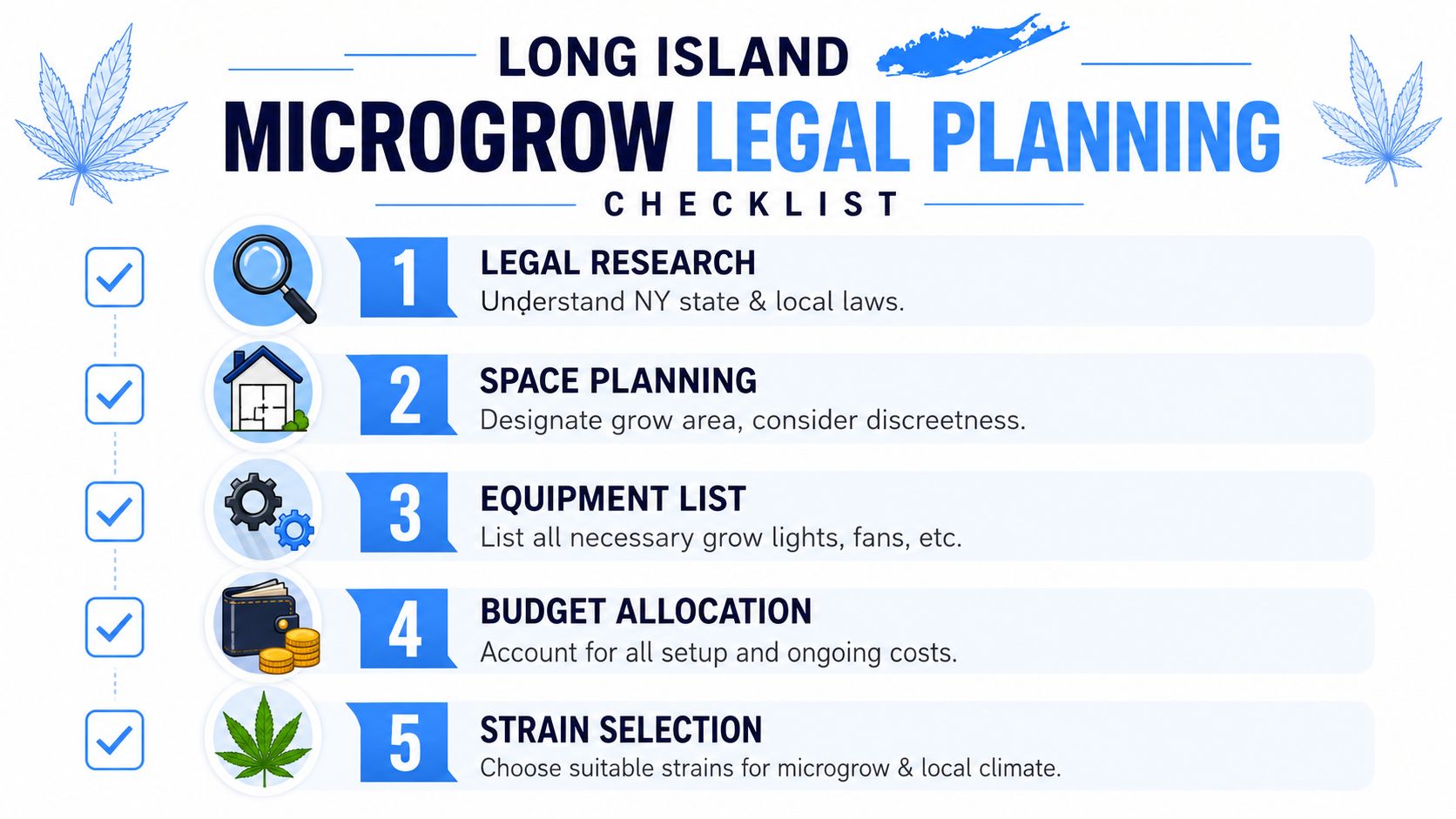
The biggest beginner mistake isn't choosing the wrong light. It's buying gear before making a realistic plan. On Long Island, that usually leads to a tent jammed into a bad spot, weak airflow, and a grow that becomes harder to hide, harder to manage, and harder to enjoy.
Start with compliance and common sense
Before seeds, decide where the grow will live and whether that location can stay secure, clean, and discreet. That means thinking through smell, noise from fans, foot traffic in the home, and who else shares the space. A tent in a laundry room can work. A tent in a room people open all day usually becomes a headache.
It also helps to know cannabis isn't some fringe hobby anymore. An estimated 62 million people age 12 and older, representing 25% of the U.S. population, reported using cannabis in the past year in 2022, according to this peer-reviewed summary of U.S. cannabis use. That doesn't replace local compliance, but it does explain why so many adults now want a more informed relationship with the plant.
For a local perspective on the adult-use market and shopping environment, Strong Strains has a useful overview in this dispensary introduction.
Build the plan before the cart
Use a pre-purchase checklist and be honest with yourself:
- Space first: Pick the exact spot. Measure it. Check outlets, airflow, and whether warm air has somewhere to go.
- Noise tolerance: Inline fans hum. Oscillating fans rattle. Thin walls make cheap equipment obvious.
- Odor management: If you can't run a proper filter setup, rethink the location.
- Daily routine: Plants need regular attention. Travel, late work nights, and inconsistent schedules show up in the canopy.
- Cleanup path: Spills, runoff, dead leaves, and sticky tools are part of the job.
A practical planning table
| Planning area | What works | What usually fails |
|---|---|---|
| Space | Spare closet, low-traffic basement corner, sealed room section | Open room corner with no privacy |
| Budgeting | Buying core gear once and skipping gimmicks | Chasing cheap replacements after poor first buys |
| Strain choice | Compact, forgiving genetics | Stretchy, odor-heavy strains in a tight apartment |
| Routine | Short daily check-ins | Ignoring plants for days, then overcorrecting |
A smooth first run usually looks boring from the outside. That's a good sign.
Long Island growers do best when they treat the setup like a small controlled project, not a weekend impulse buy.
Selecting Your Perfect Strains and Genetics
Genetics decide more than flavor. They shape plant size, sensitivity, feeding behavior, smell, finishing style, and how much room for error you have. In a Microgrow, that matters more than beginners expect.
A compact setup rewards genetics that stay manageable, recover well, and don't punish every small mistake. That's why many new growers do better with simpler plant architecture and less aggressive stretch.
Autoflower or photoperiod
If you're just getting started, I lean beginners toward autoflowers for one reason. They remove a layer of complexity. You don't have to manage a flowering light trigger, and that makes the first run less technical.
Photoperiods still have a place. They're great if you want more time to train, recover from mistakes, and shape the canopy. But they also ask for tighter control. Miss the rhythm and you create your own problems.
Here's the clean way to understand it:
- Autoflowers fit the beginner who wants simplicity: Smaller footprint, faster turnover, less schedule juggling.
- Photoperiods fit the patient tinkerer: Better if you want to top, train, and spend more time sculpting structure.
- Low-odor, humidity-tolerant plants fit Long Island homes: Especially in basements or during muggy stretches.
Don't chase strain lore too hard
A lot of strain shopping still runs on stories, labels, and expectations that sound more precise than they really are. Recent reporting has noted structural gaps in cannabis research, with decades of regulatory restrictions creating a mismatch between claimed effects and measured outcomes, as discussed in this Cannabis Business Times analysis of supply chain and market disconnects.
That's why smart growers choose genetics by grow behavior first and desired vibe second. If your space is tight and humid, it doesn't matter how dreamy the description sounds if the plant stretches too hard or invites mold trouble.
Using retail taste as a genetics guide
Your buying history offers a useful perspective. If you keep gravitating to Cookies, Runtz, Good Green, Matter, Jaunty, Jetty, Kiva, Wyld, or Wana, pay attention to the flavor lane and effect profile you consistently return to. Sweet candy notes, doughy gas, citrus, pepper, floral, earthy calm, bright daytime focus. Those patterns tell you what kind of harvest will keep you interested enough to finish a full grow cycle.
Grow the plant you'll be excited to cure, trim, and smoke. Not the one that only sounds impressive on paper.
For many first runs, the best move is boring in the right way. Choose stable, compact genetics. Save the finicky exotic for later. Once your environment and routine are reliable, then go chase louder terps and more demanding plants.
Creating the Ideal Microgrow Environment
A good grow room doesn't feel dramatic. It feels stable. Light comes on when it should, air moves steadily, temperature stays controlled, and odor doesn't leak into the hallway. That's the whole game.
The compact setup that usually works
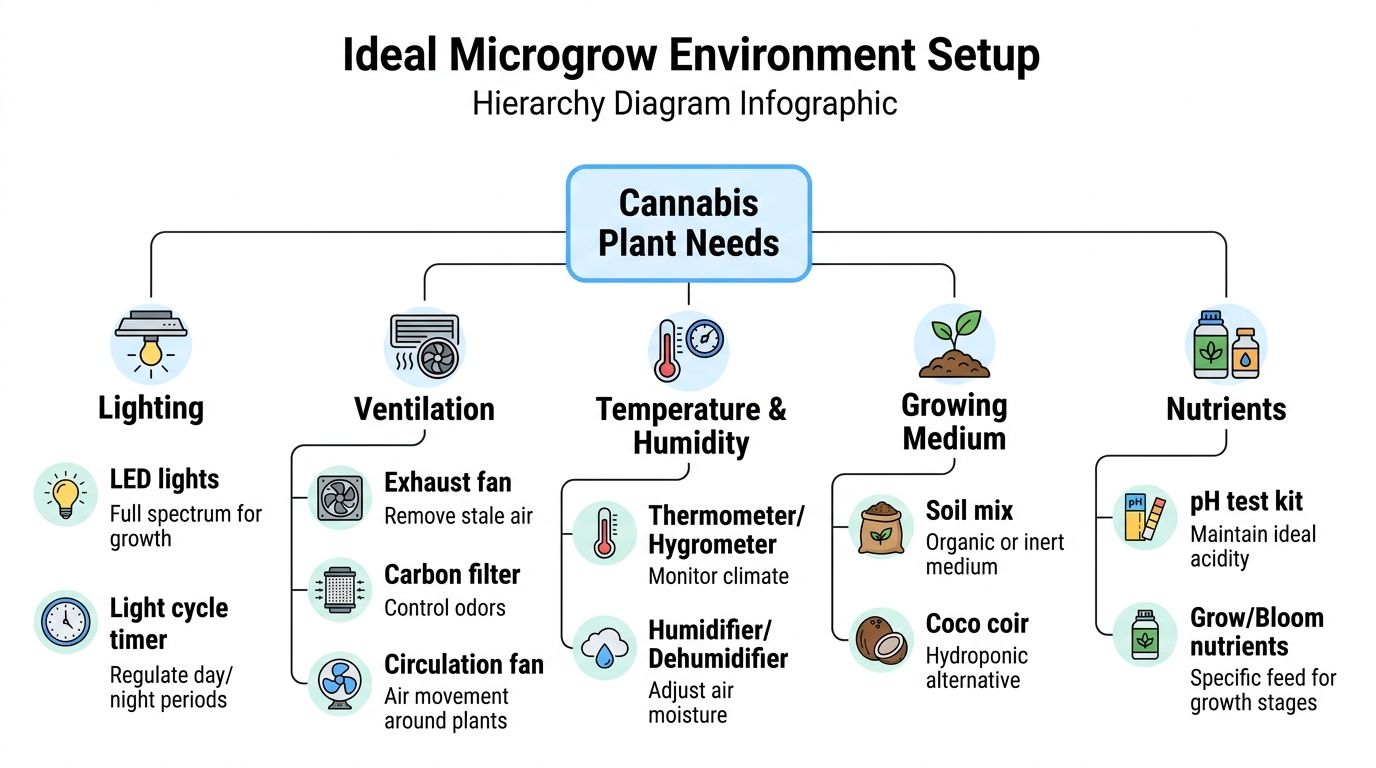
For a Long Island microgrow, the gear list should stay lean:
- Grow tent: Something that fits the room without dominating it.
- Full-spectrum LED: Less heat, lower profile, better for tight spaces than older hot-running fixtures.
- Inline exhaust fan: Pulls stale air out before heat and humidity pile up.
- Carbon filter: Essential if privacy matters.
- Circulation fan: Keeps air moving across leaves and through the canopy.
- Timer, thermometer, hygrometer: Small tools that prevent bigger mistakes.
High-design consumer brands like Puffco, Pax, Airo, Stiiizy, and Plug Play remind people that cannabis gear can be refined. Growing gear should be the same. Buy equipment that runs quietly, predictably, and cleanly.
Precision beats size
Commercial greenhouse systems make this point clearly. MicroGrow greenhouses for smaller-scale operations are built for computer-based control over heating, cooling, and air circulation, achieving ±0.5°F temperature stability, according to this MicroGrow overview video. You're probably not building a greenhouse at home, but the lesson carries over. Tight control creates better flower.
That same mindset applies to soil and root health. If you're sorting through medium choices, this guide to pot growing soil is a useful practical read.
What actually matters in the room
| Equipment | Why it matters | Beginner mistake |
|---|---|---|
| LED light | Drives structure and flower development | Hanging it wrong or changing intensity too aggressively |
| Exhaust and filter | Controls heat, humidity, odor | Waiting until smell becomes a problem |
| Air circulation | Reduces stagnant zones | Pointing fan directly at one plant all day |
| Tent | Creates consistency | Oversizing the tent for the room |
The plant can forgive a missed feeding faster than it forgives a bad room.
Long Island growers often spend too much time debating nutrients and not enough time fixing airflow. If the room swings too hard, the rest of your choices won't rescue the run.
Nurturing Your Plants from Seedling to Flower
Once the environment is set, the work becomes quieter and more hands-on. Daily observation starts doing more than any bottle on the shelf. You're reading leaf posture, water use, branch spacing, and how the plant reacts after every adjustment.
Choose a medium you can manage
Most beginners should start in soil unless they already like precision and note-taking. Soil gives you a little buffer. Coco can produce excellent growth, but it asks for tighter feeding discipline and more consistency. If you're the type who enjoys process, coco can be rewarding. If you know you tend to improvise, soil is more forgiving.
A clean first cycle often comes from doing less:
- Water evenly: Don't keep the root zone soaked.
- Feed lightly at first: It's easier to correct underfeeding than clawed, overfed plants.
- Watch the new growth: Fresh leaves usually tell the truth faster than old damage does.
- Keep records: A simple notebook beats memory.
Training is the secret in a small tent
In a Microgrow, plant training matters because vertical space disappears fast. Low-Stress Training works well for beginners because it reshapes the canopy without the plant feeling heavily attacked. You bend and secure branches so more tops get light. That spreads growth outward instead of letting one main top dominate.
Topping can also work well, but only on healthy plants that are actively growing. If a plant is already stressed, topping just adds another recovery task. Start simple. Tie branches down, open the center, and keep the canopy even.
A flat, open canopy almost always outperforms a crowded Christmas-tree shape in a tight tent.
Monitor like a grower, not a gambler
The more precisely you watch the room, the easier plant care becomes. The MicroGrow system can connect to up to 32 individual sensor modules for real-time monitoring of temperature, humidity, and PAR solar levels, according to MicroGrow's MultiGrow system page. Most home growers won't need that level of hardware, but the lesson is solid. Better inputs lead to better decisions.
Pests are another place where observation beats reaction. If you want a quick visual primer on common pests harming plants, that resource is useful for learning what leaf damage patterns can signal before an issue spreads.
The strongest first-time growers aren't the ones with the most gear. They're the ones who notice small changes early and resist the urge to overcorrect.
The Final Steps Harvesting Curing and Tips
Harvest is where rushed growers turn a promising run into forgettable flower. The plant can look done before it's really ready, and a fast dry can flatten months of work in a few days.
A jeweler's loupe helps here. Look at the trichomes, not just the calendar. You want maturity in the resin, not just orange hairs and swollen buds. This is the difference between flower that feels hollow and flower that tastes finished.
For a visual walkthrough, this process video is worth a look:
The finishing sequence
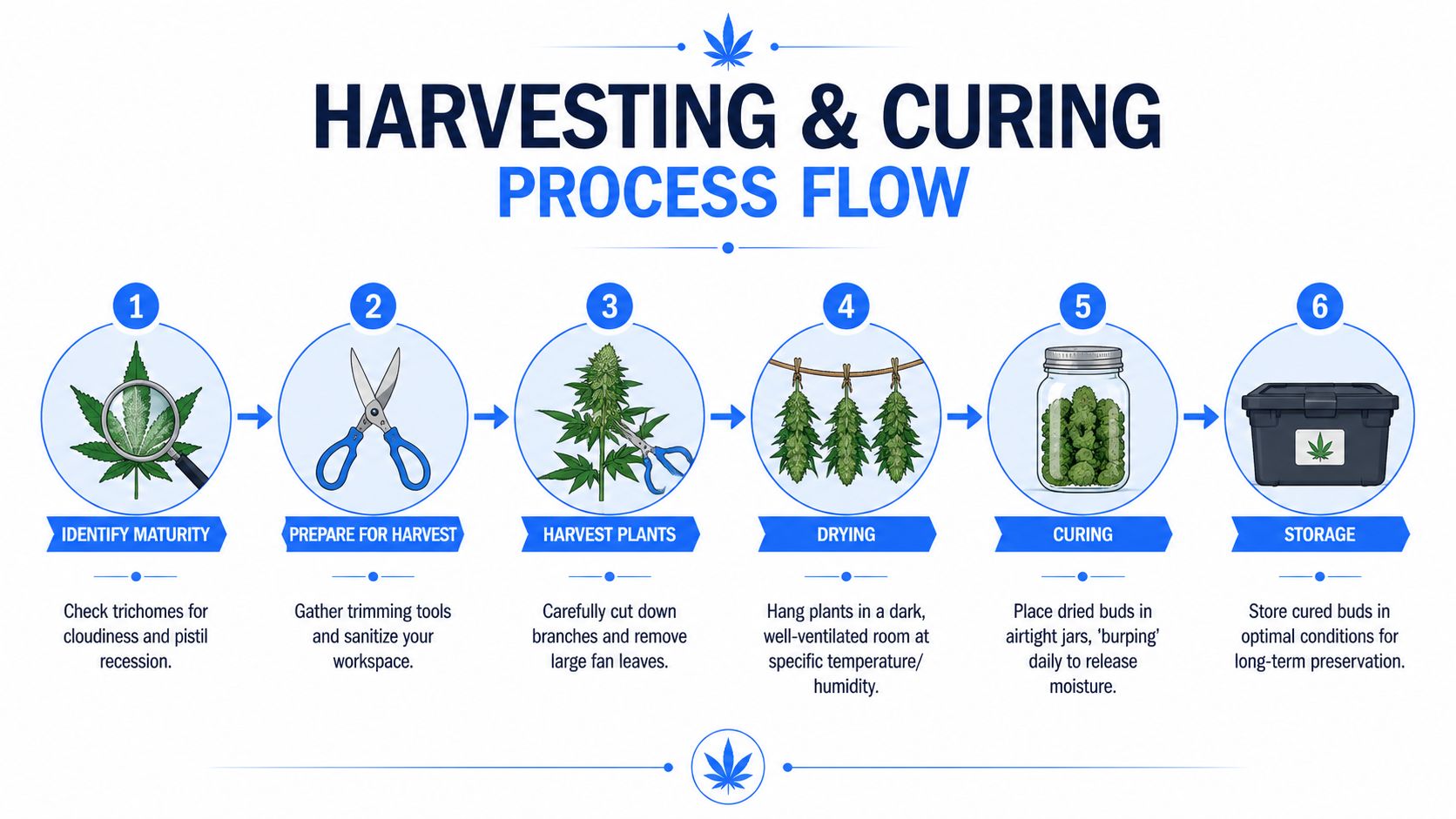
The dry and cure shape the final smoke as much as the grow did. That's where harshness softens, aroma develops, and the jar starts smelling closer to the polished finish people expect from brands like Florist Farms, Heavy Hitters, Lowell Herb Co, Dogwalker, or Stone Road.
A solid finish usually follows this order:
- Cut with intention: Take manageable branches, not a tangled pile.
- Remove large fan leaves: Keep it clean without overhandling the buds.
- Dry slowly in a dark, ventilated space: Fast drying locks in disappointment.
- Jar only when the flower is ready: Outside dry and inside wet is a classic beginner mistake.
- Burp the jars consistently early on: Let moisture escape before it turns musty.
Troubleshooting late-stage problems
Late flower is when growers get impatient and start making emotional decisions. Keep the response tied to the symptom.
| Problem | What it looks like | Better response |
|---|---|---|
| Heat stress | Canoeing leaves, tired tops, stalled look | Raise or dim light, improve exhaust |
| Nutrient excess | Dark leaves, burnt tips, clawing | Ease feeding, don't stack more additives |
| Spider mites or similar pest pressure | Speckling, weak leaves, webbing in bad cases | Isolate, inspect underside of leaves, clean aggressively |
| Bud rot risk | Dense flowers in stale humid air | Increase airflow, remove compromised material fast |
A good harvest guide for the mechanics of cutting and handling is this hemp harvesting article.
Don't judge your crop on chop day. Judge it after the cure.
That's the step a lot of beginners miss. A decent grow can become excellent after a patient cure, and a flashy harvest can fall apart if it's dried carelessly.
Your First Harvest and Beyond with Strong Strains
Your first successful Microgrow usually teaches the same lesson. Planning matters more than hype. Stable conditions beat fancy promises. Good genetics save time, and patience during the cure pays off in every jar.

The next lesson is just as useful. Growing your own doesn't replace the value of a well-run dispensary. It sharpens your eye. You start noticing trim quality, moisture, structure, terp expression, and why one pre-roll burns beautifully while another runs hot. That's why plenty of home growers still keep products from Jeeter, Wana, Camino, Wyld, Ayrloom, Fernway, Rove, Turn, and Pax in rotation.
If you want one retail example tied directly to this topic, Strong Strains carries 6 Point | Star Dawg Kush | Premium Flower (MICRO GROW) as a product labeled for micro grow cultivation. That makes it a useful shelf reference for seeing how a micro-grown flower can present in the market.
For growers who like studying broader cultivation efficiency, this breakdown of top high-yielding crops is a helpful way to think about output, space use, and practical return on limited square footage.
Bring your questions, your progress photos, or just your curiosity. A good budtender can help you connect what happened in your tent to what you're shopping for on the shelf.
If you want guidance from people who care about quality, compliance, and how cannabis performs in real life, visit Strong Strains. Stop by the East Setauket shop to talk strains, compare notes from your first grow, or pick up lab-tested flower, vapes, pre-rolls, edibles, concentrates, tinctures, topicals, and accessories for the days when you'd rather enjoy the plant than trim it.