
You've got a tincture in your hand, the label looks important, and somehow the simplest question feels weirdly slippery.
How much should you take?
Maybe the bottle lists total THC or CBD. Maybe the dropper has lines on it. Maybe it just says “dropperful,” which sounds helpful until you realize that isn't a precise dose by itself. That uncertainty is common, especially if you want a calm, controlled experience instead of guessing and hoping for the best.
A good tincture dosage calculator solves that. Not by making dosing complicated, but by turning label language into something usable. Once you understand the basic math and the practical limits of droppers and drops, tinctures become one of the easiest cannabis formats to measure with confidence.
Unlock Your Perfect Tincture Dose
A lot of people start the same way. They pick up a tincture because it feels cleaner, more flexible, and easier to control than some other formats. Then they get home, look at the bottle, and pause.
The questions come fast. Is the number on the front for the whole bottle or one serving? Is one full dropper the same as one dose? If you only want a light effect, how do you measure that without overshooting?
That's where people usually get stuck. Not because tinctures are hard, but because labels often mix total cannabinoids, bottle size, and serving ideas in a way that feels more technical than it needs to. The fix is simple. You break the bottle down into a measurable amount, then match that amount to the experience you want.
Why dosing feels confusing at first
Tinctures sit in an awkward middle ground. They're more precise than “take a puff and see,” but less obvious than a single pre-portioned edible. You need one small piece of math before the product starts making sense.
If you've ever used a tool to simplify peptide measurements, the mindset is similar. You're converting a total amount into a usable amount per measured volume. Once the unit makes sense, the product gets much easier to use safely.
A tincture works best when you stop thinking about the whole bottle and start thinking about the amount in each measurable portion.
What confidence looks like
Confident dosing doesn't mean chasing a “perfect” number on your first try. It means you can answer basic questions clearly:
- What's in 1 mL so you know the bottle's true strength
- What your dropper holds so your measurement matches reality
- What starting amount feels appropriate for your comfort level
- How to repeat the same dose next time if it worked well
That's the value of a tincture dosage calculator. It turns cannabis from a rough estimate into a repeatable routine.
The Simple Math Behind Tincture Dosage
A tincture label can look busier than it really is. You might see a big number on the front of the bottle, a smaller serving suggestion on the side, and a dropper that may or may not hold a full milliliter. The math clears that up.
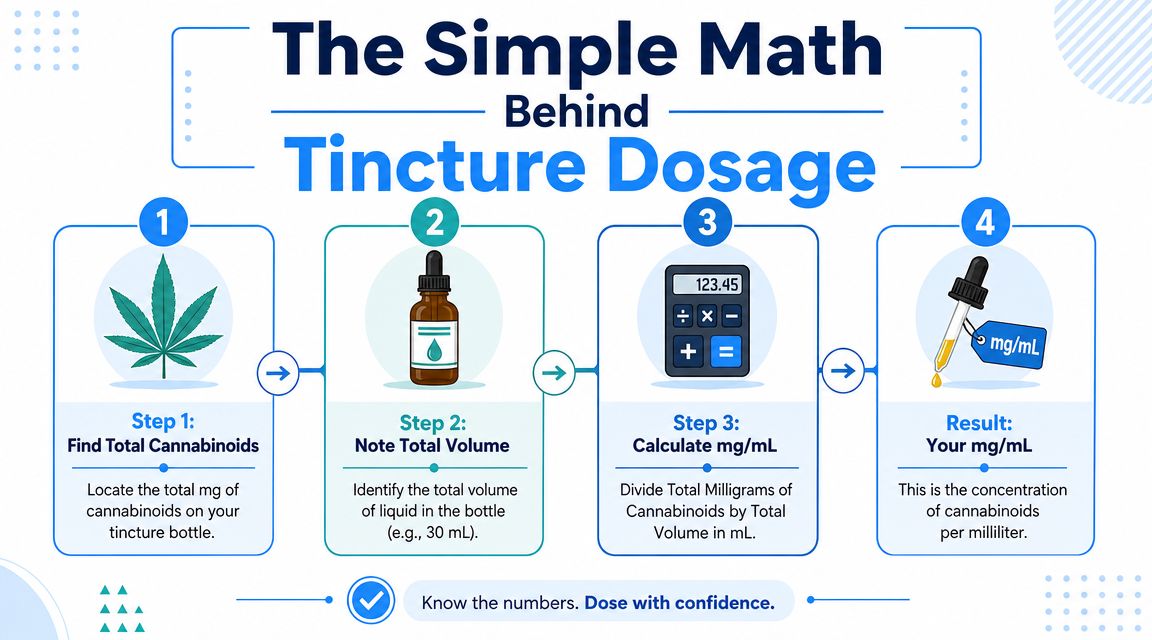
The number you want first is mg per mL. That tells you how much THC, CBD, or total cannabinoids are in each measured milliliter of oil.
The formula that matters most
Use this sequence:
- Find the total cannabinoid amount on the label
- Find the bottle volume in mL
- Divide total mg by total mL
That gives you mg/mL.
A simple example helps. If a bottle contains 100 mg THC in 20 mL of liquid, each milliliter contains 5 mg THC. Once you have that number, the bottle stops feeling abstract. You can measure from something real instead of guessing from marketing terms or front-label strength claims.
A plain-language example
Here's the practical way to read it.
If two bottles contain the same total cannabinoids, but one has less liquid, that bottle is stronger per mL. If the same cannabinoids are spread across more liquid, each mL is lighter. A tincture works a lot like drink concentrate. The same ingredient in less liquid tastes stronger. With tinctures, it doses stronger.
For readers comparing bottle strengths, this guide to a THC tincture 1000 mg format shows how total bottle potency and usable serving strength relate.
Here's a quick visual before you do the math on your own bottle:
Why mg per mL matters more than marketing language
Terms like “high potency,” “extra strength,” or “full dropper” sound helpful, but they do not tell you the actual dose. Mg/mL does.
That difference matters in real use. A label might make two products sound similar even if one delivers much more THC in the same measured amount. At Strong Strains, this is one of the first things we help customers sort out, because good dosing starts with a number you can repeat.
Practical rule: If you know the mg per mL, you can measure with much more confidence and adjust in small, predictable steps.
That is the foundation of any tincture dosage calculator. The formula is simple. The part that trips people up is measurement in practical application, where droppers and drop sizes are not always as uniform as the label makes them seem.
Translating Your Dose From Milliliters to Drops
You measure a careful amount under the tongue one night, then try to repeat it the next night by counting drops. It feels simple until the drops come out faster, slower, bigger, or smaller than you expected. That is the measurement reality with tinctures. Label math gives you a starting point, but your actual technique affects the dose you get.
The helpful estimate and where it can mislead
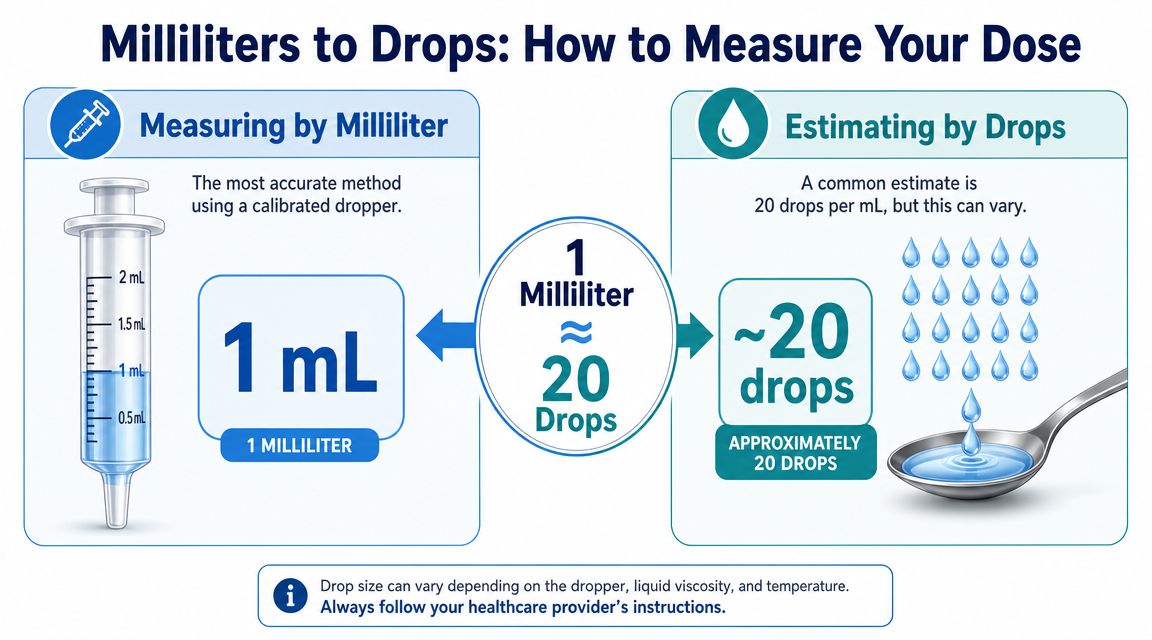
Many tincture guides use a common shortcut: about 20 drops per 1 mL. That can help for rough planning, especially if you are trying to understand how a tiny amount compares with a half dropper or full dropper.
But a rough estimate is still rough.
If your bottle is 10 mg per mL, that estimate would put each drop at about 0.5 mg. If your bottle is 20 mg per mL, each drop would be about 1 mg. The math is straightforward. A key challenge, however, is that drops are not perfectly uniform from bottle to bottle, or even from one squeeze to the next.
A practical comparison helps here. Counting drops works a lot like counting splashes from a kitchen squeeze bottle. You can get close, but it is harder to get the exact same amount every time than it is with a marked measuring spoon.
Why drop counting changes in real use
A helpful explanation from this measurement-focused tincture chart discussion points out that many dosing charts assume a standard 1 mL dropper and a standard drop count, even though real tools and liquids vary.
Several small factors can shift your delivered dose:
- Dropper design varies. Two droppers can look similar and still release different amounts.
- Liquid thickness matters. Thicker tinctures may form larger drops.
- Your squeeze pressure matters. A firmer squeeze can change drop size and speed.
- Bottle angle matters. Straight down and tilted use do not always produce the same drops.
- Marked measurements are easier to repeat. A line at 0.25 mL is usually more dependable than counting loose drops.
That last point matters most for beginners. If you are trying to find your comfort zone, repeatability matters more than perfection. You want a method you can use the same way tomorrow.
The better way to measure
Use the dropper markings if your product has them. They usually give you a steadier, more repeatable dose than manual drop counting.
| Method | What it's good for | Main limitation |
|---|---|---|
| Marked dropper in mL | Consistent day to day dosing | Depends on accurate markings |
| Counting drops | Quick estimate for very small amounts | Drop size can vary in practice |
A good rule is simple. Use milliliters for accuracy. Use drops only as a backup estimate.
That same lesson helps with other cannabis products too. Anyone comparing tinctures with weed edibles candy dosing and serving sizes will notice the same theme. The label gives the target dose, but the way you portion it determines what you take.
The best dose is the one you can measure the same way every time.
At Strong Strains, we spend a lot of time helping customers sort out this exact issue because it is where confidence usually starts. Once you know your bottle's mg per mL, the next win is choosing a measuring method you can repeat without second-guessing.
Your First Dose A Guide to Starting Low and Going Slow
The smartest first tincture dose is usually the one that feels almost modest. That's not being timid. That's giving yourself room to learn how your body responds.
A lot of people want a single answer, but cannabis doesn't work like a one-size-fits-all vitamin. Your comfort level, prior experience, metabolism, and goals all shape what feels right. The safest approach is measured experimentation.
Starting ranges that make sense
Practical dispensary education commonly suggests starting at 1 to 2 mg or 2.5 to 5 mg, waiting at least 2 hours before redosing, then increasing by 1 to 2 mg in later sessions if needed, according to this dispensary tincture dosing reference.
That guidance works because tinctures can feel deceptively easy to stack. If you take more too soon, you don't learn what the original dose was doing.
| Experience Level | Recommended Starting Dose (THC) |
|---|---|
| New or very cautious | 1 to 2 mg |
| Beginner with some comfort | 2.5 to 5 mg |
Why patience is part of precision
People often think precision means the measuring tool. It also means timing.
If you redose before you've given the first amount enough time, your notes become useless. You won't know whether the result came from the first dose, the second dose, or the combination. Waiting gives you clean feedback.
A helpful mindset is to treat your first few sessions like observation, not performance. You're not trying to prove anything. You're trying to find your lane.
- Pick one calm setting so you're not reading effects in a stressful environment
- Use one consistent product instead of bouncing between formats
- Write down what you took so you can repeat or adjust intelligently
- Increase gradually later rather than making a big jump
Start with a dose you can respect, not one you need to recover from.
If you already know that edibles sometimes hit you harder than expected, this guide to weed edibles candy can help you compare how different cannabis formats call for different pacing and expectations.
What a good first session feels like
A good first tincture session usually feels manageable. Maybe lighter than expected. That's fine.
It's much easier to build upward from a dose that felt subtle than to backtrack from one that felt too intense. The ultimate goal is finding a repeatable amount that matches your goal, whether that's staying clear-headed, easing into the evening, or getting familiar with tinctures without stress.
Find Your Perfect Tincture Match at Strong Strains
Good dosing starts with good labeling. If a tincture's packaging clearly states total cannabinoids, bottle volume, and serving details, the math gets easier and your routine gets steadier. That's one reason premium shelves matter. Better products tend to make better measurement possible.
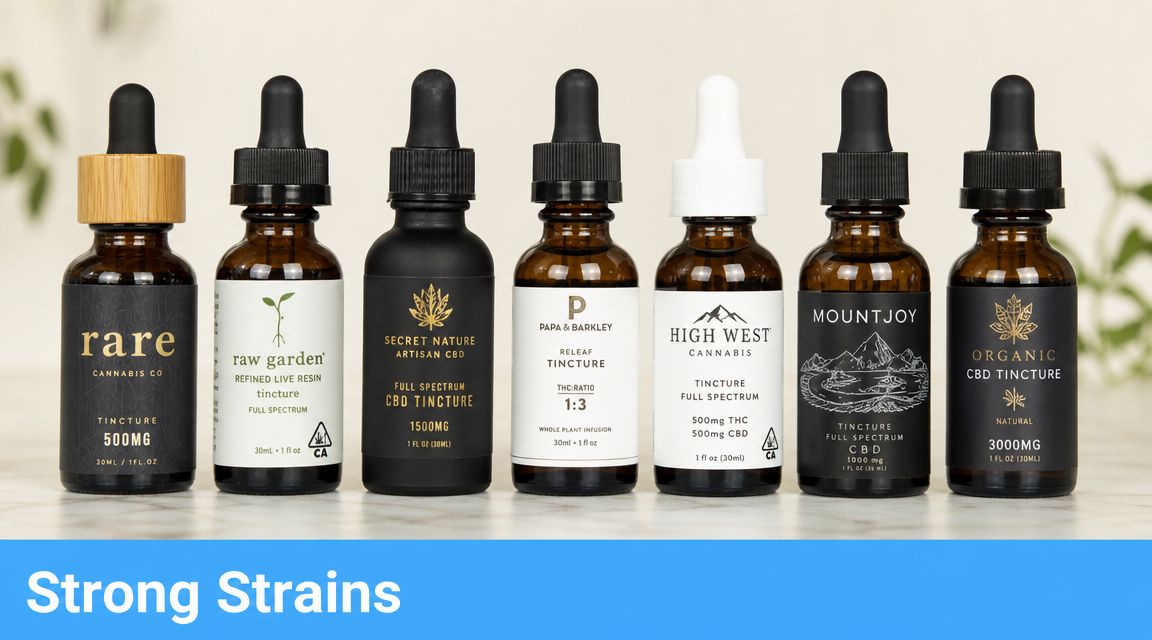
What to look for on a tincture label
When you're shopping tinctures, focus less on flashy front-label language and more on the practical details.
Look for:
- Clear total cannabinoid content so you can calculate usable strength
- Bottle volume in mL so the mg/mL math is easy
- Dropper markings that help you repeat doses more accurately
- Lab-tested presentation that supports trust and consistency
That matters whether you're browsing a wellness-leaning formula or a more classic THC tincture from brands customers already recognize, such as Ayrloom, Botanist, or Papa & Barkley.
Matching the tincture type to your goal
Different tinctures can suit different shoppers.
A full-spectrum tincture may appeal to people who want a product with a broader cannabinoid profile. A broad-spectrum option can appeal to shoppers looking for a more specific experience without the exact same profile as full-spectrum. An isolate product may feel simpler to people who want a cleaner single-cannabinoid starting point.
None of those categories automatically tells you your dose. But they do shape how you shop. The best purchase is the one where the label, format, and intended use all make sense together.
Why education changes the buying experience
Once you know how to read mg/mL and think critically about the dropper, the shelf looks different. You stop buying on guesswork. You start choosing based on clarity.
If you want a broader view of standout options and how people shop seasonally across product categories, this roundup of the best cannabis products in Long Island for summer 2025 is a useful companion read.
The best dispensary experience doesn't push you toward the strongest bottle. It helps you find the bottle you can use well.
Important Safety and Legal Considerations
Cannabis tinctures are for adults 21 and over in New York. That's the legal starting point, but safe use goes further than age compliance.
A responsible tincture routine begins with a low measured amount, a familiar environment, and enough time to observe effects before making any changes. That's especially important when you're trying a new product, a new cannabinoid ratio, or a new brand.
Keep these habits in place:
- Store products securely away from children and pets
- Never drive after using THC or combine dosing with activities that require sharp judgment
- Read the label every time because bottle strength and dropper design can vary from product to product
- Choose consistency over improvisation if you're tracking how a product feels
If you use cannabis alongside other wellness products or medications, it's wise to be extra cautious and seek professional guidance when appropriate. Responsible cannabis use isn't about fear. It's about setting yourself up for a predictable, comfortable experience.
Frequently Asked Tincture Questions
A few questions almost always come up after someone learns the math. Most of them are less about calculation and more about confidence in practical application.
If you like cross-checking product basics and sourcing questions, these hemp supplier FAQs can also be a useful general companion read for broader hemp product context.
| Question | Answer |
|---|---|
| What if I took more than I meant to? | Stay calm, hydrate, and give yourself time in a comfortable setting. Avoid adding more cannabis. If the product contains THC, the feeling should ease with time. |
| Should I count drops or use the dropper markings? | Use the marked dropper when possible. Counting drops can work as an estimate, but it's less consistent in practice. |
| How do I keep my dosing consistent? | Use the same product, the same measuring method, and the same routine. Write down how much you took and how it felt. |
| Can I switch between tinctures easily? | Not automatically. Different bottles can have different strengths and dropper behavior, so recalculate each new product. |
| What's the biggest mistake beginners make? | Taking another dose before the first one has had enough time to show its full effect. Patience protects your experience. |
The nice thing about tinctures is that they reward attention. A little label reading and a little patience go a long way. Once you understand your product's real measuring system, the experience gets much less intimidating and much more useful.
If you want help choosing a lab-tested tincture or figuring out the math on a bottle before you buy, visit Strong Strains. Our team in East Setauket helps Long Island adults 21+ compare tinctures, understand label strength, and choose premium products with confidence for pickup or local delivery.