It's late, your brain won't shut off, and you're doing what a lot of people do. You search for something fast that might help you relax before bed. Somewhere in that scroll, Pillow Talk vapes show up and the name sounds comforting enough to feel like a solution.
That name is doing a lot of work.
If you're a Long Island adult trying to wind down, it's easy to assume a product called Pillow Talk is built for rest. But names, flavors, and sleek hardware can blur the essential question. What is this device delivering, and does that line up with what your body needs at night?
A lot of sleep problems don't start with finding the “perfect” product. They start with stress, routine, screens, inconsistent bedtime habits, or using something stimulating too close to sleep. If you're trying to build a more realistic evening routine, this roundup of strategies for better night's rest is a useful companion to product research because it looks at habits, not just quick fixes.
The Search for a Restful Night and the Allure of Pillow Talk Vapes
You get home drained. Dinner's over, the notifications keep coming, and your body feels tired while your mind stays busy. That's exactly the moment when a product with a soft, cozy name can sound more therapeutic than it really is.
Pillow Talk vapes have caught attention because they feel modern, easy, and low-effort. No setup ritual. No measuring. No learning curve. You pick it up, inhale, and expect the experience to match the branding.
Why the name creates confusion
For many shoppers, the confusion starts with the word “Pillow.” It suggests bedtime, comfort, maybe even a sleep-forward effect. That's where people often mix up three very different categories:
- Nicotine vapes that are built to deliver nicotine.
- Cannabis products that may be selected for relaxation, depending on formulation.
- Wellness products marketed around calming routines.
Pillow Talk belongs in the first category. The branding may feel soothing, but the product itself needs to be understood on its actual ingredients and purpose.
Practical rule: If a product sounds like a sleep tool, check the active ingredient before you assume the effect.
What people usually want versus what they're buying
Most nighttime shoppers aren't looking for a hobby. They want one of these outcomes:
- Mental quiet after a stressful day
- Physical relaxation before bed
- A repeatable ritual that feels simple
- Predictable effects without guessing
That's why Pillow Talk can be appealing at first glance. But if your goal is sleep support or evening calm, the main issue isn't whether the device looks polished. It's whether a high-nicotine vape matches the effect you are seeking.
That distinction matters more than flavor names, packaging, or social buzz. Once you understand what's inside, the whole category becomes easier to evaluate.
What Exactly Is a Pillow Talk Vape
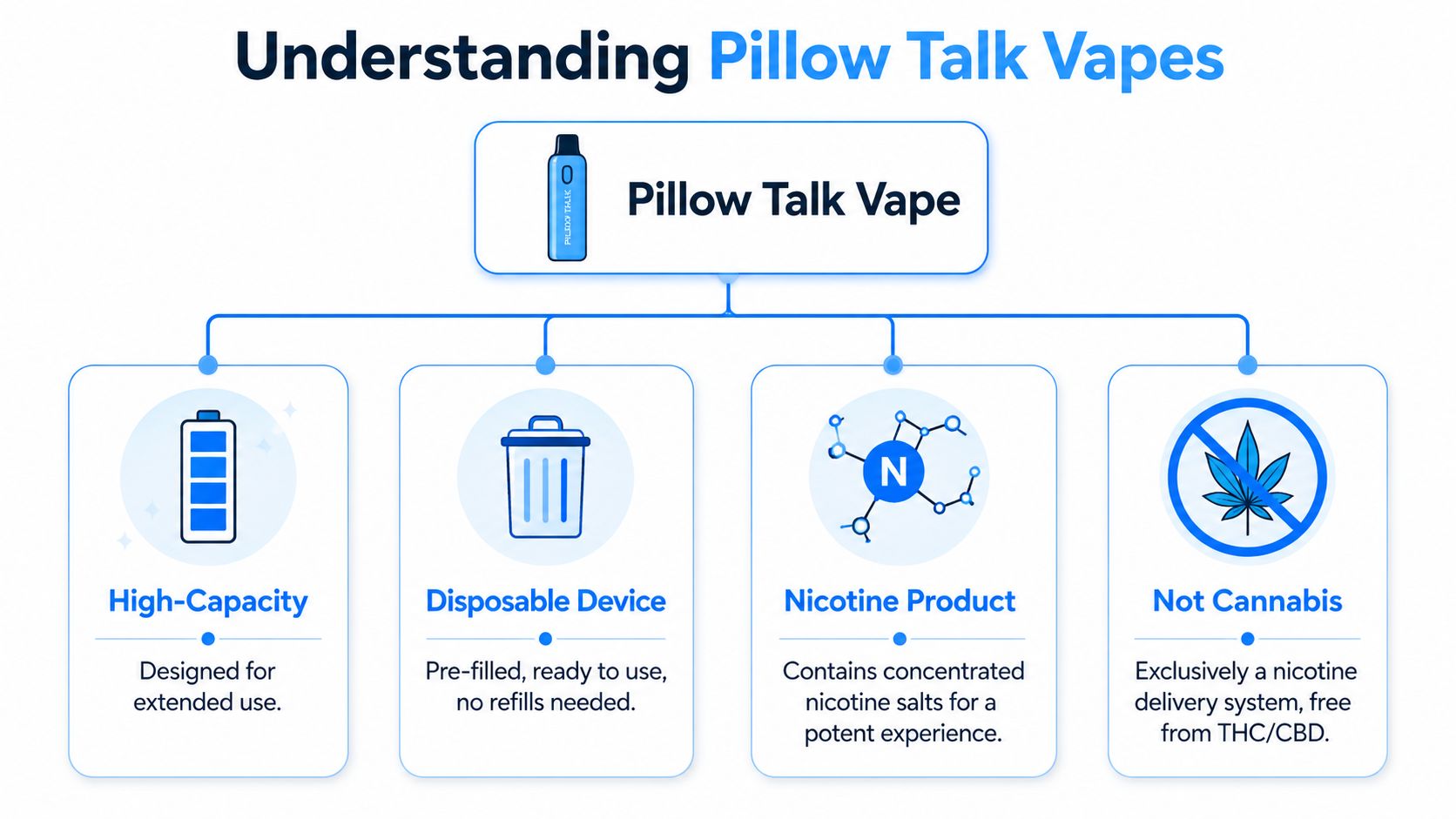
A Pillow Talk vape is not a cannabis vape. It's a high-capacity disposable nicotine device designed for extended use, strong nicotine delivery, and convenience.
That one sentence clears up most of the confusion.
Independent reviews and retail listings describe Pillow Talk's lineup as part of the high-capacity disposable vape wave, with flagship devices like the IC40000 and NC40000 marketed around a claimed 40,000 puffs, plus a 700mAh rechargeable battery, Type-C charging, and dual mesh or dual Neo Mesh coils. The same coverage also notes 20mL or 8.5mL e-liquid capacities depending on model or listing, and 50mg (5%) nicotine in some variants, which points to a product built around long-lasting nicotine delivery rather than compact convenience, as noted in this Pillow Talk vape review.
The hardware in plain English
If vape specs sound abstract, here's the simple version. Pillow Talk devices are made to last a long time for people who vape nicotine regularly.
The common setup includes:
- A rechargeable battery so the device can keep working through a large amount of e-liquid
- A prefilled reservoir so you don't refill it yourself
- Mesh-style coils that heat liquid efficiently and consistently
- A disposable format that's meant to be used as a closed unit rather than rebuilt like a traditional vape setup
That makes Pillow Talk feel more advanced than the small disposables many people picture when they hear “vape.”
What's actually inside
The key point isn't the battery or the charging port. It's the active ingredient. In many variants, that's high-strength nicotine.
So if someone walks into a dispensary thinking Pillow Talk is a THC pen, a CBD vape, or some hybrid sleep blend, they're starting from the wrong place. If you want a clearer look at how cannabis devices differ in purpose and formulation, this guide to cannabis vape formats helps separate nicotine hardware from regulated cannabis products.
Pillow Talk vapes may look like modern wellness-adjacent devices, but their core function is nicotine delivery.
That's why the product experience can feel so different from what the name implies.
Unpacking the Pillow Talk Experience Effects and Flavors
Pillow Talk's appeal doesn't come only from specs. It comes from how the device feels in the hand and how the vapor tastes on the inhale. Sweet, icy, fruity, candy-style profiles are a big part of why people keep reaching for products like this.
Flavor matters because it can soften the user's perception of what they're consuming. A smooth fruit or dessert profile can make a potent nicotine product feel gentler than it really is.
What users often feel first
The “effect” people describe from Pillow Talk usually isn't sedation. It's more like a quick nicotine hit that may feel sharp, satisfying, heady, or momentarily settling.
That can confuse newer users. Relief and relaxation aren't always the same thing.
If someone has nicotine cravings, satisfying that craving can feel calming in the short term. But that doesn't mean the product is functioning as a true sleep aid. In many cases, the person is responding to nicotine delivery, the sensory routine of inhaling, and the familiar reward loop of flavored vapor.
Why the branding and the body can tell different stories
Here's where readers often get mixed up. A product can taste soft, sound cozy, and still act like a stimulant-focused nicotine device. Those things aren't contradictory. They just operate on different levels.
Consider the split:
| Part of the experience | What it may suggest | What it likely reflects |
|---|---|---|
| Sweet or icy flavor | Comfort, treat-like indulgence | Sensory appeal |
| Fast puff satisfaction | Relaxation | Nicotine delivery |
| Reaching for it at night | Bedtime ritual | Habit formation |
| Smooth branding | Wellness | Marketing style |
That table is the heart of the issue. The experience may feel polished and enjoyable, but the chemistry still matters more than the name.
The short-term appeal
People often like Pillow Talk for reasons that are easy to understand:
- Flavor variety makes each session feel less harsh
- Convenience removes friction
- Consistency creates a repeatable ritual
- Strong delivery gives a noticeable response quickly
None of that automatically makes it a good match for sleep.
If your goal is to take the edge off after work, a nicotine buzz may feel useful in the moment. If your goal is deeper rest, staying asleep, or easing into bed without stimulation, you need to judge the product by what it does physiologically, not by the softness of the brand name.
Safety Nicotine and the Sleep Aid Question
The conversation must now become honest. Pillow Talk's sleepy branding can make the device sound gentler than its actual exposure profile.
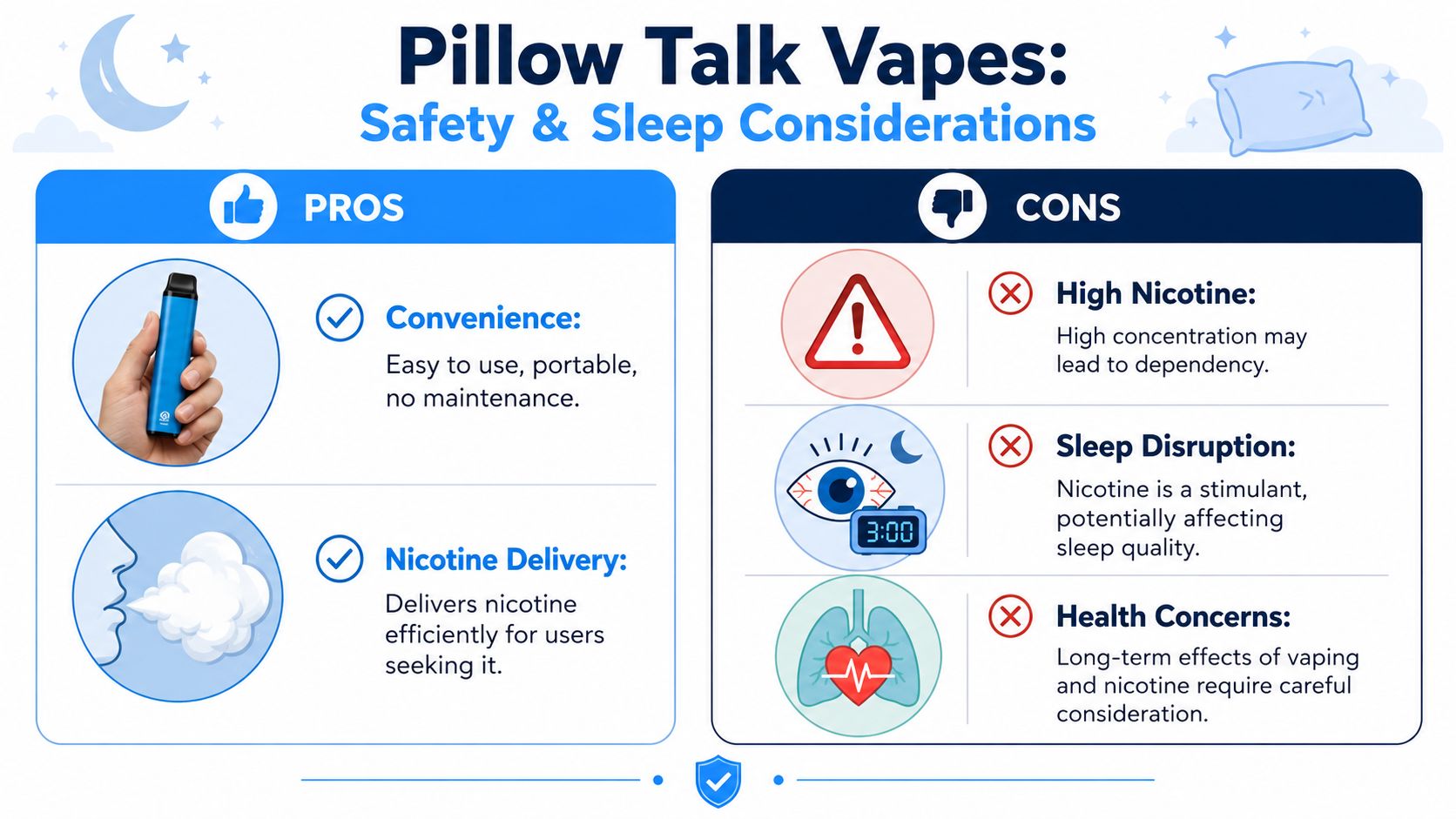
Many Pillow Talk vapes contain 50mg (5%) nicotine and may include other additives in their PG/VG base. Safety-focused coverage warns that, beyond significant addiction potential, the long-term effects of inhaling these compounds on lung and heart health remain uncertain, which makes sleep-aid style branding potentially misleading for consumers, as discussed in this article on whether Pillow Talk vapes are safe.
The first safety issue is nicotine intensity
When people hear “vape,” they often focus on flavor or convenience first. The more important question is dose strength and intended use. A product carrying 5% nicotine isn't a casual herbal bedtime puff. It's a potent nicotine format.
That matters because nicotine can create dependence. It can also make users feel like the product is helping them “settle down” when they may be relieving craving or maintaining a cycle of repeated use.
A product can feel comforting because it's familiar, not because it supports sleep.
The second issue is the sleep mismatch
The central mismatch is simple. Sleep support and strong nicotine delivery don't naturally point in the same direction.
If someone is looking for help winding down, they usually need a routine that lowers stimulation. Pillow Talk is marketed in a way that can blur that basic distinction. Even if the ritual feels soothing, the product category itself raises a fair question about whether the branding is pushing people toward the wrong tool for the job.
For readers who want a visual explainer, this short video is a useful add-on:
What else should make a careful shopper pause
The same safety discussion raises concerns that go beyond sleep claims alone.
- Additives and unknowns matter because some variants may include ingredients framed as relaxing, while long-term inhalation effects are still under study.
- Throat and airway irritation can be part of the immediate experience for some users.
- Dependence risk can get lost behind soft branding and dessert-style flavoring.
- Cardiovascular and lung questions remain relevant when inhaling high-strength nicotine products.
If your nighttime goal is harm reduction, that's an important lens. You don't have to panic to be cautious. You just need to match the product to the outcome you want.
Pillow Talk vs Cannabis Vapes for Relaxation
Once you separate the branding from the ingredient, the comparison gets easier. Pillow Talk is a nicotine vape. Relaxation-focused cannabis products are a different lane entirely.
For adults shopping for evening use, the better question isn't “Which one is trendier?” It's “Which category is built for the effect I want?”
Product Comparison for relaxation needs
| Feature | Pillow Talk Vape | Indica Cannabis Vape (e.g., Rythm) | CBN Edible (e.g., Wana) |
|---|---|---|---|
| Active ingredient | Nicotine | Cannabis extract such as THC-dominant indica oil | Cannabinoid-based edible formulation, often chosen for nighttime routines |
| Main reason people use it | Nicotine delivery | Evening relaxation, depending on product selection | Longer-lasting unwind routine |
| Typical onset feel | Fast nicotine hit | Inhaled cannabis effects tend to come on faster than edibles | Slower onset than inhaled formats |
| Sensory profile | Often sweet, icy, candy-like | Strain and terpene profile shape flavor and feel | No inhalation, flavor depends on edible format |
| Sleep-fit logic | Branding may imply rest, but product purpose is nicotine use | Better aligned with shoppers seeking cannabis-based relaxation | Often preferred by people who want a non-vape nighttime option |
| Testing expectation | Depends on source and category norms | Regulated cannabis products are selected with lab testing in mind | Regulated cannabis edibles are selected with lab testing in mind |
Why cannabis options make more sense for this goal
If someone says, “I want something for after dinner that helps me unplug,” a nicotine vape and a cannabis sleep product are not interchangeable recommendations.
A relaxation-focused cannabis conversation usually starts with format and tolerance:
- Inhaled option for adults who want a faster onset and easier session control
- Edible option for those who prefer not to inhale and want something that fits a longer evening window
- Tincture option for shoppers who value measured servings and a more adjustable ritual
That's a much more useful framework than letting a nicotine product's name do the decision-making.
Two common shopper scenarios
One customer wants something quick after a stressful commute. An indica vape may fit better because the person can take a small inhaled dose and assess how they feel before bed.
Another wants a quieter, screen-free routine and doesn't want to inhale anything at all. A CBN-forward edible from a brand such as Wana may make more sense in that case.
If you're comparing vape options specifically for nighttime use, this guide to indica strains often chosen for sleep-focused routines gives a more relevant starting point than nicotine branding.
The smartest switch isn't from one trendy device to another. It's from a mismatched category to one that fits your actual goal.
Choosing Your Nighttime Ritual at Strong Strains
When someone comes into a dispensary asking about sleep, the first job isn't to sell them the strongest item in the room. It's to figure out what they mean by “help me relax.”
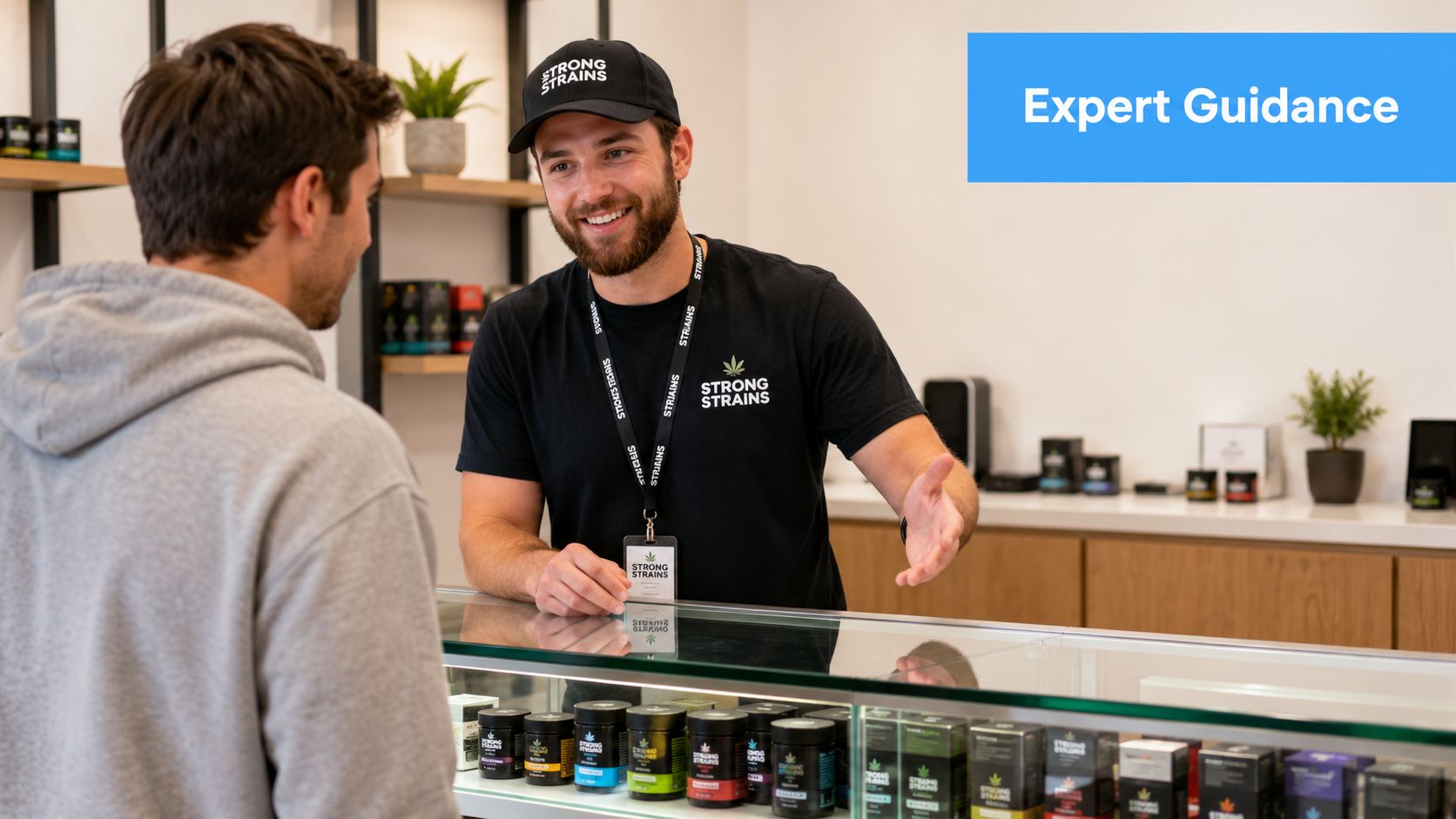
Some people mean they want to ease mental chatter. Others want body-heavy evening calm. Some want something discreet and inhaled. Others would rather skip vaping and go with gummies, tinctures, or a low-effort pre-bed format.
What a good budtender will ask you
A helpful conversation usually sounds like this:
- When do you want the effect to start because inhaled products and edibles behave differently
- Do you want to inhale anything at all since many shoppers don't
- How experienced are you with THC because nighttime products should match comfort level
- Are you chasing sleep, calm, or just a gentler landing after stress since those aren't identical goals
That's where regulated cannabis makes more sense than guessing with a nicotine product that happens to sound cozy.
Smarter category choices for evening use
At a premium dispensary, nighttime recommendations often come from a few predictable buckets:
- Indica-leaning vapes for adults who want a quicker onset and dose-by-dose control
- Night gummies from brands like Wana or Kiva for shoppers who want a no-inhale routine
- Tinctures for measured use and easier customization
- Milder options for new consumers who don't want an overwhelming first experience
For customers browsing online before pickup or delivery, products like sleep-oriented gummies are often easier to understand than inhaled products with wellness-style names but very different ingredients.
A shop can also make the process easier with practical access. East Setauket shoppers often want simple online ordering, in-store pickup, or local delivery across Suffolk County, plus clear age-gated guidance under New York's 21+ adult-use rules. Those details matter because a calm nighttime routine starts with predictability, not confusion at checkout.
Beyond the Hype Making an Informed Choice for Relaxation
Pillow Talk vapes may sound like bedtime companions, but the clearer view is simpler. They are high-nicotine disposable vapes, not true sleep aids and not cannabis products.
That doesn't mean every adult will react the same way. It does mean the label and the likely effect can point in different directions. If you're shopping for nighttime calm, the better move is to focus on ingredients, delivery format, and whether the product category matches relaxation.
A stronger routine usually combines better product choices with better habits. If you want non-product support alongside your shopping research, this guide for better sleep is a helpful reminder that your evening setup matters too.
Knowledge makes the whole process easier. Once you know the difference between nicotine branding and cannabis formulated for evening use, you can choose with a lot more confidence.
If you want help choosing a nighttime cannabis product that fits your routine, browse Strong Strains or stop by the East Setauket dispensary for guidance on lab-tested vapes, edibles, tinctures, and other evening-friendly options for adults 21+.